Enschede, 9 December 2008
René ter Haar
Master thesis
Project, program and portfolio management
in large Dutch organizations
Determining the maturity of project, program, and portfolio processes
and identifying bottlenecks in further professionalizing the project
organization
Master thesis – Final version
Enschede, 9 December 2008
Graduation committee:
J.N. Hicks (chair man) Research Associate
Department of Information Systems and Change Management Faculty of Management and Governance
University of Twente Drs. M.L. Ehrenhard Research Associate
Dutch Institute for Knowledge Intensive Entrepreneurship Faculty of Management and Governance
University of Twente Ir. S.W. Nijenhuis Managing Director Fortes Solutions B.V.
Author:
René ter Haar
Industrial Engineering and Management
Management summary
The research objective of this study is determining the maturity of project, program, and portfolio management processes in large Dutch businesses and the main bottlenecks in further professionalizing the project organization. A suitable way to measure how well organizations are doing is to measure process maturity, where maturity refers to a state where the organization is in a perfect condition to achieve its objectives. Maturity can be measured by using a maturity model which aids in defining, understanding, and measuring an organization’s processes and their effectiveness. In this study 11 maturity models are tested on their suitability using 5 selection criteria. According these critieria the model should be a best practice model, able to assess maturity on project, program, and portfolio management level, method-independent, suitable to use in large Dutch organizations, and compliant with PRINCE2. Based on these selection criteria the Portfolio, Programme and Project Management Maturity Model (P3M3) was chosen as most suitable maturity model to adopt in this study.
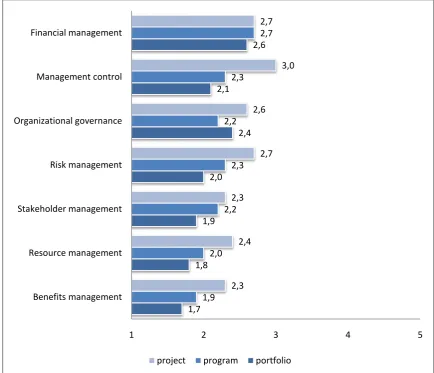
Main survey findings on maturity of project, program, and portfolio management processes (1) Using the P3M3 maturity model the project, program, and portfolio maturity levels estimation are respectively 2.6, 2.2 and 2.1. This means the maturity is in between level 2: Repeated process and level 3: Defined process. In a repeated process standard approaches exist in some areas, e.g. projects, but there is no consistency of approach used in the organization. In a defined process a consistent set of standards is being used across the organizations with clear process ownership (2) Management control and financial management are relatively well evolved process areas. Benefits management, stakeholder management, and resource management are relatively less evolved process areas (3) Project management is a relatively well evolved process level. Program management and portfolio management are relatively less evolved process levels (4) Organizations have a tendency to overrate their maturity, especially at project and corporate level (5&6) Large (project) organizations are more mature than small (project) organizations (7) Organizations with autonomous parts have a lower maturity than organizations without such separate structures (8) Maturity differs for distinct lines of business; particular sectors are more evolved than others (9) Specialist knowledge about project related activities results in a lower maturity level estimation (10) A high-level overview of project related activities results in a lower maturity level estimation.
Main interview findings on bottlenecks in further professionalizing the project organization (1) An ineffective project organization, (2) Lack of clarity in selecting, doing, and benefits realization of projects, (3) Lack of measuring instruments, (4) Insufficient planning and resource allocation, (5) Lack of uniformity in project approach, (6) lack of focus in human resource management, and (7) underestimation of the necessity of a good project preparation.
Recommendations based on survey findings on maturity
1. The average maturity of project, program, and portfolio management processes in large Dutch organizations is 2,3. Therefore organizations should concentrate using a consistent set of standards by all projects across the organizations with clear process ownership.
2. Organizations should focus on improving program and portfolio management processes. 3. Organizations should focus on improving the process areas of benefits management,
stakeholder management, and resource management.
Recommendations based on interview findings on further formalizing the project organization 1. Organizations need to select the right projects that contribute to the strategic objectives. 2. Once the right projects are chosen, business need to focus on doing projects in the right way. 3. Organizations should keep a clear and detailed overview of the project portfolio at any time. 4. Organizations should realize that further professionalizing the project organization is a
Table of contents
MANAGEMENT SUMMARY ... 3
LIST OF TABLES AND FIGURES ... 6
ACRONYMS ... 7
GLOSSARY ... 8
PREFACE ... 10
1. INTRODUCTION... 11
1.1 THE COMPANY ... 11
1.2 RATIONALE ... 11
1.3 SCOPE ... 12
1.4 OBJECTIVE ... 12
1.5 PROBLEM ... 13
1.6 PERSONAL GOALS ... 13
1.6.1 Writing a literature review ... 13
1.6.2 Executing a survey ... 13
1.6.3 Conducting interviews ... 14
2. METHOD ... 15
2.1 MIXED METHOD AND TRIANGULATION ... 15
2.2 TRIANGULATED DESIGN ... 16
2.2.1 Literature review ... 16
2.2.2 Web-based survey ... 17
2.2.3 Qualitative interviews ... 18
3. LITERATURE REVIEW ... 20
3.1 PROJECT, PROGRAM, AND PORTFOLIO MANAGEMENT ... 20
3.1.1 Relation between projects, programs, and the portfolio ... 20
3.1.2 Projects, programs and the portfolio ... 21
3.1.3 Challenges in portfolio management ... 22
3.2 THE PROJECT ORGANIZATION ... 23
3.2.1 The project management office ... 24
3.2.2 Challenges of the PMO in Dutch business practice... 24
3.2.3 Improving project management effectiveness ... 25
3.3 MATURITY OF PROJECT, PROGRAM, AND PORTFOLIO PROCESSES ... 25
3.3.1 Organizational maturity and its practical relevance ... 25
3.3.2 Project management maturity ... 26
3.4 MATURITY MODELS ... 29
3.4.1 Overview of maturity models ... 30
3.4.2 Selection criteria for maturity models ... 30
3.4.3 The Portfolio, Programme and Project Management Maturity Model ... 31
3.4.4 P3M3 maturity assessment ... 33
3.5 CHANGE MANAGEMENT ... 36
3.5.1 Recent developments in organizational change ... 37
3.5.2 Survey about organizing change management in business ... 41
3.6 DISCUSSION ... 42
4. FINDINGS AND ANALYSIS ... 44
4.1 MATURITY OF PROJECT ORGANIZATIONS ... 44
4.2 KEY FINDINGS FROM THE INTERVIEWS ... 53
4.2.1 An ineffective project organization ... 53
4.2.2 Lack of clarity in selecting, doing, and benefits realization of projects ... 55
4.2.3 Lack of measuring instruments ... 56
4.2.4 Insufficient planning and resource allocation ... 56
4.2.5 Lack of uniformity in project approach ... 57
4.2.6 Lack of focus in human resource management ... 58
4.2.7 Underestimation of the necessity of a good project preparation ... 59
4.2.8 Summary of bottlenecks in professionalizing the project organization ... 59
4.3 BOTTLENECKS RELATED TO HUMAN, PROCESS AND SYSTEM FACTORS ... 60
5. CONCLUSIONS... 63
5.1 PROJECT, PROGRAM, AND PORTFOLIO MANAGEMENT MATURITY ... 63
5.2 BOTTLENECKS IN PROFESSIONALIZING THE PROJECT ORGANIZATION ... 64
6. RECOMMENDATIONS ... 65
7. LIMITATIONS ... 66
REFERENCES ... 67
APPENDIX A – MATURITY MODELS ... 72
APPENDIX B – MATURITY SURVEY ENGLISH ... 84
APPENDIX C – MATURITY SURVEY DUTCH ... 100
APPENDIX D – INTERVIEW GUIDE V1 ... 116
List of tables and figures
TABLE 1: MATURITY VALUES OF THE PROJECT MANAGEMENT SURVEYS DESCRIBED ABOVE ... 29
TABLE 2: ELEVEN MATURITY MODELS COMPARED BASED ON FIVE SELECTION CRITERIA ... 31
TABLE 3: P3M3 ANSWER MODEL SPECIFICATION - SOURCE: OGC, 2008C ... 35
TABLE 4: IMAGES OF MANAGING CHANGE [SOURCE: PALMER AND DUNFORD, 2008] ... 40
TABLE 5: AVERAGE MATURITY LEVEL OF LARGE DUTCH ORGANIZATIONS ON THE BASIS OF 7 PROCESS AREAS AND 3 PROCESS LEVELS . 44 TABLE 6: MATURITY LEVELS BASED ON SEVEN PROCESS AREA AVERAGE AND SINGLE QUESTION ESTIMATE ... 47
TABLE 7: MATURITY LEVELS BASED ON DIFFERENCES IN ORGANIZATION SIZE (TOTAL NUMBER OF EMPLOYEES) ... 48
TABLE 8: MATURITY LEVELS BASED ON DIFFERENCES IN PROJECT ORGANIZATION SIZE (TOTAL NUMBER OF EMPLOYEES) ... 49
TABLE 9: MATURITY LEVELS BASED ON DIFFERENCES IN ORGANIZATION STRUCTURE (WITH OR WITHOUT DIVISIONS OR SBUS) ... 49
TABLE 10: MATURITY LEVELS BASED ON DIFFERENCES IN LINE OF BUSINESS ... 50
TABLE 11: MATURITY LEVELS BASED ON ASSESSMENTS BY EMPLOYEES WORKING IN DISTINCT FUNCTIONS ... 51
FIGURE 1: ORGANIZATION CHART OF FORTES SOLUTIONS ... 11
FIGURE 2: MIXED METHOD CONSISTING OF A LITERATURE REVIEW, QUALITATIVE INTERVIEWS AND A WEB-BASED SURVEY ... 16
FIGURE 3: RELATION BETWEEN PROJECTS, PROGRAMS, AND THE PORTFOLIO ... 20
FIGURE 4: A MATURITY MODEL WITH FIVE LEVELS (SOURCE: HEDEMAN, 2007) ... 26
FIGURE 5: THE PORTFOLIO, PROGRAMME, AND PROJECT MANAGEMENT MATURITY MODEL (P3M3) – SOURCE: [OGC, 2008B].. 33
FIGURE 6: GENERIC APPROACH TO P3M3 SELF-ASSESSMENT – SOURCE: [OGC, 2008C] ... 34
FIGURE 7: EXAMPLE OF P3M3 SELF ASSESSMENT - SOURCE: OGC, 2008C ... 36
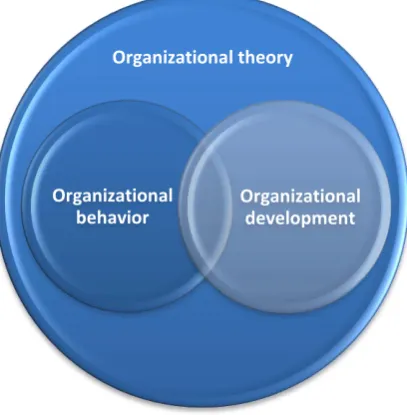
FIGURE 8: RELATION BETWEEN ORGANIZATIONAL THEORY, ORGANIZATIONAL BEHAVIOR AND ORGANIZATIONAL DEVELOPMENT ... 37
FIGURE 9: AVERAGE MATURITY LEVEL OF LARGE DUTCH COMPANIES ON THE BASIS OF 7 PROCESS AREAS AND 3 PROCESS LEVELS ... 45
FIGURE 10: AVERAGE OVERALL MATURITY LEVEL OF LARGE DUTCH ORGANIZATIONS ON THE BASIS OF SEVEN PROCESS AREAS ... 45
FIGURE 11: AVERAGE OVERALL MATURITY LEVEL OF LARGE DUTCH ORGANIZATIONS ON THE BASIS OF THREE PROCESS LEVELS ... 46
FIGURE 12: MATURITY LEVELS BASED ON SEVEN PROCESS AREA AVERAGE AND SINGLE QUESTION ESTIMATE ... 47
FIGURE 13: MATURITY LEVELS BASED ON DIFFERENCES IN ORGANIZATION SIZE (TOTAL NUMBER OF EMPLOYEES) ... 48
FIGURE 14: MATURITY LEVELS BASED ON DIFFERENCES IN PROJECT ORGANIZATION SIZE (TOTAL NUMBER OF EMPLOYEES) ... 49
FIGURE 15: MATURITY LEVELS BASED ON DIFFERENCES IN ORGANIZATION STRUCTURE (WITH OR WITHOUT DIVISIONS OR SBUS)... 50
FIGURE 16: MATURITY LEVELS BASED ON DIFFERENCES IN LINE OF BUSINESS ... 51
FIGURE 17: MATURITY LEVELS BASED ON ASSESSMENTS BY EMPLOYEES WORKING IN DISTINCT FUNCTIONS ... 52
FIGURE 18: MINDMAP OF BOTTLENECKS IN PROFESSIONALIZING THE PROJECT ORGANIZATION ... 60
FIGURE 19: BOTTLENECKS RELATED TO HUMAN FACTORS ... 60
FIGURE 20: BOTTLENECKS RELATED TO PROCESS FACTORS ... 61
FIGURE 21: BOTTLENECKS RELATED TO SYSTEM FACTORS ... 61
FIGURE 22: THE FIVE LEVELS AND KEY PROCESSES OF THE CAPABILITY MATURITY MODEL (SOURCE: PAULK ET AL., 1993) ... 72
FIGURE 23: THE EFQM EXCELLENCE MODEL (SOURCE: EFQM, 2008) ... 73
FIGURE 24: THE PROJECT EXCELLENCE MODEL (PEM) – SOURCE: WESTERVELD, 2003 ... 74
FIGURE 25: KERZNER’S PROJECT MANAGEMENT MATURITY MODEL (K-PMMM) – SOURCE: [KERZNER, 2001, 42] ... 75
FIGURE 26: THE ORGANIZATIONAL PROJECT MANAGEMENT MATURITY MODEL (OPM3) – SOURCE: PMBLOG.ACUMEN.NL ... 76
FIGURE 27: KPA’S OF PRINCE2 MATURITY MODEL (P2MM) – SOURCE: WWW.BROOKES.AC.UK ... 77
FIGURE 28: KPA’S OF PORTFOLIO, PROGRAMME AND PROJECT MANAGEMENT MATURITY MODEL (P3M3) ... 78
FIGURE 29: CLASSIFICATION OF OGC’S MATURITY MODELS P2MM, P1M3, P2M3 AND P3M3 ... 79
FIGURE 30: TOWERS IN THE MATURITY IN CONTROLLED ENVIRONMENTS (MINCE) MODEL – SOURCE: WWW.MINCE2.ORG ... 79
FIGURE 31: PM SOLUTIONS’ PROJECT MANAGEMENT MATURITY MODEL (PMS-PMMM) ... 81
FIGURE 32: PM SOLUTIONS’ PROJECT PORTFOLIO MANAGEMENT MATURITY MODEL (PMS-PPMMM) ... 82
FIGURE 33: THE PROJECT MANAGEMENT PROCESS MATURITY (PM)2 MODEL – SOURCE: [IBBS AND KWAK, 2002] ... 83
Acronyms
(PM)2 (University of California, Berkeley’s) Project Management Process Maturity model
CMM Capability Maturity Model
CMMI Capability Maturity Model Integrated
EFQM European Foundation of Quality Management
INK Instituut voor Nederlandse Kwaliteit
MINCE Maturity Increments IN Controlled Environments Model
K-PMMM Kerzner’s Project Management Maturity Model
OPM3 Organizational Project Management Maturity Model
P1M3 Project Management Maturity Model
P2M3 Program and Project Management Maturity Model
P2MM PRINCE2 Maturity Model
P3M3 Portfolio, Program and Project Management Maturity Model
PEM Project Excellence Model
PjM Project Management
PgM Program Management
PfM Portfolio Management
PMBOK Project Management Body Of Knowledge
PMMM See P1M3
PMO Project Management Office
PMS-PMMM PM Solutions’ Project Management Maturity Model
PMS-PPMMM PM Solutions’ Project Portfolio Management Maturity Model
PPM Project Portfolio Management
Glossary
Benefits management
Assesses how well the organization defines, tracks and ensures achievement of performance improvement from the investment [OGC, 2008a, 3].
Financial management
Assesses how well the organization manages and controls the investment through business cases and budgetary control [OGC, 2008a, 3].
Management control
Assesses how well the organization maintains control of the initiatives currently “in flight” [OGC, 2008a, 3].
Maturity
Webster defines ‘mature’ as having reached the state of full maximum development [Webster, 1988]. Organizational maturity refers to a state where the organization is in a perfect condition to achieve its objects [Andersen and Jessen, 2003].
Maturity model
A maturity model aids in defining, understanding, and measuring an organization’s processes and its effectiveness
Organizational governance
Assesses how well the organization controls the initiation and alignment of its investments with the corporate strategy [OGC, 2008a, 3].
Portfolio
The totality of an organization’s investment (or segment thereof) in the changes required to achieve its strategic objectives [OGC, 2008a, 2].
Portfolio management
A coordinated collection of strategic processes and decisions which enable the most effective balance of organizational change and business as usual operations [OGC, 2008a, 2].
Program
A temporary, flexible organization created to co-ordinate, direct and oversee the implementation of a set of related projects and activities in order to deliver outcomes and benefits related to the organization’s strategic objectives. A program is likely to have a lifespan of several years [OGC, 2008d, 20].
Program management
The coordinated organization, direction and implementation of a dossier of projects and activities that together achieve outcomes and realize benefits that are of strategic importance [OGC, 2008d, 21].
Program office
See Project office
Project
Project management
An unique set of coordinated activities, with definite starting and finishing points, undertaken by an individual or team to meet specific objectives within defined time, cost and performance parameters as specified in the business case [OGC, 2008a, 3].
Project-based organization
See Project office
Project management office
An organizational entity established to assist project managers, teams and various management levels on strategic matters and functional entities throughout the organization in implementing project management principles, practices, methodologies, tools and techniques [Ward, 2000].
Project office
An organizational entity established to manage a specific project or a related series of projects, usually headed by a project or program manager [Ward, 2000].
Project organization
See Project office
Project-oriented organization
See Project office
Project portfolio
See Portfolio
Project portfolio management
See Portfolio management
Resource management
Assesses how well the organization develops its own talent and utilizes the opportunities from the supply chain to overcome peaks and troughs [OGC, 2008a, 3].
Risk management
Assesses how well the organization is able to minimize impact of threats and maximize opportunities [OGC, 2008a, 3].
Stakeholder management
Preface
This assignment is the graduation project of my Master Industrial Engineering and Management (IEM) with Information Technology and Management (ITM) as specialization track. During my Bachelor Business Information Technology (BIT) and my IEM Master my interest was awoken in organizational change management and, in specific, the reasons why the majority of these initiatives are not considered as a success in practice. Therefore I became interested in a research which was related to managing change. A master’s project related to this topic would be a perfect opportunity to identify in what way academic research and practitioner experience are related about this topic and write a master thesis about it.
I am grateful to Sander Nijenhuis of Fortes Solutions B.V. for providing me this wonderful opportunity and guiding me during this project. I enjoyed his interesting stories about being an entrepreneur and am thankful for his useful suggestions and feedback about business practice. Furthermore I would like to thank Jeff Hicks and Michel Ehrenhard of the University of Twente for their helpful suggestions and guidance during my master’s assignment. A special word of thank would be to Jeff since he supervised me during my internship project in Costa Rica as well. I specifically was fascinated by his alternative approach to consulting practice and his philosophical view on reality. Furthermore I enjoyed our discussions about organizational change management. Above all, Jeff has been a very inspiring mentor to me the last year. Finally I would like to thank all people that participated in the interviews and survey of this research, which are too many to mention them all by name.
Additionally I would like to thank Pieternel and my parents for their great support during my educational period at the University of Twente. Without them I would not be capable of aiming for maximum results. I am sure they are pleased that I have finished education after seven years and soon will be starting with my professional life in business.
This graduation project was an interesting and learning experience. Above all I hope the reader enjoys reading the report and gains some new insights in project, program, and portfolio management practice.
René ter Haar
1.
Introduction
This section gives an introductory description of the project. It presents a picture of the intern company. Additionally it describes the scope, objective, problem statement and research questions of the project. Furthermore three personal goals are defined in this project.
1.1
The company
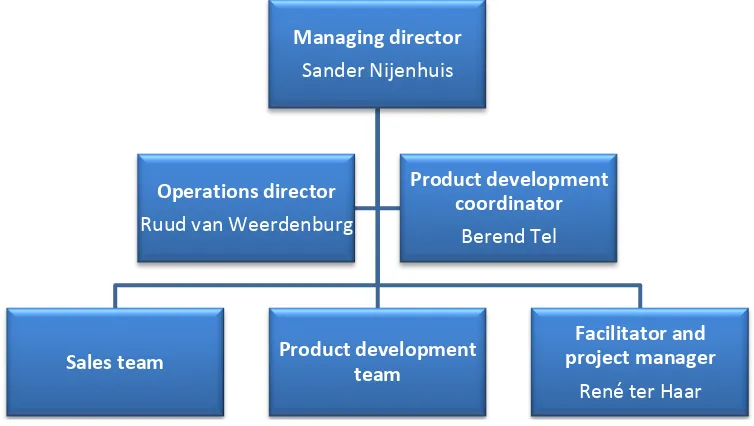
Fortes Solutions BV is software supplier of the Principal Toolbox, a web-based tool that offers functionality for managing projects, programs, and portfolios. Fortes is also responsible for the implementation of the software and the additional organizational change that is needed. The company was founded in 1997 in the Dutch city of Enschede. Besides the main office in Enschede a second office was opened in Amersfoort in 2007. Fortes furthermore has sales representatives in High Wycombe (United Kingdom), Adelaide (Australia), and Frankfurt (Germany). The clients of Fortes are large organizations in which project management is used for internal development of the project organization. The Royal Bank of Scotland, British American Tabacco, Achmea, Philips, Fortis ASR and the Dutch and Australian Department of Defense are a few of Fortes’ main customers. The last few years Fortes Solutions was among the Dutch technology companies with the highest growth percentage of revenues – 1.476% – during the last five years. This resulted in the 11th position in the Deloitte Fast 50 ranking of 2007 in the Netherlands and the 106th position in the Deloitte EMEA Technology Fast 500 ranking of 2007 in Europe. In June 2008 Fortes Solutions received the Van Den Kroonenberg price, a yearly award for relative new companies that have a link with Twente University and excel by means of their innovative products or innovative style of management [Fortes Solutions, Deloitte Fast 50, Deloitte Fast 500, 2008]. The organization chart of Fortes Solutions can be found in Figure 1.
Figure 1: Organization chart of Fortes Solutions
1.2
Rationale
In response to rapid and discontinuous business change, project work has become increasingly important for some time compared to ongoing business operations. This means project work, i.e. temporarily organized team-based work, as compared to permanent organizational operations. In the 1990s, in response to a growing number of ongoing projects, companies began to introduce another layer of coordination and administration known as project office (or its synonym project management office or its abbreviation PMO), whose responsibility it was to coordinate project related activities in the broad sense.
An additional development has been portfolio management, borrowing concepts from financial management not only to coordinate projects, but also to evaluate and manage projects as an investment portfolio [OGC, 2008a, 2]. Next to this projects in the portfolio should contribute to the corporate strategy besides just delivering financial value to the organization. Fortes Solutions is supporting companies in their project management office and portfolio management activities. A major limitation, however, is that there is great difference in the amount of progress (i.e. maturity) made by various customer companies – some companies have not even started with simple project coordination, while others have sophisticated and structured portfolio management organizations in place. Depending on where a company stands in terms of maturity, the offerings of Fortes will differ. The purpose of this graduation project is to identify how maturity can be measured, assessing the maturity of project, program, and portfolio
The purpose of this study is to identify the level of maturity in project portfolio processes and determine what the challenges are in improving the project organization. The contribution of this graduation project is:
- Identifying how maturity can be measured
- Assessing the maturity level of project, program, and portfolio management in large Dutch businesses by using a best practice model
- Identifying the main bottlenecks in further professionalizing the project organization in large Dutch businesses
This project is focused on companies that perform projects with the purpose to develop their own organization and not on companies that run projects for other companies, e.g. consultancy projects. Furthermore the focus is on large businesses in the Netherlands. In an organization several organizational entities can be distinguished. In this research a distinction is made between the functional organization and the project organization. The first group are departments and its employees being involved in core processes of the organization. The second group consist of temporary project teams that perform project-based work to support core processes and is also involved in coordinating project processes. This coordinative role, in some organizations known as project management office or similar organizational structure, is considered as ‘change organization’ and therefore is subject of study in this project. In this report several synonyms of project management office like project office, project organization are used interchangeably and have the same meaning. Previously the term ‘professionalizing’ is used which can be explained as improving processes in a structured way. This means defining why the organization cannot make progress, instead of defining the current issue the organization is dealing with. Another term that is used for ‘professionalizing’ throughout the report is ‘formalizing’ which both have the same meaning.
The research objective of this project is stated like this:
Research objective
1.5
Problem
Based on the research objective that is given above a description of the problem statement and accompanying research question can be defined:
Problem statement
There is a lack of insight in business about the status of project, program, and portfolio management in large Dutch businesses and the main bottlenecks in further professionalizing the project organization.
Based on the problem statement the following research question can be defined:
Research question
What is the maturity of project, program, and portfolio management processes in large Dutch businesses and what are the main bottlenecks in further professionalizing the project organization?
The research question can be split up into several parts:
1. What is the maturity of project, program, and portfolio management processes in large Dutch organizations?
a. What best practice models exist for determining the maturity of project, program, and portfolio management processes?
b. What criteria can be used to select a suitable best practice maturity model?
c. How can the maturity of project, program and portfolio management processes be measured with the selected best practice model?
2. What are the main bottlenecks in further professionalizing the project organization in large Dutch businesses?
d. What main bottlenecks can be found in scientific literature? e. What main bottlenecks can be retrieved from business practice?
Now the research question is divided in manageable chunks which can be handled one after another.
1.6
Personal goals
One of the requirements for the master’s project is to define personal learning goals which can be reflected upon in a later stage. In this project the personal goals are writing a literature review, executing a survey, and conducting interviews. Each of the personal learning goals are described in more detail below.
1.6.1
Writing a literature review
The first learning goal is to provide a thorough literature review about the research topic of this project and its related fields. The purpose is to deliver a literature synthesis about the topics organizational change, portfolio management, the project organization, and maturity of project portfolio processes in organizations. The sources that are used for the literature review should be considered as relevant (e.g. published in a peer-reviewed journal, cited by other articles).
1.6.2
Executing a survey
The objective is to gather as many respondents as possible for estimating maturity of project organizations in business practice and to provide an indication of the maturity of project, program, and portfolio management processes as possible. No specific quantitative number is defined since no contact list is available that can be used for approaching potential participants. Therefore practitioners that are employed in large Dutch organizations and are working in the project management field are randomly invited to participate in this research. Since it is hard to estimate a reasonable number of potential participants no specific number is predefined.
1.6.3
Conducting interviews
2.
Method
This section describes the research method that is being used during this project. It describes the concepts of mixed methods, triangulation, and exploratory research. The mixed method used in this study consists of a literature review, qualitative interviews, and a web-based survey.
2.1
Mixed method and triangulation
“The objective of exploratory research is to gather preliminary information that will help define problems and suggest hypotheses [Kotler et al., 2006, 122].”
Figure 2: Mixed method consisting of a literature review, qualitative interviews and a web-based survey
2.2
Triangulated design
The triangulated design consists of a literature review, qualitative interviews and a web-based survey, since all methods contain elements in which the same phenomena is discusses (e.g. bottlenecks in professionalizing the project organization is discussed both in the literature review, interviews, and survey). All methods are discussed in more detail in the sections below.
2.2.1
Literature review
1. Number of citations
The search process about project, program, and portfolio management is discussed in section 3.1. In addition the search process about the project organization and the project management office is discussed in section 3.2. Subsequently the search process about maturity and corresponding maturity models is described in section 3.3. Finally the search process about change management was discussed in section 3.5.
2.2.2
Web-based survey
It appeared that 81 participants started with the survey (just the first page with their background information but hardly any assessment questions), 67 of these participants filled out the survey for the larger part, and 50 of them fully completed the survey. A question that may arise is why just over half of the participants that started with the survey completed it. It appeared that nearly all participants filled in the questions about their background, e.g. country, industry sector, organization size, etc. When the questions about specific business processes on project, program, and portfolio management level arose, some participants abandoned the survey. A possible explanation may be that participants find it hard to estimate how mature their organization is. Reasons for this is that their job or organization does not perfectly fit with the subject of study. For example, it may be hard for employees with few working experience in project related activities to judge their organization. Another reason may be that participants that begun working a short time ago in a specific organization find it hard to assess its processes. Some of the participants replied by email that they were the only employee of their company and hence they were not the right persons to participate in the survey. Other participants send a message that they were currently doing projects in external companies and they cannot assess this organization. It appeared that of the 67 participants that filled out the survey for the larger part a number of 48 participants are working in a large Dutch organization with more than 500 employees. The origin of the respondents can not be traced since the survey was anonymous. Respondents had the opportunity to fill out their e-mail address after participation if they were interested in the results of the research. Not all respondents filled out their email addresses and some of are not direct approached by email. In this way it is hard to determine by what source, e.g. email, message board, through colleagues, the respondents got aware of the survey. Therefore no statements can be made about response rates. Initially both a Dutch and an international version in English of the web survey have been defined. This international version was focused on non-Dutch companies that are located abroad and resulted in a total of 4 respondents. Therefore the results from the international version are excluded in this research and the focus of the study was explicitly changed to large Dutch organizations afterwards. No specific actions were taken to secure a random sample of Dutch companies due to a lack of time and resources available in this project. The participants represent a generous cross-section of both small and large companies, based in different locations, and from a wide range of industries. Since there is a relative small number of respondents the results are less suitable to generalize. No firm conclusions can be drawn from such a small number of respondents and hence no statistical analysis is done in this study. Therefore the objective is merely to deliver results that can be relevant for business practice. Hence the purpose of this survey is primarily to give an indication of the maturity of project, program and portfolio management processes in large Dutch organizations using a best-practice model.
2.2.3
Qualitative interviews
Portfolio
Programs
Projects
3.
Literature review
In the previous section many terms were mentioned which may not be instantly clear to the reader of this report and need some explanation. In the sections below the concepts project, program, and portfolio management and their relation are discussed. Subsequently the concept of the project organization and a common structure known as project management office are explained. In addition maturity and corresponding models to assess this maturity are described. Finally the importance of change management with regard to professionalizing the project organization concerning project, program, and portfolio management is discussed.
3.1
Project, program, and portfolio management
In this section the concepts project, program and portfolio and the fields project management, program management, and portfolio management and their mutual relations are discussed. Additionally the bottlenecks in portfolio management as defined in scientific literature and business practice are described. Information about project, program, and portfolio management and their relation was found by searching in the key journals on project management, i.e. the International Journal of Project Management [IJPM, 2008] and the Project Management Journal [PMJ, 2008], both peer reviewed journals. The search engines that have been mainly used are Web of Science and Scopus, supplemented with Google Scholar using the keywords project portfolio management, portfolio management, multi project management, program management, project management, corporate portfolio management. More information about the search process in general can be found in section 2.2.1.
3.1.1
Relation between projects, programs, and the portfolio
In this section the relation between projects, programs, and the portfolio is discussed that is found in scientific literature.
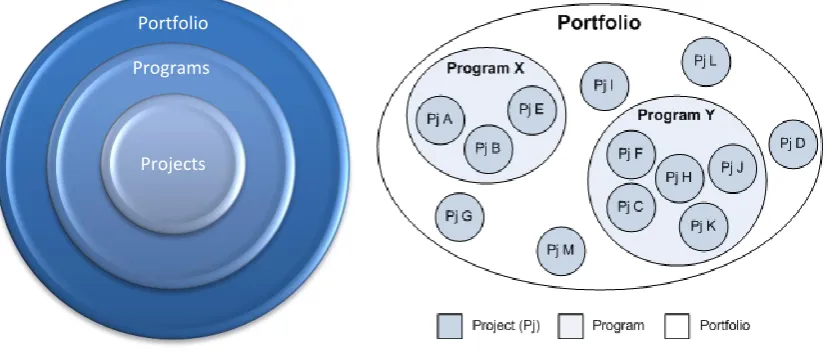
A program includes multiple related projects which together achieve strategic benefits. The portfolio includes all projects and programs in an organization, whether they are related or not. The purpose of the corporate portfolio is to determine what resources should be allocated to distinct projects and programs and whether they contribute to strategy. The portfolio is used to make decisions about the priority of projects and programs, whether they should be started, resumed, stopped, or killed. The relation between projects, programs, and the portfolio is illustrated in Figure 3.
Source: [Rajegopal et al., 2007, 12]
Furthermore, project management and portfolio management can be considered as completely different paradigms. Project management is primarily focused on finishing projects within time and budget constraints. Portfolio management, on the other hand, is focused on selecting the right mix of projects and programs, allocating resources, maximizing overall business benefit, and delivering to corporate strategic objectives. One can argue there has been a changing view on measuring the success of projects. Projects are no longer static or isolated linear entities but have complex interdependencies with the business and other projects. Additionally complexity increased due to managing multi-project environments. Difficulties appeared such as project selection based on subjective factors, a lack of a dynamic process for understanding project benefit realization, and the lack of a real-time view of resource capability. Consequently alignment was needed between projects and the business occurred since projects are regarded as an integral part of the business for realizing the business strategy. Portfolio management is a necessity in order to bridge the gap between projects, the management process and the accountability to the business, and, in doing this, it brings together strategic and operational levels. Furthermore the bottom-up approach of project management does not work for portfolio management, which should be a top-down approach.
3.1.2
Projects, programs and the portfolio
In this section the concepts project, program, portfolio and their corresponding fields project management (PjM), program management (PgM), and (project) portfolio management (PfM) are discussed in more detail below.
3.1.2.1
Projects and project management
Project management dates back to ancient times. A few examples of famous projects are the pyramids in Egypt and the Great Wall in China, which shows project management exists for a long time. Projects in a business context only exist for a few hundred years. Since the terms project and project management are very trivial a few definitions of these concepts are given below. A definition of a project is “a temporary endeavor to create a unique product or service [PMI, 2000].” The definition of a project that is being used throughout this report is “a temporary organization that is created for the purpose of delivering one or more business products according to a specified business case [OGC, 2008d, 21].” A definition of project management is “the application of knowledge, skills, tools and techniques to project activities to meet project requirements [PMI, 2000].” The definition of project management that is being used throughout this report is defined as “an unique set of coordinated activities, with definite starting and finishing points, undertaken by an individual or team to meet specific objectives within defined time, cost and performance parameters as specified in the business case [OGC, 2008a, 3].”
3.1.2.2
Programs and program management
In this section the concepts programs1 and program management are described. Next to this the difference between projects and programs are discussed. An example in which the difference between projects and programs becomes clear is given below. During an enterprise systems implementation (e.g. SAP) the technical implementation of the enterprise system can be considered as a project, which for example takes about six months to complete. The organizational change trajectory of the business required for implementing the system (e.g. technical implementation, user training, creating awareness of urgency, overcoming resistance, etc.), which for example takes about five years, is considered as a program. A real life example is the SPEER (Strategic Process and Enabled Reengineering) program of the Dutch Ministry of Defense (MoD). The purpose is to standardize financial and logistics operations of the three MoD departments land forces, air force, and the navy, which all have been independent departments in the past. MoD has selected SAP as supportive enterprise system [Atos Origin, 2008].
1
Pellegrinelli states the following about the difference between projects and programs: “A program is a framework for grouping existing projects or defining new projects, and for focusing all the activities required to achieve a set of major benefits. These projects are managed in a coordinated way, either to achieve a common goal, or to extract benefits which would otherwise not be realized if they were managed independently. Programs differ from projects in that they do not necessarily have a single, clearly defined deliverable, or a finite time horizon [Pellegrinelli, 1997, 142]. The definition of a program that is being used throughout this report is “a temporary, flexible organization created to co-ordinate, direct and oversee the implementation of a set of related projects and activities in order to deliver outcomes and benefits related to the organization’s strategic objectives. A program is likely to have a lifespan of several years [OGC, 2008d, 20].” Program management can be defined as “the integration and management of a group of related projects with the intent of achieving benefits that would not be realized if they were managed independently [Lycett et al., 2004, 289].” The definition of program management that is being used throughout this report is “the coordinated organization, direction and implementation of a portfolio of projects and activities that together achieve outcomes and realize benefits that are of strategic importance [OGC, 2008d, 21].”
3.1.2.3
The portfolio and portfolio management
In this section the concepts portfolio and portfolio management are discussed. Besides the emergence from the project management field, the origins of portfolio management date back to financial investment theory in the 1950s where portfolio management was used to select stock portfolios [Markowitz, 1952]. The last decade portfolio management has been widely used to manage IT projects [Kersten and Verniers, 2004; Reyck, et al., 2005] and new product development projects [Cooper et al., 2001]. Currently there is no full consensus on the concept of portfolio management. Different terms like project management, multi-project management, program management, and project portfolio management are used interchangeably for the same concept in scientific literature [Elonen and Artto, 2003]. A few definitions of the portfolio and portfolio management are given below. The definition of the portfolio that is being used throughout this report is “the totality of an organization’s investment (or segment thereof) in the changes required to achieve its strategic objectives [OGC, 2008a, 2].” Portfolio management can be defined as “the entire collection of projects a company is engaged in, in order to make decisions in terms of which projects are to be given priority, and which projects are to be added to or removed from the portfolio [Reyck et al., 2005].” Another definition is “the process of analyzing and allocating organizational resources to programs and projects across the organization on an ongoing basis to achieve corporate objectives and maximize value for the stakeholders [Thiry, 2006].” The definition of portfolio management that is being used throughout this report is “a coordinated collection of strategic processes and decisions which enable the most effective balance of organizational change and business as usual/operations [OGC, 2008a, 2].” The concepts projects, programs, and the portfolio and their related fields project, program, and portfolio management are discussed in the sections above. What can we tell about recent developments in these areas and the challenges business is currently dealing with?
3.1.3
Challenges in portfolio management
Companies usually decide on ‘quick-wins’ and select a surplus on small projects and consequently have few major hits [Cooper et al., 2000]. Artto, 2001a states that “a fundamental question is the problem of how to organize the whole corporation’s responsibilities, decision making, and objective setting concerning projects. These issues relate also to questions of relevant information content, information sharing, and aspects of learning [Artto, 2001a].” Furthermore Artto, 2001b describes the main problems in multi-project environments as each key individual is involved in too many projects – under capacity, the competence in other individuals is not used effectively – overcapacity, similar work entities are run in parallel in different parts of the organization – lack of coordination, results of project activities are not used in other projects – lack of coordination, too many (small) projects, too many projects as compared to available resources, projects do not support achievement of business objectives; projects do not carry appropriate value for the business, a lack of balance of projects as a whole, and too much information; lack of relevant information [Artto, 2001b]. Elonen and Artto, 2003 states that the main managerial problems in project portfolios are no link between strategy and project selection, poor-quality portfolios, reluctance to kill projects [Staw and Ross, 1987], scarce resources and additionally a lack of focus, selecting short-term and easy projects, information overflow and lacking quality of information, and decision making based on power. Furthermore the authors define six problem areas based on the managerial problems that have been found. The problem areas that can be distinguished are inadequate project level activities, lacking resources, competencies and methods, lacking commitment, unclear roles and responsibilities, inadequate portfolio level activities, inadequate information management, inadequate management of project-oriented business [Elonen and Artto, 2003]. Kendall and Rollins, 2003 reports about the missing link between strategic planning and project management, project manager stress from limited human capital, splitting resource pools, bad multitasking, and the multi-project resource conflict [Kendall and Rollins, 2003]. The latter is also mentioned in Engwall and Jerbrant, 2003 which describes the allocation of resources between simultaneous projects as a challenge [Engwall and Jerbrant, 2003]. Rintala et al., 2004 defines three categories of problems. Resource allocation can be problematic in a multi-project environment. Examples of this are key persons suffer from project overload while others work in under capacity, and lack of overall coordination and transparency between projects. Another problem is the strategic context of project composition. Projects are not aligned with the strategy or balanced optimally against different objectives at the portfolio level. The third problem is work activities that are hindered by blizzard of information and in the same time lack of information [Rintala et al., 2004]. Levine, 2005 defines problems associated with portfolio management such as how to implement PPM, ranking value and benefits, the size of the portfolio pipeline, the impact of uncertainty on projects and portfolios, and the benefits/risks relationships [Levine, 2005]. Now that the challenges with regard to portfolio management are known, what can we do to deal with these challenges?
3.2
The project organization
3.2.1
The project management office
One of the recent trends in the project (portfolio) management field is the project management office (PMO), which is known in many different guises. Some terms that are used extensively are the project office, program office, the project-oriented organization, project-based organization, center of excellence, or center of expertise. The term project management office is used in a consistent way to refer to all of these concepts since they have more or less the same meaning. Ward describes a project office as “an organizational entity established to manage a specific project or a related series of projects, usually headed by a project or program manager.” Ward, 2000 defines a project management office as “an organizational entity established to assist project managers, teams and various management levels on strategic matters and functional entities throughout the organization in implementing project management principles, practices, methodologies, tools and techniques [Ward, 2000].” Since information in companies is often widely scattered over different strategic business units (SBUs) it can be difficult to make informed decisions. This issue also holds for project related activities. As a result the new paradigm of the project-oriented organization came up in the 2000s which was in contrast with the traditional mechanistic organization. The new strategy of a project organization is ‘management by projects’. Now we got acquainted with the concept of the project management office, what can be considered as challenges with regard to the PMO in business practice?
3.2.2
Challenges of the PMO in Dutch business practice
3.2.3
Improving project management effectiveness
Dai and Wells, 2004 calls for the establishment of a PMO to improve the effectiveness of project management activities. They suggest that a PMO should acquire knowledge to learn from past failures and successes in projects [Dinsmore, 1999; Fleming and Koppelman, 1998; Knutson, 1998]. Block and Frame, 1998 states that the establishment of a PMO leads to consistency and project management professionalism and bans inefficiencies in project activities. Furthermore they suggest some characteristics to improve the organization’s effectiveness of project management. These are project support to offload administrative burdens, consulting and mentoring, development and application of standards and methods based on best practices, training and certification to improve individual skills, assistance in staffing projects, and playing a high-tech support role [Block and Frame, 1998]. Bates subsequently argues that tasks such as providing project risk assessment, performing post-project evaluation services lead to effective project management in an organization [Bates, 1998]. In Dai and Wells, 2004 also empirical research is done about the PMO. The main findings of their study are the presence of a high level of management confidence in the project management office in organizations that are establishing a PMO or already have done so, a high correlation between project management standards and methods and project performance, a high correlation between the use of project historical archives and project performance, and pioneers in establishing PMOs are providing information and advice on essential policies and documents that should accompany the establishment and use of a PMO [Dai and Wells, 2004]. This shows the PMO leads to increased organizational performance of project management activities. Now it is evident that project management effectiveness can be improved, but how do we measure how well organizations are doing their project and portfolio activities?
3.3
Maturity of project, program, and portfolio processes
A measure that can be used to determine how well organizations are doing is maturity. In this section organizational maturity and its practical relevance is discussed. Additionally project management maturity and the outcomes of previous studies on this topic is described. Subsequently an overview is given of maturity models that exist in scientific literature or are used in practice. Then criteria are formulated for selecting the best suitable maturity model for this study. Additionally this model is discussed more in depth and a description is given how this model can be used for assessing the maturity of an organization on project, program, and portfolio level. The literature that was used about maturity and maturity assessment models was found by searching in the key journals on project management, i.e. the International Journal of Project Management [IJPM, 2008] and the Project Management Journal [PMJ, 2008], both peer reviewed journals. The search engines that have been mainly used are Web of Science and Scopus, supplemented with Google Scholar using the keywords maturity, project management maturity, program management maturity, portfolio management maturity, maturity model. More general information about the search process can be found on in section 2.2.1.
3.3.1
Organizational maturity and its practical relevance
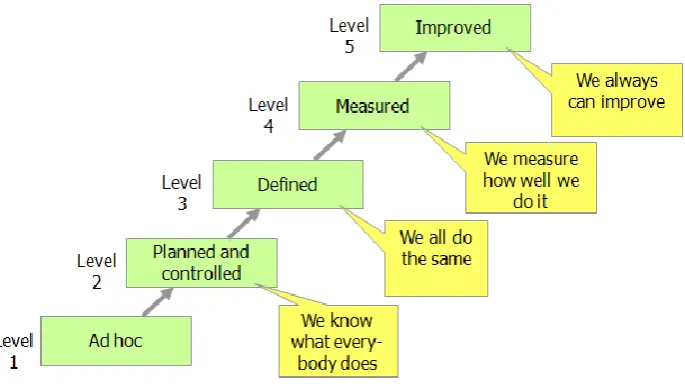
Figure 4: A maturity model with five levels (source: Hedeman, 2007)
Maturity models date back to the Capability Maturity Model (CMM) of Carnegie Mellon’s Software Engineering Institute (SEI). CMM’s development started in 1986 and initial release followed in 1991. CMM is focused on software process improvement in software engineering projects. In 2000 appeared the Capability Maturity Model Integrated (CMMI), CMM’s successor, which can be considered as a more general approach to process improvement. CMMI integrates several areas (e.g. software engineering, product and service development, acquisition, etc.) to improve the effectiveness of processes. Improving maturity can lead to a reduction in the variability of the process and an improvement in the performance of the process [Cooke-Davies et al., 2001]. Furthermore a relation exists between higher levels of maturity and improved organizational performance [Herbsleb et al., 1997]. Bourne and Tuffley argue assessing the organization’s capability using a maturity model can lead to a substantial return on investment. These authors also suggest that other benefits can be an increased productivity, improved quality, increased customer satisfaction, improved employee morale, less defects, reduced costs, and reduced costs of quality [Bourne and Tuffley, 2007]. Crawford, 2006 argues that determining a correct maturity level is not an easy task since many factors are involved like individual interviews, evaluating artifacts, processes, standards, knowledge, and company culture. Therefore it is important to use an assessment tool that is tested and proven on delivering consistent results. There is some misuse of maturity models and should not be seen as a model that solves issues but as a path forward in which project management capabilities can be improved. Crawford, 2006 states that progress in maturity levels are evolutionary steps with a specific focus and measurable goals to realize benefits within a predetermined period of time, usually a number of months. Furthermore companies should not strive for the highest maturity level but to a minimum level at which the benefits and desired results are achieved [Crawford, 2006]. Now the concept of organizational maturity and its relevance is known, what can we tell about maturity in the project related activities?
3.3.2
Project management maturity
Furthermore Andersen and Jessen state that “the basic assumption is that modern societies are typified by their change ability and their willingness to change. And change generates needs. Needs are in turn the prerequisite for development. Most individuals in modern societies are in situations were they continuously experience needs. The result is that they have to prioritize, and thus decide.” Project management maturity can be described as the ability of the organization to deal with its projects. In the real world the fully matured organization does not exist; Andersen and Jessen argue that no organization have ever reached maturity and no organization ever will. Nevertheless it is useful being able to describe organizational maturity in someway it can be measured or characterized. As a result maturity models have been designed to assess the level of maturity in organizations. Different types of assessment exist for determining the level of maturity like a baseline assessment and an comprehensive assessment. A baseline assessment enables the organization to identify the areas where it can expect the greatest return on investment and to show where actions have impact. A comprehensive assessment checks all areas where project management influences the business and progress is evaluated periodically. Three stages of maturity can be distinguished: 1. project management maturity, 2. program management maturity, and 3. portfolio management maturity. For each of these stages should be determined what the maturity is. Andersen and Jessen hypothesize that it is likely that a higher stage is less capable – or has a lower maturity – than a lower level. It is plausible to assume it is harder to fulfill the requirements in higher stages (e.g. portfolio management) compared to lower stages (e.g. project management) [Andersen and Jessen, 2003]. What studies were recently conducted about maturity of project, program, and portfolio management?
3.3.3
Previous studies on project management maturity
In this section a few studies on project management maturity are discussed. The first section describes two scientific studies on project management maturity and one scientific study on project, program, and portfolio management maturity. The latter is the actual purpose of this study. The second paragraph describes a study from the field conducted by a commercial party.
3.3.3.1
Academic studies on project management maturity
Ibbs and Kwak conducted a project management maturity assessment using the PMBOK Guide as main reference. The survey consisted of 148 multiple choice questions which were divided over 8 knowledge areas and 6 phases. A number of 38 different companies and government agencies participated in the survey which were working in 4 different industries. These industries are engineering and construction, information management and movement – also known as telecommunications, information systems – also known as software development, and hi-tech manufacturing. A relative scale from 1 (lowest) to 5 (highest) is used and an overall project management maturity is calculated by averaging the scores of all 148 questions. It appeared the project management maturity for all companies had an average of 3,26 in this study [Ibbs and Kwak, 2000].
This shows the attitude (capability to carry out different tasks) and knowledge (willingness to take them out) is greater than the actions (actually doing them) that are taken [Andersen and Jessen, 2003].
Grant and Pennypacker, 2006 has measured the project management capabilities among and between different industries. In this survey the authors adopted the PM Solutions Project Management Maturity Model (PMS-PMMM). This model consists of two dimensions. The first dimension is based on the SEI Capability Maturity Model (CMM). The second dimension is based on the nine knowledge areas of the Project Management Institute (PMI). The authors approached member of the Center for Business Practices (CBP) Consortium, containing over 900 senior practitioners in the project management field. A number of 42 detailed components of maturity were examined by using a specific question for each component. The survey was conducted among 126 North American organizations including 17 distinct industries. The following four major industries professional, scientific, and technical service; information; finance and insurance; and manufacturing were compared, but no significant in project management maturity between industries have been found. The median maturity level is 2 out of 5 with respect to 36 of the 42 components analyzed [Grant and Pennypacker, 2006]. These findings are in line with a previous study of the same authors in which 13.7% of the respondents operated at level 1 – initial process, 53.2% at level 2 – structured process and standards, 19.4% at level 3 – organizational standards and institutionalized process, 7.3% at level 4 – managed process, and only 6.5% at level 5 – optimizing process [Pennypacker and Grant, 2003]. In this section have discussed three relative small academic studies on project management maturity. In what way can this be compared to a global study by a commercial party about project management maturity in organizations world wide?
3.3.3.2
A practitioner’s study on project management maturity
The best performing and most mature companies with frequently apply change management in their projects. Additionally the degree of software use is correlated with maturity levels. It appears the lower the level of maturity the more difficult it is to implement project management software. In addition project management software is not used to its full potential in facilitating and automating the reporting process. Though reporting is time consuming and provides low value it is an essential project management activity. Furthermore projects can be better staffed with a majority of internal than external sources as a guarantee of success. However, moderated use (i.e. not more than 25%) of external sources have proven to add value and lead to higher performance of project activities. Furthermore there are some interesting and perhaps even remarkable findings. Companies can not advance more than one level in maturity at a time since a collective transformation in corporate culture is required which involves anyone. Project ‘failure’ is still expressed in internal project performance measures (e.g. bad estimates, failing deadlines, impact of scope changes) instead of delivering value to the corporation as a whole. The best performing companies adopt a ‘projectized’ structure or matrix-structure since this gives project managers significantly more influence, though this does not work out with companies with a small number of projects. Only 13% of the companies surveyed incorporates change management since this is an essential part of project management. Finally 21% of all companies does not use software in their project management activities [Nieto-Rodriguez and Evrard, 2004].
In Table 1 the maturity values from the studies above are summarized. Some of these values are recalculated in such a way that the same scale of choices ranging form 1 to 5 is used. It appeared just a few quantitative studies exist on maturity of project, program, and portfolio management processes. Most studies [Ibbs and Kwak, 2000; Pennypacker and Grant, 2003; PricewaterhouseCoopers, 2004; Grand and Pennypacker, 2006] are only focused on project management maturity. Just a single study [Anderssen and Jessen, 2003] can be found that describes both project, program and portfolio management maturity. Nevertheless values can not be compared with one another since different maturity assessments approaches have been used.
PricewaterhouseCoopers, 2004 2 - -
Grant and Pennypacker, 2006 2,5 - -
Table 1: Maturity values of the project management surveys described above
In this section four studies are discussed about project management maturity and another study about both project, program, and portfolio management (Table 1). All of them use different maturity models for determining maturity. What maturity models can be found in scientific literature and what model is most suitable to measure maturity in this research?
3.4
Maturity models
In the sections below an overview is given of the main maturity models. In addition selection criteria are defined that can be used to select the model that is best suitable to use in this study. Subsequently the chosen maturity model is discussed that is used as assessment tool in this research. Finally a description is given how the maturity model is adopted in the web survey and the way it used as assessment tool.
2 The values for project, program, and portfolio management are modified from a six choices to a five choices scale
3.4.1
Overview of maturity models
In this section an overview is given of the main maturity models that can be found in scientific literature and are used in business practice. The literature that was used about maturity models was found by searching in the key journals on project management, i.e. the International Journal of Project Management [IJPM, 2008] and the Project Management Journal [PMJ, 2008], both peer reviewed journals. The search engines that have been mainly used are Web of Science and Scopus, supplemented with Google Scholar using the keywords maturity model, project management maturity, program management maturity, portfolio management maturity, maturity model or a combination of these terms. More general information about the search process can be found on in section 2.2.1. Appendix A – Maturity models gives an extensive description of the models that were found and below only the names of these particular models are listed:
- The Capability Maturity Model (CMM) or its improved version the Capability Maturity Model Integrated (CMMI) of Carnegie Mellon University’s Software Engineering Institute (SEI)
- The European Foundation of Quality Management (EFQM) Excellence model or its Dutch equivalence Instituut voor Nederlandse Kwaliteit (INK)-model
- Berenschot’s Project Excellence Model (PEM)
- Kerzner’s Project Management Maturity Model (K-PMMM)
- PMI’s Organizational Project Management Maturity Model (OPM3) - OGC’s the PRINCE2 Maturity Model (P2MM)
- OGC’s Portfolio, Programme and Project Management Maturity Model (P3M3)
- The MINCE2 Foundation’s Maturity Increments IN Controlled Environments Model (MINCE)
- PM Solutions’ Project Management Maturity Model (PMS-PMMM)
- PM Solutions’ Project Portfolio Management Maturity Model (PMS-PPMMM)
- University of California’s or Berkeley’s Project Management Process Maturity (PM)2 model
In the next section criteria are defined for selecting an appropriate maturity model that can be used for measuring maturity in this study.
3.4.2
Selection criteria for maturity models
In this study an overview is given of a number of maturity models without having determined their usefulness so far. This is done in this section. One of the objectives of this study is to determine the maturity of project, program, and portfolio management processes in large Dutch businesses using a best practice model. Based on this research objective and the desires of Fortes Solutions the following selection criteria were defined:
1. The maturity model should be a best practice model, i.e. developed by an independent party in cooperation with business practitioners since business should be able to handle the model peculiarities in a natural way without putting a lot of time and effort in it to understand the model. In this way the model can be easily adopted in business practice. 2. The model should be able to assess maturity on three process levels: project
management, program management, and also portfolio management level.
4. The model should be suitable to use in Western Europe countries and, more specific, it should be proper to use in large Dutch organizations which is the focus group of this study. Cultural differences can lead to different assumptions on project related activities which consequently may result in models that are suitable to use in a particular region (e.g. Europe, America, Asia), but are less suitable to use in other regions.
5. The model should be compliant with PRINCE2, since this method is considered as the de facto project management standard in Dutch organizations, i.e. 61% and 72% of the participants in the surveys of respectively [KPMG, 2004] and [Vrije Universiteit Amsterdam et al., 2007]. Hence organizations and practitioners are familiar with the PRINCE2 terminology.
Based on these five selection criteria the eleven maturity models listed above can be compared with one another. It appears the Portfolio, Programme and Project Management Maturity Model (P3M3) satisfies all five selection criteria and therefore is the most suitable model to use in this study (Table 2) and is discussed in more detail in the next section.
Maturity model 1 2 3 4 5
Capability Maturity Model (CMM) / Capability Maturity Model Integrated (CMMI) - - European Foundation of Quality Management (EFQM) Excellence model /
Instituut voor Nederlandse Kwaliteit (INK)-model - -
Project Excellence Model (PEM) - - -
Kerzner’s Project Management Maturity Model (K-PMMM) - - - - Organizational Project Management Maturity Model (OPM3) - -
PRINCE2 Maturity Model (P2MM) - -
Portfolio, Programme and Project Management Maturity Model (P3M3)
Maturity Increments IN Controlled Environments Model (MINCE) - - - PM Solutions’ Project Management Maturity Model (PMS-PMMM). - - - - PM Solutions’ Project Portfolio Management Maturity Model (PMS-PPMMM) - - - Berkeley’s Project Management Process Maturity (PM)2 model - - - -
Table 2: Eleven maturity models compared based on five selection criteria
3.4.3
The Portfolio, Programme and Project Management Maturity Model
The Portfolio, Programme and Project Management Maturity Model (P3M3) was first released in February 2006 and was developed as an enhancement of the Project Management Maturity Model (P1M3), both described in more detail in Appendix A – Maturity models. P1M3, on its turn, is based on the process maturity framework that evolved into the Software Engineering Institute Capability Maturity Framework (SEI-CMM), which was developed between 1986 and 1991. A new, second and updated version of OGC’s Portfolio, Programme, and Project Management Maturity Model (P3M3) is released recently in June 2008 at the annual Best Practice Showcase in London [APMG UK, 2008]. The Portfolio, Programme and Project Management Maturity Model contains three models which are:
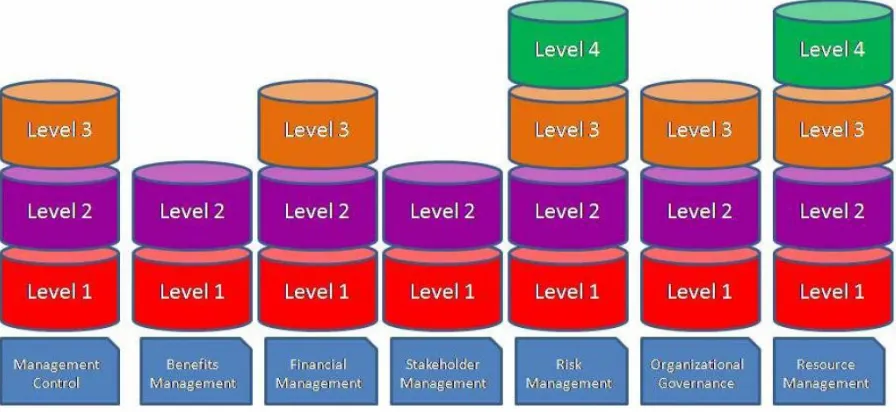
Additionally, similar to SEI-CMM, the P3M3 is described by a five level maturity framework. With the following maturity levels can be distinguished:
- Level 1 – Awareness of process - Level 2 – Repeatable process - Level 3 – Defined process - Level 4 – Managed process - Level 5 – Optimized process
In level 1 – Awareness of process the organization recognizes projects, but hardly any structured approach exists for dealing with these projects. In level 2 – Repeatable process standard approaches exist in some areas, e.g. projects, but there is no consiste


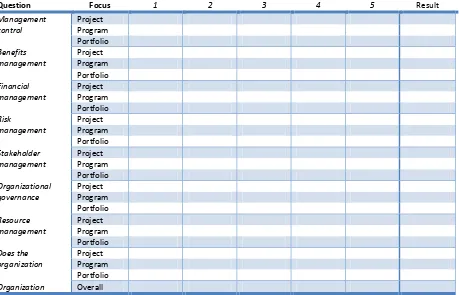
![Figure 6: Generic approach to P3M3 self-assessment – source: [OGC, 2008c]](https://thumb-us.123doks.com/thumbv2/123dok_us/1021467.1126823/34.595.223.373.70.558/figure-generic-approach-p-self-assessment-source-ogc.webp)