National Conference on Engineering Innovations and Solutions (NCEIS – 2018)
International Journal of Scientific Research in Computer Science, Engineering and Information Technology
© 2018 IJSRCSEIT | Volume 4 | Issue 6 | ISSN : 2456-3307
Remote Voting System for Mobile Device Using Android Based
voting
Naheem M R1, Dr. K. Thippeswamy2
1M.Tech in CS&E, VTU PG Centre, Mysuru, Karnataka, India
2Professor and Chairman, DoS in CS&E, VTU PG Centre, Mysuru, Karnataka, India
ABSTRACT
The project deals with the development of a Remote Voting System with an effective secure and fear free voting model. The voting model provides a new voting system which fulfill the security requirements of voting process. A voter may need to register only once for a particular election and that does all, voter need to cast his/her vote without actually being present at the voting cell. The system gives facility to voter to vote from any location through their cell phone. Voting for any social issue is essential for modern democratic societies nowadays. The main goal of the application based is to eliminate overhead related with remote components handling.
Keywords: Android, Security, Voting, Web Server.
I.
INTRODUCTION
Voting for any social issue is essential for modern democratic societies now a day. So it is becoming very important to make the voting process more easy and efficient. In other hand the rapid development in operating system of the mobile phones gives rise to the application development on the large scale. The main reason behind the tremendous development in android application is that the android is an open source operating system. It means that the software developers can have customization rights. The process of integration tasks, functions and responsibilities of the various elements into one is called centralization. It is the result of several factors in particular those associated with the availability, reliability, efficiency etc. Such convergence of applications is characteristic also for smart mobile devices. As well as the software development kit provides tools to build and run Android applications. This system gives facility to voter to vote from any
location through their cell phone. The main goal of the application based is to eliminate overhead related
with remote components handling. Also
authentication and security is maintained for any external attacks on the system.
1.1 Problem statement:
The problem is to design an Application for specific platform of a mobile device. The application as a whole is aimed at being compatible with devices from many manufacturers and running on different versions of the operating system. An integration approach can certainly prove to be a better and efficient solution.
1.2 Existing system:
The voting system currently being used by the student union is a paper based system, in which the voter simply picks up ballots sheets, tick off who they would like to vote for, and then cast their votes by merely handling over the ballot sheet back to official. The officials gather all the votes being caste into ballot box. At the end of the elections, the official converge and count the votes cast for each candidate and determine the winner of each election category. All the step by step procedures are carried out by the authorized authorities according to the jobs assigned by the ECI. The fact is all the procedures are carried out manually, starting from the registration process to result publishing.
The government to do this process manually wastes a lot of time and money. Thus the present system proves itself to be an inefficient one. The existing system is not web based. The user or person must want to go to the polling station for casting their votes.
Some of the disadvantages that which we identified in our survey are as follows.
1. Expensive and Time consuming: The process of difficult as papers become bulky with the population size.
3. Errors during data entry: Errors are part of all human beings; it is very unlikely for humans to be 100 percent efficient in data entry.
4. Loss of registration forms: Some times, registration forms get lost after being filled in with voters‟ details, in most cases these are difficult to follow-up and therefore many remain unregistered even though they are voting age nationals and interested in exercising their right to vote.
5. Short time provided to view the voter register: This is a very big problem since not all people have free time during the given short period of time to check and update the voter register.
6. Above all, a number of voters end up being locked out from voting. Hence there is great desire to reduce official procedure in the current voter registration process if the general electoral process is to improve.
were two possible solutions arising from the specification and analysis.
Solution based on an application for specific platform of a mobile device
So called web based solution
Application for specific platform of a mobile device should be designed as a client-server application. The client part doesn’t need to be implemented for web based solution. It will be provided by Internet browser. The common element in both alternative solutions is to use the same technology in communication between the mobile devices and the server. Server will coordinate the activity of the voting devices and collect the processing data.
An efficient and reliable system is essential for the trustworthy and successful implementation of any technology. Based on the analysis of exiting systems and principles our system will represent the aspect of the respondent’s quick and easy one-time-use interface. The key features of our proposed Mobile Phone Voting System are:
1. Eligibility: only authorized voter can cast their vote.
2. Uniqueness: Each user can cast their vote only once.
3. Integrity: Valid vote should not be modified or deleted.
4. Fairness: The election result should not be accessible before the official time ended.
5. Cost-effectiveness: Election system should be efficient and affordable.
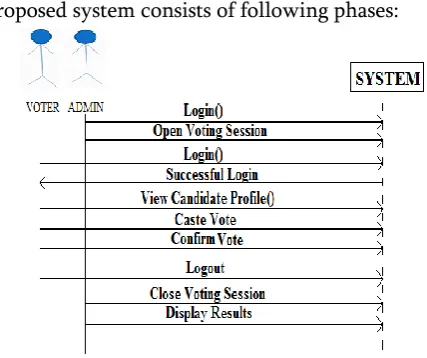
Proposed system consists of following phases:
Figure 1. Sequence diagram
A. Downloading of Mobile Application: B. Registration Phase:
The users have to SIGN IN into the application and fill its whole information like name, phone number, mail-id, age including a unique username and password. After pressing submit button, the whole information will be encrypted and sent over server to the concerned authority’s database. A one-time password (OTP) will be sent to the given mail id after entering the otp the user will be registered.
Figure: use case diagram
C. Voting Phase:
In this phase the voter will login to the application using his\her username, password. Further the information will be compared with the details stored in the server and allow access to the voter. This prevents unauthorized voter to cast a vote. The voter will be provided with a candidate list on voting day. The voter will select their candidate from the list. The voter can only vote when the admin opens the voting session, votes will not be accepted after time ends. The encrypted information will be forwarded to the authority’s server and stored in database.
D. Vote Collecting and Result Phase:
results. After ending of voting phase, votes will be decrypted and counted and results will be officially displayed.
Security is provided to our proposed system by using public-key cryptography. Working with a public-key encryption system has mainly three phases:
1. Key Generation: Whoever wants to receive secret messages create a public key (which is published) and a private key (kept secret). The keys are generated in a way that conceals their construction and makes it difficult to find the private key by only knowing the public key.
2. Encryption: A secret message to any person can be encrypted by his\her public key.
3. Decryption: Only the person being addressed can easily decrypt the secret message using the private key.
Our goal is to design an efficient and effective system that allows the voters to instantly cast a vote without the limit of time and place.
II.
METHODOLOGY
Figure: Architecture.
Steps to be followed:
Step 1: Get the android application.
Step 2: Register by providing all the details and request for OTP using Email.
Step 3: Enter the received OTP and get registered.
Step 4: Voter can login to the android application using username and password and can view the election info and candidate details in the application.
Step 6: Voter will be allowed to enter the voting page and cast their vote only on the election day.
Step 7: Admin should login to the web application and will be authorized to register candidate details and also modify voters as well as candidate’s details.
Step 8: Once the Admin opens the voting session, voter can cast their vote and will be logged out from the voting page.
Step 9: Votes will be encrypted and will be stored until the result day.
Step 10: On the result day the votes will be decrypted and displayed.
III. CONCLUSION
The Remote Voting System will manage the voter’s information by which voter can login and use his voting rights. The voter should register only once and can vote from anywhere using his android phone. There is a database which is maintained by the Admin in which all information of voter as well as candidate is stored. By online voting system, percentage of voting increases. It decreases the cost and time of voting process. It is very easy to use and it is very less time consuming. Considering the drawbacks of present system by some issues like security, efficiency, robustness, flexibility, and data integrity this system overcomes all the cons.
IV. ACKNOWLEDGEMENTS
V.
REFERENCES
1. “Efficient E-voting on Android System” paper (InternationalJournal of Emerging Technology and AdvancedEngineering) preparedby: Dr.Aree Ali Mohammed, RamyarAbdolrahmanztimour, November 2013.
2. K. Kim, and D. Hong, “Electronic Voting System using Mobile Terminal,” World Academy of Science, Engineering and Technology, pp. 33-37, 2007.
3. “A Modular Voting Architecture (“Frogs”),” ShukiBruck,David Jefferson, and Ronald L. Rivest, August 2001.
4. “Mobile voting System “byDipali More, MehzabinShaikh, MeeraAwaskar, Supriya
Ghongde, SampadaWattamwar,
DivyaTadpelliwar,International Journal of
Emerging Technology and Advanced
Engineering Website: www.ijetae.com (ISSN 2250-2459, ISO 9001:2008 Certified Journal, Volume 5, Issue 1, January 2015)
5. ”E-Voting System Using Android Application” M.s.SaiMohit, M.Karthik, T.rajavel May 2014. 6. “Designing, developing and testing a mobile