CSEIT1831440 | Received : 16 Feb 2018 | Accepted : 27 Feb 2018 | January-February-2018 [(3) 2 : 74-79]
International Journal of Scientific Research in Computer Science, Engineering and Information Technology © 2018 IJSRCSEIT | Volume 3 | Issue 2 | ISSN : 2456-3307
74
Implementation of Personal Web Search by Using Content and
Location Concept
Vissa Rajyalakshmi1, Muddana Sarada2
1PG Student, Department of M.C.A, St.Ann’s College of Engineering & Technology, Chirala, Andhra Pradesh, India
2Assistant Prof, Department of M.C.A, St.Ann’s College of Engineering & Technology, Chirala, Andhra Pradesh,
India
ABSTRACT
Presently a day there is a noteworthy issue in mobile search is that the communications between the clients and search engines are constrained by the small form components of the mobile devices. Subsequently, portable clients have a tendency to submit shorter, thus, more questionable queries contrasted with their web search counterparts. Keeping in mind the end goal to return exceptionally pertinent outcomes to the clients, mobile search engines must have the capacity to profile the client's advantages and customize the query items as per the client's profiles. In this paper, A Personalized Mobile Search Engine (PMSE) utilizing substance and location idea, that catches client's inclinations as ideas by mining their navigate information. Because of the significance of location data in portable query, PMSE orders these ideas into content ideas and location ideas. The client inclinations are sorted out in a philosophy based client profile, which is utilized to adjust a personalized ranking capacity for rank adjustment of future search lists.
Keywords: Click through data, mobile search engine, location search, personalization.
I.
INTRODUCTION
Mobile devices have advanced to give bigger full-colour screens, upgraded preparing power and quicker and perpetual broadband Internet associations. These innovations have conveyed the World Wide Web to mobile devices presenting new necessities and desires. In any case, the most dominant part of sites and web sites are generally composed on account of work stations. Therefore, ebb and flow versatile pursuit encounter is a long way from acceptable. Search engine investigators, monitoring this issue, have composed portable arranged perspectives to give a similar service from a littler interface. Versatile Web Search presents new difficulties not present in customary web seek. Clients regularly claim current PDAs which enables them to be for all time online anyplace, whenever. A run of the mill portable web search situation
which speaks to various kinds of ideas in various on to logies. By mining substance and location ideas for client profiling, it uses both the substance and location inclinations to customize query items for a client.
II.
RELATED WORK
A noteworthy issue in portable web look is that the connection between the clients and associations between the clients and web search tools are restricted by the little frame variables of the mobile devices. As an outcome, versatile clients have a tendency to submit shorter, consequently, more uncertain queries contrasted with their web search counterparts. With a specific end goal to return very significant outcomes to the clients, versatile web indexes must have the capacity to profile the clients' advantages and customize the list items as indicated by the clients' profiles. A pragmatic way to deal with catching a client's advantages for personalization is to dissect the client's click through information. Click through information has been utilized as a part of deciding the clients' inclinations on their indexed lists. Many existing personalized web search frameworks are based click through information to decide clients' inclinations. Personalized query recommendations in light of a personalized bunching procedure. An algorithm named agglomerative clustering algorithm to misuse query record relationship from click through information. Another approach for circumstance mindful personalized seek. Case-Based Reasoning [CBR] approach is utilized. A framework situated in a semantic setting mindful system, which causes the client to manufacture personalized search queries by methods for an auto finish component. In any case, a large portion of the past work accepted that all ideas are of a similar sort. In this paper isolate ideas into location ideas and substance ideas to perceive data significance So far there have been many papers composed and examined on web search tools. Most business web indexes return generally similar outcomes to all clients. Nonetheless, extraordinary data needs notwithstanding for a similar query.
PMSE profiles both of the client's substance and location inclinations in the philosophy based client profiles, which are naturally gained from click through and GPS information without requiring additional endeavours from the client. In PMSE propose a practical outline for PMSE by receiving search approach which depends on one of the business search engines, for example, Google or Yahoo to play out a real pursuit. The customer is mindful for receiving the client's solicitations, presenting the solicitations to the PMSE server, showing the returned results, and gathering his/her click through keeping in mind the end goal to determine his/her own inclinations. The PMSE server, then again, is in charge of taking care of overwhelming assignments, for example, sending the solicitations to a business web index, and in addition preparing and re-ranking of query items before they are come back to the customer. The client profiles for particular clients are put away on the PMSE customers, therefore saving protection to the clients. PMSE has been prototyped with PMSE customers on the Google Android stage and the PMSE server on a PC server to approve the proposed thoughts Studies the exceptional attributes of substance and location ideas, and gives a lucid methodology utilizing customer server design to coordinate them into a uniform answer for the versatile condition. By mining substance and location ideas for client profiling, it uses both the substance and location inclinations to customize list items for a client. The contrasts between existing work and PMSE utilizing substance and location idea are:
b) Propose and actualize another and reasonable outline for PMSE. This prepares the client profiles rapidly and proficiently.
Problem Definition
To outline a framework as a PMSE for recovering applicable data relying on clients provided query. In this venture, way to deal with customizing web seeks in a versatile condition. As a contextual analysis, Android telephone as the portable stage to execute work. Principle objective is to distinguish client’s interests in view of the site pages he visits, and convey customized web query items by using the distinguished client interests. We learn and keep up verifiably an ontological profile of client s interests through inactive perception of the client s click stream. The client s intrigue profile is put away locally on his cell phone and refreshed with each site page visit. Personalization is accomplished by re-ranking standard web list items utilizing the client s intrigue profile. Isolate ideas to be specific area ideas and content ideas is utilized to perceive the significance of area data in portable pursuit. Area inclinations others the portable web search tool an extra measurement for catching a client’s intrigue and a chance to improve look quality for clients. The executed framework is skilled of consolidating a client’s GPS areas and area inclinations into the personalization procedure.
III. PROBLEM CONVERSION
This frameworks to mine archive inclinations from navigate information. It is to join a spying strategy together with a novel voting strategy to decide client inclinations. It presented a compelling methodology to foresee clients' calculated inclinations from navigate information for customized query proposals. PMSE PMSE by receiving the meta seek approach which depends on one of the business web search tools, for example, Google, Yahoo, or Bing, to play out a genuine pursuit. The customer is in charge of accepting the client's solicitations; presenting the solicitations to the PMSE server, showing the
returned results, and gathering his/her navigate with a specific end goal to determine his/her individual inclinations. The PMSE server, on the other hand, is in charge of taking care of substantial errands, for example, sending the solicitations to a business web search tool, and in addition preparing what’s more, re-positioning of indexed lists before they are come back to the customer. PMSE utilizes "ideas" to demonstrate the interests and inclinations of a client. Since area data is imperative in versatile pursuit, the ideas are additionally arranged into two distinct composes, to be specific, content ideas and area ideas. PMSE addresses this issue by controlling the measure of data in the customer's client profile. The current framework has the accompanying downsides: • The PMSE doesn't abuse normal travel examples and query designs from the GPS.
IV. PROBLEM SOLUTION
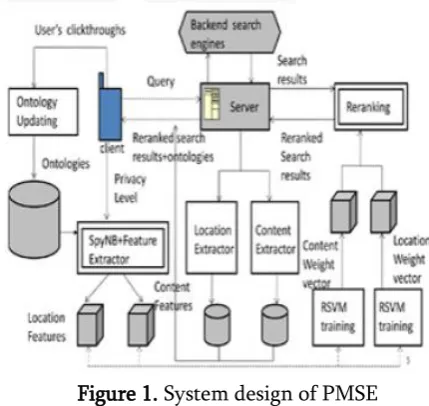
inclinations expressed in the component vectors. Figure 1 demonstrates PMSE's customer server design, which meets three imperative prerequisites. To start with, calculation concentrated undertakings, for example, RSVM preparing, ought to be dealt with by the PMSE server because of the restricted computational power on mobile devices. Second, information transmission amongst customer and server ought to be limited to guarantee quick and effective preparing of the query. Third, click through information, speaking to exact client inclinations on the indexed lists, ought to be put away on the PMSE customers with a specific end goal to safeguard client security. PMSE's outline tended to two issues:
a) Restricted computational power on mobile devices.
b) Information transmission minimization.
PMSE comprises of two noteworthy exercises: Re-ranking the indexed lists at PMSE server: When a client presents a query on the PMSE customer, the query together with the component vectors containing the client's substance and location inclinations (i.e., separated on to logies as indicated by the client's protection setting) are sent to the PMSE server, which thus acquires the list items from the back-end web search tool (i.e., Google). The substance and location ideas are extricated from the indexed lists and sorted out into ontologies to catch the connections between the ideas. The server is utilized to perform metaphysics extraction for its speed. The element vectors from the customer are then utilized as a part of RSVM preparing to get a substance weight vector and a location weight vector, speaking to the client intrigues in view of the client's substance and location inclinations for the re-ranking. Once more, the preparation procedure is performed on the server for its speed. The query items are then re-ranked as indicated by the weight vectors got from the RSVM preparing. At last, the re-ranked comes about and the removed on to logies for the personalization of future queries are come back to the customer. Re-ranking the indexed lists at PMSE server: When a client presents a query on the
PMSE customer, the query together with the element vectors containing the client's substance and location inclinations (i.e., separated ontologies as indicated by the client's security setting) are sent to the PMSE server, which thusly acquires the list items from the back-end web index (i.e., Google). The substance and location ideas are extricated from the list items and sorted out into ontologies to catch the connections between the ideas.
Figure 1. System design of PMSE
The server is utilized to perform ontology extraction for its speed. The element vectors from the customer are then utilized as a part of RSVM preparing to acquire a substance weight vector and a location weight vector, speaking to the client intrigues in light of the client's substance and location inclinations for the re-ranking. Once more, the preparation procedure is performed on the server for its speed. The list items are then re-ranked as per the weight vectors acquired from the RSVM preparing. At last, the re-ranked comes about and the separated ontologies for the personalization of future queries are come back to the customer.
V.
EXPLORATORY EVALUATION
enthusiasm for similarly that a standard web search tool would have been utilized. After the clients completed the majority of the five test queries in the test stage, the preparation stage starts. The clicked comes about because of the test stage are dealt with as positive preparing tests in RSVM preparing. The click through information, the separated substance ideas, and the extricated location ideas are utilized in RSVM preparing to acquire the personalized ranking capacity. After the preparation stage, the assessment stage is performed to choose if the personalized ranking capacity acquired in the preparation stage can in fact return more significant outcomes for the client. There are 4 factors are broke down in this paper. They are:
1. Domain - spend time 2. Open a link
3. Explore a link 4. Ignore
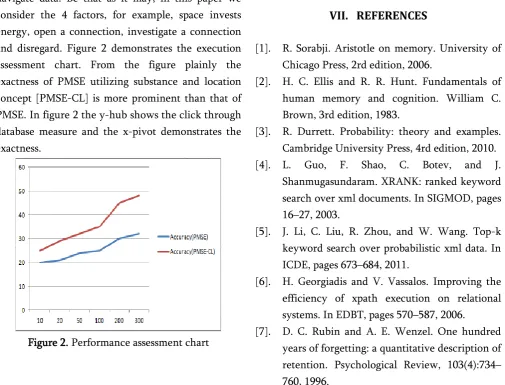
For URL ranking, in old paper, just think about the navigate data. Be that as it may, in this paper we consider the 4 factors, for example, space invests energy, open a connection, investigate a connection and disregard. Figure 2 demonstrates the execution assessment chart. From the figure plainly the exactness of PMSE utilizing substance and location concept [PMSE-CL] is more prominent than that of PMSE. In figure 2 the y-hub shows the click through database measure and the x-pivot demonstrates the exactness.
Figure 2. Performance assessment chart
VI. CONCLUSION
The personalized portable web search tool utilizing substance and location idea is an inventive approach for customizing web list items. By mining substance and location ideas for client profiling, it uses both the substance and location inclinations to customize list items for a client. In this paper, personalized the list items in light of client's click through inclinations. Hunt queries are arranged by inclinations. Most existing location based pursuit frameworks, expect clients to physically characterize their location inclinations (with scope longitude sets or content form).But PMSE consequently gain from click through and GPS information without requiring additional exertion from the client. Here we store individual data in versatile. At the season of pursuit we pass this data to server. Here there is shot of releasing this individual data. In future we will execute a secured individual search engine.
VII.
REFERENCES
[1]. R. Sorabji. Aristotle on memory. University of Chicago Press, 2rd edition, 2006.
[2]. H. C. Ellis and R. R. Hunt. Fundamentals of human memory and cognition. William C. Brown, 3rd edition, 1983.
[3]. R. Durrett. Probability: theory and examples. Cambridge University Press, 4rd edition, 2010. [4]. L. Guo, F. Shao, C. Botev, and J.
Shanmugasundaram. XRANK: ranked keyword search over xml documents. In SIGMOD, pages 16–27, 2003.
[5]. J. Li, C. Liu, R. Zhou, and W. Wang. Top-k keyword search over probabilistic xml data. In ICDE, pages 673–684, 2011.
[6]. H. Georgiadis and V. Vassalos. Improving the efficiency of xpath execution on relational systems. In EDBT, pages 570–587, 2006. [7]. D. C. Rubin and A. E. Wenzel. One hundred
[8]. I. Ruthven and M. Lalmas. A survey on the use of relevance feedback for information access systems. Knowledge Engineering Review, 18(2):95–145, 2003.
[9]. M. A. Soliman, I. F. Ilyas, D. Martinenghi, and M. Tagliasacchi. Ranking with uncertain scoring functions: semantics and sensi- tivity measures. In SIGMOD, pages 805–816, 2011. [10]. M. V. Vieira, B. M. Fonseca, R. Damazio, P. B.
Golgher, D. d. C. Reis, and B. Ribeiro-Neto. Efficient search ranking in social networks. In CIKM, pages 563–572, 2007.
[11]. S. Yokoji, "Kokono Search: A Location Based Search Engine," Proc.Int’l Conf. World Wide Web (WWW), 2001.
[12]. Q. Tan, X. Chai, W. Ng, and D. Lee, "Applying Co- Training to Clickthrough Data for Search Engine Adaptation," Proc. Int’l Conf. Database Systems for Advanced Applications (DASFAA), 2004..
[13]. T. Joachims, "Optimizing Search Engines Using Clickthrough Data," Proc. ACM SIGKDD Int’l Conf. Knowledge Discovery and Data Mining, 2002.
[14]. K.W.-T. Leung,W.Ng, and D.L. Lee, "Personalized Concept-Based Clustering of Search Engine Queries," IEEE Trans. Knowledge and Data Eng., vol. 20, no. 11, pp. 1505-1518, Nov. 2008.
[15]. "Ontology Supported Personalized Search for Mobile Devices"DanielArechiga, Jesus Vegas
and Pablo de la
FuenteRedondo,proc.int’lconf.Web search and Data Mining,2011.
[16]. "semantic context aware framework for paersonalization"Y.Xu, B.Zhang,and Z.Chen, 2oo7.
[17]. J. Hur and D.K. Noh, "Attribute-based Access Control with Efficient Revocation in Data Outsourcing Systems," IEEE Transactions on Parallel and Distributed Systems, vol. 22, no.7, pp. 1214-1221, Nov 2010, doi: 10.1109/ TPDS.2010.203.
[18]. M. Li, S. Yu, Y. Zheng, K. Ren, and W. Lou,"Scalable and Secure Sharing of Personal Health Records in Cloud Computing Using Attribute-Based Encryption, IEEE Transactions on Parallel and Distributed Systems, vol. 24, no. 1, pp. 131-143, Jan. 2012, doi:10.1109/ TPDS.2012.97.
[19]. M. Green, S. Hohenberger and B. Waters, "Outsourcing the Decryptionof ABE Ciphertexts," Proc. 20th USENIX Conference on Security (SEC ’11), pp. 34, 2011.