CSEIT183362 | Received : 12 March 2018 | Accepted : 24 March 2018 | March-April-2018 [ (3 ) 3 : 454-458 ]
© 2018 IJSRCSEIT | Volume 3 | Issue 3 | ISSN : 2456-3307
454
Agro Product Detection and Counting
Aklesh Sakunia1, Yogesh Tandulkar1, Vinay Chopkar1, Aditya Raut1, Atharva Yogi1, Prof. Rashmi Jain2,
Prof. Shilpa Katre3
1BE Scholars, Department of Computer Science and Engineering Rajiv Gandhi College of Engineering and
Research, Hingna Road, Wanadongri, Nagpur, Maharashtra, India
2Prof., Department of Computer Science and Engineering Rajiv Gandhi College of Engineering and Research, Hingna Road,Wanadongri, Nagpur, Maharashtra, India
3Prof.,Department of Electronics, Rajiv Gandhi College of Engineering and Research,Hingna Road,Wanadongri, Nagpur, Maharashtra, India
ABSTRACT
Object identification in digital image is the most important application that saves time and increases productivity. Various Techniques have been developed but improvements are still required in order to achieve the targeted precision.This paper focuses on methods for detecting fruits from a tree. The techniques used are such as edge detection and color filtering to eliminate the irrelevant color or object from the image. Besides that, shape detection is used where it will use Circular Hough Transform (CHT), Haar cascade. This technique will determine the candidates of fruits. The program should automatically detect the desired object and provide a statistical analysis of it.
Keywords : Circular Hough Transform, Object Identification, Object Detection, Digital Image, Haar Cascade Algorithm
I.
INTRODUCTION
As the conventional method for object counting is manual which is time consuming and non-automated, so to automate the task of counting by capturing the image by the camera and by using the object detection algorithm which is “Haar Cascade algorithm for Object Detection”. The detection of the object is done by specifying the color and the size of the object which we have to detect the agriculture field the detection of the fruits or the vegetable is most likely done by specifying the colour and the size of the object. But this is the most challenging task as every fruit is of different size and there is some difference between the colour. Currently, there is lot of research being done on object counting. This paper presents literature review on few approaches of object detection and counting. Recognizing the size and type of the objects in
neural networks can be applied to make automated predictions without on-field survey.
II.
RELATED WORK
A. Detection and position method of apple tree image It is referred from the paper named as the detection and position method of apple tree image[5].By applying computer vision to detect the Fuji apple(Red color apples) surrounded by the various objects like green leaves, branches, sky and soil as all these parameters are captured into the image. So the color of apple is the main part to detect but as the image also consists other elements these elements are extracted to get the targeted image consists of only apples in white color and all the background data in black color.
B. Locating fruits from trees.
It is referred from the paper A survey of computer vision methods for locating fruits from trees[3].By using the shakers there are more chances to damage the fruits by impacting the branches of trees during the fall so the robotic machine should be used which will able to locate the trees by guiding through the field and without making any harm to the fruits it pluck the fruits from the trees by characterizing the fruits(ripen or not).This is the automatic way to detached the fruits from trees one by one.
PART BASED OBJECT RECOGNITION
The basic idea is to represent an object by a collection of parts arranged in a haphazard configuration. The appearance of each part is modelled separately, and the haphazard configuration is represented by spring-like connections between pairs of parts. Such models
REGION BASED OBJECT RECOGNITION
This algorithm converts the image into directed graph which is devised through several checking conditions. The graph characteristics represent the global shape information of the object inside the input image, and are extracted during the graph construction. This solution defers the post processing traversing to the graph, with consequent improvement of computational time. The algorithm was tested over a specific data base, and the experiments were conducted to show its performance in the light of two types of problems: object class recognition and similar image retrieval.
CONTOUR-BASED OBJECT RECOGNITION
The robot is equipped with an database in which a variety of different object's image is stored as prototype images. Using a camera, the robot is expected to recognize and locate the objects and to pick them up thereby performing a task like sorting. The object recognition strategy proposed here is a two-step process. The first step is to locate individual objects and describe them by their shapes. Detected shapes are able to camouflage with almost similar shapes of different objects. The second step is to match these shapes with the prototype images ad detect the type of the objects.
III.
LITERATURE SURVEY
with the help of different RGB cameras fitted on the drone.
Classification of fruits based on the shape, color and texture was proposed by Deepika Bairawa and Gaurav Sharma[2],Three stage procedure is used, in the first step image is captured with the help of digital camera, in second step the important things also called the space which is useful for us has been detected followed by the third step in which classification of fruit takes place by applying some knowledge algorithms, so togetherly these three steps are called as processing the data in advance, fetching the characteristics and the training phase. A survey of computer vision method to locate fruits from trees was proposed by A.R.Jimenez,R.Ceres and J.L.Pons[3], A robot with mechanical arm is used which will get the location of the fruit from the cameras and the sensor’s used to locate the fruit from the tree . Only location of the fruit is not the factor but also the condition of the fruit that is it ripen or not or it is damage (i.e. the shape is right or not) have to be estimated.
Object recognition and object counting using CNN was proposed by L.S.Vishnu Sai Rao and Saurabh Kataria [4], Convolutional Neural Network (CNN) architecture is implemented with the help of transfer learning In this form of learning, a pre-trained architecture is incorporated into the current model and training is done only on few layers in the current model. This saves huge amount of training time. They used the pre-trained architecture trained on image-net dataset with the help of this the objects in the images has been detected.
IV.
PROPOSED
APPROACH/IMPLEMENTATION
SOFTWARE APPROACH
Figure 1(a)
Object detection from a complex background is a challenging application in image processing .The main part of this work consists of two techniques: pre-processing & Circular Hough transform (C.H.T) .Pre-processing includes histogram equalization, masking, eroding, and dilation.
First the image is sent through the pre-processing block where the image is enhanced using histogram equalization. Histogram equalization tends to increase the contrast of the image and produces better result for region-based feature extraction. Next is masking which eliminate the irrelevant color and irrelevant object from the original image. Masking eliminates the background from the original image. The elimination of the irrelevant object can be achieved using thresholding operation. Then CHT is applied to image.
The CHT is performed to detect the existence of circular shape. The CHT is a kind of Hough transform that can derive circular objects from an image. Using the CHT, the radius r is known beforehand because of the object’s shape is an important feature, so the radius r can be treated as known parameter. CHT is used in several applications such as detecting fingertips position, automatic ball recognition and iris detection for face recognition.
SYSTEM ARCHITECTURE
Pre-processing
Circular Hough Transform
Object Counter Input
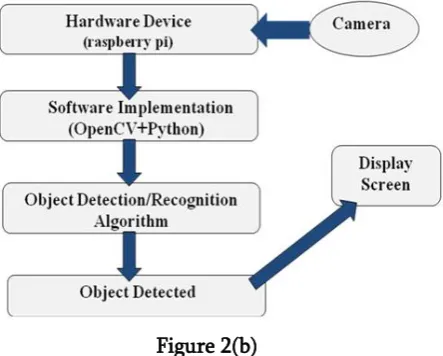
Figure 2(b)
First we capture the image from a camera and then that image is used as an input to our software module which is configured in the Raspberry pi.The image is then processed by software module by analyzing the desired object.
After analyzing the image ,the count of ripe fruits will be displayed alongside resultant contour formed image and original image.
RESULTS:-
Following are the images that are computed by our software module as shown in below
Image 1
This image is taken in daylight. Here we performed HSV equalization and CHT Algorithm to separate required objects from the image resulting nearly 85% accuracy.
Image 2
This image is taken from the high resolution camera. After performing CHT Algorithm, the resultant image is generated as shown. Hence with high resolution image good accuracy is generated.
Image 3
This image is taken in a low light condition.
Hence our proposed software is working with images with different lighting conditions flawlessly.
V.
PURPOSE
Face Detection:-It is a computer technology being used in a variety of applications that identifies human faces in digital images.
VI. DIFFICULTIES IN OBJECT RECOGNITION
UNDER VARIED CIRCUMSTANCES
1. Lightning: The lighting conditions may vary during the course of the day. Also the climatic conditions may affect the lighting in an image. Indoor and outdoor images for same object can have differing lightning condition. Shadows in the image can affect the image too. Irrespective of lighting the system must be able to identify the object. 2. Positioning: Position of the object in the image can be changed. The system must handle such images uniformly.
3. Rotation: The image can be in rotated form. The system must be capable to handle such difficulty. As the character 'A' can appear in any of the form. But the orientation of the letter or image must not affect the recognition of character 'A' or any image of object.
4. Mirroring: The mirror image of any object must be recognized by the object recognition system.
5. Occlusion: The condition when object in an image is not completely visible is referred as occlusion. The system must handle such type of condition and in the output result it. In a segmentation aware object
detection model is presented with occlusion handling. 6. Scale: Efficiency of Object recognition system
must be independent of size of object. Change in the size of the object must not affect the correctness of the object recognition system.
VII.
CONCLUSION
Image processing techniques are helpful for counting and reduce the time of counting effectively. Proper recognition of the object is important for object counting. The accuracy of the algorithm depends on camera used, size and colour of object and how the cameras are placed which detects image accurately.
VIII. REFERENCES
[1].Dor Oppemheim, Yael Edan, Guy Shami, "Detecting tomato flowers in green house using computer vision", World Academy of Science, Engineering and Technology International Journal of Computer and Information Engineering Vol:11, No:1, 2017.
[2].Deepika Bairawa,Gaurav Sharma,"Classification of fruits on te shape,color and texture",International Journal of Engineering Rsearch and Technology(IJERT),Vol.6,Issue 12,December-2017.
[3].A.R.Jimenez, R.Ceres,J.L.Pons,"A Survey of Computer Vision Methods for Locating Fruit on Trees", Instituto de Automatica Industrial (CSIC), Vol. 43(6): 1911-1920, 2000.
[4].L.S. Vishnu Sai Rao , Saurabh Kataria Department of Electrical Engineering,"Object Recognition snd object counting using CNN",IIT Kanpur
[5].Wenhua Mao , Baoping Jia , Xiaochao Zhang , Xiaoan Hub,"Detection and position of apple tree image",
[6].B. Dhananjaya, (2015)," Moving Object detection in videos for object extraction and tracking in UAV Applications", International Journal of Computer Applications.
[7].https://ieeexplore.ieee.org.document/4566268 [8].OpenCV "Cascade Classifier Training –
OpenCV2.4.9.0documentation,"
http://docs.opencv.org/doc/user_guide/ug_trainca scade.html
[9]. https://stackoverflow.com/questions/19286273/co