DOI : https://doi.org/10.32628/CSEIT195537
Sentiment Analysis for Product Recommendation System Using Enhanced
Stochastic Learning Algorithm
S. Gayathri1*, Dr. K. Thyagarajan2
1Research Scholar, Department of Computer Science, A. V. C. College, Mayiladuthurai,Tamil Nadu, India 2Head of The Department of Computer Science, A. V. C. College, Mayiladuthurai, Tamil Nadu, India
Corresponding Author : [email protected]
ABSTRACT
E-Commerce has been known as a rapidly growing commercial enterprise, and even though on line purchasing has no longer accompanied those identical boom patterns within the beyond, it's miles now being diagnosed for its capability. Sentiment evaluation is one of the current research subjects in the subject of textual content mining. Opinions and sentiments mining from natural language are very difficult task. Sentiment analysis is the best solution. This gives important information for decision making in various domains. Various sentiment detection methods are available which affect the quality of result. In this project we are finding the sentiments of people related to the services of E-shopping websites. The sentiments include reviews, ratings and emoticons. The main goal is to recommend the products to users which are posted in E-shopping website and analyzing which one is the best. For this we use hybrid learning algorithm which analyze various feedbacks related to the services. Text mining algorithm is used to find scores of each word. Then sentiments are classified as negative, positive and neutral. It has been observed that the pre-processing of the data is greatly affecting the quality of detected sentiments. Finally analysis takes place based on classification. To find out fake review in the website can be analyzed. This device will discover fake critiques made via posting fake remarks about a product via figuring out the MAC deal with in conjunction with assessment posting styles. User will login to the device using his consumer identification and password and could view various merchandise and will give assessment approximately the product. To discover the evaluation is fake or authentic, system will find out the MAC address of the consumer if the machine observes fake assessment send by way of the identical MAC Address many a times it'll inform the admin to do away with that overview from the device. This gadget uses information mining technique. This machine allows the user to find out accurate overview of the product.
Keywords : E-Commerce Framework, Recommendation System, Opinion Mining, Fake Review Analysis
I. INTRODUCTION
Recommender systemsorrecommendation systemsare a subclass of
information filtering
system
that seek to predict the "rating" or "preference" that a user would give to an item. Recommendation System are information filtering system that deal withthe problem of information overload by filtering vital information fragment out of large amount of
dynamically generated information according to user’s
preferences, interest (or) observed behaviour about item. Recommender System has the ability to predict whether a particular user would prefer an item (or) not
beneficial to both service provider and user. They reduce transaction costs of finding and selecting items in an online shopping environment. Recommender systems have become increasingly popular in recent years, and are utilized in a variety of areas including movies, music, news, books, research articles, search queries, social tags, and products in general. Recommendation System has also proved to improve decision making process and quality. In e-commerce setting, recommender system enhances revenues, for the fact that they are effective means of selling more products. In scientific libraries, recommender system support users by allowing them to move beyond catalog searches. Therefore, the need to use efficient and accurate recommendation techniques within a system that will provide relevant and dependable recommendations for cannot be over-emphasized. In general, Recommender systems are classified as Collaborative Filtering (CF), Content Based and Hybrid recommender systems. CF is widely used in RS, and this recommendation can be divided into User-Based and Item-User-Based.
II. RELATED WORK
Dong-mokoo, et.al,…[1]investigated the effects of two consumer characteristics, namely, tie strength between the communicators (i.e., strong, weak, or
none) and recommender’s experience (i.e., high or
low), and their interactions on e-WOM message credibility and purchase intentions, and the mediated moderation on intentions. Prior studies have proposed that negative WOM from strong ties are important sources of recommendations. However, this research presents evidence contrary to these prior results and shows that weak ties are as influential in the recommendations of services as strong ties if the WOM comes from recommenders with experience. The present findings may bring unique theoretical and practical implications.
Wang, et.al,…[2]evaluated the online
citizen-generated texts to assess public sentiment for making policies. Furthermore, many customer-generated reviews of products and services have become valuable sources for market analysis; these reviews are used to set business strategy of E-commerce websites, such as Amazon.com and Epinion.com. Online users can also benefit from reading others' opinions through recommender systems. The sentiment classification problem was initially tackled granularly at the levels of document, sentence, clause, phrase, and word, depending on the specific objectives of applications. Heuristic based methods and machine learning approaches were frequently employed in previous research. Heuristic-based methods were primarily used in conjunction with linguistic characters and semantic features. For example, Turney used mutual information with predefined sentiment words to score other phrase tags, therefore identifying the sentiment of documents. In parallel, many studies focused on using machine learning algorithms to classify sentiment. For instance, Support Vector Machines (SVM) and Naive Bayes (NB) are commonly used to identity sentiment, due to their predictive power.
Yao Lu, et.al,…[3]applied three different machine
find progressive relationships between adjectives and measure polarity strength of each adjective based on a link analysis method. NLP-based technique is used to calculate the sentiment strength of each review. Based on the calculated overall sentiment score, each review is graded with 1 to 5 stars according to the predefined interval division.
HaoWang, et.al,…[4] extracted the corpus-level
aspects, and predict the aspect ratings for each product. This kind of fine-grained sentiment analysis will help users efficiently digest the reviews, and gain more insight into the product quality. Aspect-based opinion mining has attracted lots of attention today. In this paper, addressed the problem of product aspect rating prediction, where would like to extract the product aspects, and predict aspect ratings simultaneously. Topic models have been widely adapted to jointly model aspects and sentiments, but existing models may not do the prediction task well due to their weakness in sentiment extraction. The sentiment topics usually do not have clear correspondence to commonly used ratings, and the model may fail to extract certain kinds of sentiments due to skewed data. To tackle this problem, we propose a sentiment-aligned topic model (SATM), where incorporate two types of external knowledge: product level overall rating distribution and word level sentiment lexicon.
Xiang et.al,…[5] focused on sentiment analysis of
Twitter data (tweets). It is one of the challenging tasks in NLP given the length limit on each tweet and also the informal conversation. Generally “offensive” is
used as a negative word (as in the first tweet), but it bears no sentiment in the second tweet when people are talking about a football game. Even though some local contextual features could be helpful to distinguish the two cases above, they still may not be enough to get the sentiment on the whole message correct. Also, the local features often suffer from the sparsity problem. This motivates us to explore topic information explicitly in the task of sentiment analysis
on Twitter data. In this paper, presented multiple approaches to improve sentiment analysis on Twitter data.First establish a state-of-the-art baseline with a rich feature set. Then build a topic-based sentiment mixture model with topic-specific data in a semi-supervised training framework. The topic information is generated through topic modeling based on an efficient implementation of Latent Dirichlet Allocation (LDA).
III.EXISTING FRAMEWORK
Recommender Systems are indispensable to provide personalized services on the Web. Recommending
items which match a user’s preference has been
researched for a long time, and there exist a lot of useful approaches.
COLLABORATIVE FILTERING WITH EXPLICIT FEEDBACKS
values. It means feedbacks are observed in very small portion of all possible user-item pairs. However the Matrix Factorization model is known to work better than other models even if the data is sparse.
COLLABORATIVE FILTERING WITH IMPLICIT FEEDBACKS
Here, we discuss existing Collaborative Filtering methods with implicit feedbacks. Basically, a dataset with implicit feedbacks consists of user-item pairs where the user provided feedbacks to the item. Often timestamps are also provided. Existing works for Collaborative Filtering with implicit feedbacks assume that implicit feedbacks are observed as one-class positive feedbacks and missing values do not indicate the negative feedbacks. Thus, existing Collaborative Filtering methods with explicit feedbacks cannot be directly applied to the dataset with implicit feedbacks because they require both positive and negative feedbacks in the dataset.
To address this problem, many existing approaches try to find possible negative values hidden in missing values. And employed a weighted Matrix Factorization model. They initially filled all missing values with negative values, and assign weights to discount the relative contribution of each value to prediction. The weights are determined based on the number of items to which a user provided feedback, or the number of users who gave feedbacks for an item, or given uniformly. This approach has the problem of running time. Basically, the Matrix Factorization model can save computation for missing values, but the weighted Matrix Factorization model must cope with all elements even when the original dataset is given very sparse and also proposed a sampling based method. This approach samples only a part of the missing values and replaces them with negative values. Three kinds of sampling methods are proposed: User-oriented sampling, Item-User-oriented sampling and Uniform sampling. User-oriented sampling assumes
that the number of negative values hidden in missing values and the amount of past feedbacks given by a user are related. Item-oriented sampling assumes that the number of negative values hidden in missing values and the amount of past feedbacks given for an item are related. In this work, this method is combined with our proposals. Also, proposed an extension of the weighted Matrix Factorization model. They incorporate similarity matrices over items and users to the weighted Matrix Factorization model. And implemented the joint model of the Matrix Factorization model and non-negative Matrix Factorization model which classify missing values into positive and negative feedbacks. Packet and proposed a bayesian generative model which predicts the probability with which missing values are converted to negative feedbacks. There exist other approaches that use the auxiliary data to treat missing values
IV.PROPOSED FRAMEWORK
A recommendation system has been implemented based on hybrid approach of stochastic learning and context based engine. We have tried to combine the existing algorithms for recommendation to come up with a hybrid one. It improves the performance by overcoming the drawbacks of traditional recommendation systems. Recommender systems being a part of information filtering system are used to forecast the bias or ratings the user tends to give for an item. Among different kinds of recommendation approaches, collaborative filtering technique has a very high popularity because of their effectiveness. These traditional collaborative filtering systems can even work very effectively and can produce standard recommendations, even for wide ranging problems.
For item based on their neighbor’s preferences
filtering approach. In this Item based collaborative filtering technique we first examine the User item rating matrix and we identify the relationships among various items, and then we use these relationships in order to compute the recommendations for the user. Then using cosine similarity which is a similarity weight is going to play an important role in the collaborative item based filtering approach and hence in order to maintain or select the trustable users from the given set of user. Hence they give us a method to increase or decrease the significance of a particular user or item. In the present methodology we are using adjusted similarity for computation of similar weights of items.
Sentiment analysis of natural language texts is a large and growing field. Sentiment analysis or Opinion Mining is the computational treatment of opinions and subjectivity of text. Sentiment analysis is an Information Extraction task that intends to acquire
writer’s feelings expressed in positive or negative
comments, after analyzing his documents. The term
‘Presence’ is more important to sentiment analysis then term ‘Frequency’ which was earlier used for
traditional information retrieval. It has also been reported that unigrams surpass bigrams for classifying movie reviews by sentiment polarity. In the proposed framework we can implement stochastic learning algorithm to analyze reviews, ratings, and emoticons. The proposed work is described as follows:
Framework construction:
E-commerce framework is used to buy the products in online to easy retrieval the mobile products. This module is used to create android and web site for recommending best mobiles in specific area. Admin is the responsibility for maintaining the all details in server and server can be design in server. There are two accounts such as admin and user account. Admin can login to the system and post item details with expiry dates. User can login to the mobile to choose the language and area. Then view the products with
specified filter. This module is used to create web site buy or post products for users. Admin can login to the system and post products with features. User can login to the system to view product details.
Reviews collection:
Admin collect reviews and have various types of reviews. Reviews may be rating reviews, text reviews and smileys reviews. All reviews are stored in database for future evaluation. Ratings, reviews and emoticons are stored in database. Rating, Reviews and Emoticons are the evaluation or assessment of something, in terms of quality (as with a critic rating a novel), quantity or some combination of both.
Sentiment analysis:
Sentiment analysis refers to the use of natural language processing, text analysis, computational linguistics to systematically identify, extract, quantify, and study affective states and subjective information. Sentiment analysis is widely applied to voice of the customer materials such as reviews and ratings for applications that range from marketing to customer service to buy the products efficiently. Admin can analyze whether the product is positive or negative. In star rating, we can calculate star count values. In text reviews, extract keywords and matched with database. Then smileys reviews are calculated based positive and negative symbols.
Recommendation system:
negative review means, automatically the positive products in recommendation panel. And algorithm is stated as follows:
The pseudo code of the stochastic algorithm is stated as follows
Input: A review collection D, its attached ratings R, its attached emoticons E, a user set U and item set V Output: Recommend the positive mobile products Step 1: Read ratings, reviews and emoticons of each products
Step 2: If the rating is higher than 5 star or 4 star, consider as positive, otherwise consider as negative Step 3: Read the words from reviews datasets, Consider words as keywords
Step 4: Match the keywords with training datasets
Step 5: Labeled the review as “positive” and also
labeled review as negative based on training words Step 6: Read the emotiocons from datasets
Step 7: If the symbol is happy symbol labeled as positive, otherwise labeled as negative
Step 8:Combine rating, review, emoticons labels, Feedbacks are stated as positive or negative
Step 9: Update each user reviews for each itemsets Step 10: Recommend positive label products
Aggregation is finding out the polarity of each review to conclude if it falls in the positive class or negative class. However, to find out the overall response about the product, an evaluation of all the reviews is required
Fake reviews monitoring
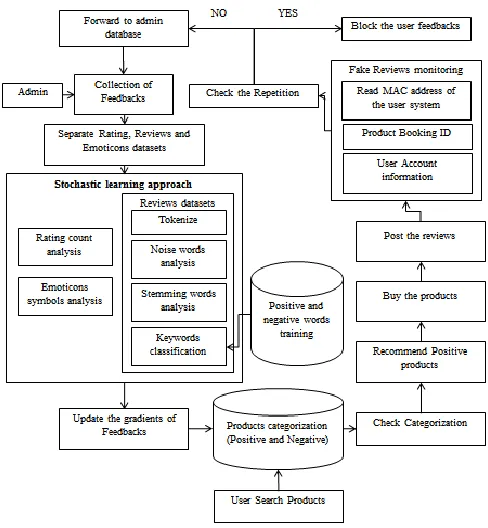
In this module, fake reviews are analyzed by admin. A media access control address (MAC address) of a computer is a unique identifier assigned to network interfaces for communications at the data link layer of a network segment. Admin can get user account details, Mobile address and Order id details. So one user can post one reviews that will be genuine reviews. The proposed framework is shown in fig 1.
Fig 1. Proposed Framework
V. CONCLUSION
VI.REFERENCES
[1]. M. Jahrer, A. Toscher, and R. Legenstein, "Combining predictions for accurate recommender systems," in KDD'10, pp. 693-702, 2010.
[2]. Y. Zhang, B. Cao, and D. Y. Yeung, "Multi-domain collaborative filtering," in Proc.UAI, pp. 725-732, 2010.
[3]. R. Keshavan, A. Montanari, and S. Oh, "Matrix completion from noisy entries," Journal of Machine Learning Research, vol. 11, pp. 2057-2078, 2010.
[4]. M. Harvey, M. Carman, I. Ruthven, and F. Crestani, "Bayesian latent variable models for collaborative item rating prediction," in
CIKM’11, pp. 699-708, 2011.
[5]. H. Ma, D. Zhou, C. Liu, M. Lyu, and I. King, "Recommender Systems with Social Regularization," in ACM WSDM, pp. 287-296, 2011.
[6]. S.E. Madnick, R.Y. Wang, Y.W. Lee, H. Zhu, "Overview and framework for data and information quality research,"Journal of Data and Information Quality, vol. 1(1, Article No 2: 22p.), 2009.
[7]. J.R.C. Nurse, S.S. Rahman, S. Creese, M. Goldsmith, K. Lamberts, "Information quality and trustworthiness: A topical state-of-the-art review,"International Conference on Computer Applications and Network Security (ICCANS), Male, The Maldives, pp. 492-500, 2011.
[8]. Gorton, J. Klein, "Distribution, data, deployment: Software architecture convergence in big data systems,"IEEE Software, vol. 32(3), pp. 78-85, 2015.
[9]. J.R.C. Nurse, Agrafiotis‚Ioannis, Creese‚Sadie,
M. Goldsmith, K. Lamberts, "Building
confidence in Information−Trustworthiness
metrics for decision support,"The 12th IEEE
International Conference on Trust‚ Security and
Privacy in Computing and Communications (IEEE TrustCom−13), Melbourne, VIC, pp. 535 -543, 2013.
[10]. S.S. Rahman, S. Creese, M. Goldsmith, "Accepting information with a pinch of salt:
Handling untrusted information
sources,"Security and Trust Management, Lecture Notes in Computer Science Volume 7170, pp. 223-238, 2011.
Cite this article as :
S. Gayathri, Dr. K. Thyagarajan, "Sentiment Analysis for Product Recommendation System Using Enhanced Stochastic Learning Algorithm", International Journal of Scientific Research in Computer Science, Engineering and Information Technology (IJSRCSEIT), ISSN : 2456-3307, Volume 5 Issue 5, pp. 228-234, September-October 2019. Available at doi : https://doi.org/10.32628/CSEIT195537