© 2018 IJSRCSEIT | Volume 3 | Issue 5 | ISSN : 2456-3307
An Improved Data Reduction Technique Based On KNN & NB
with Hybrid Selection Method for Effective Software Bugs Triage
Kapil Sahu1, Dr. Umesh Kumar Lilhore2, Prof Nitin Agarwal3
1M. Tech Scholar, Department of CSE, NIIST Bhopal, Madhya Pradesh, India 2Head PG, Department of CSE, NIIST Bhopal, Madhya Pradesh, India 3Assistant Professor, Department of CSE, NIIST Bhopal, Madhya Pradesh, India
ABSTRACT
In software development process testing process ensures quality management of the product by ensuring bugs free product. Existing methods are based on Naïve byes, SVM methods, which encounters with several issues such as poor precision, recall, TPR and accuracy results. In this research, we are presenting an improved data reduction technique based on kNN & NB with hybrid selection method for effective software bugs triage. Reasons behind the selection of two methods are, k nearest neighbor technique will help in word counts from bug report data and Naïve byes method helps to measure the frequency of the word. The proposed method uses bug report classification, bug report retrieval, and bug report triage. In this proposed method we are also using hybrid selection method for reducing the database, feature selection, and Instance selection methods. Existing method Naïve byes and proposed (kNN + NB with Hybrid selection) are implemented over MATLAB simulator and various performance measuring parameters such as precision, recall, accuracy, detection time and TPR are calculated. An experimental study clearly shows that our proposed method shows outstanding in terms of all the performance measuring parameters as compared to the existing method for bug triage and data reduction. Keywords- Bug triage, Data Mining, Naïve Byes, kNN, Instance selection, Feature selection
I. INTRODUCTION
A computer code bug is a miscalculation or fault during a program which causes the package to behave in uncaused ways in which. A computer software bugs area unit sometimes annoying and inconvenient for developers, usually leading to serious consequences. Massive software systems come to use bug trailing repositories wherever the users and developers report all the bugs they encounter. The developers attempt to reproduce the bugs with the help of data provided by a newsperson in a bug report then build the desired corrections within the ASCII text file to rectify the difficulty [1].
However, generally, it's impracticable to breed the reportable bug with the data mere in a bug report. In such a state of affairs, the bug is marked with resolution “Non-Reproducible” or “works for me” [3]. This research paper is organized in following chapters, Introduction, data reduction, and Bug triage, existing work, problem statement, proposed solution, result in analysis and finally covers conclusions of the work.
II. DATA REDUCTION & BUG TRIAGE
ordered, and simplified kind. The essential construct is that the reduction of innumerable amounts of information all the way down to the significant elements [4]. Bug triage can be defined as “Bug triage may be a method wherever hunter problems square measure screened and prioritized. Triage ought to facilitate guarantee and we have a tendency to suitably manage all rumored problems with bugs yet as enhancements and have requested” [6].
III. EXISTING METHODS
Data mining techniques are widely used in data reduction from large datasets. These methods help in efficient Bug-triage in bug management process. In this research work following research papers has been used for review work.
Pap er Refe renc e
Method used Key Concept
a netting plant. knowledge (generated by developers), it's necessary
to come up with well-processed bug knowledge to facilitate the appliance.
Existing method encounters with several issues such as-
Precision- Existing methods have challenges in precision results. Higher precision value for a method shows better results.
Recall- Existing methods have challenges in recall results. Higher recall value shows better results.
Accuracy- Existing methods have challenges in accuracy results. A higher value of accuracy is always desirable for any best algorithm.
True positive rate- Existing methods have challenges in true positive rate results. A higher result for TPR shows better performance for any method.
Detection time - Existing methods have challenges in detection time or data reduction time results. For any method, lesser detection time shows better performance.
4.1 OBJECTIVE
In this research, we are presenting an improved data reduction technique based on kNN + NB with hybrid selection method for effective software bugs triage. The main objective of this research work is to overcome the problems which are described in chapter 4.1.
The main objective of the research work is as follows-
Precision-Higher precision value for a method shows better results. The proposed method will achieve better precision results.
Recall-Higher recall value shows better results. The proposed method will achieve better recall results.
Accuracy-Higher value of accuracy is always desirable for any best algorithm. The proposed method will achieve better accuracy results. True positive rate- A higher result for TPR shows
Detection time- For any method lesser detection time shows better performance. The proposed method will achieve better detection time results.
V. PROPOSED SOLUTION
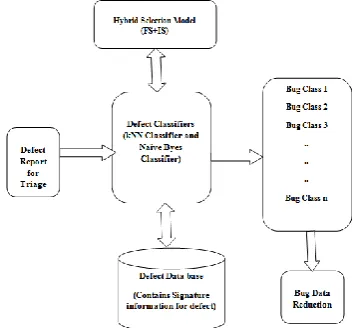
Data reduction techniques are widely used for bug triage. It attracts researcher to work in the field of efficient data reduction technique for effective and efficient bug triage. Existing methods are based on Naïve byes, SVM methods, which encounters with several issues such as poor precision, recall, TPR and accuracy results. In this research, we are presenting an improved data reduction technique based on KNN + NB with hybrid selection method for effective software bugs triage [5].
Figure 5.1 Working of Proposed Method
Reasons behind the selection of two methods are, K nearest neighbor technique will help in word counts from bug report data and Naïve byes method helps to measure the frequency of the word. The proposed method uses bug report classification, bug report retrieval, and bug report triage. In this proposed method we are also using hybrid selection method for reducing the database, feature selection, and Instance selection methods [7].
Figure 5.1.2 Simulation of proposed method
5.1 DATA SET-
For simulation of existing method and proposed method following eclipse and Mozilla open source, data set were used.
Data set link for eclipse
https://raw.githubusercontent.com/ansymo/msr
2013bug_dataset/master/data/v02/eclipse/assig
ned_to.json
Data set link for Mozilla data set-
https://github.com/ansymo/msr2013-bug_dataset/tree/master/data/v02/mozilla
VI.RESULT ANALYSIS
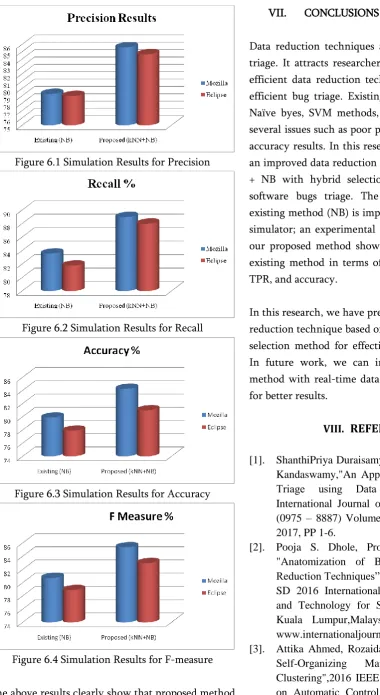
Figure 6.1 Simulation Results for Precision
Figure 6.2 Simulation Results for Recall
Figure 6.3 Simulation Results for Accuracy
Figure 6.4 Simulation Results for F-measure
The above results clearly show that proposed method shows better results over existing metho.
VII. CONCLUSIONS & FUTURE WORKS
Data reduction techniques are widely used for bug triage. It attracts researcher to work in the field of efficient data reduction technique for effective and efficient bug triage. Existing methods are based on Naïve byes, SVM methods, which encounters with several issues such as poor precision, recall, TPR and accuracy results. In this research, we have presented an improved data reduction technique based on KNN + NB with hybrid selection method for effective software bugs triage. The proposed method and existing method (NB) is implemented over MATLAB simulator; an experimental study clearly shows that our proposed method shows better results over the existing method in terms of better precision, recall, TPR, and accuracy.
In this research, we have presented an improved data reduction technique based on KNN + NB with hybrid selection method for effective software bugs triage. In future work, we can implement our proposed method with real-time data and use more classifiers for better results.
VIII.
REFERENCES
[1]. ShanthiPriya Duraisamy, Laxmi Raja, KalaiSelvi
Kandaswamy,"An Approach for Predicting Bug Triage using Data Reduction Methods”, International Journal of Computer Applications (0975 – 8887) Volume 177 – No. 5, November 2017, PP 1-6.
[2]. Pooja S. Dhole, Prof. Avinash P. Wadhe,
"Anatomization of Bug Triage using Data Reduction Techniques”, Satellite Conference ICS SD 2016 International Conference on Science and Technology for Sustainable Development, Kuala Lumpur,Malaysia, May 24-26, 2016, www.internationaljournalssrg.org, PP 124-130.
[3]. Attika Ahmed, Rozaida Ghazali, "An Improved
Self-Organizing Map for Bugs Data
[4]. Dhyan Chandra Yadav, Saurabh Pal,"Software Bug Detection using Data Mining", International Journal of Computer Applications (0975 – 8887) Volume 115 – No. 15, April 2015, PP 21-27.
[5]. Sangameshwar Patil,"Concept-based
Classification of Software Defect Reports",2017 IEEE/ACM 14th International Conference on Mining Software Repositories (MSR),978-1-5386-1544-7/17 $31.00 © 2017 IEEE, PP 182-187.
[6]. Poonam Pandey, Radhika Prabhakar, "An
Analysis of Machine Learning Techniques (J48 & AdaBoost) -for Classification", IEEE 2016 Conference CNC-16, PP 978-984.
[7]. Haidar Osman, Mohammad Ghafari,"An
Extensive Analysis of Efficient Bug Prediction Configurations", ACM PROMISE Conferences November 8, 2017, Toronto, Canada, PP 978-988.
[8]. Seyed Ali Asghar Mostafavi Sabet, Alireza
Moniri, Farshad Mohebbi, "Root-Cause and Defect Analysis based on a Fuzzy Data Mining Algorithm", (IJACSA) International Journal of Advanced Computer Science and Applications, Vol. 8, No. 9, 2017, PP 21-29.
[9]. SEYED MOHAMMAD GHAFFARIAN and
HAMID REZA SHAHRIARI,"Sofware
Vulnerability Analysis and Discovery Using Machine-Learning and Data-Mining Techniques: A Survey", ACM Computing Surveys, Vol. 50, No. 4, Article 56. Publication date: August 2017, PP 56-92.
[10]. Yu Zhou, Yanxiang Tong, Ruihang Gu and
Harald Gall,"Combining text mining and data mining for bug report classification ", JOURNAL
OF SOFTWARE: EVOLUTION AND
PROCESS J. Softw. Evol. and Proc. 2016; 28:150–176.
[11]. Rafael Alcala, Maria Jose Gacto, Jesus Alcala
Fdez, "Evolutionary data mining and
applications: A revision on the most cited papers from the last 10 years (2007–2017)", WIREs Data Mining Knowl Discov. 2017, Wiley, PP 1-17.
[12]. GOWTHAM ATLURI, ANUJ KARPATNE,
VIPIN KUMAR, "Spatio-Temporal Data
Mining: A Survey of Problems and Methods", ACM Computing Surveys, Vol. 1, No. 1, Article. Publication date: November 2017, PP 1-37.
[13]. D. Kavitha, "SURVEY OF DATA MINING
TECHNIQUES FOR SOCIAL NETWORKING WEBSITES", IJCSMC, Vol. 6, Issue. 4, April 2017, pg.418 – 426.
[14]. Naresh.E, Vijaya Kumar B.P, Sahana.P.Shankar,
"Comparative Analysis of the Various Data Mining Techniques for Defect Prediction using the NASA MDP Datasets for Better Quality of
the Software Product", Advances in
Computational Sciences and Technology ISSN 0973-6107 Volume 10, Number 7 (2017) pp. 2005-2017
[15]. ZHANG Jie, WANG XiaoYin, HAO Dan, XIE
Bing, ZHANG Lu MEI Hong, "A survey on bug-report analysis", SCIENCE CHINA Information Sciences Sand printer-Verlag Berlin Heidelberg 2015, Vol. 58, PP 1-24.
[16]. Anvik J, Hiew L, Murphy G C. Who should fix
this bug? In: Proceedings of the International Conference on Software Engineering, Shanghai, 2006. 361–370.
[17]. Hooimeijer P, Weimer W. Modeling bug report
quality. In: Proceedings of the IEEE/ACM International Conference on Automated Software Engineering, Atlanta, 2007. 34–43.
[18]. Nguyen AT, Nguyen T T, Nguyen T N, et al.
Duplicate bug report detection with a
combination of information retrieval and topic modeling. In: Proceedings of the IEEE/ACM International Conference on Automated Software Engineering, Essen, 2012. 70–79.
[19]. Xie J, Zhou M, Mockus A. Impact of triage: a
study of Mozilla and gnome. In: Proceedings of the ACM / IEEE International Symposium on
Empirical Software Engineering and
Measurement, Baltimore, 2013. 247–250.
[20]. J. W. Park, M. W. Lee, J. Kim, S. W. Hwang,
and S. Kim, “Costriage: A cost-aware triage algorithm for bug reporting systems,” in Proc. 25th Conf. Artif. Intell. Aug. 2011, pp. 139–144.
[21]. A. Tamrawi, T. Nguyen, J. Al-Kofahi, and T.
Nguyen, “Fuzzy set and cache-based approach for bug triaging,” in Proc. 19th ACM SIGSOFT Symposium and the 13th European Conference on Foundations of Software Engineering, 2011, pp. 365–375.
[22]. Q. Shao, Y. Chen, S. Tao, X. Yan, and N.
Int. Conf. Knowl. Discovery Data Mining, Aug. 2008, pp. 605–613.
[23]. Jifeng Xuan, He Jiang, Yan Hu, Zhilei Ren,
Weiqin Zou, Zhongxuan Luo, and Xindong Wu, “Towards Effective Bug Triage with Software Data Reduction Techniques”, IEEE transactions on knowledge and data engineering, vol. 27, no. 1, January 2015.
[24]. T. Zhang, G. Yang, B. Lee, I. Shin “Role
Analysis-based Automatic Bug Triage
Algorithm”, 2012.
[25]. P. Bhattacharya, L. Neamtiu, C. R. Shelton
“Automated, highly-accurate, bug assignment using Machine learning and tossing graphs”, 2012.
[26]. https://raw.githubusercontent.com/ansymo/msr20
13bug_dataset/master/data/v02/eclipse/assigned_ to.json
[27].