A Framework for Machine Translation Output Combination
Yi-Chang Chen
Department of Computer Science and Engineering National Sun Yat-Sen University
[email protected] Chia-Ping Chen
Department of Computer Science and Engineering National Sun Yat-Sen University
摘
摘
摘
要
要
要
本研究提供一個線上機器翻譯整合系統整合三個不同的線上翻譯引擎。該翻譯整合 系統,利用了選擇、替換、插入及刪除等模組,針對線上翻譯假說進行修正。我們實
際整合了GOOGLE、YAHOO、譯言堂的翻譯假說。在IWSLT07的測試語料進行中文至 英文的翻譯整合。由實驗結果得知,該翻譯整合系統其BLEU分數由所整合的最佳翻
譯系統的19.15進步到20.55。該翻譯整合系統相較於所整合的最佳線上翻譯系統進步
了1.4 BLEU。
Abstract
In this paper, we propose a framework for combining outputs from multiple on-line ma-chine translation systems. This framework consists of several modules, including selection, substitution, insertion, and deletion. We evaluate the combination framework on IWSLT07 in travel domain, for the translation direction from Chinese to English. Three different on-line ma-chine translation systems, Google, Yahoo, and TransWhiz, are used in the investigation. The experimental results show that our proposed combination framework improves BLEU score from 19.15 to 20.55. It achieves an absolute improvement of 1.4 in the BLEU score.
Keyword: Machine translation, System combination
1
Introduction
The on-line machine translation is one application that is becoming popular nowadays. As each on-line translation system has its own strength and weakness, it is reasonable to expect that a framework capable of combining multiple on-line machine translation outputs may have the potential to produce translation results of better quality than the single-system outputs. In fact, this proposition has been shown to be true in certain published works, e.g., [1, 2].
Figure 1: The consensus network of combining “I like watching TV”, “I enjoy watching TV” and “I like to watch TV”.
3
Method
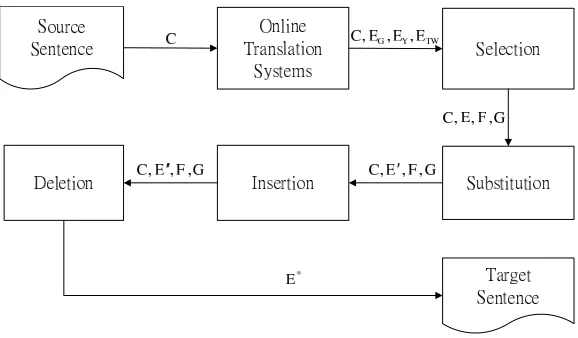
Our proposed system combines three on-line machine translation systems. Let the source sentence be denoted by C. Given C, the target sentences from these systems are denoted by EG, EY, ET W, respectively for Google, Yahoo, and TransWhiz. With EG, EY, ET W and C as input, the combination system performs the following steps.
• selection: One of EG, EY, ET W with the highest language-model score is selected. We denote the selected sentence by E, and the unselected hypotheses as F and G.
• substitution: Some words in E are considered and may be substituted. The hypothesis after substitution is denoted by E′.
• insertion: Each position in E′ is considered to insert an extra word. The hypothesis after insertion is denoted by E′′.
• deletion: Each word in E′′ is considered to be deleted. The hypothesis after deletion is denoted by E∗.
E∗is the final output sentence. The overall process is depicted in Figure 2. We next describe the implementation details.
S= {send}, w′ =send, c= 送, w= deliver.
The system checks the translation-model score
pt(send|送)> pt(deliver|送), 3 and the language-model score
log pbg(send|to)+log pbg(this|send)> log pbg(deliver|to)+log pbg(this|deliver), and decides
• E′ : I want tosendthis special delivery to Japan. The reference is
• R: I want to send this by special delivery to Japan.
3.3
Insertion
The insertion of words into E′is based on the following idea. If a word w in E′also appears in F or G, we check the adjacent words of w in F or G for possible insertion. The pseudo code for insertion is given in Algorithm 2. An example for insertion is given in Example 2.
Example 2 (Insertion)
The input is
• C: 你有地鐵地圖嗎?
• E′ : Do you have subway map?
• F: You have subway map?
• G: You have a subway map?
The set of wordsIin this example is
I={you, have, subway, map}.
The system checks language-model score
log pbg(a|have)+log pbg(subway|a)>2 log pbg(subway|have), and decides
• E′′ : Do you have a subway map?
The reference is
• R: Do you have a subway map?
3p
Example 3 (Deletion)
The input is
• C: 那裡有手工藝品商店?
• E′′ : Where is the handicraft article store?
The set of wordsDis
D={article}.
The system checks that “handicraft article” and “article store” are neither in the training data and decides
• E∗: Where is the handicraft store?
The reference is
• R: Where is the handicraft store?
4
Experiments
4.1
Setup
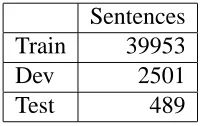
We use IWSLT07 C E task to run this experiment. IWSLT07 contains tourism-related sentences. The test set consists of 489 Chinese sentences, each of which is accompanied by six reference sentences. Note that the Chinese sentences are word-segmented. The IWSLT07 C E task we present in the Table 4.1.
Table 1: IWSLT07 C E task. Sentences Train 39953
Dev 2501
Test 489
We use the on-line machine translation systems of Google5, Yahoo6 and TransWhiz7. We input the 489 Chinese sentences of the test set to these engines, and get 1,467 English sentences back.
We use the training data in IWSLT07 task to train our 5-gram language model with SRILM [10]. We use MOSES to train the translation model from the training data in IWSLT07 task.
The BLEU [11] measure with six references per sentence is used in our evaluation. The answers are treated as case-insensitive.
5http://translate.google.com.tw/translate t 6http://tw.babelfish.yahoo.com/
4.2
Results
The experimental results are presented in Table 4.2. The progressive improvements can be clearly seen in this table. Systems A to C are the three on-line machine translation systems ordered by their performance in BLEU.
• selection (sel): The selection module leads to an absolute improvement of 0.58 BLEU score. Using the language model to select an output from multiple hypotheses is effective, as the selection module selects the most fluent sentence according the 5-gram language model. We think that the selection module can be further improved by joining other features to select the hypothesis.
• substitution (sub): The substitution module leads to a small absolute improvement of 0.07 BLEU score. In this module, a rare word can be replaced by the common word. The candidate set of substitution is small, so we cannot achieve much improvement in this module. Yet it still fixes certain errors in the output. We think that the substitution module can be further improved by replaceing words not only from other hyptoheses but also from dictionaries.
• insertion (ins): The insertion module leads to an absolute improvement of 0.29 BLEU score. It inserts the articles and the adjectives. Given E already contains most of the correct words, the improvement is somewhat limited. We think that the insertion module can be further improved by joining words from other source. For exmaple, phrase tables, dictionaries, and others.
• deletion (del): The deletion module leads to an absolute improvement of 0.46 BLEU score. It deletes the redundant words, incorrect words, and out of travel domain words in the output. These words are error sources of our combination hypotheses.
The total improvement over the single best system is 1.4 BLEU absolute.
Table 2: Experimental results.
System BLEU
System A 19.15
System B 12.39
System C 10.51
+sel 19.73
+sel+sub 19.80 +sel+sub+ins 20.09 +sel+sub+ins+del 20.55