ABSTRACT
TELANG, PANKAJ RAMESH. Multiagent Business Modeling. (Under the direction of Dr. Munindar P. Singh.)
Cross-organizational business processes are common in today’s economy. Of necessity, enterprises conduct their business in cooperation to create products and services for the marketplace. Thus business processes inherently involve autonomous partners with heterogeneous software designs and implemen-tations. The existing business modeling approaches that employ high-level abstractions are difficult to operationalize, and the approaches that employ low-level abstractions lead to highly rigid processes that lack business semantics. We propose a novel business model based on multiagent abstractions. Unlike existing approaches, our model gives primacy to the contractual relationships among the business partners, thus providing a notion of business-level correctness, and offers flexibility to the participants. Our approach employs reusable patterns as building blocks to model recurring business scenarios. A step-by-step methodology guides a modeler in constructing a business model. Our approach employs temporal logic to formalize the correctness properties of a business model, and model checking to verify if a given operationalization satisfies those properties. Developer studies found that our approach yields improved model quality compared to the traditional approaches from the supply chain and healthcare domains.
Commitments capture how an agent relates with another agent, whereas goals describe states of the world that an agent is motivated to bring about. It makes intuitive sense that goals and commitments be understood as being complementary to each other. More importantly, an agent’s goals and commitments ought to be coherent, in the sense that an agent’s goals would lead it to adopt or modify relevant commit-ments and an agent’s commitcommit-ments would lead it to adopt or modify relevant goals. However, despite the intuitive naturalness of the above connections, they have not yet been studied in a formal framework. This dissertation provides a combined operational semantics for goals and commitments. Our semantics yields important desirable properties, including convergence of the configurations of cooperating agents, thereby delineating some theoretically well-founded yet practical modes of cooperation in a multiagent system.
© Copyright 2013 by Pankaj Ramesh Telang
Multiagent Business Modeling
by
Pankaj Ramesh Telang
A dissertation submitted to the Graduate Faculty of North Carolina State University
in partial fulfillment of the requirements for the Degree of
Doctor of Philosophy
Computer Science
Raleigh, North Carolina
2013
APPROVED BY:
Dr. Jon Doyle Dr. Thom J. Hodgson
Dr. John F. Madden Dr. Emerson Murphy-Hill
Dr. Tao Xie Dr. Munindar P. Singh
DEDICATION
BIOGRAPHY
ACKNOWLEDGEMENTS
I am deeply indebted to my advisor Professor Munindar Singh for his teachings and relentless support during this work. Without his guidance, this work would have been impossible. Beyond the skills for effective research, I have learnt the qualities of a good teacher from him. I wish to be a researcher and a teacher like him.
I would like to especially thank Neil-Yorke Smith, Felipe Meneguzzi, and Anup Kalia for extensively collaborating with me on portions of this work. I learnt a great deal about goals from Neil, which enabled the development of joint operational semantics on goals and commitments. I learnt extensively about AI planning from Felipe, which enabled the development of HTN planning formalism for goals and commitments. Anup has supported me in the developer evaluations, and implemented Protos modeling tool.
Several other individuals have reviewed and provided critical suggestions to improve my work. I would like to thank, in no particular order, Scott Gerard, Amit Chopra, Chung-Wei Hang, Derek Sollenberger, Nirmit Desai, Prashant Kediyal, Pradeep Murukannaiah, Christoph Bussler, and M. Birna van Riemsdijk.
I am deeply grateful to my advisory committee members Dr. Jon Doyle, Dr. Thom J. Hodgson, Dr. John F. Madden, Dr. Emerson Murphy-Hill, and Dr. Tao Xie for advising me during this work. Their valuable suggestions have significantly improved the quality of this work.
TABLE OF CONTENTS
LIST OF TABLES . . . ix
LIST OF FIGURES . . . x
Chapter 1 Motivation . . . 1
1.1 Motivating Examples . . . 2
1.1.1 Order-To-Cash . . . 2
1.1.2 Breast Cancer Screening and Diagnosis . . . 4
1.2 The Proposed Approach . . . 5
1.2.1 Metamodel and Patterns . . . 5
1.2.2 Methodology and Evaluation . . . 6
1.2.3 Relating Commitments and Goals . . . 7
1.2.4 Hierarchical Planning about Commitments and Goals . . . 7
1.3 Contributions . . . 7
1.4 Organization of the Dissertation . . . 8
Chapter 2 Background . . . 9
2.1 Achievement Commitments . . . 9
2.1.1 Lifecycle of a Commitment . . . 9
2.2 Achievement Goals . . . 12
2.2.1 Lifecycle of an Achievement Goal . . . 13
2.3 Maintenance Goals . . . 14
2.3.1 Lifecycle of a Maintenance Goal . . . 15
2.4 Computation Tree Logic . . . 16
2.5 NuSMV Model Checking Tool . . . 17
2.6 Classical and HTN Planning . . . 19
2.6.1 Logic Language . . . 19
2.6.2 Classical Planning . . . 20
2.6.3 Hierarchical Task Network (HTN) Planning . . . 21
2.7 UML 2.0: Sequence Diagrams . . . 21
2.8 RosettaNet . . . 22
2.9 HL7 . . . 23
Chapter 3 Metamodel, Patterns, and Verification . . . 24
3.1 Metamodel . . . 24
3.2 Business Model Patterns . . . 25
3.2.1 Conditional Offer Pattern . . . 26
3.2.2 Commercial Transaction . . . 26
3.2.3 Outsourcing . . . 27
3.2.4 Standing Service Contract . . . 27
3.3 Applying the Patterns . . . 28
3.3.1 Quote-To-Cash Process . . . 29
3.5 Patterns Formalized . . . 33
3.5.1 Conditional Offer Pattern Formalization . . . 33
3.5.2 Commercial Transaction Pattern Formalization . . . 39
3.5.3 Outsourcing Pattern Formalization . . . 39
3.5.4 Service Contract Pattern Formalization . . . 39
3.6 Applying Verification . . . 40
3.7 Runtime Violations . . . 42
3.8 Conclusion . . . 43
3.9 Related Work . . . 44
Chapter 4 Comma: Modeling Methodology . . . 47
4.1 Methodology: Comma . . . 48
4.2 Design of the Study . . . 49
4.2.1 Study Solution . . . 50
4.2.2 Study Mechanics and Threat Mitigation . . . 52
4.2.3 Dependent Variables . . . 53
4.3 Study Results . . . 54
4.3.1 Quality . . . 54
4.3.2 Difficulty . . . 56
4.3.3 Time . . . 58
4.4 Conclusion . . . 60
4.5 Related Work . . . 60
Chapter 5 Modeling Healthcare Processes . . . 62
5.1 Dialectical Commitments . . . 62
5.1.1 Lifecycle of Dialectical Commitments . . . 63
5.2 Organizational Context . . . 68
5.3 Commitment Patterns . . . 69
5.3.1 Service Provider with Correctness . . . 69
5.3.2 Escalate . . . 69
5.3.3 Chained Service Providers with Joint Correctness . . . 70
5.4 Applying the Patterns . . . 71
5.4.1 Breast Cancer Screening and Diagnosis . . . 71
5.4.2 Comparison with the Traditional Approach . . . 73
5.5 Applying Verification . . . 74
5.6 Empirical Evaluation of Comma compared to HL7 . . . 77
5.6.1 Managing Threats . . . 78
5.6.2 Dependent Variables . . . 79
5.7 Results of Empirical Evaluation . . . 80
5.7.1 Flexibility and Objective Quality . . . 80
5.7.2 Subjective Quality . . . 81
5.7.3 Time and Difficulty . . . 81
5.7.4 Hypothesis Testing . . . 82
5.8 Conclusion . . . 82
Chapter 6 Commitments and Goals . . . 86
6.1 Operational Semantics . . . 86
6.1.1 Assumptions . . . 87
6.1.2 Formalization . . . 89
6.1.3 Practical Rules . . . 91
6.1.4 Nested Commitments . . . 99
6.2 Illustrative Application . . . 100
6.3 Establishing Convergence Properties . . . 104
6.3.1 Proof by Model Checking: The NuSMV Model . . . 110
6.3.2 Output of Model Checking showing Convergence . . . 113
6.3.3 Output of Model Checking showing Lack of Convergence . . . 114
6.4 Maintenance Commitments . . . 115
6.4.1 Lifecycle of a Maintenance Commitment . . . 115
6.4.2 Formalization including Maintenance Commitments and Goals . . . 117
6.5 Operational Semantics including Maintenance Commitments and Goals . . . 119
6.5.1 Maintenance Goal to Achievement Commitment . . . 120
6.5.2 Maintenance Goal to Maintenance Commitment . . . 121
6.5.3 Maintenance Commitment to Maintenance and Achievement Goals . . . 121
6.5.4 Nested Achievement Commitment to Achievement Goals . . . 122
6.5.5 Achievement Goal to Maintenance Commitment . . . 123
6.5.6 Achievement Goal to Nested Maintenance Commitment . . . 123
6.6 Conclusion . . . 124
6.7 Related Work . . . 125
Chapter 7 Hierarchical Planning about Commitments and Goals . . . 128
7.1 Formalization within HTN . . . 129
7.1.1 Goal and Commitment Dynamics . . . 129
7.1.2 Commitment Axioms and Operators . . . 130
7.1.3 Goal Axioms and Operators . . . 131
7.1.4 Methods Relating Commitments and Goals . . . 133
7.1.5 Bringing it all Together . . . 133
7.2 Applying the HTN Formalization . . . 134
7.3 First Order Formalization in HTN . . . 138
7.3.1 Commitment Dynamics . . . 139
7.3.2 Goal Dynamics . . . 141
7.4 Formalizing the Patterns . . . 143
7.5 Conclusion . . . 146
7.6 Related Work . . . 147
Chapter 8 Discussion . . . 149
8.1 Conclusions . . . 149
8.2 Future Directions . . . 150
APPENDICES . . . .161
Appendix A Metamodel, Patterns, and Verification . . . 162
Appendix B Modeling Healthcare Processes . . . 170
LIST OF TABLES
Table 2.1 Semantic postulates of Computation Tree Logic . . . 17
Table 4.1 Comma methodology steps. . . 48
Table 4.2 RosettaNet model PIPs forSi. . . 51
Table 4.3 Study exercises. . . 52
Table 4.4 Quality measures, as judged by experts. . . 54
Table 4.5 Hypothesis testing for model and MSC development times. . . 59
Table 5.1 Subscenarios and patterns from the breast cancer diagnosis scenario. . . 84
Table 5.2 Hypothesis testing via Student’s t-test. . . 85
Table 6.1 Syntax for beliefs, commitments, and goals in Backus-Naur Form. . . 89
Table 6.2 Goals and commitments from the aerospace scenario. . . 102
Table 6.3 Progression of configurations in the aerospace scenario. . . 103
Table 6.4 Syntax for beliefs, commitments, and goals. . . 119
Table 6.5 Practical rules: From m-goal to a-commitment. . . 121
Table 6.6 Practical rules: From m-commitment to m-and a-goals. . . 123
Table 7.1 Goals and commitments from the purchase example. . . 135
Table 7.2 Domain-specific axioms . . . 136
Table 7.3 Domain-specific methods and operators . . . 137
Table 7.4 Goals and commitments for the patterns. . . 144
LIST OF FIGURES
Figure 1.1 Order-To-Cash business process . . . 3
Figure 1.2 Breast cancer screening and diagnosis process . . . 4
Figure 2.1 Commitment lifecycle as a state transition diagram. . . 10
Figure 2.2 Goal lifecycle as a state transition diagram. . . 13
Figure 2.3 Maintenance goal lifecycle as a state transition diagram. . . 15
Figure 2.4 TRANSconstraint for a simple sequence diagram. . . 22
Figure 2.5 TRANSconstraint for a sequence diagram with anOPT. . . 23
Figure 3.1 A commitment-based business metamodel. . . 24
Figure 3.2 Conditional offer pattern. . . 26
Figure 3.3 Commercial transaction pattern. . . 27
Figure 3.4 Outsourcing pattern . . . 28
Figure 3.5 Standing service contract pattern. . . 29
Figure 3.6 Commercial transaction: Customer-Reseller . . . 30
Figure 3.7 Outsourcing: Reseller-Distributor . . . 31
Figure 3.8 Outsourcing: Distributor-Shipper . . . 32
Figure 3.9 Commercial transaction: Distributor-Cisco . . . 33
Figure 3.10 Outsourcing: Cisco-Shipper . . . 34
Figure 3.11 Service contract: Customer-Cisco . . . 35
Figure 3.12 Quote-To-Cash business model . . . 36
Figure 3.13 Verification approach . . . 37
Figure 3.14 Verifying the conditional offer pattern . . . 38
Figure 3.15 Operational interactions in a Quote-To-Cash implementation . . . 40
Figure 3.16 NuSMV output indicating satisfaction . . . 43
Figure 3.17 NuSMV output showing violation . . . 44
Figure 4.1 Message sequence charts for outsourcing. . . 47
Figure 4.2 Comma model forSi. . . 50
Figure 4.3 Example Comma MSCs forSi. . . 51
Figure 4.4 Example RosettaNet MSCs forSi. . . 52
Figure 4.5 Our approach of grouping the subjects. . . 53
Figure 4.6 Quality of the models ofSi. . . 55
Figure 4.7 Flexibility of the MSCs produced forSi. . . 55
Figure 4.8 Difficulty of modeling, as percentage of responses by the subjects. . . 56
Figure 4.9 Time in hours expended in creating models, as reported by subjects. . . 57
Figure 5.1 Dialectical commitment life cycle as a state transition diagram. . . 64
Figure 5.2 Dialectical commitments in radiologist and pathologist interactions. . . 65
Figure 5.3 Service provider with correctness pattern. . . 69
Figure 5.4 Escalate pattern. . . 70
Figure 5.5 Chained service providers with joint correctness pattern. . . 70
Figure 5.7 Sequence diagrams for breast cancer scenario . . . 75
Figure 5.9 NuSMV output indicating satisfaction for breast cancer scenario . . . 77
Figure 5.10 NuSMV output indicating failure in breast cancer scenario . . . 78
Figure 5.11 Flexibility and objective quality . . . 80
Figure 5.12 Distributions of quality . . . 81
Figure 5.13 Time and difficulty reported by the subjects . . . 82
Figure 6.1 Simple agent architecture. . . 88
Figure 6.2 Aerospace aftermarket process . . . 100
Figure 6.3 NuSMV output showing convergence . . . 115
Figure 6.4 NuSMV output showing convergence failure . . . 116
Figure 6.5 Maintenance commitment lifecycle as a state transition diagram. . . 117
Figure 6.6 Patterns starting from a maintenance goal . . . 118
Figure 6.7 Patterns starting from an achievement goal . . . 124
Figure 7.1 A decomposition tree for the purchase scenario. . . 138
Figure 7.2 A decomposition tree for the piecemeal pattern. . . 144
Figure 7.3 A decomposition tree for the concession pattern. . . 146
Figure 7.4 A decomposition tree for the consolidation pattern. . . 146
Figure 7.5 A decomposition tree for the compensation pattern. . . 147
Figure A.1 Revert commercial transaction. . . 164
Figure A.2 Revert commercial transaction: Customer-Reseller . . . 165
Figure A.3 Revert commercial transaction: Reseller-Distributor-Shipper . . . 165
Figure A.4 Operational interactions in a QTC implementation. . . 166
Figure A.5 Operational interactions in a QTC implementation. . . 167
Figure A.6 AGFIL process expressed as a business model. . . 168
Figure B.1 Biopsy scenario. . . 171
Figure B.2 Diagnosis reports. . . 172
Figure B.3 PATIENT’s registration. . . 172
Figure B.4 PATHOLOGISTrequestsTUMOR BOARDto review theRADIOLOGISTresults. . 173
Figure B.5 RADIOLOGISTrequestsTUMOR BOARDto review thePATHOLOGISTresults. . 174
Figure B.6 PHYSICIAN requests TUMOR BOARD to review the joint RADIOLOGIST and PATHOLOGISTresults. . . 175
Figure B.7 PATIENTrequestsTUMOR BOARDto review thePHYSICIANresults. . . 175
Figure C.1 Protos tool architecture. . . 176
Figure C.2 Protos business modeler. . . 177
Chapter 1
Motivation
Real-world organizations seldom operate in isolation. To conduct business, organizations enter into complex contractual relationships with each other. As an example, in a supply chain, a seller may outsource the manufacturing of goods to a contract manufacturer, and their shipping to a shipper. In another example, an individual may purchase a health insurance policy from an insurance provider. The insurance provider may have a network of physicians. In such scenarios, to conduct the business, the organizations and individuals carry out subtle interactions with one another. The problem of engineering IT systems for such cross-organizational interactions is challenging, and the existing solutions are in their infancy.
With only a few notable exceptions, much of the existing work on business models emphasizes low-level or operational details of the interactions. Existing approaches specify the control and data flow among the business partners, but they fail to specify their business relationships. Such business relationships are known to business analysts and motivate the specification of the processes. Therefore, losing track of the relationships in the operational perspective is unfortunate: losing the notion of business correctness by which to judge operational execution complicates the creation and maintenance of each partner’s software systems. To address the shortcomings of existing approaches, we propose a novel multiagent business modeling approach based on commitments and goals.
Second, it would provide a basis for a comprehensive account of the software engineering of multiagent systems going from interaction-orientation (with commitments) to agent-orientation (with goals).
Further, consider an agent that wishes to maintain a condition, such as a home owner who wishes to maintain his lawn using a contracted lawn mower. Such situations highlight the need for understanding maintenancecommitments, and how they relate to achievement commitments, and achievement and maintenance goals.
To operationalize a multiagent business model that is declaratively specified in terms of goals and commitments, the agents (participants) need to be able to develop cost effective and feasible plans. There is a natural hierarchy in the plans that an agent requires to achieve its goals and to satisfy its commitments. For example, a goal may be decomposed into multiple conjunctive or disjunctive subgoals. The agent may satisfy a subgoal on its own, or may create a commitment toward another agent to satisfy it. If the commitment expires or is violated, then the agent may create a commitment toward some other agent, and sanction the violating agent. Not only can operations on commitments and goals feature within plans, but also to satisfy a commitment or a goal may require another hierarchical plan.
1.1
Motivating Examples
To further motivate the problem, we now describe two examples.
1.1.1 Order-To-Cash
Consider the so-called Extended Order-To-Cash process flow, which is specified as an important scenario in the RosettaNet eBusiness Process Scenario Library [RosettaNet, 2010]. Such a flow is representative of traditional business modeling approaches.
Figure 1.1 shows the Order-to-Cash business process scenario. The participants of this process are a supplier, a customer, and a shipper. The customer orders products from the supplier. Later, the customer may request a change to the order. The supplier engages a shipper for shipping the goods to the customer. Additionally, the shipper periodically sends an inventory report to the supplier. Prior to shipping the goods, the shipper notifies the customer. The customer notifies the supplier upon receiving the goods. Subsequently, the supplier sends an invoice to the customer. The customer validates the invoice, and thereafter sends a remittance advice to the supplier. Figure 1.1 shows the RosettaNet PIPs (messages) that the participants employ for the above interactions.
A model such as the above specifies the process as a workflow at an operational level. It shows the messages that the participants exchange, and their temporal ordering. But it completely ignores the business relationships among the participants. Thus, it leaves several important questions unanswered.
C u s to m e r S u p p li e r S h ip p e r Create Purchase Order Process Purchase Order Create Change Order Process Change Order Create Shipping Order Process Shipping Order Create Inventory Report Process Inventory Report Create Shipment Notice Process Shipment Notice Create Receiving Information Process Receiving Information Create Invoice Validate Invoice Create Remittance Advice Process Remittance Advice 3A4 3A8
3B12 4C1 3B2
4B2 3C3 3C6
Figure 1.1: The Order-To-Cash business process (verbatim from RosettaNet documentation [RosettaNet, 2010]).
• Why must the supplier create an invoice only after the customer sends the receiving information? At a business-level, it may be acceptable for the supplier to create an invoice before the customer sends the receiving information.
• Why must the shipper process a shipping order? Is the shipper contractually bound to processing a shipping order that the supplier sends?
• Is it mandatory for the shipper to send an inventory report? Sending an inventory report is arguably not as important. In that case, the process model is being unnecessarily rigid in mandating the shipper to send the inventory report.
1.1.2 Breast Cancer Screening and Diagnosis
Figure 1.2 shows another example from the healthcare domain. This is a simplified scenario adapted from ASPE [2010] that deals with breast cancer screening and diagnosis. The model shows four main participants, but omits the patient who receives the treatment, and the tumor board that serves as an authority to resolve any disagreements. A patient visits a primary care physician who detects a suspicious mass in her breast; he sends her over to a radiologist for mammography (imaging). The radiologist notices calcifications of about 0.50 mm, which are borderline suspicious. She forwards her report to the primary care physician recommending he order a biopsy, which he does. The radiologist performs a biopsy and sends a specimen to a pathologist, who analyzes the specimen, potentially performing additional studies. The pathologist and radiologist might hold a conference to ensure their results are concordant, and provide an integrated report to the primary physician for discussion with the patient. The physician reviews the integrated report with the patient to create a treatment plan. The pathologist sends a report to the registrar who adds the patient to the cancer registry.
Z Ğ Ő ŝƐ ƚƌ Ă ƌ W Ă ƚŚ Ž ůŽ Ő LJ Z Ă Ě ŝŽ ůŽ Ő LJ W ƌŝ ŵ Ă ƌLJ Ă ƌĞ KƌĚĞƌdž /ŵĂŐŝŶŐ ZĞǀŝĞǁ ZĂĚŝŽůŽŐLJ ZĞƉŽƌƚ KƌĚĞƌ ŝŽƉƐLJ ZĞǀŝĞǁ /ŶƚĞŐƌĂƚĞĚ ZĞƉŽƌƚƐ ƌĞĂƚĞ dƌĞĂƚŵĞŶƚ WůĂŶ WĞƌĨŽƌŵ /ŵĂŐŝŶŐ ƌĞĂƚĞ ZĂĚŝŽůŽŐLJ ZĞƉŽƌƚ ŽůůĞĐƚ ^ƉĞĐŝŵĞŶ /ŶƚĞƌƉƌĞƚ /ŵĂŐĞƐ ƌĞĂƚĞ ZĂĚŝŽůŽŐLJ ZĞƉŽƌƚ ŽŵƉůĞƚĞ ZĞƋƐ ZĞǀŝƐĞ ZĂĚŝŽůŽŐLJ ZĞƉŽƌƚ ,ŽůĚ ŽŶĐŽƌĚ ŽŶĨ ƌĞĂƚĞ WĂƚŚŽůŽŐLJ ZĞƉŽƌƚ ĚĚƚŽ ĂŶĐĞƌ ZĞŐŝƐƚƌLJ ĐĐĞƐƐŝŽŶ ^ƉĞĐŝŵĞŶƐ WƌŽĐĞƐƐ ^ƉĞĐŝŵĞŶ /ŶƚĞƌƉƌĞƚ ^ůŝĚĞƐ WĞƌĨŽƌŵ ŶĐŝůůĂƌLJ ^ƚƵĚŝĞƐ /ŶƚĞƌƉƌĞƚ ZĞƐƵůƚƐ
Figure 1.2: The breast cancer screening and diagnosis adapted from ASPE [2010].
cannot answer the following questions.
• What is the radiologist committing to in her report, and in the tissue specimen she sends to the pathologist?
• Can a pathologist easily deviate from the normal process by asking questions about how the specimen was taken?
• What happens if the patient does not arrive for the follow up visit for the biopsy?
• Can a service fulfillment be delegated? For example, can the radiologist’s report be produced by an off-shore radiologist based on images provided from the laboratory?
• Is it acceptable in an emergency setting for the primary care physician to concurrently request the radiologist for mammography and biopsy?
The above workflow expresses a business process captured in terms of the interlacing activities of the participants involved. Such representations are common in traditional business settings [OMG, 2010] and are best suited to highly regimented efforts by clerical workers. However, they are inadequate for modern cross-organizational settings. In particular, because traditional representations fail to capture business meaning, they preclude the following essential elements:
• Flexible enactment, essential for dealing with exceptions and corner cases, because without a proper meaning, there is no justification for any deviations from the stated flow.
• Model evolution, essential for accommodating requirements changes, because without a proper meaning, there is no justification for any modifications to the stated flow in light of a new require-ment.
• Verification, essential for correctness of an operationalization, because without a proper meaning, it is difficult to correlate low-level operational events with their potential meanings.
1.2
The Proposed Approach
This section summarizes our proposed approach.
1.2.1 Metamodel and Patterns
as agents [Singh and Huhns, 2005]. An agent has goals, and executes business tasks. A role is an abstraction over an agent. For each business relationship in which an agent participates, it enacts one or more roles.
The business relationships among the roles are expressed in terms of theircommitmentsto one another. Each role specifies the commitments expected of the agents who play that role along with the tasks they must execute to function in that role. A goal is a state of the world that an agent desires to be brought about. An agent achieves a goal by executing appropriate tasks or by negotiating with other agents to have them execute appropriate tasks. A task here is a business activity viewed from the perspective of an agent.
A practical commitment is an element of a contractual business relationship. A commitment
C(DEBTOR,CREDITOR,antecedent,consequent) denotes that the debtor commits to the creditor to bring about the consequent if the antecedent begins to hold [Singh, 1999]. A business relationship is a set of iterrelated commitments among two or more roles that describe how they carry out the given business process.
Adialectical commitmentpertains to an agent making an assertion about certain state of affairs. Note how dialectical commitment is in contrast to a practical commitment which involves a debtor bringing about certain condition typically by performing an action. As an example, by providing diagnosis report, a doctor makes a dialectical commitment to a patient for the correctness of that report.
Apatternis a recipe for modeling recurring business scenarios. Our approach seeks to develop a key set of patterns that could seed a potential business model pattern library. A few examples of the patterns are: commercial transaction and outsourcing.
Our approach verifies an operational model specified as a set of UML 2.0 sequence diagrams with respect to a business model. We employ NuSMV, an existing model checker. We map the business model to a temporal logic specification regarding the progression of the states of the relevant commitments, and the UML 2.0 sequence diagrams to a model in NuSMV input language. NuSMV takes the temporal logic specification and the model as input, and reports if the model satisfies the specification.
1.2.2 Methodology and Evaluation
1.2.3 Relating Commitments and Goals
We present the lifecycles of commitments and goals as state transition diagrams. Next we develop the combined operational semantics based on guarded rules. We term thesepractical rulesbecause they capture patterns of practical reasoning that an agent may adopt. We propose and prove convergence properties for agents that adopt our practical rules. We employ model checking over CTL formulas to establish the proof.
We propose a lifecycle of maintenance commitments. We extend the work on relating achievement commitments and goals to maintenance commitments and goals. Further, we detail how achievement and maintenance commitments and goals can be composed.
1.2.4 Hierarchical Planning about Commitments and Goals
We formalize the combined operational semantics of achievement commitments and goals in terms of hierarchical task networks (HTNs) and show how HTN planning provides a natural representation and reasoning framework for them. Our approach combines a domain-independent theory capturing the lifecycles of goals and commitments, generic patterns of reasoning, and domain models. Specifically, our approach shows how each agent may take into account its capabilities, costs, and preferences as it plans its interactions (captured as operations on commitments) with other agents to attempt to achieve its goals.
We enhance the HTN formalization to accommodate first-order representations and reasoning. Although we confine ourselves to finite domains, the first-order representation leads to a more natural encoding for domain scenarios involving commitments. Our proposed approach further accommodates patterns for reasoning about commitments and goals that previous approaches do not tackle cleanly.
1.3
Contributions
We now summarize the key contributions of this dissertation.
Metamodel, Patterns, and Verification: This dissertation proposes a simple, yet expressive declarative way to specify business models at a high level based on the notion of commitments. In addition to practical commitments, it considers dialectical commitments. It shows how a commitment-based model maps to a conventional operational model. It provides a basis for verifying the correctness of the operational representations with respect to the declarative business model using existing temporal model checking tools. This dissertation validates the above claims on scenarios from the supply chain and healthcare domains.
[2007], a healthcare industry standard. Our results confirm the relative effectiveness of Comma for the quality of modeling cross-organizational processes, and some benefits in ease of modeling and time expended. Further, the results yield insights for future improvements.
Joint Operational Semantics for Commitments and Goals: This dissertation studies the complemen-tary aspects of commitments and goals by establishing an operational semantics of the related life cycles of the two concepts. We distinguish the purely semantic aspects of their lifecycles from the pragmatic aspects of how a cooperative agent may reason. We establish a set of convergence properties that follow from our semantics, and prove them by model checking. We illustrate our semantics with a well-known insurance scenario [Browne and Kellett, 1999]. Further, this disser-tation proposes maintenance commitments as a construct in their own right and presents a novel operational semantics linking maintenance and achievement goals and commitments. We illustrate our semantics including maintenance on a scenario in the domain of aerospace aftermarket services [van Aart et al., 2007].
Hierarchical Planning about Commitments and Goals: This dissertation proposes a new treatment of commitments and goals that accommodates first-order representations and reasoning via the Hierarchical Task Network (HTN) formalism. Moreover, we show how our formalization over-comes expressivity limitations found in previous work. Thus, our contribution is twofold. First, we provide a formalization of commitments and goals that enables us to use an off-the-shelf HTN planner in the verification of the realizability of a multiagent system. Second, we identify key limitations in the expressiveness of existing formalizations and reasoning mechanisms and develop reasoning patterns in our formalism that address these limitations.
1.4
Organization of the Dissertation
Chapter 2
Background
This chapter consolidates the salient background needed for understanding our approach.
2.1
Achievement Commitments
An achievementcommitmentexpresses a social or organizational relationship between two agents. This sense of commitments was defined by Singh (1991) and adopted by Castelfranchi (1995): its key feature is that it relates one agent to another and thus contrasts with an agent’s commitment to its intention Bratman [1987]. Additional motivation and historical background on our view of commitments is available in Singh [2012]. Specifically, a commitmentC(DEBTOR,CREDITOR,antecedent,consequent) denotes that theDEBTORcommits to theCREDITORfor bringing about theconsequentif theantecedentbecomes true [Singh, 1999].
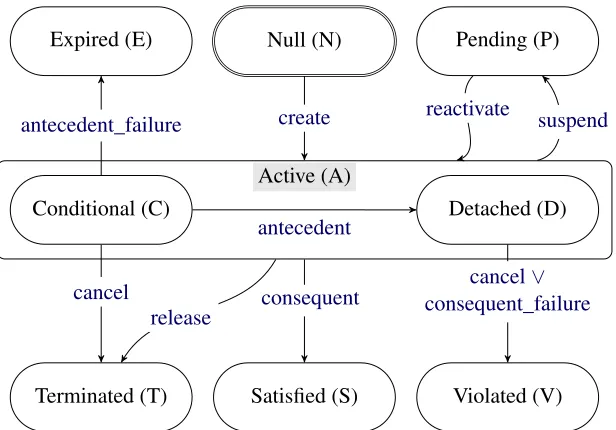
Figure 2.1 shows the lifecycle of a commitment. A labeled rounded rectangle represents a commitment state, and a directed edge represents a transition; transitions are labeled with the corresponding action or event. A commitment can be in one of the following states:Null(before it is created),Conditional(when it is initially created),Expired(when its antecedent becomes forever false, while the commitment was
Conditional),Satisfied(when its consequent is brought about while the commitment wasActive, regardless of its antecedent),Violated(when its antecedent has been true but its consequent will forever be false, or if the commitment is cancelled whenDetached),Terminated(when cancelled whileConditionalor released whileActive), orPending(when suspended whileActive).Activehas two substates:Conditional
(when its antecedent is false) andDetached(when its antecedent has held). A debtor maycreate,cancel,
suspend, orreactivatea commitment; a creditor mayreleasea debtor from a commitment.
2.1.1 Lifecycle of a Commitment
• If the debtor creates a commitment, then the commitment becomes active; it becomes conditional or detached depending on the antecedent.
• The antecedent failure (timeout) of a conditional commitment causes it to expire.
• If the antecedent of a conditional commitment is brought about, then the commitment detaches.
• If the debtor suspends a conditional or detached commitment, then the commitment becomes pending.
• If the debtor reactivates a pending commitment, the commitment becomes active; moreover, if the antecedent holds, then the commitment becomes detached else conditional.
• If the debtor reactivates a pending commitment and the consequent holds, then the commitment is satisfied.
• If the debtor cancels a conditional commitment, then the commitment terminates.
• If the creditor releases the debtor from a conditional or detached commitment, then the commitment terminates.
• If the debtor cancels a detached commitment, or there is failure (timeout) of the consequent, then the commitment is violated.
Expired (E) Null (N) Pending (P)
Conditional (C) Detached (D)
Terminated (T) Satisfied (S) Violated (V) Active (A)
create antecedent_failure
antecedent
cancel cancel∨
consequent_failure consequent
release
suspend reactivate
• If the debtor brings about the consequent of a conditional or detached commitment, then the commitment is satisfied.
We consider commitments whose antecedents and consequents are propositions. In mapping from informal examples, this means we would (1) parameterize the antecedent and consequent, and (2) instantiate such parameters when we instantiate such a commitment. For example, a seller’s offer to a buyer would be formalized as a commitment with parameters such as item description and price. By listing items for sale in a price catalogue, the seller creates multiple specific commitments, each for its specified item and price. The above life cycle applies to each suchinstantiatedcommitment. Such a commitment is detached when its antecedent comes to hold and satisfied when its consequent comes to hold.
Note that we specify the truth of a condition—our approach is neutral as to who brings about a condition—as opposed to the performance of an action by an agent. In general, focusing on conditions facilitates greater flexibility during enactment. Further, for some commitments, as in the payment example above, the creditor may adopt a goal to bring about the antecedent. However, in other commitments, the creditor may not. For example, an insurance company may commit to paying a car driver’s medical bills if the driver is injured in an accident: the driver would not ordinarily have a goal of getting injured! For these reasons, we keep the lifecycle of commitments general and enable agents in different settings to exercise that lifecycle in ways that best make sense to them in the appropriate context.
Second, note that, in general, commitments need not be symmetric, i.e., reciprocal. That is, in general, an agent may have a commitment to another agent without the latter having a converse commitment to the former agent. As an example, by accepting to review a paper, a conference committee member commits to a program chair to review that paper. The chair makes no converse commitment. Singh [2012] discusses such properties of commitments at length.
2.2
Achievement Goals
An achievementgoalexpresses a state of the world that an agent wishes to bring about. Our view of goals follows Thangarajah et al. [2011].1Goals differ from both desires and intentions. An agent’s desires represent the agent’s proattitudes [Rao and Georgeff, 1992]; an agent may concurrently hold mutually inconsistent desires. By contrast, it is customary to require that a rational agent believe its goals are mutually consistent [Winikoff et al., 2002]. An agent’s intentions are its adopted or activated goals.
Specifically, a goalG=G(x, p, q, s, f,) of an agentxhas aprecondition(or context)pthat must be true beforeGcan becomeActiveand some intention can be adopted to achieve it, and apost-condition (or effect)qthat becomes true ifGis successfully achieved [Winikoff et al., 2002]. Thesuccess condition
sdefines the success ofG, and thefailure conditionf defines its failure. A goal is successful if and only ifsbecomes true prior tof: that is, the truth ofsentails the satisfaction of the goal only iff does not intervene. Note thatsandf should be mutually exclusive.
As for commitments, the success or failure of a goal depends only on the truth or falsity of the various conditions, not on which agent brings them about. The antecedent and consequent of a commitment are respective analogues of the precondition and post-condition of a goal. For example, if a buyer has a commitment to pay if the seller ships the items, then the buyer may consider a goal to pay with the precondition of the items being shipped.
Often, the post-conditionqand the success conditionscoincide, but they need not. Since the pre-and post-conditions of goals do not have a direct bearing on our semantics pre-and are not relevant for the discussion (see also [Günay et al., 2012]), after this point we omit them and simply writeG(x, s, f). In fact, one can seepas a guard on theactivateandreactivatetransitions in the goal lifecycle, and can fold qintosby rewritingG(x, p, q, s, f,) asG(x, s∧q, f).
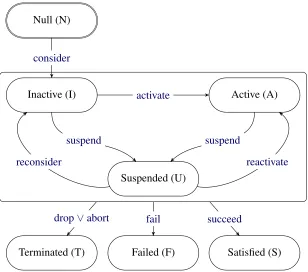
Figure 2.2 simplifies Thangarajah et al.’s (2011) lifecycle of an achievement goal. A goal can be in one of the following states:Null,Inactive2,Active,Suspended,Satisfied,Terminated, orFailed. The last three collectively areterminal states: once a goal enters any of them, it stays there forever. Note how both commitment and goal lifecycles haveSatisfiedandFailedstates, and also haveNullandActivestates.
Before its creation, a candidate goal is in stateNull. Once considered by an agent (its “goal holder”), a goal commences asInactive. Upon activation, the goal becomesActive; the agent may pursue its satisfaction by attempting to achieves. Ifsis achieved, the goal transitions toSatisfied. At any point, if the failure condition of the goal becomes true, the goal transitions toFailed. At any point, the goal may becomeSuspended, from which it may eventually return to anInactiveorActive state appropriately. Lastly, at any point the agent maydroporabortthe goal, thereby moving it to theTerminatedstate. Note the difference between thedropandabortoperations is that the former omits any clean-up that might be
1We do not follow their inclusion of an
in-conditionthat is true once a goal isActiveuntil its achievement. 2
Null (N)
Inactive (I) Active (A)
Suspended (U)
Terminated (T) Failed (F) Satisfied (S)
consider
activate
reconsider reactivate
suspend suspend
drop∨abort fail succeed
Figure 2.2: Goal lifecycle as a state transition diagram.
appropriate for plans part-way through execution for the goal—such as canceling an order made to a supplier—and simply discards the goal and any associated plans [Thangarajah et al., 2011].
2.2.1 Lifecycle of an Achievement Goal
In detail, the lifecycle of a goal as in Figure 2.2 is as follows:
• If an agent creates and considers a goal, then the goal becomes inactive.
• If an agent activates an inactive goal, then the goal becomes active.
• If an agent suspends an active or inactive goal, then the goal becomes suspended.
• If an agent reconsiders a suspended goal, then the goal becomes inactive.
• If an agent reactivates a suspended goal, then the goal becomes active.
• If an agent drops or aborts an inactive, active, or suspended goal, then the goal terminates.
• If the agent begins to believe the satisfaction condition of an inactive, active, or suspended goal, then the goal is satisfied.
It is worth remarking on a subtle but important point. Although we represent commitment and goal lifecycles using the same notation, they are conceptually quite different in that a goal represents an element of a private state whereas a commitment represents an element of a social state. Thus a commitment comes into being in stateActivethe moment it is created (typically due to communications and based on the social norms in play) whereas for a goal, an agent may mull it over. In other words, a commitment is created via an atomic public event whereas a goal, being private, can be createdInactive
and then transition toActive. We return to this point in Section 6.1.2.
We also remark that the careful analysis of states and transitions of a goal lifecycle, demanded by our coupled commitment—goal operational semantics, has the side benefit of clarifying minor points in the operational semantics for goals themselves. For example, in some cases the literature has ambiguity about the possibility of the simultaneous truthhood of the success and failure conditions of a goal, and its semantic implication (if permitted). Our semantics is explicit in disallowing states in which both the success and failure conditions of a goal simultaneously become true.
As discussed earlier, a conceptual relationship is established between a goal and a commitment when they reference each other’s objective conditions. Even when related in such a manner, however, a goal and a commitment independently progress in accordance with their respective lifecycles. For example, when agentybrings about conditions—an objective condition—a commitmentC =C(x, y, s, u)detaches, and a goalGend =G(x, s, f)is satisfied. That is,Chassas a condition (its antecedent) andGendhas sas a condition (its success condition), butCandGendprogress independently through their lifecycle whenscomes about.
2.3
Maintenance Goals
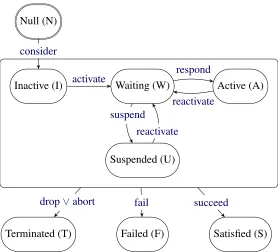
We define a maintenance goal and its lifecycle based on Duff et al. [2006]. LetM =M(x, m, R, P, s, f) be agentx’smaintenance goalfor conditionm.Mpersists until either its success conditionsor its failure conditionf become true.Bx |=¬m means thatxbelieves thatmis false: thus,xadopts a recovery achievement goalR. Letπxcapturex’s lookahead mechanism, independent ofM. Then,Bx |=πx(¬m) means thatxbelieves thatmwill become false unless it acts appropriately: thus,xadopts a preventive achievement goalP. Herexdeliberates as normal to achieveRorP. We omit the latter parameters ofM
unnecessary for exposition.
Null (N)
Inactive (I) Waiting (W) Active (A)
Suspended (U)
Terminated (T) Failed (F) Satisfied (S)
consider
activate
suspend
reactivate respond
reactivate
drop∨abort fail succeed
Figure 2.3: Maintenance goal lifecycle as a state transition diagram.
maintenance goalM toActive, wherexcreates and adopts goalsP orRas explained above.M remains
Activeuntilmis restored or is no longer predicted to become false, whereuponM returns toWaiting. ShouldP orRfail,xretries them. Ifxbelieves that itcannotprevent¬mor restorem, it may failM. The failure conditionf could incorporate this requirement or include the failure ofP orR, i.e.,xtries once to prevent¬mor restorem, and failsM if it cannot. We note that an agent so equipped may plan to find other ways to achieve the success condition ofP orR[de Silva et al., 2009]. Whenxtransitions M to theSuspendedstate, it no longer monitorsmand aborts any active achievement goalsP orR generated byM [Thangarajah et al., 2008].
2.3.1 Lifecycle of a Maintenance Goal
In detail, the lifecycle of a maintenance goal as in Figure 2.3 is as follows:
• If an agent considers a goal, then the goal becomes inactive.
• If an agent activates an inactive goal, then the goal becomes waiting.
• If an agent suspends a waiting goal, then the goal becomes suspended.
• If the agent believes that the maintenance condition of a waiting goal is not true or will not remain true in future, then the goal becomes active.
• If the agent restores the maintenance condition of an active goal, then the goal becomes waiting.
• If an agent drops or aborts an inactive, active, or suspended goal, then the goal terminates.
• If the agent begins to believe the failure condition of an inactive, active, or suspended goal, then the goal fails.
• If the agent begins to believe the satisfaction condition of an inactive, active, or suspended goal, then the goal is satisfied.
2.4
Computation Tree Logic
Computation Tree Logic(CTL) is a temporal logic that conceptualizes time as branching into the future [Clarke et al., 1999]. The different future branches orpathsemanating from a state can indicate the possible ways in which the future may evolve. In our setting, the different paths will correspond to the combinations of choices made by the various agents.
The syntax of the CTL language in Backus-Naur Form is:
φ::=⊥ | > |p|(¬φ)|(φ∧φ)|(φ∨φ)|(φ→φ)|
AXφ|EXφ|AFφ|EFφ|AGφ|EGφ|A[φUψ]|E[φUψ]
wherepis an atomic proposition, and¬,∧,∨and→are logical operators for negation, conjunction, disjunction, and implication, respectively. The symbols⊥and>mean false and true, respectively. Each temporal operator of CTL is a pair of symbols. The first symbol of this pair quantifies paths, and can be eitherA, meaning along all paths, orE, meaning along at least one path. The second symbol is a linear-time operator: it can beX, meaning in the next state,G, meaning in all future states,F, meaning in a current or future state, orUψ, meaning untilψholds. Note thatUis strong, i.e.,φUψholding requires thatψdoes hold.
Table 2.1: Semantic postulates of Computation Tree Logic [Clarke et al., 1999].
1. M, s>andM, s2⊥
2. M, spiffp∈L(s)
3. M, s¬φiffM, s2φ
4. M, sφ1∧φ2 iffM, sφ1andM, sφ2
5. M, sφ1∨φ2 iffM, sφ1orM, sφ2
6. M, sφ1 →φ2iffM, s2φ1 orM, sφ2
7. M, sAXφiff∀π∈Π(s),M, π1φ
8. M, sEXφiff∃π ∈Π(s),M, π1φ
9. M, sAGφiff∀π ∈Π(s),∀i≥0,M, πi φ
10. M, sEGφiff∃π ∈Π(s),∀i≥0,M, πiφ
11. M, sAFφiff∀π∈Π(s),∃i≥0,M, πi φ
12. M, sEFφiff∃π∈Π(s),∃i≥0,M, πi φ
13. M, sA[φ1Uφ2]iff∀π∈Π(s),∃i≥0,M, πi φ2,∀j < i,M, πj φ1
14. M, sE[φ1Uφ2]iff∃π∈Π(s),∃i≥0,M, πi φ2,∀j < i,M, πj φ1
2.5
NuSMV Model Checking Tool
Model checkingis a formal verification technique to determine whether a model satisfies certain desired properties. NuSMV [NuSMV, 2012] is a contemporary, well-known tool that implements model checking [Clarke et al., 1999]. NuSMV supports CTL for specifying the properties to be verified. We now describe the features of the NuSMV input language that we will use to construct a computational model.
• VAR: declares a model variable. We employ variables of two types: Boolean and enumeration. For each transition from the goal lifecycle and the commitment lifecycle, the model contains a Boolean variable. An enumeration variable models the state of a goal or a commitment. For example,
VAR
create: boolean;
status: {NULL, CONDITIONAL, DETACHED, EXPIRED,
declarescreateas a Boolean variable, which represents thecreatetransition of a commitment from
NULLstate toCONDITIONALstate, andstatusas an enumeration variable, which models the status of a commitment.
• INIT: declares initial values of the model variables. For example,
INIT
create = FALSE & status = NULL;
assigns initial values ofFALSEandNULLtocreateandstatus, respectively.
• INVAR: declares an invariant, i.e., a Boolean constraint that isTRUEin each state on all the paths that NuSMV considers. For example,
INVAR
cancel = FALSE & release = FALSE;
constrains the model paths to only those in which in all statescancelandreleaseareFALSE.
• MODULE: declares a reusable unit containing various NuSMV constructs. For example,
MODULE goal()
VAR
status: {NULL, INACTIVE, ACTIVE, SUSPENDED,
FAILED, TERMINATED, SATISFIED};
declares agoalmodule containing astatusvariable.
Then we can make use of thegoalmodule by writing, for example,
MODULE main()
VAR
g: goal;
to specify amainmodule that declares a variablegof kindgoal.
• ASSIGN: declares assignment of a value to a model variable. For example,
ASSIGN
next(status) :=
case
status = NULL & consider : INACTIVE;
status = CONDITIONAL & ant & con : {DETACHED,
SATISFIED};
TRUE : status;
assigns the value ofstatusvariable in the next state using acaseblock with two clauses. The first clause assignsstatusthe value ofINACTIVEin the next state, provided that in the current statestatusisNULL, andconsiderisTRUE. The second clause assignsstatusthe value of either DETACHEDorSATISFIED, provided that in the current statestatusisCONDITIONAL, andantand
conareTRUE. Effectively, this clause produces two execution branches from the current state: on one branch the clause setsstatusasDETACHED, and on the second branch the clause setsstatusas SATISFIED. The third clause is a default clause that assigns the value ofstatusin the next state to be the value ofstatusin the current state.
• CTLSPEC: declares a CTL specification that NuSMV verifies. For example,
CTLSPEC
AG(g_end.g.status = ACTIVE & c.status = NULL->
AF c.status = CONDITIONAL);
declares a CTL specification: on all paths globally, in some statesif the end goal status (g_-end.g.status) isACTIVEand the commitment status (c.status) isNULL, then on all paths emanating fromsin future the commitment status will beCONDITIONAL.
• FAIRNESS: declares a Boolean constraint that is true infinitely often on all paths that NuSMV considers. For example,
FAIRNESS
g.status != NULL & g.status != INACTIVE & g.status !=
ACTIVE;
declares a fairness constraint that means that NuSMV considers only those paths on which the status of goalgis not infinitely often null, inactive, or active. We employ a fairness constraint to encode the assumption of some of our theorems that no infinite sequence of a certain type of states occurs.
2.6
Classical and HTN Planning
2.6.1 Logic Language
We use a first-order logic language consisting of an infinite set of symbols for predicates, constants, functions, and variables, obeying the usual formation rules of first-order logic and following its usual semantics when describing planning domains [Ghallab et al., 2004].
Definition 2(Atomic formula). A (first-order) atomic formula, denoted asϕ, is a construct of the form
p(τ0, . . . , τn), wherepis ann-ary predicate symbol andτ0, . . . , τnare terms. A first-order formulaΦis recursively defined asΦ ::= Φ∧Φ0|¬Φ|ϕ.
We assume the usual abbreviations:Φ∨Φ0stands for¬(¬Φ∧ ¬Φ0);Φ→Φ0stands for¬Φ∨Φ0and Φ↔Φ0stands for(Φ→Φ0)∧(Φ0 →Φ). Additionally, we also adopt the equivalence{Φ1, . . . ,Φn} ≡ (Φ1∧ · · · ∧Φn)and use these interchangeably. Our mechanisms use first-order unification [Apt, 1997], which is based on the concept of substitutions.
Definition 3(Substitution). A substitutionσis a finite and possibly empty set of pairs
{x1/τ1, . . . , xn/τn}, wherex1, . . . , xnare distinct variables and eachτiis a term such thatτi6=xi.
Given an expression E and a substitution σ = {x1/τ1, . . . , xn/τn}, we use Eσ to denote the expression obtained fromE by simultaneously replacing each occurrence ofxi inE withτi, for all i∈ {1, . . . , n}. Unifications can becomposed; that is, for any substitutionsσ1={x1/τ1, . . . , xn/τn} andσ2 ={y1/τ10, . . . , yk/τk0}, their composition, denoted asσ1·σ2, is defined as{x1/(τ1·σ2), . . . , xn/(τn·σ2), z1/(z1·σ2), . . . , zm/(zm·σ2)}, where{z1, . . . , zm}are those variables in{y1, . . . , yk} that are not in{x1, . . . , xn}. A substitutionσis aunifierof two termsτ1, τ2, ifτ1·σ =τ2·σ.
Definition 4(Unify Relation). Relationunify(τ1, τ2, σ)holds iffτ1·σ =τ2·σ. Moreover,
unify(p(τ0, . . . , τn), p(τ00, . . . , τn0), σ)holds iffunify(τi, τi0, σ),for all0≤i≤n.
Thus, two termsτ1, τ2are related through theunifyrelation if there is a substitutionσthat makes the terms syntactically equal. In our representation and algorithms, we adopt Prolog’s convention [Apt, 1997] and use strings starting with a capital letter to represent variables and strings starting with a small letter to represent constants.
2.6.2 Classical Planning
2.6.3 Hierarchical Task Network (HTN) Planning
A Hierarchical Task Network (HTN) planner generates a plan by successive refinements of sets oftasks. Tasks are classified intoprimitive(à la individual operators in STRIPS-style planning) andcompound (abstract high-level tasks). An HTN planner recursively decomposes compound tasks by using a designer-specified library ofmethodsuntil only primitive tasks remain. Methods are elements of domain knowledge that describe how a higher-level task can be decomposed into more primitive tasks, they constrain the search space making HTN planning more efficient. For example, in a purchase scenario, the customer’s higher-level task,achieveGoal, to achieve its goal for procuring the goods could be decomposed into primitive tasks of creating a commitment,C(CUSTOMER,MERCHANT,goods,pay), toward the merchant, and of paying the merchant after the merchant provides the goods.
Formally Ghallab et al. [2004], an HTNplanning problemP is a tuple(d,I,D), where (1)dis a task network, (2)Iis aninitial state, and (3)Dis an HTNplanning domain. The planning domainDis a tuple(A,M), respectively, finite sets of operators and methods. Atask networkHis a tuple(T, C), whereT is a finite set of tasks (primitive and compound), andCis a set of partial ordering constraints on tasks inT. A constraint specifies the order in which certain tasks can be executed, and can be either a precedes or a succeeds relation. For example,ti ≺tjmeans thattimust be executed beforetj. A task has a precondition that must hold under some substitution before the task can be executed. Corresponding to each primitive taskt, an operator exists in the planning domain, that is,A ⊆T. The operator specifies the effect on the world state if the task is executed. Corresponding to each compound taskt, a method exists in the planning domain, that is,M ⊆T. A methodmis a tuple(t, s,H’), wheresis a precondition that must hold for a tasktto be refined into another task networkH’= (T’, C’). Note thatA ∪ M=T: all operators inAand all methods inMare in the task setT.
2.7
UML 2.0: Sequence Diagrams
R1 R2
m1 m2
mn
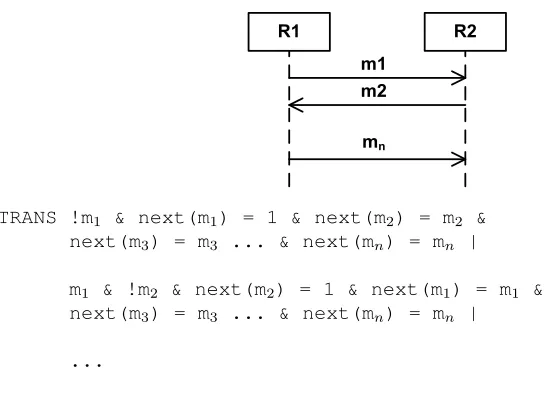
TRANS !m1 & next(m1) = 1 & next(m2) = m2 & next(m3) = m3 ... & next(mn) = mn |
m1 & !m2 & next(m2) = 1 & next(m1) = m1 & next(m3) = m3 ... & next(mn) = mn |
...
Figure 2.4: TRANSconstraint for a simple sequence diagram.
(all messages prior tomi are exchanged), to a state in whichmi is true.
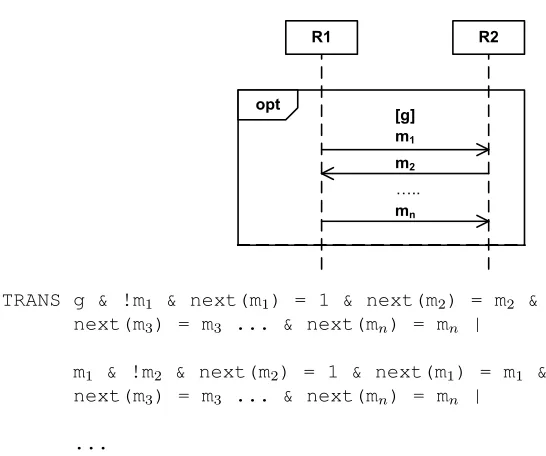
The opt(ion) operator is the simplest sequence diagram operator. Figure 2.5 shows a sequence diagram with two participantsR1andR2, and an opt(ion) operator. The option operator has one message fragment with messagesm1–mn. If the guardgholds, thenR1andR2exchange the messages. The corresponding NuSMVTRANSconstraint allows transitions from a state in which: (a) the guardgis true, (b)mi is false,1≤i≤n, (a messagemiis not exchanged), and (c)mj is true,1≤j < i, (all messages prior to mi are exchanged), to a state in whichmi is true.
2.8
RosettaNet
RosettaNet [2008] is a leading industry effort, that creates standards for business-to-business integration. The RosettaNet consortium consists of over 500 organizations of various sizes, and from various industry sectors including electronics manufacturing from which domain RosettaNet began. These organizations use elements of the RosettaNet standard, named Partner Interface Processes (PIPs), to transact business that is worth billions of dollars. A PIP specifies two-party interactions for some specific business purpose. For example, a buyer requests a quote from a seller using PIP 3A1, and a seller requests financing from a financing processor, on behalf of the buyer, using PIP 3C2. A PIP specification includes a natural language document that informally describes the purpose of the PIP, any underlying assumptions, the intended outcome of executing the PIP, and the message structures as XML DTD or XML Schema.
opt
R1 R2
….. m1
m2
mn [g]
TRANS g & !m1 & next(m1) = 1 & next(m2) = m2 & next(m3) = m3 ... & next(mn) = mn |
m1 & !m2 & next(m2) = 1 & next(m1) = m1 & next(m3) = m3 ... & next(mn) = mn |
...
Figure 2.5: TRANSconstraint for a sequence diagram with anOPT.
business process. Each segment contains many PIP specifications. For example, Cluster 3 represents the Order Management process. Segment A of Cluster 3 represents the subprocess Quote and Order Entry. Segment A contains PIPs such as for Request Quote (3A1), Request Shopping Cart Transfer (3A3), and Request Purchase Order (3A4). RosettaNet PIPs are commonly identified through their code names such as those in parentheses above.
2.9
HL7
Chapter 3
Metamodel, Patterns, and Verification
This chapter describes our metamodel and the reusable patterns.
3.1
Metamodel
We concern ourselves with business models that involve two or more participants. The businesspartners, abstracted asroles, participate in abusiness relationship. The participants create, manipulate, and satisfy commitmentsin each relationship. They executetasksfor each other that enable them to achieve their respectivegoals.
executes requires
refers to
Agent
Commitment plays
has Goal
debtor creditor Role
Business Relationship Task
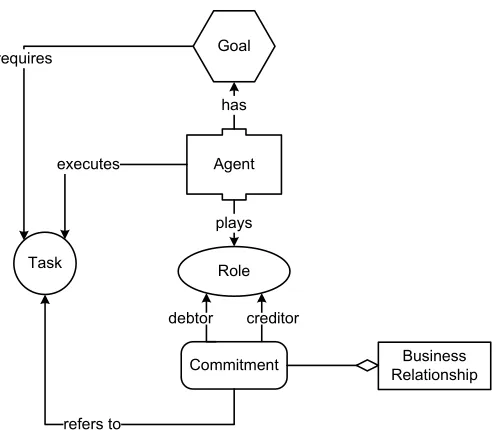
Figure 3.1 describes our business metamodel. The following are the concepts that occur in it.
Agent: a computational representation of a business partner. An agent has goals, and executes business tasks. For each business relationship in which an agent participates, it enacts one or more roles.
Role: an abstraction over agents that helps specify a business relationship in templatic form. Each role specifies the commitments expected of the agents who play that role along with the tasks they must execute to function in that role.
Goal: a state of the world that an agent desires to be brought about. van Riemsdijk et al. [2008] define this as an achievement goal. An agent achieves a goal by executing appropriate tasks or negotiating with other agents to have them execute appropriate tasks.
Task: a business activity viewed from the perspective of an agent.
Commitment: an element of a contractual business relationship. A commitmentC(DEBTOR,CREDITOR,
antecedent,consequent) denotes that theDEBTORcommits to theCREDITORto bring about the
consequentif theantecedentbegins to hold [Singh, 1999]. A commitment when active functions as a directed obligation from a debtor to a creditor. However, unlike a traditional obligation, a commitment may be manipulated, e.g., delegated, assigned, or released.
Business relationship: a set of interrelated commitments among two or more roles that describe how they carry out the given business process.
3.2
Business Model Patterns
A business pattern is a recipe for modeling recurring business scenarios in terms of manipulations of commitments. This section describes a key set of such patterns [Telang and Singh, 2009], which could seed a potential business model pattern library. Section 3.3.1 demonstrates the effectiveness of this simple set of patterns on the Quote-To-Cash business process.
We use the attributesname,intent,motivation,implementation, andconsequencesto describe our patterns [Gamma et al., 1995]. Here theconsequencesof a pattern allude to the practical consequences of applying the pattern, i.e., the assumptions underlying the model.
The expired and violated states do not appear in the pattern diagrams since the diagrams illustrate a normal execution, that is, an execution in which none of the commitments expire or are violated.
3.2.1 Conditional Offer Pattern
This is the simplest possible pattern. It merely views a commitment (as described in Figure 2.1) as an offer.
Proposer Client
Proposer Client
consequent antecedent CC
create(C)
C(PROPOSER,BENEFICIARY,antecedent,consequent)
Figure 3.2: Conditional offer pattern.
Intent: A proposer conditionally offers to execute a task for a client.
Motivation: For example, a conference committee member commits to a program chair to review a paper that the program chair requests the member to review. The chair makes no converse commitment.
Implementation: A commitment is created in which the proposer is the debtor, the client is the creditor, the consequent is the task that the proposer executes, and the antecedent is a condition that brings the commitment into force. Figure 3.2 shows this pattern.
Consequences: This presumes a benefit to the proposer from the antecedent of the commitment.
3.2.2 Commercial Transaction
Intent: This pattern expresses a value exchange between two trading partners. The trading partners negotiate and, upon agreeing, commit to executing certain tasks for each other.
Motivation: A typical situation would be where a seller and a buyer agree to exchange goods for payment. Similarly, if two parties barter goods or services that would fit in the same pattern.
Partner 1
create(C1) create(C2)
consequent antecedent C1C
antecedent consequent C2C
Partner 2 Partner 1 Partner 2
C1 C(PARTNER1,PARTNER2,antecedent,consequent) C2 C(PARTNER2,PARTNER1,consequent,antecedent)
Figure 3.3: Commercial transaction pattern.
Consequences: In general, the antecedents and consequents of the commitments are composite expres-sions. Importantly, we need a mechanism to ensure progress by in essence breaking the symmetry, e.g., via a form of concession [Yolum and Singh, 2007].
3.2.3 Outsourcing
Intent: An outsourcer delegates a task to a subcontractor, typically because the outsourcer lacks the necessary capabilities or expects some other benefit, such as reduced costs or a lower risk of failure.
Motivation: Many business organizations outsource noncore activities. As an example, consider a customer who signs up for cable television service. The cable operator commits to the customer for installation. Instead of staffing its entire service area directly, the cable operator outsources the installation task to its local partners in various regions.
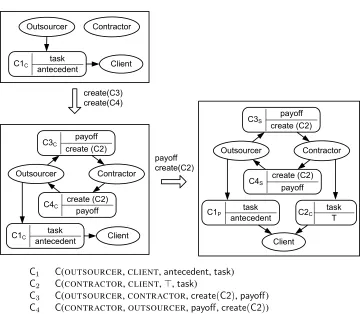
Implementation: The outsourcer has a commitmentC1 towards its client to execute a task. The out-sourcer and the contractor negotiate, and agree that the contractor will create the commitmentC2 to execute the task if the outsourcer pays. Conversely, the outsourcer commits to pay the contractor if the contractor createsC2. Note that the antecedent of this commitment is true (>), which means that it is unconditional. We say that the commitmentC2 coversthe commitmentC1. Eventually when the contractor createsC2the original commitment becomes pending. Figure 3.4 shows this pattern.
Consequences: The commitment from the outsourcer is pending and must either be discharged or reactivated depending on how the contractor performs.
3.2.4 Standing Service Contract
payoff create(C2) create(C3) create(C4) task antecedent C1C Outsourcer Client Contractor Outsourcer Contractor create (C2) payoff C3C payoff create (C2) C4C task antecedent
C1C Client
Outsourcer Contractor create (C2) payoff C3S payoff create (C2) C4S task antecedent C1P Client task Τ C2C
C1 C(OUTSOURCER,CLIENT,antecedent,task) C2 C(CONTRACTOR,CLIENT,>,task)
C3 C(OUTSOURCER,CONTRACTOR,create(C2),payoff) C4 C(CONTRACTOR,OUTSOURCER,payoff,create(C2))
Figure 3.4: Outsourcing pattern
Motivation: A business service such as plumbing maintenance refers to (potentially) numerous service instances. Whenever the faucet leaks (within specified limitations), the plumber will fix it.
Implementation: The provider and consumer negotiate, and upon agreement, create a pair of commit-mentsC1(the consumer commits to paying the service provider, if the service provider commits to provide service), andC2(the converse ofC1). CommitmentC3is the standing service contract. In C3, the provider commits to the consumer to serve each request prior to expiration up to a fixed number of requests. Figure 3.5 shows this pattern.
Consequences: Each service request should take a bounded effort.
3.3
Applying the Patterns
create (C1) create (C2)
payoff Create(C3) payoff
create (C3) C1C
create (C3) payoff C2C
service [ i ] request [ i ] ^ ¬expired ^
i < maxInstance C3C
create (C3) payoff C2S
payoff create (C3) C1S
Consumer Provider
Consumer Provider
Consumer Provider
C1 C(CONSUMER,PROVIDER,create(C3),payoff) C2 C(PROVIDER,CONSUMER,payoff,create(C3))
C3 C(PROVIDER,CONSUMER,request[i]∧ ¬expired∧(i≤maxInstance),service[i])
Figure 3.5: Standing service contract pattern.
identifying each applicable patterns based on its specifiedintent. To apply each pattern, the modeler associates each business role (e.g., Shipper) with the appropriate pattern role (e.g., Contractor) and the tasks with the antecedents and consequents of the relevant commitments.
The patterns compose naturally when the business roles referenced by the patterns overlap. Our graphical representation emphasizes the composition by showing one node for each business role, thus highlighting the interrelationships among the commitments from the composed patterns.
3.3.1 Quote-To-Cash Process
This section evaluates our proposed methodology on the Quote-To-Cash business process loosely based on the public descriptions of Cisco System’s Quote-To-Cash implementation. Cisco is in the business of selling networking products and services. The Quote-To-Cash process encompasses all of the key business activities that begin from a customer requesting a quote, and end in Cisco receiving cash from the customer.
Customer
create(C1) create(C2) create(C3)
shipGoodsE payR C3C
Reseller Customer install Reseller
payR C2C
payR install ^ shipGoodsE C1C
C1 C(CUSTOMER,RESELLER,install∧shipGoodsE,payR) C2 C(RESELLER,CUSTOMER,payR,install)
C3 C(RESELLER,CUSTOMER,payR,shipGoodsE)
Figure 3.6: Commercial Transaction: Customer purchases the goods and the installation service from the reseller.
Cisco utilizes a set of contract manufacturers, and for shipping a set of transportation providers. The participants use different banks and credit companies for making payments.
Next we apply our approach to a fragment of the Quote-To-Cash process. To satisfy a business goal, a customer desires to install Cisco goods. The customer selects a reseller of Cisco for the purchase. Thecommercial transaction patternmodels this scenario. The customer and the reseller negotiate the purchase price. Upon agreement, they create commitmentsC1,C2,andC3, as Figure 3.6 shows. The customer commits (C1) to the reseller to pay if the reseller ships and installs the goods, and the reseller commits to the customer to ship (C2) and install (C3) the goods if the customer pays. Note that we model the commitment to ship (C2), and the commitment to install (C3) as separate commitments since the reseller outsources the shipping (C3) to a distributor, but installs the goods by itself (C2).
The reseller outsources to a distributor its commitmentC3to the customer to ship the goods. Figure 3.7 applies theoutsourcing pattern to this scenario. The reseller and the distributor negotiate, and upon agreement, createC4andC5. The reseller commits (C4) to the distributor to pay if the distributor commits to (C6) ship the goods to the customer. The distributor conversely commits (C5) to createC6if the reseller pays the distributor. When the distributor createsC6,C5discharges,C4detaches, andC3transitions to the pending state. The reseller may pay (payD) the distributor either before or after the distributor commits (C6) to shipping the goods to the customer. The figure shows a possible progression in which the reseller pays the distributor at a later time.
create(C6)
Customer install Reseller
payR C2C
payR install ^ shipGoodsE C1C
Distributor
shipGoodsE payR C3P
Customer install Reseller
payR C2C
payR install ^ shipGoodsE C1C Distributor payD create (C6) C4D create (C6) payD C5S shipGoodsE Τ C6C payD create (C6) C4C create (C6) payD C5C shipGoodsE payR C3C
C4 C(RESELLER,DISTRIBUTOR,create(C6),payD) C5 C(DISTRIBUTOR,RESELLER,payD,create(C6)) C6 C(DISTRIBUTOR,CUSTOMER,>,shipGoodsE)
Figure 3.7: Outsourcing: Reseller outsources the shipping of the goods to the distributor.
If the distributor lacks the stock of goods that it needs to ship to the customer to satisfy C9, the distributor purchases the goods from Cisco. Figure 3.9 shows how thecommercial transaction pattern models this purchase. Upon successful negotiation, the distributor and Cisco create the reciprocal commitmentsC10andC11. The distributor commits (C10) to Cisco to pay if Cisco ships the goods to the distributor. Conversely, Cisco commits (C11) to the distributor to ship the goods if the distributor pays Cisco.
In Figure 3.10, Cisco outsources the shipping of the goods to the distributor, to a shipper. The outsourcing patternmodels this scenario, and the figure shows the commitments that are created.
![Figure 1.1:The Order-To-Cash business process (verbatim from RosettaNet documentation [RosettaNet,2010]).](https://thumb-us.123doks.com/thumbv2/123dok_us/1594623.1196734/16.612.136.497.68.298/figure-order-business-process-verbatim-rosettanet-documentation-rosettanet.webp)
![Figure 1.2: The breast cancer screening and diagnosis adapted from ASPE [2010].](https://thumb-us.123doks.com/thumbv2/123dok_us/1594623.1196734/17.612.95.540.316.556/figure-breast-cancer-screening-diagnosis-adapted-aspe.webp)