Hierarchical Wireless Sensor Network with
Timer/Rf Wake on Sleep Mode Based Energy
Saving Scheme
Sunita Sharma 1, Abhigya Saxena 2, B.J. Kishore3, Alka Chaudhary 4
P.G. Student, Department of Computer Science & Engineering, Apex Engineering College, Jaipur, Rajasthan
Assistant Professor, Department of Computer Science & Engineering, Apex Engineering College, Jaipur, Rajasthan
Associate Professor, Department of Computer Science & Engineering, Apex Engineering College, Jaipur, Rajasthan
Assistant Professor, Department of Information Technology, Manipal University, Jaipur, Rajasthan
ABSTRACT: There are numerous applications of wireless sensor networks that are unavoidable these days. The limited energy available in such sensors is a threat to extend the life of an entire hierarchical network. This work is aimed at reducing the energy consumption of the wireless sensor nodes by taking advantages of the different operating modes of power and the structure of the hierarchical networks. Combination of interrupted sleep timer activated from Sleep for sensor data Acquisition and RF high frequency and the interruption of the base station for data exchange reduces the average power consumption in many fields and therefore increases the duration of the battery-life.
I. INTRODUCTION
There are numerous applications of wireless sensor networks which are inevitable now a day in our daily life. Majority of such applications which use wireless sensor networks will be in areas where the direct human intervention is impossible. So the limited energy available in such sensors is a threat for prolonging the life of the entire network. The need of making an energy efficient wireless sensor networks is a hot research topic in which lot of new strategies for improvement in energy efficiency has been sought after. As communication process consumes more energy, an energy efficient routing strategy can probably reduce the energy consumption to a great extend. In this paper we presents an overview of the different routing techniques in which mobile sinks are used to facilitate the routing process which can effectively reduces the energy use.
Wireless Sensor Networks (WSNs) usually collection of a large number of small, interconnected sensor nodes that offers the unique capability to observe the physical scenario accurately. WSNs have gained a lot of interest in the field of research nowadays due to its varied applications in diverse fields that require surveillance and monitoring that have become inevitable in our daily life. But the main drawback of such sensors are their resource constrained nature mainly in the power backup capabilities of sensor nodes and as a result a number of issues have mixed out to find which one energy efficiency is an important point of concern [1].
cost. These transceivers are sensitive to temperature variations which affects both their transmission as well as their reception capabilities.
II. RELATEDWORK
An ad hoc network is a collected set of mobile nodes that makes a temporary network without using any pre- established infrastructure or centralized management. In such an environment, a node may need the help of other nodes to transmit the data packets to its destination because of the limited radio transmission range of each mobile node. In this paper, we describe routing protocols in ad hoc networks using on-demand routing mechanism [6]. This type of protocols responds quickly about the changes in routes when hosts are moving frequently, but little or no overhead is required if the hosts are not moving frequently. Based on the packet-level simulation results of mobile hosts operating in ad hoc networks, protocols work well under various environmental conditions such as host density and moving speed of the mobile hosts. Although the simulated hosts have the highest speed of movement, the protocol overhead is rather low, which is only 1% of the total data packets transmitted at medium mobile speeds in the network of 24 mobile hosts. In all cases the difference between the route used and the optimal route length is negligible. In most cases, the length of the route is 1.01 times the optimum on average.
There are number of protocols are intensely designed to use in wireless environments like ad hoc networks. Some protocols do not have any prior periodic router advertisement. Instead, some others are designed for a scenario where if a host needs a route to another host, it determines the routs based on the cached information and the results of the route detection protocol dynamically. We make sure that our-on-demand routing protocols provide many potential advantages over traditional routing protocols. First, unlike conventional routing protocols, our protocol does not use any periodic routing advertisement messages, so overhead of network bandwidth is reduced during periods when there is little or no host movement of particular significance. Also on the mobile host, battery power is also saved by not sending advertisements and not having to receive them (the host goes to sleep or standby mode when not participating in other ways) so power consumption can be reduced by using this approach. On the other hand, traditional protocols like distance vectors and link state routing continue send advertisements without any change in the network topology, so remaining other nodes will continue to consider that those routes are as valid one. In addition, many of the "links" between routers seen by routing algorithms can be redundant. Wired networks are usually explicitly configured to have one (or a few) routers connected to the two networks, but there is no explicit link in the ad hoc network and all communications are take place using broadcast transmission mechanism. The unwanted paths in the wireless environment unnecessarily increases the size of the routing update that needs to be sent across the network and increases the cache and CPU overhead required to estimate and compile each update and to compute new routes for the transmission[7][8].
Distance vector algorithms can compute some routes that do not work. In a wireless environment, transmission of the network between two hosts does not necessarily work so well in both directions, due to the different propagation or interference patterns around the two hosts. For example, with distance vector routing, even if a host can receive a routing ad from another mobile host, packets that it can then send back to that host for transmission may not be able to reach it. Our protocol does not require that transmissions between hosts operate bidirectional, although we use them when provided, for example, by protocols at the MAC level such as MACA or MACAW that provide it. Finally, conventional routing protocols are not designed for the type of dynamic topological changes that may be present in ad hoc networks. In conventional networks, links between routers fall occasionally or occur, and sometimes the cost of a link may change due to congestion, but routers usually do not move dynamically. In an environment with mobile hosts as routers, however, convergence to new, stable routes after such dynamic changes in network topology can be slow, especially with distance vector algorithms [9] [10] . Our dynamic routing protocol source is able to adapt quickly to changes such as host movement, but does not require overloading of routing protocol during periods when such changes do not occur. Section 2 of this article details our assumptions about network and mobile hosts.
Despite years of research and development, the pioneering deployments of multi-hop wireless networks have not been successful. Routing and transport performance are often unstable due to contention-induced packet loss, especially when the network is large and the load offered is high. In this article, we propose RAIN, reliable wireless network architecture for large-scale multi-hop wireless networks. A RAIN network imposes contention control by limiting the queue length to the minimum intermediate wireless routers. To reduce queuing time, a RAIN network provides congestion control through an implicit back pressure in the network. RAIN congestion control relies on wireless data link layer mechanisms, for example, mandatory frame-based acknowledgment and inter-frame back-off in popular CSMA / CA wireless transceivers, thus highly efficient and effective compared to those defined at the level of the network or the transport layer for the wired Internet. Due to integrated contention and congestion control, RAIN presents end-users with a highly reliable network service model that is even more reliable than wired Internet. End hosts only need to manage packet loss due to router or routing errors. Therefore, the transport protocol can be considerably simplified. This contrasts sharply with the existing approach of adding more and more complexity to adapt the TCP protocol to multi-hop wireless networks. We propose the details of the RAIN data link layer protocol, and a simple transport protocol at the end of the hosts. Performance evaluation by intensive simulations shows that RAIN improves throughput up to 92% and equity by up to 48%, with packet loss due to contention and congestion considerably reduced [11] [12]. Multi-hop wireless networks first emerged in response to the demand for instant networking in the form of ad hoc mobile networks (MANET) [13].
It has recently developed wireless mesh networks to provide high-speed broadband Internet connectivity. However, despite years of research and development in MANETs and wireless mesh, pioneering deployments of multi-hop wireless test benches have encountered the serious problem of stability.
Our contributions in this paper are three-fold. First, we propose novel reliable network architecture for large-scale multi-hop wireless networks. RAIN re-defines the service models for the data-link layer and transport layer, so as to better fit into the interference-prone multi-hop wireless networks. Second, we propose new data-link and transport protocols to demonstrate the feasibility of the RAIN architecture. Our protocol designs leverage the unique characteristics of popular CSMA/CA wireless transceivers, with a counter-intuitive queue management strategy. As a result, our protocols realize fine time granularity contention and congestion control. Finally, we have built the RAIN architecture and companying protocols in ns-2. Extensive simulation results show that RAIN’s contention and congestion controlled data-link layer improves the throughput of individual unregulated UDP traffic by up to 92%, and improves the fairness among competing UDP traffic by up to 25%. Together with our simplified transport protocol, RAIN achieves an average 61% gain in aggregate throughput and an average 48% gain in fairness in highly mobile ad hoc networks[14][15].
network contention control, which is usually the primary cause of packet losses in a large multi-hop wireless network but often missed in the existing designs. Finally, Ramanathan et al. propose a new MANET architecture. Its main goal is to streamline packet forwarding at intermediate wireless nodes using the future full-duplex, relay-oriented wireless physical layer without having the upper MAC or network layer involved, similar to circuit switching in synchronous networks. RAIN is instead motivated by contention control for packet-switched asynchronous wireless networks with off-the-shelf half-duplex wireless physical layers [16].
III. EXPERIMENTAL RESULTS
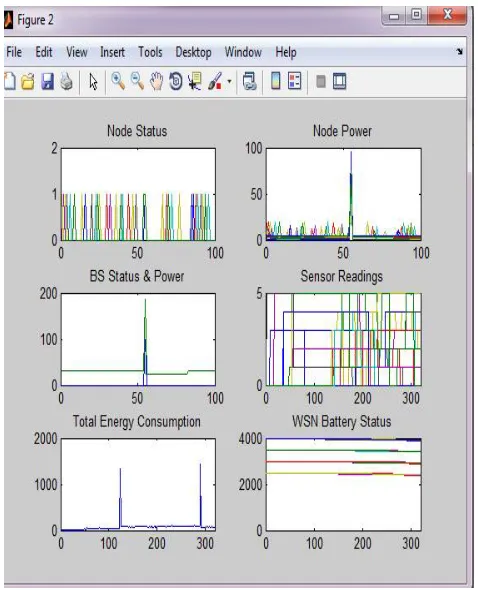
Figure 5.2 – Base Station
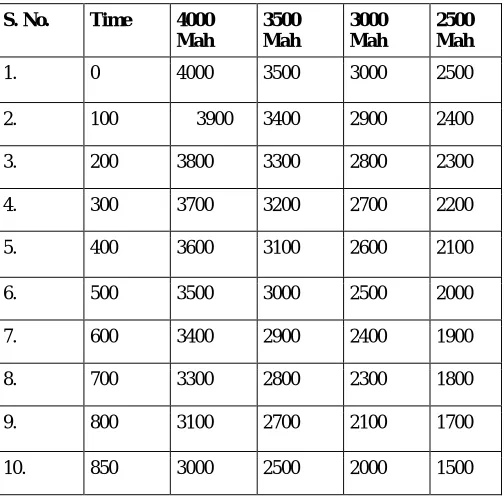
Table – 5.2 Battery Capacities vs. Time
S. No. Time 4000 Mah
3500 Mah
3000 Mah
2500 Mah
1. 0 4000 3500 3000 2500
2. 100 3900 3400 2900 2400
3. 200 3800 3300 2800 2300
4. 300 3700 3200 2700 2200
5. 400 3600 3100 2600 2100
6. 500 3500 3000 2500 2000
7. 600 3400 2900 2400 1900
8. 700 3300 2800 2300 1800
9. 800 3100 2700 2100 1700
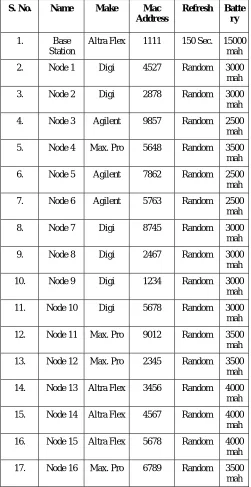
Table – 5.1 Nodes Mac Address & Refresh Rate
S. No. Name Make Mac
Address
Refresh Batte ry
1. Base Station
Altra Flex 1111 150 Sec. 15000 mah
2. Node 1 Digi 4527 Random 3000 mah
3. Node 2 Digi 2878 Random 3000 mah
4. Node 3 Agilent 9857 Random 2500 mah
5. Node 4 Max. Pro 5648 Random 3500 mah
6. Node 5 Agilent 7862 Random 2500 mah
7. Node 6 Agilent 5763 Random 2500 mah
8. Node 7 Digi 8745 Random 3000 mah
9. Node 8 Digi 2467 Random 3000 mah
10. Node 9 Digi 1234 Random 3000 mah
11. Node 10 Digi 5678 Random 3000 mah
12. Node 11 Max. Pro 9012 Random 3500 mah
13. Node 12 Max. Pro 2345 Random 3500 mah
14. Node 13 Altra Flex 3456 Random 4000 mah
15. Node 14 Altra Flex 4567 Random 4000 mah
16. Node 15 Altra Flex 5678 Random 4000 mah
Fig. 5.3 Battery Capacities vs. Time
IV. CONCULSION
We are aware that energy efficiency is always a critical concern in Wireless Sensor Networks, even though lot of work has been done in this field, but an efficient algorithm that prolongs battery life multiple times without compromising on security was lacing. The proposed algorithm takes care of both these issues simultaneously by exploiting the understanding & modification of various constituent parts of wireless sensor Nodes & the structure of Hierarchical Wireless Sensor Networks. The proposed algorithm, controls Processor, Ratio & Sensor Data Acquisition (ADC), blacks of the Wireless Sensor Node in different modes to implement various power operating modes thus save on average power consumption aspects.
REFERENCES
[1] P. Agrawal, J. -c. Chen, S. Kishore, P. Ramanathan and K.M. Sivalingam, Battery power video processing in wireless networking, in: IEEE PIMRC'98 (1998). [2] P.Agrawal, B. Narendran, J. Sickick and S. Yajnik, An adaptive power control and coding scheme for mobile radio systems, in: of IEEE Personal Communications Conf. (New Delhi, India, 1996) pp. 283-288.
[3] R. Alonso and S. Ganguly, Energy efficiency query optimization, Technical report MITL-TR-33-92, Matsushita Info Tech Lab, Princeton, NJ (1993). [4] E.Ayanoglu, S. Paul, T.F. Laboni and R.D.Gitlin, AIRMAIL: A link-layer protocol for wireless networks, Wireless Networks 1 (2) (1995) 161-174.
[5] A. Bakre and B.R. Badrinath, I-TCP: indirect TCP for mobile hosts, in: of 15th Int. Conf. On Distributed Computing Systems (1995) pp.136-143. 356 JONES ET AL. [6] H.Balakrishnan, S. Seshan and R. Katz, Improving reliable transport and handoff performance in cellular wireless networks, Wireless Networks 1 (4) (1995).
[7] N.Bambos, Toward power-sensitive network architectures in wireless communications: concepts, issues and design again, IEEE Personal Communications 5 (3) (1998) 50-59.
[8] K. Brown and S.Singh, M-TCP: TCP for mobile cellular networks, Computer Communication Review 27 (5) (1997) 19-43.
[9] R. Cáceres and L. Iftode, Improving the performance of reliable transport protocols in mobile computing environments, IEEE Journal on Selected Areas in Communications 13 (5) (1995) 850-857.
[10] A. Chandrakasan and R.W. Brodersen, Low Power Digital CMOS Design (Kluwer Academic, Norwell, MA, 1995).
[11] J.-H. Chang and L. Tassiulas, Energy savingving routing in wireless ad-hoc networks, in: IEEE INFOCOM, Tel-Aviv, Israel (2000).
[12] J.-C. Chen, K.M. Sivalingam and P.Agrawal, Performance comparison of battery power consumption in wireless multiple access protocols, Wireless Networks 5 (6) (1999) 445-460.
[13] J.-C. Chen, K.M. Sivalingam, P. Agrawal and R.Acharya, Scheduling multimedia services for a low-power MAC in wireless and mobile ATM networks, IEEE Transactions on Multimedia 1 (2) (1999) 187-201.
[14] L. Chen, Mobile-based wireless network error compensation algorithm, Master's thesis, Washington State University, Pullman (2000).
[15] S. Damodaran and K.M. Sivalingam, Adaptiveization for mobile networks for multiple networks and multiple transmission channels, in: International Conf. On High Performance Computing, Calcutta, India (1999).
[16] I.B. Dhaou, A novel load-sharing algorithm for energy efficient MAC protocol compliant with 802.11 WLAN, in: IEEE Vehicular Technology Conference, Amsterdam, Holland (1999).
[17] F. Douglis, P. Krishnan and B. Marsh, Thwarting the power-hungry disk, in: Proceedings of the 1994 Winter USENIX Conference (1994).
[18] L.M.Feeney, An energy consumption model for performance analysis of routing protocols for mobile ad hoc networks, in: 45th IETF meeting: MANET Working Group (1999).
[19] L.M.Feeney, investigating the energy consumption of the IEEE 802.11 network interface, the technical report T1999-11, the Swedish Kista, the Swedish Institute of Computer Science (1999).
0