Case Study and Experimental Investigation
towards the CNC Router
G.Y.Karthik Chandragiri 1, S.Shyam Sunder Rao 2
M.Tech Student, Department of Mechanical Engineering, VNR VJIET College, Bachupalli, Hyderabad, India1 Associate Professor, Department of Mechanical Engineering, VNR VJIET College, Bachupalli, Hyderabad, India2
ABSTRACT: As the competition of the cabinetry industry becomes more and more intense, improving the efficiency of production, reducing the cost and increase the quality of products are increasingly important for companies to defend the market share and remain the competitive statues in the industry. The implementation of fully automatic CNC router is one effective way to deal with the current challenges. Although CNC routers require relatively higher capital investment, they can increase the accuracy, productivity, flexibility and simplicity of the production significantly. In reality, these factors are all keys to success for the cabinetry companies. Qubia’s Cabinets is one example that shows the change of the manufacturing method. Its outstanding performance in the industry proves that the automatic operating system is the future trend in the secondary wood industry. According to the cost analysis, we can see the present worth of the total cost of investing and operating a CNC router for ten years.
KEYWORDS: CNC Router, Production Efficiency, low Cost, High Quality.
I. INTRODUCTION
II. MACHINE DESCRITION
The Computer Numerically Controlled (CNC) routers are versatile and fully automatic machineries that integrate the function of sawing, drilling, routing, etc. As the name Indicated, a CNC machine is controlled to conduct certain operations by inputting numerical data into the computer system, so different machining operations can be displayed if the sequences of the program codes are varied. In this section, I will explain the main uses and evaluate the advantages and disadvantages of the CNC machines used for wood cabinet manufacturing.
A. Uses
There are two types of CNC routers: Three-axis and Five-axis. Three-axis machines are mainly used to cut flat parts while Five-axis machines are capable of producing three-dimensional parts. In this case, the CNC routers introduced are three-axis machines because the kitchen cabinet production is a relatively standardized process, and for a kitchen cabinet company like Qubia’s Cabinets, the main machining operations are nested cutting, sawing, grooving, shaping and drilling of composite panel products like particle board, MDF, Hylam, Epoxy, Polycarbonate, Acrylic, HDPE and plywood. Nested cutting and all-in-one process are excellent features of CNC routers because they speed up the process and increase the accuracy significantly. Moreover, the computerized system simplifies the process and meanwhile, it increases the flexibility of the cutting, so it allows more customized products to be produced at a high production speed. The design of kitchen cabinet varies among different manufacturers, but, in general, they all consist of five basic components: base unit, wall unit, tall unit, corner unit and countertop so the manufacturing processes are similar panel-based cutting process which includes sizing, groove cutting and drilling for each product. Particle board, MDF and plywood panels are the most popular materials of making the box structures because engineered wood panels are relatively cheap but have outstanding dimensional stability and machinability. For body structure, the most important factor we need to consider is the in-service performance, such as water resistance and warp resistance, rather than the appearance since they are not exposed to the outside. However, for doors, countertop and drawer front, composite wood product with solid wood veneer and solid hardwoods are often used since their appearance affects people’s perceptions of the products to a large extent. In this part, I will take a simple base unit which is shown in Figure 1 as an example to show the advantages and disadvantages of automatic operation process.
Fig. 1 Standard Frameless Cabinet Base Unit
so that they can focus more on the core parts of the kitchen cabinet. Therefore, in my analysis, I will assume the company only produce the body structure.
B. Advantages
The CNC routers have many advantages over the conventional manufacturing machines, such as accuracy, productivity and simplicity. The following parts compare the CNC router with the conventional production lines to explain the advantages of CNC machines in detail, so that people can have a better idea when they decide to invest in the automatic production lines.
1) Improve Accuracy: All-in-one feature of the CNC machines is the main reason that increases the accuracy of the
final products since it eliminates the human errors and reduces the chance of having machine errors. In other words, the less the inter-processes, the less the errors will happen. For conventional production system, the components have to go through several stations, such as sizing, shaping and drilling, and each machine is set up and operated by the operators. Also, for different components, the machine has to be set up accordingly since the sizes and type of operation of different parts are various. Although company often requires experienced and skilled operators to ensure the quality of products, it is still highly possible to make mistakes. Even for the CNC routers, the accuracy reduces when we reposition the board during the process because it is impossible to replace the board on the same spot. However, CNC routers enable all the components including the odd shaped parts to be cut in one process without interruption. As long as the codes are correctly programmed, the machining process will be extremely accurate (Nested-Based Manufacturing).
Computer aided system is another reason for the CNC routers to achieve greater positioning accuracy. By the aid of computers, the servo motor is closed loop which can get instant feedback so that the machine will know the exact position of the tools. According to the feedback received, the computer will analyze the conflicts between the actual and expected situations, so that it can correct the improper commands and accomplish a better job. For high quality CNC routers, servo motors are often used.
2) Improve Productivity
The improved productivity can be shown by the increased yield and reduced processing time. By using the computer aided drawing software, all the parts can be completely nested on a panel sheet, so engineers can optimize the cutting patterns prior to the cutting process, so that the yield can be maximized. Compare to the conventional cutting system, the waste of raw materials are lowered to the minimum amount.
The parts coming out from the CNC machine center are ready to assemble, so it reduces the in-process stacking and unshackling time and labours. Also, with the development of Mechanical technology, current CNC routers can support high speed production while they can still maintain the high accuracy. This improvement reduces the production time and therefore, increases the productivity. As shown in a video, the current CNC routers can finish a series of cutting on one 4’by 8’ plywood sheet within five minutes.
Also, compare to the conventional production, the use of CNC routers reduces the machine setup time significantly. For conventional production, different machines require different setups according to the cutting application and size of the parts. Whenever one parameter is changed, the machines need to be readjusted, so it is impossible to achieve Continuous process. However, the CNC routers enable non-stop process, so it boosts the productivity to a higher level. Once the CNC operator correctly loads the program, the machine will automatically do all the jobs including cutting, drilling and tool changing, so it eliminates the time for machine setup and speeds up the production.
3) Other Advantages: Apart from the benefits that mentioned above, CNC routers also reduce the complexity of
Canada found that skilled and experienced labours are the top one constraint that limits the expansion of companies. Therefore, obtaining CNC routers facilitates the future development of the companies. Moreover, one key to success of cabinetry companies is the diversity of products. CNC routers can easily cut various shaped parts, so it increases the flexibility of designs and also enhances the competitive strength of the companies.
C. Disadvantages
High cost is considered as major disadvantage of the CNC routers. If a company already has the conventional operating system, it will cost nothing for them to stick to the current production line. However, it will cost $25,000 to $ 60,000 if they want to purchase a medium level CNC router; and $60,000 to $100,000 has to be spent to obtain a high quality CNC router (CNC Router Prices).
On the other hand, the CNC center can cut down the expanses of labours and raw materials for long-term because it requires fewer workers with minimum wage. For example, the required machineries for the conventional production line of the operation are panel saw, shaper and driller. First, the panels are cut into target sizes according to the design. And then, they can be transferred to either groove cutting or drilling station to make the grooves and drill holes. Finally, switch over the above operations to finish up the break-down process. As we can see, at least one operator for each machine is needed for one shift production, so three or more workers in total are necessary because the in process components handling requires more labours. However, the CNC production line only needs one minimum paid machine operator because the special skills are not required. Most people can qualify the position and it is easily trained. The results from Natural Resource Canada’s research found that more than 70% of the total operating costs are from the labours and materials. Thus, it is hard to tell the actual cost and saving for the CNC routers. It really depends on the companies’ demand and long- term strategies.
Other disadvantages like education and training of the code programmers are also true. The codes are the key part for the operation of CNC machines because it decides the final quality of the products largely. Therefore, the CNC programmers have to accomplish a certain level of education, so that the training can be carried out successfully.
III. CASE STUDY OF QUBIA ENTERPRISES’S CNCROUTER
Qubia’s Cabinets is a medium sized Canadian cabinet manufacturer that is located in Cherlapally, Hyd with a group of experienced employees. The company was established in 1970 and mainly aimed to produce high quality cabinets and provide superior installation and after-sale services. Qubia’s Cabinets are mainly targeting the local markets and United States as well. The company is running in the form of batch production which allows it to have more flexibility over the product customization, so that they can satisfy various customers with different cultures. Also, the just-in-time manufacturing effectively lowers the inventory level, so the cost can be reduced as well.
As the production manager, Mr. MD Hatim, introduced, the CNC router that Qubia’s Cabinets purchased its first CNC router in 1992 to adopt the fast growing demand and improve the quality of the products. The machine they bought was from Biesse and the main application of the machine is nested cutting. He addressed some benefits of the CNC router in the practical way. For example, the CNC router improves the productivity, increases the efficiency and reduces the defects of the products. Compare to the past operation line, the most obvious advantage that he thought is the drilling process. Many defect pieces were happened in the previous hand drilling operation, but the utilization of the CNC router considerably lower the number of defect pieces. At the same time, it accelerates the drilling process and the accuracy of the drilling process was improved significantly.
IV. EXAMPLE MACHINE
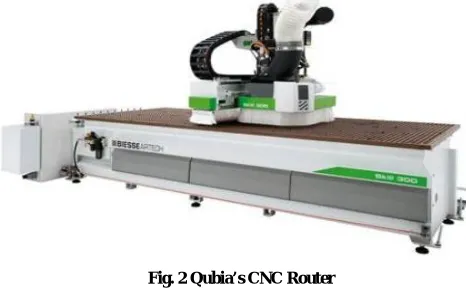
Biesse is an Italian engineering machinery manufacturer which commits to provide advanced machineries with superior quality for various types of manufacturers to achieve a more productive and efficient production process. Through the great efforts for over 40 years, the company made considerable progresses in products innovations and also won the global reputation as a reliable supplier. Skill 300 is one powerful CNC machine center that is produced by Biesse, and it is mainly designed for nested panel cutting, so it is ideal for small or medium sized cabinet manufacturing applications. This machine is user- friendly since it uses Windows-based control system that most people are familiar with. The maximum rotation speed of the high-speed spindles is 6000rpm; and the maximum rotation speed of the electro-spindle is four times faster than the previous one (Biesse Wood Division). The outstanding high rotation speed of the spindle is not only increasing the production rate, but it also improves the product quality because it can create a smoother surface. According to the price offered by TNG Machinery, a brand new Biesse Skill 300 CNC machine center is pricing at $98,500 (tools included) (TNG Machinery New Used Listing –Winter, 2009).
Fig. 2 Qubia’s CNC Router
V. COST ANALYSIS
Cost is one important factor for the companies to consider when they are deciding whether or not to invest in the automatic systems. The costs mentioned here are the total processing costs including machine, labour, tooling, maintenance, electricity, and other overhead costs. In this part I will take Qubia’s Cabinets Company as an example to show the cost of investing the automatic operation system if they want to purchase it now. Based on the revenue and cost, I can calculate the break-even point and do the net present value analysis so that the investor can have a better idea.
The only material they used to produce the cabinet boxes is 4’ by 8’ plywood panels. Based on their rule of thumb, each plywood sheet can make one box, and the panel they purchased is about 18 dollars per sheet. Therefore, according to an annual demand of 9920 boxes, the total material cost is $178560 per year.
To calculate the annual loan payment, a 6% interest rate is assumed based on the 10 years payment period. The initial investment can be obtained by adding the machine cost, training cost and software cost. Training cost is hard to accurately estimate because the training time largely depends on the education level of the operators. For some people, they can learn the skills in a few days, but for other people, they may need a few months to acquire the knowledge. Therefore, in this analysis, a ten-day based training of two operators with a rate of $300 per day per person is assumed. The total estimated training cost is $6000. The software cost is about $4500 (Price of Software, 2011) and the machine cost, as mentioned above, is $98,500, so, by using Excel Financial Function, we can get an annual loan payment amount of $14,809.61. The TABLE 1 below shows the calculation of the annual loan payment.
TABLE 1 ANNUAL LOAN PAYMENT
Initial Investment
Interest Rate
Service Life Annual Payment
$109,000.00 $0.06 $10.00 $14,809,61
Insurance of the equipment is another cost that should be considered. In this case, a 2% of the equipment cost is
assumed as the annual insurance expense of the initial investment, so the annual insurance cost will be $1970.
The total working days of the company are 248 days per year, and they work eight hours per day, so the total paid hour is 1984 hours per year (Federau, 2011). The rates of the salary for workers in different positions are different. To calculate the total labour costs, one programmer and one machine operator are needed and their salaries are shown in TABLE 2.
TABLE 2 CALCULATIONS OF TOTAL LABOUR COSTS
Position Hours/Year $/hour Salary($)
Programmer 1984 20 39680
Machine Operator 1984 10 19840
Total 59520
Electricity expense is calculated based on the power consumption requirement of the machine. In this case, the CNC router spindles require 15KW to reach the optimum running speed. The total energy consumption is 29760KWh per year. According to the electricity rates for medium general service obtained from BC Hydro, a list of charges is shown in Table 3. Therefore, the total cost of the electricity is $1847.24 per year (BC Hydro, 2011).
TABLE 3 COST OF ELECTRICITY
Basic Charges/Day($) 0.1716
Energy Charge/KWH($)-first 14800KWh
0.081 Energy
Charge/KWh($)-additional KWh
0.0405
TABLE 4 MAINTENANCE COSTS
Year 1 2 3 4 5 6 7 8 9 10 NPV
Cost($) 985 1034 1086 1140 1197 1257 1320 1386 1455 1528 $8.907.72
The salvage value is calculated by declining balance method. The depreciation rate is estimated at 30%, so based on a 10-year service life period, the salvage value at the end of the tenth year will be $6895.
TABLE 5 illustrates the summarized costs of operating a CNC router for a ten years period. The annual expenses include the material costs and machine operate salary; annual O&M expenses consist of insurance cost, maintenance cost, electricity cost, overhead costs, training cost, salary of the CNC programmer and depreciation cost. By using the present worth calculation method, a total of $1,896,820.5 cost over the ten-year period is obtained.
TABLE 5 PRESENT WORTH OF THE TOTAL COST
Initial Investment($)
Annual Expenses($)
Annual Loan Payment($)
Annual O&M Expenses($)
Present Worth(PW) 109.000 198.200 14.810 54.558 $1,896,820.5
Compare to the conventional production line, the annual savings of CNC machine center are from the savings of labour and materials. The labour saving is from two sources. First, CNC machines save two skilled machine operators; and it also reduces the manufacturing time, so the actual labour cost is lowered by this two ways. The total labour savings that was provided is about $55,000 per year under current production demand of Qubia’s Cabinets. The material saving can be estimated at 20% of the total consumption which will be $35,712 per year. Therefore, at the demand of 9920 boxes per year, the manufacturer can save $9.14 per unit box. Using the same way as before, a present worth can be calculated with the annual saving. As we can see the total cost is reduced to $1,229,172.2.
TABLE 6 PRESENT WORTH WITH SAVING
Initial Investment($)
Annual Expenses($)
Annual Loan Payment($)
Annual O&M Expenses($)
Annual Saving($)
Present Worth(PW) $109,000.00 $198,200.00 14809.61 54,558 $90,712.00 $1,229,172.23
VI. CONCLUSION
As shown in the economic analysis, CNC machines can save the total costs in the way of reducing the number of employees, reducing the time of manufacturing process and lowering the material consumption, so, for the manufacturers as the same size as Qubia’s Cabinets, it is beneficial to invest in CNC routers.
Although many cabinet companies in Lower Mainland have realized the importance of the change of production methods, for positive results have been shown by many real life examples, some companies are still struggling of maintaining the old traditions. Implementing new technologies is a must to survive in the competitions because it allows more competitive marketing strategies to be carried out. For cabinet companies, increasing the flexibility, improve the product quality, lower the cost and reducing the manufacturing lead time are key success factors. CNC machine centers enable more complex shaped components to be produced within a short time period, so manufacturers will have ability to design more differentiated products.
Taking into account all the benefits that the CNC machines will bring, the investment is worthwhile. Although the costs of the machines are relatively high, the companies have to also consider the savings that are generated by the CNC routers. When the companies are purchasing the machines, a reliable supplier is critical because the performance of the machine affects the products quality to a large extent. Also, reliable suppliers usually have experienced engineers who can provide critical technical supports to the manufacturers, so that it ensures a smooth operation for the manufacturers.
REFERENCES
[1] Leonardo Romero Muñoz, “Development of a computer numerically controlled router machine with 4 degrees of freedom using an open architecture Power, Electronics and Computing (ROPEC)” , 2013 IEEE International Autumn Meeting on, pp. 91 – 94, 13-14 Nov. 2013.
[2] O. L. ASATO, E. R. R KATO, R. Y. INAMASU, A. J. V. PORTO, “Analysis of open CNC architecture for machine tools”, J. Braz. Soc. Mech. Sci. [online], vol.24, pp. 208 – 212, 2002.
[3] Zhai Wen-zheng, “Design and Implementation of CNC Machine Remote Monitoring and Controlling System Based on Embedded Internet”, Vol. 1, pp. 508 – 509, Oct. 2010.
[4] Yi-Hong Long, Zu-De Zhou, Quan Liu, Ben-Yuan Chen, Heng-Lin Zhou, “Embedded-based modular NC systems", Adv. Manuf Technol, vol. 40, pp. 7-8, Feb. 2009.
[5] G. Renann Baldovino, “Optimization of machine process parameters through 2D image layout enhancing and ArtCAM post-processing for 3D machining: Support program for the productivity and competitiveness of the metals and engineering industries”, Humanoid, Nanotechnology, Information Technology, Communication and Control, Environment and Management (HNICEM), 2014 International Conference, pp. 1 – 4, Nov. 2014.
[6] Dr. B. Jayachandraiah, O. Vamsi Krishna, P. Abdullah Khan, R. Ananda Reddy, “ Fabrication of Low Cost 3-Axis Cnc Router”, international Journal of Engineering Science Invention, Vol. 3, pp. 01 – 10, June 2014.
[7] H. Dhruv Patel, V. N. Patni, “An Investigation Effect of Machining Parameters on CNC ROUTER”, International Journal Of Engineering Development And Research, Vol. 2, 2321-9939, 2014.
[8] Naveed-e-Sahar, Syed Ashraf Ali, Ahmed Iqbal, “3D MOTION CONTROLLER FOR CNC ROUTER”, International Journal of technology and Research, Vol. 1, pp. 153 – 158, May 2013.
[9] Zhenhe Ye, Ying Li2 and Bo Han, “Appearance Design Evaluation on CNC Machine Tools Based on Fuzzy Synthetic Evaluation Model”, International Journal of Multimedia and Ubiquitous Engineering, Vol. 9, pp. 65 – 76, 2014.
[10] B. Malleswara Swami, K.Sunil Ratna Kumar, “Design and Structural Analysis of Cnc Vertical Milling Machine Bed”, International Journal of Advanced Engineering Technology, Vol. 3, pp. 97-100, Dec., 2012.
[11] Camelia, Ivan, “Complex Ornament Machining Process on a CNC Router”, Editura Universitatii Transilvania din Brasov, Vol. 01, pp. 22 – 30, 2014.
[12] Mr.Dhruv H. Patel, Prof. V. N. Patni, “An Investigation Effect of Machining Parameters on CNC ROUTER, VOL. 2, and ISSN: 2321-9939, March 2014.
[13] http://www.meikitchens.com, “About the Box Thickness of Kitchen Cabinets.” [14] http://www.biesseamerica.com, “Biesse Wood Division”.
[15] http://www.cncroutersource.com, “CNC Router Prices”.
[16] http://www.ic.gc.ca, “Manufacturing Production Wood Kitchen Cabinet and Counter Top Manufacturing”. [17] http://www.icam.co, “Nested-Based Manufacturing”.
[18] http://www.Qubia.com, “Qubia Cabinets”.
[19] http://www.cabinetsolutions.net, “Price of Software”. [20] http://www.homag.com, "Processing Centres."
[21] http://woodworkingnetwork.com, “Skill 300 CNC Machining Center” [22] http://canadaforests.nrcan.gc.ca, “Statistical Data”.