Experimental Investigation on Strength
Characteristics of Geopolymer Concrete with
Partial Replacement of Coarse Aggregate with
Recycled Coarse Aggregate
Babu.S, Fazal.N, Genie Beneacos.D, M. Murugalingam, M. Kirubakaran,
Department of Civil Engineering, Loyola Institute of Technology, Kuthambakkam, Tamil Nadu, India
ABSTRACT: Geopolymer concrete is ecofriendly and it does not emit Co2 (carbon dioxide) into the atmosphere. In this study the coarse aggregate is replaced with Recycled Coarse Aggregate (RCA) which is obtained from construction waste. The compressive strength of concrete containing 50% RCA has strength in close proximity to that of normal concrete. This replacement of coarse aggregate with RCA reduces the cost , also tends to alter the characteristics of the Geopolymer concrete. The geopolymer is a combined mixture of sodium hydroxide (NaoH) and sodium silicate (Na2Sio3) with the use of alkaline liquid. The characteristic changes are observed and tested. As a result of this project investigation on the optimum percentage of strength , the geopolymer concrete mix with 3M, 4M and 5M (molar) so in this we study the failure pattern of geopolymer concrete mix design are to be conducted.
KEYWORDS: Geopolymer Concrete, Alkaline liquid, Recycled Coarse Aggregate, Partial replacement,
I. INTRODUCTION
The geopolymer technology is proposed by Davidovits and gives considerable promise for application in concrete industry as an alternative binder to the Portland cement. In terms of reducing the global warming, the geopolymer technology could reduce the CO2 emission in to the atmosphere, caused by cement and aggregate industries about 80%. In this technology, the source material that is rich in silicon (Si) and Aluminium (Al) is reacted with a highly alkaline solution through the process of geopolymerisation to produce the binding material. The term „geopolymer‟ describes a family of mineral binders that have a polymeric silicon-oxygen-aluminium framework structure, similar to that found in zeolites, but without the crystal structure. The polymerisation process involves a substantially fast chemical reaction under highly alkaline condition on Si-Al minerals that result in a three-dimensional polymeric chain and ring structure consisting of Si-O-Al-O bonds. Geopolymer concrete is emerging as a new environmentally friendly construction material for sustainable development, using flyash and alkali in place of OPC as the binding agent. This attempt results in two benefits. i.e. reducing CO2 releases from production of OPC and effective utilisation of industrial waste by products such as flyash, slag etc by decreasing the use of OPC.
ADVANTAGES OF GEOPOLYMER high strength
very low creep and shrinkage chemical resistance
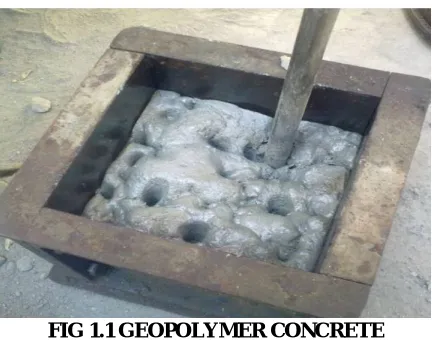
FIG 1.1 GEOPOLYMER CONCRETE
II.DISADVANTAGE OF GEOPOLYMER
difficult to create pre-mix only
geopolymerisation process is sensitive
III. FUTURE TRENDS IN GEOPOLYMER CONCRETE
One current producer has said that it is e asy to make geopolymer and almost any one can do it. However to make large quantities of GPC ,with acceptable properties, at a competitive price, is a very
different matter,
However such GPC needs to reach full industrial scale to be fully cost competitive
A large variety of cement replacement materials and chemical admixtures are already in use
Mix design is shifting from grading curves to nano-technology and natural sand is becoming unavailable in many areas.
V.MATERIALS USED
Fly ash used in this study is low calcium class F Fly ash from Dirk India private limited under the name of the product POZZOCRETE 60. Ground granulated blast furnace slag used is obtained from JSW cements. The chemical and physical properties of GGBFS and Fly Ash used. The most commonly used alkaline activators are a mixture of sodium hydroxide (NaOH) with sodium silicate (Na2SiO3). For preparation of alkaline liquids.Locally available 10 mm and 20
mm crushed aggregates have been used as coarse aggregates and also using Recycled Coarse Aggregate. .The specimens were cast and kept in steel moulds for 1 day as the rest period, and then kept in oven at 900 C for two different period of time viz. 24 h and 48h.
VI. PROPERTIES OF RECYCLED COARSE AGGREGATE
Crushing and abrasion resistance Presence of harmful substance
VII. MIX DESIGN
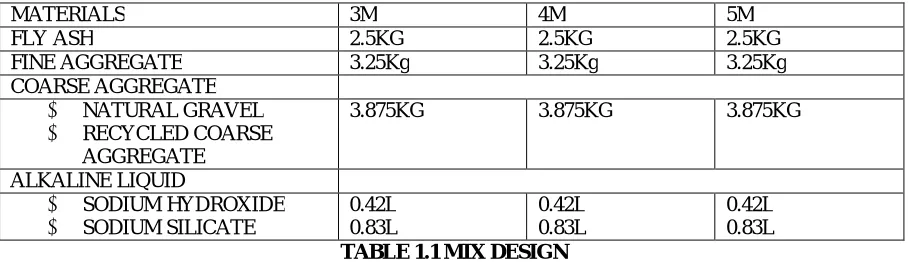
The previous studies on Geopolymer concrete ((Van Chanh Bui et al., 2008; Wallah & Rangan, 2006)) The mix proportion of fly ash: Fine Aggregate: Coarse Aggregate are 1:1.3:3.10 with a solution (NaOH& Na2SiO3 combined together) to fly ash ratio of 0.35. The fly ash, fine aggregates and coarse aggregates were mixed manually in a container and then the alkaline solution was added to prepare the geopolymer concrete. The geopolymer concrete was placed in 150 mm cube moulds in three layers and each layer was compacted by giving 25 blows with a 25mm tamping rod.
Totally 3 molar design mix were used such as Molarity for 3M
Molarity for 4M Molarity for 5M
Manual calculation for molarity
MOLARITY = (molecular wt. of NaOH * number of moles) / Vol
of water
MATERIALS 3M 4M 5M
FLY ASH 2.5KG 2.5KG 2.5KG
FINE AGGREGATE 3.25Kg 3.25Kg 3.25Kg
COARSE AGGREGATE NATURAL GRAVEL RECYCLED COARSE
AGGREGATE
3.875KG 3.875KG 3.875KG
ALKALINE LIQUID
SODIUM HYDROXIDE SODIUM SILICATE
0.42L 0.83L
0.42L 0.83L
VIII. MATERIAL TESTING RESULTS
SIEVE ANALYSIS
FIG 1.2 SIEVE ANALYSIS
Specific gravity of coarse aggregate is found to be 2.8 and as per IS 2386 (part3):1963, the specific gravity of coarse aggregate should be 2.6 to 2.9.
% of water absorption of coarse aggregate= 3.5 % The specific gravity of cement obtained is 3.08. Fineness of cement = 1%
The percentage of water required for obtaining cement paste of standard consistency = 22.5%
IX.TESTING RESULTS
Comparative results for Compression
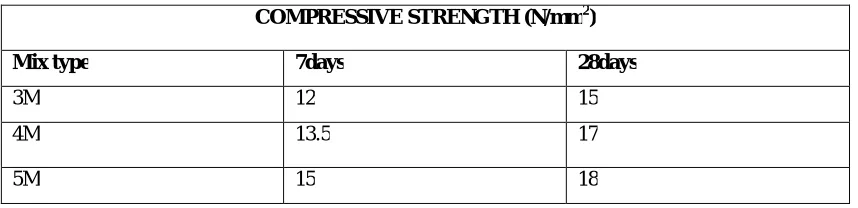
Comparing the results of compression from the 3 type of specimens it is typically found that the mix containing alkaline liquid with partial replacement of recycled coarse aggregate has relatively high strength compared with that of the conventional one. It is clearly observed that even though there is a failure in the three molar concentration but the cubes underwent partial failure rather than complete failure.
COMPRESSIVE STRENGTH (N/mm2)
Mix type 7days 28days
3M 12 15
4M 13.5 17
5M 15 18
29%
46% 18%
6% 1%
% Weight retained
40mm
20mm
12mm
10mm
4.75mm
X.FAILURE STUDY CRAZING
Crazing is a web like series of fine cracks, usually at the surface of the concrete. These can be caused by surface shrinkage, which can occur in low humidity, hot air or sun and wind. Since these crack occur on the surface and do not penetrate deeper into the concrete, they do not indicate deeper structural issue.
X.CONCLUSION
The Geopolymer concrete showed high performance with respect to the strength. The Geopolymer concrete was a good workable mix. High early strength was obtained in the Geopolymer concrete mix. The increase in percentage of fine aggregates and coarse aggregates increased the compressive strength up to the optimum level. This may be due to the high bonding between the aggregates and alkaline solution. The compressive strength was found reduced beyond the optimum mix. This may be due to the increase in volume of voids between the aggregates. The optimum mix is- Fly ash: Fine aggregate: Coarse aggregate are 1:1.3:3.10 with asolution (NaOH& Na2SiO 3combined
together) to fly ash ratio of 0.50. The Geopolymer concrete exhibited high bond strength. The Bond strength of GPC is in the order of about one third of the corresponding compressive strength. The bond strength of GPC is about four times higher than the corresponding standard concrete.
ADVANTAGE
This project is ecofriendly and it does not emit Co2 (carbon dioxide) into the atmosphere.
It will give more strength when compared to normal concrete.
DISADVANTAGE
Manuel preparation of sodium hydroxide it will affect the human beings
When compared to normal concrete geopolymer will need more skills person to handle the preparation.
REFERENCES
1. Rekha Devi .S.K, Sharma, Himmi Gupta , “ AN EXPERIMENTAL STUDY EFFECT OF DIFFERENT CURING CONDITIONS ON
GEOPOLYMER CONCRETE BY PARTIALLY REPLACING SAND WITH FOUNDRY SAND” M. E. (CTM), Civil Engineering, NITTTR, Chandigarh, India Professor, Assistent Professor, Civil engineering Department, NITTTR, Chandigarh, India. DOI:10.15415/jotitt.2015.32008; (2015).
2. S. Divya, T.Nithyanandam, R. Ramasubramani, “AN EXPERIMENTAL INVESTIGATION OF GEO POLYMER CONCRETE WITH
PEBBLES AS COARSE AGGREGATE” International Journal of Innovative Research in Science, Engineering and Technology , ISSN: 2319-8753, Vol. 3, Issue 11, November 2014 .
3. SUDHIR P.PATIL, GANESH S.INGLE, PRASHANT D.SATHE “AN EXPERIMENTAL STUDY ON RECYCLED COARSE
AGGREGATES” , International Journal of Advanced Technology in Civil Engineering, ISSN: 2231 –5721, Volume-2, Issue-1, 2013
4. Preethy K Thomas, Binu M Issac, Deepak John Peter, “AN EXPERIMENTAL ASSESSMENT OF DEMOLISHED CONCRETE AS
COARSE AGGREGATE IN GEOPOLYMER CONCRETE “International Journal of Advance Research in Science and Engineering, ISSN 2319 – 8354 , Vol No. 4, Special Issue (01), September 2015.
5. J. S. Jayalakshmi, Shri N. G.Bhagavan, R.Kumutha, “AN EXPERIMENTAL DEVELOPMENT OF LOW STRENGTH AND GEOPOLYMER
CONCRETE MIX UTILIZING DEMOLISHED AGGREGATE”,International Journal of Advanced Research, ISSN 2320-5407, Volume 4, Issue 4, 1168-1179, year (2016).
6. M.K.Thangamanibindhu, Dr.D.S.Ramachandra Murthy “AN EXPERIMENTAL FLEXURAL BEHAVIOUR OF REINFORCED
GEOPOLYMER CONCRETE BEAMS PARTIALLY REPLACED WITH RECYCLED COARSE AGGREGATES” International Journal of Civil Engineering and Technology (IJCIET), ISSN 0976 – 6308 (Print) ,ISSN 0976 – 6316(Online), Volume 6, Issue 7, July (2015), pp. 12-21.
7. M.I. Abdul Aleem, P.D. Arumairaj, “AN EXPERIMENTAL OPTIMUM MIX FOR THE GEOPOLYMER CONCRETE” Indian Journal of