ISSN(Online): 2319-8753
ISSN (Print): 2347-6710
I
nternational
J
ournal of
I
nnovative
R
esearch in
S
cience,
E
ngineering and
T
echnology
(A High Impact Factor, Monthly Peer Reviewed Journal)
Vol. 5, Issue 2, February 2016
Optimization Algorithms for Generating
Golomb Ruler Sequences – A Comparison
Preet Kamal Singh1, Neena Gupta2
P.G. Student, Department of Electronics Engineering, PEC University of Technology, Chandigarh, India1
Professor, Department of Electronics Engineering, PEC University of Technology, Chandigarh, India2
ABSTRACT: An undesirable nonlinear effect which degrades system performance significantly is acknowledged as
Four Wave Mixing (FWM). In the optical communication systems, the FWM crosstalk is reduced by using unequally spaced channel allocation method. This channel allotment method is constructed on optimal Golomb ruler (OGR) which not only maintains the bandwidth efficiency but also decreases the FWM effect. To generate and optimize Golomb ruler sequence, classic approaches as well as nature- inspired algorithms have been used by various researchers. In this paper, some of the algorithms are reviewed and compared.
KEYWORDS: Channel allocation algorithm, Optimal Golomb ruler, Soft Computing, Firefly algorithm, Ant Colony
Optimization, Cuckoo Search, Genetic algorithm.
I. INTRODUCTION
A method of multiplexing various signals on laser beams at different Infrared (IR) wavelengths for transmission along optical fiber media is known as wavelength-division multiplexing (WDM). In standard WDM systems, center frequencies which are equally spaced from each other determine the allocation of channels. Due to this, the noise (like FWM) has large possibility that they may enter into the equally spaced channels which results in severe crosstalk [1]. The definition of Four-Wave Mixing states it as an intermodulation phenomenon in non-linear optics, in which two extra wavelengths are produced by interactions between two wavelengths in the signal.
The fourth wavelength (f4) is generated when the fourth photon is produced by the scattering of the incident photons. For input frequencies f1, f2 and f3, the non-linear system will generate
±f1±f2±f3
Due to this, the three co-propagating waves produce nine new optical waves [2].And the most deteriorating signals to the working of system are calculated as:
fijk = fi + fj – fk, where i,j ≠ k, because these frequencies will be in close proximity to the input frequencies. To improve the performance, the FWM generation is avoided at the channel frequencies.
FWM can be alleviated by employing uneven channel spacing or a fiber that increases dispersion [3], [4].
It can be seen that FWM is suppressed if any two channels use different frequency spacing than other two channels in a WDM system [5]-[8].
However, using unequal channel spacing increases the required bandwidth in contrast to equal spaced channel allocation.
ISSN(Online): 2319-8753
ISSN (Print): 2347-6710
I
nternational
J
ournal of
I
nnovative
R
esearch in
S
cience,
E
ngineering and
T
echnology
(A High Impact Factor, Monthly Peer Reviewed Journal)
Vol. 5, Issue 2, February 2016
II. RELATEDWORK
Vrizlynn L. L. Thing et. al. [5], proposed a channel allocation method which was based on fractional optimal Golomb ruler that allows suppression of FWM crosstalk in WDM systems while maintaining the bandwidth efficiency. Through this scheme an average bit–error rate improvement factor of 1.336 for an 8–channel WDM system was achievable. Shobhika [32], proposed that how Genetic Algorithm can be used to solve the problem of OGR sequences and compare the results obtained from GA in terms of ruler length and bandwidth with the two classical approaches i.e. EQC and SA proposed in [11] and [12]. From simulation results she concluded that the results obtained from Genetic Algorithm, approaches to optimal after a number of iterations.
N. Ayariet. al. [22], presented that by using exact methods, many months on thousands computers are necessary to prove the optimality of a large rulers. To deal with this, they proposed a hybrid Genetic Algorithm combined with a local search to find optimal and near–optimal Golomb rulers to reduce the search space exploration. The hybrid GA algorithm incorporates a Tabu Search as a mutation operator. The advantage of this approach was to diversify solutions with the crossover operator in GA and improve these solutions with the TS. In fact, this hybrid algorithm allowed increasing the performance in terms of effectiveness of approximate methods.
S. Sugumaran et al. [12], implemented a DWDM system using opt–sim software to evaluate bit error rate (BER) and Q–factor in the presence of FWM under the impact of equal and unequal channel spacing. They also implemented a channel allocation method based ontwo classical computing algorithms i.e. Exhaust algorithm and Search algorithm to construct the Golomb ruler sequences in order to suppress the FWM crosstalk in MATLAB.
S. Bansalet. al.in [13] applies two soft computing based approaches i.e. GA and BBO to generate OGR sequences for various marks. From the simulation results they concluded that BBO/GA outperforms the two existing classical algorithms i.e. EQC and SA.
III.OPTIMAL GOLOMB RULER
The concept of Golomb Rulers’ was proposed by W.C. Babcook [9] in 1952 and developed by Professor Solomon W. Golomb [10] in 1977.
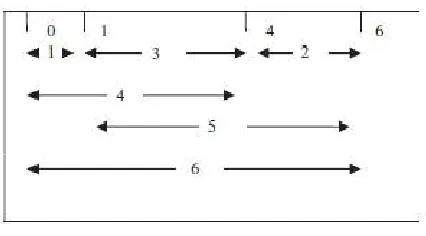
The phrase “Golomb ruler” [25] denotes a set of positive integer values, where any two numbers from the set consisting of different pairs do not have the same difference. An illustration of the Golomb ruler is shown in Figure 1 [2]. An Optimal Golomb Ruler depends on given number of marks and is the shortest ruler possible[6].
Fig.1 Perfect Golomb Ruler
Fig. 1 shows a Perfect Golomb ruler which measures the distances {1, 2, 3, 4, 5, 6}. A Golomb ruler with n marks
measures exactly
(
−
1)
distances. When these distances are exactly the first ( −1)positive integers, we have a perfect Golomb ruler.
ISSN(Online): 2319-8753
ISSN (Print): 2347-6710
I
nternational
J
ournal of
I
nnovative
R
esearch in
S
cience,
E
ngineering and
T
echnology
(A High Impact Factor, Monthly Peer Reviewed Journal)
Vol. 5, Issue 2, February 2016
A g-mark Golomb ruler is a collection of g discrete non negative integers (p1, p2, .., pg) defined as marks, where the positive differences |pi-pj|, calculated on the whole possible pairs of distinct i, j = 1,… g with i≠j are dissimilar. Assume
pg be the biggest integer in a g-mark Golomb ruler. Then g-mark Golomb ruler exists if
1. Another g-mark Golomb ruler with smaller largest mark pg is nonexistent.
2. The ruler should be smaller of the comparable rulers (0, p2,….,pg) and(0,...., pg–p2,pg), when written in canonical form where the first conflicting entry is smaller than the equivalent entry in the other ruler.
IV.ALGORITHMSTOGENERATEGOLOMBRULER
Various algorithms used to create Golomb ruler sequences are discussed in this section. The two basic approaches are classical and soft computing. The classical approach is used to create exact sequences whereas the soft computing approach is used to create optimal sequences in a feasible time. Due to this reason various metaheuristic algorithms are employed to resolve optimization problems proficiently. Of all the algorithms, those inspired by nature give better results.
A. Exhaust Algorithm (EA)
Exhaust algorithm requires two parameters for the generation procedure. Firstly, the number of marks contained in the desired Golomb ruler and the second parameter confines the length of the Golomb ruler. This procedure is recursive in nature. An existing N-mark Golomb ruler is chosen and a new mark, to the right side of the ruler, is added resulting in N+1 mark ruler [12]. This procedure does not keep track of the mark position but the spaces between the adjacent marks stored in arrays are traced and are called spaces. These values make the first row of the difference triangle for the ruler. The algorithm starts by initializing the first elements in the spaces to the distance. Then it progresses to the next distance and starting at a value of 1, increments this value until the distances measured by the first two entries are unique. Then the process is repeated for the next element and so on. If the total distance, at any point, measured by these elements exceeds the maximum ruler length then the algorithm will back up one element and increment that element and add new distances from there. When the last mark is placed and a ruler of desired length is found, it prints this information and continues the search.
B. Search Algorithm (SA)
The search algorithm is used to generate optimal sequences for a given Prime number P and minimum pulse separation m.
N = P + 1 and S = (m + (P – 1) / 2) P, where N denotes the number of terms in the sequence and S is the maximum length of the slot vector [11].
1. If a prime number is denoted by P and minimum pulse separation m, the initial delay vector n1 = [n0, n1,.., nP_1] = [m, m+1, y, m+P-1] is built.
2. The jth delay vector nj =[l0, l1 ,…., lk,.., lP-1] for j ={1, 2,3,..., P-1} are generated with lk = nj⊗k, where ⊗
denotes modulo-P-multiplication.
3. The jth code word sj=[s0, s1, s2,..., sq,.…, sP] with weight P+1 are created from nj, according to the rule sq = lq-1+sq-1 where q = {1,2, 3,..., P} and s0 = 0.
4. At last, the code words sj’s with aperiodic correlation constraint one are found.
C. Genetic Algorithm (GA)
ISSN(Online): 2319-8753
ISSN (Print): 2347-6710
I
nternational
J
ournal of
I
nnovative
R
esearch in
S
cience,
E
ngineering and
T
echnology
(A High Impact Factor, Monthly Peer Reviewed Journal)
Vol. 5, Issue 2, February 2016
genetics for creating a new set of approximations. This procedure directs to the advancements of populations of entities which befits to their surroundings than the entities that were originate from, just as in natural adaptation [25], [22], [24].
D. Biogeography based optimization (BBO)
Biogeography Based Optimization is a population based evolutionary algorithm (EA) developed for global optimization. To unravel the optimization problem, algorithm apes the migration strategy of species [26]-[31]. Biogeography concept suggests that immigration and emigration mainly determines the number of species located on habitat. In BBO, islands correspond to problem solutions and emigration and immigration symbolize the distribution of attributes. The term island represents a habitat which is secluded from other habitats geographically [21]. Biogeography corresponds to nature’s way of problem solving. An island with high Habitat Suitability Index (HSI) is similar to a good solution and a poor solution denotes an island with a low HSI [13].
E. Firefly Algorithm (FA)
Firefly Algorithm is a metaheuristic algorithm inspired by nature which is based on the movement and activities of fireflies [15]. It is described using three ideal rules:
1. All fireflies will be attracted to other fireflies as they are thought to be unisex.
2. Attraction is determined by their brightness. Therefore, the brighter one with attract the less bright one. Attraction decreases as the distance between the fireflies decreases. If there is no brighter firefly in the surrounding area, then that individual firefly will move randomly.
3. The brightness of a firefly is correlated with an objective function. For a maximization problem, the brightness is basically relational to value of objective function [15]-[16].
F. Ant Colony Optimization (ACO)
Ant colony Optimization uses positive feedback principle of pheromone to find optimal path. At the preliminary stage, pheromone concentration is not there in any paths. So, an ant will select a random path and places some quantity of pheromone all over the path they have traced [14]. Therefore, each path has disproportionate amount of pheromone and an ant can select the path based on the amount. Generally the path with highest concentration is chosen and after selecting the ant will intensify the pheromone concentration in that path during its course.
As the amount if pheromone increases in a path, more the possibility of ants to select that path, thus strengthens the concentration. Finally, all ants will join the selected path and it finds the optimal path [17]
G. Bat Algorithm (BA)
Bat algorithm as the name defines is inspired from bats based on the echolocation behaviour of bats with loudness and varying pulse emission [16]. Bats sense the distance using echolocation which also allows them to distinguish between prey and object. Bats produce pulses with maximum loudness for searching food. Once the bat finds the prey, it minimizes (usually zero) the loudness in order to avoid the loss of prey. Also, the pulse emission rate increases as the bat gets closer to prey and when the prey is found, the pulse emission rate becomes maximum [18].
H. Cuckoo Search Algorithm (CSA)
The Cuckoo Search Algorithm (CSA) is a Swarm Intelligence based metaheuristic population-based nature inspired optimization algorithm in which a nest denotes the pattern and each specific feature of the pattern relates to the bird egg [16]. Cuckoo bird uses other birds’ nest to lay their eggs. This algorithm is able to remove noise from the network efficiently by training the network [19]. The cuckoo’s egg is regarded as the solution for preferred object function. For simplicity, only one egg is there in a nest.The three ideal rules are given below:
ISSN(Online): 2319-8753
ISSN (Print): 2347-6710
I
nternational
J
ournal of
I
nnovative
R
esearch in
S
cience,
E
ngineering and
T
echnology
(A High Impact Factor, Monthly Peer Reviewed Journal)
Vol. 5, Issue 2, February 2016
2. The best nest, which has high quality eggs (solution) are carried over to the next generations.
3. If the host bird finds the alien egg, it can either discard the egg or simply vacate the nest to make an entirely new nest in a new location [18].
V. ALGORITHMCOMPARISON
The algorithms are classified on the basis of approaches i.e. Exhaust and search algorithms are based on classical approach whereas Genetic and Biogeography Based Optimization algorithms are based on Soft Computing approach. The rest four algorithms – Firefly, ACO, Bat and Cuckoo search algorithm are nature inspired which have various features matching with the natural species. The Search Algorithm is better than the Exhaust Algorithm as it requires less computational time and bandwidth. Soft computing approaches show a significant improvement with respect to bandwidth and ruler length than classical approaches. Firefly algorithm is very dominant and it has a high rate of concurrence. It has very low running time and its success rate is high.
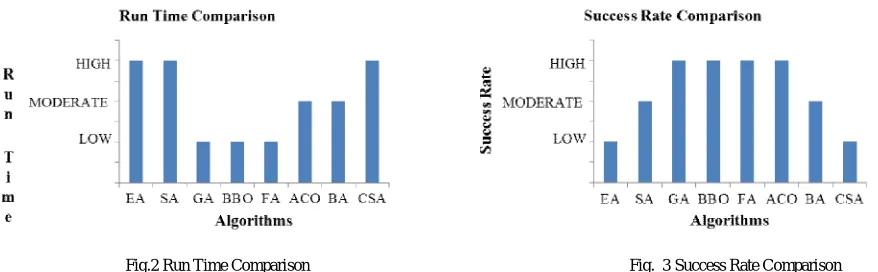
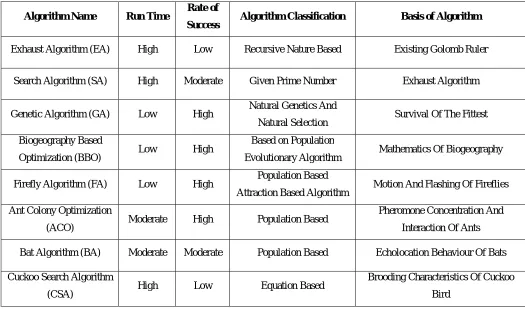
Comparison is done by using different parameters such as Running time, Success rate, Algorithm basis and classification. The comparison is given in TABLE I. Graphical comparison of Run time and success rate is shown in Fig. 2 and 3 respectively. Exhaust algorithm depends on the existing Golomb ruler to generate exact golomb ruler and Search algorithm depends on the Exhaust algorithm. Genetic Algorithm measures the survival of the fittest technique for generation of optimal Golomb ruler and Biogeography Based Optimization uses mathematics of Biogeography for generating OGR. Rest of the algorithms uses natural species behaviour to construct the Golomb ruler.
Fig.2 Run Time Comparison Fig. 3 Success Rate Comparison
Fig. 2 shows the Run time comparison between the different algorithms. It has been found that GA, BBO and FA have least run time as compared with other algorithms.
ISSN(Online): 2319-8753
ISSN (Print): 2347-6710
I
nternational
J
ournal of
I
nnovative
R
esearch in
S
cience,
E
ngineering and
T
echnology
(A High Impact Factor, Monthly Peer Reviewed Journal)
Vol. 5, Issue 2, February 2016
TABLE IComparison of Algorithms
Algorithm Name Run Time Rate of
Success Algorithm Classification Basis of Algorithm
Exhaust Algorithm (EA) High Low Recursive Nature Based Existing Golomb Ruler
Search Algorithm (SA) High Moderate Given Prime Number Exhaust Algorithm
Genetic Algorithm (GA) Low High Natural Genetics And
Natural Selection Survival Of The Fittest
Biogeography Based
Optimization (BBO) Low High
Based on Population
Evolutionary Algorithm Mathematics Of Biogeography
Firefly Algorithm (FA) Low High Population Based
Attraction Based Algorithm Motion And Flashing Of Fireflies
Ant Colony Optimization
(ACO) Moderate High Population Based
Pheromone Concentration And
Interaction Of Ants
Bat Algorithm (BA) Moderate Moderate Population Based Echolocation Behaviour Of Bats
Cuckoo Search Algorithm
(CSA) High Low Equation Based
Brooding Characteristics Of Cuckoo
Bird
Table 1 shows the comparison of algorithms on the basis of run time, rate of success, classification and basis of algorithm.
VI. CONCLUSION
From the comparisons of the algorithms, it is clear that based on application the algorithm is chosen to give the best performance. To Find OGR sequences using classical approaches is a complicated method which sprouts in size as the size of mark increases. To solve this problem, the soft computing methods are designed which gives near optimal results under the limitations of given cost and time. Using these algorithms, it is seen that there is noteworthy improvement in Bandwidth requirement and ruler length.
REFERENCES
[1] W.C. Kwong, G.-C. Yang, “An algebraic approach to the unequal-spaced channel-allocation problem in WDM lightwave systems”, IEEE Trans. Commun. 45pp. 352–359, March 3, 1997.
[2] F. Forghieri, R.W. Tkach, A.R. Chraplyvy, “WDM systems with unequally spaced channels”, J. Lightwave Technol. 13 (5) pp. 889–897, 1995. [3] A.R. Chraplyvy, “Limitations on lightwave communications imposed by optical-fiber nonlinearities”, J. Lightw. Technol. 8 pp. 1548–1557,
October 10, 1990.
[4] G.P. Aggarwal, “Nonlinear Fiber Optics”, second ed., Academic Press, San Diego,CA, 2001.
[5] V.L.L. Thing, P. Shum, M.K. Rao, “Bandwidth-efficient WDM channel allocationfor four-wave mixing-effect minimization”, IEEE Trans. Commun. 52 pp. 2184–2189, December 12, 2004.
ISSN(Online): 2319-8753
ISSN (Print): 2347-6710
I
nternational
J
ournal of
I
nnovative
R
esearch in
S
cience,
E
ngineering and
T
echnology
(A High Impact Factor, Monthly Peer Reviewed Journal)
Vol. 5, Issue 2, February 2016
[7] F. Forghieri, R.W. Tkach, A.R. Chraplyvy, D. Marcuse, “Reduction of four-wavemixing crosstalk in WDM systems using unequally spaced channels”, IEEE Pho-ton. Technol. Lett. 6 pp. 754–756, June 6, 1994.
[8] W. Babcock, “Intermodulation interference in radio systems”, Bell Syst. Tech. J. pp. 63–73, 1953.
[9] O.K. Tonguz, B. Hwang, “A generalized suboptimum unequally spaced channelallocation technique – Part II: in coherent WDM systems”, IEEE Trans. Commun.46 pp. 1186–1193, September 9, 1998.
[10] M.D. Atkinson, N. Santoro, J. Urrutia, “Integer sets with distinct sums and differ-ences and carrier frequency assignments for nonlinear repeaters”, IEEE Trans.Commun. COM-34, June 1986.
[11] Rajneesh Randhawa, J.S. Sohal, R.S. Kaler, “Optimum algorithm for WDM channel allocation for reducing four-wave mixing effects”, Optik 120 pp. 898–904, March 2008.
[12] S Sugumaran, Neeraj Sharma, SourabhChitranshi, Nischya Thakur, P Arulmozhivarman, “Effect of Four-wave Mixing on WDM System and its Suppression Using Optimum Algorithms”, International Journal of Engineering and Technology (IJET) Vol 5 No 2 Apr-May 2013. [13] ShonakBansal, “Optimal Golomb ruler sequence generation for FWM crosstalkelimination: Soft computing versus conventional approaches”,
Applied Soft Computing 22 pp. 443–457, 2014.
[14] Deepthi S, AswathyRavikumar, “A Study from the Perspective of Nature-Inspired Metaheuristic Optimization Algorithms”, International Journal of Computer Applications (0975 – 8887) Volume 113 – No. 9, March 2015
[15] Tang Rui, Simon Fong, Xin-She Yang and Suash Deb, “Nature-inspired Clustering Algorithms for Web Intelligence Data,” pp. 978-0-7695-4880-7 vol. 12, 2012.
[16] Sankalp Arora, Satvir Singh, “A Conceptual Comparison of Firefly Algorithm,Bat Algorithm and Cuckoo Search,”pp. 978-1-4799-1375, 2013. [17] KuangXiangling and Huang Guangqiu, “An Optimization Algorithm Based on Ant Colony Algorithm,” 2012.
[18] KunjaBihari Swain, S.S Swalanki and Asim Kumar mahakula, “Bio Inspired Cuckoo Search Algorithm Based Neural Network and its Application to Noise Cancellation,” pp.4799-2866, 2014.
[19] SiddharthAgarwal, Amrit Pal Singh, NitinAnand, “Evaluation performance study of firefly algorithm, particle-swarm optimization and artificial bee colony algorithm for non-linear mathematical optimization function”, ICCCNT, 2013.
[20] A. Dollas, W.T. Rankin, D. McCracken, “A new algorithm for Golomb ruler deriva-tion and proof of the 19 mark ruler”, IEEE Trans. Inform. Theory 44 pp. 379–382, January 1, 1998.
[21] D. Simon, M. Ergezer, D. Du, “Population distributions in biogeography-based optimization algorithms with elitism, in: Proceedings of the 2009 IEEEInternational Conference on Systems”, Man, and Cybernetics, October, San Anto-nio, TX, USA, pp. 991–996, 2009.
[22] N. Ayari, T. Van Luong, A. Jemai, “A hybrid genetic algorithm for Golomb rulerproblem”, in: ACS/IEEE International Conference on Computer Systems andApplications (AICCSA 2010), 16–19, pp. 1–4, May, 2010.
[23] S. Rajasekaran, G.A. VijayalakshmiPai, “Neural Networks, Fuzzy Logic, andGenetic Algorithms – Synthesis and Applications”, Prentice Hall of India Pvt.Ltd., New Delhi, 2004.
[24] M. Mitchell, “An Introduction to Genetic Algorithms”, Prentice Hall of India Pvt.Ltd., New Delhi, 2004.
[25] D.E. Goldberg, “Genetic Algorithms in Search, Optimization, and Machine Learning”, Addison Wesley, USA, 1989.
[26] H. Mo, L. Xu, “Biogeography based optimization for travelling salesman problem”,in: Sixth International Conference on Natural Computation (ICNC 2010), vol. 6, pp. 3143–3147, August, 2010.
[27] D. Simon, M. Ergezer, D. Du, R. Rarick, “Markov models for biogeography-based optimization”, IEEE Trans. Syst. Man Cybern. B: Cybern. 41 pp. 299–306, January 1, 2011.
[28] S. Kumar, P. Bhalla, A. Singh, “Fuzzy rule base generation Part II: a BBO approach”,in: Proceedings of the Workshop on Intelligent System Engineering (WISE-2010), July, Institute of Science & Technology, Klawad, pp. 83–91, 2010.
[29] S. Kumar, P. Narula, T. Ahmed, “Knowledge extraction from numerical data forthe Mamdani type fuzzy systems: a BBO approach”, in: Innovative Practices inManagement and Information Technology for Excellence, Jagadhri, India, May2010.
[30] H. Ma, S. Ni, M. Sun, “Equilibrium species counts and migration model trade-offs for biogeography-based optimization”, in: IEEE Conference on Decision andControl, Shanghai, pp. 3306–3310, December, 2009.
[31] H. Ma, “An analysis of the equilibrium of migration models for biogeography-based optimization”, information sciences, Inform. Sci. 180 pp. 3444–3464, September 18, 2010.