Population Structure With Localized Haplotype Clusters
Sharon R. Browning*
,1and Bruce S. Weir
†*Department of Statistics, University of Auckland, Auckland 1142, New Zealand and†Department of Biostatistics, University of Washington, Seattle, Washington 98195
Manuscript received March 15, 2010 Accepted for publication April 28, 2010
ABSTRACT
We propose a multilocus version ofFSTand a measure of haplotype diversity using localized haplotype clusters. Specifically, we use haplotype clusters identified with BEAGLE, which is a program implementing a hidden Markov model for localized haplotype clustering and performing several functions including inference of haplotype phase. We apply this methodology to HapMap phase 3 data. With this haplotype-cluster approach, African populations have highest diversity and lowest divergence from the ancestral population, East Asian populations have lowest diversity and highest divergence, and other populations (European, Indian, and Mexican) have intermediate levels of diversity and divergence. These relationships accord with expectation based on other studies and accepted models of human history. In contrast, the population-specificFSTestimates obtained directly from single-nucleotide polymorphisms (SNPs) do not reflect such expected relationships. We show that ascertainment bias of SNPs has less impact on the proposed haplotype-cluster-basedFSTthan on the SNP-based version, which provides a potential expla-nation for these results. Thus, these new measures of FSTand haplotype-cluster diversity provide an important new tool for population genetic analysis of high-density SNP data.
G
ENOME-WIDE data sets from worldwide panels of individuals provide an outstanding opportunity to investigate the genetic structure of human popula-tions (Conrad et al. 2006; International Hapmap Consortium2007; Jakobssonet al. 2008; Autonet al. 2009). Populations around the globe form a contin-uum rather than discrete units (Serreand Paabo2004; Weiss and Long2009). However, notions of discrete populations can be appropriate when, for example, an-cestral populations were separated by geographic dis-tance or barriers such that little gene flow occurred.FST (Wright 1951; Weir and Cockerham 1984;
Holsingerand Weir2009) is a measure of population divergence. It measures variation between populations vs.within populations. One can calculate a global mea-sure, assuming that all populations are equally diverged from an ancestral population, or one can calculateFST
for specific populations or for pairs of populations while utilizing data from all populations (Weir and Hill 2002). One use ofFSTis to test for signatures of selection
(reviewed in Oleksyket al. 2010).
FSTmay be calculated for single genetic markers. For
multiallelic markers, such as microsatellites, this is use-ful, but single-nucleotide polymorphisms (SNPs)
con-tain much less information when taken one at a time, and thus it is advantageous to calculate averages over windows of markers (Weiret al. 2005) or even over the whole genome. The advantage of windowedFSTis that
it can be used to find regions of the genome that show different patterns of divergence, indicative of selective forces at work during human history.
Another measure of human evolutionary history is haplotype diversity. Haplotype diversity may be measured using a count of the number of observed haplotypes in a region or by the expected haplotype heterozygosity based on haplotype frequencies in a region. Application of this regional measure to chromosomal data can be achieved by a haplotype block strategy (Patilet al. 2001) or by windowing (Conradet al. 2006; Autonet al. 2009).
One problem with the analysis of population struc-ture based on genome-wide panels of SNPs is that a large proportion of the SNPs were ascertained in Caucasians, potentially biasing the results of the analyses. Analysis based on haplotypes is less susceptible to such bias (Conradet al. 2006). This is because haplotypes can be represented by multiple patterns of SNPs; thus lack of ascertainment of a particular SNP does not usually pre-vent observation of the haplotype. On a chromosome-wide scale, one cannot directly use entire haplotypes, because all the haplotypes in the sample will almost certainly be unique, thus providing no information on population structure. Instead one can use haplotypes on a local basis, either by using windows of adjacent markers or by using localized haplotype clusters, for Supporting information is available online athttp://www.genetics.org/
cgi/content/full/genetics.110.116681/DC1.
1Corresponding author:Department of Statistics, University of Auckland,
Private Bag 92019, Auckland 1142, New Zealand. E-mail: [email protected]
example those obtained from fastPHASE (Scheetand Stephens2006) or BEAGLE (Browning2006; B rown-ingand Browning2007a).
Localized haplotype clusters are a clustering of haplotypes on a localized basis. At the position of each genetic marker, haplotypes are clustered according to their similarity in the vicinity of the position. Both fastPHASE and BEAGLE use hidden Markov modeling to perform the clustering, although the specific models used by the two programs differ.
Localized haplotype clusters derived from fastPHASE have been used to investigate haplotype diversity, to create neighbor-joining trees of populations, and to create multidimensional scaling (MDS) plots (Jakobssonet al. 2008). It was found that haplotype clusters showed different patterns of diversity to SNPs, while the neigh-bor-joining and MDS plots were similar between haplo-type clusters and SNPs.
In this work, we apply windowed FST methods to
localized haplotype clusters derived from the BEAGLE program (Browning and Browning 2007a,b, 2009). We consider population-average, population-specific, and pairwise FST estimates (Weir and Hill 2002). Population-averageFST’s either assume that all the
pop-ulations are equally diverged from a common ancestor, which is not realistic, or represent the average of a set of population-specific values. This can be convenient in that the results are summarized by a single statistic; however, information is lost. A common procedure is to calculateFSTfor each pair of populations, and these
values reflect the degree of divergence between the two populations. Different levels of divergence are allowed for each pair of populations but each estimate uses data from only that pair of populations. On the other hand, population-specific FST’s allow unequal levels
of divergence in a single analysis that makes use of all the data.
We compare results from the localized haplotype clus-ters to those using SNPs directly. The results of apply-ing localized haplotype clusters to population-specific FSTestimation are very striking, showing better
separa-tion of populasepara-tions and a more realistic pattern of di-vergence than for population-specific FST estimation
using SNPs directly. We also use BEAGLE’s haplotype clusters in a haplotype diversity measure and investigate the relationship between this measure of haplotype-cluster diversity and the recombination rate.
METHODS
Data: We analyzed data from phase 3 of the
Inter-national HapMap Project (International Hapmap Consortium2005, 2007). As the full analysis of these data had not been published at the time this study was performed, we restricted our attention to chromo-some 22 and to two regions of interest: the lactase gene (LCT) and the 8p23 inversion (Antonacciet al. 2009). Samples from 11 populations are represented in the HapMap3 data; population labels and descriptions are given in Table 1.
We downloaded chromosomes 2, 8, and 22 of the draft 2 phase 3 HapMap in nonredundant HapMap format fromwww.hapmap.orgin January 2009. We used only those SNPs that were genotyped in all populations (13,875 SNPs on chromosome 22). In any trio or parent–offspring pair with Mendelian inconsistency at a SNP, we set as missing all the genotypes for all individuals in the trio or pair for that marker. Genetic (centimorgan) positions were also obtained from phase II HapMap (InternationalHapmapConsortium2007).
Imputation of missing genotypes and haplotype
phase: We used BEAGLE version 3.0 (Browningand
Browning2007b, 2009) to impute missing genotypes TABLE 1
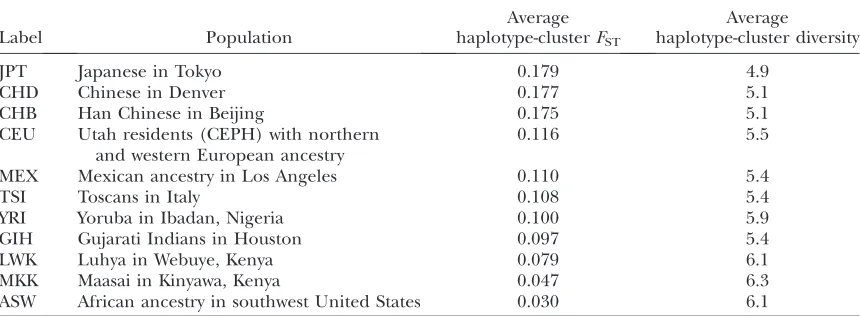
HapMap3 population descriptions and chromosome 22 average values of population-specific haplotype-clusterFSTand haplotype-cluster diversity
Label Population
Average haplotype-clusterFST
Average
haplotype-cluster diversity
JPT Japanese in Tokyo 0.179 4.9
CHD Chinese in Denver 0.177 5.1
CHB Han Chinese in Beijing 0.175 5.1
CEU Utah residents (CEPH) with northern and western European ancestry
0.116 5.5
MEX Mexican ancestry in Los Angeles 0.110 5.4
TSI Toscans in Italy 0.108 5.4
YRI Yoruba in Ibadan, Nigeria 0.100 5.9
GIH Gujarati Indians in Houston 0.097 5.4
LWK Luhya in Webuye, Kenya 0.079 6.1
MKK Maasai in Kinyawa, Kenya 0.047 6.3
ASW African ancestry in southwest United States 0.030 6.1
and estimate haplotype phase. For related individuals (mother–father–child trios or parent–offspring pairs), we used the pedigree information to increase the accuracy of the imputation/phasing (Browning and Browning2009). All individuals were combined in the imputation and phasing analysis. This had two purpo-ses. First, BEAGLE performs better with a larger sample size, although its performance in simultaneous analysis of individuals from multiple populations has not been examined in detail. Second, if the imputation and haplotype phase inference were performed separately for each population, this could bias the inferred results to further separate the populations, potentially leading to inference of differences between populations when none exist. In contrast, when all populations are analyzed simultaneously, the bias is toward the average of all populations, which is of less serious consequence. See, for example, Balding(2006) for a brief discussion of separatevs.combined phasing of cases and controls in case–control studies. On the other hand, pooling of populations for phasing could be problematic in that patterns of linkage disequilibrium (LD) differ substan-tially between populations, and the pooled population would not be in Hardy–Weinberg equilibrium. Thus, we also performed supplementary analyses in which each population was phased separately using BEAGLE. It will be seen that phasing the data together or separately does not have any notable effect on the results. After haplotyping, parent–offspring trios were reduced to the four parental haplotypes, parent–offspring pairs were reduced to three haplotypes (the child’s two haplotypes plus the parent’s nontransmitted haplotype), and un-related individuals each contributed two haplotypes.
Haplotype clusters: Beginning with phased
haplo-types with no missing data, obtained using the methods described above, we built a localized haplotype cluster model (Browning 2006) using BEAGLE version 3.0. We do not dwell on the construction of the cluster model here; details can be found in previous work (Browningand Browning2007a). We used the default option that gives the version of the model that we have used for multilocus association testing (Browningand Browning2007a).
After fitting the localized haplotype cluster model, as described above, each haplotype is a member of one ‘‘localized haplotype cluster’’ state (Browning2006; Browningand Browning2007a) at each marker posi-tion. Figure 1 depicts the clusters obtained for the LCT gene. Note that the haplotypes are clustered at each marker position. Figure 2 shows the specific haplotypes contained in four of the clusters. Each haplotype within a haplotype cluster with marker position at SNP x has the same allele at SNP x; however, two haplotypes within the cluster may have differing alleles at other SNPs. In general, haplotypes within the same cluster will tend to have the same allele at SNPs near the marker position of the cluster. For example, in Figure 2, SNP 12 (rs12988076) is the SNP defining the cluster location, and all haplotypes within a cluster share the same allele at this SNP. Moreover, SNPs around SNP 12 also tend to be shared within each cluster. In cluster 1 we see that SNPs 8–19 are identical for all haplotypes, while some differences are seen at SNPs that are farther away.
FSTestimation:We estimated population-averageFST
using the method of Weirand Cockerham(1984), as Figure 1.—Plot of haplotype clusters in the
follows. Letrbe the number of populations sampled, and letnibe the number of haplotypes in the sample
from populationi(note that in our data all missing data are imputed, so there is no dependence of this value on genetic markerl). For genetic markerl, letnlij be the
number of copies of allelejin individuals sampled from population i, and let ˜plij ¼nlij=ni be the sample allele
frequency of allele j in population i. Similarly, for haplotype clusters, at the position corresponding to genetic marker l, let nlij be the number of sampled
haplotypes from population i that are in haplotype clusterj, and let˜plij ¼nlij=nibe the sample frequency of
haplotype clusterjin populationi.
We define the adjusted population sample size
nci ¼ni
n2i
Pr
i¼1ni
;
which has adjusted average
nc¼
Pr
i¼1nci r1 :
We also obtain the weighted average frequency for each allele or haplotype cluster,
plj ¼
Pr
i¼1ni˜plij
Pr
i¼1ni
:
We form mean squares among (MSA) and within (MSW) populations
MSAlj ¼
Pr
i¼1nið˜plijpljÞ2
r1
MSWlj ¼
Pr
i¼1ni˜plijð1˜plijÞ
Pr
i¼1ðni1Þ
:
The population-averageFSTis estimated by
ˆ u¼
P l
P
jðMSAlj MSWljÞ P
l P
j MSAlj1ðnc1ÞMSWlj
;
where the sums are over loci and alleles or haplotype clusters within the current window.
For SNP-based analysis, windows are defined by the chromosomal positions of the SNPs. For haplotype clusters, each haplotype cluster has a corresponding marker (SNP), the chromosomal position of which we use as the position of the haplotype cluster.
We calculated pairedFSTfor a pair of populations by
con-sidering only the samples from the two populations and applying the population-average FST estimator ˆu given
above.
We calculated population-specificFSTusing the method
of Weirand Hill(2002). Following the notation above, the estimated population-specificFSTfor populationiis
ˆ
bi¼1 ðr1Þ
P l
P
jnc˜plijð1˜plijÞni=ðni1Þ P
l P
j
Pr
i¼1 nið˜plijpljÞ21nci˜plijð1˜plijÞ
h i:
When calculating FSTestimates for SNPs, we made
use of the phased haplotype data rather than the raw Figure 2.—Haplotype clusters in the LCT
genotype data. We did not utilize the phase information directly, but did make use of the imputed sporadic miss-ing genotypes and the reduction to unrelated haplo-types from the trio and parent–offspring pair data.
RESULTS
Haplotype-cluster FST: Figure 3 shows
population-specific FST values for each HapMap3 population in
sliding windows of 5 Mb along chromosome 22, while the third column of Table 1 shows the chromosome-averaged values of population-specific haplotype-cluster FST. The corresponding results for data phased separately
by population are given in supporting information,
Figure S2andTable S1, but are virtually indistinguishable from the results for data phased together shown in Figure 3 and Table 1. The striking feature of the results is that the haplotype-cluster approach (Table 1 and left panel of Figure 3) separates the ethnicities into broad geographic origins, with Africans (Yoruba in Ibadan, Nigeria, YRI; Luhya in Webuye, Kenya, LWK; Maasai in Kinyawa, Kenya, MKK; and African ancestry in southwest United States, ASW) least diverged from the average or ancestral population; East Asians (Japanese in Tokyo, JPT; Chinese in Denver, CHD; and Han Chinese in Beijing, CHB) most diverged; and Europeans [Utah residents (CEPH) with northern and western European ancestry, CEU; Toscans in Italy, TSI], Mexicans (MEX), and Gujarati (GIH) intermediate, as we would expect from other studies of human genetic demography (Prugnolleet al. 2005). In contrast, the SNP-based estimates (right panel of Figure 3) are mixed together with no obvious meaning-ful pattern. The YRI, JPT/CHB, and CEU data from the right panel of Figure 3 have a similar pattern to the chromosome 22 panel of Figure 4 in Weiret al. (2005), which was based on HapMap phase I data. The East Asian populations show an increase in divergence37–41 Mb. We are not aware of any known targets of selection in this region; however, a cluster of extreme integrated
haplo-type score (iHS) values was found at 38.0 Mb in HapMap phase I data (Voightet al. 2006).
FSTanalysis of genetic markers can be affected by the
marker ascertainment scheme. A high proportion of SNPs in the HapMap3 data were ascertained from Caucasian individuals. Thus, SNPs with very low minor allele frequency (MAF) in Caucasians, but high MAF in some other populations will be underrepresented. To investigate the effect that this type of ascertainment has on theFSTestimates, we ran additional analyses in which
we first removed all markers with MAF , 0.05 in the CHB HapMap3 sample data. On chromosome 22, this reduced the number of SNPs from 13,875 down to 12,480. We then recalculated the population-specific FSTestimates, averaging over the whole of chromosome
22, and looked at the difference between these values and the original estimates. For the SNP-based results, the differences ranged from0.021 to 0.049, with mean absolute difference (over the 11 populations) of 0.022. For the haplotype cluster results, the differences ranged from 0.012 to 0.021, with mean absolute difference of 0.009. Thus the haplotype cluster results were less changed by the added ascertainment than were the based results. Not surprisingly, for both the SNP-based and the haplotype cluster results, the African populations had the largest decreases in estimatedFST
resulting from the ascertainment, while the East Asian populations had the largest increases. Since the ascer-tainment was performed in an East Asian population (the CHB), it is biased toward SNPs that differ more between East Asians and other populations (those SNPs that have reached high frequency in East Asians but may not have reached high frequency in other populations), thus making East Asians look more different from other populations. Other populations lose some of their most differentiated SNPs in the ascertainment, particularly African populations that have the most low-frequency SNPs not shared by other populations, resulting in decreases inFST.
Figure3.—Sliding 5-Mb windows of
Variants in LCTconferring lactase persistence have been selected for in pastoralist populations, including northwestern Europeans (represented by the CEU) and Kenyans (represented by the MKK) (Swallow 2003; Tishkoff et al. 2007). The region around LCT has a signature of selection in CEU from HapMap phase I in population-specific FSTanalysis (Weir et al. 2005).
Figure 4 shows population-specific FSTanalysis of the
region surrounding this gene in the HapMap3 data. In both the SNP-based and the haplotype-cluster analyses, the CEU and MKK populations have increased within-population homogeneity (equivalently, increased di-vergence from the ancestral population) around the gene, indicating selection for a favored allele. Although the peak for MKK is less pronounced in the haplotype cluster analysis, it has better localization than in the SNP-based analysis. Figure 1 shows BEAGLE’s localized haplotype clusters in this gene. It is clear that a large proportion of CEU individuals share one haplotype (cluster 10 in Figure 2), while a large proportion of MKK individuals share a different haplotype (cluster 11 in
Figure 2). This is consistent with the results of a study by Tishkoff et al. (2007), which found that African and European lactase persistence arose independently on differing haplotypic backgrounds.
The 8p23 inversion covers the approximate region 8.1–12.3 Mb on chromosome 8 (Antonacciet al. 2009). An analysis of pairwise population FSTestimates from
HapMap2 data showed that East Asians (CHB and JPT) have a signature consistent with positive selection at this location. We also find this signal in the three HapMap3 East Asian populations (CHB, CHD, and JPT), as shown in Figure 5. As in Denget al. (2008), we see this signal over the first and the last third of the region. Deng et al. conclude that the signal is likely the result of positive selection in East Asians inXKR6, located at 10.8–11.1 Mb. We calculated pairedFSTestimates (seemethods) for each pair of populations, averaged these over chromo-some 22, and converted to distances using the formula D¼ lnð1uÞ(Reynoldset al. 1983). Neighbor-joining trees (Saitouand Nei1987) based on these distances are shown inFigure S3. Whereas Jakobssonet al. (2008) Figure 4.—Population-specific FST estimates
in the region of LCT for HapMap3 data. The location ofLCTis shown with a pair of dashed lines. Haplotype-cluster-based estimates are shown on the left, while estimates based on SNPs are on the right. In both cases, the estimates are from 500-kb windows.
Figure 5.—Population-specific FST estimates
also constructed neighbor-joining trees based on hap-lotype clusters, their trees were constructed using allele-sharing distances rather thanFSTestimates.
Haplotype-cluster diversity:We calculated
haplotype-cluster diversity, which we define to be the number of haplotype clusters at each location, in each population sample. Results for diversity by chromosomal location are shown in Figure 6, while chromosome-wide average diversity values are given in the right-hand column of Table 1. There is a clear ordering of populations, very similar to that seen with the haplotype-cluster-basedFST,
with African populations showing greatest diversity; East Asians showing least diversity; and Europeans, Mexi-cans, and Gujarati showing intermediate diversity.
We calculated correlations between our measure of haplotype-cluster diversity, the inverse recombination rate [megabases per centimorgan; obtained from Hap-Map phase II estimates of genetic distance (I nterna-tionalHapmapConsortium2007)], and SNP density (SNPs per kilobase) for sliding windows of 100 markers over chromosome 22. The sliding windows of diversity and inverse recombination rate have correlations be-tween 0.45 and 0.60, depending on the population (lowest correlations for non-African populations, high-est for the African populations). Figure 7 shows sliding windows of diversity and inverse recombination rate for the YRI sample (the correlation for YRI is 0.56). At positions with high recombination rate, LD is low and haplotype clusters represent small numbers of SNPs, resulting in fewer haplotype clusters and lower diversity.
On the other hand, where recombination rate is low, LD is high and haplotype clusters represent large numbers of SNPs, which tends to result in more haplotype clusters and higher diversity. We also checked the correlation between diversity and the marker density. Although marker density (SNPs per kilobase) is highly correlated with recombination rate (centimorgans per megabase), with correlation 0.42, the correlation be-tween diversity and marker density is low (range0.004 to 0.16). Thus the number of genotyped SNPs in a region does not greatly affect haplotype-cluster diversity. We also investigated the use of haplotype-cluster data for visualizing individual ancestry via MDS plots. As in Jakobssonet al. (2008), we saw no obvious difference between the haplotype-cluster and standard SNP-based MDS plots (results not shown). This suggests that the use of haplotype clusters in analysis of population structure does not provide large amounts of new in-formation not already evident in the SNP data. Rather, it seems that the use of haplotype clusters partially corrects for SNP ascertainment bias, which is important for analysis methods such as FST that assume an
un-biased sample of genetic markers and are sensitive to violations of this assumption.
DISCUSSION
We have shown that haplotype-clusterFSThas useful
properties compared to SNP-basedFST.Haplotype-cluster
population-specific FSTprovides results that have better
Figure 6.—Haplotype cluster diversity along
chromosome 22 for sliding windows of 100 SNPs. Each plotted line represents one population, with the corresponding population label having the same color. Population labels are ordered by averages over the whole of chromosome 22 (see Table 1). Population descriptions corresponding to the labels can be found in Table 1.
Figure7.—Haplotype-cluster diversity for YRI
interpretability than results from the SNP-based version. We showed that haplotype-clusterFSTis less influenced
by SNP ascertainment than is SNP-based FST, which
provides an explanation for the improved interpretabil-ity of the results from the haplotype-cluster-based estimator. In this work, we used haplotype clusters from BEAGLE in calculating theFSTvalues. One could also
use haplotype clusters from fastPHASE, which would likely give similar results. We did not apply fastPHASE to these data, as fastPHASE (version 1.2.3) takes unphased data from unrelated individuals and hence would not have been able to take full advantage of the HapMap3 data, which include parent–offspring pairs and trios.
The use of a haplotype-cluster-based approach avoids problems with appropriate choice of windowing when investigating properties of haplotypes (Jakobssonet al. 2008). We used haplotype clusters to measure haplotype diversity. Jakobsson et al. (2008) also used haplotype clusters to investigate diversity, but whereas they used a fixed number of clusters (from fastPHASE), we used BEAGLE’s variable number of clusters. BEAGLE’s vari-able-cluster approach has the advantage of greater flexibility for modeling regions of the chromosome with different LD patterns, compared to using a fixed number of clusters as in fastPHASE. Jakobsson et al. measured diversity by displaying sample population frequencies for each cluster and by looking for haplo-type clusters that were not shared by all populations. In contrast, we measured diversity by counting numbers of observed haplotype clusters within each population sample. We found that our measure of haplotype-cluster diversity varies between populations in a manner that is consistent with the population histories and that our measure of haplotype-cluster diversity is strongly corre-lated with recombination rate.
The authors thank Brian Browning for helpful comments on a draft manuscript. This work was supported in part by National Institutes of Health grant GM075091.
LITERATURE CITED
Antonacci, F., J. M. Kidd, T. Marques-Bonet, M. Ventura, P.
Siswaraet al., 2009 Characterization of six human
disease-associated inversion polymorphisms. Hum. Mol. Genet.18:2555– 2566.
Auton, A., K. Bryc, A. R. Boyko, K. E. Lohmueller, J. Novembre et al., 2009 Global distribution of genomic diversity underscores rich complex history of continental human populations. Ge-nome Res.19:795–803.
Balding, D. J., 2006 A tutorial on statistical methods for population
association studies. Nat. Rev. Genet.7:781–791.
Browning, B. L., and S. R. Browning, 2007a Efficient multilocus
association testing for whole genome association studies using localized haplotype clustering. Genet. Epidemiol.31:365–375. Browning, B. L., and S. R. Browning, 2009 A unified approach to
genotype imputation and haplotype-phase inference for large data sets of trios and unrelated individuals. Am. J. Hum. Genet.
84:210–223.
Browning, S. R., 2006 Multilocus association mapping using
variable-length Markov chains. Am. J. Hum. Genet.78:903–913. Browning, S. R., and B. L. Browning, 2007b Rapid and accurate
haplotype phasing and missing-data inference for whole-genome association studies by use of localized haplotype clustering. Am. J. Hum. Genet.81:1084–1097.
Conrad, D. F., M. Jakobsson, G. Coop, X. Wen, J. D. Wallet al.,
2006 A worldwide survey of haplotype variation and linkage dis-equilibrium in the human genome. Nat. Genet.38:1251–1260. Deng, L., Y. Zhang, J. Kang, T. Liu, H. Zhaoet al., 2008 An unusual
haplotype structure on human chromosome 8p23 derived from the inversion polymorphism. Hum. Mutat.29:1209–1216. Holsinger, K. E., and B. S. Weir, 2009 Genetics in geographically
structured populations: defining, estimating and interpreting FST. Nat. Rev. Genet.10:639–650.
InternationalHapMapConsortium, 2005 A haplotype map of
the human genome. Nature437:1299–1320.
InternationalHapMapConsortium, 2007 A second generation
human haplotype map of over 3.1 million SNPs. Nature 449:
851–861.
Jakobsson, M., S. W. Scholz, P. Scheet, J. R. Gibbs, J. M. VanLiere et al., 2008 Genotype, haplotype and copy-number variation in worldwide human populations. Nature451:998–1003. Oleksyk, T. K., M. W. Smithand S. J. O’Brien, 2010 Genome-wide
scans for footprints of natural selection. Philos. Trans. R. Soc. B Biol. Sci.365:185–205.
Patil, N., A. J. Berno, D. A. Hinds, W. A. Barrett, J. M. Doshiet al.,
2001 Blocks of limited haplotype diversity revealed by high-resolution scanning of human chromosome 21. Science294:
1719–1723.
Prugnolle, F., A. Manicaand F. Balloux, 2005 Geography
pre-dicts neutral genetic diversity of human populations. Curr. Biol.
15:R159–R160.
Reynolds, J., B. S. Weirand C. C. Cockerham, 1983 Estimation of
the coancestry coefficient: basis for a short-term genetic distance. Genetics105:767–779.
Saitou, N., and M. Nei, 1987 The neighbor-joining method: a new
method for reconstructing phylogenetic trees. Mol. Biol. Evol.4:
406–425.
Scheet, P., and M. Stephens, 2006 A fast and flexible statistical
model for large-scale population genotype data: applications to inferring missing genotypes and haplotypic phase. Am. J. Hum. Genet.78:629–644.
Serre, D., and S. Paabo, 2004 Evidence for gradients of human
ge-netic diversity within and among continents. Genome Res.14:
1679–1685.
Swallow, D. M., 2003 Genetics of lactase persistence and lactose
intolerance. Annu. Rev. Genet.37:197–219.
Tishkoff, S. A., F. A. Reed, A. Ranciaro, B. F. Voight, C. C. Babbitt et al., 2007 Convergent adaptation of human lactase persistence in Africa and Europe. Nat. Genet.39:31–40.
Voight, B. F., S. Kudaravalli, X. Wenand J. K. Pritchard, 2006 A
map of recent positive selection in the human genome. PLoS Biol.4:e72.
Weir, B. S., and C. C. Cockerham, 1984 Estimating F-statistics for
the analysis of population structure. Evolution38:1358–1370. Weir, B. S., and W. G. Hill, 2002 Estimating F-statistics. Annu. Rev.
Genet.36:721–750.
Weir, B. S., L. R. Cardon, A. D. Anderson, D. M. Nielsenand
W. G. Hill, 2005 Measures of human population structure
show heterogeneity among genomic regions. Genome Res.15:
1468–1476.
Weiss, K. M., and J. C. Long, 2009 Non-Darwinian estimation: my
ancestors, my genes’ ancestors. Genome Res.19:703–710. Wright, S., 1951 The genetical structure of populations. Ann.
Eu-gen.15:323–354.
Supporting Information
http://www.genetics.org/cgi/content/full/genetics.110.116681/DC1
Population Structure With Localized Haplotype Clusters
Sharon R. Browning and Bruce S. Weir
Copyright © 2010 by the Genetics Society of America
S. R. Browning and B. S. Weir 2 SI
Plot of haplotype clusters with transitions added
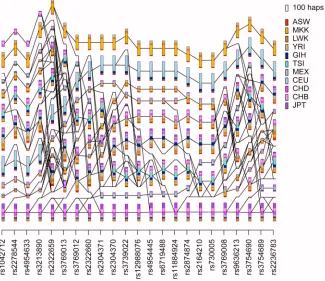
Figure S1 is similar to Figure 1 in the main paper, but has transitions added. The transition lines show possible transitions between clusters that a haplotype can make as it moves from one marker position to the next. Whereas in the fastPHASE model, any cluster at one position can transition to any cluster at the next position, in the BEAGLE model, the possible transitions are limited which helps to make the model parsimonious. Viewing the allowed transitions can be helpful, as one can see instances of haplotype clusters remaining the same from one position to the next (one transition in and one transition out), indicating an extended haplotype shared identically by multiple individuals.
Plots and tables of FST calculated using haplotypes phased separately by population.
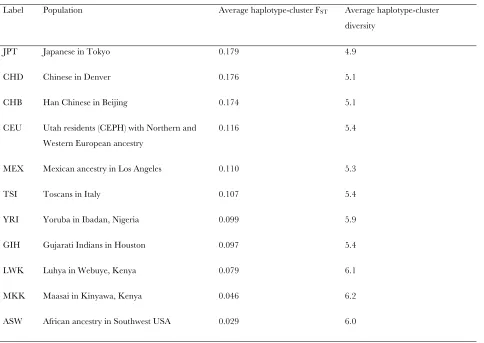
In the main paper, results are for haplotypes phased with all populations together. Here we show results for haplotypes phased separately by population for comparison. Figure S2 corresponds to Figure 3, while Table S1 corresponds to Table 1.
FIGURE S2.—Sliding 5 Mb windows of population-specific FST on chromosome 22 for HapMap3 data using data phased
separately by population. Estimates of population-specific FST were calculated using localized haplotype clusters from BEAGLE
S. R. Browning and B. S. Weir 4 SI
FIGURE S3.—Neighbor-joining trees constructed from paired FSTs for HapMap3 chromosome 22 data. The left tree is based
TABLE S1
HapMap3 population descriptions and chromosome 22 average values of population specific
haplotype-cluster FST and haplotype diversity using data phased separately by population
Label Population Average haplotype-cluster FST Average haplotype-cluster
diversity
JPT Japanese in Tokyo 0.179 4.9
CHD Chinese in Denver 0.176 5.1
CHB Han Chinese in Beijing 0.174 5.1
CEU Utah residents (CEPH) with Northern and Western European ancestry
0.116 5.4
MEX Mexican ancestry in Los Angeles 0.110 5.3
TSI Toscans in Italy 0.107 5.4
YRI Yoruba in Ibadan, Nigeria 0.099 5.9
GIH Gujarati Indians in Houston 0.097 5.4
LWK Luhya in Webuye, Kenya 0.079 6.1
MKK Maasai in Kinyawa, Kenya 0.046 6.2