On k-Heronian Mean Labeling
Akilandeswari. K1, Tamilselvi. M2
Research Scholar, PG and Research Department of Mathematics, Seethalakshmi Ramaswami College,
Tiruchirappalli, India1
Associate Professor, PG and Research Department of Mathematics, Seethalakshmi Ramaswami College,
Tiruchirappalli, India2
ABSTRACT: In this paper, we introduce k-Heronian mean labeling and investigate k-Heronian mean labeling of Path, ⊙ ; ≤ ≤ and Ladder.
KEYWORDS:k-Heronian mean labeling, k-Heronian mean graph, Path, ⊙ ; ≤ ≤ , Ladder.
I. INTRODUCTION
In this paper, all graphs are finite, undirected and simple graphs. Terms not defined here are used in the sense of Harary [2]. Graph labeling is first introduced by Rosa in 1967. The concept of mean labeling was introduced and studied by S. Somasundaram and R.Ponraj [5]. The concept of Heronian mean labeling was introduced and studied by S. S. Sandhaya and others [3] [4]. Here we investigate k – Heronian mean labeling of Path, ⊙ ; ≤ ≤ , and Ladder. For brevity, we use k-HML for k-Heronian mean labeling and k is any positive integer.
II. MAINRESULTS Definition 2.1:
A graph G=(V,E) with p vertices and q edges is said to be a k-Heronian Mean graph if it is possible to label the vertices ∈ with distinct labels ( ) from k, k+1, k+2,…,k+q in such a way that when each edge = is labeled with, ∗( ) = ( ) ( ) ( ) ( ) ( ) ( ) ( ) ( )
, then the resulting edge labels are distinct. In this case is called a k-Heronian Mean labeling of G.
Theorem 2.2:
Any path Pn is a k-Heronian mean graph, for all ≥2.
Proof:
Let ( ) = { ; 1≤ ≤ } and ( ) = { = ( , ); 1≤ ≤ −1} be the vertices and edges of
respectively.
Define : ( )→{ , + 1, + 2, … , + −1} by
( ) = + −1; 1≤ ≤ .
Now the induced edge labels are
∗( ) = + −1; 1≤ ≤ −1.
Here p = n and q = n-1.
Example 2.3:
50-Heronian mean labeling of is given in the figure 2.1:
Theorem 2.3:
Any comb, ⊙ is a k-Heronian mean graph, for all ≥2.
Proof:
Let ( ⊙ ) = { , ; 1≤ ≤ } and ( ⊙ ) = { = ( , ); 1≤ ≤ −1}∪
{ = ( , ); 1≤ ≤ } be the vertices and edges of ⊙ respectively.
Define : ( ⊙ )→{ , + 1, + 2, … , + 2 −1} by
( ) = + 2 −2; 1≤ ≤ ,
( ) = + 2 −1; 1≤ ≤ .
Now the induced edge labels are
∗( ) = + 2 −2; 1≤ ≤ ,
∗( ) = + 2 −1; 1≤ ≤ −1.
Here p = 2n and q = 2n-1.
Clearly, f is k-Heronian mean labeling of ⊙ . Hence ⊙ is a k-Heronian mean graph, for all ≥2.
Example 2.4:
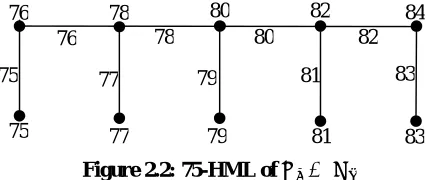
75-Heronian mean labeling of ⊙ is given in the figure 2.2:
Theorem 2.5
The graph ⊙2 is a k-Heronian mean graph, for all ≥2.
Proof:
Let ( ⊙2 ) = { , , ; 1≤ ≤ } and ( ⊙2 ) = { = ( , ); 1≤ ≤ −1}∪
{ = ( , ); 1≤ ≤ }∪{ = ( , ); 1≤ ≤ } be the vertices and edges of ⊙2 respectively.
Define : ( ⊙2 )→{ , + 1, + 2, … , + 3 −1} by
( ) = + 3 −2; 1≤ ≤ ,
Figure 2.2: 75-HML of ⊙ 76
76
75 75
77 78
78 80 82 84
80 82
77 79 81 83
79 81 83
51 52 54 55
50 51 52 54
∗( ) = + 3 −2; 1≤ ≤ .
Here p = 3n and q = 3n-1.
Clearly, f is k-Heronian mean labeling of ⊙2 . Hence ⊙2 is a k-Heronian mean graph, for all ≥2.
Example 2.6:
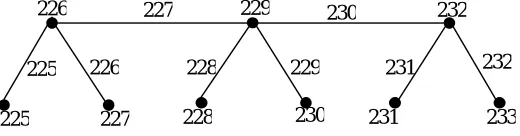
225-Heronian mean labeling of ⊙2 is given in the figure 2.3:
Theorem 2.7:
The graph ⊙3 is a k-Heronian mean graph, for all ≥2.
Proof:
Let ( ⊙3 ) = { , , , ; 1≤ ≤ } and ( ⊙3 ) = { = ( , ); 1≤ ≤ −1}∪
{ = ( , ); 1≤ ≤ }∪{ = ( , ); 1≤ ≤ }∪{ = ( , ); 1≤ ≤ } be the vertices and edges of
⊙3 respectively.
Define : ( ⊙3 )→{ , + 1, + 2, … , + 4 −1} by
( ) = + 4 −3; 1≤ ≤ ,
( ) = + 4 −4; 1≤ ≤ ,
( ) = + 4 −3; 1≤ ≤ ,
( ) = + 4 −1; 1≤ ≤ .
Now the induced edge labels are
∗( ) = + 4 −1; 1≤ ≤ −1,
∗( ) = + 4 −4; 1≤ ≤ ,
∗( ) = + 4 −3; 1≤ ≤ ,
∗( ) = + 4 −2; 1≤ ≤ .
Here p = 4n and q = 4n-1.
Clearly, f is k-Heronian mean labeling of ⊙3 . Hence ⊙3 is a k-Heronian mean graph, for all ≥2.
Example 2.8:
50-Heronian mean labeling of ⊙3 is given in the figure 2.4:
Figure 2.3: 225-HML of ⊙ 225
225 226
226
227 228 229
230 231
232
233 227
228 229
230
Theorem 2.9:
The graph ⊙4 is a k-Heronian mean graph, for all ≥2.
Proof:
Let ( ⊙4 ) = { , , ; 1≤ ≤ } and ( ⊙4 ) = { = ( , ); 1≤ ≤ −1}∪
{ = ( , ); 1≤ ≤ }∪{ = ( , ); 1≤ ≤ }∪{ = ( , ); 1≤ ≤ }∪ = ( , ); 1≤ ≤ be
the vertices and edges of ⊙4 respectively.
Define : ( ⊙4 )→{ , + 1, + 2, … , + 5 −1} by
( ) = + 5 −4; 1≤ ≤ ,
( ) = + 5 −5; 1≤ ≤ ,
( ) = + 5 −3; 1≤ ≤ ,
( ) = + 5 −2; 1≤ ≤ ,
( ) = + 5 −1; 1≤ ≤ .
Now the induced edge labels are
∗( ) = + 5 −1; 1≤ ≤ −1,
∗( ) = + 5 −5; 1≤ ≤ ,
∗( ) = + 5 −4; 1≤ ≤ ,
∗( ) = + 5 −3; 1≤ ≤
,
∗ = + 5 −2; 1≤ ≤
. Here p = 5n and q = 5n-1.
Clearly, f is k-Heronian mean labeling of ⊙4 . Hence ⊙4 is a k-Heronian mean graph, for all ≥2.
Example 2.10:
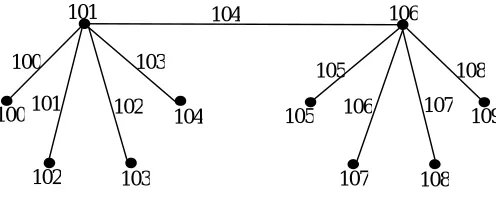
50-Heronian mean labeling of ⊙4 is given in the figure 2.5:
101
102 103
104 105
106
107 108 109 100
101 102 103
104
105
106 107 108
100
61 60
Figure 2.3: 50-HML of ⊙ 50
50 52
53 54 57 58
53
54 56
57
58
51 55 59
52 56 60
51 55
Proof:
Let ( ) = { , ; 1≤ ≤ } and ( ) = { = ( , ); 1≤ ≤ }∪{ = ( , ); 1≤ ≤ −1}∪
{ = ( , ); 1≤ ≤ −1} be the vertices and edges of respectively.
Define : ( )→{ , + 1, + 2, … , + 3 −2} by
( ) = + 3 −3; 1≤ ≤ ,
( ) = + 3 −2; 1≤ ≤ .
Now the induced edge labels are
∗( ) = + 3 −3; 1≤ ≤ ,
∗( ) = + 3 −2; 1≤ ≤ −1,
∗( ) = + 3 −1; 1≤ ≤ −1.
Here p = 2n and q = 3n-2.
Clearly, f is k-Heronian mean labeling of . Hence is a k-Heronian mean graph, for all ≥2.
Example 2.12:
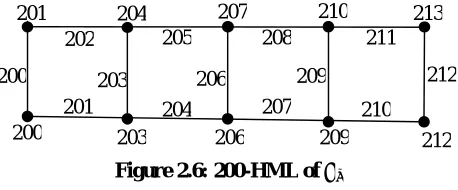
200-Heronian mean labeling of is given in the figure 2.6:
III. CONCLUSION
Graph labeling has its own applications in communication networks and astronomy, so enormous types of labeling have grown. Towards this k-Heronian mean labeling is also a kind of labeling which an extension of Heronian mean labeling. In this paper we discussed k-Heronian mean labeling of the graphs, Path, ⊙ ; 1≤ ≤4 and Ladder.
REFERENCES
[1] J. A. Gallian, A dynamic survey of graph labeling, Electronic Journal of Combinatorics, 18 (2016) # DS6. [2] F. Harary, Graph Theory, Addison Wesley, Massachusetts (1972).
[3] S.S.Sandhya, E.Ebin Raja Merly and S.D.Deepa, “Heronian Mean Labeling of Graphs”, Communicated to International Journal of Mathematical Form.
[4] S.S.Sandhya, E.Ebin Raja Merly and S.D.Deepa, “Some Results on Heronian Mean Labeling of Graphs”, communicated to Journal of Discrete Mathematical Sciences and Cryptography.
[5] S. Somasundaram and R. Ponraj, Mean labeling of graphs, National Academy Science Letter, 26 (2003), 210-213.
[6] S.Somasundaram, R.Ponraj and S.S.Sandhya, “Harmonic Mean Labeling of Graphs”, communicated to Journal of Combinatorial Mathematics and Combinatorial Computing .
Figure 2.6: 200-HML of
201 202
200 200
203 205
204 207 210 213
208 211
203 206 209 212
206 209 212