Development and Performance Evaluation of
Animal Drawn Raised Bed Planter
V. M. Victor1, S. Jogdand2
Asst. Professor., Dept. of Farm Machinery & Power Engineering, SVCAET, IGKV, Raipur, Chhattisgarh, India1
Professor, Dept. of Farm Machinery & Power Engineering, SVCAET, IGKV, Raipur, Chhattisgarh, India2
ABSTRACT: Encouragement for the animal farming needs to be given looking to future crises of fuels and costly inputs. In Chhattisgarh, on an average 80 per cent farmers are belonging to marginal and small category and are dependent on the draught animals for carried out their agricultural operations. The raised bed planting system is one of the most crucial system which affecting productivity and profitability of farmer. Bed planting of wheat is an important resource conservation technology to be encouraged in the state of Chhattisgarh. The exact placement of seed with fertilizer into the raised bed soil ensures saving in costly input, reduce the problem of temporary water logging stress and higher yield with greater control of irrigation and each plants gets desired quantity of sunlight, water and nutrients. Considering the above points, to encourage the raised bed planting system among the small and marginal farmers an effort has been made to develop an animal drawn raised bed planter at Faculty of Agricultural Engineering, IGKV, Raipur (C.G.) and was tested at research field having silty-clay –loam soil with moisture of 14.3% db for sowing of wheat (Variety Sujata). The developed MPT-Raised bed planting machine was also compared with other existing methods of sowing wheat. Results showed that the bed planting technique of sowing wheat was helpful in reduction of input use. The effective field capacity and field efficiency of the developed raised bed planter was observed as 0.141 ha/h and 77.19 per cent respectively. The average draught requirement to pull the developed machine was 63.49 kgf. The power exerted during operation of Indira seed drill was found to be the highest 0.526 kW among all three implements, followed by 0.399 kW for zero tillage seed drill and 0.382 kW for raised bed planter. Adequate plant population 137 plants/m2 was obtained with raised bed planter at 20 DAS. Raised bed planter could save 112.07 Rs./ha as compared to zero tillage planting technique. In addition to this, the developed machine could also save 21.30 per cent time over the conventional practice. The energy use pattern for sowing operation followed the trend: zero tillage planting > raised bed planter > conventional planting.
KEYWORDS: Draught animals, raised bed, planter, animal drawn implements
I. INTRODUCTION
In Chhattisgarh, average power availability is 1.09 kW/ha which is less than the national average of 1.5 kW/ha with a contribution of Animal & Human power as 27.4 per cent and 48.39 per cent respectively (Mishra and Tripathi, 2006). The draught animal power (DAP) is still the main source of farm power in India especially for tillage, sowing and intercultural operations and for rural transport. About 80 per cent of the cultivated area is still managed by using animals for the above farm operations. In Chhattisgarh, on an average 80 per cent farmers belonging to marginal and small category, have less than 2 hectare land holding with low annual income resulting in low purchase capacity of improved costly machinery or tractor, and therefore they are dependent on the animals for tillage, sowing and weeding operations. The annual utilization of DAP was in the range of 300 to 1200 hours against the ideal utilization of about 2400 hours annually (Anon, 2006). Therefore, it is necessary to develop farm machines to maximize the annual utilization of draught animals. Keeping in view the above facts, an effort has been made to develop an animal drawn raised bed planter for sowing wheat on beds.
II. MATERIALSANDMETHODS
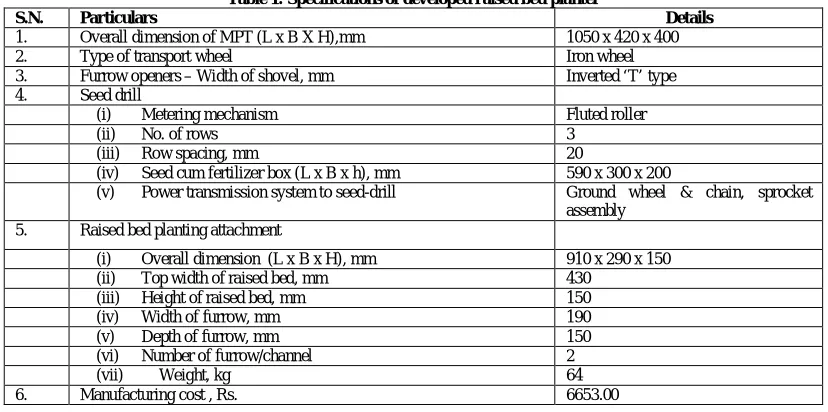
The animal drawn raised bed planter was developed, looking to the need of the farmers of this region to perform raised bed planting of wheat by using a multipurpose tool frame. The MPT-raised bed planter was developed, fabricated and tested in the fields of Faculty of Agricultural Engineering, Indira Gandhi Krishi Vishwavidyalaya, Raipur (C.G.) during the year, 2010-2011and 2104-15. A slight modification was done on existing multi purpose tool frame with seed drill previously developed at the faculty for attaching of the raised bed system easily as shown in Fig. 1 and 2. The raised bed planting attachment was made by joining of two mild steel sheet of 14 gauge in ridge-furrow pattern by welding. Mild steel C-30 angle iron size 35 x 35 x 5 mm was used for fabricating of supporting frame. The planting attachment was mounted beneath the pre existing MPT-frame. An adjustable provision has been made in MPT frame to accommodate three numbers of inverted 'T' type furrow openers at 20 cm spacing as suggested by Hobbs (2001) for wheat per bed. Two transporting wheels diameter 320 mm and width 40 mm are provided on the back side of MPT-frame for easy to transportation during field operation. Screw nut bolt system in supporting frame was provided for raising and lowering the raised bed attachment for depth control. The seed fertilizer box (600x 200x 250 mm) was mounted on the main MPT-frame. Brief specification of the developed planter is given in Table 1.
Table 1: Specifications of developed raised bed planter
S.N. Particulars Details
1. Overall dimension of MPT (L x B X H),mm 1050 x 420 x 400
2. Type of transport wheel Iron wheel
3. Furrow openers – Width of shovel, mm Inverted ‘T’ type
4. Seed drill
(i) Metering mechanism Fluted roller
(ii) No. of rows 3
(iii) Row spacing, mm 20
(iv) Seed cum fertilizer box (L x B x h), mm 590 x 300 x 200
(v) Power transmission system to seed-drill Ground wheel & chain, sprocket
assembly 5. Raised bed planting attachment
(i) Overall dimension (L x B x H), mm 910 x 290 x 150
(ii) Top width of raised bed, mm 430
(iii) Height of raised bed, mm 150
(iv) Width of furrow, mm 190
(v) Depth of furrow, mm 150
(vi) Number of furrow/channel 2
(vii) Weight, kg 64
6. Manufacturing cost , Rs. 6653.00
Field experiments were conducted at research farm of IGKV, Raipur (Chhattisgarh) having silty clay loam soil, during rabi season of 2010 -11. One dry cross ploughing by animal drawn MB plough + one roto tilling (rotavator) and one dry cross ploughing by animal drawn indigenous plough were performed as primary tillage operation for bed planting and conventional sowing of wheat respectively. The draught requirement, field capacity, speed of operation and power output were determined for different sowing implements. To estimate the operational energy for different sowing methods standard energy coefficients were used as suggested by Mittal and Dhawan (1988).
III. EXPERIMENTAL RESULTS
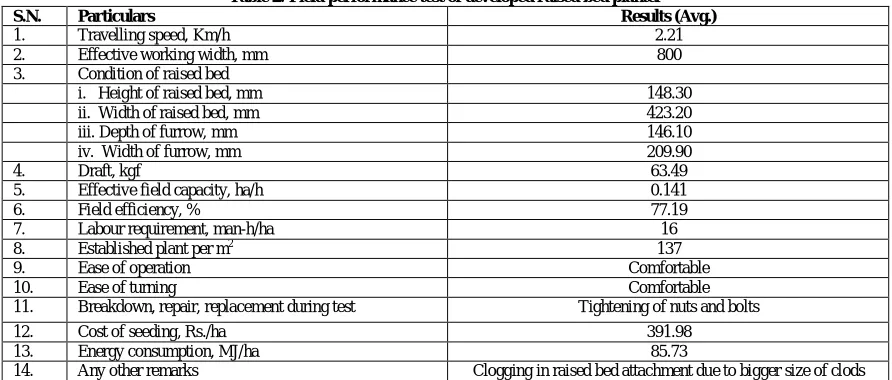
The developed implement was tested in the experimental plots for sowing of wheat on bed. It was observed that the machine worked satisfactorily for sowing of wheat on raised beds. The developed implement could prepare the beds even in improperly prepared field having small sized clods. The raised bed formed by the developed machine could be apparently visible after operation as shown in Fig 3 and 4. The field test results of the developed raised bed planter are furnished in Table 2. The developed machine was effective for making raised bed and sowing seeds on them. The machine was found to be maneuverable and non-clogging if field was prepared properly. However, little bit of clogging was observed during field operation due to bigger size of clods. The average effective working width of the machine during field operation was recorded as 800 mm. The effective field capacity was found to 0.141 ha/h at an average speed of 2.21 km/h with a field efficiency of 77.19 per cent. The average draught required to pull the machine was found to be 63.49 kgf, which was within the capacity of local bullocks found in this region. The raised bed formed by the machine was of 148.30 mm height, 423.20 width and 146.10 mm depth. The width of furrow formed by the machine was found to be 209.90 mm.
Fig. 1: MPT frame with raised bed attachment Fig. 2: View of developed Raised Bed Planter
Table 2: Field performance test of developed raised bed planter
S.N. Particulars Results (Avg.)
1. Travelling speed, Km/h 2.21
2. Effective working width, mm 800
3. Condition of raised bed
i. Height of raised bed, mm 148.30
ii. Width of raised bed, mm 423.20
iii. Depth of furrow, mm 146.10
iv. Width of furrow, mm 209.90
4. Draft, kgf 63.49
5. Effective field capacity, ha/h 0.141
6. Field efficiency, % 77.19
7. Labour requirement, man-h/ha 16
8. Established plant per m2 137
9. Ease of operation Comfortable
10. Ease of turning Comfortable
11. Breakdown, repair, replacement during test Tightening of nuts and bolts
12. Cost of seeding, Rs./ha 391.98
13. Energy consumption, MJ/ha 85.73
14. Any other remarks Clogging in raised bed attachment due to bigger size of clods
Raised bed planting of wheat by raised bed planter was compared to flat sown and no tillage condition (Table 3). Average draught offered by the soil on different sowing implements during the sowing operation was found maximum of 63.49 kgf for MPT-raised bed planter followed by 62.42 kgf for zero tillage planting respectively and minimum 56.34 kgf for the conventional planting method by Indira seed drill in rows. Draught offered by the soil on raised bed planter was slightly higher than conventional planting (Indira seed drill) which might be due to higher weight of raised bed planter implement as compared to the other. The effective field capacity of Indira seed drill (conventional planting method), zero till drill and raised bed planter was found as 0.174, 0.111, and 0.141 ha/h respectively. The field efficiency of Indira seed drill, zero till drill and raised bed planter was found 84.46, 78.72 and 77.19 per cent respectively. Crop performance of wheat crop raised under different methods of sowing was also compared and data pertaining to yield attributing characters showed that number of spikes per square meter, ear length and grain yield of bed planted wheat was higher over other methods of sowing. However, highest (44.28 q/ha) grain yield was obtained under bed planting. Water use was highest in conventional method of sowing i.e. line sowing by Indira seed drill. The crop water use efficiency estimated on the basis of wheat equivalent yield revealed that bed planting system was most efficient (123 kg/ha-mm). Conventional planting system was found least efficient in utilization of irrigation water as it produced 86.10 kg dry matter/ha-mm of irrigation water.
Table 3: Comparative performance of different sowing methods
S.N. Implement
Particular
Raised bed planter (Bed
planting)
Indira Seed Drill (Conventional planting)
Zero tillage Seed Drill
A. Machine Performance
1. Draught, kgf 63.49 56.34 62.42
2. Speed, Km/h 2.21 3.43 2.35
3. Power developed, kW 0.382 0.526 0.399
4. Depth of seed placement, mm 27.26 31.64 34.43
5. Effective field capacity, ha/h 0.141 0.174 0.111
7. Field efficiency, % 77.19 84.46 78.72
B. Crop Performance
1. Plant population (20 DAS), No/ m2 137.0 119.0 103.0
2. Spikes, m-2 410.92 400.08 389.24
3. Ear length, cm 8.16 7.96 7.77
4. Grain yield, q/ha 44.28 41.32 39.12
5. Water use, cm 36 48 41
6. Water use efficiency, kg/ha-cm 123 86.10 95.41
The estimated operating cost of the raised bed planter was calculated as 391.98 Rs./ha as compared to 321.55 Rs./ha for conventional planting (Indira seed drill) and 504.05 Rs./ha for zero tillage planting method. Thus, raised bed planter could save 112.07 Rs./ha as compared to zero tillage planting and could save 21.30 per cent time over the traditional practice (Table 4).
Table 4: Cost economics of different sowing methods
S. N. Description Raised bed Conventional Zero tillage
1. Investment cost, Rs. 6653.00 5600.00 5600.00
2. Cost of sowing operation, Rs/h 55.27 55.95 55.95
3. Operating time, h/ha 7.09 5.75 9.01
4. Operating cost, Rs/ha 391.98 321.55 504.05
5. Cost saving, Rs/ha 112.07 182.50 -
6. Time saving, % 21.30 36.18 -
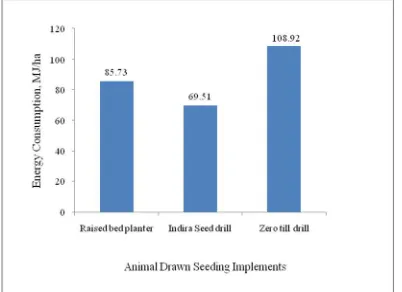
operation by saving time. The energy use pattern for planting operation followed the trend: Zero tillage seed drill > raised bed planter > conventional planting by Indira seed drill.
Fig. 3: Operational Energy requirement for different sowing implements
IV.CONCLUSION
The raised bed planter developed under the present investigation worked satisfactorily for raised bed planting operations. The bed formed by the developed machine was satisfactorily as shown in Fig. 4.The performance of raised bed planter was found better than the corresponding traditional practices. This implement could save time, increased the efficiency and quality of operation. This implement is a versatile implement for raised bed planting field operations. The draught requirement of the developed implement was within the draught capacity of local bullocks.
Fig. 4: Bed formed by developed machine
REFERENCES
1) Anonymous “Annual Report of AICRP on Utilization of Animal Energy”, IGKV Raipur, Chhattisgarh pp: 1-12, 2006.
2) Fahong, W., Xuquing, W. and Sayre, K. D., “ Comparision of conventional, flood irrigated, flat planted with furrow irrigated, raised bed planting for winter wheat in Chine”, Field Crop Research, Vol. 87, pp: 35-42, 2004.
3) Hobbs, P. R., “ Tillage and crop establishment in South Asian rice-wheat systems, present practices and future options. In: The rice-wheat cropping system of South Asia: Efficient Production management” (Ed., Kataki, P. K.), The Haworth Press, New York, 2001.
4) Mishra, B. P. and Tripathi, R. S., “Availability of farm power and mechanization planning for India and Chhattisgarh” Agro-Resource
Conservation and Management. Ind. Soc. of Agronomy, Raipur Chapter, IGKV, Raipur. pp: 341-349, 2006.
5) Mittal, J.P. and Dhawan, K. C., “Research manual on energy requirements in agricultural sector, coordinating cell, AICRP on energy requirement in rural sector”, PAU, Ludhiana, India, 1988.
7) Ram, H., Singh, Y., Timsina, J., Humphreys, E., Dhillon, S. S., Kler, D. S. and Kumar, K., “Performance of non-rice crops and alternative cropping systems on permanent raised beds in the Indo-Gangetic plains of north-western India”. Proceedings of Int. Workshop on permanent raised beds. 1-3 Mar. ACAIR, Griffith, NSW, Australia, 2005.
8) Sayre, K. D., “Bed Planting Sysytems: An Overview”. CIMMYT, Mexico, 2001. 9) Sayre, K. D., “Raised-Bed Cultivation” Encyclopedia of Soil Science. pp: 1-4, 2003.
10) Sayre, K. D., and Ramos, O. H. Moreno, “Applications of raised bed planting systems of wheat”. CIMMYT. Wheat Programme Special Report No. 3, 1997.
11) Singh, S., Yadav, A., Makil, R. K. and Singh, H., “Furrow irrigated raised bed planting system -A resource conservation technolog for increasing wheat productivity in rice-wheat sequence” Proceedings of an International Workshop on Her. resist. mgt. & ZT in R_W cropp. sys. 4-6 Mar. CCS HAU, Haryana, 2002.