Concrete Made by Using Fly Ash Pallets as
Coarse Aggregate
Sivaiah Kotapati1, A.Brahmini2
M.Tech (Structural Engineering) Student, Dept. of Civil Engineering, KMM Institute of Technology and Science,
Ramireddipalli, Tirupati, Andhra Pradesh, India1
Assistant Professor, Dept. of Civil Engineering, KMM Institute of Technology and Science, Ramireddipalli, Tirupati,
Andhra Pradesh, India2
ABSTRACT: Many investigators have been carried out in the area of fly ash usages in the past. It mainly concentrated on replacement of cement with fly ash but production of artificial aggregates with fly ash helps in utilizing large volume of ash in concrete. The world is much interested in this part recently due to this large scale utilization which also reduces environmental pollution and dwindling of natural resources. This paper mainly focuses on manufacturing process of light weight aggregates using pelletizer and curing has been done in cold bonded technique. The equity of these fly ash aggregates have been tested and differentiate with natural gravel and the study shows that cold bonded fly ash aggregates can be used as an aggregate replacement material in concrete. The strength property and density of concrete made with artificial fly ash aggregates and natural gravel were also studied which confirms that introduction of fly ash aggregates in concrete decrease the compressive strength but meets the needed strength to be used as a structural material.
I.INTRODUCTION
In growing need for electricity in India, 70% of power is generated through thermal power plants. The environmental dreads from these plants include air pollution due to particulate emission, water pollution and shortage of land for dumping the fly ash. later, the less quality of Indian coal has high ash content, which worsens the disposal problem. Fly ash generation is estimated to be around 200 million tonnes in 2013 -2014. Instead of dumping the fly ash as landfills, fly ash is widely used as cement replacement material, pavement base, blocks etc., in these days. To use fly ash in huge volume the functions like embankment fill or aggregate replacement material should be considered. Construction industry is growing very fast manner. The availability of raw materials for the construction is facing many problems in most of the world. The continuous usage of natural resources for the production of the concrete in some locations create many threatens to the environmental conditions .Researchers have carried out extensive work on this area are trying for new alternative materials for this deficiency in the construction industry.
Still the unnatural aggregate production attained attention in research field, in India it is not implemented widely. This may be due to the availability of natural resources, relatively higher initial cost for manufacturing and the energy required for curing. There are some methods like cold bonding which does not needed energy for curing of artificial aggregate.
II.LITERATURE REVIEW
1. Chi et al. (2003) selected three types of cold secured cement based fly ash aggregates for the manufacture of concrete. The study indicates that type of light weight aggregate and water to binder ratio are the significant factors influencing strength of concrete.
2. Google et al. manufacture of these concrete using cold bonded fly ash aggregate enclose of Portland Type 1 cement as binder. The variables of this study are water cement ratio cement content and coarse aggregate ratio. The artificial aggregates are used after soaking for a period of 30 minutes in water. The compressive strength of concrete is found to be between 20 and 47 Map. Test results express that compressive strength reduce with coarse aggregate to total aggregate ratio.
3. Joseph and Ramamurthy resolved the fresh and hardened properties of concrete build using cold bonded fly ash aggregate. The cement content of 250 and 450 kg/m3 is used for the preparation of concrete. The variables considered are cement content, water cement ratio and aggregate ratio. It is found that the compresed density of concrete decrease with improve of in volume fraction of cold bonded fly ash aggregate. The workability of concrete is find out to be regulated by content of cold bonded aggregate. The test results point out that the strength of the concrete enhance with increase cement content. The failure of concrete is find out to be regulated by aggregate fracture.
5. Joseph and Ramamurthy studied the influence of high volume of fly ash in concrete containing cold bonded fly ash aggregate. The replacement ratio of cement with fly ash is 10, 30 and 50 percent is used. The coarse aggregate ratio of 50 and 65 percent is used. The fresh density of concrete reduces with increase in replacement of cement with fly ash and cold bonded aggregate ratio.
III.MATERIALS AND METHOD
CEMENT
Portland cement earn its strength from chemical reactions amidst the cement and water. The process is known as hydration. This is a complex process that is best understood by first understanding the chemical composition of cement.
FLY ASH
Fly ash is a finely divided residue resulting from the combustion of pulverized coal and transported by the flue gases of boilers fired by pulverized coal.
CLAY
\Clay is a smooth, sloppy, earthy material enclose of particles with a raise size of less than 4 micrometers; it forms as a result of the weathering and erosion of rocks containing the mineral group feldspar (known as the mother of clay) over vast spans of time.The principal minerals in bentonite. Clay is an important material in preparation of cold bonded fly ash aggregate because it acts as binding material.
LIME
predominate. By contrast, “quick lime” specifically applies to the single chemical compound calcium oxide. Calcium oxide which survives processing without reacting in building products such as cement is called as free lime. Quick lime is relatively inexpensive. Both it and a chemical derivative (calcium hydroxide, of which quick lime is the base anhydride) are important commodity chemicals. Lime is an important material in preparation of cold bonded fly ash aggregates because it acts as binding material.
PELLETIZING PROCESS
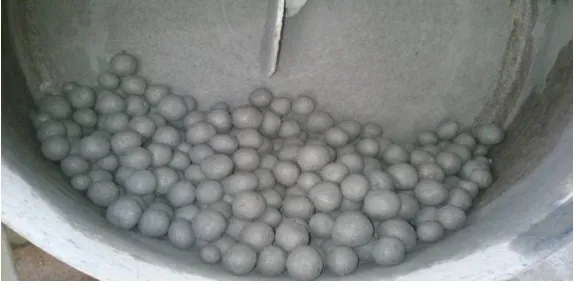
The crave growth size distribution of an unnatural lightweight aggregate is either crushed or by means of agglomeration process. The pelletization process is used to manufacture lightweight coarse aggregate; some of the parameters need to be considered for the efficiency of the production of pellet such as speed of innovation of pelletizer disc, moisture content, angle of pelletizer disc and period of pelletization (Harikrishnan and Ramamurthy, 2006). The different types of pelletizer machine were used to make the pellet such as disc or pan type, drum type, cone type and mixer type. With disc type pelletizer the pellet size trading is easier to regulate than drum type pelletizer. With mixer type pelletizer, the small grains are formed initially and are subsequently increased in particle size by disc type pelletization (shown in Figure 1, Bijen, 1986). The disc pelletizer size is 570 mm diameter and side depth of the disc as 250 mm, it is fixed in a flexible frame with adjusting the angle of the disc as 35 to 55° and to control for the rotate disc in vertically manner should varying speed as 35 to 55 rpm shown in Figure 2 (Manikandan and Ramamurthy, 2007).
Fig. : Pelletization Machine
In a cold bonded method is to made the increase the strength of the pellet as to increase the fly ash/cement ratio as 0.2 and above (by weight) (Yang, 1997). Moisture content and angle of the disc parameter influence the size growth of pellets (Harikrishnan and Ramamurthy, 2006). The dosage of binding agent is more important for making flyash balls adopted for high-early strength (Manikandan and Ramamurthy, 2008). A higher strength of the aggregate can be obtained at 8 to 10 h in autoclave curing (Bekir and Tayfun, 2007). Sintering process can be defined as burning the cold bonded pellet in a muffle furnace at temperature range of 800 to 1200°C. The mineral particles in the binder fuse together to form the crystalline structure (CSH) and results in higher strength of the aggregate. Therefore sintered fly ash lightweight aggregate manufacture is more comfortable while restore the normal weight aggregate to lightweight aggregate (Verma et al., 1998).
IV. EXPERIMENTAL INVESTIGATIONS
Aggregate Crushing Value
Crushing value test
In this test, the sample of roughly-a single size [between 10 mm and 12.5 mm] is kept in standard cylinder of metal and is crushed under a certain load applied gradually. The aggregate breaks. The quality of finer material [smaller than 2.36 mm] formed is a measure of aggregate crushing value.
Aggregate Abrasion Value
Apart from testing the aggregate with respect to its crushing value and impact resistance, the aggregates must be tested with respect to its resistance to wear when used in construction of roads,pavements, and wear house floors. I.S 2386(Part IV) covers two methods for finding out the abrasion value of coarse aggregate namely Deval and Los Angels abrasion testing machine. However, use of Los Angels abrasion testing machine gives a better realistic picture of the abrasion resistance of the aggregate. Following are the guidelines for grading of the test sample and specifications for the abrasive charge to be used for the test.
MIX PROPORTION
Mix has been designed as per IS 10262:2009 for 28 days strength of 40 MPa. Table gives the mix proportion for Normal concrete made with natural gravel and fly aggregate concrete. In the proportion, coarse aggregate forms the major volume of 1293 Kg/m 3, which consumes large volume of fly ash.
Mix Proportion
Mix Normal concrete Fly ash aggregate
concrete
Super plasticizers (lit/m3) 0.2 0.1
Cement (kg/m3) 311 311
Water (lit/m3) 140 140
Sand (kg/m3) 737 737
Coarse aggregate (kg/m3) 1293 1293
High range water reducing admixture was used as super plasticizer (SP) in this study. SP content was consumed lesser for fly ash aggregate (FAA) concrete because of its rounded nature that itself improved workability.
V.RESULTS AND DISCUSSION
CONCRETE PROPERTIES
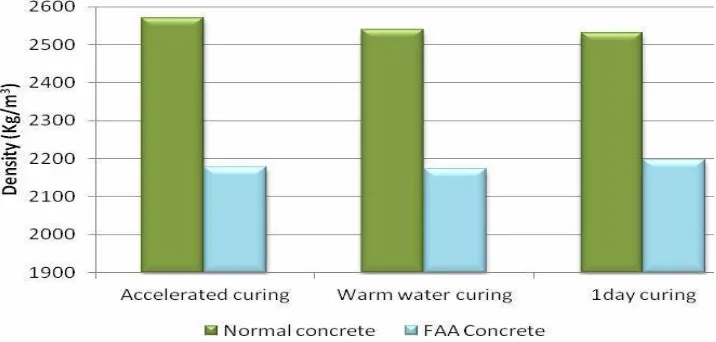
Many researchers studied the strength properties of fly ash aggregate light weight concrete which shows different results that depends on the properties of fly ash used for its manufacturing and various other factors like curing time etc., (Chi et al., 2003; Wasserman and Bentur, 1997; Zhang and Gjorv, 1990, 1991; AlKhaiat and Haque, 1998, 1999). Concrete with fly ash exhibited better workability which can be justified by the reduced SP usage. The density of concrete was much lesser for FAA concrete . This is due to the light weight of fly ash aggregate which is used in the manufacturing of light weight concrete. There is 15% decrease in density for FAA concrete compared to normal concrete which was increasing for warm water by 2% and 3% increase was seen for accelerated curing. the light weight concrete is widely used all over the world for various applications in recent days.
Fig. 18: Density of normal and FAA concrete
Fig.: Compressive strength of normal and FAA concrete
VI.CONCLUSION
As a pilot study, fly ash aggregates has been manufacture by pelletizing and cold bonding process and the property of the obtained aggregates has been compared with natural gravel and results are found to be comparable.
1. The rounded shape of fly ash aggregate gives better workability compared to the angular natural gravel.
2. Crushing and impact value shows value much lesser than the allowable limit. Abrasion value is too low but still cannot be used as a high way material due to its high percentage of water absorption. Though both natural and artificial aggregates shows crushing and impact value with in the limit of 45%, fly ash aggregate shows 31.8% lower value than the natural aggregate for crushing and 26.4% higher impact value. But abrasion nearly equal for both cases.
3. Less specific gravity distinguish to natural aggregate proves it to be a light weight aggregate material and fly ash has been consumed in large volume when it is used as a coarse aggregate replacement material due to its occupation of large volume in concrete. This in turn reduces the problem of dumping as landfills to greater extent. 4. The water absorption of fly ash aggregate is 9 times bigger than that of natural aggreates which is the major
disadvantage which can be eliminated by various treatment methods that are available like treating with waterglass etc.,
5. Concrete with density 2150 kg/m 3 can be achieved using fly ash aggregates while density of normal concrete mix goes up to 2580 kg/m 3 .
6. Though compressive strength of FAA concrete is 48% lesser compared to normal concrete mix, it exceeds the value of 17 MPa that has been fixed as minimum criteria for concrte to be used as a structural material.
REFERENCES
1. AlKhaiat, H., Haque, M. N., 1998, Effect of initial curing on early strength and physical properties of a lightweight concrete, Cement and Concrete Research, 28, pp 859–866.
2. AlKhaiat, H., Haque, N., 1999, Strength and durability of lightweight and normal weight concrete, Journal of Materials in Civil Engineering, 11, pp 231– 235.
3. Baykal, G., Doven, A.G., 2000, Utilization of fly ash by pelletization process, theory, application areas and research results, Resource Conservation Recycling, 30(1), pp 59–77.
4. Bijen, J. M. J. M., 1986, Manufacturing processes of artificial lightweight aggregates from fly ash, The International Journal of Cement Composites and Lightweight Concrete, 8, pp 191199.
5. Cheeseman, C. R. and Virdi, G. S., 2005, Properties and microstructure of lightweight aggregate produced from sintered sewage sludge ash, Resources, Conservation and Recycling, 45, pp 1830.