ABSTRACT
JORGENSEN, ZACHARY. Practical Private Data Analysis with Differential Privacy. (Under the direction of Dr. Ting Yu and Dr. Douglas Reeves.)
The goal of private data analysis is to extract useful aggregate knowledge from sensitive datasets without disclosing information about individual constituents. Early work on this prob-lem focused on anonymization techniques, which have since been criticized due to the feasibility of attacks that can lead to disclosure of sensitive attributes. Consequently, more robust notions, led by differential privacy, are now preferred. Differential privacy is a powerful framework for providing strong, formal privacy guarantees that are robust against informed adversaries with access to auxiliary information. However, achieving strong differential privacy guarantees for complex analyses, without significantly harming utility, is non-trivial in general. This disserta-tion presents practical techniques for satisfying differential privacy for important tasks in the social network analysis domain, as well as introduces a new personalized variant of differential privacy, which offers significantly improved utility on datasets comprising users with diverse privacy requirements.
Specifically, our first work tackles the problem of generating item recommendations that are personalized on a user’s social network, while simultaneously preventing the disclosure of sensitive user-item preferences (e.g., product purchases, ad clicks, web browsing history, etc.). We propose and evaluate a privacy-preserving framework for a natural class of social recommendation algorithms and show that it is possible to attain strong differential privacy guarantees while maintaining good recommendation accuracy.
differential privacy.
In our third work, we return to the social network analysis domain, where we focus on the problem of publishing social network graphs without disclosing the sensitive relationships and node attributes of the individuals contained in the graph. To that end, we present a differen-tially private framework that takes a sensitive social graphG and generates a synthetic graph
e
© Copyright 2015 by Zachary Jorgensen
Practical Private Data Analysis with Differential Privacy
by
Zachary Jorgensen
A dissertation submitted to the Graduate Faculty of North Carolina State University
in partial fulfillment of the requirements for the Degree of
Doctor of Philosophy
Computer Science
Raleigh, North Carolina
2015
APPROVED BY:
Dr. Rada Chirkova Dr. Laurie Williams
Dr. Ting Yu
Co-chair of Advisory Committee
ACKNOWLEDGEMENTS
This has been a long journey and I have many people to thank for helping me get to this point. First, I’d like to express my sincere appreciation to my advisor, Ting Yu, for his guidance, pa-tience and financial support over the years. Ting encouraged my interests in privacy-preserving data analysis and introduced me to differential privacy, which is the foundation of all of the work in this dissertation. At the same time, he afforded me considerable freedom to explore in-teresting tangents and to develop my own research interests. Even after departing from NCSU, Ting continued to work closely with me to ensure that I was able to complete my research. Ting, thanks for being a wonderful advisor and for always making time for me when I needed guidance.
I’d like to thank the rest of my committee, Doug Reeves, Laurie Williams and Rada Chirkova for their time, helpful guidance and thoughtful feedback, which helped improve the quality of this dissertation. Additionally, I’d like to say a special thanks to Doug Reeves for taking the reigns as my co-advisor upon Ting’s departure. Doug, thanks for your support and for making yourself available when I needed advice.
I had the privilege of collaborating with Graham Cormode, from the University of Warwick, on two of the works in this dissertation (Ch. 4 and 5). Graham is a brilliant researcher and I learned a lot from working with him. His input helped to greatly improve the quality of those chapters and the associated papers. Graham, thanks for all of your help and friendly guidance. I’d like to thank my lab mates: Entong, Wei, Alley, Ling, Vasant, Ashwin, Adwait, Ben and Al for attending numerous practice talks and for helpful discussions along the way.
known. She instilled in me an appreciation for education and for hard work and has shown me unconditional love and support in everything that I have done. I’m also very grateful to my in-laws, Bill and Harriet Hartman, for their love and support, especially during the chaotic final months of my Ph.D. I’d also like to thank my dear friends Cody and Melinda Weaver for their friendship and for providing much needed distractions that kept me from burning out during my final year. They also graciously gave me a place to stay when the lease on my apartment ended before the completion of my dissertation.
Last, but certainly not least, I owe an enormous debt of gratitude to my wife, Rachael, for her constant love, support and patience. Rachael, thank you for being an amazing companion, for picking up my slack at home during deadlines and for never ceasing to believe in me. You encouraged me to keep going during my lowest lows and helped me celebrate during my high points. Thank you for patiently sticking by me all these years. I love you dearly.
TABLE OF CONTENTS
LIST OF TABLES . . . vi
LIST OF FIGURES . . . vii
Chapter 1 Introduction . . . 1
1.1 Motivation . . . 1
1.2 Contributions . . . 4
1.3 Organization . . . 6
Chapter 2 Background and Related Work . . . 7
2.1 Differential Privacy . . . 7
2.1.1 Achieving Differential Privacy . . . 8
2.1.2 Properties of Differential Privacy . . . 11
2.2 Related Work . . . 11
Chapter 3 Differential Privacy for Personalized Social Recommendations . . . 18
3.1 Motivation . . . 18
3.1.1 Contributions . . . 21
3.2 Model . . . 22
3.2.1 Setting . . . 22
3.2.2 Personalized Social Recommenders . . . 22
3.2.3 Assumptions and Attacker Model . . . 25
3.2.4 Privacy Model . . . 26
3.2.5 Measuring Recommendation Accuracy . . . 27
3.3 Related Work . . . 28
3.4 Proposed Framework . . . 31
3.4.1 Rationale . . . 32
3.4.2 Algorithm and Analysis . . . 39
3.5 Experimental Study . . . 43
3.5.1 Datasets . . . 43
3.5.2 Experimental Setup . . . 44
3.5.3 Analysis of Privacy-Accuracy Trade-off . . . 46
3.5.4 Comparison with Other Approaches . . . 50
3.6 Summary . . . 52
Chapter 4 Personalized Differential Privacy . . . 54
4.1 Motivation . . . 54
4.1.1 Contributions . . . 56
4.2 Related Work . . . 57
4.3 Personalized Differential Privacy . . . 60
4.3.1 Privacy Definition . . . 60
4.4 Mechanisms for Achieving PDP . . . 64
4.4.1 Baseline Mechanisms . . . 65
4.4.2 Achieving PDP via Sampling . . . 66
4.4.3 Direct Approach . . . 71
4.5 Experimental Study . . . 76
4.5.1 PDP for Count and Median . . . 78
4.5.2 PDP for Multiple Linear Regression . . . 83
4.6 Summary . . . 86
Chapter 5 Publishing Attributed Social Graphs with Formal Privacy Guar-antees . . . 87
5.1 Introduction . . . 87
5.1.1 Contributions . . . 89
5.1.2 Organization . . . 90
5.2 Preliminaries . . . 91
5.2.1 Setting and Notation . . . 91
5.2.2 Attributed Graph Model (AGM) . . . 91
5.2.3 Privacy Model . . . 95
5.3 Privately Computing the Model Parameters . . . 96
5.3.1 Attribute-Edge Correlations . . . 97
5.3.2 Node Attribute Distribution . . . 107
5.3.3 Structural Model: TriCycLe . . . 108
5.4 AGM-DP: Putting It All Together . . . 123
5.4.1 End-to-End Workflow . . . 123
5.4.2 Privacy Analysis . . . 127
5.4.3 Extensions . . . 127
5.5 Empirical Analysis . . . 129
5.5.1 Datasets . . . 130
5.5.2 Experiment Setup . . . 131
5.5.3 Statistics Evaluated . . . 132
5.5.4 Results . . . 133
5.5.5 Discussion . . . 138
5.6 Related Work . . . 139
5.7 Summary . . . 142
Chapter 6 Conclusions and Future Research. . . .144
6.1 Review of Contributions . . . 144
6.2 Future Work . . . 147
6.2.1 Graph and Network Analysis . . . 147
6.2.2 Differential Privacy in Practice . . . 148
6.2.3 Weaker Notions of Privacy . . . 149
LIST OF TABLES
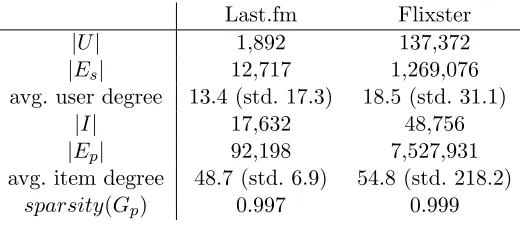
Table 3.1 Summary of data sets. . . 44
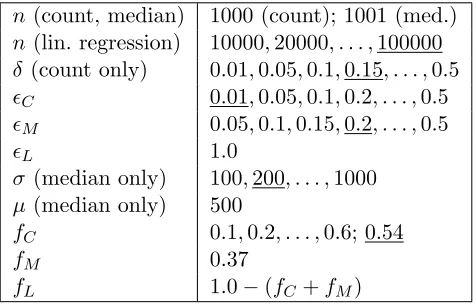
Table 4.1 Experiment parameters (defaults underlined). . . 78
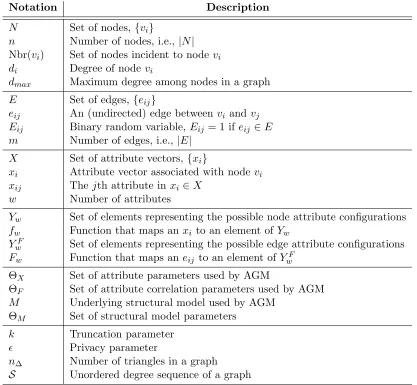
Table 5.1 Summary of the notation used in Chapter 5 . . . 92 Table 5.2 Datasets used in empirical analysis. The columns are number of nodes n,
number of edgesm, maximum degree dmax, average degreedavg, number of
trianglesn∆, and average local clustering coefficientC. . . 131 Table 5.3 Results for AGM-DP with the FCL FCL) and TriCycLe
(AGMDP-TriCL) structural models on theLast.fm dataset for different privacy set-tings,. . . 134 Table 5.4 Results for AGMDP-FCL AGMDP-TriCL on thePetsterdataset for
differ-ent privacy settings,. . . 134 Table 5.5 Results for AGMDP-FCL AGMDP-TriCL on theEpinions dataset for
dif-ferent privacy settings,. . . 135 Table 5.6 Results for AGMDP-FCL AGMDP-TriCL on thePokecdataset for different
LIST OF FIGURES
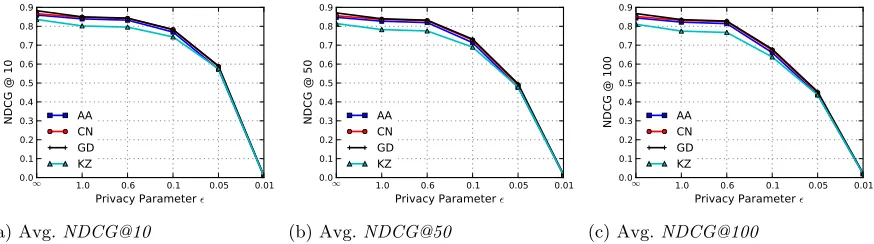
Figure 3.1 (Last.fm) Comparison of average NDCG@N of each private social recom-mender for different settings ofand N onLast.fm. Note that the privacy guarantee varies from weak to strong as you move left to right along the x-axis. . . 45 Figure 3.2 (Flixster) Comparison of average NDCG@N of each private social
recom-mender for different settings of and N on Flixster. (Note the different y-axis values used in this figure compared to Fig. 3.1.) . . . 46 Figure 3.3 Relationship between user degree (log scale) andNDCG@50 due to
approx-imation error (i.e., =∞), observed for CN similarity measure on Last.fm (3.3a) and Flixster (3.3b). A similar relationship was seen for the other similarity measures. . . 47 Figure 3.4 Figs. 3.4a and 3.4b showNDCG@50 of the na¨ıve NOU and NOE baselines,
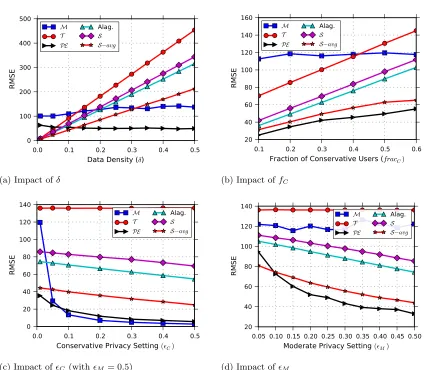
as well as adaptations of the recent LRM [135] and GS [61] approaches, on Last.fmwith ∈ {1.0,0.1}. . . 48 Figure 4.1 (Count) RMSE of each mechanism for the count task, as four parameters
are varied. . . 79 Figure 4.2 (Median) RMSE of each mechanism in for themediantask, as four
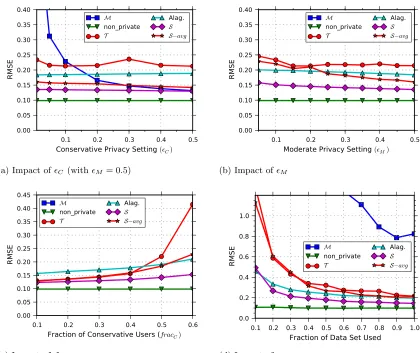
param-eters are varied. . . 80 Figure 4.3 (Linear Regression) RMSE of each mechanism forlinear regression, as four
parameters are varied. . . 85
Figure 5.1 Adding or removing a single edge can create/destroy up ton−2 triangles. . 96 Figure 5.7 Fig. 5.7a provides a graphical overview of our differentially private
Chapter 1
Introduction
1.1
Motivation
In our increasingly digital and connected society, large amounts of detailed, personal data are continuously collected and stored by commercial entities, governments and other organizations. Search engines, such as Google and Bing, record our search queries and the web sites we visit. Online stores, like Amazon, track the products we view and buy, even as brick-and-mortar stores track our purchases through loyalty card programs. Credit card companies and credit agencies track where we shop and how we spend, while telephone providers retain records of who we communicate with, how often and for how long. Recently, the explosive growth of online social networks, such as Facebook and Google Plus, has created vast stores of digital records of our social interactions, the groups we belong to, the places we visit and the things we like.
are initiatives to utilize collected data to “enhance operational efficiency, transparency, citizen’s well-being and engagement in public affairs, economic growth, and national security [65]”.
However, mining and analyzing sensitive data creates important privacy challenges that must not be overlooked. Organizations want to benefit from user data but are under legal and ethical obligations to preserve the privacy of their customers, citizens or users. The goal of privacy-preserving data analysis is to extract useful patterns and knowledge from private data sets without disclosing the sensitive information of the individuals contained in the data. In the typical setting, a sensitive data set, comprised of data contributed by many individuals, resides with a trusted data holder. It is convenient to think of the data set as a table where each row, or record, corresponds to a single individual1. Data analysts who wish to conduct analyses on the sensitive data set must go through the data holder, rather than accessing it directly. We emphasize that the challenge here is different from that targeted by access control techniques; here, analyses may require access to an entire data set, and the goal is to ensure that the output of the analysis preserves the privacy of individuals, while providing useful information about the population as a whole. For example, we might want to learn whether there is a link between the consumption of diet soda and the development of Type 2 diabetes, without disclosing that Bob, a participant of the study, has diabetes.
Much of the prior work on this problem has centered around the idea of anonymization. For example,k-Anonymity, formalized in [118], anonymizes a data set by suppressing or generalizing identifying attributes of all records, such that every record is indistinguishable (in terms of its identifying attributes) from at leastk−1 others. However, this approach has the flaw that ifk
individuals in an anonymity group all have same sensitive value (or all have “bad” values) then privacy is still violated. Moreover,k-anonymity, as well as subsequent anonymization approaches (e.g., [81, 128, 130]) do not hold up in the presence of collusion or adversaries with auxiliary information about the data set.
Within the last decade,differential privacy [26, 29] has emerged as a powerful framework for
1In reality, data sets may contain multiple records for an individual and can take on other forms such as
providing strong, formal privacy guarantees for aggregate data analysis. Informally, differential privacy guarantees that the output of an analysis task will be almost the same regardless of whether any one record is present in the input data. Thus, an adversary who sees the output will not be able to infer whether any particular individual contributed his or her data to the input. Since an individual’s privacy risk does not increase significantly by participating in the analysis, privacy concerns are alleviated and the incentive for an individual to withhold (or falsify) their data is effectively removed. In contrast to prior attempts to define privacy, the guarantee that differential privacy provides does not depend on what auxiliary information an adversary may have about the input data: an adversary who knows the full input, except for one recordr, will still be unable to deduce even whetherr was in the input [27].
A common approach for satisfying differential privacy for computations with numerical output2 is to inject random noise that has been carefully calibrated according to the compu-tation’s sensitivity (i.e., the maximum impact that any one record can have on the output), and a configurable privacy parameter [31]. Since injecting random noise makes the result of the computation less precise, the challenge is to find a good balance between privacy and utility.
Since its introduction, differential privacy has grown into an active area of research and is increasingly regarded as the gold standard for privacy-preserving data analysis; however, achieving its strong privacy guarantees for many complex, yet common, analysis tasks remains an elusive goal. This dissertation contributes to the growing differential privacy literature by introducing novel applications of differential privacy to the tasks of social recommendation and attributed graph modeling and generation. We also introduce a new privacy definition that generalizes differential privacy to incorporate user-level privacy guarantees, and give novel mechanisms for satisfying the new definition. In addition to increased flexibility, our privacy definition and accompanying mechanisms offer the potential for significant utility gains (rela-tive to differential privacy) by ensuring that users receive only the level of privacy that they individually require. The next section discusses each of our main contributions in detail.
2
1.2
Contributions
Our first work (Chapter 3) considers the problem of producing item recommendations that are personalized based on a user’s social network, while simultaneously preventing the disclosure of sensitive user-item preferences (e.g., product purchases, ad clicks, web browsing history, etc.). Our main contribution is a privacy-preserving framework for a class of social recommenda-tion algorithms that provides strong, formal privacy guarantees under the model of differential privacy. Existing mechanisms for achieving differential privacy lead to an unacceptable loss of utility when applied to the social recommendation problem. To address this, the proposed frame-work incorporates a clustering procedure that groups users according to the natural community structure of the social network and significantly reduces the amount of noise required to satisfy differential privacy. Although this reduction in noise comes at the cost of some approximation error, we show that the benefits of the former significantly outweigh the latter. We explore the privacy-utility trade-off for several different instantiations of the proposed framework on two real-world data sets and show that useful social recommendations can be produced with-out sacrificing privacy. We also experimentally compare the proposed framework with several existing differential privacy mechanisms and show that the proposed framework significantly outperforms all of them in this setting.
then introduce several novel mechanisms for achieving PDP. Our primary mechanism is a general one capable of automatically transforming any existing differentially private algorithm into one that satisfies PDP. We also present a more direct approach for achieving PDP, inspired by the well-known exponential mechanism [88]. We demonstrate our framework through extensive experiments on real and synthetic data. We show that in many cases, satisfying PDP, rather than differential privacy, yields a significantly higher utility, while meeting the privacy requirements of all users.
In our third work (Chapter 5), we return our focus to preserving privacy in the social network analysis (SNA) domain, where we explore the challenge of publishing attributed social networks with strong privacy guarantees. Specifically, our goal is to be able to generate synthetic graphs that approximate the characteristics of an input social network graph, while satisfying differential privacy. Compared to running analyses on an input graph directly, graph publishing has a number of advantages, as highlighted in [43]: it eliminates the need to compute the sensitivity3 of each analysis task, which can be highly non-trivial for complex analyses; it facilitates exploratory analyses, which would be otherwise unfeasible, given that every analysis performed directly on a graph leaks some information about the graph; and it enables an analyst to hide the details of an analysis (e.g., a proprietary algorithm) from the data owner. Our work advances the state of the art by considering social networks that have nodal attributes (e.g., gender, age, sexual preference, etc.) that may be correlated with the structure of the graph. Although attributed social graphs are common in practice, prior works on differentially private graph publishing have focused only on approximating graph structure. The ability to privately generate graphs that preserve attribute correlations as well as structural properties will enable the study of complex properties such as homophily4, which is a common phenomenon in social graphs [85]. To that end, we present a differentially private framework that takes a sensitive social graphGand generates a synthetic graphGethat mimics the important structural
3
As will be explained in Chapter 2.1, differential privacy is often achieved by injecting noise into a computation, where the scale of the noise is based on the sensitivity of the computation—or the extent to which a small change in the input can affect the output.
4
characteristics (e.g., degree distribution and clustering coefficients) and attribute correlations observed in G, while protecting the relationships and attributes of the individuals represented in the graph. We experimentally evaluate our solution on four real-world social network datasets and show that it produces realistic synthetic graphs with strong, formal privacy guarantees.
1.3
Organization
Chapter 2
Background and Related Work
In this chapter we introduce some background and notation common to all the works in this dissertation. In particular, we review the notion of differential privacy and the mechanisms commonly used to achieve it; we also state some of its useful properties. We then review the relevant literature surrounding differential privacy to help situate our work.
2.1
Differential Privacy
We typically model adata set as a set of tuples from a universeD, with one or more attributes
A1, . . . , Ad. The notion ofneighboring data setsis an important one for differential privacy. We
say that two data sets are neighboring if one is a proper subset of the other and the larger data set contains exactly one additional tuple.
Definition 2.1.1(Neighboring Data Sets). Two data setsD, D0 ⊂ Dare said to beneighboring, orneighbors, denoted D∼D0, ifD⊂D0 and|D0|=|D|+ 1(or vice versa). We write D∼t D0
to denote thatD and D0 are neighbors and that t∈D0 and t /∈D.
A mechanism M : D → R is a randomized algorithm that takes a data set as input and returns an output from some range R. The notation M(x) then denotes the probability distribution onRinduced by inputx. Informally, a mechanism is said to bedifferentially private if the probability distribution M(D) on any data set D is approximately the same asM(D0), for every D∼D0. In other words, the mechanism’s behavior should be (mostly) insensitive to the presence or absence of any one tuple in the input. More formally,
Definition 2.1.2(-Differential Privacy [26, 31]). MechanismM:D →Rsatisfies-differential privacy if for all pairs D∼D0 ⊂ D and any set O⊆R of possible outputs,
Pr[M(D)∈O]≤e×Pr[M(D0)∈O]
This definition protects against, for example, an adversary who knows the full input except for any one tuplet: they are still unable to deduce even whethertwas in the input. In the definition,
>0 is a publicly knownprivacy parameterthat controls the strength of the differential privacy guarantee: a largeryields weaker privacy, while a smallerleads to stronger privacy. Typical settings forare 0.01, 0.1, or possibly, ln 2 or ln 3 [28]. When epsilon is small, e ≈1 +.
2.1.1 Achieving Differential Privacy
For real valued functions, i.e.,f :D →Rd, the most common way to satisfy differential privacy
is to inject carefully chosen random noise into the output. The magnitude of the noise is adjusted according to the global sensitivity of the function, or the maximum extent to which any one tuple in the input can affect the output. Formally,
Definition 2.1.3 (Global Sensitivity [31]). The global sensitivity of a function f :D →Rd, is
∆f = max D∼D0
f(D)−f(D0) 1
Note that global sensitivity does not depend on the input data, but is a property of function
f alone. A function f can be made-differentially private by adding random noise drawn from the Laplace distribution with mean zero and scale ∆f
to its output. We will subsequently use
the notation Lap(λ) to denote the Laplace distribution with mean 0 and scale λ.
Theorem 2.1.1 (Laplace Mechanism [31]). For a function f : D → Rd, the mechanism that
returnsf(D) +zd, where eachzi is drawn i.i.d. from Lap(∆f) satisfies-differential privacy.
For functions where adding noise does not make sense or the output space is non-numeric, the exponential mechanism [88] can be used to achieve differential privacy. The exponential mechanism uses the concept of a score function, denoted s(D, r), that returns a real-valued score to indicate the quality of outputr with respect to the true output,f(D). A higher score is assumed to mean thatr is closer to (i.e., a better approximation for) the true output,f(D). For a given score function s, the exponential mechanism, denotedEs
is defined as follows.
Theorem 2.1.2 (Exponential Mechanism [88]). For a score function s : D ×R → R, the mechanism Es
(D) that outputs r ∈ R with probability proportional to exp( s(D,r)
2∆s ), satisfies -differential privacy.
Here, ∆s is the global sensitivity of the score function and is defined slightly differently than in
the context of the Laplace mechanism: ∆s= maxD∼D0,r∈R|s(D, r)−s(D0, r)|.
To address the issues with global sensitivity, Nissim et al. [98] introduced the notion of smooth sensitivity. Rather than determining the noise scale based on the global sensitivity, they proposed using a smooth bound on the local sensitivity. Local sensitivity measures the maximum difference in the output of a functionf when run on true inputDand any neighboring input D0.
Definition 2.1.4 (Local Sensitivity [98]). Forf :D → Rd and D∈ D, the local sensitivity of f atD is
LSf(D) = max D0:D∼D0
f(D)−f(D0)
1.
Rather than using the local sensitivity directly, which can leak information about the true input
D (thus violating differential privacy), one can compute a smooth upper bound on the local sensitivity.
Definition 2.1.5 (Smooth Sensitivity [98]). Forβ > 0, the β-smooth sensitivity of a function
f atD is
Sf,β = max D0∈D
LSf(D0)·eβd(D,D 0)
where d(D, D0) is the distance between D and D0, i.e., the number of additions or deletions needed to turn D intoD0.
In [98] the authors show that adding noise according to the smooth sensitivity satisfies the slightly weaker (, δ)-differential privacy. For example, adding noise from Lap
2S f,β(D)
satisfies (, δ)-differential privacy, where β=/2 ln(1/δ) [98].
2.1.2 Properties of Differential Privacy
An important practical property of differential privacy is composability.
Theorem 2.1.3 (Sequential Composition [87]). Given a set of k mechanisms M1, . . . ,Mk, each of which independently satisfies i-differential privacy, if we run these mechanisms on an
input D in sequence, then the full output is0-differentially private, where 0 =Pk
i=1i.
In other words, when we perform multiple computations on the same data set (or a set of non-disjoint data sets), each mechanism leaks a little privacy, which accumulates; this leads to a graceful degradation of the overall privacy guarantee.
On the other hand, given a set of disjoint inputs, the resulting sequence of computations is (maxi)-differentially private.
Theorem 2.1.4 (Parallel Composition [87]). Given a set of computations, each of which in-dependently satisfies i-differential privacy, the sequential execution of those computations on
disjoint inputs satisfies maxi-differential privacy.
The next theorem states that post-processing the output of a differentially private algorithm does not impact the privacy guarantee.
Theorem 2.1.5 (Post-processing [63]). If M satisfies -differential privacy, and A is a ran-domized algorithm whose input space is the output space of M, and whose randomness is in-dependent of both the input data and the randomness of M, then M0 ≡ M ◦A also satisfies -differential privacy.
Using these composition theorems, one can easily construct complex differentially private algorithms from individual differentially private components.
2.2
Related Work
definition without destroying the utility of the analysis. Consequently, much of the literature has focused on making differential privacy practical for specific applications and problem settings. We categorize the prior work based on the targeted setting or problem area below.
Histograms. Histograms are an important tool for summarizing the distribution of random variables. A significant amount of prior work [132, 45, 131, 3, 133, 36, 105] has focused on optimizing differential privacy for private histogram publishing, in which a data domain is partitioned into disjoint bins and the goal is to privately release counts of the number of records in each bin; the noisy counts can be used, for example, to answer arbitrary range queries over a data set.
Correlated Workloads. The Matrix Mechanism (MM) [71], and the closely related Low-rank Mechanism (LRM)[135] consider how to optimize utility for a workload of correlated, linear queries under differential privacy. In the MM framework, a data set is represented as a column vector of counts and the workload as a matrix in which each row corresponds to a query (i.e. a linear combination of the counts). The idea is to find a different, smaller set of queries, called a strategy that can be answered more accurately than the original workload (due to having a lower sensitivity), and to use noisy answers to the strategy queries to derive approximate answers for the original workload. While [71] formalizes the idea, they do not provide an efficient method for deriving suitable strategies for arbitrary workloads. The low-rank mechanism (LRM) [135] uses low-low-rank approximation to efficiently derive strategies. The rank of a workload matrix—or “the number of non-negative eigenvalues”—is often small when there is a lot of correlation among the rows and columns of the matrix [135]. LRM uses this property to reduce the amount of noise required to answer low-rank workloads. Given anm×n
Data Mining and Learning. Data mining and machine learning under differential privacy has received significant attention. Several works have focused on the task of privately learning decision trees (e.g., [38, 50, 142]). Chaudhuri et al. [18] applied differential privacy to regu-larized logistic regression and support vector machines and proposed the idea of perturbing the objective functions of the minimization problem, rather than adding noise to the output; however, their approach only works with cost functions that are convex and doubly differen-tiable. Zhang et al. [140] generalized the idea to all types of optimization functions with their proposed functional mechanism. The problem of learning with kernels under differential privacy is also studied in [51]. Jagannathan et al. [49] studied differentially private learning in the set-ting where both private and public training data are available and they use the public data to “boost” the accuracy of the learned classifier. Mohammed et al. [92] combined generalization with differential privacy to publish data privately, which could then be used for data mining tasks, such as learning decision trees. Dishabi and Azgomi [25] use Haar wavelet transforms for differentially private data clustering. Differentially private frequent itemset mining (FIM) for transaction data is studied by [8] and [138]. The goal of FIM, in general, is to identify top K
sets of items that appear together most frequently in the input transactions.
Recommendation Systems. Initial work by McSherry and Mirinov [86] integrated differen-tial privacy into item-based, collaborative filtering recommendation systems, such as those used in the NetFlix Prize competition. Machanavajjhala et al. [82] studied social recommendation systems, which recommend items based on a user’s social network. They concluded that gen-erating social recommendations that were both accurate and preserved differential privacy was unfeasible. However, their analysis considered a graph model in which there was no distinction between the sensitivity of item preferences and social relations—both were considered to be private. Our work in Chapter 3 exploits the observation that social edges are typically public in many real-world social networks and proposes an effective technique for achieving differential privacy for the user-item edges while maintaining good utility.
providing differential privacy for continuous queries over event streams, where events arrive at a trusted aggregator at every time step and are represented with a binary value (i.e., a 1 means that some event of interest occurred at the current time step, while a 0 means it did not). Events in the stream are assumed to be independent and the goal is to provide event-level privacy—that is, two lengtht streams are considered to be neighboring if they differ in at most one position (e.g., 101110 and 111110). In [32, 17], the authors consider the problem of publishing, at every time step, a running count of 1’s seen so far. A subsequent work [13] studies various decayed sum functions, including: window sums, exponentially decayed and polynomial decayed sums. Instead of considering a single query that counts the number of 1’s seen so far, [16] considers a setting in which there are multiple continuous sliding window count queries, and the sliding window may be defined differently for every query. Kellaris et al. [62] proposed the notion of
w-eventprivacy, which generalizes event-level privacy on infinite streams. This notion protects events occurring within a set of wconsecutive time steps.
the paper is the problem of computing a query at each time step in the presence of an untrusted aggregator. In [35, 34] an adaptive system for releasing real-time aggregate statistics over time-series data is presented. Like [107], each user’s events are assumed to be temporally correlated, but a trusted aggregator is assumed. They attempt to address the problem of real-time analysis; their goal is to release a count of the number of 1’s at each time step (in real-time) while providing user-level DP. The main idea behind the approach is to stretch the privacy budget over as much of the time series as possible by adaptively sampling the time series based on the detected dynamicity. Kalman filtering on dynamic data, in the context of (, δ)-differential privacy is studied in [69].
Location and Trajectory Analysis. A trajectory is a temporal sequence of coordinates that represents the movement of an object (e.g., a person or vehicle) over a finite time pe-riod. [54] studied the problem of how to publish a ship’s entire trajectory sequence, with a publicly known starting point and terminal point, while preserving -differential privacy. The proposed mechanism requires the full trajectory to be available and is therefore not suitable for real-time publishing of trajectories. [46] studies the problem of mining location history to discover “interesting geographic locations” under differential privacy. Traffic pattern analysis under differential privacy is studied in [94].
statistics over sensitive graphs, such as degree distribution [44], subgraph counting [58, 10, 139], clustering coefficient [126], and frequent subgraph mining [113]; and (2) private graph publication, which typically involves privately fitting a generative graph model to an input graph and then generating a representative synthetic graph (e.g., [91, 110, 125, 19, 129]). Very recently, a few works have attempted to address node privacy by introducing new notions of sensitivity [20], and the idea of using low-sensitivity transforms to project an input graph onto the set of degree-bounded graphs, which have lower global sensitivity [59, 10].
Chapter 3
Differential Privacy for Personalized
Social Recommendations
3.1
Motivation
Today’s Internet users are constantly overloaded with information, and recommendation sys-tems have become an essential tool for separating relevant and interesting content from the mounds of chaff. Recent years have witnessed the astounding growth and penetration of online social networks, spurring interest in the idea of leveraging social relations to generate more use-ful recommendations. A number of early studies (e.g. [116, 41]) found that recommendations based on social connections are useful, and in many cases superior to those produced by tradi-tional, collaborative filtering recommendation systems. More recently, a wide variety of social recommendation approaches have appeared in the literature, some of which augment traditional collaborative filtering approaches with social similarity measures (e.g. [77, 48, 137]) while others are based on random walks (e.g. [67]), probabilistic matrix factorization (e.g. [24]) and collabo-rative topic regression (e.g. [104]). In many cases, these social recommendation approaches have been shown to outperform traditional, socially agnostic approaches.
significant, it also poses a significant threat to personal privacy. In particular, social recom-mendations may allow one user to easily make valid inferences about another user’s preferences for sensitive items. Although this threat is also to some extent present in traditional, socially-agnostic recommenders, social recommenders are more vulnerable to privacy attacks for several reasons: (1) the recommendations are, by nature, derived from smaller, more targeted sets of users, (2) the recommendations sources are typically people known by the receiver, and (3) the users of a social network have considerable power to affect the structure of the social network (and therefore the input to the social recommender). These facts enable simple but powerful privacy attacks. For instance, a malicious (or simply curious) user, Bob, could easily manipu-late the social graph so that another user, Alice, is Bob’s only real recommendation source (see Section 3.2.3); consequently, every recommendation that Bob receives reveals a potentially sen-sitive preference that Alice has for some item. In addition to protecting individual privacy and reducing liability for recommendation service providers, privacy-preserving approaches for so-cial recommendation will likely encourage broader participation by providing users with “peace of mind”.
It is well known that syntactic privacy approaches, like k-anonymity [118], do not guarantee privacy in the presence of colluding adversaries or those with auxiliary information [81]. Thus, in this work we aim for provable privacy guarantees, enabled by a mathematically rigorous privacy model known as differential privacy [26]. Informally, differential privacy guarantees that almost nothing can be learned about individual input records based on the output of the algorithm; thus a user loses nothing by participating. Differential privacy is usually achieved by injecting random noise that is carefully calibrated according to an algorithm’ssensitivity—the maximum change in the output resulting from the addition or removal of a single input record. Intuitively, the sensitivity dictates how much random noise is necessary to mask the presence of any one individual’s data. In the case of social recommendation, one must consider how the recommendations of all users may be affected by changing a single item preference.
with utility. Social recommendation presents an especially difficult challenge due to its inherent high sensitivity. The high sensitivity comes from the fact that a single user may have many neighbors in the social graph, and hence may affect the recommendations received by many users.
3.1.1 Contributions
We present a formalization of the social recommendation problem that explicitly differentiates user nodes from item nodes and social relations from item preferences; this distinction enables us to decouple the computations on the typically insensitive social graph from those on the often sensitive item preferences.
Next, we develop a privacy-preserving framework for a natural class of social recommen-dation algorithms based on structural similarity measures, that provides differential privacy guarantees for user-item preferences. Our approach achieves strong privacy and high utility by incorporating a novel user clustering phase that groups users according to the social graph structure, significantly reducing sensitivity, and hence the amount of noise required to satisfy differential privacy. Although the clustering phase introduces some approximation error, we show that its impact is small compared to that of the noise it replaces. To the best of our knowledge, this is the first work to propose an effective approach for achieving differential privacy in social recommendation systems, without significantly degrading accuracy.
Finally, we present empirical results for several concrete instantiations of the proposed framework on two real-world data sets, demonstrating that it is possible to make accurate social recommendations while simultaneously providing a high degree of privacy for item preferences. Additionally, we experimentally compare our approach against two traditional methods for achieving differential privacy, as well as to two recently proposed differential privacy mechanisms ([135, 61]) that have proven successful in similar settings. Our results show our approach to significantly outperform these other approaches under both high and low privacy settings.
3.2
Model
In this section we formalize our setting and specify the basic class of non-private social recom-menders targeted by our privacy-preserving framework.
3.2.1 Setting
Our setting assumes the existence of two distinct graphs, a social graph and a preference graph, that comprise the input to a social recommendation system. They are defined as follows:
Definition 3.2.1 (Social Graph). A social graph, Gs = (U, Es), consists of a set of user
nodes, U, and a set of edges,Es, where a social edge (u, v)∈Es represents a social connection
(e.g. friendship) between two usersu, v∈U.
Definition 3.2.2 (Preference Graph). A preference
graph,Gp = (U, I, Ep), is a bipartite graph consisting of the same set of usersU, a set of items, I, and a set of directed edges, Ep. A preference edge (u, i)∈Ep expresses a positive preference
of user u∈U for item i∈I.
For simplicity, we assume that the preference graph is unweighted, or equivalently that every edge (u, i) has weightw(u, i) = 1. For notational convenience, we assume thatw(u, i) = 0, ∀(u, i) ∈/ Ep. Many real-world recommendation settings can be modeled with unweighted
preference graphs; for example, an edge (u, i) might indicate that u has purchased product i, that u has listened to a song by artist i, that u ‘Likes’ content i, or that u has visited web pagei, to name a few. Our approach could be easily extended to support weighted edges (e.g., ratings).
3.2.2 Personalized Social Recommenders
based on a utility function that takes onlyGs and Gp as input and computes for all user-item
pairsv, i a utility value µiu indicating the utility of recommending item ito user u. The social recommender outputs, for each target user u ∈ U, a personalized recommendation list, Ru,
consisting of the top-nitems, ranked by utility.
Our model assumes that the utility function depends on an underlyingstructural similarity measure, denoted sim(u, v), that operatessolely on the structure ofGs and returns a positive
numeric value indicating the similarity of users u, v ∈ U (or 0 if not similar). Since these similarity measures operate solely on the social graph, we refer to them henceforth as social similarity measures. Abusing this notation slightly, we will frequently usesim(u) to denote the set of users with non-zero similarity to u, i.e.sim(u) ={v∈U|sim(u, v)>0}. We callsim(u) thesimilarity set of u.
Many existing structural similarity measures that can be plugged into this model (see [79] for a good survey covering many different measures). Prior work in the link analysis literature has demonstrated the usefulness of structural similarity measures for predicting missing edges in social networks [75], and other graphs [79]; moreover, several measures have been shown to outperform collaborative filtering approaches for recommendation on certain data sets [48], making them appealing candidates for the social recommendation task. For concreteness, we will consider four well-known social similarity measures in this work. Let Γ(u) denote the set containing u’s immediate neighbors in Gs. In the context of two arbitrary users u, v∈ U, the
four measures are defined briefly below (see [75, 79] for more details):
Common Neighbors (CN): two usersu, v∈U are similar if they share many common neighbors; formally,sim(u, v) =|Γ(u)∩Γ(v)|.
Graph Distance (GD): the similarity of u andv is equal to the the reciprocal shortest path distance between them, i.e.,sim(u, v) = 1d, wheredis the length of the shortest path betweenu and v.
inter-section with low degree; it is defined assim(u, v) =P
x∈Γ(u)∩Γ(v) 1
log|Γ(x)|.
Katz (KZ): in this path-based measure, the similarity ofuandvis based on the number of short paths between them; it is defined assim(u, v) =Pk
l=1αl·|pathsluv|, wherepathsluv
is the set of all length-l paths betweenuand v, andαis a small damping factor (e.g. 0.05 or 0.005).
For GD and KZ it is common to limitdandk(e.g., to 2 or 3) respectively, since in social graphs, the number of reachable users explodes after two hops due to the small-world property [96] of social graphs.
The utility of recommending an item ito a useru is computed by autility query:
Definition 3.2.3(Utility Query). Given a similarity measure,sim, the utility of recommending an item ito user u is given by:
µiu = X
v∈sim(u)
sim(u, v)×w(v, i) (3.1)
We now formally define top-N social recommender as follows:
Definition 3.2.4 (Top-N Social Recommender). Given a social graph Gs= (U, Es), a
prefer-ence graph Gp = (U, I, Ep) and a social similarity measure sim, a top-N social recommender
identifies, for all usersu∈U, a size N ranked list of itemsRu⊂I that have the highest utility
with respect to user u.
3.2.3 Assumptions and Attacker Model
The social recommender, as well as the underlying data, is assumed to reside with a trusted and secured central party and that the recommender has full, unfettered access to the data. In practice, the recommender would typically (though not necessarily) reside with the owner of the preference data, while the social graph data would be obtained from a third-party social network though an API (e.g., Facebook’s Open Graph, Twitter API, etc.). Our concern is with preventing the sensitive preference information from being leaked through the social recom-mender’s output (i.e., the recommendations themselves). We remark that the trusted server model is not uncommon in previous works on differential privacy; in particular, the work of [86] that studies differential privacy for non-social recommenders makes the same assumption.
Second, we assume that Gs and Gp are static at the time that recommendations are
com-puted. That is, we take a snapshot of the graphs at timeti and generate recommendations for
all users from that snapshot. In this work, we focus on the problem of making private social rec-ommendationsonly for a single snapshot. Enforcing differential privacy over dynamic graphs is a non-trivial extension and we leave it as a subject for future work. We remark that most of the related works discussed in this work are also subject to the same limitation (e.g., [86, 61, 135]). Adversary Model. We consider a powerful, informed adversary A, whose goal is to deduce the existence (or absence) of a specific preference edge, called the target edge.A is assumed to have complete knowledge of the social graph and of the inner-workings of the recommendation algorithm. Also, consistent with the model of differential privacy, A could potentially have knowledge of all preference edges in Gp, except for the target edge. Finally, we assumeA may
observe all recommendations output by the social recommender. The latter two assumptions account for possible collusion among users, the possibility of a single user controlling multiple user accounts, and arbitrary background knowledge that may be available to the adversary.
concreteness, consider the CN (or AA) similarity measure defined in Section 3.2.2. One possible attack proceeds as follows: (1)A identifies an immediate neighboraof the victim in the social graph that has no other neighbors; (2) A then creates a fake user accountb and establishes a new social edge (b, a), either through collusion or a simple profile-cloning attack [9]. A profile cloning attack involves setting up a fake node to impersonate one of the victim’s existing friends and then issuing a friend request to the victim1. (3)A observes the recommendations received byb. Sinceb’s only friend isa, and only the victim andbare friends witha, all recommendations received by b reveal that victim has a positive preference for some item. Note that in the case where the victim has no neighbors with a single friendship edge, the attacker could link two fake nodes together and then trick the victim into accepting a friendship request from one of them using a profile cloning attack. This attack could also be extended to the GD and KZ similarity measures by chainingd−1 or k−1 fake nodes together, respectively, depending on the distance cutoff parameters (i.e., dand k) in use by those similarity measures.
The thing to note from the example above is that, from the defender’s point of view, any node in the graph could be the attacker, any node could be the victim, and there is no reliable way to know which nodes are colluding; moreover, there is no reliable way to know which edge is the target edge and which edges the attacker has knowledge of due to auxiliary information. Thus, to ensure privacy, we must provide privacy guarantees for every preference edge as though it were the target edge. Differential privacy allows us to make such guarantees.
3.2.4 Privacy Model
To meet the challenges of our adversary, we adopt the mathematically rigorous differential pri-vacy model [26], which offers provable pripri-vacy guarantees against such adversaries. A thorough review of differential privacy was presented in Chapter 2. Extending the differential privacy definition (Def. 2.1.2) to our setting, we have the following:
1
Definition 3.2.5 (Private Social Recommender). For a fixed social graph, Gs, a social
rec-ommender R is -different- ially private if for all preference graphs Gp1 = (U, Ep1) and Gp2 = (U, Ep2) that differ by at most one edge (i.e. Ep1 ⊆Ep2 and |Ep2| − |Ep1| ≤1, or vice versa), and for any subset S of the possible recommendation lists inRange(R),
P r[R(Gp1, Gs)∈S]≤exp()×P r[R(Gp2, Gs)∈S]
Thus, a social recommender preserves the privacy of preference edges if the probability of outputting any list of recommendations is nearly the same, with or withoutany one preference edge. Recall that an algorithm with sensitivity ∆ can be made-differentially private by adding random noise drawn from Lap(∆) to its output (Theorem 2.1.1). The parameter >0 controls the strength of the privacy guarantee, where a smaller yields stronger privacy. The variance of Lap(λ) is 2λ2, and thus the expected error ispvar(Lap(λ)) =
√
2∆
.
3.2.5 Measuring Recommendation Accuracy
The primary challenge to incorporating differential privacy into social recommenders (and in-deed any task) is how to do so without significantly harming the utility, or accuracy of the output. In order to validate our approach, we will need a way to measure the accuracy of our private social recommenders relative to their non-private counterparts (i.e., an instance of def-inition 3.2.4 with the same similarity measure and inputs). Common accuracy metrics, such as precision and recall, are inappropriate for this task because they fail to take into account the rank and utility of the items. For example, with precision and recall, failing to recommend the top ranked item would incur the same penalty as failing to recommend the Nth item, even though higher ranked items have higher utility for the user. Similarly, if an item iwith utility
µ appears in the true ranking but is replaced by a different (but equal-utility) item j in the private ranking, it will incur an unnecessary penalty.
[53] as our accuracy metric in this work. Formally, letAbdenote a top-N, private social recom-mender and letRdN
u denote the list of ranked recommendations output byAbfor useru. Likewise, letA denote the non-private counterpart toAband letRNu denote the ranked recommendations output byA. We will useµi
u to denote the ideal utility for itemiwith respect to useru—that
is, the utility computed by A. Then, the NDCG for the top N recommendations, for a given data set, is defined as:
N DCG@N =X
u∈U
DCG(RdNu, u)
DCG(RN u, u)
× 1
|U| (3.2)
whereDCG(X, u) =X
i∈X
µi u
max(1,log2p(i) + 1),
and p(i) is the index of item i in X. This metric essentially computes the accuracy of a rec-ommendation list by summing up the true utility of each item, logarithmically discounted by the item’s position in the list of recommendations, thus giving more weight to the items near the top of the list. AnNDCG@N of one indicates that the top N items recommended by the private recommender are perfectly ranked by their true utilities, while an NDCG@N of zero has the opposite meaning.
In the next section, we briefly discuss related work. We then present our proposed framework in Section 3.4.
3.3
Related Work
Aside from the previously mentioned theoretical work of Machanavajjhala et al. [82], there have been few works to study privacy in social recommendation. Danezis et al. [23] proposed a k-anonymity like approach for private social recommendations, which breaks the social graph up intok-plexes2 and subsequently propagates item preferences from each member of a k-plex to all other members. This approach, like k-anonymity in general, is not resistant to collusion or auxiliary information attacks. It is precisely these limitations that motivate our use of differential
2
privacy in the present work, which provides strong guarantees in the presence of such attacks. McSherry and Mirinov [86] integrated differential privacy into traditional, non-social rec-ommendation systems, such as those used in the NetFlix Prize competition. Specifically, they considered item-based collaborative filtering algorithms that make recommendations to users based on a sanitized, global, item-item covariance matrix that is constructed using item ratings contributed by all users. This is different from our setting, in which the recommenders are necessarily user-based and where recommendations are personalized according to each user’s social network. In the social setting, the sensitivity–and hence the amount of noise required to satisfy differential privacy–grows with the size of the social graph, which can be very large in practice.
Private approaches for computing social recommendations in distributed settings have re-cently been proposed [47, 57]. However, these approaches use cryptographic techniques to elim-inate the need for a central aggregator with access to all of the raw preference data; these approaches do not prevent privacy leaks through the output of the recommendation system (i.e., the recommendations themselves), which is our goal in the present work. We consider a centralized setting in the present work, where the recommendation system resides at a secure and trusted central party, with unfettered access to the data.
A number of recent works (e.g., [132, 45, 131, 3, 133]) focus on private histogram publishing, where the goal is to release a noisy version of a histogram that can be used to answer arbitrary range queries. The general idea behind many of these approaches is to group similar counts, where the counts associated with each bin have a sensitivity of one, since a single record in the underlying database affects only one count. The basic idea is to group the bins of the histogram such that counts of the bins in each group are similar and can be approximated by their noisy mean. While histogram counts have a sensitivity of one, the sensitivity of the utility queries in our setting can be arbitrarily high, as a single preference edge may affect an arbitrary number of query answers. Therefore, these approaches are unsuitable for our task.
Differentially private frequent itemset mining (FIM) for transaction data is studied by [8] and [138]. The goal of FIM, in general, is to identify top K sets of items that appear together most frequently in the transactions. While this task may appear similar to the social recommendation problem in some respects, a critical difference is that in the FIM task, a single global ranking is produced, while in social recommendation apersonalized ranking is produced for every user fromoverlapping sets of preference edges. Personalization implies significantly higher sensitivity, and hence more noise.
Recently [107] proposed a dimensionality reduction approach for privately answering queries on time series data, where a single user’s data affects every query answer. The approach produces a private approximation of a sequence of counts by first applying a discrete Fourier transform (DFT), then adding noise to a subset of the resulting Fourier coefficients, and finally applying the inverse DFT. This approach could be adapted to our setting by viewing the set of utility values as a timeseries, however this approach does not take advantage of query structure and thus leads to much higher levels of noise. It is useful mainly for time series data and is known to perform poorly when there is no natural ordering to the sequence of counts[61].
be answered more accurately under differential privacy than the original workload, and to use the noisy answers to the strategy queries to derive approximate answers to the original work-load. This idea was formalized in [71] but no efficient method for deriving suitable strategies for arbitrary workloads was provided. A more recent work [135] proposes the low-rank mecha-nism (LRM), which uses low-rank approximation to derive the strategy queries for an arbitrary workload. In Section 3.5, we show that LRM can be adapted naturally to our setting, but with negative empirical results.
Very recently, [61] considered a similar problem to ours (although in an entirely different context), in which the goal was to privately publish a set of counts, where a single user’s data can affect multiple counts. For example, each count may correspond to a location (e.g., a restaurant or place of business) and the count indicates the number of users that have “checked-in” at that location. Each user may check-in at multiple places, and thus may affect multiple counts. The goal is to publish the set of counts while preserving user-level differential privacy; that is, the impact of a single user’s data (e.g., all of his check-ins) on the set of counts should be masked. The proposed group and smooth (GS) approach involves grouping similar counts and approximating the counts in each group by the noisy mean of the group. A sampling technique is proposed for finding an approximately optimal grouping based on rough, noisy estimates of the counts. In Section 3.5.4, we show that the ideas used in GS can be adapted to our task, but that the resulting approach is unable to effectively cope with the high sensitivity of our task.
3.4
Proposed Framework
Our goal in this paper is to create a framework that can be used to easily transform non-private, top-nsocial recommenders (as defined in Section 3.2.2), into differentially private social recommenders that are able to provide non-trivial privacy guarantees while also maintaining good recommendation accuracy for most users.
clusters such that the edges in each cluster frequently co-occur in many different utility queries. This process minimizes the sensitivity of the utility queries and greatly reduces the amount of noise required to satisfy differential privacy. However, the clustering process essentially trades perturbation error for approximation error and the challenge is to find a clustering such that the approximation error is outweighed by the reduction in perturbation error. The problem is further complicated by the fact that if the preference graph is used to guide the clustering process in any way, then additional noise (and hence additional perturbation error) must be injected to ensure that no privacy is leaked through the clustering process. The surprising finding of this paper is that the insensitive structure of the social graph alone can be used to guide the creation of an effective clustering, without incurring any additional perturbation error.
3.4.1 Rationale
To better explain the rationale behind our approach, we begin with a high-level discussion of two strawman approaches that satisfy differential privacy, but that fail to provide useful recommendation accuracy. We then use the short-comings identified in the strawman approaches to motivate our proposed user clustering approach, which achieves the same level of privacy, but with a significantly higher utility. We start by making some simplifying observations and introducing additional notation to simplify the discussion.
Our goal is to design a differentially private algorithm that takes a social graphGs= (U, Es)
and a preference graphGp = (U, I, Ep) and returns, for every user inU, a personalized list of the
topN items ranked by utility. Recall that in our model, generating a list of recommendations for an arbitrary useru involves first computing the set of utility queriesµu ={µiu|i∈I}, then
sorting the items inI according to their utilitiesµu, and finally returning the topN items. Our
over sanitized data does not pose any additional privacy risk.
A second simplifying observation is that answering utility queries for an arbitrary item i, i.e.,µiu =P
v∈sim(u)sim(u, v)·w(v, i), requires only the social graph (to compute the similarity scores) and the subset Gi
p ⊂Gp of preference edges to item i, i.e., Gip = (U, i, Epi = {(v, i) ∈ Ep|v∈U}). LetAdenote the algorithm that takes as inputGs= (U, Es), an itemi∈I and the
subgraphGip, and outputs the utilities for all users with respect toi, i.e.,A(Gs, i, Gip) ={µiu|u∈ U}. If we can devise an -differentially private version of A, denoted ˆA, then it follows from parallel composition (Theorem 2.1.4), that calling ˆA(Gs, i, Gip) for all i ∈I, in sequence, also
satisfies -differential privacy. Thus, our focus in the following discussion will be on devising algorithm ˆA. At the end of our discussion, we will present pseudocode for the end-to-end algorithm, as well as a proof of its privacy guarantees.
3.4.1.1 Strawman Approaches
One na¨ıve approach, which we will refer to asNoise on Utility(NOU), to satisfying-differential privacy for A involves a direct application of the Laplace mechanism (Theorem 2.1.1) to the utility values output byA. That is, ˆA(Gs, i, Gip) ={µiu+Lap(∆A)|u∈U}, where eachLap(
∆A
)
is drawn independently from the Laplace distribution with mean 0 and scale ∆A
. The sensitivity
∆A is determined by considering the greatest possible impact that adding or removing any
arbitrary preference edge could have on the output of A, i.e., ∆A = maxu∈UPv∈Usim(v, u).
= 1.0).
A second na¨ıve approach, which we refer to as Noise on Edges (NOE), involves injecting independent Laplace noise directly into the weight of each preference edge (i.e., ˆw(u, i) =
w(u, i) +Lap(1)) and using the resulting sanitized edges as input to the original algorithm
A. Note that non-existent edges are represented as edges with a weight of zero. The expected error for an arbitrary utility query µiu would be
√
2
P
v∈sim(u)sim(u, v). Meanwhile, the true value ofµiuisat mostP
v∈sim(u)sim(u, v) (but often much less, due to the sparsity of real-world preference graphs). Thus for any non-trivialthe error is expected to drown out the true signal, leading to poor recommendation accuracy. We demonstrate the poor accuracy of this approach via empirical results in Section 3.5.
3.4.1.2 Proposed Approach
The approach that we propose in this paper is essentially an extension of NOE. The general idea is to group multiple preference edges together, forming disjointclusters, and then to add noise to theaverage edge weight of each cluster. We then use the noisy averages in place of the true weights to derive privacy-preserving estimates for the utility values, which are then used to determine what items to recommend. As we will explain, this allows us to spread a small quantity of noise over multiple edges. More formally, let Epi denote the set of preference edges inGip with the addition of zero-weight edges for all (v, i)∈/ Gip. LetS(Epi) = ΦS={c1, . . . , cn}
denote a clustering ofEpi into disjoint clusters ci, produced using aclustering strategy S 3. For
now, let us assume that S simply clusters the edges randomly, without regard to their weights. Equation (3.3) formalizes the process of computing the noisy averages, while equation (3.4) uses them to derive a perturbed estimate ˆµiu for utility query µiu (i.e., the utility of recommending
i to u). Note that since we are only considering the preference edges for a single arbitrary item i at the moment, one may think of a cluster as containing users or preference edges, interchangeably—each user is associated with a single preference edge, which in-turn belongs
3
to a single cluster. We will use this fact to simplify the equations and discussions that follow.
¯
c=Lap
1 |c|
+X
v∈c
w(v, i)
|c| (3.3)
ˆ
µiu = X
c∈ΦS X
v∈sim(u)∩c
sim(u, v)·¯c (3.4)
Note that the sensitivity of the Laplace noise in equation (3.3) is |c|1, because adding/removing a single edge e to/from Epi could change ¯c by at most ±|c|1 , where c is the cluster to which
e was assigned by S. To clarify, since S randomly assigns edges to clusters without regard to their edge weights, adding or removing edge e (which, is equivalent to changing its weight to one or zero, respectively) does not changee’s cluster assignment; thus, the average edge weight for only one cluster is affected by the addition/deletion. Moreover, since S does not use the sensitive edge weights to determine the clustering, it does not violate privacy.
Computing the utility estimates with equations (3.3) and (3.4) introduces two sources of error into each estimate:perturbation error, due to the Laplace noise, andapproximation error, due to averaging. Equation (3.5) quantifies the total error introduced into an arbitrary utility estimate.
Err[ˆµiu] =AEiu+ X
c∈ΦS X
v∈sim(u)∩c
sim(u, v)·Err
Lap
1 |c|
=AEiu+ X
c∈ΦS
√ 2
|c|
X
v∈sim(u)∩c
sim(u, v)
(3.5)
The AEiu term refers to the approximation error and will be discussed shortly. The right-hand side of (3.5) characterizes the perturbation error due to the Laplace noise. Observe that when each user is in its own singleton cluster, the error will be the same as that of NOE; but, as the cluster size increases, the expected perturbation error quickly disappears. Intuitively, the bigger a cluster gets, the less sensitive its average weight is to any one preference edge, allowing a smaller amount of noise to provide the same level of privacy.
that we pay comes in the form of approximation error,AEiu, due to averaging:
AEiu =µiu− X
c∈ΦS X
v∈sim(u)∩c
sim(u, v)ׯc
= X
v∈sim(u)
sim(u, v)×w(v, i)− X
c∈ΦS X
v∈sim(u)∩c
sim(u, v)ׯc
= X
c∈ΦS X
v∈sim(u)∩c
sim(u, v)×(w(v, i)−c¯)
(3.6)
From the equation above, it is obvious that simply assigning edges to clusters at random will lead to a significant amount of approximation error; however, by using a more intelligent clustering strategy, we can exchange a large amount of perturbation error for a relatively small amount of approximation error.
Devising a Clustering Strategy. An immediate observation from equation (3.6) is that approximation error occurs when the weight of a preference edge differs significantly from the average weight of its cluster. Based on this observation, we might attempt to design a clustering strategy that minimizes approximation error by clustering such that the edges in each cluster have uniform weight. For example, consider a hypothetical strategy SU that optimally
clusters the preference edges into two clusters c0, c1 where c0 ={(u, i)|w(u, i) = 0}, and c1 = {(v, i)|w(v, i) = 1}. Then, the approximation error becomes:
AEiu= X
c∈ΦSU
X
v∈sim(u)∩c
sim(u, v)×(w(v, i)−¯c)
= X
c∈ΦSU
X
v∈sim(u)∩c
sim(u, v)×0
= 0.
assigned to c0 would have to be close to its probability of being assigned to c1, which suggests that many edges must be mis-clustered, leading to poor results.
Instead of clustering based on the edge weights, we propose a clustering strategy that uses only the public social graph as input, and importantly, does not require the introduction of additional noise. The key observation, based on equation (3.6), is that low approximation error can be obtained for an arbitrary utility estimate ˆµiu, without the need to look at the sensitive edge weights, by clustering such that the edges belonging to the users that are most similar to
u are assigned to the same cluster and constitute a large fraction of the edges in that cluster4. The following simple example illustrates. Suppose that there is a clusterc={(v, i)|v∈sim(u)} and assume for simplicity that sim(u, v) =x,∀v ∈sim(u); then, rewriting equation (3.6), we can see that the approximation error cancels out:
AEiu= X
c∈ΦS X
v∈sim(u)∩c
sim(u, v)×(w(v, i)−c¯)
= X
v∈sim(u)
x×(w(v, i)−c¯)
=x×
X
v∈sim(u)
w(v, i)− X
v∈sim(u) ¯
c
=x×
X
v∈sim(u)
w(v, i)− X
v∈sim(u)
1 P
v∈sim(u)w(v, i)
= 0.
(3.7)
Of course, in real social graphs, any given user will usually belong to many different similarity sets, so it will not be possible to produce clusters that are both disjoint and that perfectly correspond to the similarity sets of all users, as the example above assumes. However, the observation above suggests that approximation error can be significantly reduced by building clusters around groups of edges belonging to users that havehigh mutual similarity to many of
4


![Figure 3.4 Figs. 3.4a and 3.4b show NDCG@50 of the na¨ıve NOU and NOE baselines, as well as adap-tations of the recent LRM [135] and GS [61] approaches, on Last.fm with ϵ ∈ {1.0, 0.1}.](https://thumb-us.123doks.com/thumbv2/123dok_us/1646823.1206074/58.612.111.515.182.352/figure-figs-ndcg-ive-baselines-tations-recent-approaches.webp)