A Study on Controlling the Mobile Robot in an
Automatic Manufacturing Processes
R.Sateesh 1, P.Vivek2
PG Scholar, Department of Mechanical Engineering, VELS University, Chennai, India1
Assistant Professor, Department of Mechanical Engineering, VELS University, Chennai, India 2
ABSTRACT: In today's industry it is of major concern to keep the manufacturing processes as effective and flexible as possible. The usage of robots and automatic technology is a much known way to achieve the goals of rationalization. The disadvantage lays in the fact that implementation of robots is usually a very resource consuming task. However, in some circumstances a solution to this matter may be to simply implement mobile robots instead of fixed robots.
I. INTRODUCTION 1.1 Friction stir welding
Today's necessities in the competition of the manufacturing industry are to be flexible to the always changing market conditions. In the field of automation technology it can at times seem like it is almost impossible to keep up to date with all the latest development, and if a company would allow them self to fall back its application of new technology will be sure to soon find itself incapable of meeting its clients demands. As of result of this many companies will today show great interest in investing in the modern advanced systems, very often together with a flexible solution to produce different types of products all in the same production line. In the flexible systems, often referred as Flexible Manufacturing Systems (FMS), there are a lot of advantages such as faster production rate, lower cost/unit, and greater labor productivity. Another important matter today is the level of automation, the higher level of automation will result in also a higher level of rationalization the production may reach, and even some applications such as the Automatic Manufacturing Process (AMP) are not far from completely automated.
In these systems implementing industrial robots is of great importance, however rather than implementing many robots, in some cases just one mobile robot can successfully do the job of many fixed robots.
An automated manufacturing process located at the laboratory of Shanghai University of Engineering Science (SUES) consists of high-technology systems which are to produce diversified products at an effective rate. One part of this system is a mobile robot located on a rail between two very essential positions in the production. The first position (often referred as the home position) is located within reach for a conveyor and a lathe machine, at this station the mobile robot is suppose to grab items from the conveyor belt and do some various operations and processing in the lathe machine. Further along the rail there is a second position, were a CMM (Coordinate-measuring machine) and a milling machine is reachable for the robot.
II. AUTOMATION AND ROBOTICS
The control of industrial and other processes, mentioned above , by automatic rather than manual means is often called automation. Automation has played an integral part, and a vital role not only in modern industrial processes, but also in traffic, robotis, and automotive systems. Typical examples where automation takes place include: chemical, steel, electric power, and automobile industries, among others. Automation is characterized by self-acting machines and devices with integrated control systems that are often arranged in complex industrial processes or systems.
tatsks, which are far beyond the physical abilities of humans, such as positioning accurately a large radio telescope at the predetermined location.
Nowadays, many automated industrial manufacturing processes are performed by multiple-link computer-controlled robots. Their links rotate in a co-ordinated manner corresponding to a variety of tasks, such as welding, spray-painting, or parts assembling in the automobile industry. The engineering discipline for developing and application of multi-link computer-controlled robots is relatively new and is denoted as “robotics”. Control systems engineering, besides image processing and measurement techniques, represents essentially the background for robotics.
PURPOSE
The goal of this project is to successfully control and understand the system of a mobile robot in a given manufacturing process. The task includes both studies on software and hardware level. The hardware structure includes a two-layered control system, I/Os, Profibus (Process Field Bus) and Ethernet wiring. The software level consists of computer communication and the comprehensive Profibus system with an integrated script language which are to be used for controlling the processes.
LIMITATIONS
The mobile robot has its main objective in the manufacturing process, for the operations between the lathe and the milling machine, therefore the thesis is limited to this specific task and nothing else.
In fact, the robot has already been controlled successfully before in a number of operations. The process is fairly well documented. However there is another rather big limitation, it’s within the fact that the script language and the documentation are both in Chinese. Therefore, the translation from Chinese to English is a necessary part of the whole projects research. See Appendix A for some of the translated documentation and samplecodes.
BENEFITS OF USING ROBOTICS IN MANUFACTURING
• Using robotic machinery can help to increase profits because productivity is higher and faster. • Using robotic machinery can help to reduce overhead expenses. However, this should be indicated that most of the saved overhead is in reduced payroll costs. • Using robotic machinery can help give the manufacturing company a long term edge in the market place. • Using robotic machinery can give you a higher output for a considerably lower cost.
III. METHODOLOGIES
The mobile robot is fundamentally contained of a robot arm fixed on a platform which is mounted to a horizontal rail. The robot model is a NX100 by Japanese robot manufacturer Motoman. The platform is controlled by a motion card by Chinese company GOOGOL Technology Limited. The mobile robot in all is controlled by the Profibus to move between the station of the lathe machine, milling machine, CMM and a conveyor belt.
Figure 1: The first figure is the upper computers, the figure to left from back is the warehouse followed by the conveyors, third one is a view of the client computers and the fourth figure is the original sketch of the system map.
SYSTEM MAP
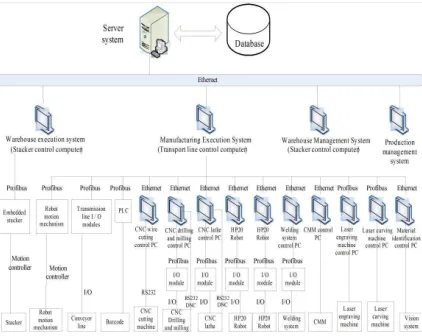
The task includes both studies on software and hardware level. The hardware structure includes a two-layered control system, I/Os, Profibus (Process Field Bus) and Ethernet wiring. The software level consists of computer communication and the comprehensive Profibus system with an integrated script language which are to be used for controlling the processes.
Secondly, the project also includes related theory regarding different control systems and there flaws and faults.
Figure 2: From the top, the server system and the upper computers, controlling the sub-systems and components through the bus net of Ethernet and Profibus.
PROFIBUS
around system integration, engineering and, in particular, the application profiles. These profiles have made PROFIBUS the only fieldbus that provides comprehensive both factory and process automation. Additionally, Information Technology (IT) increasingly determines development in today´s world of automation. Modern fieldbus systems have adopted IT principles and are achieving greater consistency with the corporate management level. In this respect, industrial automation is following the development trends of the office world, where IT has long since left its mark, radically transforming infrastructure, systems and processes. The integration of information technology in the world of automation opens up many new prospects for global data communication between automation systems. In pursuit of this objective, PROFIBUS is enhanced by the Ethernet-based communication standard PROFInet. The use of open standards rather than proprietary solutions ensures long-term compatibility and expandability - in other words - protection of existing investment. This is a matter of key importance to the PROFIBUS User Organization. The continuous development of PROFIBUS technology provides members with a long-term perspective.
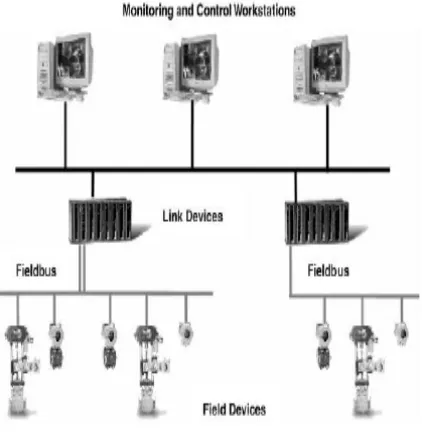
Figure 3: PROFIBUS Architecture
IV. COMMUNICATION IN AUTOMATION
world using standards such as Ethernet, TCP/IP, Intranet and Internet. This information flow requires large data packets and a range of powerful communication functions. As well as PROFIBUS, Ethernetbased PROFInet offers a trendsetting solution for this purpose. Recently, Ethernet-based communication systems have emerged in industrial automation. They offer wide-ranging options for communications between the different levels of industrial automation and the office world. PROFInet is an example of one such Ethernet-based communication system.
INDUSTRIAL COMMUNICATION
At the sensor-actuator level signals of binary sensors and actuators are transmitted over a sensor actuator bus. This provides a simple and cost-effective technology where data and power are transmitted over a shared medium. AS-Interface offers a suitable bus system for this field of application. At field level distributed devices such as I/O modules, transducers, drive units, analysis devices, valves or operator terminals, communicate with automation systems over a powerful, real-time communication system. Transmission of the process data is cyclic, while additional interrupts, configuration data and diagnosis data are transmitted acyclically as required. PROFIBUS fulfills these criteria and offers an universal solution for both factory and process automation. At the cell level programmable controllers such as PLCs and IPCs, communicate with each other and with IT systems of the office world using standards such as Ethernet, TCP/IP, Intranet and Internet. This information flow requires large data packets and a range of powerful communication functions. As well as PROFIBUS, Ethernetbased PROFInet offers a trendsetting solution for this purpose. Fieldbuses are industrial communication systems that use a range of media such as copper cable, fiber optics or wireless, with bit-serial transmission for coupling distributed field devices (sensors, actuators, drives, transducers, etc.) to a central control or management system. Fieldbus technology was developed in the 80s with the aim of replacing the commonly used central parallel wiring and prevailing analog signal transmission (4-20 mA- or +/- 10V interface) withdigital technology. Due, in parts, to the different industryspecific demands and preferred proprietary solutions of large manufacturers, several bus systems with varying properties were established in the market. The key technologies are now included in recently adopted standards IEC 61158 and IEC 61784. PROFIBUS is an integral part of these standards. Recently, Ethernet-based communication systems have emerged in industrial automation. They offer wide-ranging options for communications between the different levels of industrial automation and the office world. PROFInet is an example of one such Ethernet-based communication system. A need for the coordinated development and distribution of these fieldbus systems in the market has seen the emergence of a number of User Organizations comprising manufacturers, users and institutes, such as the PROFIBUS User Organization (PNO) and its parent organization PROFIBUS International (PI) for PROFIBUS and PROFInet technologies.
USER BENEFITS
PROFIBUS I/O
Table 1 consists of all the mayor components of the automatic manufacturing process. Number 1-11 is the machines and robots used for processing, 12-16 is all conveyor related technology and 17-18 is the central control part for the mobile robot.
Table 2: The following is the input/output of the Profibus system.
DISTRIBUTED CONTROL SYSTEM OF MOBILE ROBOTS
communication on Ethernet and develop a distributed I/O system using it as an onbody network for a humanoid robot HRP-3P. This paper is organized as follows. Section 2 explains why Ethernet is selected as an onbody network. Section 3 describes how to realize real-time communication on Ethernet. Section 4 presents a small-size controller to distribute all over the body. Section 5 explains a real time CORBA which works on realtime Ethernet. Section 6 measures the performance of a realtime communication library. Section 7 describes a distributed I/O system for HRP 3P using the real-time CORBA. Section 8 concludes the paper.
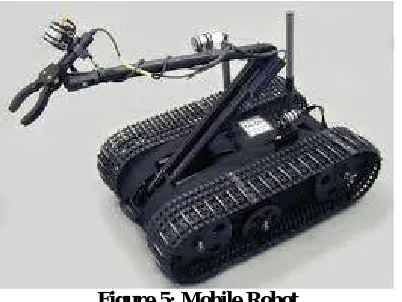
Figure 5: Mobile Robot DISTRIBUTED ROBOT CONTROLLER
In order to make a distributed I/O system using the realtime communication library, a small-size CPU board and I/O boards are developed. Figure 6 shows four kinds of developed boards. The upper row shows a CPU board which has SH4 and it is used by stacking with an I/O board as shown in the middle row. The bottom row shows a link I/O board which controls up to five joints, a sensor I/O board which measures sensors with analog outputs and a serial I/O board which has four RS422 ports from left. I/O boards are connected with a CPU board by a connector which is mounted at the upper left corner of boards and power is supplied through the connector. Brief specifications of these boards. The CPU board has two Ethernet ports to construct ring topology as mentioned above. A kernel and a root filesystem of ARTLinux are placed in flash memory and their modification can be done while running OS. Therefore, if maintenance is required, a user can log on from a remote computer through network and modify them. The user needs not to connect a serial cable and download new files. This is possible by using Ethernet as network.
V. RESULTS AND CONCLUSIONS
To create a program from scratch to control a system of this magnitude and complexity requires tremendous amount of work and time. Therefore the value of a functioning program like Profibus values high. In the very beginning of the project there was an actual plan to try to do an exception from the Profibus software and create a standalone application to control the mobile robot. The idea was to create an application in C++ and then use Dynamic-link library (DLL) to call commands to the motion card through either Ethernet or Profibus communication. It is a possible way to control the mobile robot in this way of course; if there was time, right preparation and a more familiar setting to do such a project it could have been a good way. Unfortunately there wasn't much time, after arriving to Shanghai and later receiving the project the timetable didn't turn out to be suitable at all for the first plan. No harm done, the second plan took place and the work of learning and programming the Profibus started.
already, the Profibus had already been configured up to handle the hardware aspects such as the data transmission and the network connectivity for example.
It took a fair amount of time getting started with the actual programming and the testing, partly because the need of a teachers assistances to get started and also sometimes simply lack of knowledge. There were some problems with e.g. which computer belonging to which sub-system and how to set up the systems different configurations. Even though I did document and translate a lot of the environment in the manufacturing process, both the hardware and the software aspects, translating everything would have been completely impossible considering the time schedule. With other words language problems were not an uncommon occurrence during the project.
Nevertheless, most of the problems were overcome fairly soon after they appeared. The result of planning and executing the project was overall a very constructive and instructive experience. Studying the different parts of the manufacturing process gave a very wide view of how the system works. But also, the study gave a lot of insight in specific sub-systems and components of the process such as the control system and the motion card.
Personally, I think staying in the laboratory of SUES gave me a good picture of modern research and development in the fields of robotics and mechatronics. The experimental research of an automatic manufacturing processes, included with robots, a distributed control system and other high-technology components, state as a good example for the fact that the industry is only heading for more and more intelligent systems and solution to improve the processes of manufacturing. This is what many manufacturers all over the world are working on to successfully accomplish, commonly with their main goal to reduce the need for human intervention and simply maximizing the profits. Although it is important to not forget that in many cases the use of humans is just far more cost-effective than implementing automatic technology, even when automation of industrial tasks is possible.
Even so, nothing can prevent the fact that automation plays a longtime important and increasing role in the world economy.
REFERENCES
[1] CHEN MEICHENG, X. J., FANG YANJUN 2005. Implementation of Fully Integrated Automation with PROFIBUS.
[2] HEMEIDA, A. M., EL-SADEK, M. Z. & YOUNIES, S. A. 2005. Distributed control system approach for a unified power system. Universities Power Engineering Conference, 2004. UPEC 2004. 39th International
[3] HONG, S. H. 2000. Experimental Performance Evaluation of Profibus-EMS
[4] MING RAO, H. Y. A. H. Y. 1997. Integrated distributed intelligent system architecture for incidents monitoring and diagnosis. Computers in Industry,
[5] SALVATORE CAVALIERI, A. D. S., AND ORAZIO MIRABELLA, MEMBER, IEEE 1997. Impact of Fieldbus on Communication in Robotic Systems. 13.
[6] VITTURI, S. DP-Ethernet: the Profibus DP protocol implemented on Ethernet. Computer Communications, 26.
[7] 1999-2010. Distributed Control Systems (DCS) [Online]. GlobalSpec. Available:
http://www.globalspec.com/learnmore/networking_communication_equipment/ networking_equipment/distributed_control_systems_dcs [Accessed].
[8] Material Handling Institute, "Material Handling and Logistics U. S. Roadmap," Material Handling Institute http://www.mhlroadmap.org/downloads/mhl_roadmap.zip 2014.
[9] S. Rosenthal and M. Veloso, "Mobile Robot Planning to Seek Help with Spatially-Situated Tasks," presented at the Twenty-Sixth AAAI Conference on Artificial Intelligence (AAAI-12), Toronto, Canada, 2015.