Involvement from the Perspective of the Low-SES African-American Mother. (Under the direction of Dr. Jessica T. DeCuir-Gunby).
There is general agreement in the relevant research literature that parental
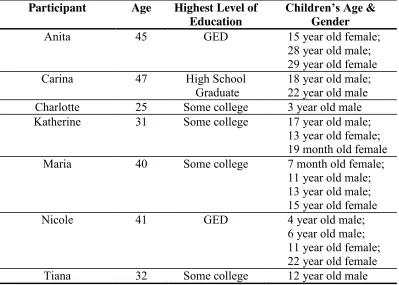
involvement in home- and school-based educational experiences leads to positive academic, social/emotional, and behavioral outcomes for children. More specifically, low-income African-American children have shown to benefit the greatest when their parents are involved in their educational experiences. There is also general agreement that to the extent trust and collaboration between parents and teachers are developed and maintained, the more likely parents are to become and remain involved. Trusting relationships between parents and teachers, however, are not always easily acquired. Race and social class have been shown to impact levels of trust within the relationship. Through semi-structured interviews, this qualitative study examined the lived experiences of 7 low-SES African-American mothers who participated in a year-long, faith-based program designed to assist them in creating more stable lives. Interviews with case managers familiar with the mothers’ school-based
by
Dina Carol Walker-DeVose
A dissertation submitted to the Graduate Faculty of North Carolina State University
in partial fulfillment of the requirements for the degree of
Doctor of Philosophy
Curriculum and Instruction
Raleigh, North Carolina 2013
APPROVED BY:
_______________________________ ______________________________
Dr. Jessica T. DeCuir-Gunby Dr. Heather Davis
Committee Chair
________________________________ ________________________________
DEDICATION
This dissertation is dedicated to the amazing women who took part in this study. Thank you for your time, your voice, and your honesty. I am proud to have you as partners in this work. I hope this research inspires educators to think differently about families and their role in their children’s education.
ACKNOWLEDGMENTS
It would be impossible in the limited space here to fully express my gratitude to all of the individuals who supported me in this work. It has been said that it takes a village to raise a child. Indeed, it takes a village to write a dissertation. Thank you to those who have prayed for me, counseled me, cared for my children, and in other ways supported me through the creation of this document.
My sincerest appreciation goes to my dissertation committee who each provided their own unique contribution to this project and my degree as a whole. As the committee
chairperson, Dr. Jessica T. DeCuir-Gunby went above and beyond her duty to ensure my success in this Ph.D. program. She both supported and challenged me in my coursework and in the writing of this dissertation. Thank you for your perspective and your support as I continue to grow in my knowledge of critical race theory. Dr. Heather Davis, thank you for sharing your passion for pre-service teacher education with me. Thank you also for allowing me an opportunity to expand my teaching repertoire. Most importantly, thank you for helping me to believe in myself as an educator, researcher, and a writer. Thank you Dr. Jocelyn D. Taliaferro for always dotting the Is and crossing the Ts and for providing invaluable feedback during my writing process. Last, but never least, thank you Dr. Marc Grimmitt for offering both your wisdom and your emotional support during my last few semesters. It truly was a blessing working with each of you. While I could never repay you for all you have given to me, I can promise to pay it forward to my future students.
You have been teacher, mentor, mother-figure, and friend. Thank you for all of the roles you have played. Most importantly, thank you for your belief in me over time. You encouraged me to overcome past experiences and move forward in my educational aspirations. I love you dearly for that. Thank you also to Dr. Alan Reiman, my former advisor at North Carolina State University. You will always be one of my favorite professors, but what I appreciated the most were our conversations about life, teaching, and family during our advising sessions. I always left feeling empowered and supported. Thank you for that.
Thank you to my family. To my husband, Delton DeVose, I continue to be amazed at the way you love and care for me. Never intimidated, you have embraced my success as your own. You have supported me on this journey, now it is my turn to support you. To my
to God for bringing such and incredible family together and allowing me to be one in the number.
To my colleagues and friends at North Carolina Central University, the College of Education and the Friday Institute for Educational Innovation at North Carolina State
TABLE OF CONTENTS
LIST OF TABLES ...x
LIST OF FIGURES ... xi
Chapter 1: Introduction ...1
Statement of the Problem ...2
Parent Involvement ...2
Trust ...7
Purpose of the Study ...9
Theoretical Framework ...9
Research Questions ...15
Definition of Terms ...15
Significance of the Study ...16
Subjectivity Statement ...17
Chapter 2: Literature Review ...22
Parent Involvement: Operationalization & Conceptualization ...22
Variables that Influence Parental Involvement ...31
Social Class ...31
Race ...34
Parental Role Construction & Self-Efficacy ...35
Parent & Child Characteristics ...37
Trust ...41
The Meaning of Trust ...42
The Process of Establishing Trust ...45
Types of Trust ...47
Home-School Collaboration: The Intersection of Trust, Parent-Teacher Relationships & Parental Involvement ...52
Chapter 3: Methods ...55
Research Design ...55
Appropriateness of Qualitative Methods ...56
Appropriateness of a Critical Race Theory (CRT) ...58
Evolution of the Design ...60
Participants &Context ...61
Context ...62
Participant Recruitment & Selection ...63
Primary Research Participant Overview ...64
Case Manager Participant Overview...67
Data Collection ...68
Demographic Data ...68
Semi-Structured Interviews...69
Data Analysis ...70
Trustworthiness & Credibility...71
Chapter 4: Results...74
Primary Participant Interviews ...76
Theme #1: Education as a Shared Responsibility ...77
Theme #2: Trust Given, Not Earned ...85
Theme #3: Race Mediates Trust ...88
Theme #4: Desire to Be Involved ...94
Theme #5: Varied Types of Involvement ...96
Theme #6: Work Negates School-Based Involvement ...98
Theme #7: Just Talk to Me! ...100
Case Manager Interviews ...102
Theme #1: Barriers Between Families & Schools ...104
Theme #2: Race & Income Mediate Relationships ...108
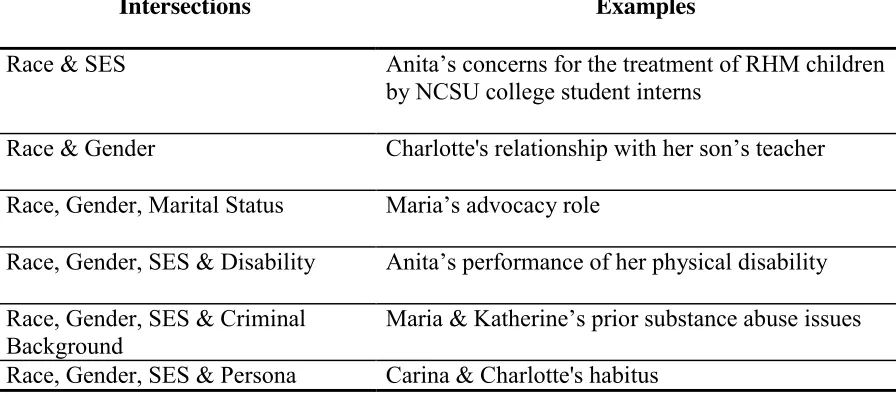
Application of Critical Race Perspective: Intersectionality ...112
Summary ...117
Chapter 5: Discussion ...119
Summary of Study ...119
Summary of Findings ...120
Research Question #1 ...120
Research Question #2 ...121
Research Question #3 ...122
Research Question #4 ...124
Implications for Teachers ...125
Implications for Teacher Education Programs & Schools ...126
Implications for Parenting & Family Support Programs ...127
Study Limitations ...128
Future Research ...131
Summary ...132
References ...136
Appendices ...152
Appendix A Recruitment Flyer ...153
Appendix B Demographic Questionnaire ...155
Appendix C Informed Consent Form ...159
Appendix D Primary Participant Interview Protocol ...163
LIST OF TABLES
Table 1 Epstein’s Framework of Six Types of Involvement For Comprehensive
Programs of Partnerships and Sample Practices ...25
Table 2 Participant Description ...65
Table 3 Research Question & Theme Alignment ...76
LIST OF FIGURES
Chapter 1: Introduction
If you ask a group of diverse parents about their relationships with the schools their children attend, you are likely to get a myriad of responses. Some parents will report positive relationships where parents and teachers are collaborative partners who trust each other and have formed a productive partnership. Others will report a somewhat distant relationship with separate spheres of influence (parents influence the home; teachers influence the schools) and surface interactions. Still others will report relationships marred by miscommunication, mistrust, and missed opportunities to connect. Despite the varied
responses parents may give, there is general agreement in the relevant research literature that parental involvement (PI) in children’s school experiences leads to positive academic, social/emotional, and behavioral outcomes for children (Epstein, 1986; 1995; Epstein & Sanders, 2000; Fan & Chen, 2001; Gonzalez-DeHass, Willems & Doan Holbein, 2005; Henderson & Mapp, 2002; Hoover-Dempsey & Sandler, 1997; Jeynes, 2003, 2005, 2007; Pena, 2000; Seefeldt, Denton, Galper, & Younoszai, 1998). More specifically, low-income African-American students have shown to benefit the greatest when their parents are involved in their educational experiences (Chavkin & Williams, 1993; De Civita, Pagania, Vitaro & Tremblay, 2004; Delgado-Gaitan, 1991; Eamon, 2002; Meidel & Reynolds, 1999). Some research suggests that increasing PI may be one way of reducing the educational achievement gap between White and racial minority groups (Jeynes, 2005, 2007; Lee & Bowen, 2006).
their child’s school experiences (Adams & Christenson, 2000;; Bryk & Schneider, 2003;; Christenson, 2004; Tschannen-Moran, 2001). But trust is not always easily acquired by all parents. Race and social class have been shown to impact levels of trust between parents and teachers (Beard & Brown, 2008; Goodard, Tschannen-Moran, & Hoy, 2001; Lareau, 1987; Lareau & Horvat, 1999; Murry, Kotchick, Wallace, Ketchen, Eddings & Heller, 2004; Tschannen-Moran & Hoy, 1998; Williams & Barber, 2007). Low-income African-American parents may enter the school setting with a disposition of suspicion and lower levels of trust than White, middle-class parents. When White parents enter the school setting, they do so with more trust and less suspicion in the motives of the school and teacher. Therefore, they acquire more value (capital) in a setting that stresses positive, affirmative, and supportive family-school relationships. Lack of trust on the part of the African-American parent often results in lack of collaboration and lower levels of PI (Lareau & Horvat, 1999).
This study attempts to examine how low-SES African-American parents see themselves in the parenting role, how differences in race and SES influence their trust in teachers, and how they make their decisions about their home- and school-based involvement activities. In the forefront of this study is the intersection of race, income, and gender, which informs not only how study participants view themselves, but also how they are viewed by others.
Statement of the Problem
Chen, 2001; Fishel & Ramirez, 2005; Hoover-Dempsey, Battiato, Walker, Reed, DeJong, & Jones 2001; Jeynes, 2005; Marcon, 1999; Powell, Son, File, San Juan, 2010; Stylianides & Stylianides, 2011) while a few others have failed to uncover a significant relationship (e.g., Fantuzzo, McWayne, Perry & Childs, 2004; Mattingly, Prislin, McKenzie, Rodriguez, Kayzar, 2002; Miller & Kelley, 1991). Among the research, Ginsburg-Block, Manz, and McWayne (2010) identified methodological issues as possible reason for the inconsistencies. She and her colleagues note several problems including: (a) use of a single survey item to assess the complex construct, (b) the inclusion of multiple confounding variables (e.g., child age, culture, SES, etc.) with no attempt to understand findings given these differences, and (c) the correlational nature of the majority of these studies that report only strength and direction of the relationship, but nothing about the intervening variables does more to explain student academic achievement (e.g., poverty status) than family involvement.
Nevertheless, the overwhelming evidence points to the fact that parents can and do make a difference in their children’s education (Epstein, 1986, 1995;; Hoover-Dempsey & Sandler, 1997). In a 2001 meta-analysis, Fan and Chen examined 25 studies that reported empirical findings from which Pearson’s correlations between the PI indicators and the achievement outcome variables could be obtained. They found an overall medium effect size (r=.25) and concluded that PI does have a positive influence on students’ academic
Jeynes conducted two meta-analyses, one examining PI on urban elementary school children (2005) and the other on urban secondary school children (2007). The results of both studies indicate that PI had a positive impact on children’s academic achievement. The elementary study (n=41) produced a fairly large effect size (0.8) and a positive association between PI programs and elementary children’s academic achievement. The secondary school study (n=52) reported overall effect sizes of .46 for studies that examined all minority children and .53 for those studies that included mostly minority children. In this study, Jeynes also found that specific components of PI were more influential to student achievement than others. Parenting style (the extent to which parents demonstrated a
supportive and helpful parenting approach) yielded an effect size of .40; communication (the extent to which parents and their children communicated about school activities) yielded an effect size of .32;; and parental expectations (the extent to which student’s parents maintained high expectations of the student’s abilities to achieve a high grade) yielded the highest results with an effect size of .88. These correlations generally held across race. In both studies, Jeynes suggests that PI may be one way of reducing the achievement gap between White and racial minority groups.
participate in homework (Hoover-Dempsey & Sandler, 1997). Other benefits include regular school attendance, good behavior, and improved teacher efficacy (Epstein & Salinas, 2001). Research also shows that the physical participation in educational activities is not the only way that parents can positively influence their children’s academic outcomes. Both Lee & Bowen (2006) and Feuerstein (2000) found that parents’ higher educational expectations for their children were associated with higher academic achievement. This finding held true across racial and social groups.
teacher ratings. Jenyes also noted that when there is involvement from the parents of African-American students, on the average, these children benefit more than their average Asian-American counterparts.
In another study utilizing a largely African-American and low-SES student population, Stylianides & Stylianides ( 2010) found that higher levels of parent-child interactions contributed to higher academic achievement in kindergarten in all major school subjects (e.g., mathematics, reading, science, and social studies). Parent-child interactions was defined as: reading to the child, telling the child stories, helping the child do art, building things with the child, teaching the child about nature, playing games with the child, and participating in sports activities with the child. Other research on the benefits of PI for African-American and low-SES students include higher levels of student-rated school engagement, school competence, and standardized achievement in reading (Murray, 2009); improvements in children’s social behavior and peer-to-peer interactions (Fantuzzo, Tighe & Childs, 2000); higher levels of rule compliance and sociability at school (Adams, Ryan, Ketsetzis & Keating, 2000); and better emotional adjustment, communication, and social skills (Marcon, 1999).
helping them and their children excel (Rotter, 1967). Given the overwhelming amount of research indicating the importance of parental involvement both in the home and in the school, understanding how parents experience trust in their relationship with the teacher and the school is worthy of exploring.
Trust. Trust in the family-school relationship is of critical importance. The
responsibilities conferred on schools to care for children require a high level of trust on the part of the parent (Goddard, Tschannen-Moran, & Hoy, 2001). Conversely, the increasing demand to actively involve families in the decision-making process of the school requires that teachers trust families as well (Clark, Sheridan & Woods, 2010). While several studies have established trust as a key factor that influences the extent to which parents and teachers develop collaborative relationships (Adams & Christenson, 2000; Bryk & Schneider, 2003), there is surprisingly little research on outcomes of trust and the family-school relationship. Of the extant research, studies have shown that trusting relationships between parents and teachers yields positive outcomes for students and schools.
helping to revitalize public schools in New York City’s East Harlem district cited the
building of trust as a key component in the success of the schools she created. James Comer, of the Comer’s School Development Project, also recognizes the importance of a community of trust and the active involvement of parents (Bryk & Schneider, 2003).
A few studies have linked parents’ level of trust directly to their level of PI. Lake & Billingsley (2000) found that parents with higher levels of trust in the parent-teacher relationship held more positive attitudes with regard to the value of their involvement in schools, are more engaged in their children’s learning, and are less likely to attach undue significance to occasional negative events, demonstrating greater tolerance and a willingness to forgive. Mapp (2002) studied why economically disadvantaged parents got involved with their children’s education. She found that parents’ desires to be involved in their children’s education was linked to the level of effort schools engaged in to build trusting relationships with parents. Feelings of mistrust toward schools by African-American parents impact the family-school relationship and may influence the nature of PI. Lareau (1987) found that African-American parents monitored the school and teachers more so than actively engage with teachers. Rather than working with teachers, minority parents often find that they must defend their children against their teachers and advocate with great difficulty for the basic academic needs for their children (Hill, 2010).
become involved. The social barriers of race and SES present challenges to educators in developing and fostering relationships with low-SES African-American parents, challenges that may not exist in their relationship with middle-class White families. To that end, this research was designed to amplify the voice of the low-SES African-American mother in hopes that her story will shed light on how she experiences trust in the parent-teacher relationship and how it influences her decision to become involved in her children’s school experiences.
Purpose of the Study
Through the lens of Critical Race Theory (CRT), a qualitative methodology was used to understand the lived experiences of low-SES African-American mothers as it relates to trusting their children’s teachers and their decisions to become involved in their children’s educational experiences. The overarching goal of this study was to amplify the voice of the study participants and to identify ways in which parent-teacher relationships can be improved in order to enhance parental school involvement and subsequently, academic outcomes for African-American students.
Theoretical Framework
examine this issue.
Grounded in the work of critical legal studies (CLS), CRT emerged in the 1970s following the Civil Rights Movement and an overall failure of CLS to address the effects of race and racism in the U.S. legal system (Decuir & Dixson, 2004). It was described as both an outgrowth and a separate entity from the earlier CLS. Lead by Derrick Bell, a law
professor and activist, CRT began with the notion that racism is so enmeshed in American society that it has become a natural part of the culture. Because of this enmeshment, CRT argues that the long, slow, upward pull of change as seen in the civil rights movement is no longer effective. Rather, racism requires sweeping changes if real gains are to be made (Ladson-Billings, 1998). These gains, according to Bell (1980) are highly unlikely unless they are in the best interest of Whites. According to Bell (2004):
The interest of blacks in achieving racial equality will be accommodated only when that interest converges with the interests of whites in policy-making positions. This convergence is far more important for gaining relief than the degree of harm suffered by blacks or the character of proof offered to prove that harm. (p.69)
Bell further asserts that even if the interests of Whites converge with the interests of African-Americans to form an effective remedy for racial problems, at the point in which that remedy threatens “the superior societal status of whites” (2004, p. 69), it will be rescinded.
multiple ways in which race is connected to create predictable outcomes in the education of students of color (Ladson-Billings & Tate, 1995; Solorzano & Yossa, 2001). Solorzano (1997) identifies five characteristics that describe CRT in education:
1. CRT in education centers its analysis on race and racism with attention to how race intersects with other forms of oppression (gender, class, etc.);
2. CRT in education challenges customary notions such as that of meritocracy, objectivity, color-blindness and equal opportunity;
3. CRT in education is committed to social justice;
4. CRT in education recognizes the critical role of the experiential knowledge of people of color in theorizing about race (counter-storytelling);
5. CRT in education utilizes inter-disciplinary methods to provide historical contexts in its analysis of race and racism.
Solorzano (1997) posits that the overall goal of CRT in education is to:
develop a pedagogy, curriculum and research agenda that accounts for the role of race and racism in U.S. education and works toward the elimination of racism as a part of the larger goal of eliminating all forms of subordination in education. (p. 7)
The application of CRT is particularly relevant to my research. Three elements resonate in particular: race and its intersection with other forms of oppression, focus on experiential knowledge and voice of low-SES African-American mothers, and the action-orientation of the research.
and the lessening of the value of others in all arenas, including education (DeCuir & Dixson, 2004). The current model of education and PI provides an example of how both race and class provides a privileging of some. PI in education has been socially constructed to privilege White middle-class norms and expectations (Lareau, 1989). Certain “legitimate acts” such as helping with homework, attending open houses, and chaperoning field trips have been set as the norm. Because teachers place a higher premium on school-based involvement, low-SES African-American parents who are less likely to come to the school are assumed to not care about their children’s schooling. These assumptions, rooted in deficit thinking, perpetuate the myth of the uninvolved minority parent (Auerbach, 2007) and further disempowered the African-American family.
Issues of power are also seen between middle- and working-class parents. Middle-class parents exert considerably more influence over schools and decisions about their children’s schooling, whereas poor and working-class parents have less power and more ambivalent relations with school staff. These class-based constraints in PI result in opportunities for more “customized” education for higher-SES children versus more generic ones for low-SES children (Lareau, 1989). A final example of how both race and class create power dynamics in schools is seen in Cooper’s (2007) qualitative examination of African-American mothers and their involvement practices addressed differences in power and the relational dynamics between White and African-American mothers:
(Fields-Smith, 2005; Holme 2002; Lareau & Horvat, 1999). Even low-income White mothers who have economic struggles do not to contend with racism. Moreover, White mothers as a whole do not have to confront educators’ race-based notions of
them being uncaring, angry or dysfunctional. As Lareau and Horvat (1999) explain, ‘Whiteness represents a largely hidden cultural resource that facilitates white parents’
compliance with the standard of deferential and positive parental involvement in school,’ (p. 49) and it also facilitates educators’ positive reaction towards them. (p.
495)
Cooper’s comments above speak to the added burden experienced by low-SES
African-American mothers in their children’s schools. Being non-white and non-middle class form an intersection of disadvantage for parents who may desire to be involved, but do not know how. Or, whose involvement in the school building may be too emotionally painful to handle. This research seeks to examine the multiple ways that the study participants’
identities (e.g., low-income, African-American, single mother) intersect and create additional burdens for them as they attempt to engage teachers and schools. Allowing the multiply-burdened to share their stories (referred to as the counter-story in CRT language) is a way to begin building bridges between parents and schools who might otherwise remain on
opposites sides of the river.
who have experienced discrimination speak with a special voice to which we should listen. DeCuir and Dixson (2004) assert that the “use of counterstories allows for the challenging of privileged discourses, the discourses of the majority, therefore, serving as a means for giving voice to marginalized groups” (p. 27). It is the stories that provide the necessary context for understanding, feeling, and interpreting (Ladson-Billings, 1998).
While on an upward trend, the PI and trust literature has historically been lacking in its representation of the voice of low-SES, African-American mothers. With some exceptions (e.g., Auerbach, 2007; Horvat, Weininger & Lareau, 2003; Lareau, 1987; Lareau & Horvat, 1999; Williams & Barber, 2007, etc.), they are often talked about, but less often talked to. Missing from the scholarly literature is first-hand, detailed accounts from low-SES, African-American mothers about how they view their relationships with teachers and schools, and how those relationships have influenced their efforts at PI. The value in this experiential knowledge may offer opportunities for new conversations between parents and teachers.
struggle for social justice within education (Ladson-Billings, 1998).
Research Questions
The following research questions were investigated in this study:
1. How do low-SES African-American mothers conceptualize the roles of the parent, teacher, community, and student in their children’s education? 2. How do differences in race and SES influence low-SES African-American
mothers’ relationships with teachers, specifically their levels of trust? 3. How involved are low-SES African-American mothers in their children’s
educational experiences and what, if any, barriers exist that negate involvement? 4. What strategies do low-SES African-American mothers recommend
schools/teachers use to increase their levels of parental involvement?
Definition of Terms
Cultural Capital – forms of knowledge, skills, education, and advantages that are valued by a society. Closely linked to social capital, the aggregate of actual or potential resources linked to possession of a durable network of essentially institutionalized relationships of mutual acquaintance and recognition (Bourdieu, 1986).
Intersectionality – term coined by Kimberlé Crenshaw and used to describe the various ways in which race, sex, class, national origin, and sexual orientation combine and are played out in various settings (Delgado & Stefancic, 2012).
Role Construction – beliefs about what one should do in a given role and the behaviors characteristically associated with performance of the role (Green, Walker, Hoover-Dempsey, Sandler, 2007).
Self-Efficacy – a person’s belief that he or she can act in ways that produce desired outcomes (Bandura, 1977).
Trust – the confidence that another person (the teacher/school) will act in a way to benefit or sustain the relationship, or the implicit or explicit goals of the relationship, to achieve
positive outcomes for students (Adams & Christenson, 2000).
Significance of the Study
This study seeks to understand the lived experiences of low-SES African-American parents as it relates to trusting their children’s teachers and their decisions to become
involved in their children’s school experiences. A wealth of research exists on the benefits of parental involvement for the academic outcomes of young children and the importance of trust in the parent-teacher-school relationship. However, much less research exists on how low-SES African-American mothers’ experience the parent-teacher relationship and how that relationship contributes to their involvement in their children’s educational experiences. It is anticipated that the knowledge gained from this inquiry will afford new insights to teachers, teacher education programs, school administrators, and parenting and family support
become involved in their children’s education as a complex decision involving many varied components and sometimes competing demands.
Subjectivity Statement
My past experience with my study participants has allowed me to recognize the similarities we share and the differences that exist. On a personal level, we share both a racial and maternal background. I am an African-American mother of two biological children (12 old son; 7 old daughter) and two stepchildren (19 old stepdaughter; 16 year-old stepson). I place a high value on my children’s education and their overall learning experiences both in and out of school. Perhaps like the study participants, I do not always know the best way to involve myself in the process of academically assisting my children, and trust of my children’s teachers and schools is often a choice I have to make prior to even getting to know any of them. Unlike the study participants, my middle-class background affords me with a certain cultural capitol valued by the school system and that makes
developing a trusting relationship with the middle-class teachers easier to obtain. Although, I have to admit I am somewhat hyper-vigilant to the interactions between children and
teachers, particular African-American children and White teachers.
education is very different from that of the study participants. What we have in common is a belief that parents can and do play a critical role in the overall development of their children, including their education.
In my heart, I am a right-fighter. I tend to be sensitive to the plight of those
individuals who are marginalized in society, as in many ways I too have been. I would like to believe in an ‘ideal world’ where resources are shared equally, people are treated fairly, and a high quality education is available to all. My experiences in life and in the classroom have taught me that that world does not exist. At present, I teach the same class that introduced me to RHM a few years prior. In this setting, I have encountered White, middle-class teacher education students who are stuck in the belief that low-SES students and those from other cultural backgrounds should ‘pick themselves up by their bootstraps’ and ‘not make excuses for their own failure’. These students are not willing to see or consider the context of
growing up poor and/or non-White in the United States. They regularly dismiss relevant research that points to the inequities in education and shut down when we discuss the privilege that our shared middle-class background affords. The few African-American students in the class seem afraid to speak up, share their experiences, or challenge the hurtful statements of their classmates. Some of them, based on their written reflections, fail to see race as a factor in their relationships.
issues related to education and African-American children from a deficit-perspective. On the other hand, most of the conversations revolved around low-SES African-American families. Since I did not identify as low-SES I was able to disassociate myself from this group. I now recognize this as a survival skill. In an effort to preserve my self-esteem in a setting that was designed to promote the White middle-class agenda of the schools, I had to distance myself from the group that research consistently pointed to as less capable of succeeding, and adapt a more colorblind mentality. This was coupled with the fact that my parents, both of the civil-rights generation, appeared to adopt a more integrationist perspective. We lived in
predominately White neighborhoods and attended predominately White schools. My brother and I were discouraged from using race as an excuse for our difficulties inside and outside of school. Even when the evidence pointed to race as a factor, we were taught to work harder to overcome. This, for me, translated into self-silencing in the classroom and allowed me to downplay the role of race in my life, much like the African-American students in my class. It was only when my doctoral advisor pushed me to examine CRT as a possible theoretical lens through which to examine my participants’ experiences (and ultimately my own experiences) was I given the motivation to delve deeper into my own experiences with race and the
language with which to speak about it.
amplify the voice of the marginalized and silenced, but also to provide one more source of information from which teacher educators can utilize to support change and
Chapter 2: Literature Review Parent Involvement: Operationalization & Conceptualization
A vast body of literature exists which attempts to operationalize and conceptualize the construct and process of PI in children’s education. What was once thought to be a
unidirectional construct is now widely recognized as one that is multidimensional and multifaceted encompassing a variety of different types of involvement (Epstein, 2005; Epstein & Dauber, 1991; Grolnick, Benjet, Kurowski & Apostoleris, 1997) worthy of further exploration. Research has examined the complex decision-making process parents engage in as they make their involvement decisions (Hoover-Dempsey & Sandler, 1995). It has also explored the complicated dynamics of power and social capital (Lareau, 1987, Lareau & Horvat, 1999) between the parent and the teacher. Studies have also uncovered compelling evidence that PI yields positive outcomes for children (Barnard, 2004; Fan & Chen, 2001; Fishel & Ramirez, 2005; Hoover-Dempsey et al., 2001; Jeynes, 2005; Marcon, 1999; Powell et al., 2010; Stylianides & Stylianides, 2011). Moreover, research has uncovered that PI is a complex social phenomenon that is complicated by a multitude of sociological variables such as social class, race, parental role construction, parental self-efficacy, and the relationship parents form with their children’s teachers. What follows is an attempt to define and clarify this dynamic construct.
community all play a critical role in children’s intellectual and social development. Grolnick and Slowiaczek (1994) provide a widely used definition and conceptualization of the
construct. They define PI as the “dedication of resources by the parent to the child in a given domain” (p. 238). More specifically, in the context of schooling, Grolnick and Slowiaczek (1994) describe three types of involvement: (a) cognitive-intellectual, (b) personal, and (c) behavioral. The cognitive-intellectual aspect of PI includes exposing the child to intellectual stimulation, such as museums, cultural events, books, and the like. Exposure to cognitively stimulating materials would presumably bring the home, community, and the school closer together and help the child practice skills that may be useful in schools. The personal aspect involves maintaining knowledge of the child’s academic life and school activities. It also includes expressing interest and enjoyment in the interactions with the child about their school learning and experiences. The behavioral aspect of PI originally included participation in school-related activities such as attending conferences, assisting with homework, and chaperoning on field trips. In 1997, Grolnick et al. redefined the behavioral category to include both school- and home-based activities. In the 1997 study, the three dimensions of this typology were found to contribute independently to the PI construct and were associated with children’s motivational resources in sixth through eighth grade students’ school
performance.
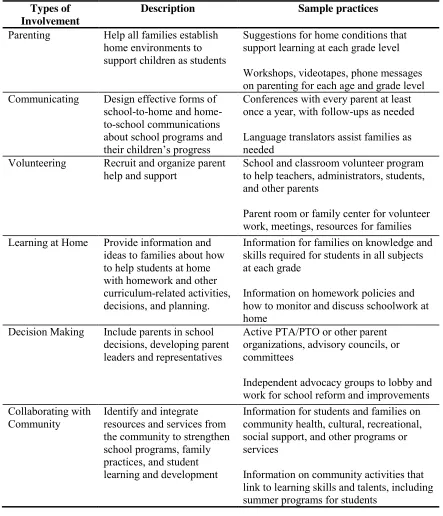
responsibility of the parent and the school, especially the critical role of teacher practices and attitudes that encourage and motivate parents’ active and continued engagement. Table 1 (Epstein’s Framework of Six Types of Involvement For Comprehensive Programs of
Partnerships and Sample Practices) describes each level of involvement and provides sample practices in which teachers might engage to ensure greater amounts of parental involvement. Because there are many possible activities for each type of involvement, both parents and schools must choose which practices are likely to produce specific goals and how to implement the selected activities effectively (Sheldon & Epstein, 2010).
Table 1
Epstein’s Framework of Six Types of Involvement For Comprehensive Programs of Partnerships and Sample Practices
Types of Involvement
Description Sample practices
Parenting Help all families establish home environments to support children as students
Suggestions for home conditions that support learning at each grade level
Workshops, videotapes, phone messages on parenting for each age and grade level Communicating Design effective forms of
school-to-home and home-to-school communications about school programs and their children’s progress
Conferences with every parent at least once a year, with follow-ups as needed
Language translators assist families as needed
Volunteering Recruit and organize parent help and support
School and classroom volunteer program to help teachers, administrators, students, and other parents
Parent room or family center for volunteer work, meetings, resources for families Learning at Home Provide information and
ideas to families about how to help students at home with homework and other curriculum-related activities, decisions, and planning.
Information for families on knowledge and skills required for students in all subjects at each grade
Information on homework policies and how to monitor and discuss schoolwork at home
Decision Making Include parents in school decisions, developing parent leaders and representatives
Active PTA/PTO or other parent organizations, advisory councils, or committees
Independent advocacy groups to lobby and work for school reform and improvements Collaborating with
Community
Identify and integrate resources and services from the community to strengthen school programs, family practices, and student learning and development
Information for students and families on community health, cultural, recreational, social support, and other programs or services
Another line of thought in the conceptualization of PI asks the question, “How do parents make the decision to become involved in their children’s schooling?” Grolnick et al. (1997) proposes an ecological, hierarchical model specifying three levels of factors: (a) individual, (b) contextual, and (c) institutional. At the individual level, parents’ decisions may be influenced by qualities of the parent-child dyad in three ways. First, parents differ in how they define the parental role. To the extent that they feel the parent has a place in the teaching-learning process, they may be more likely to become involved. Second, the parents’ sense of efficacy is likely to impact their behavior. Parents who believe they can make a difference are more likely to be involved. Lastly, Grolnick et al. (1997) explain that parents use their children’s behavior as regulators of their own behavior. Research has demonstrated that parents who saw their children as more difficult were less involved with them (Grolnick, Weiss, McKenzie, & Wrightman, 1996).
At the contextual level of the model, the focus is on the parent as a member of the family unit. The researchers suggest that the social context of the parent is a key contributor to the way resources are allotted to the child. If parents perceive themselves to have
inadequate resources (time, money, social supports, and high levels of stress) their
involvement with their children’s school will most likely be disrupted. Having such support and lower levels of stress may provide the parent with the time to be involved.
positive about their abilities to help (Epstein & Dauber, 1991). Research conducted on this model underscored the complexity of understanding factors associated with parents’
involvement decisions. For example, Grolnick and colleagues (1997) found that mothers who headed single-family homes were less involved on all three dimensions than those in two-parent families. The researchers hypothesize that involvement at school may be most difficult for mothers from single-parent families who often experience a lack of financial and social supports. Teachers and schools may find it useful to consider targeting other types of involvement that do not require daytime availability.
Figure 1
Level 1 - Why Parent’s Become Involved in their Children’s Education (Walker et al., 2005) Why Parents Become Involved in their Children's Education?
Parents' Motivational
Beliefs
Parental Role
Construction Parental Self-Efficacy
Parents' Perceptions of Invitations for Involvement
from Others
Perceptions of General School Invitations
Perceptions of Specific Child
Invitations
Perceptions of Specific Teacher
Invitations
Parents' Perceived Life
Context
Self-Perceived Time and Energy
The first level of the model describes three categories of motivators: (a) parents’ motivational beliefs, (b) parents’ perceptions of invitations for involvement from others, and (c) parents’ perceived life context. The ways in which parents construct their roles as parents and their sense of self-efficacy make up their motivational beliefs. Role construction for PI is influenced by parents’ beliefs about child rearing, child development, and appropriate home support roles in children’s education. In general, parents who hold an active role construction are more involved in their children’s education than parents who hold less active roles (Green et al., 2007). Self-efficacy, defined as a person’s belief that he or she can act in ways that will produce desired outcomes, is a significant factor in shaping the goals an individual chooses to pursue and his or her level of persistence in working toward that goal (Bandura, 1994). Positive personal beliefs about efficacy for helping one’s children succeed in school are associated with increased PI among elementary, middle, and high school students (Grolnick et al., 1997).
The second category describes parents’ perceptions of invitations for involvement from others. General school invitations are observable in the welcoming and responsive atmosphere of the school, practices that ensure parents are well informed about student progress, and practices that convey respect for and responsiveness to parental questions and suggestions (Green et al., 2007). Teacher invitations appear to also be an important motivator of parents in part because they underscore the teacher’s valuing of the parents’ contributions to students’ educational success (Adams & Christenson, 2000). Lastly, specific child
true of all types of invitation for involvement, invitations from the child may be increased by school actions to enhance family engagement in children’s schooling (Green et al., 2007).
The last category of motivators is parents’ perceptions of life context variables. The model suggests that parents’ understanding of their own skills and knowledge influences their thinking about the kinds of involvement activities they may reasonably take on. When parents believe that students’ or teachers’ requests for involvement fits their skills, they are generally pleased to help and believe that their responses are likely to contribute to their children’s learning (Hoover-Dempsey, Whitaker, & Ice, 2010). The model also suggests that parents’ perception of the time and energy they have available for involvement influences their decision to become involved on a practical level. For example, when parents are constrained by non-negotiable work hours or low levels of support for meeting multiple family obligations, school involvement is likely to suffer (Green et al., 2007).
reviewed individually, it is important to note that most of the variables are interrelated and may help to explain each other.
Variables That Influence Parental Involvement
Social Class. Parenting behaviors, like all other behaviors, occur within a context. The social context of parenting is a key contributor to the way resources are allotted to the child and appears to be a highly relevant determinant of parenting behavior (Bronfenbrenner, 1986; Grolnick et al., 1997). Social class is thought to create distinctive parenting styles that influence how parents define their role in their children’s lives (Lareau, 2002). For example, Lareau (2002) contends that middle class parents, both African-American and White,
conform to a cultural logic of childrearing she calls ‘concerted cultivation’. Middle-class parents enroll their children in more organized activities that often dominate family life. This ‘cultivation’ approach results in children with a wider range of experiences, a greater sense of individualism within the family, and an emphasis on children’s performance. On the contrary, working-class and poor parents put more emphasis on natural growth. Their belief is that as long as children are provided with love, food, and safety, they will grow and thrive. These children tend to have fewer organized activities, have more free time, and more
parents hoped their children would earn college and advanced degrees (Grolnick et al., 1997; Lareau 1987).
Another stark area of difference in middle- and working-class families is in the existence and the make-up of their social networks. Middle-class families tend to have more social networks. These networks are often comprised of other parents at the school and professionals in the community. Working-class families have fewer social networks, and rely more on kinship relationships for support (Horvat et al., 2003). One benefit of social
networks in school communities is that they provide a way to access resources or information that may or may not be shared by school officials (e.g., passing rates of teachers, teacher evaluation scores). Social networks provide parents with a source of capital that may be activated when needed. Having fewer networks means fewer resources. In their qualitative study of 18 African-American parents, Diamond & Gomez (2004) found that working-class African-American parents owned different resources with which to navigate educational environments. The middle-class parents in the study possessed resources that were more highly valued by the educational system (e.g., human, financial, social, and cultural). The working-class parents in the sample negotiated more challenging environments with fewer of the valued resources.
families were more individualistic, concerning themselves with what benefits their children and other middle-class children, lower-income students and families continued to be
marginalized and PI was ‘fragile’. In schools where the middle-class families held a more collective perspective and were committed to the well-being of all children, PI persisted over several decades and all children benefited.
Race. As previously mentioned, the variables discussed within this work are interrelated. Race, which will be discussed next, has strong links to social class. Although some research has found that social class is a better indicator of PI (Ginsburg-Block et al., 2010; Jeynes, 2003), others have shown that race, regardless of social class, influences PI activities. Lareau and Horvat (1999) argued that race contributes independently and
negatively on African-American parents’ levels of involvement. African-American parents, with a history of racial discrimination, approach schools with criticism and challenge rather than support and deference, which is preferred in the culture of the school. This leads to negative relationships between parent and teacher and the likelihood that efforts to be involved will be rejected. Much like their White, middle-class counterparts, middle-class African-Americans were also more likely than working-class or poor parents to ‘customize’ their children’s school experiences by intervening in ways that teachers do not perceive as confrontational.
Kerbow and Bernhardt (1993) argued that race and ethnicity mediated the social class effect. They found that African-American and Hispanic parents contacted schools and
groups to be involved at home. Immigrant status also seems to influence the nature and levels of PI in schools. Huntsinger & Jose (2009) found that Chinese-American parents were less involved than European-American parents in activities at school, and more involved in explicitly teaching their children at home, even against the teacher’s request. Because White, higher-income parents are more likely to participate in activities held in the school, ethnic minority parents, who are often less visible in the school, are perceived as not valuing or being interested in education. Consequently, ethnic minority parents’ involvement is often underestimated by teachers who focus only on school-based participation (Patel & Stevens, 2010).
Diamond & Gomez (2004) found that while White middle-class parents intervened and challenged the school policies more often than their working-class White counterparts, African-American working-class parents were more likely than working-class White parents to intervene and were more often thought to be confrontational in their approach, as
perceived by teachers. Grolnick and colleagues (1997) studied 209 mothers of 3rd-5th grade students and concurred that family social class was a strong predictor of two types of involvement: school-based and cognitive involvement (i.e., exposing children to
intellectually stimulating activities). However, they found no differences between middle and working-class parents in personal involvement in the child’s life (i.e., knowing about and keeping abreast of what is going on). The researchers suggest that the more effective types of involvement may occur equally regardless of social class.
race/ethnicity and social class. Fewer consider attitudinal variables such as parental role construction and parental self-efficacy (Grolnick et al., 1997). Parents’ role construction for involvement in their children’s schooling is grounded in three ideas: (a) their own personal ideas and expectations they have of themselves as parents, (b) their perceptions of what others important to them believe their role should be, and (c) their perceptions of what other groups who are important to them believe their role should be. Parental self-efficacy, the perceived ability to positively influence the behavior and development of one’s own child (Coleman & Karraker, 2000), is grounded in Bandura’s (1977) self-efficacy theory. The theory suggests that parents guide their choices and actions regarding involvement by considering and evaluating the outcomes they believe will result from their involvement behavior. These beliefs are not focused specifically on skills the parents possess, but on their beliefs about whether engaging these skills will make a difference in students’ school
outcomes (Hoover-Dempsey et al., 2010). Like role construction, self-efficacy is socially constructed and shaped primarily by mastery experiences (i.e., previous successful
involvement activities), vicarious mastery experiences (i.e., observing similar others succeed in similar tasks), verbal persuasion from relevant others (e.g., family members, other parents, teachers), and affective arousal regarding the importance of children’s school success
(Bandura, 1977).
school tended to be less involved. The same research also found that parents with a greater sense of self-efficacy regarding their children’s education were more involved in home-based educational activities. It was speculated that this may be because home-based involvement activities are driven almost exclusively by parents. This may require more initiative on the part of the parent to engage in independent educational activities at home, as compared to attending programs at the school (Waanders, Mendez & Downer, 2007). Downer and Mendez (2005) in their examination of African-American father’s involvement with preschool children found a significant relationship between father’s self-efficacy regarding education and frequency of home-based educational activities with their children enrolled in Head Start. Locus of control appears important in this line of research. Downer and Mendez also found evidence that parents with an internal locus of control were more involved in educational activities at home and in school than those with an external locus of control. Georgiou & Tourva (2007) found similar results. They determined that parents who
attributed their child’s achievement to a factor that was under their control tended to believe that involvement was worthwhile. On the contrary, those who attributed it to an external and uncontrollable factor (e.g., child’s ability, teacher) tended not to have this belief. In sum, Georgiou & Tourva state, “parents who think that they can make a difference are motivated to get involved, while those who think that other factors and not them have the determining power prefer to keep their distance” (p. 480).
Peisner-Feinberg, & Skinner, 2004; Fantuzzo et al., 2000; Georgiou & Tourva, 2007; Grolnick & Slowiaczek, 1994). However, Fantuzzo and colleagues (2000) found that higher levels of education were not related to home-based involvement and Waanders et al. (2007) found no significant differences in levels of school involvement among parents with higher and lower educational levels. Waanders did find that mothers with less than a high school education reported significantly lower levels of conferencing with school personnel.
Parent’s marital status has also been studied. Fantuzzo and colleagues (2000) found that two-parent families were more involved in both home-school conferencing and school-based involvement than single, widowed, divorced or separated parents. These findings support the belief that the added resources and stability provided in two-parent households enhance parents’ capacity to be involved. This research and others (e.g., Grolnick et al, 1997;; McWayne, Campos, & Owisanik, 2008) suggest that involvement at school may be most difficult for parents who head households independently. Schools should consider targeting other types of involvement that do not require day-time availability.
Lastly, while a wealth of research exists examining the relationship between child characteristics and parenting behavior, fewer studies examine the relationship as it
specifically relates to parent school involvement. In general, the literature points to specific child temperament characteristics as a major influence of parenting behavior (Clark,
Kochanska, & Ready, 2000; McBride, Schoppe, & Rane, 2002). Researchers give the most attention to children thought to have difficult temperaments (e.g., irregular biological
association between temperament and general PI, both home- and school-based, for fathers than mothers. They found that less sociable girls had less involved fathers. No differences in boys’ sociability were linked to father involvement. The researchers hypothesize that for fathers, parenting a son may be a more integral part of their identity than parenting daughters, such that fathers feel that they have more discretion in the degree to which they become involved with their daughters. While fewer associations were found for mothers, they did find that less active girls received less maternal involvement. The researchers suggest that this might be because more active children require more supervision than less active children.
As it related specifically to PI in schools or with educational experiences, the age of the child and the child’s gender have been examined. Patel & Stevens (2010) found that parents of sixth graders were more involved than parents of eighth graders and Fantuzzzo et al. (2004) identified the parents of preschool-age children were more involved than children in the first grade. This may be indicative of parents’ belief that younger children require more oversight. As the research above suggested, fathers of boys have been found to be more significantly involved in home- and school-based involvement than fathers of girls (Patel & Stevens, 2010). This finding is not surprising when considering how fathers construct their role in the family and their strong identification with their male children.
The role of sociological variables greatly informs our understanding of parent’s school involvement decisions. Schools interested in capitalizing on the wealth of resources of all families, upper-, middle-, working-class, and poor, would be wise to examine their current involvement strategies and identify ways in which current practices and policies
parents want their children to be successful and that all parents believe that their involvement in school activities is important, then we must also believe that adjusting the current practices of schools so that they are more inclusive is a necessary next step.
Parenting Within the School & Community
Until this point, this review has primarily focused on PI in a dyadic manner, a relationship between parent and teacher. While the examination of this relationship is important, it takes place within the larger context of the community. In fact, many scholars believe that successful school partnerships must include three important elements: the family, the school, and the community (Cochran & Dean, 1991; Comer & Emmons, 2006; Delgado-Gaitan, 1991; Dunst, Johanson, Rounds, Trivette & Hambey, 1992; Epstein 1986, 1995; Henderson & Mapp, 2002; Hoover-Dempsey et. al., 2010;). What follows is a description of one of the most popular models of school-family-community partnership cited in literature.
characteristics of the student, school policies) that create conditions, spaces, opportunities, and incentives for more or fewer shared activities. The internal structures of the model are made up of the specific institutional and individual lines of communications, and they locate where and how social interactions of participants occur within and across the boundaries of school, home, and community (Sheldon & Epstein, 2010).
This framework, representing the sharing of responsibilities and the overlapping influence, means that parents do not bear the entire burden of figuring out how to become and remain involved in their children’s schooling. Rather, the burden is shared between the school, family, and the community. The assumption is that if children feel cared for and encouraged to work hard in the role of the student, they are more likely to do their best, learn other skills and talents, and to remain in school (Epstein & Sanders, 2000). But the sharing of responsibilities requires a level of trust and collaboration that is not always felt by all parents. Low-SES and African-American parents experiences more difficulties in establishing and maintaining trusting relationships with teachers (Beard & Brown, 2008; Rotter, 1967; Tschannen-Moran & Hoy, 2000; Williams & Barber, 2007). At this point in the review, we examine the construct of trust; specifically, the importance of trust, what it means to trust, how it is developed, the types of trust relevant to this work, and the factors that influence the formation of trust.
Trust
others. The efficiency, adjustment, and even survival of any social group depends upon the presence or absence of such trust. (Rotter, 1967, p. 651)
When Julian Rotter wrote those words, he was not specifically speaking of trust in a school setting; however, his words certainly apply within such a context. Schools are complex social organizations that require a great deal of trust among their members if they are to run efficiently. Students, teachers, principals, parents, and communities are all interdependent members of the school organization who must trust each other to perform specific tasks for the greater good of all (Adams, Forsyth, & Mitchell, 2009; Bryk &
Schneider, 2003; Tschannen-Moran, 2004). To the extent that trust is formed and maintained, teachers feel more efficacious and have a higher morale, school culture becomes one of cooperation and caring, parents feel greater levels of collaboration with teachers, and students feel safer and can devote more energy to learning (Tschannen-Moran, 2004;
Tschannen-Moran & Hoy, 2000). What follows is a review of the trust literature with a focus on those principles and ideas that are relevant to trust within school settings. This literature and our general understanding of the construct are greatly informed by research in
organizational management and psychology.
defined as a collective judgment that another group will not act opportunistically, is honest in negotiations, and makes a good faith effort to behave in accordance with commitments (Bradach & Eccles 1989). From a psychological perspective, trust can be defined as an “expectancy that is held by an individual or group that the word, promise, or statement of another individual or group can be relied upon” (Rotter, 1967, p. 651). From an educational perspective, trust can be defined as confidence that another person will act in a way to benefit or sustain the relationship, or the implicit or explicit goals of the relationship, to achieve positive outcomes for children (Adams & Christenson, 2000). Tschannen-Moran & Hoy (2000) offer yet another definition within the educational literature that speaks to the multifaceted nature of trust. They define trust as one party’s willingness to be vulnerable to another party based on the confidence that the later party is (a) benevolent, (b) reliable, (c) competent, (d) honest, and (e) open (Tschannen-Moran & Hoy, 1998). The facets of trust as described by Tschanen-Moran & Hoy, have been empirically studied and have been found to covary together to form a coherent construct of trust (Tschannen-Moran & Hoy, 2000). What follows is a brief description of each.
Vulnerability. Vulnerability speaks to the interdependent nature of trust. Without a
Confidence. Trust resides in the degree of confidence one holds in the face of risk
rather than in the choice or action that increases one’s risk (Rousseau, Sitkin, Burt, & Camerer, 1998). This means that trust is not always absolute.
Benevolence. The confidence that one’s well-being or something one cares about will be
protected and not harmed by the trusted person. Trust is the assurance that the other will not exploit one’s vulnerability or take excessive advantage of one even when the opportunity is available (Tschannen-Moran & Hoy, 2000).
Reliability. While at its most basic level, trust is about predictability, consistency over time, it goes beyond that. People can be predictably late, malicious, or self-serving. When this happens, our needs may be getting met, but our sense of trust in the other person is weakened (Beard & Brown, 2008; Tschannen-Moran & Hoy, 2000).
Competence. In school relationships, good intentions are often not enough. Parents,
students, administrators, and other teachers need to feel confident that the teacher has the ability to perform the task that is expected (Goddard et al., 2001).
Honesty. A fundamental facet of trust, honesty speaks to the person’s character, integrity, and authenticity (Tschannen-Moran, 2004). The implication is that statements made are truthful and conform to “what really happened,” at least from the person’s perspective, and that commitments made about future actions will be kept (Tschannen-Moran & Hoy, 2000).
Tschannen-Moran & Hoy (2000) note that while all of the facets of trust are important, their relative weight will depend on the nature of the interdependence and vulnerability in the relationship.
The Process of Establishing Trust. Trust is a dynamic phenomenon that changes over time and takes on different characteristics at different stages within the relationship (Tschannen-Moran & Hoy, 2000). Rempel, Holmes, and Zanna (1985) describe a three-level, developmental progression of trust, beginning with a stage they call predictability. In this first stage, trust is based solely on the behavior of an individual and maintenance of the emotional environment. If behavior is stable, predictable, and positive, then trust is likely to be developed. In the context of the parent-teacher relationship, predictability is enhanced when parents and teachers have reasonable expectations of each other and communicate with each other in positive ways. At the next stage dependability, the relationship progresses toward trust being seen as a personal attribute, rather than simply based on a set of behaviors. This shift occurs when individuals demonstrate that their behavior is predictable and
responsive to the other’s needs over time. When expectations that parents and teachers have of each other are continuously met over the course of the school year, the trust in the