Effect of Information Technology Dimensions on
E
nterprise
R
isk
M
anagement
PARVANEH SAEIDI1
,
S
AUDAHS
OFIAN2,
S
ITIZ
ALEHAA
BDULR
ASID3,
S
EYYEDA
LIREZAS
AAEIDI41 Faculty of Management, Universiti Teknologi Malaysia, Johor Bahru, Malaysia
2 Department of Accounting and Finance, Universiti Teknologi Malaysia, Skudai,
Johor Bahru, Malaysia
3 International Business School, Universiti Teknologi Malaysia, Kuala lumpur,
Malaysia
4 Higher Education Institute of Faran-Mehr Danesh, Valeeasr Street, Tehran, Iran
ABSTRACT. Financial institutions are exposed to many risks from different directions. Too many areas need to be protected which is not possible unless a holistic and comprehensive risk management process is in order. Enterprise risk management (ERM) proponents argue that ERM is that process which is a good instrument to overcome today’s challenges. Moreover, researchers claimed thatan effective risk management is impossible without effective technology. Therefore the purpose of this study is to evaluate the effect of different dimensions of technology on ERM among Iranian financial institutions. This study used survey questionnaire to evaluate ERM and the level of companies’ technology including IT strategy and IT structure in organizations. This study found that there is positive and significant relationship between all dimensions of technology and ERM.
Keywords: Enterprise risk management; Information system; Information technology.
1.
Introduction. Risk management is the foundation of prudent financial institutions practices. Undoubtedly all financial institutions in today’s volatile environment are facing a large number of risks which may threaten an institution’s survival and success [1]. For this reason, effective risk management is absolutely required [2, 3]. Reference [4] asserts the only perfect method of managing a company in today’s complex world is through “balancing risk.” Unlike conventional risk management which group individual risk as independently managed risk ‘silos’, ERM allows organizations to manage a wide range of risks in a coordinated, enterprise-wide manner. According to [5] and [6], in today’s environment, technology could have important effects in improving risk management systems in organizations. In other words, without effective technology it is imposible to have effective risk management [5, 6, 7, 8]. While previous researchs have been argued about the impact of technology on ERM theoretically, few attempts have been made to test the proposed theory empirically. Moreover, regarding the measurement of constructs, this study considered both dimensions of IT including IT strategy and IT structure [9] which, to the authors knowledge have not been considered in previous studies, and ERM is measured based on all 8 variables of ERM in Committee of Sponsoring Organization of the Tread way Commission’s (COSO) framework [10]. Therefore this study can provide a comprehensive view of a companies’ IT as well as ERM.developing countries such as Iran which can offer new knowledge about ERM in the world. Moreover, according to Iran’s 20-years perspective (vision) plan, Iran should be ranked first in the region in terms of economic, scientific and technology levels by the year 2025 [11]. Therefore, the objective of this study is to examine the relationship between IT strategy and IT structure on ERM.
2
. Literature and hypotheses development 2.1Enterprise Risk Management (ERM)Globalization, competition, strict regulation, litigation, technology, and complex financial models all contribute to the challenges facing businesses. The inability to meet the challenges in any of these areas can result in negative consequences for an organization. Traditional risk management is not sufficient enough to overcome all aforementioned challenges [12, 13, 14]. Under traditional method, risks will be managed in different units of the firm. For example, financial corporations have separate units for managing risk in their companies, and can include market, liquidity, operational and credit risks which are separately managed in individual risk silos [15].
Recently many companies have come to view risk management as a holistic approach instead of a silo- based perspective to survive and succeed in today’s environment. This holistic approach is called Enterprise Risk Management (ERM) [1, 10, 12, 16, 17, 18]. In this approach, each risk class is a part of the firms overall risk portfolio. In other words, it is an integrated approach for managing the total risk portfolio in a company.
Committee of Sponsoring Organization of the Treadway Commission (COSO) provided an ERM definition as follows:
“Enterprise risk management is a process affected by an entity’s board of directors, management and other personnel, applied in a strategic setting and across the enterprise, designed to identify potential events that may affect the entity and manage risk to be within its risk appetite, to provide reasonable assurance regarding the achievement of entity objectives.” [10]
The available studies on ERM frequently describe many benefits of using ERM. For example, ERM allows firms to consider risk in their decision making processes, preventing the duplication of processes and reducing risk management expenses [13]. Organizations that incorporate ERM principals can better recognize the risks inherent in a variety of business activities. Additionally, companies that use ERM can objectively evaluate how resources can be allocated, thus improving the efficiency of their capital and increasing the return on their equity. Furthermore, large cash flow shortages are reduced when risk is managed using ERM [16]. Moreover as well as reducing monetary losses, ERM benefits organizations because it can be used to provide investors with risk profiles. As a result, the costs associated with regulatory scrutiny and external capital are also reduced [19].
In this regard, the results of previous studies revealed that companies that embrace ERM have a competitive advantage over those organizations that rely on traditional silo approaches [1, 10, 16]. Reference [20] pointed out that ERM is a management tool that ultimately enhances shareholder value. Reference [12] and [1] explained that ERM reduces financial distress because it identifies the negative consequences of a single risk to the organization as a whole thus allowing it to be identified and controlled. These two researchers also found that one of the greatest advantages of ERM on corporate earnings was its ability to control variable costs and revenue sources.
Overall, ERM benefits organizations by increasing stakeholder value, competitive advantage, performance, and the ability of an organization to accomplish their objectives [1, 10, 12, 16, 17, 20, 21, 22, 23].
A number of ERM models are in use at the moment. In this respect, one of the most commonly adopted models is the Committee of Sponsoring Organizations of the Treadway Commission (COSO) [8, 21, 24]. The origin for the ERM approach was based on COSO’s 1992 internal control-integrated framework, a publication that formed the basis of a universal method to manage internal control mechanisms [24].
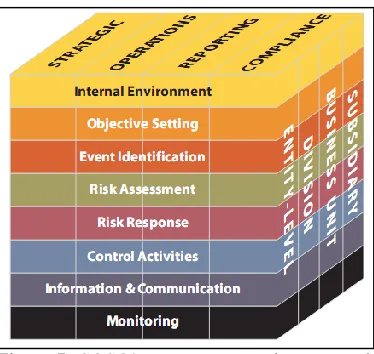
The framework provides risk management infrastructure in terms of eight elements to be studied under each of the four themes of objectives. Therefore each level of the company implements the eight ERM elements to the following four themes of objectives concerned (Figure 1). A specific objective may be grouped into one or more categories. Thus, the grouping may demarcate the purpose into multiple lines of authority.
According to this framework ERM components are: (1) internal environment; (2) objective setting; (3) event identification; (4) risk assessment; (5) risk response; (6) control activities; (7) information and communication; and (8) monitoring.
Figure I: COSO’s ERM Integrated Framework Table I: Summary of definition of ERM components
ERM Factors Definition
Internal environment Risk management viewpoint, risk appetite, truthfulness and ethical values. Tone of the firm which sets the framework for how risk is perceived.
Objective setting Goals support and align with system’s mission and are consistent with its risk desire. Event identification Recognition of events affecting accomplishment of objectives.
Risk assessment Risk assessed on intrinsic and residual foundation. Risk response Preventing, accepting, decreasing or sharing risk.
Control activities Policies and Practices are set up for all procedures and all personnel are aware of it. Information and
communication
Essential data is recognized, captured and communicated.
Monitoring Ongoing management processes, separate analysis.
Source: [25]
While ERM is very important in today’s economy, not many studies have done on different dimensions and issues of this new mechanism. Most previous studies only considered ERM as a dummy variable or only examined the extent of ERM usage or level of ERM adoption. Accordingly, in order to better understand ERM in organizations, and since there are limited studies that investigate different components of ERM [26] this study provides a broader insight to ERM by focusing on all 8 COSO (2004) dimensions.
2.2 Information Technology
Technology plays a key role in today's business environment. Many companies want to adopt and implement different models of technology [27]. This is because product life cycles have become very short, the windows of opportunity that exist for companies to achieve the benefits of technology have been shortened and technology is changing rapidly. Therefore business organizations intend to build technologies to provide competitive advantage, and to create portfolios of products in ever changing markets [28 , 29]. In the same avenue, environmental changes create the need for more information and interpreting, greater information gathering, synthesis capabilities, which in turn lead to enhance an organizations performance [9]. According to [30] Information system (IS) and technology (IT) can be considered as a central point of technology in organizations.
IT structure reflects the firm’s information-processing ability. Three dimensions form the basis of the concept of IT. Organizational architecture is the first dimension that contains the level of demoralization of the IT organizational structure and the degree of responsibility of IT functions [33, 34]. The second one is the technological architecture. It is comprised of the nature of hardware deployment, the level of data integration and application, and standardization of the technology [35, 36, 37]. Finally, the process and skills is the last dimension, which contain arrangement mechanisms and the standardization of application progress and implementation methods [38].
Information system researchers have investigated essentially at these two (IT structure and IT strategy) separately, whereas according to contingency theorists an aggregated conceptualization has better power to explain by increasing the ability to retain the interrelation and complex nature of the linkage between variables [39]. Therefore in this study the information technology structure and strategy are considered together. Further, by reviewing the information system studies it can be conducted that while there are many studies regarding the effect of technology and its dimensions on other fields (e.g. accounting system, firm performance etc.) there have been few studies regarding the effect of IT on risk management.
2.3 Information Technology and ERM
The relationship between information technology and ERM has been mentioned by researchers and are outlined in the following discussion. Reference [40] posited that it is almost impossible to carry out effective management of risk without an efficient IT. Reference [41] recommended organizations adopt IT to have effective risk management. The author pointed out that: 1) IT can generate a relevant connection between risk management and business performance; 2) IT offers data security by personnel level, reducing a user's access by time, line of commerce, commercial activity and personal risk; and 3) IT instruments gather information utilized previously so that organizations can learn through experience and avoid repeating the same mistakes. The effectual risk management information creates more value for decision making [6]. Therefore, IT is an essential element of prosperous risk management.
Considering the question that arises on how technology can aid risk management in commerce, there are four important areas where it plays a role [42]: 1) Collecting data and storage, 2) Analysing risks and modelling, 3) Monitoring risks and controlling, 4) Risk information and communication.
Thus, it encompasses providing adequate information for better decision making, gathering information that needs good front-end mechanism, an efficient mechanism, intelligence technology, adequate database, and information structure with little intervention of people. This stage requires properly trained personnel with the right tradition, attitude and processes to: (a) capture and log the data appropriately, and (b) to analyse the data effectively [42]. Moreover, analysis and modeling of risks is the basis for decision making [43]. By the use of technology, managers would be better able to analyze and model data and information.
Additionally, the ability to access information and the use of technology has enabled organizations to effectively and consistently control risks. It would be almost impossible for risk managers to perform well without the storage and processing abilities of advanced technology and immediate capacity to communicate data-rich material around the world. In addition, computerised controls play an ever increasing role in risk management systems [42].
Literature has investigated several empirical studies regarding technology and risk management [5, 6, 7, 8, 44]. Reference [7] evaluated overall risk management as the capability to respond to market variables which lead to stable organizational revenue. The investigation was based on a concluded sample of 1,386 US-based firms with financial data provided from Compustat. The researcher found that: (1) companies functioning in high-technology and sophisticated sectors, such as semiconductors, computer products, pharmaceuticals, aircraft engines, diagnostic instruments, etc., have essentially greater advantage from effective risk management capabilities compared with other companies; and (2) technology, innovation, and risk management are positively related to performance measures. Further, [6] studied critical and significant success factors for prosperous risk management procedures on a sample of 111 organizations in Thailand. The study found a group of seven critical success factors that can be utilized as parameters on how to increase the efficiency of risk management procedures. The elements are: (1) commitment and support from top management, (2) culture, (3) communication, (4) information technology (IT), (5) training, (6) organization structure, and (7) trust. The authors mentioned that IT is the most important factor for the success of an RM system in organizations.
(HR, technical validity, and organizational validity) in documentation is necessary for all three phases of risk management system; readiness, execution and administration.
As shown in the above discussion, literature documented that effective risk management depends on effective technology [5, 6, 7, 8, 44]. Technology can improve risk management system in organizations [5, 6]. While several authors have adopted and described the relationship between technology and risk management, there is lack of study which offer a comprehensive view of IT by evaluating all its different dimension and its effect on ERM. Therefore the hypothesis of this study is:
H1) IT strategy has a positive and significant effect on ERM. H2) IT structure has a positive and significant effect on ERM.
3 Methodology 3.1 Data Collection
Following most of the previous studies regarding ERM and IT issues, data collection and analysis method of this study is based on quantitative approach through a questionnaire survey. The population of this study consisted of 183 firms which are all financial institutions of Iran including those listed on Iranian central insurance website, stock exchange market as well as Iranian central bank website,. In accordance with [12, 17, 18], the sample of this study is 86 financial institutions those have already implemented and utilized ERM as their risk management system. In this regard, following the studies of [12], [17], [18], and [45], this study searched for various terms which are known as indicators of the presence of ERM in companies.
According to previous studies the presence of “chief risk officer”, “vice president enterprise risk management”, “risk management committee”, “executive risk manager”, “senior risk manager”, “head of risk manager”, and “vice president risk management” are proxies for implementing ERM [12, 17, 18, 45].
Due to the small number of financial institutions which have implemented ERM, this study used census sampling techniques and self-administered supervised (one-to-one supervision) method of data collection to reduce the respondent’s error [46, 55].
3.2 Variable measurement
To evaluate the ERM system in organizations, and to fulfill the objectives and hypothesis of the study, this study adapts some questionnaire items developed by [47], [26], and [48]. However, to enable a comprehensive view of ERM, the author tried to develop and add some questions to the above instrument to cover all 8 components of ERM which is offered by COSO [10] including internal environment, objective settings, event identification, risk assessment, risk response, control activities, information and communication, and monitoring. To develop the questions the author followed the principles and definitions offered by The Committee of Sponsoring Organizations of the Treadway Commission (2004b) in the “Enterprise Risk Management-Integrated Framework.”
Regarding IT, this study followed the [9] questionnaire as a comprehensive measurement which measured technology of organizations by looking at IT strategy and IT structure. IT strategy is evaluated by IT environment scanning, and strategic use of IT. In addition, IT planning and control, and IT acquisition and implementation was used to measure IT structure.
There was a total of 36 items for ERM and 29 items for IT used in the survey based on a respondent’s agreement or disagreement on a five-point Likert-type scale. The questionnaire was validated through expert interviews with three Chief risk officers and IT managers to gather information about ERM and IT. Moreover, to ensure the use of clear language the researchers employed two language professionals to revise the study instruments. A pilot test was also carried out for further refining the instrument. A small sample of institutions were requested to evaluate the questionnaire and provide feedback on the items. Based on general comments made, there were a few minor edits. The questionnaires of this study were administered through one to one supervision method to gather maximum response. Out of 86 questions developed, 84 were usable.
3.3 Data Analysis
3.3.1 Measurement model
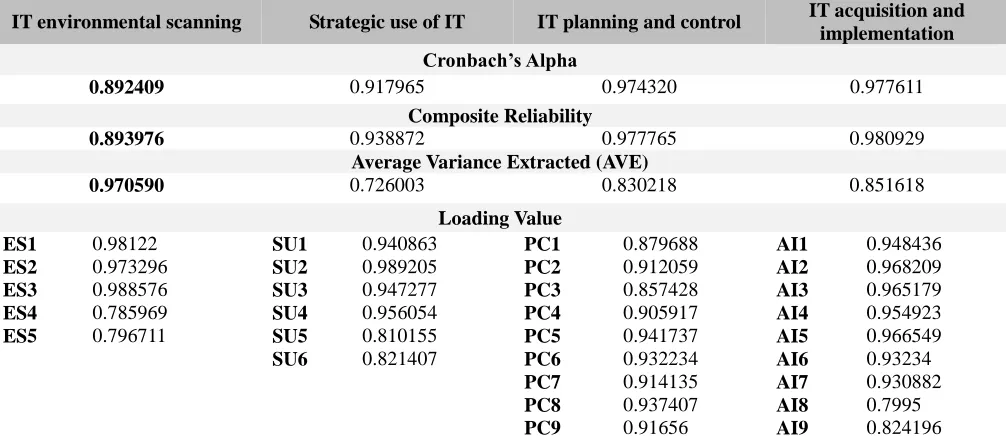
This study assessed the adequacy of the measurement model through an examination of individual item reliabilities, convergent and discriminant validity of all constructs (total of 84 items) which are presented in Table 2 and Table 3 (see Appendix 1 and 2).
Discriminant validity is met when the shared variance among any two variables (i.e., the square of their inter-correlations) is less than the average variance extracted (AVE) of each variable [52]. As can be seen from Table 2, there was no correlation between any two latent constructs larger than or even equal to the square root AVE of these two constructs. Moreover, in ordet to evaluate discriminant validity, this study examined cross loading. In this regard, the items loading values was analysed to specified whether the indicators have the largest value on their own latent construct. The analysis revealed that all indicator variables load highest on the latent variable. Thus, this criterion is also fulfilled. Consequently, discriminant validity was supported and confidence was gained that all constructs in the research model were indeed measuring different concepts [52]. Finally Cronbach’s alpha scores and composite reliability were used to evaluate the reliability of the measures as suggested by [53], [54], and [55]. Cronbach’s alpha can be considered an adequate index of the inter-item consistency reliability of independent and dependent variables [54]. Reference [56] recommends that constructs have reliability scores in excess of 0.7 as a minimum threshold. According to [55] the minimum value of 0.7 is required for composite reliability (CR). The analysis of AVE, CR, and Cronbach’s Alpha of each variable and CFA for each instrument is presented in Table 3 (see Apendix 2).
3.3.2 Structural model (hypothesis testing)
After testing measurement model, the structural model was tested to answer the hypotheses of study. The R2 (variance explained) and the sign and significance of path coefficients were applied to assess the
structural model. In PLS model evaluation path, R2 values are the amount of variance of dependent
construct(s) that is explained by the independent construct(s). Co-efficient, on the other hand refers to the extent of change in the dependent variable that is associated with a one unit change in the independent variable. Both R2 and path coefficient values vary between 0 and 1 and closer to 1 is better (Hair et al.,
2003). According to Cohen (1988), the R2 values can be interpreted as follows: >0.35=strong effect; >0.15=moderate
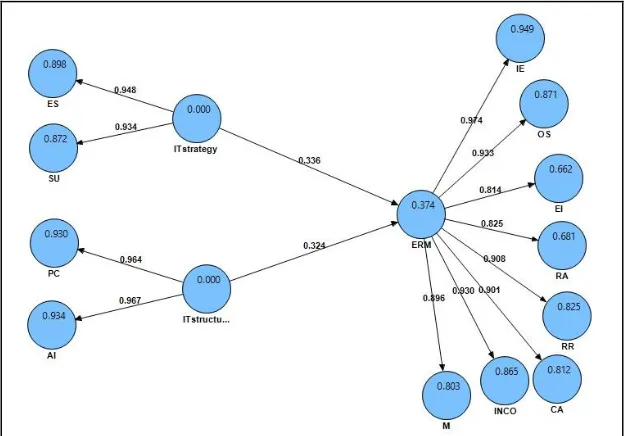
effect; >0.02=weak effect. The corresponding t-values are assessed using the bootstrapping method. Good structural model fit exists when there are a sufficiently high explanatory relative power (R2) and statistically significant t-values. A bootstrapping method with 200 resamples was applied to evaluate the statistical significance of the path estimates. Figure 2 and Table 4 present the results of the measured structural model.
Table IV: Hypotheses testing
Path Mean STDEV Coefficient t-value Hypothesis IT strategy -> ERM 0.947537 0.014601 0.336355 2.718469 Supported IT structure -> ERM 0.327173 0.125739 0.323792 2.575121 Supported
The results of Table 3 allow us to test each of the proposed hypotheses. There are two main direct effects of IT on ERM in this study. All hypotheses (H1 and H2) are supported because the model shows a highly significant link between both IT strategy (β=0.336, p>0.01, t value= 2.718) and IT structure (β=0.324, p>0.05, t value= 2.575) with ERM. The R2 values of the model show that IT strategy and IT structure explain 37.4% of the
variance of ERM.
4 Discussion and Conclusion
The results provided support for hypothesis 1 and 2 that there is a positive and significant relationship between IT strategy and IT structure and ERM in organization. This means that whatever IT system and its foundation is greater, the risk management would be better for the firm. The calculated values and path coefficient of the variables revealed that IT dimensions among Iranian financial institutions has positive and significant impact on ERM. This finding supports previous researches into this area which linked other dimensions of technology to risk management and found a positive and significant relationship [e.g. 6, 8].
The findings of this study make several contributions. First, the current findings extend ERM literature by providing a comprehensive view of IT through considering IT strategy as well as IT structure. This research could serve as a base for future studies on ERM in Iran. The findings further assist scholars’ in obtaining a better understanding of the role of technology in controlling risks and hazards. Second, the empirical findings in this study provide a new understanding of the underlying concepts of ERM by considering all 8 components of COSO’s framework. Further, the findings contribute to managers’ knowledge of uses and benefits of improving ERM system through promoting IT system and its dimension.
5 Limitations of Study
The findings in this report are subject to at least three limitations. In other words, generalizing these results is subject to certain limitations. First, these findings are limited by the use of a cross sectional design. Second, these data apply only to measure the state of ERM and IT in the financial sector. Therefore, the results might not be generalizable to other business industries. Further works therefore are required in other industries. Third, since only Iranian firms were included in this study, caution must be applied as the findings might not be transferable to other developing countries as well. It is strongly recommended that further research be undertaken in the same subject in other developing countries. It would also be interesting to compare the gained results from different business sectors and different countries together. Suggested studies results would be of great help to add substantially to scholars and managers understanding of various concepts and benefits of improving IT and ERM. At last, a further study with more focus on identifying other aspects of technology on ERM practices is suggested.
REFERENCES
[1] M. S. Beasley, R. Clune, and D. R. Hermanson, "Enterprise Risk Management: an imprical analaysis of factors associated with the extent of implementation," accounting and public policy vol. 24, pp. 521-531, 2005.
[2] H. A. H. Al‐Tamimi and F. M. Al‐Mazrooei, "Banks' risk management: a comparison study of UAE national and foreign banks," The Journal of Risk Finance, vol. 8, pp. 394-409, 2007.
[3] S. Z. A. Rasid and A. R. A. Rahman, "Management Accounting and Risk Management Practices in Financial Institutions," Jurnal Teknologi, vol. 51, pp. 89-110, 2009.
[4] S. Berinato. (2004, Nov. 1) Risk's Rewards. CIO Magazine. 46-58.
[5] N. Yaraghi and R. G. Langhe, "Critical success factors for risk management systems," Journal of Risk Research, vol. 14, pp. 551-581, 2011.
[7] T. J. Andersen, "The Performance Relationship of Effective Risk Management: Exploring the Firm-Specific Investment Rationale," Long Range Planning, vol. 41, pp. 155-176, 2008.
[8] M. Arena, M. Arnaboldi, and G. Azzone, "The organizational dynamics of Enterprise Risk Management," Accounting, Organizations and Society, vol. 35, pp. 659-675, 2010.
[9] F. Bergerona, L. Raymondb, and S. Rivardc, "Ideal patterns of strategic alignment and business performance," Information & Management, vol. 41, pp. 1003-1020, 2004.
[10] COSO, "Enterprise Risk Management – Integrated Framework," Committee of Sponsoring Organizations of the Treadway Commission, New York, NY2004.
[11] D. Iranian, Vision,. (2004, 3). Iran's Vision 1404, Available at http://www.vision1404.ir/ (Accessed 1, March, 2015).
[12] A. P. Liebenberg and R. E. Hoyt, "The determinants of enterprise risk management: evidence from the appointment of chief risk officers," Risk Management and Insurance Review vol. 6, pp. 37-52, 2003. [13] R. E. Hoyt and A. P. Liebenberg, "The Value Of Enterprise Risk Management," The Journal of Risk and
Insurance, vol. 78, pp. 795-822, 2011.
[14] J. Miccolis and S. Shah, "Enterprise Risk Management: An Analytic Approach," tillinghast-towers perrin2000.
[15] C. Cumming and B. Hirtle, "The Challenges of Risk Management in Diversified Financial Companies," FRBNY Economic Policy Review, vol. 7, pp. 1-17, 2001.
[16] B. W. Nocco and R. M. Stulz, "enterprise risk management: theory and practice," applied corporate finance, vol. 18, pp. 8-20, 2006.
[17] l. A. Gordon, m. P. Loeb, and c. y. Tseng, "Enterprise risk management and firm performance: A contingency perspective," J. Account. Public Policy vol. 28, pp. 301-327, 2009.
[18] D. Pagach and R. Warr, "The Characteristics of Firms That Hire Chief Risk Officers," Risk and Insurance, vol. 78, pp. 185-211, 2011.
[19] L. K. Meulbroek, "Integrated Risk Management for the Firm: A Senior Manager's Guide," Journal of Applied Corporate Finance, vol. 14, pp. 56-70, 2002.
[20] D. Pagach and R. Warr, "The Effects of Enterprise Risk Management on Firm Performance," Available at SSRN: http://ssrn.com/abstract=1155218 (accessed 10 november 2013), 2010.
[21] I. M. Tahir and A. R. Razali, "The Relationship Between Enterprise Risk Management (ERM) and Firm Value: Evidence From Malaysian Public Listed Companies," International Journal of Economics and Management Sciences, vol. 1, pp. 32-41, 2011.
[22] P. Burnaby and S. Hass, "Ten steps to enterprise-wide risk management," Corporate Governance, vol. 9, pp. 539-550, 2009.
[23] E. O’Donnell, "Enterprise risk management: A systems-thinking framework for the event identification phase," International Journal of Accounting Information Systems, vol. 6, pp. 177-195, 2005.
[24] J. K. Bowen, R. Cassel, C. Collins, K. Dickson, M. Fleet, D. Ingram, et al., "Enterprise Risk Management Specialty Guide (ERMSG)," 2006.
[25] A. Jalal, F. S. AlBayati, and N. R. AlBuainain, "Evaluating Enterprise Risk Management (ERM); Bahrain Financial Sectors As a Case Study," International Business Research vol. 4, pp. 83-92, 2011.
[26] N. Subramaniam, P. Collier, M. Phang, and G. Burke, "The effects of perceived business uncertainty, external consultants and risk management on organisational outcomes," Journal of Accounting & Organizational Change, vol. 7, pp. 132-157, 2011.
[27] K. Amoako-Gyampah, "Perceived usefulness, user involvement and behavioral intention: an empirical study of ERP implementation," Computers in Human Behavior, vol. 23, pp. 1232-1248, 2007.
[28] D. Wu and D. Olson, "Enterprise riskmanagement: coping with model risk in a large bank," Journal of the Operational Research Society, vol. 61, pp. 179-190, 2010.
[29] D. L. Olson and D. D. Wu, "Enterprise Risk Management," in Financial Engeneering and Risk Management, J. R. Birge, Ed., ed Chicago: University of Chicago Graduate School of Business, 2007. [30] E.-J. Mutsaers, H. v. d. Zee, and H. Giertz, "The evolution of information technology," Information
Management & Computer Security, vol. 6, pp. 115-126, 1998.
[31] S. A. Z. S.R. Das, M.E. Warketin, "Integrating the content and concept of strategic planning with competitive strategy," Decision Sciences, vol. 22, pp. 953-984, 1991.
[32] S. H. Y. Chan, D.W. Barclay, D.G. Copeland, "Business strategic orientation, information systems strategic orientation, and strategic alignment," Information Systems Research, vol. 8, pp. 125-150, 1996.
[34] S. L. M. C.V. Brown, "Reconceptualizing the contextdesign issue for the information systems function," Organization Science, vol. 9, pp. 176-194, 1998.
[35] E. S. P. Ein-Dor, "Organizational context and MIS structure: some empirical evidence," MIS Quarterly, vol. 6, pp. 55-68, 1982.
[36] V. G. K.D. Fiedler, J.T.C. Teng, "An empirically derived taxonomy of information technology structure and its relationship to organizational structure," Journal of Management Information Systems, vol. 13, pp. 9-34, 1996.
[37] W. L. C.W. Holsapple, "A framework for studying computer support of organizational infrastructure," Information & Management Accounting, vol. 31, pp. 13-24, 1996.
[38] A. C. B. B.R. Allen, "Information architecture: in search of efficientflexibility," MIS Quarterly, vol. 15, pp. 435-446, 1991.
[39] J. E. P. N. Venkatraman, "Environment-strategy coalignment: an empirical test of its performance implications," Strategic Management Journal, vol. 11, pp. 1-23, 1990.
[40] Xenomorph, "A Platform for Effective Risk Management.Increasing market risk managers’ effectiveness,"
Available at
www.xenomorph.com/downloads/whitepapers/risk-platform/xenomorph--risk-platform-white-paper.pdf (accessed 10 november 2012), 2007.
[41] H. Rolland, "Using IT to Drive Effective Risk Management," Risk Management, vol. 55, pp. 43-43, 2008. [42] E. T. Watson, "The role of technology in risk management," Available at:
www.towerswatson.com/assets/pdf/4795/TW-EU-2011-20552.pdf (accessed 30 October 2012), 2011. [43] R. Jamieson and M. Handzic, "A framework for security, control and assurance of knowledge management
systems," in Handbook on Knowledge Management. vol. 1, C. Holsapple, Ed., ed New York, NY: Springer-Verlag, 2003.
[44] S. Otim, K. E. Dow, V. Grover, and J. A. Wong, "The Impact of Information Technology Investments on Downside Risk of the Firm: Alternative Measurement of the Business Value of IT," Journal of Management Information Systems, vol. 29, pp. 159 - 194, 2012.
[45] N. M. Golshan and S. A. Rasid, "Determinants of Enterprise Risk Management Adoption: An Empirical Analysis of Malaysian Public Listed Firms," international Journal of Social and Human Sciences, vol. 6, pp. 119-126, 2012.
[46] L. B. Bourque and E. P. Fielder, How to Conduct Self-Administered and Mail Surveys. USA: SAGE Publications, 2002.
[47] P. M. Collier, A. J. Berry, and G. T. Burke, Risk and Management Accounting: Best Practice Guidelines for Enterprise-Wide Internal Control Procedures vol. 2. Burlington, USA: CIMA, Elsevier Ltd., 2007. [48] S. Gates, "Incorporating Strategic Risk into Enterprise Risk Management: A Survey of Current Corporate
Practice," Journal of Applied Corporate Finance, vol. 18, pp. 81-91, 2006.
[49] D. Gefen, D. W. Straub, and M. Boudreau, "Structural equation modeling and regression: Guidelines for research practice.," Communications of the Association for Information Systems, vol. 4, pp. 1-77., 2000. [50] W. W. Chin, "Issues and Opinion on Structural Equation Modeling," MIS Quarterly, vol. 22 pp. VII-XVI,
1998a.
[51] W. W. Chin, "The partial least squares approach to structural equation modeling. In G.A. Marcoulides (Ed.), Modern methods for business research (pp. 295-358). Mahwah, NJ: Erlbaum.," 1998b.
[52] C. Fornell and D. F. Larcker, "Evaluating structural equation models with unobservable variables and measurement error," Journal of Marketing Research, vol. 18, pp. 39-50, 1981.
[53] G. A. Churchill, "A paradigm for developing better measures of marketing constructs," Journal of Marketing Research, vol. XVI, pp. 64-73, 1986.
[54] U. Sekaran, Research methods for business: a skill-building approach, 14 ed. New York: John Wiley & Sons, 2003.
[55] j. F. Hair, G. T. M. Hult, C. M. Ringle, and M. Sarstedt, A Primer on Partial Least Squares Structural Equation Modeling (PLS-SEM). USA: SAGE, 2013.
[56] J. C. Nunnally, Psychometric theory New York: McGraw-Hill, 1978.
Diagonal items: AVE score roots
(IE: Internal environment, OS: Objective setting, EI: Event Identification, RA: Risk assessment, RR: Risk response, CA: Control activities, INCO: Information and communication, M: Monitoring, ES: IT environmental scanning, SU: strategic use of IT, PC: IT planning and controlling, AI: IT acquisition and implementation)
Appendix 2: Table III: Construct measurements summary Internal
Environment
Objective Setting
Event identification
Risk
assessment Risk response Control activity
Information
communication Monitoring Cronbach’s Alpha
0.890588 0.988641 0.789000 0.891409 0.891409 0.887201 0.885437 0.793802
Composite Reliability
0.892236 0.970427 0.792727 0.893607 0.893607 0.890492 0.889220 0.795376
Average Variance Extracted (AVE)
0.955161 0.936657 0.978493 0.974908 0.974908 0.963023 0.958235 0.981757
AI 2.8122 1.28632 0.92283
CA 3.0060 1.27651 0.48119 0.98133
EI 3.0952 1.42606 0.48373 0.68086 0.98918
ES 2.9071 1.31807 0.56642 0.49766 0.50389 0.98518
IE 2.8452 1.35519 0.53381 0.88983 0.75804 0.53680 0.97732
Loading Value
IE1 0.96972 OS1 0.96707 EI1 0.88493 RA1 0.98723 RR1 0.8715 CA1 0.98146 INCO1 0.97820 M1 0.98978 IE2 0.98137 OS2 0.86365 EI2 0.98867 RA2 0.96631 RR2 0.98281 CA2 0.88009 INCO2 0.96518 M2 0.96971 IE3 0.98443 OS3 0.95343 EI3 0.98392 RA3 0.9856 RR3 0.98500 CA3 0.98087 INCO3 0.79305 M3 0.98682 IE4 0.89405 OS4 0.98916 RA4 0.86025 RR4 0.79684 CA4 0.88291 INCO4 0.97893 M4 0.89699 IE5 0.96318 OS5 0.94734
IE6 0.97084 OS6 0.93377 OS7 0.88851
Table III: Construct measurements summary (continue)
IT environmental scanning Strategic use of IT IT planning and control IT acquisition and implementation Cronbach’s Alpha
0.892409 0.917965 0.974320 0.977611
Composite Reliability
0.893976 0.938872 0.977765 0.980929
Average Variance Extracted (AVE)
0.970590 0.726003 0.830218 0.851618
Loading Value
ES1 0.98122 SU1 0.940863 PC1 0.879688 AI1 0.948436
ES2 0.973296 SU2 0.989205 PC2 0.912059 AI2 0.968209
ES3 0.988576 SU3 0.947277 PC3 0.857428 AI3 0.965179
ES4 0.785969 SU4 0.956054 PC4 0.905917 AI4 0.954923
ES5 0.796711 SU5 0.810155 PC5 0.941737 AI5 0.966549
SU6 0.821407 PC6 0.932234 AI6 0.93234
PC7 0.914135 AI7 0.930882
PC8 0.937407 AI8 0.7995