BOOKHOLT, CHRISTOPHER G. Address Space Layout Permutation:
Increasing Resistance to Memory Corruption Attacks. (Under the direction of Jun Xu).
A key problem with current address randomization techniques is their use of ran-domly sized pads that shift the location of critical memory regions. Pads limits the potential of existing techniques because pads are unused space. To increase protection, pad size needs to increase, thereby wasting additional address space. The relationship between protection and pad size forces system designers to choose between security and address space conser-vation.
This thesis proposes Address Space Layout Permutation (ASLP), which improves upon existing address randomization techniques with a novel approach to increase proba-bilistic protection at performance overhead comparable to contemporary techniqueswithout using large pads. ASLP randomly places the user stack, heap, and shared libraries through-out the entire 3 gigabyte user address space. In doing so, ASLP randomizes 28 bits of the user stack base address, 29 bits of the heap base address, and 20 bits of each shared library allocation. Our approach randomizes 4 bits more than any other techinque, for a 16-fold increase in region placement options. Further, both SPEC CPU2000 and Apache Benchmarks indicate ASLP incurs less than 1% runtime overhead.
We also present a validation of address space randomization by showing that ran-domization limits the propagation speed of worms reliant on the absolute location of either the user stack, heap, or a shared library function. The increased randomization leads to increased exploit time needed for such worms. Compared to kernel-based related work, we increase average exploit time by a factor of 16. This means the fastest conceivable memory corruption worm could not infect a single host in the same amount of time the Slammer Worm took to infect approximately 500,000 hosts – or 90% of its vulnerable population.
by
Christopher G. Bookholt
A thesis submitted to the Graduate Faculty of North Carolina State University
in partial satisfaction of the requirements for the Degree of
Master of Science
Computer Science
Raleigh
2005
Approved By:
Dr. Peng Ning Dr. Laurie Williams
Dr. Jun Xu
Biography
Acknowledgements
First, my parents deserve great deal of thanks for putting me through school. Without their help staying in school would have been impossible. Simply put, I owe it all to them.
Carolyn, my girlfriend, was a tremendous source of support and comfort. In addition to making meals and letting me vent frustration, she listened to my incessant babbling about address space randomization far, far more than any one person should have to endure.
Fellow members of the NC State University Systems Security research group – particularly Emre (John) Sezer, Chongkyung Kil, and Prachi Gauriar – were an invaluable source of second opinions, reality checks, and thoughtful discussions. It was a pleasure and honor to work closely with such obviously talented company.
I would also like to thank the members of the PaX community for their constructive criticism. Specifically, on several occasions Alexander (Pappy) Gabert volunteered hours of his time to explain Linux virtual memory and general kernel development concepts to me, a total stranger. Pappy, you have my respect and admiration.
Credit for the initial idea of ASLP goes to Dr. Jun Xu, my adviser and the chair of my thesis committee. His direction, motivation, and assistance were crucial to the completion of this project. Many thanks also go to my committee members, Dr. Peng Ning and Dr. Laurie Willians. In addition to finding time for me in their busy schedules, their input helped define a more logical organization of this paper.
Contents
List of Figures vi
List of Tables vii
1 Introduction 1
1.1 The Case for Increasing Randomness . . . 3
1.2 ASLP Contributions . . . 5
2 Related Work 8 2.1 User Land . . . 8
2.2 Kernel Land . . . 10
3 ASLP Randomization 12 3.1 Supporting Theory . . . 12
3.2 Implementation . . . 13
3.2.1 Demonstration of Permutation . . . 17
4 ASLP Evaluation 19 4.1 Security Evaluation . . . 19
4.1.1 Micro-Security . . . 19
4.1.2 Macro-Security . . . 23
4.2 Performance Evaluation . . . 24
4.2.1 SPEC CPU2000 Integer Benchmark . . . 26
4.2.2 LMBench Micro-Benchmark . . . 29
4.2.3 Apache Benchmark . . . 34
4.2.4 Summary of Performance Evaluation . . . 35
5 Kernel Space Randomization Proposal 37 5.1 Randomizing Kernel Data Structures . . . 39
5.2 Randomizing Vmalloc . . . 41
6 Conclusions & Future Work 42
6.1 Future Work . . . 43
Bibliography 45 A GNU/Linux User Address Space 50 B CPU2000 Benchmark Data 52 C LMBench Benchmark Data 55 C.1 LMBench: Process Operations . . . 55
C.2 LMBench: Context Switching . . . 55
C.3 LMBench: File and VM System . . . 57
C.4 LMBench: Local Communication Latency . . . 57
C.5 LMBench: Communication Bandwidth . . . 58
D Apache Benchmark Data 66
List of Figures
1.1 Example PaX ASLR Process Memory Layout . . . 6
1.2 Example ASLP Process Memory Layout . . . 6
4.1 Comparing Randomness Provided by Related Techniques . . . 21
4.2 Infection Plot: With ASLP vs. Without ASLP . . . 23
4.3 CPU2000 Integer Benchmark Overheads . . . 27
4.4 LMBench Process Operation Overheads . . . 30
4.5 LMBench Context Switch Overheads . . . 31
4.6 LMBench File and VM System Latency Overheads . . . 32
4.7 LMBench Communication Latency Overheads . . . 33
4.8 LMBench Communication Bandwidth Overheads . . . 33
4.9 Apache Benchmark Overheads . . . 35
5.1 Kernel Address Space Memory Layout . . . 38
A.1 Example Normal Process Memory Layout . . . 51
B.1 CPU2000 Integer Benchmark Runtimes . . . 53
C.1 LMBench Process Operation Runtimes . . . 56
C.2 LMBench Context Switch Runtimes . . . 56
C.3 LMBench File & VM Runtimes . . . 59
C.4 LMBench Communication Latency Runtimes . . . 59
C.5 LMBench Communication Bandwidth Runtimes . . . 64
List of Tables
3.1 Comparing Process Memory Layout on Standard and ASLP Kernels . . . . 17
4.1 PaXtest Results Summary . . . 20
4.2 ASLP Protection Evaluation . . . 21
4.3 Red Hat Exec-Shield Protection Evaluation . . . 22
4.4 PaX ASLR Protection Evaluation . . . 22
4.5 Configurations Compared to ASLP . . . 25
4.6 Understanding PIE Overhead . . . 28
4.7 CPU2000 PIE Overhead Analysis . . . 29
5.1 Possible Permutations for Kernel Space Regions . . . 38
B.1 Descriptions of CPU2000 Integer Benchmarks . . . 52
B.2 SPEC CPU2000 Benchmark Run times (seconds) . . . 54
B.3 SPEC CPU2000 Benchmark Overhead (%) . . . 54
C.1 Descriptions of LMBench Process Operations Benchmarks . . . 57
C.2 LMBench Process Operations Benchmark Run times . . . 58
C.3 LMBench Process Benchmark Overheads . . . 60
C.4 Descriptions of LMBench Context Switching Benchmarks . . . 60
C.5 LMBench Context Switch Benchmark Run times . . . 60
C.6 LMBench Context Switch Benchmark Overheads . . . 61
C.7 Descriptions of LMBench Virtual Memory and File System Benchmarks . . 61
C.8 LMBench File and VM System Latency Benchmark Run times . . . 61
C.9 LMBench File and VM System Latency Benchmark Overheads . . . 62
C.10 Descriptions of LMBench Communication Latency Benchmarks . . . 62
C.11 LMBench Local Communication Latency Benchmark Run times . . . 62
C.12 LMBench Local Communication Latency Benchmark Overheads . . . 63
C.13 Descriptions of LMBench Communication Bandwidth Benchmarks . . . 63
C.14 LMBench Local Communication Bandwidth Benchmark Run times . . . 64
C.15 LMBench Local Communication Bandwidth Benchmark Overheads . . . 65
Chapter 1
Introduction
Memory corruption attacks are the most common means by which attackers take control of computers: of all US-CERT Cyber Security Alerts between mid-2005 and 2004, at least 56% of them have components of memory corruption [42]. With a high concentration of memory corruption attack vectors, there is reason to believe that mitigating attacks of this kind would give attackers significantly fewer ways to exploit their targets, thereby reducing the threat they pose.
Memory corruption is a mechanism to locate and alter critical portions of memory in a target program. Examples of critical memory regions are buffers, function return addresses, and function pointers [44]. In an attack scenario, the attacker attempts to alter program memory with the goal of causing that program to behave in a certain way. When an attacker is able to modify the contents of memory at will, the results can range from system instability to execution of arbitrary code. Examples of common memory corruption attacks are buffer overflows [29], format string exploits [30], and double-free attacks [1].
Vulnerability to this type of attack is typically caused by a lack of input validation. Programs written in the C language are particularly susceptible because they grant the programmer the freedom to decide when and how to handle input validation. This flexibility often results in improved application performance. However, the number of vulnerabilities caused by failure of input validation indicates that programming errors of this type are easy to make and difficult for programmers to fix.
vulner-ability to memory corruption attacks. Testing can be expensive and time consuming. Tools like CCured [27] offer a way to guarantee that a program is free from memory corruption vulnerabilities. However, such tools must be run directly against the source code, which is not always available. Further, when a bug is detected, the program must be manually corrected and tested again. The correction process requires a specially trained developer and also takes manpower away from other areas of development. Other products like Ac-cMon [45] run with program in the precense of a memory monitor that identifies likely attacks on the fly based on a statistical model of memory accesses. However, in addition to relatively high overhead of 24 to 288%, this latter type of tool does not provide a sound analysis of the program, meaning some vulnerabilities may be missed.
Although bug prevention techniques attempt to address the problem at the source, the continued presence of memory corruption vulnerabilities indicates that developers are either not commonly using such techniques when it is feasible to do so or the tools are missing vulnerabilities. Instead, we believe it is effective to deter the successful exploitation of memory corruption vulnerabilities by altering the operating system on which vulnerable code is executed. Providing protection at the operating system kernel level provides numer-ous benefits: only one system component needs to be changed to provide effective protection for the entire system; no application source code needed; no developer time required; low performance overhead.
The kernel level protection against memory corruption attacks discussed in this thesis comes in the form of address randomization. It has been observed that attackers use absolute memory addresses during memory corruption attacks. Without randomization, the location of a process’ memory regions will be the same every time. This allows an attacker to run a local copy of the target application on his own machine to determine the location of critical memory regions. This information can then be hard-coded into the exploit code. The general solution to this attack is to randomize the layout of process memory, thereby making the needed memory addresses unpredictable and breaking the hard-coded address assumption. The implication is that to attack randomized systems, an attacker must guess the needed memory address(es) with a low probability of success. The benefit is that when an attacker makes an incorrect guess, the program crashes. Although this may cause some services to become unavailable, we argue that an unavailable service is more desirable than a compromised system.
ap-proaches to address randomization for protection against memory corruption vulnerabilities. Our approach is implemented by making modifications to the memory management subsys-tems of the Linux kernel. We randomize three user land memory regions: the stack, thebrk
managed heap, and mmap allocations. These three regions were chosen because control in-formation exploited by memory corruption attacks resides within these areas. Compared to existing kernel-based techniques, our approach provides 16 times better protection against derandomization attacks described in [31]. To validate its practicality, we demonstrate the low performance overhead of our approach in computing environments such as scientific computing applications, basic system operations, and high-load server applications.
Other existing software is capable of detecting and mitigating specific types of memory corruption attacks. To name a few, StackGuard [10] addresses stack smashing buffer overflows; FormatGuard [11] addresses format string attacks; PointGuard [12] ad-dresses pointer overwriting; LibSafe [2] adad-dresses more generic buffer overflows. Although they may successfully mitigate their target vulnerabilities, the problem with these tech-niques is that they cannot readily be merged to provide complete protection against all types of memory corruption attacks.
Randomization provides a generic, low-overhead, runtime mechanism to mitigate memory corruption vulnerabilities. Exploiting such vulnerabilities requires precise knowl-edge of the memory layout of the target program. By dynamically randomizing the memory layout during process creation, the information needed to conduct a successful exploit must be guessed.
1.1
The Case for Increasing Randomness
Existing randomization techniques randomize the location of three critical mem-ory regions: the user stack, heap, and shared libraries. These regions were chosen because their contents are frequently abused by memory corruption attacks. The techniques accom-plish randomization by effectively inserting a randomly sized pad before each region during process startup, thereby dynamically shifting the regions and their contents by a random amount. The result is that two sequential process instances for the same program will have different memory layouts.
a buffer overflow into a brute-force guessing attack against address randomization. Their attack works by repeatedly guessing the memory address of the standard C library. Once the library is located, they use the system() function to cause the target computer to execute arbitrary commands. This attack is feasible for two reasons. First, the target application in this case was the Apache web server, which uses the worker-supervisor design where a crashed worker processes is immediately replaced by forking a child process from a supervisor processes. Although the supervisor process was randomized, the replacement process is forked from an existing process, so the memory regions are copied and not re-randomized. This allows the attacker to keep making guesses without the process memory layout changing after each guess. The second reason for their derandomizing attack success is that the shared libraries are traditionally the least randomized region, meaning they are the weakest point of protection.
Of the existing kernel-based techniques, PaX [34] Address Space Layout Random-ization [35] provides the most protection. However, the derandomRandom-ization attack can defeat PaX ASLR in an average of 216 seconds [31]. This is a clear indication that stronger ran-domization is needed if address ranran-domization is to effectively deter a determined attacker from exploiting a specific vulnerable target. Their paper also formally identifies a limita-tion of address randomizalimita-tion on x86 memory architectures: although each region’s address may be composed of 32 bits, due to x86 memory architecture design regions must be page-aligned, meaning they are placed at 4 KB (1 page) intervals. This restriction reduces the maximum randomness from 32 bits down to 20 bits for page-aligned allocations.
1.2
ASLP Contributions
ASLP fills a gap in contemporary kernel land address randomization techniques: page-aligned memory allocations allow 20 out of each 32-bit memory region address to be randomized, but even the best existing technique only randomizes 16. ASLP randomizes all 20 bits for each page-aligned allocation. It does so by randomly permuting regions throughout the entire 3 GB user address space. Then ASLP applies a sub-page random shift to both the user stack and the heap to reclaim some low-order bits lost to randomness. This increases the randomized bits to 28 for the user stack and 29 for the heap, which means ASLP is capable of generating process memory layouts that are an order of magnitude more unpredictable than any other kernel-based address randomization technique, making it the most resistant to brute-force derandomization attacks.
ASLP also has comparable performance overhead to contemporary techniques. Our results show that overhead occurs during process startup and runtime performance overhead is less than 1%.
A traditional argument against address randomization is that it wastes too much space. The wasted is space is caused by an approach shared by all contemporary address randomization techniques: in effect, they insert a randomly sized pad at the beginning of each memory region to be randomized. The pad shifts all address in the region by its random size, creating an unpredictable addresses for allocations in the padded regions. The pad is wasted space. A further limitation of these approaches is that the only way to increase the amount randomization is by increasing the size of the pad, thereby wasting more space.
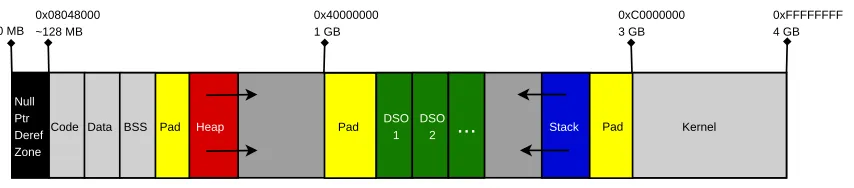
For illustration, the diagram in Figure 1.1 depicts the memory layout for a process randomized with either PaX ASLR or Exec Shield. Note that (1) the relative order of mem-ory regions is the same as an unrandomized layout and (2) the use of three pad allocations that consume space.
ASLP provides increased protection without the use of large pads. With ASLP, pads are only used in the sub-page randomization with a random size of 0 to 4 KB. Since this pad is only applied to the user stack and heap, a maximum of 8 KB out of the 3 GB user address space is consumed by pads. Figure 1.2 depicts the memory layout of a process randomized with ASLP. Note (1) the random relative order of memory regions and (2) the lack of large pad allocations.
as-0xFFFFFFFF 4 GB 0xC0000000 3 GB 0x40000000 1 GB 0x08048000 ~128 MB 0 MB Pad Pad Pad BSS
Code Data Heap DSO
1 Stack Kernel Null Ptr Deref Zone DSO 2 ...
Figure 1.1: Example PaX ASLR Process Memory Layout
Code Data BSS Stack Heap Kernel
0xFFFFFFFF 4 GB 0xC0000000 3 GB 0x40000000 1 GB 0x08048000 ~128 MB 0 MB Null Ptr Deref Zone DSO 2 DSO 1
Figure 1.2: Example ASLP Process Memory Layout
sumptions about the memory layout of any process before they attack: the heap is allocated following uninitialized data near the bottom of the address space, shared libraries are allo-cated contiguously, and the stack is the memory region highest in the address space. Even with contemporary address randomization techniques, attackers can still make the same assumptions. These assumptions allow attackers to craft more efficient derandomization attacks.
In summary, the ASLP approach contributes in three ways:
1. ASLP provides probabilistic protection an order of magnitude stronger than related kernel-based techniques.
2. A negligible amount of address space is consumed by pads.
3. The performance overhead is generally less than 1% and is comparable to contempo-rary techniques that provide less protection.
These contributions simultaneously debase the traditional space consumption ar-gument while increasing protection against derandomizing attacks.
Chapter 2 discusses related work in the address randomization area. Chapter 3 describes the theory and implementation of ASLP. Chapter 5 proposes two techniques to introduce randomness into kernel address space. Chapter 6 contains our concluding remarks and a brief overview of future work.
Appendix A gives background information on virtual memory management in the standard Linux kernel for those that may not already be familiar. Although the material is very straightforward, it is crucial to first understand the basic operation of an unrandomized Linux virtual memory system in order to appreciate the contributions made by this and related work.
Chapter 2
Related Work
There is a large quantity of related research in the area of mitigating memory corruption attacks. Included in this section are a subset of those works that mitigate memory corruption attacks via address randomization.
The seminal work in the field by Forrestet al. illustrates the value of diversity in ecosystems and proposes similar benefits for diverse computing environments [15]. In short, their case for diversity is that if a vulnerability is found it one computer system, that same vulnerability is likely to be effective against all identical systems. By introducing diversity into a population, resistance to vulnerabilities is increased. Address randomization achieves diversity by making the virtual memory layout of every process unique and unpredictable. We separate related work into two categories: kernel land and user land. Kernel land techniques achieve randomization with modification to the kernel; user land approaches achieve randomization with modification to user space applications.
2.1
User Land
An important weakness of most user land address randomization techniques is their need to recompile every application to allow it to have address randomization. It is unreasonable to assume that users will be able and willing to recompile every program to be randomized; recompilation assumes an unacceptably high level of technical knowledge for end users. Further, recompilation is impossible without access to the source code of the application. Thus, the remaining option is to assume that binary distributors will recompile application binaries with the corresponding randomization options. However, it seems un-realistic to assume that the myriad (occasionally competing) distributors will willingly align under a common standard set of configuration options for application compilation. Further, this model neglects legacy binaries that are no longer supported by any distributors. Fi-nally, consider management of software upgrades from system administrators’ perspective: as newer versions of the user land address randomization techniques are released, software must again be recompiled to transition to the latest version. This requirement means any technique requiring software recompilation is unattractive in large scale deployments.
Address Obfuscation The techniques presented by Bhatkar et al. in [3] and [4] are
significant because they implement a mechanism for not only randomly shifting the place-ment of the three critical regions, but also randomly re-ordering code and datawithin their respective segments, which addresses offset-based and data attacks. This allows for a very fine-grained randomization. For shared library randomization, they statically link a ran-domly sized dummy library to each executable, effectively padding the start of the shared library area by the size of the dummy library. However, this means that the shared library randomization is then static because it does not change on a per process basis.
Note thatall of the major drawbacks listed at the beginning of this section apply. Further, the base address for both the stack and heap are randomized by shifting each region by up to approximately 95 megabytes (MB). This means nearly 200 MB of address space can be wasted in just these two regions. Although this method provides the strongest probabilistic protection of any existing address randomization technique – and neglecting the typical user land drawbacks stated earlier – it wastes too much memory to be considered practical.
Transparent Runtime Randomization (TRR) [44] TRR is different than other user
applica-tion recompilaapplica-tion or access to source code. Although this is a highly desirable feature from a user land technique, when compared to PaX ASLR or our own ASLP, Transparent Run-time Randomization does not offer as much randomness in the user stack, heap, or shared library regions. Therefore, TRR is most adept in computing environments where maxi-mum availability (i.e. avoiding reboots) is valued more than providing strong resistance to memory corruption attacks.
2.2
Kernel Land
Kernel land techniques strike an attractive compromise between ease of manage-ment and probabilistic protection. Software upgrades are a common task as updated ver-sions are released. The same applies to the Linux kernel: the release rate for new kernels depends on the vendor, but once every two months is a fair estimate. So, although up-dating the kernel requires a reboot, address randomization installation and upgrades can transparently accompany normal system maintenance as updated kernels are installed.
In contrast to the user land approaches described in Section 2.1, kernel land address randomization techniques are being actively used in major Linux distributions: Exec-Shield can be found in both Red Hat Enterprise Linux [22] and Fedora Core [8] from Red Hat Inc. [21]; PaX ASLR can be found in Hardened Gentoo [5], Adamantix (Trusted Debian) [6], and OpenBSD [13].
All kernel land projects in this section share a fundamental approach to address randomization: insert a randomly sized pad before the stack, heap, andmmaparea. Although they share a general methodology, they differ greatly in their priorities. Since padding consumes address space, the few programs that need all available address space will observe a reduction in available memory. This extreme case forces developers to prioritize the protection provided by large pads and conservation of available address space.
Red Hat Exec-Shield [24] Red Hat Exec-Shield developers chose to favor the
plainly backwards, but the target audience is not security experts. Instead, they target a very broad range of server and scientific computing environments that don’t normally allow security features to encroach upon application performance. Molnar argues that increasing space devoted to shifting regions consumes too much space to be practical because it reduces the amount of memory an application can allocate.
Although the probabilistic protection provided by this method suffers from this ideology, a major deterrent remains: attackers must still spend extra development time to make an attack that can succeeded against a randomized target program. For more information on Exec-Shield see [14].
PaX Address Space Layout Randomization [35] In contradiction, PaX ASLR favors
Chapter 3
ASLP Randomization
This chapter presents Address Space Layout Permutation (ASLP) in detail. We begin with a discussion of supporting theory underlying our approach. This is followed by an overview of the ASLP implementation. Then a concrete demonstration of ASLP permutation is presented using the memory allocations of thecatexecutable.
3.1
Supporting Theory
The protection afforded by all address randomization techniques is probabilis-tic. Assuming no other countermeasures are in place, a derandomizing attack against a vulnerable application will eventually succeed. We forego the argument that additional countermeasures could effectively prevent derandomizing attacks in order to focus on the probabilistic protection provided solely by the address randomization in ASLP.
In a derandomizing attack, the attacker must repeatedly make guesses for an address. For example, a derandomizing stack smashing attack guesses the absolute address of the attacker’s injected code, which resides in the stack. Intuitively, the larger the range in which the stack can be randomly placed, the more guesses the attack must make to successfully guess the correct address. To make addresses harder to guess, ASLP uses nearly all 3 GB of user address space in which to randomly place memory allocations.
allocations must be made at the beginning of a page. With a page size of 4 kilobytes (KB) on IA32 systems, only 1 of every 212 addresses can be used as the starting location for
region allocations. This leaves a maximum of 220 possible locations for each randomized
page-aligned region. The consequence of this memory architecture design is that even though ASLP can randomly allocate a region anywhere in 32-bit user space, only 20 bits of page-aligned allocations can be random.
The mechanism for circumventing this limitation is to find ways to insert sub-page randomization after the initial page-aligned allocation is made. As discussed in Section 3.2, ASLP uses a two phase randomization for the heap and stack regions that regains some of the low-order bits lost to page alignment. However, no sub-page randomization method for
mmapallocations has yet been implemented because doing so would violate the POSIXmmap
specification [19]. Thus, in all kernel-based techniques, mmap allocations are page-aligned and limited to at most 20 bits of randomness.
3.2
Implementation
We build our proof of concept ASLP kernel for the popular 32-bit x86 CPU. Although 64-bit processors are slowly entering the market, 32-bit processors are still in pro-duction and will remain online for several years to come. Recall the standard memory layout of a process in 32-bit virtual address space with the Linux 2.4.31 kernel1
. The addresses at which the code and data segments are loaded is determined by the ELF executable stan-dard. Standard ELF executables do not include relocation information in the binary file. Therefore relocating code and data segments would break placement assumptions and is not done. The other region that remains untouched is the top 1 gigabyte (GB) of address space, which is reserved for kernel data structures. Kernel address space is handled very differently than user address space. For example, user processes cannot directly access kernel space virtual address. Further, access control checks are frequently done based on the assumption that access to virtual addresses higher than 3 GB is strictly reserved for kernel-mode execu-tion. Thus, moving this region would require a more complex access control check on each memory access, introducing additional performance overhead. As a result, ASLP does not permute the top 1 GB of virtual address space. This leaves three regions for permutation:
the user-mode stack, brk()-managed heap, and mmapallocations.
We employ a two-phase randomization process for both the user stack and the
brk()-managed heap. The primary phase is a major, page-aligned permutation that places the region on any page boundary between approximately 128 MB (following the data seg-ment) and 3 GB (the top of user address space). The address of such regions are randomized in 20 bits. To reclaim the low-order bits, the secondary minor, sub-page sift is used. This shift only moves a region by 0 to 4 KB, but has the effect of de-aligning these regions.
We need a two-phase process because all regions must be page aligned due to the design of the hardware memory management unit (MMU). According to the MMU, the atomic unit of memory is the page. So with the two-phase sub-page randomization, although the actual region allocations are page-aligned, the contents of both the user stack andbrk()-managed heap are shifted within their respective regions by up to 4 KB. Although the secondary phase is conceptually similar to the large pads applied by other techniques, this sub-page shift consumes at most 8 KB of space, which is negligible in a 3 GB user address space.
The User Stack. The location of the user stack is determined and randomized during
process creation. In the early states of process creation the kernel builds a data structure which holds process arguments and environment variables. This data structure is not yet allocated in process memory, but rather it is prepared for the process in kernel space memory. In this structure, the stack pointer is defined. This pointer is merely an offset into the first page of the soon-to-be stack region. We subtract a random amount between 0 and 4 KB from the stack pointer, thereby introducing randomization in low-order bits 2
.
In the later stages of process creation, the same data structure is copied into the process address space. During this phase we introduce the large scale randomization. A random amount is subtracted from the standard 3 GB stack base location so that the region starts anywhere between approximately 128 MB and 3 GB.
To ensure the stack has room to grow, ASLP prevents subsequent allocations immediately below the stack. This feature prevents the stack from being allocated so close to another region that it cannot expand. The exact amount of reserved area is configurable, but empirical evidence suggests that 8 MB is sufficient for most applications.
The brk()-managed Heap. Similar to the stack, the heap location is set during process creation. In an unmodified Linux kernel, the heap is allocated along with the BSS region, which is conceptually part of the data segment. We modify the allocation code for the BSS and heap so they occur in two independent steps. Separation allows the heap location to be defined independently of the data segment. The amount of space to be allocated for the heap is then augmented by 4 KB (1 page). Then a random, page-aligned virtual address between 0 and 3GB is generated for the start of the heap. Finally, a random value between 0 and 4 KB is added to this address to achieve sub-page randomization. Since the initial heap allocation was given an extra page, the sub-page shift will not push it beyond the original allocation.
The heap is also similar to the stack in that it can grow to fulfill dynamic memory requirements as the corresponding process runs. As with the stack, a comparable solution is used for the heap in which an unused region of configurable size is maintained following the heap. This prevents the heap from being placed too near other regions and ensures that it has enough room to grow. Empirical evidence suggests a reservation of 128 MB is needed for the heap.
mmap() Allocations. The mmap system call is used to map objects into memory. Such objects include shared libraries as well as any other files the application may wish to bring into memory. Allocations made by mmap are randomized using a one-phase, major ran-domization that is nearly identical to the primary phase used for the stack and heap. A secondary, sub-page shift is not used for mmap allocations because doing so would violate the POSIX mmapspecification. From the specification:
The off argument is constrained to be aligned and sized according to the value returned bysysconf()when passed SC PAGESIZEor SC PAGE SIZE. When
MAP FIXEDis specified, the application shall ensure that the argumentaddr also meets these constraints. The implementation performs mapping operations over whole pages. [19]
From this excerpt, the straightforward approach of applying a similar 0 to 4 KB random shift for mmap allocations is forbidden.
not necessarily occupy a contiguous, sequential set of virtual memory addresses as they do in all related techniques and unrandomized kernels. This is beneficial because the location of one library will be of no use to determine the location of another library.
Although the mmap system call allows a user process to request a specific virtual address at which to store the mapping, there is no guarantee the request will be honored even in the vanilla kernel. In the ASLP kernel, if a specific address is requested it is simply disregarded and replaced by a random address. The random, page-aligned addresses are issued between 0 and 3GB. Therefore,mmapallocations use a one-phase major randomization rather than the two-phase approach used for the stack and heap. An exception to overriding supplied addresses exists for fixed regions, such as the code and data segments. These regions are also brought into memory via mmap, but because they are flagged as fixed the supplied address is honored without modification.
Randomization Mechanism. A critical part of the probabilistic protection is the
ran-domization function responsible for introducing unpredictability into process memory lay-out. The Linux kernel has a built-in non-deterministic random number generator (RNG) based on both hardware events and user activity sources. These individual sources are mixed together into an entropy pool on every hardware interrupt. When a request for ran-dom bytes is issued, the pool is hashed using the SHA1 algorithm and the resulting hash is given to the requester. Thus, even if there were a lack of entropy from all sources, an attacker would still need to be able to derive useful information from the hash to determine the values used to generate randomness.
However, in the interests of reducing overhead and preserving the entropy pool, we use a combination of the built-in RNG and an adapted pseudo random number generator (PRNG). Our PRNG adaptation is based on a traditional linear congruential of the form in equation 3.1 from the IEEE POSIX specification document example [20]
xn+1 = (A×xn+C) modM (3.1)
where x0 is the seed, xn is the nth member of the sequence, and A, C, and M
This requirement means we must incorporate a fractional modifier to scale down the range of possible values. We do not simply use a modulus operator to limit addresses between 0 to 3 GB because this would skew the distribution toward the lower 1 GB of memory. The resulting formula is equation 3.2.
xn+1=
(1103515245×xn+ 12345)
4 ×3 (3.2)
Early during process creation, the built-in RNG is used to establish the initial seed for our PRNG. This approach introduces non-determinism into a computationally simple PRNG without the need to tap the system entropy pool for subsequent randomization operations.
3.2.1 Demonstration of Permutation
As a demonstration of the region permutation provided by ASLP, Table 3.1 pro-vides a side-by-side comparison of two memory layouts of catprocess instances on a vanilla kernel (left) and our ASLP kernel (right).
Vanilla Kernel
Addresses File Description
08048000-0804c000 cat cat code
0804c000-0804d000 cat cat data
0804d000-0804e000 - heap
40000000-40015000 ld-2.3.2.so loader code
40015000-40016000 ld-2.3.2.so loader data
40016000-40017000 - anon map A
40021000-40154000 libc-2.3.2.so libc code 40154000-40158000 libc-2.3.2.so libc data
40158000-4015a000 - anon map B
4015a000-4035a000 locale-archive mmap
40154000-40158000 - user stack
ASLP Kernel
Addresses File Description
08048000-0804c000 cat cat code
0804c000-0804d000 cat cat data
0bc29000-0bd5c000 libc-2.3.2.so libc code
0bd5c000-0bd60000 libc-2.3.2.so libc data
0bd60000-0bd62000 - anon map B 1be74000-1be89000 ld-2.3.2.so loader code
1be89000-1be8a000 ld-2.3.2.so loader data
23452000-23454000 - heap
30d9f000-30f9f000 locale-archive mmap
589e8000-589ea000 - user stack
69996000-69997000 - anon map A
Table 3.1: Comparing Process Memory Layout on Standard and ASLP Kernels
Chapter 4
ASLP Evaluation
This chapter evaluates ASLP randomization from both security and performance perspectives.
4.1
Security Evaluation
This section provides a security evaluation of ASLP compared to both Exec-Shield and PaX ASLR. Presented first is an evaluation of security in the context of a single random-ized target against a determined attacker. The results for PaXtest evaluate the randomness in each randomized region for each technique. Next, a chart of the estimated average pro-tection provided by each technique is presented. Finally, security is evaluated in the context of Internet worm propagation in the presence of the different kernel-based randomization techniques.
4.1.1 Micro-Security
is able to spawn simple helper programs that merely output the virtual addresses of their variables, each allocated in a randomized region. In doing so, it can determine the number of randomized bits for such variables based on where they would normally reside in an unrandomized system. The application provides unbiased verification of randomization effectiveness for PaX ASLR as well as Red Hat Exec-Shield and our own ASLP.
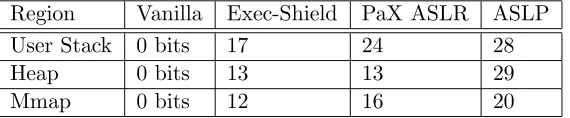
Table 4.1 provides a summary of the PaXtest results for each of the tested kernels. The raw results are included in Appendix E.
Region Vanilla Exec-Shield PaX ASLR ASLP
User Stack 0 bits 17 24 28
Heap 0 bits 13 13 29
Mmap 0 bits 12 16 20
Table 4.1: PaXtest Results Summary
The vanilla kernel has no randomization, so each region has zero bits of random-ness. Exec-Shield is the most susceptible to derandomization attacks, providing the lowest amount of randomization in all three regions. PaX ASLR comes in the middle, with signif-icantly better stack and mmaprandomization. Our ASLP approach comes out ahead by at least 4 bits in all three regions for an 1600% increase in probabilistic protection. Figure 4.1 shows a graphical representation of the PaXtest results summary.
The results from PaXtest are used to make estimates regarding the probabilistic protection provided by each technique. For example, PaX ASLR randomizes 16 bits in the address of the shared library base. This means that there are 216or 65,536 possible locations
for placement for the shared libraries. Assuming a random distribution, the address can be guessed in a number of guesses equal to half of the possible locations. Knowing both the reported attack duration of 216 seconds to brute-force guess the address of shared library region [31] and the number of possible locations in this region from Table 4.1, we can estimate the average guess rate. Equation 4.1 shows the calculation of guess rate.
65536 possible locations
2 →
32768 average guesses
Comparing Randomization Techniques
0 8 16 24 32
Vanilla Exec-Shield PaX ASLR ASLP
Kernels
B
it
s
o
f
R
a
n
d
o
m
n
e
s
s
User Stack Heap Mmap
Figure 4.1: Comparing Randomness Provided by Related Techniques
bits of randomness returned from PaXtest in Table 4.1, we can calculate the amount of time required to brute force the randomization in each memory region for ASLP, PaX ASLR and Exec-Shield. Table 4.2 illustrates how we derive the probabilistic protection provided by our implementation of ASLP.
Region Random Bits Num. Locations Avg. Guesses Avg. Protection (s) stack 28 268435456 134217728 884757.60
heap 29 536870912 268435456 1769515.20
mmap 20 1048576 524288 3456.08
Table 4.2: ASLP Protection Evaluation
earlier discussion of macro- and micro-security and Figure 4.2, which presents the effect of address space randomization on worm propagation speed. We argue from a macro-security perspective that address space randomization – specifically ASLP – provides a mechanism by which the memory corruption Warhol worm can be slowed to a rate that allows intrusion detection systems and system administrators to respond.
Table 4.3 estimates the amount of protection provided by Red Hat Exec-Shield using the same methodology.
Region Random Bits Num. Locations Avg. Guesses Avg. Protection (s)
stack 17 131072 65536 432.01
heap 13 8192 4096 27.0
mmap 12 4096 2048 13.0
Table 4.3: Red Hat Exec-Shield Protection Evaluation
Similarly, Table 4.4 estimates the amount of protection provided by PaX ASLR. Region Random Bits Num. Locations Avg. Guesses Avg. Protection (s)
stack 23 8388608 4194304 27648.68
heap 13 8192 4096 27.0
mmap 16 65536 32768 216.0
Table 4.4: PaX ASLR Protection Evaluation
In PaX ASLR, all three regions have a placement range of 256 MB, however the stack has randomization both above and below the page level, which is how it retains more possible placement locations within the same placement range.
4.1.2 Macro-Security
Consider the effect of address randomization at the macro-security level: Internet worm propagation on a large scale. With ASLP, exploiting a single host via memory cor-ruption attacks takes longer than worms like Sapphire/Slammer took to infect their entire vulnerable population [26]. With address space randomization, the speed at which worms can spread using memory corruption attacks is bounded not by how fast they can find vul-nerable hosts, but by how fast they they can derandomize the randomized address space of each target.
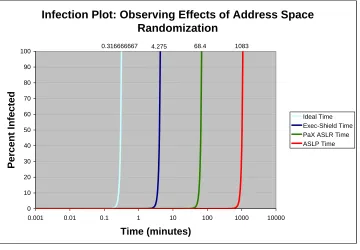
Using the derived attack speed and average probabilistic protection of 57 minutes (the lowest protection value from Table 4.2, consider Figure 4.2 showing the exponential growth rate of a hypothetical hit list-based worm in a population of more than 500,000 vulnerable hosts when it must first brute-force through ASLP address randomization.
Infection Plot: Observing Effects of Address Space Randomization
0.316666667 4.275 68.4 1083
0 10 20 30 40 50 60 70 80 90 100
0.001 0.01 0.1 1 10 100 1000 10000
Time (minutes) P e rc e n t In fe c te d Ideal Time Exec-Shield Time PaX ASLR Time ASLP Time
Figure 4.2: Infection Plot: With ASLP vs. Without ASLP
Note that the worm propagation model presented here makes several unrealistic assumptions in favor of the rapid worm spread:
2. The worm propagation code is configured such that there is no overlap in population coverage.
3. Network congestion caused by thousands of hosts flooding the network with address guesses is assumed to have no affect on propagation speed.
The result of this model is a wost-case worm outbreak on a hypothetical, ideal network. The reason for these pessimistic assumptions is to assert that ASLP is still able to limit worm propagation speed such that total infection is achievable in hours instead of minutes. Therefore, the propagation speed limit enforced by ASLP pushes the infection time well above the 15 minute limit for so called Warhol worms [32]. This is crucial because the extra time gives system administrators additional time to react.
Specifically, with no randomization the hypothetical worst-case worm is able to infect 100% of vulnerable hosts in less than one minute by doubling in size every one second. With randomization in place, the worm must first brute-force guess the location of the least protected region: the shared libraries. For Exec-Shield, 100% infection occurs in just over four minutes; for PaX ASLR the time is just over one hour. Our ASLP method is able to delay 100% infection for over eighteen hours.
This extension of infection time illustrates the benefit of having effective address space layout protection because fast worms that exploits memory corruption vulnerabilities must first get through address randomization before they can compromise their target. The Sapphire/Slammer worm [33] is currently the fastest know worm, which infected 90% of vulnerable hosts in less than 10 minutes [26]. Similar or even faster worms could not achieve such speeds if exploiting a vulnerable target requires an average of more than 57 minutes.
Further, the barrage of attempts to guess the correct address should be visible by intrusion detection and prevention systems. Increasing probabilistic protection means forcing attackers to make more guesses, effectively giving intrusion detection systems a bigger target.
4.2
Performance Evaluation
impact of our randomization technique, we compare our ASLP kernel to the configurations listed in Table 4.5.
Test Configuration Description
Vanilla Kernel Acts as control
PaX ASLR Randomizes user stack, heap, & shared libraries Red Hat Exec-Shield Randomizes user stack, heap, & shared libraries Position Independent Executable PIEs allows relocation of code & data segments
Table 4.5: Configurations Compared to ASLP
The various kernels are tested by installing each of them on the a single test computer and selecting the desired kernel at boot time. The test computer runs Red Hat Linux 9.0 with a 2.66 GHz Intel Pentium 4 CPU, 512 MB of RAM, and a 7200 RPM ATA IDE hard disk drive. All benchmark suites were compiled using GCC version 3.4.4.
The vanilla kernel establishes the baseline by which the absolute performance im-pact of other configurations can be measured. Both Exec-Shield and PaX ASLR are closely related works that provide kernel-based address layout randomization. Performance of the two closely related projects provides a metric to determine if ASLP does or does not have comparable performance. PIE is included in this evaluation because, although it doesn’t provide any randomization by itself, it does allow address randomization mechanisms to move the code and data segments from their traditionally fixed position. This is valuable to see how much overhead would be introduced by randomizing the location of the code and data segments. Since PIE is a compilation option and not a kernel modification, we test it using a vanilla kernel and compile the benchmark suite with the PIE options; in this configuration we isolate the performance impact of PIE without the additional overhead of address randomization techniques.
Although minimizing performance overhead was not the primary goal of the ASLP implementation, our target is to incur comparable performance overhead to both PaX ASLR and Exec-Shield. It should be noted that both PaX ASLR and Exec-Shield can be configured to do more than address randomization. Where possible, we disable their extra features to make the related projects as similar to ASLP as possible.
[16]. Each benchmark suite is chosen to represent a popular area of computing: scientific, general desktop, and server, respectively.
The SPEC CPU2000 Integer Benchmark shows our ASLP technique has an average runtime overhead of 0.27%. The LMBench micro-benchmark indicates start-up performance less than 13%. Finally, Apache Benchmark shows an average runtime performance for server applications of 0.71%. Each of the three benchmarks was run nine times on every configuration. Having nine runs is less than ideal, but was as many as possible given the time constraints of the project. Further, these performance results are not intended to have high precision, but rather to present the general performance characteristics of the ASLP approach and its similarity to closely related work. The remainder of this section discusses these results in more detail.
4.2.1 SPEC CPU2000 Integer Benchmark
The SPEC CPU2000 Integer benchmark suite is a set of computationally intensive integer applications that simulate the workload of scientific computation. Each benchmark in the CPU2000 suite measures the time required to complete a different integer computa-tion. For this reason, we use the CPU2000 benchmark to measure the impact of address randomization on computational efficiency.
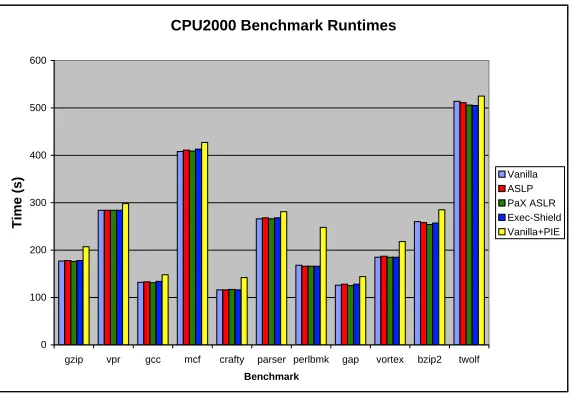
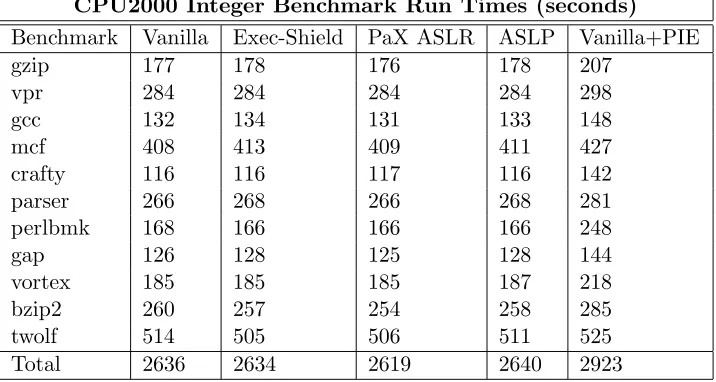
Figure 4.3 gives the normalized performance overheads of each benchmark and configuration, relative to the vanilla kernel configuration while Appendix B presents the absolute runtime information for each of the 11 integer benchmarks. 1
The CPU2000 benchmark suite was run nine times on each configuration; the resulting times for each benchmark are the geometric mean.
According to the CPU2000 Integer benchmark results, ASLP has an average per-formance overhead of 0.27%. All of the tested address randomization techniques have an average computational overhead of less than 0.6%. The average overhead for all address randomization techniques differ by less than 0.5%. With a range this small we can safely say ASLP has computational performance overhead comparable to closely related works. In High Performance Computing environments it seems unlikely that any address
ran-1The full CPU2000 Integer benchmark suite contains 12 benchmarks. One of the 12, the ”eon” benchmark,
CPU2000 Benchmark Overheads -10 0 10 20 30 40 50 60
gzip vpr gcc mcf crafty parser perlbmk gap vortex bzip2 twolf
Benchmark P e rc e n t O v e rh e a d ASLP PaX ASLR Exec-Shield Vanilla+PIE
Figure 4.3: CPU2000 Integer Benchmark Overheads
domization features would be used because they measurably – albeit minimally – impact performance. However, should they be used, any of the tested techniques will be roughly equivalent in terms of performance impact.
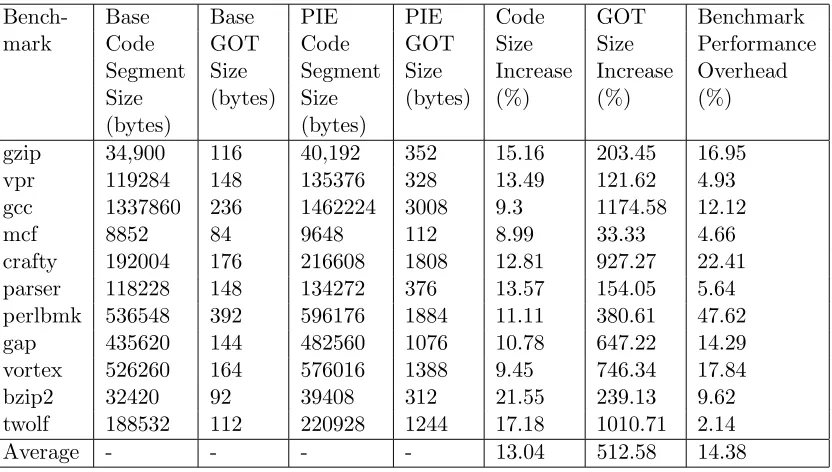
A second notable aspect of the performance data is that PIE linking incurs an average of nearly 15% computational overhead. To gain an understanding of why PIE per-formance is consistently degraded during runtime, consider the following simple C program:
Program 1An Example Two-Function Simple C Program
int my_global_var = 0;
int sim() {
Table 4.6 shows the assembly language translation of thesim()function insimple.c. The assembly code on the left was generated using standard compilation options while the code on the right is the same function, but is part of a position independent executable. Other than the code in the sim() function that references a global variable, the assembly code representation is the same for both versions of the executable.
1 sim: 1 sim:
2 pushl %ebp 2 pushl %ebp
3 movl %esp, %ebp 3 movl %esp, %ebp
4 movl my global var, %eax 4 call .L3
5 addl $5, %eax 5 .L3:
6 leave 6 popl %ecx
7 ret 7 addl $ GLOBAL OFFSET TABLE +[.-.L3], %ecx
8 movl my global var@GOTOFF(%ecx), %eax
9 addl $5, %eax
10 leave
11 ret
Table 4.6: Understanding PIE Overhead
Since PIE code is relocatable, its location in virtual memory must be determined at run time. To determine the location of data structures, the position independent code is automatically augmented by the compiler with instructions used to determine the needed location information. Note that on line 4 the PIE version deviates by going toL3, which was automatically inserted by the compiler. In line 6 the function’s address is popped into the
ecxregister. This address is then used in line 7 to calculate an offset into the global offset table (GOT). In line 8, the PIE instructions again match those in the non-PIE version, by moving the variable value into theeaxregister.
These additional instructions are the source of the PIE runtime performance over-head. Therefore code compiled with PIE options has more instructions and takes longer to execute than its non-PIE counterpart. For example, consider Table 4.7 that contains details about the executable size and running time increases associated with PIE and the CPU2000 integer benchmarks.
Bench- Base Base PIE PIE Code GOT Benchmark
mark Code GOT Code GOT Size Size Performance
Segment Size Segment Size Increase Increase Overhead Size (bytes) Size (bytes) (%) (%) (%) (bytes) (bytes)
gzip 34,900 116 40,192 352 15.16 203.45 16.95 vpr 119284 148 135376 328 13.49 121.62 4.93 gcc 1337860 236 1462224 3008 9.3 1174.58 12.12
mcf 8852 84 9648 112 8.99 33.33 4.66
crafty 192004 176 216608 1808 12.81 927.27 22.41 parser 118228 148 134272 376 13.57 154.05 5.64 perlbmk 536548 392 596176 1884 11.11 380.61 47.62 gap 435620 144 482560 1076 10.78 647.22 14.29 vortex 526260 164 576016 1388 9.45 746.34 17.84 bzip2 32420 92 39408 312 21.55 239.13 9.62 twolf 188532 112 220928 1244 17.18 1010.71 2.14
Average - - - - 13.04 512.58 14.38
Table 4.7: CPU2000 PIE Overhead Analysis
reasonable outcome.
4.2.2 LMBench Micro-Benchmark
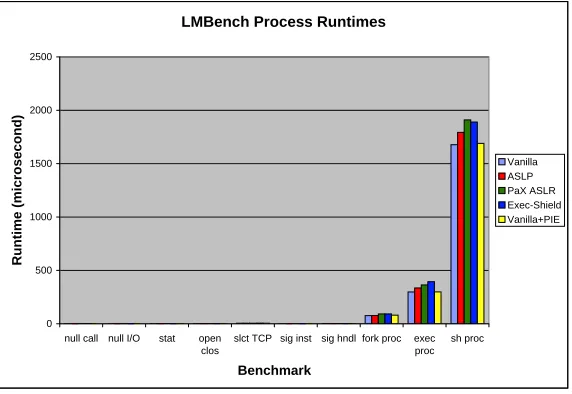
The LMBench benchmark suite differs from CPU2000 because it strives to bench-mark general operating system performance rather than the computational performance of a set of applications. It provides a meaningful way to measure the performance impact of address space randomization on everyday computing. The LMBench operating system benchmark suite consists of five sets of micro-benchmarks, each of which is designed to focus on a specific aspect of operating system performance: system calls & process operations, context switching, file & virtual memory system latency, local communication latency, and local communication bandwidth. The series of figures in this section show the overhead for each set of benchmarks; Appendix C contains the results for absolute run times. All LMBench benchmarks were run nine times. Results and analysis use the arithmetic mean time for each benchmark.
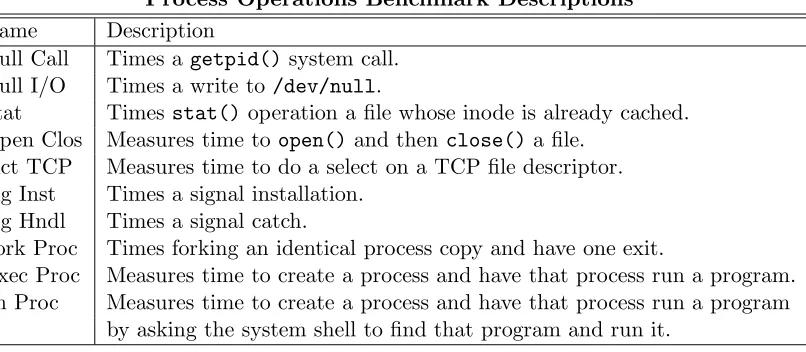
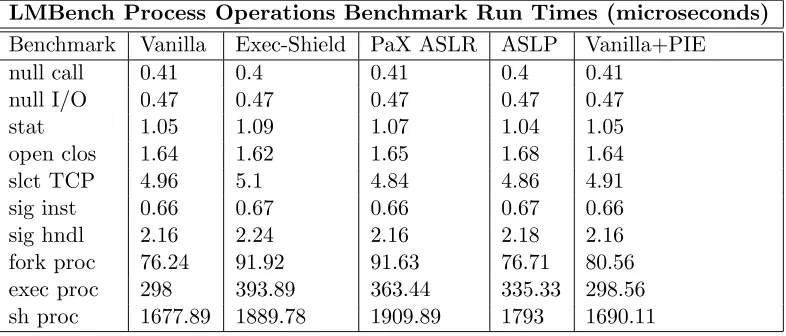
12.53% respectively. Process creation overhead is the primary location of expected overhead from address space randomization techniques like PaX ASLR, Exec-Shield, and our ASLP because additional operations are inserted into the process creation functions. The process creation functions are augmented with randomization hooks that change the location of the stack, heap, and mmapallocations. Such code is not present in the vanilla kernel. However, observe that both PaX ASLR and Exec-Shield have consistently higher overheads for the same tasks: 13.83–21.96% and 12.63–32.18% respectively. ASLP incurs less overhead for these operations because both Exec-Shield and PaX ASLR are doing additional operations that could not be disabled without modification to their respective source codes. However, even though those extra operations prevent a direct comparison, we are confident stating that ASLP has comparable overhead to these two closely related projects because ASLP is roughly twice as fast at both operations, which leaves a comfortable margin of error. This estimation is good enough because we are only interested in demonstrating that ASLP has reasonably similar performance when compared to closely related techniques.
LMBench Process Overheads
-5 0 5 10 15 20 25 30 35
null call null I/O stat open clos
slct TCP sig inst sig hndl fork proc exec proc sh proc Benchmark O v e rh e a d ( % ) ASLP PaX ASLR Exec-Shield Vanilla+PIE
Figure 4.4: LMBench Process Operation Overheads
set.
LMBench Context Switch Latency Overheads
-15 -10 -5 0 5 10 15 20 25 30 35
2p/0K ctxsw 2p/16K ctxsw 2p/64K ctxsw 8p/16K ctxsw 8p/64K ctxsw 16p/16K ctxsw 16p/64K ctxsw Benchmark O v e rh e a d ( % ) ASLP PaX ASLR Exec-Shield Vanilla+PIE
Figure 4.5: LMBench Context Switch Overheads
File and virtual memory (VM) system latency results are shown in Figure 4.6. This area of operations is the second location where we expect to observe performance overhead because eachmmapoperation has been instrumented with additional randomization instructions. Randomization instructions are executed every time an allocation is made via
mmap and the Mmap Latency test does exactly that. More specifically, every time mmap
is called, the location of the allocation is randomly generated, verified against consistency checks, and finally approved. We therefore expect an increase in mmap latency because we are increasing the number of instructions to complete mmap allocations. Although ASLP incurs an average of 12.51% overhead formmaplatency, this added latency is still reasonably similar to closely related techniques. Again our goal is not to claim a speed gain over related works, but rather to achieve similar performance. Also notice that although ASLP provides more randomized bits formmapallocations than both PaX ASLR and Exec-Shield, the performance is comparable. See Table C.8 for a numeric representation of the file and virtual memory system data set.
LMBench File & VM System Latency Overheads -25 -20 -15 -10 -5 0 5 10 15 0K File Create 0K File Delete 10K File Create 10K File Delete Mmap Latency
Prot Fault Page Fault 100fd selct
Benchmark O v e rh e a d ( % ) ASLP PaX ASLR Exec-Shield Vanilla+PIE
Figure 4.6: LMBench File and VM System Latency Overheads
since changes were made only to the user space memory management subsystems; the Linux kernel networking code and the memory management code are quite separate.
Figure 4.8 shows another apparently significant performance feature: local com-munication bandwidth is improved by more than 32%. Again this behavior is unexpected because there were no changes to the networking code. In fact, our modifications should only decrease performance because of the additional instructions added to memory alloca-tion routines.
LMBench Local Communication Latency Overheads -1000 0 1000 2000 3000 4000 5000 6000 7000 2p/0K ctxsw
Pipe AF UNIX UDP RPC/UDP TCP RPC/TCP TCP conn
Benchmark O v e rh e a d ( % ) Exec-Shield PaX ASLR ASLP Vanilla+PIE
Figure 4.7: LMBench Communication Latency Overheads
LMBench Local Communication Bandwidth Overheads
-35 -30 -25 -20 -15 -10 -5 0 5 10
Pipe AF UNIX TCP File reread Mmap reread Bcopy (libc) Bcopy (hand)
Mem read Mem write Benchmark O v e rh e a d ( % ) ASLP PaX ASLR Exec-Shield Vanilla+PIE
than vanilla kernel and some had worse. The fact that this occurs on several different ker-nels suggests either a bug in the LMBench TCP benchmarks or buggy behavior shared by several randomization methods. Although it seems most likely that the bug resides within the benchmark suite, without considerable code analysis of all affected kernels and bench-marks we do not have enough information to decide. Such analysis is outside the scope of this thesis and additional robustness testing is left for future work.
However, the Apache Benchmark results in Section 4.2.3 put the significance of the LMBench TCP micro-benchmarks into perspective. The LMBench TCP latency benchmark is a synthetic benchmark that measures the speed at which a specially written client program can establish a TCP connection to a specially written local server. When compared to a performance evaluation using the Apache web server, a real world TCP-based client-server application, in which ASLP has no test run failures and less than 1% performance overhead, the importance of the LMBench TCP benchmarks is greatly diminished in the context of this performance assessment.
4.2.3 Apache Benchmark
The Apache Benchmark [16] measures the performance of an Apache HTTP server [17] in terms of how quickly it can serve a given number of HTML pages via TCP/IP. The test environment places two identical test computers on a 100 megabit per second switched net-work where one computer acts as HTTP client and the other acts as HTTP server. The client system configuration remains constant throughout all tests. To test the various ker-nels we boot the server using the appropriate kernel before running the benchmark. To test PIE, we recompile the Apache HTTP server with PIE options and boot from the vanilla kernel.
Our Apache Benchmark configuration makes 1 million requests, in simultaneous batches of 100, for a static HTML page of 1881 bytes, which includes 425 bytes of images. The Apache HTTP server configuration was modified from the default configuration to preemptively spawn 100 worker processes to handle incoming requests. This modification removes the previously documented affect of process startup overhead on this benchmark.
Apache Benchmark Overheads
-2 0 2 4 6 8 10 12 14 16 18
ASLP PaX ASLR Exec-Shield Vanilla+PIE
Kernel Variant
O
v
e
rh
e
a
d
(
%
)
Figure 4.9: Apache Benchmark Overheads
4.2.4 Summary of Performance Evaluation
The CPU2000 results indicate that ASLP incurs 0.27% performance overhead in scientific computing environments, which is comparable to other address space randomiza-tion techniques. Although scientific computing is not the primary target environment, the small performance overhead indicates that deployment of ASLP is feasible in mixed envi-ronments concerned with providing protection against remote memory corruption exploits. The LMBench results show a more granular perspective on the types of operating system functions that incur performance overhead. Of highest significance, process creation incurs 7-13% overhead, context switching incurs less than 11% overhead, and mmap incurs less than 13% latency overhead.
The Apache Benchmark results indicate that ASLP incurs less than 1% perfor-mance overhead. The results also show ASLP perforperfor-mance is reasonably similar to closely related techniques. We favor the Apache Benchmark over the LMBench TCP measurements because the Apache Benchmark evaluation is based on widely used, real world code.
Chapter 5
Kernel Space Randomization
Proposal
ASLP and other related work focuses primarily on randomizing allocations made in user space. That is, the techniques all randomize the user stack, heap, andmmapin some way, which reside in the user space virtual address space of 0 to 3 GB. However, with the exception of PaX kernel stack randomization [36], the kernel address space between 3 to 4 GB in virtual memory is left untouched. This section proposes two novel techniques for randomizing kernel space allocations.
Figure 5.1 depicts kernel space address layout for the default configuration on x86 architecture based on the survey [18] by Mel Gorman.
There are two straightforward options to randomize the layout of kernel space memory: either permute the regions as we did in user space or add a random amount to each gap region thereby shifting the contents of each region. However, the kernel address space differs from user address space in several important ways.
Figure 5.1: Kernel Address Space Memory Layout
each region as hardware and software interrupts occur, but region boundaries do not move, meaning that once the system is booted, the location of each region does not change even as different processes are switched in and out.
The Physical Memory Map region size depends on the amount of RAM installed in the computer. This region will match the RAM size up to 896 MB. Further, the location of the Fixed Virtual Address Mapping region is determined during kernel compilation. Although the presence of this region depends on the configuration options during kernel compilation, if present, it cannot be moved at all. Finally, notice that only slightly more than 8 MB of the kernel address space is unused, which means there is little space left to move the large regions.
We first consider permuting the regions as we did in user space. With three movable regions, we have only six (3!) possible permutations, as Table 5.1 shows:
Permutation Movable Kernel Space Regions 1. map|8 MB vmalloc|2 pg kmap 2. map|8 MB kmap vmalloc|2 pg 3. vmalloc|2 pg map|8 MB kmap 4. vmalloc|2 pg kmap map|8 MB 5. kmap map|8 MB vmalloc|2 pg 6. kmap vmalloc|2 pg map|8 MB
Table 5.1: Possible Permutations for Kernel Space Regions
derived estimated guess rate of 151.7 guesses per second, this randomization is clearly insufficient. It also adds complexity to the kernel space memory management code. We wish to make modifications only if the benefits outweigh the added complexity and in this case, they do not. So, we eliminate the permutation option and investigate the padding option.
The size of the small gaps between regions may be padded by a random amount during each boot. With this approach, the amount of randomization is proportional to the amount of wasted space (as are all pad-based randomization techniques). This method is unappealing in an already cramped address space. Achieving substantial page-aligned randomization requires a many MB and preferably several GB. Pads of such large magnitude would waste large chunks of limited space in the 1 GB kernel address space. Thus we conclude that the padding approach is also not worthy of pursuit.
A further weakness to both of these approaches is that once the regions are ran-domized during the boot process, no further randomizations are made until the computer is rebooted. Although the two randomization techniques are technically dynamic since they change during every boot, the address space layout of the kernel is relatively long lived, so an attacker would conceivably have enough time to brute-force guess the needed information. With the elimination of both options, permutation and padding of the kernel address space are not promising avenues for kernel address space randomization. However, we present two novel options that randomize allocations made in kernel space.
5.1
Randomizing Kernel Data Structures
using page table translation requires several times more calculations compared to a simple one step addition or subtraction. This redundancy is tolerated because of the importance of fast memory allocation.
Low level memory allocations are principally controlled by the buddy allocator, which is responsible for the allocation of physical memory pages. The slab allocator is logically positioned on top of the buddy allocator and is responsible for efficiently handling relatively small allocations of frequently used sizes. This two tiered approach is desirable because finding, allocating, and initializing memory is relatively expensive. The slab allo-cator can avoid initialization steps by using pre-allocated memory of the correct size. For example, when a process is spawned, several kernel data structures are created to track the process and its resources. Those data structures, which are always the same size, are re-trieved from the slab allocator’s cache of correctly sized memory slabs. These memory slabs are typically fractions of contiguous physical pages, which the buddy allocator previously issued to the slab allocator.
It is from this interconnection that the possibility exists for randomizing kernel data structures. We propose to modify or replace the buddy allocator, slab allocator, or both to introduce unpredictability in their allocations.
The technicalities of randomizing allocations in the physical memory map exist in much greater numbers than those of other regions. This is primarily because allocations in this region correspond directly to physical memory. In effect, we propose the randomization of physical memory.
Both the buddy allocator and slab allocator are written for the express purpose of efficiently finding, allocating, and otherwise managing physical memory while minimizing internal and external fragmentation. The slab allocator is also written to organize alloca-tions in such a way that optimizes the use of hardware caches. Introducing randomness into this carefully balanced system will almost certainly be accompanied by a performance penalty, an increase in unusable memory due to fragmentation, or both. Due to the sen-sitive balance of the existing system it is likely that new randomization-friendly memory allocation mechanisms will be required.
de-spite technical challenges. Future attacks may use assumptions about physical memory and kernel memory layout. Introducing unpredictability would potentially thwart those attacks.
5.2
Randomizing Vmalloc
Due to its limited size, the Vmalloc area is used sparingly. Its space is reserved for mapping loadable kernel modules and swap maps into virtual memory. To randomize these allocations, we propose a method similar to that done by our ASLP mmap randomization, where eachvmalloc()call would return an allocation with a random virtual address in the Vmalloc region. Since the Vmalloc area can be no smaller than approximately 100 MB, there is a relatively large amount of room for random placement of each allocation without wasting any address space.
The primary limitation of this approach is that the Vmalloc area may be so small that external fragmentation