STRUCTURAL, ELECTRONIC AND OPTICAL PROPERTIES
OF DEFECT CHALCOPYRITE CDGA2S4 AND HGGA2S4
COMPOUNDS BY FIRST PRINCIPLES
1
NORHASLINDA OSMAN, 2*MOHAMAD ALAM SAEED
1
Department of Physics, Faculty of Science, Universiti Teknologi Malaysia, 81310, UTM Johor Bahru, Johor Darul Ta’azim, Malaysia
1
[email protected], 2* [email protected]
*Corresponding author
Abstract. The physical properties of defect chalcopyrite compounds are
discussed here. Initial study are carried out under the framework of density functional theory by keeping in view the device manufacturing characteristics relating to structure, energy band configuration and bonding nature of the selected PbGa2S4 and HgGa2S4 defect chalcopyrite compounds. The computational work are executed using highly accurate full potential linearized-augmented plane wave + local orbital approach through the latest edition of Wien2k software. In a next step, the electronic properties of PbGa2S4 and HgGa2S4 defect chalcopyrite compounds are investigated. Precise band gap are calculated by employing GGA and LDA techniques. This work provided a comprehensive theoretical study of the physical properties with special emphasis on structural and electronic properties of defect chalcopyrite compounds.
Keywords DFT; PbGa2S4 ; HgGa2S4; Wien2K
1.0 INTRODUCTION
family. PbGa2S4 (Lead thiogallate) and HgGa2S4 (Mercury thiogallate) semiconductors have been found to crystallize in the defect-chalcopyrite tetragonal structure and belong to space group [I-4]. For device applications it is vital to know the optoelectronic properties of a material [3]; this give motivation to study the structural and electronic properties of PbGa2S4 and HgGa2S4. Detailed computational or theoretically study of structural and electronic properties are very vital.
In the structure of PbGa2S4 and HgGa2S4, which belongs to defect chalcopyrite (DC) family, gallium atoms occupy the positions of two different types. The gallium atoms of the first type (Ga1) occupy the half of gallium positions of the compound AgGaS2 (Figure 1), whereas the second type of gallium atoms (Ga2) are placed in half of the silver positions AgGaS2 leaving the other part of gallium positions in AgGaS2 empty. The second half of the silver positions AgGaS2 are occupied by lead/mercury. As a result, the number of neighboring atoms in the first atomic shell of the atom sulfur is equal to three (Figure 1) in this structure.
Figure 1. Crystal structure of AgGaS2. The coordinate atom in the left lower
corner are: (ua, a/4, c/8) [4]
properties to existing research on this interesting family of compounds. Highly accurate all electron FP-LAPW+lo method under DFT are certainly contribute in removing discrepancies associated with these materials. Precise band gap are presented by employing GGA and LDA techniques. The project’s goal are provided accurate structural and electronic for these materials which are helpful in establishing new devices.
By ab initio or first principles means an approach of doing calculations which rely on the well established and fundamental laws of science and does not involve any special models, suppositions or fitting techniques. In physics, such calculations of electronic structure which do not incorporate fitting models to experimental results and which make use of Schrodinger equation as a starting point along with a group of estimations may be called as ab intio or first principle calculations [5].
There are two possible ways by which materials can be analyzed. One way is to characterize the material experimentally for the description of its properties. Though in some cases, it is almost impossible to furnish experiments with required conditions for synthesis or characterization. Atomic scale calculations are difficult to handle even by modern experimental techniques. The other option is to solve many body problems by solving complex quantum mechanical equations, but this also takes a large time [5]. Recently computational approaches have gained enormous attention because of their ability to solve many body problems in less time with the advancement in computer processing technology [1]. Now simulation and modeling of materials is possible in ideal conditions which were impossible to achieve before. Computational approaches are a cheaper way of discovering new possibilities for preparing and understanding materials for device manufacturing. The valuable properties which are difficult to explore through experimentation are now can be revealed through simulation techniques.
with different exchange-correlation approximation are reported in this paper. To calculate the ground state properties, the local density approximation (LDA) and generalize gradient approximation (GGA) shows good result but underestimate the band gaps energy values. This work leads to more systematic understanding of the structural and electronic properties of these group defect chalcopyrite.
2.0 PROBLEM STATEMENT
Research shows that, PbGa2S4 and HgGa2S4 have been studied almost few years ago and the main emphasis was generally on their structural and electronic properties [1,2]. The structural properties and the electronic properties using LDA and GGA are proposed, which offered a better results for our calculations. Moreover, these results help in analysis and proper comparison with existing literature. Therefore, structural and electronic properties are expected to significantly improve.
The properties and underlying physics of certain materials are very important for the development of new devices as well as operating characteristics of such devices. To comprehend the physical properties of such compounds a lot of research has been carried out but there are yet many characteristics needs clarity, like electronic band gap disagreement among different studies. This motivate us to perform more advance calculations using the all electron full- potential linearized augmented plane wave plus local orbital method (FP-LAPW+lo) which has confirmed to be one of the most accurate method for the calculation of the electronic structure of solids within DFT with different kind of exchange correlation. Therefore, an inclusive theoretical analysis of structural and electronic properties along with experimental results is therefore essential.
Our calculations are carried out within the framework of DFT using the highly accurate all-electron full potential linear augmented plane wave plus local orbitals method as employed in WIEN2k code [5]. In this method Kohnan-Sham wave functions, charge density and potential are expanded in the different sets of basis functions. For the wave functions, inside the MT spheres of radius (RMT) around each atom, a linear combination of the atomic wave functions times the spherical harmonic expansion is used and in the interstitial region a plane wave expansion is used. The charge density and potential are expanded into lattice harmonics inside MT spheres and as a Fourier series in the remaining space.
The dependency of the total energy on the number of k-points in the irreducible wedge of Brillouin zone optimized with the size of mesh is set to 10x10x10 k-points. Self-consistency is considered to be reached when total energy difference between successive iterations is less than 10-5 Ry. For the unit cell parameters of the tetragonal lattice, first we need to optimize the total energy for various ratios c/a keeping unit cell volume constant. Once the c/a ratio is fixed, we optimized the total energy for various unit cell volumes. The obtained set of unit cell volume and total energy was used to make a fit to the Murnaghan equation of state to determine the equilibrium unit cell volume , the optimized lattice constants ‘a’, the bulk modulus and the pressure derivative of the bulk modulus . The Murnaghan equation of state (1944) is written as
( ) [( ) ]
And the bulk modulus corresponding to the equilibrium unit cell volume is given by the relation:
( )
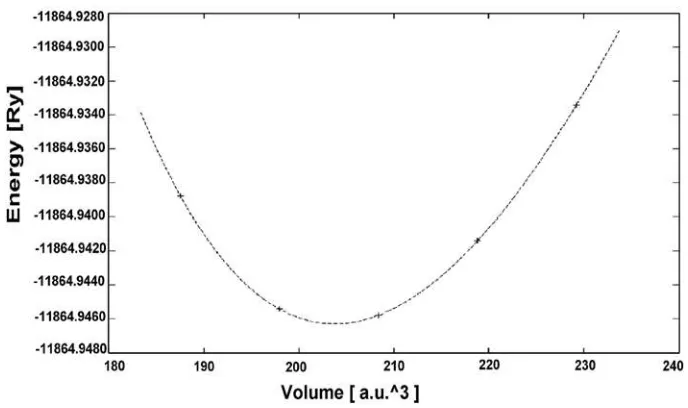
Figure 2. The total energy vs. Primitive cell volume for ZB- HgGa2S4 within LDA
3.1 Structural properties
In order to study the structural properties of PbGa2S4 and HgGa2S4, LDA and GGA has been used. The equilibrium lattice constant, bulk modulus and it’s pressure derivative in this section are calculated by using fitting the Murnaghan equation of state as shown in Figure 2. The obtained values are listed in Table 1, with the experimental results and other computations. From Table 1, it may be observed that our results with LDA/GGA are closed to the experiment and in agreement with previous theoretical calculation. However, it appears that the lattice constants (compared with the experiment) are slightly underestimated within LDA, and overestimated within GGA. All results agree with the experimental numbers within 1-2%.
Table 1. The lattice parameters of PbGa2S4 and HgGa2S4 taken from Reference
Compounds Method a ( ̇) V (a.u.)3 B (GPa)
PbGa2S4
Our work FP-LAW-GGA 5.56 121.23 111 4.56
FP-LAW-LDA 5.279 118.56 110 4.53
Experiment 5.545[1] - 102[1] -
HgGa2S4
Our work FP-LAW-GGA 5.507 155.12 156 4.52
FP-LAW-LDA 5.230 149.54 149 4.28
Experiment - 5.435[2] - 148[2] –
3.2 Electronic properties
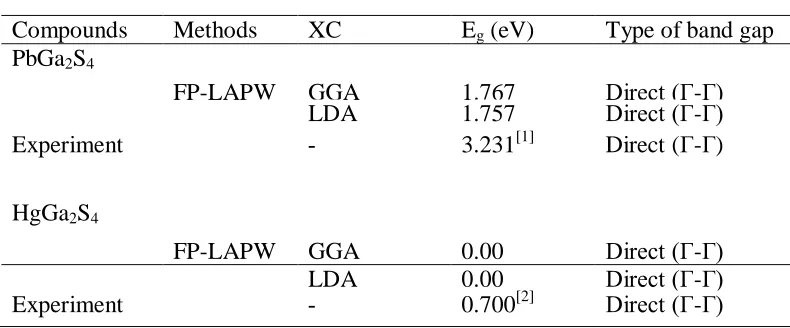
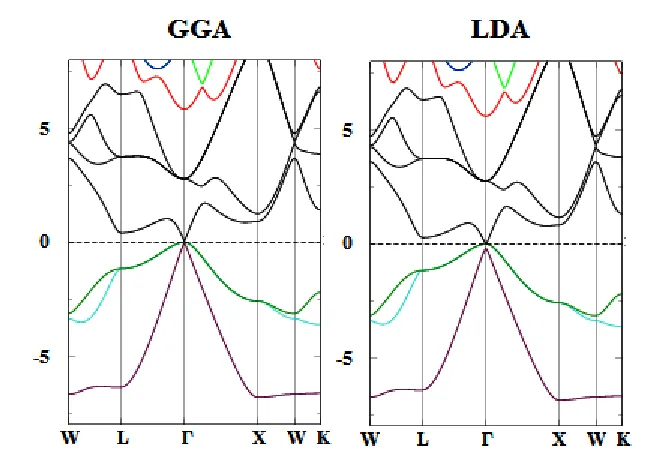
The electronic band structure plays a vital role in determination the electronic properties of materials. Figure 3 and 4, shows the calculated band structures of PbGa2S4 and HgGa2S4 by using LDA and GGA methods along high symmetry direction in the first Brillion zone, respectively. It is obvious that the LDA and GGA gap values are samaller than the experimental values.
Table 2: The energy band gap (Eg) properties of PbGa2S4 and HgGa2S4
Compounds Methods XC Eg (eV) Type of band gap
PbGa2S4
FP-LAPW GGA 1.767 Direct (Γ-Γ)
LDA 1.757 Direct (Γ-Γ)
Experiment - 3.231[1] Direct (Γ-Γ)
HgGa2S4
FP-LAPW GGA 0.00 Direct (Γ-Γ)
LDA 0.00 Direct (Γ-Γ)
Figure 3. Band structure of PbGa2S4 calculated by the LDA and GGA
4.0 CONCLUSIONS
The structural and electronic properties of PbGa2S4 and HgGa2S4 have been studied by first principles based on DFT within the LDA and GGA methods. The results show that the LDA/GGA yields quite reliable structure properties, but seriously underestimates the band gap values.
ACKNOWLEDGMENTS
The authors would like to thank the Malaysian Ministry of Higher Education and Universiti Teknologi Malaysia (UTM) Skudai, Johor, Malaysia for their financial funding through grant Q.J130000.2526.03H78.
REFERENCES
[1] Badikov V. et al.,(2008). Optical properties of lead thiogallate. Optical Materials 31, 184–188 [2] Gomis O. et al.,(2014). Structural and elastic properties of defect chalcopyrite under high
pressure. Pattern recognition.Journal of Alloys and Compounds 583, 70–78
[3] Karlheinz Schwarz, Peter Blaha (2003). Solid State calculations using WEIN2K. Computational Materials Science 28. 259-273.
![Figure 1. Crystal structure of AgGaScorner are: (ua, a/4, c/8) [4]](https://thumb-us.123doks.com/thumbv2/123dok_us/1311776.1163803/2.499.173.356.364.552/figure-crystal-structure-aggascorner-ua-c.webp)