LEARNING AUTOMATA AND SIGMA IMPERIALIST COMPETITIVE ALGORITHM FOR OPTIMIZATION OF SINGLE AND MULTI OBJECTIVE
FUNCTIONS
RASUL ENAYATIFAR
A thesis submitted in fulfilment of the requirements for the award of the degree of
Doctor of Philosophy (Computer Science)
Faculty of Computing
Universiti Teknologi Malaysia
ACKNOWLEDGEMENT
I would like to express my deepest gratitude and sincere appreciation to my supervisor, Prof. Dr. Abdul Hanan Abdullah, for his invaluable advice and guidance and insight throughout my entire study. Without his continued advice, support, intellectual input and critical reviews, this project would not have been accomplished. His deep insight and broad knowledge was very valuable and beneficial in accomplishing this thesis.
I would like to appreciate my family especially my beloved parents and wife, Fatemeh Mirzaei, for their patience and constant supports and love throughout the course of my PHD’s program. My special thanks also go to my brother, Ali and my sisters, Azam and Akram who have been always of great help and encouragement to me. Finally, I am also grateful to those who have directly or indirectly helped me throughout the course of this research study.
ABSTRACT
ABSTRAK
TABLE OF CONTENTS
CHAPTER TITLE PAGE
DECLARATION ii
DEDICATION iii
ACKNOWLEDGEMENTS iv
ABSTRACT v
ABSTRAK vi
TABLE OF CONTENTS vii
LIST OF TABLES xi
LIST OF FIGURES xiii
LIST OF ABBREVIATION xvi
1 INTRODUCTION 1
1.1 Overview 1
1.2 Background of the Problem 3
1.3 Problem Statement 6
1.4 Research Goal 8
1.5 Research Objective 9
1.6 Research Scope 9
1.7 Significant of Study 9
1.8 Thesis Organization 10
2 LITERATURE REVIEW 11
2.1 Overview 11
2.2 Optimization Algorithms 11
2.3 Single Objective Evolutionary Algorithm 12
2.4 Harmony Search 13
2.4.1 The Improved Harmony Search Algorithm 16
2.4.2 Global Best Harmony Search 17
2.4.3 Self-adaptive Global Best Harmony Search
2.5 Learning Automata 18
2.6 Imperialist Competitive Algorithm 19
2.7 Multi Objective Evolutionary Algorithm 24
2.7.1 Multi Objective Problem 25
2.7.2 Fast Non Dominated Sorting 27
2.7.3 Crowding Distance 28
2.7.4 Theory of Measure 29
2.7.5 Existing Approach in Multi Objective
Evolutionary Algorithm 30
2.8 Performance Evaluations 30
2.8.1 Single Objective Benchmark 31
2.8.2 Application on Electrical Load Forecasting 35
2.8.3 Multi Objective Benchmark 37
2.8.4 Application in Wireless Sensor Networks 39
2.9 Summary 42
3 RESEARCH METHODOLOGY 44
3.1 Overview 44
3.2 Learning Automata Harmony Search Algorithm
Framework 45
3.2.1 Investigation and Identification of the LAHS
Method 46
3.2.2 Design and Development of LAHS Method 47
3.2.3 Evaluation of LAHS Algorithm 48
3.3 Sigma Imperialist Competitive Algorithm Frameworks 50 3.3.1 Investigation and Identification of the SICA 51
3.3.2 Design and Development of SICA 52
3.3.3 Evaluation of SICA 53
3.4 Summary 55
4 LEARNING AUTOMATA HARMONY SEARCH 57
4.1 Overview 57
4.2 Learning Automata Base Evolutionary Algorithm 58 4.3 Learning Automata Harmony Search Experiments 60
4.3.1 Experimental Setup 60
4.3.3 The Effect of HMCR, PAR and bw 62 4.3.4 The Harmony Memory Size Effect
65 4.3.5 A Comparison Between HS Algorithms and
LAHS 66
4.3.6 Computational Time 67
4.3.7 The Learning Capability Effect 71
4.3.8 A Discussion on the Learning Behavior of
LAHS 73
4.4 Application on Electrical Load Forecasting 74
4.4.1 Proposed LAHS-FTS Algorithm 74
4.4.2 Experiments on LAHS-FTS Algorithm 76
4.4.2.1 Data 77
4.4.2.2 Training Experiments 78
4.4.2.3 Testing Experiments 80
4.4 Summary 82
5 SIGMA IMPERIALIST COMPETITIVE
ALGORITHM 84
5.1 Overview 84
5.2 A Novel Multi-Objective Evolutionary Algorithm 85
5.2.1 The Sigma Method 85
5.2.1.1 Foundation of the Sigma Method 85
5.2.1.2 The Sigma Method Proving 86
5.2.1.3 The Sigma Imperialist Competitive
Algorithm 89
5.3 Sigma Imperialist Competitive Algorithm Results 91
5.3.1 Benchmark’s Experiments 91
5.3.1.1 Testing the Convergence Rate 91 5.3.1.2 Testing the Computational Time 98 5.3.2 Application on Coverage Problem in Wireless
Sensor Network 102
5.3.2.1 Formulate the Coverage Problem 102 5.3.2.2 Solving Coverage Problem Using
SICA 104
5.3.2.3 Coverage Problem Experiments 105
6 CONCLUSIONS 117
6.1 Introduction 117
6.2 Contribution 117
6.2.1 Contribution of Learning Automata
Harmony Search 118
6.2.2 Contributions of Sigma Imperialist
Competitive Algorithm 119
6.3 Future work and recommendation 120
LIST OF TABLES
TABLE NO. TITLE PAGE
1.1 Various used methods for improving the optimization
algorithms 6
2.1 The HS algorithm pseudo-code 15
3.1 Objectives, activities and deliverable of the research 45
4.2 Parameter settings for all HS algorithms 61
4.3 The Wilcoxcon’s rank sum test to compare the HS
algorithm variants to LAHS 62
4.4 Mean and standard deviation (SD) of the fitness function with varying HMCR (n = 30, PAR = 0.4 &
bw = 0.001) 63
4.5 Mean and standard deviation (SD) of the fitness function with varying PAR (n = 30, HCMR=0.95 &
bw = 0.001) 64
4.6 Mean and standard deviation (SD) of the fitness function with varying bw (n = 30, HMCR = 0.95 &
PAR = 0.4) 65
4.7 Mean and standard deviation (SD) of the fitness
function with varying HMS (n = 30) 66
4.8 Mean and standard deviation (SD) of the fitness function for benchmark function optimization results
(n = 30). 68
4.9 Compare the exact computational time for Schwefel’s
2.22 function 69
4.10 Compare the exact computational time for Griewank
function 70
4.11 Compare the exact computational time for Griewank
function 71
4.12 Mean and standard deviation (SD) of the fitness
function with learning each parameter (n = 30) 72 4.13 Comparison of MAPEs for training among different
4.14 A comparison of the MAPEs when forecasting on the
testing datasets 81
4.15 Comparison of the MSEs between different methods
on the testing datasets 81
5.1 Comparison of mean and variance of deviation
measure 98
5.2 The pseudo code of applying SICA on coverage
problem 106
5.3 The effect of the number of initial empires on the
solutions 107
5.4 SICA performance for different random distribution 112 5.5 Number of deployed sensors vs. the number of
working sensors and coverage rate obtained using
LIST OF FIGURES
FIGURE NO. TITLE PAGE
2.1 The general structure of single objective EA 12
2.2 The relationship between the learning automata and its
random environment 19
2.3 Imperialist competitive algorithm steps 20
2.4 Composing the empires 21
2.5 The movement of colony towards their related imperialist 22
2.6 Imperialistic competition 23
2.7 Pareto-front solutions 26
2.8 True Pareto-front solutions 28
2.9 Ranking the Pareto-front solution 28
2.10 2D Sphere function 31
2.11 2D Schwefel’s problem 2.22 32
2.12 2D Rosenbrock problem 32
2.13 2D Step function 33
2.14 2D Rotated hyper-ellipsoid function 33
2.15 2D Schwefel’s problem 2.26 34
2.16 2D Rastrigin function 34
2.17 2D Ackley function 35
2.18 2D Griewank function 35
3.1 The LAHS’s framework 46
3.2 The mechanism for LA based improvement of HS algorithm 48
3.3 LAHS’s fetch process 49
3.4 The LAHS’s framework 51
3.5 The whole process of MOEA 53
3.6 The whole process of SICA 53
3.7 SICA’s fetch process 54
4.1 The LAHS algorithm flowchart 59
Ackley
4.4 Typical HMCR trajectories when solving Sphere, Rosenbork
and Ackley 73
4.5 Typical PAR trajectories when solving Sphere, Rosenbork
and Ackley 74
4.6 The flowchart of the proposed algorithm 75
4.7 2010 Hourly load data of Johor city 77
4.8 2010 Hourly temperature data of Johor city 77
4.9 The categorization of data related to group 1 78
4.10 Comparison of the results in the training dataset 80 4.11 Comparison of the results in the testing dataset 80 4.12 APEs calculated for different methods in the testing dataset of
group 5 82
5.1 Sample for theory of Measure 86
5.2 The process of proposed SICA 90
5.3 Test function MOP1 with 500 population and a) 500
iterations, b)1000 iterations 92
5.4 Test function MOP2 with 500 population and a) 500
iterations, b)1000 iterations 93
5.5 Test function MOP3 with 500 population and a) 500
iterations, b)1000 iterations 94
5.6 Test function MOP4 with 500 population and a) 500
iterations, b)1000 iterations 95
5.7 Test function MOP5 with 500 population and a) 500
iterations, b)1000 iterations 96
5.8 Test function MOP6 with 500 population and a) 500
iterations, b)1000 iterations 97
5.9 Comparing computational time between MOPSO, NSGA-II and SICA for a)MOP1, b)MOP2, c)MOP3, d)MOP4,
e)MOP5, f)MOP6 102
5.10 A typical two-point crossover 105
5.11 Illustration of non-dominated solutions obtained in the second experiment. (a) optimal sensor distribution, 39 sensors. (b) the 20th generation, coverage rate 0.9528, 40 sensors. (c) the 50th generation, coverage rate 0.9783, 39 sensors. (d) the 80th generation, coverage rate 0.9426, 37 sensors. (e) the 100th
generation, coverage rat 0.9996, 39 sensors.
5.12 The weak empires are eliminated in the evolution process 110 5.13 The evolution of the maximum coverage rate objective for the
Non-dominated solutions of each empire 111
5.14 The evolution of the number of sensor nodes objective for the
non-dominated solutions of each empire 111
5.15 A comparison between the proposed algorithm and ECCA 113 5.16 A computational time comparison of the proposed algorithm
and ECCA method for different numbers of deployed sensors
with sensing radius 10 114
5.17 A computational time comparison of the proposed algorithm and ECCA method for different numbers of deployed sensors
LIST OF ABBREVIATION
BW - Band Width
CCP - Coverage Configuration Protocol EA - Evolutionary Algorithm
ECCA - Energy-Efficient Coverage Control Algorithm
GA - Genetic Algorithm
GAF - Geographical Adaptive Fidelity GHS - Global Harmony Search
GSO - Glowworm Optimization Algorithm
HM - Harmony Memory
HMCR - Harmony Memory Consideration Rate
HMS - Harmony Memory SIZE
HS - Harmony Search
ICA - Imperialist Competitive Algorithm
IHS Improved Harmony Search
LA - Learning Automata
LAHS - Learning Automata Harmony Search MOEA - Multi Objective Evolutionary Algorithm SICA - Sigma Imperialist Competitive Algorithm NSGA - Non-Dominated Genetic algorithm
NSGA-II - Fast Non-dominated sorting genetic algorithm OGDC - Optimal Geographical Density Control
PAR - Pitch Adjustment Rate PSO - Particle Swarm Optimization
SGHS - Self-adaptive Global-best Harmony Search
SD - Standard Deviation
CHAPTER 1
INTRODUCTION
1.1 Overview
Optimization is the process of seeking values of the variables that lead to an optimal value of the function that is to be optimized. Generally, when optimization is applied to a problem, it is desired to adjust the problem variables in order of finding the ‘best’ configuration. A variety of engineering problems are categorized in optimization
Fine tuning of the algorithm parameters could greatly affect the output results. Therefore, one of the main concerns of this thesis is to present a learning based approach to eliminate the parameter setting and enhance the performance of EAs. Learning automata introduced by Tsetlin (1973) is implemented in the evolution process of the EAs and controls the parameters based on its previous experience. The learning approach has been proved to significantly improve the success rate of particle swarm optimization in the previous studies (Hashemi and Meybodi, 2011).
Most of the previous studies have been focused on single objective optimization while the majority of the real world optimization problems contain two or more conflicting objectives that should be considered simultaneously. It is a complicated task since usually no prior information of their exact interactions is available. For instance, in any product design, achieving a minimum production cost is often receives a great interest whilst a corporation may wish to achieve the highest possible quality as well. Obviously, these objectives could not be satisfied by a single solution. Therefore, considering a given set of constraints (for example, size limits of the product, legal requirements, and production time) different combination of these objectives could be achieved by adjusting the design variables.
A curve (for two objectives) or surface (for more than two objectives) that includes solutions representing all optimal trade-off possibilities of the objectives is called Pareto front. Considering any solutions lying on Pareto front, no feasible solutions exists in the search space that improves one or more objectives without degrading at least one of the others simultaneously. Hence, any multi-objective algorithm should aim at tracing the Pareto front of these non-dominated solutions.
optimization problems (Altinoz and Yilmaz, 2012; Poli et al., 2007), various studies have tried to make use of swarm intelligence for developing MOEAs (Chen et al., 2011; Liu et al., 2007; Sundar and Singh, 2012). Utilizing PSO and fast non-dominated sorting, developed MOPSO (Coello Coello and Lechunga, 2000) that has proved its efficiency ever since (Ali et al.,2012; Hu et al., 2011; Moslemi and Zandieh, 2011).
Hence, one of the primary concerns of this study is to develop a MOEA based on the newly introduced EAs to utilize their capabilities in the multi-objective domain. The new method uses fast non-dominated sorting and Sigma method for ranking. To demonstrate the performance of Sigma Imperialist Competitive Algorithm (SICA), it has been applied on various well-studied benchmark problem. The numerical results are compared with those obtained by NSGA-II and MOPSO.
1.2 Background of the Study
After the introduction of GA and its enormous success in optimization domain, researchers have been trying to develop more efficient EAs in terms of accuracy, efficiency and computational time. PSO was introduced in 1995 inspired by a flock of birds in search for food. Due to its simplicity and great performance, it became popular among researchers and engineers rapidly. However, PSO has its own particular drawback: its dependency on the proper selection of its parameters. PSO could easily get trapped in local optima if the parameters are not selected properly.
Ever since, many studies have been focusing on improving particle swarm optimization. These attempts could be classified as.
1. Parameters adjusting in standard particle swarm optimization (Chatterjee and Siarry, 2006; Clerc and Kennedy, 2002; Shi and Eberhart, 1998).
2. Designing different population topologies (Hu and Eberhart, 2002; Kennedy, 1999; Kennedy and Mendes, 2002; Suganthan, 1999).
3. Combining particle swarm optimization with other search techniques (Juang, 2004; Zhang and Xie, 2003).
5. Utilizing multi-population scheme instead of single population of the basic particle swarm optimization (Niu et al., 2005a; Niu et al., 2005b; van den Bergh and Engelbrecht, 2004).
Despite the improvement these methods have brought to the original PSO, they have introduced new parameters in the algorithm that consequently increase the complexity of the model. Recently, Hashemi and Meybodi (2011), applied learning automata for parameters selecting. The proposed method does not add any new parameter, yet improves the performance of PSO.
Learning automata, which have been employed successfully in many engineering applications, operate in an unknown stochastic environment and adaptively improve their performance through a learning process. Some of the applications of LA are: call admission control in cellular networks (Beigy and Meybodi, 2002, 2005), capacity assignment problems (Oommen et al., 2000), adaptation of back propagation parameter (Meybodi and Beigy, 2002), and determination of the number of hidden units for three layers neural networks (Beigy and Meybodi, 2009).
HS algorithm was developed by Geem, inspired by the improvisation process of musicians (Geem et al., 2001). It has gained much attention in recent years because (a) it has fewer mathematical parameters compared to other meta-heuristics and (b) it is adaptable to a wide range of applications given that it can deal with both continuous and discrete variables without additional effort. Recently, the HS algorithm has been effectively used in a wide range of engineering applications (Cao and Wang, 2012; Geem, 2006; Geem, 2007; Pan et al., 2011; Saka, 2009; Santos Coelho and de Andrade Bernert, 2009; Vasebi et al., 2007). Nevertheless, similar to PSO, it has a serious drawback that is its sensitivity to the fine-tuning of its parameters. Therefore, different studies were focused on HS parameter setting. However, these methods were basically tested on low-dimensional problems and were not rigorous enough in high-low-dimensional ones.
Imperialist competitive algorithm (ICA) was proposed in 2007 inspired by social-political evolution of countries in an imperialistic competition. This evolutionary optimization algorithm has been successfully utilized in many engineering applications such as control (Lucas et al., 2010), data clustering (Niknam et al., 2011), industrial engineering (Nazari-Shirkouhi et al., 2010) in recent years and has shown great performance in both convergence rate and achieving global optima. However, ICA performance could be further improved in MOPs cases.
Owing to the promising results obtained by swarm intelligence based PSO, glowworm optimization algorithm (GSO) was proposed on the same basis (Krishnanand and Ghose, 2005). The behavior of ants, honeybee swarms, flocking of birds and fish schools demonstrate that even complicated goals could be achieved by simple interactions of individuals. In a swarm, the decision are not taken individually, hence it is suitable in multi-agent algorithms. GSO was inspired by the behavior of Glowworms which are a type of insects that have the ability to modify their light emission and use the bioluminescence glow for different purposes. In GSO, agents locally interact to exchange information. In addition, their movements are not deterministic.
Although, most of the real-world optimization problems are multi-objective, it has not gained due attention comparing to single-objective ones. The application of EAs in MOPs was first presented in 1985 by Schaffer (1985) and these EAs were called multi-objective evolutionary algorithms (MOEAs). However, the first notable EA developed in this domain was the Non-dominated Genetic algorithm (NSGA). The main disadvantageous of NSGA were reported over the years as follow.
1- High computational complexity of non-dominated sorting
2- Lack of elitism
3- Need for specifying the sharing parameter
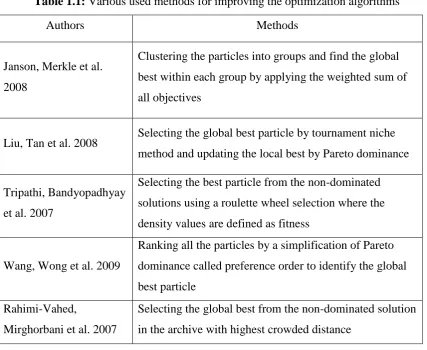
achieved by usually creating a secondary population to keep the good individuals. For the former, different methods were employed that could be shown in Table 1.1.
]
Table 1.1: Various used methods for improving the optimization algorithms
Authors Methods
Janson, Merkle et al. 2008
Clustering the particles into groups and find the global best within each group by applying the weighted sum of all objectives
Liu, Tan et al. 2008 Selecting the global best particle by tournament niche method and updating the local best by Pareto dominance
Tripathi, Bandyopadhyay et al. 2007
Selecting the best particle from the non-dominated solutions using a roulette wheel selection where the density values are defined as fitness
Wang, Wong et al. 2009
Ranking all the particles by a simplification of Pareto dominance called preference order to identify the global best particle
Rahimi-Vahed,
Mirghorbani et al. 2007
Selecting the global best from the non-dominated solution in the archive with highest crowded distance
Other well-known EAs namely ICA algorithm and GSO have not been employed in multi-objective optimization domain.
1.3 Problem Statement
objective, is a type of optimization problem that focus on problems including one objective or numbers of objectives with the same direction. Second category is multi objective problems (MOPs) which have at least two conflicting objectives. Many new evolutionary based algorithms have been proposed to tackle this problem based on various evolution phenomena (Deb et al., 2002; Coello Coello and Lechunga., 2000). The new EAs have been tested on different benchmark problems and employed in real-world engineering problems. The results have indicated their advantageous over the conventional optimization algorithms. However, the capabilities of these new EAs in terms of convergence rate and computational time could be further improved.
One of the well-design EA is HS algorithm where used to solve single objective optimization problem (Geem et al., 2001). One of the common drawbacks of the HS is that there always exists a possibility that the algorithm converges to a local optima solution instead of the global optima point (Mahdavi et al., 2007). The local-optima trap could deter the algorithm from finding the desired solutions especially in the problems that too many local optima solutions exist. The efficiency of an HS depends greatly on its ability to escape these so-called local traps and converge to the desired solution that mostly depends on the proper selection of the EAs parameters. The parameter setting of an HS is a cumbersome process and has to be repeated for any new problem, as the parameter setting is problem dependent. Implementing learning capabilities for parameter setting of the HS can help them adjust their parameters automatically considering the feedback they receive in the course of optimization. This enhancement not only eliminates the time-consuming parameter setting of the HS, but also further improves the efficiency of the algorithm in terms of convergence rate.
deficiency in current MOEAs is their disability to determine the quantitatively merit of each solution. Crowded distance which is used as the ranking method in MOEAs (Deb et al., 2002; Coello Coello and Lechunga., 2000), is just able to evaluate solution, quantitatively. This weakness causes many single objective evolutionary algorithms abdicate to become MOEA. Therefor the lack of method for measuring the quantitatively merit of solution is felt.
The proposed algorithms are usually tested on the well-known benchmark problems. Although the benchmark problems are carefully designed and selected to incorporate different aspects and challenges of any optimization problem, real-world optimization problems can better examine the efficiency and applicability of a newly introduced algorithm.
Hence, the research questions of this study can be stated as.
1- How learning capability could improve the convergence rate and computational time of the existing evolutionary algorithms?
2- How new ranking method could propose to measure the quantitatively merit of each solution?
3- How more efficient multi-objective algorithms could be developed for tackling MOPs?
1.4 Research Goal
1.5 Research Objective
The main objectives of the study are as following.
1- To propose a new single objective evolutionary algorithm, namely learning automata harmony search (LAHS), which is able to improve harmony search performance in terms of convergence rate and computational time.
2- To propose new quantitatively ranking method namely Sigma method
3- To develop new multi-objective evolutionary algorithms based on the Sigma method, namely Sigma Imperialist Competitive Algorithm (SICA).
1.6 Research Scope
1. This research is focused on evolutionary computation field. Other mathematical optimization tools are not to be explored.
2. Only the well-established and well-known EAs being applied in different engineering applications are to be explored.
3. MATLAB is used for programming.
4. The algorithms are to be tested on a set of well-established benchmark problems and a limited number of engineering applications
1.7 Significant of Study
The outcome of this research can be used in industry and laboratories for solving real engineering problems, which can increase the performance of existing methods and decreasing the costs.
1.8 Thesis Organization
REFERENCES
Ali, H., Shahzad, W., and Khan, F. A.(2012). Energy-efficient clustering in mobile ad-hoc networks using multi-objective particle swarm optimization. Applied Soft Computing, 12(7), 1913-1928.
Altinoz, O. T., and Yilmaz, A. E. (2012). Particle Swarm Optimization with Parameter Dependency Walls and its sample application to the microstrip-like interconnect line design. AEU - International Journal of Electronics and Communications,
66(2), 107-114.
Anastasi, G., Conti, M., Di Francesco, M., and Passarella, A. (2009). Energy conservation in wireless sensor networks: A survey. Ad Hoc Networks, 7(3), 537-568.
Anile, A. M., Cutello, V., Nicosia, G., Rascuna, R., and Spinella, S. (2005). Comparison among evolutionary algorithms and classical optimization methods for circuit design problems., The 2005 IEEE Congress on Evolutionary Computation, 5-5 Sept. 2005,761, 765-772.
Aladag, C. H., Basaran, M. A., Egrioglu, E., Yolcu, U., and Uslu, V. R. (2009). Forecasting in high order fuzzy times series by using neural networks to define fuzzy relations. Expert Systems with Applications, 36 (3, Part 1), 4228-4231. Arumugam, M. S., and Rao, M. V. C. (2008). On the improved performances of the
particle swarm optimization algorithms with adaptive parameters, cross-over operators and root mean square (RMS) variants for computing optimal control of a class of hybrid systems. Applied Soft Computing 324-336.
Ashry, G. A. (2006). On globally convergent multi-objective optimization. Applied Mathematics and Computation, 183(1), 209-216.
Atashpaz-Gargari, E., and Lucas, C. (2007). Imperialist competitive algorithm: An algorithm for optimization inspired by imperialistic competition. IEEE Congress on Evolutionary Computation, 4661- 4667.
Baker, J. E. (1987). Reducing Bias and Inefficiency in the Selection Algorithm.
Bandyopadhyay, S., and Bhattacharya, R. (2013). Solving multi-objective parallel machine scheduling problem by a modified NSGA-II. Applied Mathematical Modelling, 37(10–11), 6718-6729.
Beigy, H., and Meybodi, M. R. (2002). Call admission control in cellular mobile networks: a learning automata approach. EurAsia-ICT 2002: Information and Communication Technology, 450-457.
Beigy, H., and Meybodi, M. R. (2005). An adaptive call admission algorithm for cellular networks. Journal of Computer and Electrical Engineering 31 132-151.
Beigy, H., and Meybodi, M. R. (2009). A learning automata based algorithm for determination of the number of hidden units for three layers neural networks.
International Journal of Systems 101-118.
Bogachev, V., I. (2006), Measure theory, Berlin: Springer R. M. Dudley, 2002. Real Analysis and Probability. Cambridge University Press.
Cao, F., and Wang, W. (2012). Harmony search based particle swarm optimisation approach for optimal PID control in electroslag remelting process. International Journal of Modelling Identification and Control 20-27.
Chatterjee, A., and Siarry, P. (2006). Nonlinear inertia weight variation for dynamic adaptation in particle swarm optimization. Computers and Operations Research 33, 859–871.
Chen, C.Y., Chang, K.C., and Ho, S.-H. (2011). Improved framework for particle swarm optimization: Swarm intelligence with diversity-guided random walking. Expert Systems with Applications, 38(10), 12214-12220.
Chen, S. M. (2002). Forecasting enrollments based on high-order fuzzy time series.
Cybernetics and Systems, 33(1), 1-16.
Clerc, M., and Kennedy, J. (2002). The particle swarm-explosion, stability, and convergence in a multidimensional complex space. IEEE Transactions on Evolutionary Computation, 58-73.
Coello Coello, C. A., and Lechunga, M. S. (2000). MOPSO: A Proposal for Multiple Objective Particle Swarm Optimization. IEEE world congress on Computional Intelligence, Hawaii, 12-17.
Deb, K. (1999). Multi-objective genetic algorithms: Problem difficulties and construction of test Functions. Evolutionary Computation, 7(3), 205-230.
Deihimi, A., Orang, O., and Showkati, H. (2013). Short-term electric load and temperature forecasting using wavelet echo state networks with neural reconstruction. Energy, 57, 382-401.
Ding, F., Song, G., Yin, K., Li, J., and Song, A. (2009). A GPS-enabled wireless sensor network for monitoring radioactive materials. Sensors and Actuators A: Physical,
155(1), 210-215.
Familiar, M. S., Martínez, J. F., Corredor, I., and García-Rubio, C. (2012). Building service-oriented Smart Infrastructures over Wireless Ad Hoc Sensor Networks: A middleware perspective. Computer Networks, 56(4), 1303-1328.
Fan, S., Chen, L., and Lee, W.-J. (2009). Short-term load forecasting using comprehensive combination based on multimeteorological information. Industry Applications, IEEE Transactions on, 45(4), 1460-1466.
Gagarin, A., Hussain, S., and Yang, L. T. (2010). Distributed hierarchical search for balanced energy consumption routing spanning trees in wireless sensor networks.
Journal of Parallel and Distributed Computing, 70(9), 975-982.
Gao, X., Chen, B., He, X., Qiu, T., Li, J., Wang, C., et al. (2008). Multi-objective optimization for the periodic operation of the naphtha pyrolysis process using a new parallel hybrid algorithm combining NSGA-II with SQP. Computers & Chemical Engineering, 32(11), 2801-2811.
Geem, Z. W. (2006). Optimal cost design of water distribution networks using harmony search. Engineering Optimization 38(3), 259-277.
Geem, Z. W. (2007). Optimal scheduling of multiple dam system using harmony search algorithm. Computational and ambient intelligence. In: Sandoval F et al., editors. Computational and ambient intelligence. Berlin/Heidelberg: Springer, 316-323. Geem, Z. W., Kim , J. H., and Loganathan, G. V. (2001). A new heuristic optimization
algorithm: harmony search. simulation, 60-68.
Goldberg, D., Korbd, B., and Deb, K. (1989). Messy genetic algorithms: Motivation, analysis, and first results. The Clearinghouse for Genetic Algorithms (TCGA), Report, 89003.
Guria, C., Bhattacharya, P. K., and Gupta, S. K. (2005). Multi-objective optimization of reverse osmosis desalination units using different adaptations of the non-dominated sorting genetic algorithm (NSGA). Computers & Chemical Engineering, 29(9), 1977-1995.
Hakimi-Asiabar, M., Ghodsypour, S. H., and Kerachian, R. (2009). Multi-objective genetic local search algorithm using Kohonen’s neural map. Computers &
Hashemi, A. B., and Meybodi, M. R. (2011). A note on the learning automata based algorithms for adaptive parameter selection in PSO. Applied Soft Computing 11, 689–705.
He, S., Wu, Q. H., Wen, J. Y., Saunders, J. R., and Paton, R. C. (2004). A particle swarm optimizer with passive congregation. Biosystems 78, 135-147.
Horn, G., and Oommen, B. J. (2010). Solving Multiconstraint Assignment Problems Using Learning Automata. Systems, Man, and Cybernetics, Part B: Cybernetics, IEEE Transactions on, 40(1), 6-18.
Hou, T-H., and Hu, W.-C. (2011). An integrated MOGA approach to determine the Pareto-optimal kanban number and size for a JIT system. Expert Systems with Applications, 38(5), 5912-5918.
Hu, P., Rong, L., Liang-lin, C., and Li-xian, L. (2011). Multiple Swarms Multi-Objective Particle Swarm Optimization Based on Decomposition. Procedia Engineering,
15(0), 3371-3375.
Hu, X., and Eberhart, R. C. (2002). Multiobjective optimization using dynamic neighborhood particle swarm optimization. Congress on Evolutionary Computation, 1677-1681.
Huang, B., Buckley, B., and Kechadi, T. M. (2010). Multi-objective feature selection by using NSGA-II for customer churn prediction in telecommunications. Expert Systems with Applications, 37(5), 3638-3646.
Huarng, K. (2001). Effective lengths of intervals to improve forecasting in fuzzy time series. Fuzzy Sets and Systems, 123(3), 387-394.
Hui-Kuang, Y. (2005). A refined fuzzy time-series model for forecasting. Physica A: Statistical Mechanics and its Applications, 346(3-4), 657-681.
Jeyadevi, S., Baskar, S., Babulal, C. K., and Willjuice Iruthayarajan, M. (2011). Solving multiobjective optimal reactive power dispatch using modified NSGA-II.
International Journal of Electrical Power & Energy Systems, 33(2), 219-228. Jia, J., Chen, J., Chang, G., and Tan, Z. (2009). Energy efficient coverage control in
wireless sensor networks based on multi-objective genetic algorithm. Computers & Mathematics with Applications, 57(11–12), 1756-1766.
Jinhong, M., and Wen-zhi, Z. (2011). The Multi-object Optimal Pass Design based on MOGA. Procedia Engineering, 15(0), 3270-3276.
Kalaivani, L., Subburaj, P., and Willjuice Iruthayarajan, M. (2013). Speed control of switched reluctance motor with torque ripple reduction using non-dominated sorting genetic algorithm (NSGA-II). International Journal of Electrical Power & Energy Systems, 53, 69-77.
Kennedy, J. (1999). Small worlds and mega-minds: effects of neighborhood topology on particle swarm performance. Congress on Evolutionary Computation, DOI: 10.1109/CEC.1999.785509.
Kennedy, J., and Eberhart, R. (1995). Particle Swarm Optimization. International Conference on Neural Networks, 1942-1948.
Kennedy, J., and Mendes, R. (2002). Population structure and particle swarm performance. Evolutionary Computation Congress, 2, 1671 - 1676.
Kestelman, H. (1960). Lebesgue Measure. Chapter 3 in Modern Theories of Integration, 2nd rev. ed. New York: Dover, 67-91.
Kim, C.i., Yu, I.k., and Song, Y. (2002). Kohonen neural network and wavelet transform based approach to short-term load forecasting. Electric Power Systems Research, 63(3), 169-176.
Ko, C.H., and Wang, S.F. (2011). Precast production scheduling using multi-objective genetic algorithms. Expert Systems with Applications, 38(7), 8293-8302.
Kong, T., Cheng, H., Hu, Z., and Yao, L. (2009). Multiobjective planning of open-loop MV distribution networks using ComGIS network analysis and MOGA. Electric Power Systems Research, 79(2), 390-398.
Krishnanand, K. N., and Ghose, D. (2005). Detection of multiple source locations using a glowworm metaphor with applications to collective robotics. IEEE swarm intelligence symposium, 113, 84-91.
Krishnanand, K. N., and Ghose, D. (2009). Glowworm swarm optimization for simultaneous capture of multiple local optima of multimodal functions. Swarm Intelligence, 87–124.
Kulkarni, S., Simon, S. P., and Sundareswaran, K. (2013). A Spiking Neural Network (SNN) Forecast Engine for Short-term Electrical Load Forecasting. Applied Soft Computing, 13(8), 3429-3762.
Kunhuang, H., and Tiffany Hui-Kuang, Y. (2006). Ratio-based lengths of intervals to improve fuzzy time series forecasting. Systems, Man, and Cybernetics, Part B: Cybernetics, IEEE Transactions on, 36(2), 328-340.
Li, S.T., and Cheng, Y.C. (2007). Deterministic fuzzy time series model for forecasting enrollments. Computers & Mathematics with Applications, 53(12), 1904-1920.
Liang, J. J., and Qin, A. K. (2006). Comprehensive learning particle swarm optimizer for global optimization of multimodal functions. IEEE Transactions On Evolutionary Computation, 10(3), 281-295.
Li, K., and Li, J. (2012). Optimal energy allocation in heterogeneous wireless sensor networks for lifetime maximization. Journal of Parallel and Distributed Computing, 72(7), 902-916.
Li, X., and Wong, H.-S. (2009). Logic optimality for multi-objective optimization.
Applied Mathematics and Computation, 215(8), 3045-3056.
Lin, K., Chen, M., Zeadally, S., and Rodrigues, J. J. P. C. (2012). Balancing energy consumption with mobile agents in wireless sensor networks. Future Generation Computer Systems, 28(2), 446-456.
Liu, H., Abraham, A., and Clerc, M. (2007). Chaotic dynamic characteristics in swarm intelligence. Applied Soft Computing, 7(3), 1019-1026.
Lucas, C., Nasiri-Gheidari, Z., and Tootoonchian, F. (2010). Application of an imperialist competitive algorithm to the design of a linear induction motor. Energy Conversion and Management, 51(7), 1407-1411.
Mahdavi, M., Fesanghary, M., and Damangir, E. (2007a). An improved harmony search algorithm for solving optimization problems. Applied Mathematics and Computation, 188(2), 1567-1579.
Mendes, L. D. P., and J. P. C. Rodrigues, J. (2011). A survey on cross-layer solutions for wireless sensor networks. Journal of Network and Computer Applications, 34(2), 523-534.
Meybodi, M. R., and Beigy, H. (2002). A note on learning automata based schemes for adaptation of bp parameters. Journal of Neurocomputing 48, 957–974.
Moslemi, H., and Zandieh, M. (2011). Comparisons of some improving strategies on MOPSO for multi-objective inventory system. Expert Systems with Applications,
38(10), 12051-12057.
Murugan, P., Kannan, S., and Baskar, S. (2009). NSGA-II algorithm for multi-objective generation expansion planning problem. Electric Power Systems Research, 79(4), 622-628.
animal head movement. Computers and Electronics in Agriculture, 75(2), 238-242.
Narendra, K. S., and Thathachar, M. A. L. (1974). Learning automata: A survey. IEEE Transactions on Systems, Man, and Cybernetics, 323-334.
Nazari-Shirkouhi, S., Eivazy, H., Ghodsi, R., Rezaie, K., and Atashpaz-Gargari, E. (2010). Solving the integrated product mix-outsourcing problem using the Imperialist Competitive Algorithm. Expert Systems with Applications, 37(12), 7615-7626. Nemati, K., Shamsuddin, S. M., and Darus, M. (2014). An optimization technique based
on imperialist competition algorithm to measurement of error for solving initial and boundary value problems. Measurement, 48(7), 96-108.
Nie, H., Liu, G., Liu, X., and Wang, Y. (2012). Hybrid of ARIMA and SVMs for Short-Term Load Forecasting. Energy Procedia, 16, Part C(0), 1455-1460.
Niknam, T., Taherian Fard, E., Pourjafarian, N., and Rousta, A. (2011). An efficient hybrid algorithm based on modified imperialist competitive algorithm and K-means for data clustering. Engineering Applications of Artificial Intelligence,
24(2), 306-317.
Niu, B., Zhu, Y. L., and He, X. X. (2005a). Construction of fuzzy models for dynamic systems using multi-population cooperative particle swarm optimizer. Fuzzy Systems and Knowledge Discovery, Springer, 987–1000.
Niu, B., Zhu, Y. L., and He, X. X. (2005b). Multi-population cooperative particle swarm optimization. Advances in Artificial Life, Springer, 874-883.
Omran, M. G. H., and Mahdavi, M. (2008). Global-best harmony search. Applied Mathematics and Computation, 198(2), 643-656.
Oommen, B. J., and Hashem, M. K. (2010). Modeling a Student Classroom Interaction in a Tutorial-Like-System Using Learning Automata. Systems, Man, and Cybernetics, Part B: Cybernetics, IEEE Transactions on, 40(1), 29-42.
Oommen, B. J., Roberts, T. D., and . (2000). Continuous learning automata solutions to the capacity assignment problem. IEEE Transactions on Computers 49, 608–620. Pan, Q.K., Suganthan, P. N., Tasgetiren, M. F., and Liang, J. J. (2010a). A self-adaptive
global best harmony search algorithm for continuous optimization problems.
Applied Mathematics and Computation, 216(3), 830-848.
Pan, Q. K., Suganthan, P. N., Tasgetiren, M. F., and Liang, J. J. (2010b). A self-adaptive global best harmony search algorithm for continuous optimization problems.
Applied Mathematics and Computation, 830-848.
Papadimitriou, G. I., and Maritsas, D. G. (1996). Learning automata-based receiver conflict avoidance algorithms for WDM broadcast-and-select star networks.
IEEE/ACM Trans. Netw., 4(3), 407-412.
Papadimitriou, G. I., and Pomportsis, A. S. (2000). Learning-automata-based TDMA protocols for broadcast communication systems with bursty traffic.
Communications Letters, IEEE, 4(3), 107-109.
Peng, I. H., and Chen, Y.-W. (2013). Energy consumption bounds analysis and its applications for grid based wireless sensor networks. Journal of Network and Computer Applications, 36(1), 444-451.
Pires, D. F., Antunes, C. H., and Martins, A. G. (2012). NSGA-II with local search for a multi-objective reactive power compensation problem. International Journal of Electrical Power & Energy Systems, 43(1), 313-324.
Poli, R., Chio, C. D., and Langdon, W. B. (2005). Exploring extended particle swarms: a genetic programming approach. Conference on Genetic and Evolutionary Computation, ACM, 169-176.
Poli, R., Kennedy, J., and Blackwell, T. (2007). Particle swarm optimization. Swarm Intelligence, 1(1), 33-57.
Ramesh, S., Kannan, S., and Baskar, S. (2012). Application of modified NSGA-II algorithm to multi-objective reactive power planning. Applied Soft Computing,
12(2), 741-753.
Saka, M. P. (2009). Optimum design of steel sway frames to BS5950 using harmony search algorithm. Journal of Constructional Steel Research 36-43.
Santos, C, L. D., and de Andrade Bernert, D. L. (2009). An improved harmony search algorithm for synchronization of discrete‒time chaotic system. Chaos Solitons &
Fractals 2526-2532.
Schaffer, J. D. (1985). Multiple objective optimization with vector evaluated genetic algorithms 1st International Conference on Genetic Algorithms, 593-595.
Shi, Y., and Eberhart, R. C. (1998). A modified particle swarm optimizer. IEEE International Conference on Evolutionary Computation.
Song, Q., and Chissom, B. S. (1993a). Forecasting Enrollments with Fuzzy Time-Series .1. Fuzzy Sets and Systems, 54(1), 1-9.
Srinivas, N., and Deb, K. (1995). Multi-Objective function optimization using non-dominated sorting genetic algorithms, Evolutionary Computation, 2(3), 221-248. Suganthan, P. N. (1999). Particle swarm optimiser with neighbourhood operator.
Congress of Evolutionary Computation, 23-56.
Sun, Z., Wang, P., Vuran, M. C., Al-Rodhaan, M. A., Al-Dhelaan, A. M., and Akyildiz, I. F. (2011). BorderSense: Border patrol through advanced wireless sensor networks.
Ad Hoc Networks, 9(3), 468-477.
Sundar, S., and Singh, A. (2012). A swarm intelligence approach to the early/tardy scheduling problem. Swarm and Evolutionary Computation, 4(0), 25-32.
Thathachar, M. A. L., and Sastry, P. S. (2002). Varieties of learning automata: an overview. Man, and Cybernetics, Part B: Cybernetics, IEEE Transactions on Systems, 32(6), 711-722.
Tsetlin, M. L. (1973). Automaton Theory and Modeling of Biological Systems. Academic Press.
van den Bergh, F., and Engelbrecht, A. (2004). Acooperative approach to particleswarmoptimization. IEEE Transactions on Evolutionary Computation, 225-239.
Vasebi, A., Fesanghary, M., and Bathaee, S. M. T. (2007). Combined heat and power economic dispatch by harmony search algorithm. International Journal of Electrical Power & Energy Systems 713-719.
Wang, X., Xing, G., Zhang, Y., Lu, C., Pless, R., and Gill, C. (2003). Integrated coverage and connectivity configuration in wireless sensor networks. Proceding of the First international conference on Embedded networked sensor systems, 28-39.
Whitley, D. (1994). A genetic algorithm tutorial. Statistics and Computing, 4(2), 65-85. Xiao, Z., Ye, S.-J., Zhong, B., and Sun, C.-X. (2009). BP neural network with rough set
for short term load forecasting. Expert Systems with Applications, 36(1), 273-279. Xie, X. F., Zhang, W., and Yang, Z. (2002). Hybrid particle swarm optimizer with mass
extinction. International Conference on Communication, Circuits and Systems,
1170-1174.
Xu, Y., Heidemann, J., and Estrin, D. (2001). Geography-informed energy conservation for ad hoc routing. Proceding of the 7th Annual International Conference on Mobile Computing and Networking, 70-84.
Yao, S. J., Song, Y. H., Zhang, L. Z., and Cheng, X. Y. (2000). Wavelet transform and neural networks for short-term electrical load forecasting. Energy Conversion and Management, 41(18), 1975-1988.
Yong, Z., and Pei, Q. (2012). A Energy-Efficient Clustering Routing Algorithm Based on Distance and Residual Energy for Wireless Sensor Networks. Procedia Engineering, 29(0), 1882-1888.
Yusoff, Y., Ngadiman, M. S., and Zain, A. M. (2011). Overview of NSGA-II for Optimizing Machining Process Parameters. Procedia Engineering, 15, 3978-3983. Zeydan, E., Kivanc, D., Comaniciu, C., and Tureli, U. (2012). Energy-efficient routing for
correlated data in wireless sensor networks. Ad Hoc Networks, 10(6), 962-975. Zhang, H., and Hou, J. C. (2005). Maintaining sensing coverage and connectivity in large
sensor networks. Ad-hoc and Sensor Wireless Networks, 1, 89-124.
Zhang, W. J., and Xie, X. F. (2003). hybrid particle swarm with differential evolution operator. IEEE International Conference on Systems,4, 3816 – 3821.
Zhu, C., Zheng, C., Shu, L., and Han, G. (2012). A survey on coverage and connectivity issues in wireless sensor networks. Journal of Network and Computer Applications, 619-632.
Zitzler, E., Deb, K., and Thiele, L. (2000). Comparison of Multiobjective Evolutionary Algorithms: Empirical Results. Evolutionary Computation, 2(8), 173-195
Adalah disahkan bahawa projek penyelidikan tesis ini telah dilaksanakan
melalui kerjasama antara dengan
Disahkan oleh:
Tandatangan : . . . Tarikh : . . . . Nama : . . . .
Jawatan : . . . . (Cop Rasmi) :
*Jika penyediaan tesis/projek melibatkan kerjasama.
BAHAGIAN B : Untuk Kegunaan Pejabat Sekolah Pengajian Siswazah
Tesis ini telah diperiksa dan diakui oleh:
Nama dan Alamat Pemeriksa Luar :
Nama dan Alamat Pemeriksa Dalam :
Nama Penyelia Lain (jika ada) :
Disahkan oleh Penolong Pendaftar di SPS: