A ROBUST VIDEO WATERMARKING USING SIMULATED BLOCK BASED SPATIAL DOMAIN TECHNIQUE
FARNAZ ARAB
A thesis submitted in fulfilment of the requirements for the award of the degree of
Doctor of Philosophy (Computer Science)
Faculty of Computing Universiti Teknologi Malaysia
ACKNOWLEDGEMENTS
ABSTRACT
ABSTRAK
Tera air digital membenamkan isyarat tidak kelihatan ke dalam data seperti audio, video dan imej, untuk tujuan yang berbeza termasuk pengesahan dan pengesanan gangguan. Teknik pengesanan gangguan untuk tera air video memainkan peranan utama sebagai bukti forensik di mahkamah. Teknik sedia ada dalam penyembunyian maklumat hos multimedia adalah kebanyakkannya berdasarkan domain spatial berbanding dengan domain frekuensi. Ketahanan teknik domain spatial tidak seteguh teknik domain frekuensi. Pendekatan yang paling biasa untuk
menyembunyikan maklumat dalam multimedia adalah menggunakan domain spatial. Kemantapan dari segi keteguhan, teknik domain spatial adalah tidak setinggi berbanding dengan domain frekuensi. Dalam usaha meningkatkan keteguhan domain spatial, tera air boleh dibenamkan secara berulang kali. Bagi menjadikan teknik
TABLE OF CONTENTS
CHAPTER TITLE PAGE
DECLARATION ii
ACKNOWLEDGEMENTS iv
ABSTRACT v
ABSTRAK vi
TABLE OF CONTENTS vii
LIST OF TABLES xi
LIST OF FIGURES xiv
LIST OF ABBREVIATIONS xxiv
LIST OF APPENDICES xxv
1 INTRODUCTION 1
1.1 Overview 1
1.2 Background of the Problem 2
1.3 Statement of the Problem 3
1.4 Research Questions 4
1.5 Research Objectives 4
1.6 Scope of the Study 5
1.7 Significance of the Study 5
1.8 Summary 6
2 LITERATURE REVIEW 7
2.1 Introduction 7
2.2 Watermarking 7
2.2.2 Authentication 18 2.2.3 Basic Characters of Digital Watermarking 21 2.2.4 Characteristics of Video Watermarking 22
2.2.5 General Video Frame Work 23
2.2.6 Performance Measurements 25
2.2.7 Fragile and Semi-fragile techniques 26
2.3 Type of Domains 27
2.3.1 Spatial domain 27
2.3.2 Frequency domain watermarking 31
2.4 Attacks 32
2.5 Related works 35
2.6 Summary 43
3 METHODOLOGY 44
3.1 Introduction 44
3.2 Research Activities 44
3.3 Research Framework 47
3.3.1 Investigation Phase 48
3.3.2 Development Phase 49
3.3.3 Testing and Evaluation Phase 50
3.3.4 Reporting the Research Phase 50
3.4 Implementation Tools 51
3.5 Design and Implementation of Proposed Technique 52
3.5.1 Technique VW16E 53
3.5.2 Technique VW16F 56
3.5.3 Technique VW8F 58
3.6 AVI 61
3.6.1 RIFF File Format 61
3.6.2 AVI RIFF Form 62
3.6.3 Stream Data ('movi' List) 65
3.7 Metadata 67
3.7.1 Confidential Message 67
3.7.2 AVI video Samples 68
4 DESIGN AND IMPLEMENTATION 69
4.1 Introduction 69
4.2 Test the Imperceptibility 69
4.3 Test Results of Proposed Techniques 70
4.3.1 Test Results of VW16E Technique 71
4.3.2 Test Results of VW16F Technique 85
4.3.3 Test Results of VW8F Technique 100
4.4 Discussion and Analysis on Proposed Scheme 115
5 RESULTS AND ANALYSIS 116
5.1 Introduction 116
5.2 Test and Evaluation 116
5.2.1 Attacks on Video Sample No 1 117
5.2.2 Attacks on Video Sample No 5 124
5.2.3 Attacks on Video Sample No 8 133
5.2.4 Attacks on Video Sample No 9 141
5.2.5 Attacks on Video Sample No 10 149
5.2.6 Attacks on Video Sample No 11 158
5.2.7 Attacks on Video Sample No 12 166
5.2.8 Attacks on Video Sample No 13 175
5.2.9 Attacks on Video Sample No 14 183
5.3 Technical Analysis 191
5.4 Summary 192
6 EFFICIENCY EVALUATION 193
6.1 Introduction 193
6.2 Comparison of the Test Results of Proposed Techniques 193
6.2.1 VW16E Comparing to VW16F 193
6.2.2 VW8F Comparing VW16F 200
6.3 Analysis of the Test Results of Proposed Techniques 210 6.3.1 Analysis the compare of VW16E with VW16F 211 6.3.2 Analysis the compare of VW16F with VW8F 211
6.4 Comparison and Discussion 211
6.6 Summary 217
7 DISCUSSION AND CONCLUSION 218
7.1 Introduction 218
7.2 Summary of Findings 218
7.2.1 To Achieve Objective 1 218
7.2.2 To Achieve Objective 2 219
7.2.3 To Achieve Objective 3 220
7.3 Contributions 221
7.4 Limitations and Recommendations of Future Research 222
7.5 Summary 222
REFERENCES 223
LIST OF TABLES
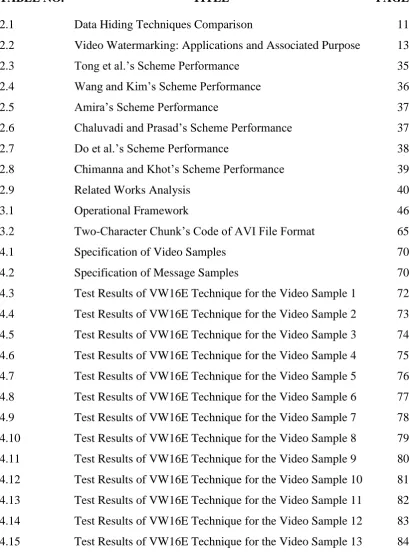
TABLE NO. TITLE PAGE 2.1 Data Hiding Techniques Comparison 11 2.2 Video Watermarking: Applications and Associated Purpose 13 2.3 Tong et al.’s Scheme Performance 35 2.4 Wang and Kim’s Scheme Performance 36
2.5 Amira’s Scheme Performance 37
2.6 Chaluvadi and Prasad’s Scheme Performance 37 2.7 Do et al.’s Scheme Performance 38 2.8 Chimanna and Khot’s Scheme Performance 39
2.9 Related Works Analysis 40
3.1 Operational Framework 46
5.6 Attack Results on Video Sample No 11 158 5.7 Attack Results on Video Sample No 12 167 5.8 Attack Results on Video Sample No 13 176 5.9 Attack Results on Video Sample No 14 184 6.1 Comparison VW16E & VW16F for the Video Sample 2 194 6.2 Comparison VW16E & VW16F for the Video Sample 6 195 6.3 Comparison VW16E & VW16F for the Video Sample 7 196 6.4 Test Results of VW16E Technique for the Video Sample 9 197 6.5 Comparison VW16E & VW16F for the Video Sample 12 198 6.6 Comparison VW16E & VW16F for the Video Sample 14 199 6.7 Comparison VW16F and VW8F for the Video Sample 1 200 6.8 Comparison VW16F and VW8F for the Video Sample 3 201 6.9 Comparison VW16F and VW8F for the Video Sample 4 202 6.10 Comparison VW16F and VW8F for the Video Sample 5 203 6.11 Comparison VW16F and VW8F for the Video Sample 7 205 6.12 Comparison VW16F and VW8F for the Video Sample 8 206 6.13 Comparison VW16F and VW8F for the Video Sample 10 207 6.14 Comparison VW16F and VW8F for the Video Sample 11 208 6.15 Comparison VW16F and VW8F for the Video Sample 13 209 6.16 Comparison VW16F and VW8F for the Video Sample 14 210 6.17 Comparison the Proposed Technique with Related Works 212
LIST OF FIGURES
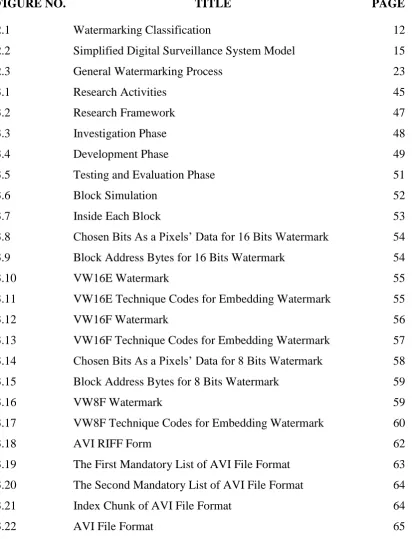
FIGURE NO. TITLE PAGE 2.1 Watermarking Classification 12 2.2 Simplified Digital Surveillance System Model 15 2.3 General Watermarking Process 23
3.1 Research Activities 45
3.2 Research Framework 47
3.3 Investigation Phase 48
3.4 Development Phase 49
3.5 Testing and Evaluation Phase 51
3.6 Block Simulation 52
3.7 Inside Each Block 53
3.8 Chosen Bits As a Pixels’ Data for 16 Bits Watermark 54 3.9 Block Address Bytes for 16 Bits Watermark 54
3.10 VW16E Watermark 55
3.11 VW16E Technique Codes for Embedding Watermark 55
3.12 VW16F Watermark 56
3.13 VW16F Technique Codes for Embedding Watermark 57 3.14 Chosen Bits As a Pixels’ Data for 8 Bits Watermark 58 3.15 Block Address Bytes for 8 Bits Watermark 59
3.16 VW8F Watermark 59
3.17 VW8F Technique Codes for Embedding Watermark 60
3.18 AVI RIFF Form 62
3.19 The First Mandatory List of AVI File Format 63 3.20 The Second Mandatory List of AVI File Format 64 3.21 Index Chunk of AVI File Format 64
3.23 Start of Chunk 66
3.24 End of Chunk 66
3.25 Index of AVI File Format 67
LIST OF ABBREVIATIONS
AI - Artificial Intelligence
CD - Compact Disc
DVD - Digital Video Disc
DFT - Discrete Fourier Transform DCT - Discrete Cosine Transform DWT - Discrete Wavelet Transform
IDWT - Inverse Discrete Wavelet Transform DVS - Digital Video Surveillance Systems
dB - Decibel
CCTV - Closed Circuit Television HAS - Human Auditory System HVS - Human Visual System LSB - Least Significant Bit
MSB Most Significant Bit
RIFF - Resource Interchange File Format AVI - Audio Video Interleave
MPEG - Moving Picture Experts Group JPEG - Joint Photographic Experts Group
RSA - Rivest, Shamir, & Adleman (Public Key Encryption Technology) PCA - Principal Component Analysis
LIST OF APPENDICES
APPENDIX TITLE PAGE
A AVI Video Samples 234
CHAPTER 1
INTRODUCTION
1.1 Overview
A digital watermark is a kind of indication, which is accommodated in the host medium such as digital image, audio, text, software or video. It can be commonly used for ownership protection. Watermarking is a technique of covering digital information in the carrier signal (host). The hidden data is not necessarily related to the content of the host (Chang, Wang, et al., 2011; Junxiao et al., 2011; Liu, 2012). Particularly for video files, in order to solve the problem of unlawful manipulation and dishonest distribution, video watermarking is applied (Liu et al., 2009; Sinha et al., 2011).
Digital Video play a major role of forensic evidence in court (Su et al., 2008; Xu et al., 2010). Hence the video files should be authenticable with ability to detect the tamper, thus a technique like watermarking is applied for the purpose. The watermark must not have any effect on visual information and must not reduce the ability for compromise on the video evidence. Therefore, high imperceptible watermark has responded to the mentioned necessity (Su et al., 2008). Video tamper detection is the challenge of today’s researchers in the field of multimedia security (Van Schyndel, 2010).
between these conflicting requirements of watermarking should be found for any application and techniques (Agarwal et al., 2012; Ishtiaq et al., 2009).
1.2 Background of the Problem
Nowadays cameras in many circumstance has been installed, even these cameras mounted on the streets for fights, drug deals and other improper activities in an environment. The police might see the crime as it was happening or use the video to help in any consequent investigation. Digital multimedia content can easily be duplicated and stored and even without losing fidelity. In Digital Video System (DVS) video file is very vital, because it can be used as a piece of evidence, on the other hand; manipulating the video file by many editing video software in the market is like a piece of cake, so easy and simple with low cost (Sinha et al., 2011).
By growth of communication network, due to the characteristics of digital products such as easy to transform and easy to copy, digital tamper detection has been critical issues which need to be solved (Agarwal et al., 2012). Techniques used for video watermarking tamper detection compared to digital image are stagnant (Agarwal et al., 2012). Ascribable to the natural redundancy between the video frames, proposed techniques for image tamper detection are not appropriate for digital video watermarking which are not presented for attacks including frame dropping, frame inserting, frame shifting and etc. Beside these attacks, techniques are restricted in ability to detect the tamper areas (Sinha et al., 2011).
imperceptible and robust. Hence, in addition to robustness and imperceptibility the constraint of computational is imposed to video watermarking (Hasnaoui and Mitrea, 2012).
Video application requires a large quantity of sequences to be processed. Watermarking techniques can also be applied in the frequency domain. In these techniques higher imperceptibility can be obtained as well as better robustness. The disadvantage of frequency domain methods is that they are computationally expensive when compared with spatial. Spatial domain techniques are best suit for video watermarking than other watermarking domains. Watermark can also be embedded in the frequency domains (Chimanna and Khot, 2013). In transform domain, first the host is converted to the frequency domain then the watermark is added and then the inverse frequency transform is applied. One of the common transform methods is the Discrete Cosine Transform (DCT) which divides the image into low, middle and high frequency bands. In the aspect of imperceptibility the middle band is best chosen rather than two other frequency bands. If the watermark is embedded in high frequency band, the details of the edges and other information would be affected. On the other hand, when the watermark is embedded into the low frequency, the imperceptibility is influenced negatively. The DCT is not more efficient than spatial domain when it comes to transparency and also it has intensive computation relatively (Yu et al., 2014). Another common transform method is Discrete Wavelet Transform (DWT) which decompose the image into four sub bands that are low resolution approximation (LL), horizontal (HL), vertical (LH) and diagonal (HH) of detail components. The edge and texture patterns are located in high resolution sub bands. The watermark cannot embed in LL because the smoother part of the image is in this part and also the watermark cannot embed in HH because major details of the image will be lost. That is why the HL and LH are normally selected for watermarking (Chimanna and Khot, 2013; Sinha et al., 2011). The DWT also is not more efficient than spatial domain in aspect of transparency and also have more computation compared to DCT.
The most common approach for concealing information in the video host is spatial domain. The robustness of spatial domain techniques is not as high as other techniques. In order to improve the robustness of spatial domain, a watermark can be embedded several times repeatedly. As a result, if a single copy of that watermark can survive after attacks, that can be retrieved and the techniques passes the robustness test. Moreover, although spatial domain technique is easy to implement, sometimes adding noise entirely demolish the watermark and could be noticeable for attacker by comparing the anticipated sample with the received signal (Agarwal et al., 2012).
In order for spatial domain techniques to be as efficient as other techniques, more payload is needed to embed additional information. The additional information would include the redundant watermarks to ensure the achievable robustness and more metadata of pixels to ensure achievable efficiency to detect more attacks. All these required additional information will degrade the quality (imperceptibility).
1.4 Research Questions
During conducting this research we try to find a suitable answer for the following questions:
(i) What are the recent tamper detection techniques for video watermarking in spatial domain?
(ii) How to improve imperceptibility and efficiency of video tamper detection watermarking techniques in spatial domain?
(iii) How efficiency is the proposed technique?
1.5 Research Objectives
The exact research targets are as follows:
(ii) To propose a video tamper detection watermarking technique in order to improve imperceptibility and efficiency
(iii) To evaluate the efficiency of proposed technique
1.6 Scope of the Study
This research has been focused on following scopes; (i) Digital video watermarking
(ii) Tamper detection on watermarked video (iii) Vowel less video
(iv) Audio Video Interleave (AVI) files format. (v) Uncompressed data part of AVI (dB) (vi) Spatial domain techniques is used (vii) C # is used for programming
(viii) Avihex is used for visually compare files and check AVI files (ix) VirtualDub is used for expanding and combining the video frames (x) Microsoft Windows Paint and Microsoft office picture manager is
used for applying attacks
(xi) Efficiency and robustness of nine attacks (Frame Insert, Frame Exchange, Frame Deletion, Crop, Rotate, and Reverse Rotate, Frame shift, Salt and Pepper and Superimpose attack)
1.7 Significance of the Study
tamper detection. Furthermore, the vision difference between original video and watermarked video is not recognizable. Additionally the method has high security and is robust against various modifications such as frame cut, frame swapping and frame insertion and variety of geometric attacks (Sinha et al., 2011).
1.8 Summary
8 REFERENCES
Agarwal, H., Ahuja, R., and Bedi, S. (2012). Highly Robust and Imperceptible Luminance Based Hybrid Digital Video Watermarking Scheme for
Ownership Protection. International Journal of Image, Graphics & Signal Processing. 4(11).
Al-Haj, A., Mohammad, A., and Bata, L. (2011). DWT-Based Audio Watermarking. International Arab Journal of Information Technology. 8(3), 326-333.
Ali, M., and Ahn, C. W. (2014). An optimized watermarking technique based on self-adaptive DE in DWT-SVD transform domain. Signal Processing. 94, 545-556.
Ali, M., Ahn, C. W., and Pant, M. (2014). A robust image watermarking technique using SVD and differential evolution in DCT domain. Optik. 125(1), 428-434.
Alnawok, F., and Ahmed, B. (2008). Multi-Segment Steganography Technique. International Arab Journal of Information Technology (IAJIT). 5(3).
Amira, H., Rhouma, R., and Belghith, S. (2010). An Eigen value based
Watermarking scheme for tamper detection in gray level images. Systems Signals and Devices (SSD), 2010 7th International Multi-Conference on. 1-5.
Amirgholipour, S., and Sharifi, A. (2014). A Pre-Filtering Method to Improve Watermark Detection Rate in DCT Based Watermarking. International Arab Journal of Information Technology. 11(2), 178-185.
Atawneh, S., Almomani, A., and Sumari, P. (2013). Steganography in digital images: Common approaches and tools. Iete Technical Review. 30(4), 344-358. Behnia, S., Teshnehlab, M., and Ayubi, P. (2010). Multiple-watermarking scheme
Bhatnagar, G., and Raman, B. (2009). A new robust reference watermarking scheme based on DWT-SVD. Computer Standards & Interfaces. 31(5), 1002-1013. Cedillo-Hernandez, A., Cedillo-Hernandez, M., Garcia-Vazquez, M.,
Nakano-Miyatake, M., Perez-Meana, H., and Ramirez-Acosta, A. (2014). Transcoding resilient video watermarking scheme based on spatio-temporal HVS and DCT. Signal Processing. 97, 40-54.
Cedillo-Hernandez, M., Garcia-Ugalde, F., Nakano-Miyatake, M., and Manuel Perez-Meana, H. (2014). Robust hybrid color image watermarking method based on DFT domain and 2D histogram modification. Signal Image and Video Processing. 8(1), 49-63.
Cedillo-Hernandez, M., Garcia-Ugalde, F., Nakano-Miyatake, M., and Perez-Meana, H. (2013). Robust Object-Based Watermarking Using SURF Feature
Matching and DFT Domain. Radioengineering. 22(4), 1057-1071.
Cetin, O., Akar, F., Ozcerit, A. T., Cakiroglu, M., and Bayilmis, C. (2012). A blind steganography method based on histograms on video files. Imaging Science Journal. 60(2), 75-82.
Chaluvadi, S. B., and Prasad, M. V. (2009). Efficient image tamper detection and recovery technique using dual watermark. Nature & Biologically Inspired Computing, 2009. NaBIC 2009. World Congress on. 993-998.
Chang, C.-C., Chen, K.-N., Lee, C.-F., and Liu, L.-J. (2011). A secure fragile
watermarking scheme based on chaos-and-hamming code. Journal of Systems and Software. 84(9), 1462-1470.
Chang, C.-C., Lin, C.-Y., and Fan, Y.-H. (2011). Reversible Steganography for BTC-compressed Images. Fundamenta Informaticae. 109(2), 121-134.
Chang, X., Wang, W., Zhao, J., and Zhang, L. (2011). A survey of digital video watermarking. Natural Computation (ICNC), 2011 Seventh International Conference on. 61-65.
Cheddad, A., Condell, J., Curran, K., and Mc Kevitt, P. (2009). A skin tone detection algorithm for an adaptive approach to steganography. Signal Processing. 89(12), 2465-2478.
Chen, H.-y., and Zhu, Y.-s. (2012). A robust watermarking algorithm based on QR factorization and DCT using quantization index modulation technique. Journal of Zhejiang University-Science C-Computers & Electronics. 13(8),
573-584.
Chen, S., and Leung, H. (2008). Chaotic watermarking for video authentication in surveillance applications. Circuits and Systems for Video Technology, IEEE Transactions on. 18(5), 704-709.
Chen, T.-Y., Istanda, V., Chen, T.-H., Wang, D.-J., and Lin, Y.-L. (2010). H.264 VIDEO AUTHENTICATION BASED ON SEMI-FRAGILE
WATERMARKING. International Journal of Innovative Computing Information and Control. 6(3B), 1411-1420.
Chimanna, M. A., and Khot, S. (2013). Robustness of video watermarking against various attacks using Wavelet Transform techniques and Principle
Component Analysis. Information Communication and Embedded Systems (ICICES), 2013 International Conference on. 613-618.
Choi, O., Jeon, I., Yoo, S.-W., and Moon, S. (2013). An Extended DCT Domain Watermarking for Robot Vision against Geometric Image Attacks. Journal of Applied Mathematics.
Cichowski, J., Czyzewski, A., and Ieee. (2011). Reversible Video Stream
Anonymization for Video Surveillance Systems Based on Pixels Relocation
and Watermarking.
Coskun, I., Akar, F., and Cetin, O. (2013). A new digital image steganography algorithm based on visible wavelength. Turkish Journal of Electrical Engineering and Computer Sciences. 21(2), 548-564.
Cui, D., and Zuo, J. Interest authentication and tamper detection digital
watermarking method, involves determining region of interest by user to generate digital watermark and HASH code to trusted third party.
Das, C., Panigrahi, S., Sharma, V. K., and Mahapatra, K. K. (2014). A novel blind robust image watermarking in DCT domain using. inter-block coefficient correlation. Aeu-International Journal of Electronics and Communications. 68(3), 244-253.
Signal Processing and Information Technology, 2008. ISSPIT 2008. IEEE
International Symposium on. 330-335.
Elbasi, E. (2012). Robust MPEG Watermarking in DWT Four Bands. Journal of Applied Research and Technology. 10(2), 87-93.
Fallahpour, M., and Megias, D. (2010). DWT-Based High Capacity Audio Watermarking. Ieice Transactions on Fundamentals of Electronics Communications and Computer Sciences. E93A(1), 331-335.
Fallahpour, M., Shirmohammadi, S., Semsarzadeh, M., and Zhao, J. (2014). Tampering Detection in Compressed Digital Video Using Watermarking. Ieee Transactions on Instrumentation and Measurement. 63(5), 1057-1072.
Findik, O., Babaoglu, I., and Ulker, E. (2010). A digital robust image watermarking against desynchronization attacks. Scientific Research and Essays. 5(16), 2288-2294.
Golshan, F., and Mohammadi, K. (2013). A hybrid intelligent SVD-based perceptual shaping of a digital image watermark in DCT and DWT domain. Imaging Science Journal. 61(1), 35-46.
Guan, Y. L., and Poh, C. L. Method for preparing digital medical image for secure transmission, involves embedding code for tamper detection and localization into digital medical image using reversible watermarking process.
Guan, Z. L. Q. L. S., and Peng, X. (2009). a robust watermarking algorithm based on differential energy and qim for uncompressed video.
Han, S., Chu, C.-H., and Luo, Z. (2011). Tamper Detection in the EPC Network Using Digital Watermarking. Ieee Security & Privacy. 9(5), 62-69. Hasnaoui, M., and Mitrea, M. (2012). Semi-fragile watermarking for video
surveillance applications. Signal Processing Conference (EUSIPCO), 2012 Proceedings of the 20th European. 1782-1786.
He, Y., Yang, G., and Zhu, N. (2012). A real-time dual watermarking algorithm of H.264/AVC video stream for Video-on-Demand service. Aeu-International Journal of Electronics and Communications. 66(4), 305-312.
Ishtiaq, M., Jaffar, M. A., Khan, M. A., Jan, Z., and Mirza, A. M. (2009). Robust and imperceptible watermarking of video streams for low power devices. In
Signal Processing, Image Processing and Pattern Recognition (pp. 177-184):
Jayanthi, V. E., Rajamani, V., and Karthikayen, P. (2011). Performance analysis for geometrical attack on digital image watermarking. International Journal of Electronics. 98(11), 1565-1580.
Jin, C., and Pan, M. HTML webpage tamper detection and positioning method, involves producing line of webpage digital watermark, and positioning rows and lines in webpage digital watermark with different authentication codes. Junxiao, X., Qingbin, L., and Zhiyong, L. (2011). A novel digital video
watermarking algorithm. Procedia Engineering. 24, 90-94.
Keyvanpour, M., and Bayat, F. M. (2013). Blind image watermarking method based on chaotic key and dynamic coefficient quantization in the DWT domain. Mathematical and Computer Modelling. 58(1-2), 56-67.
Kumar, M., and Newman, R. (2010). J3: High payload histogram neutral JPEG steganography. Privacy Security and Trust (PST), 2010 Eighth Annual International Conference on. 46-53.
Kurniawan, M. T., Adiwijaya, Agung, W., and Ieee. (2012). Multiple Watermarking On Digital Medical Images for Tamper Detection and Integrity Control. 2012 2nd International Conference on Uncertainty Reasoning and Knowledge
Engineering (Urke), 145-148.
Kwitt, R., Meerwald, P., and Uhl, A. (2011). Lightweight Detection of Additive Watermarking in the DWT-Domain. Ieee Transactions on Image Processing. 20(2), 474-484.
Lamgunde, A., and Kale, A. (2011). Palette Based Technique for Image
Steganography. In Advances in Computing, Communication and Control (pp.
364-371): Springer.
Lee, M.-J., Im, D.-H., Lee, H.-Y., Kim, K.-S., and Lee, H.-K. (2012). Real-time video watermarking system on the compressed domain for high-definition video contents: Practical issues. Digital Signal Processing. 22(1), 190-198. Lei, M., Yang, Y., Luo, S., and Niu, X. (2010). Semi-Fragile Audio Watermarking
Algorithm in DWT Domain. China Communications. 7(4), 71-75.
Li, C.-T. (2009). Authentication and recovery of digital images: potential application in video surveillance and remote sensing. 2009 Digest of Technical Papers International Conference on Consumer Electronics. 1-2.
Lin, S. D., Chuang, C.-Y., Chen, M.-J., and Meng, H.-C. (2009). A Novel Video Watermarking Scheme in H. 264/AVC Encoder. Innovative Computing, Information and Control (ICICIC), 2009 Fourth International Conference on.
357-360.
Ling, H., Wang, L., and Zou, F. (2011). Real-time video watermarking scheme resistant to geometric distortions. Journal of Electronic Imaging. 20(1). Liu, F., and Wu, C.-K. (2011). Robust visual cryptography-based watermarking
scheme for multiple cover images and multiple owners. Information Security, IET. 5(2), 121-128.
Liu, J., and She, K. (2012). A Hybrid Approach of DWT and DCT for Rational Dither Modulation Watermarking. Circuits Systems and Signal Processing. 31(2), 797-811.
Liu, M. (2012). Study of Digital Video Watermarking. Computer Science and Electronics Engineering (ICCSEE), 2012 International Conference on.
77-80.
Liu, Z., Li, Q., Guan, S., and Peng, X. (2009). A robust watermarking algorithm based on differential energy and QIM for uncompressed video. Intelligent Information Hiding and Multimedia Signal Processing, 2009. IIH-MSP'09.
Fifth International Conference on. 382-385.
Lu, W., Sun, W., and Lu, H. (2009). Robust watermarking based on DWT and nonnegative matrix factorization. Computers & Electrical Engineering. 35(1), 183-188.
Lu, W., Sun, W., and Lu, H. (2012). Novel robust image watermarking based on subsampling and DWT. Multimedia Tools and Applications. 60(1), 31-46. Masoumi, M., and Amiri, S. (2013). A blind scene-based watermarking for video
copyright protection. Aeu-International Journal of Electronics and Communications. 67(6), 528-535.
Mohanty, S. P., and Kougianos, E. (2011). Real-time perceptual watermarking architectures for video broadcasting. Journal of Systems and Software. 84(5), 724-738.
Munoz Munoz, A., and Argueelles Alvarez, I. (2013). COMPUTATIONAL
LINGUISTICS AND LINGUISTIC STEGANOGRAPHY. DISTRIBUTING HIDDEN INFORMATION WITH MINIMAL RESOURCES. Arbor-Ciencia Pensamiento Y Cultura. 189(760).
Nakamoto, M., Sayama, K., Muneyasu, M., Harano, T., and Ohno, S. (2011).
Improvement of Detection Performance in DWT-Based Image Watermarking under Specified False Positive Probability. Ieice Transactions on
Fundamentals of Electronics Communications and Computer Sciences.
E94A(2), 661-670.
Nithyanandam, S., Gayathri, K., Raja, K., and Priyadarsini, P. (2011). Recent Trends in Secure Personal Authentication for Iris Recognition Using Novel
Cryptographic Algorithmic Techniques. Process Automation, Control and Computing (PACC), 2011 International Conference on. 1-6.
Paunwala, M., and Patnaik, S. (2014). Biometric template protection with DCT-based watermarking. Machine Vision and Applications. 25(1), 263-275. Poljicak, A., Mandic, L., and Agic, D. (2011). ROBUSTNESS OF A DFT BASED
IMAGE WATERMARKING METHOD AGAINST AM HALFTONING. Tehnicki Vjesnik-Technical Gazette. 18(2), 161-166.
Poonkuntran, S., and Rajesh, R. S. (2014). Chaotic model based semi fragile watermarking using integer transforms for digital fundus image authentication. Multimedia Tools and Applications. 68(1), 79-93.
Preda, R. O., and Vizireanu, D. N. (2010). A robust digital watermarking scheme for video copyright protection in the wavelet domain. Measurement. 43(10), 1720-1726.
Preda, R. O., and Vizireanu, D. N. (2011a). Robust wavelet-based video watermarking scheme for copyright protection using the human visual system. Journal of Electronic Imaging. 20(1).
Rahman, S. M. M., Ahmad, M. O., and Swamy, M. N. S. (2009). A New Statistical Detector for DWT-Based Additive Image Watermarking Using the Gauss-Hermite Expansion. Ieee Transactions on Image Processing. 18(8), 1782-1796.
Rathore, S. A., Gilani, S., Mumtaz, A., Jameel, T., and Sayyed, A. (2007). Enhancing invisibility and robustness of DWT based video watermarking scheme for copyright protection. Information and Emerging Technologies, 2007. ICIET 2007. International Conference on. 1-5.
Reyes, R., Cruz, C., Nakano-Miyatake, M., and Perez-Meana, H. (2010). Digital Video Watermarking in DWT Domain Using Chaotic Mixtures. Ieee Latin America Transactions. 8(3), 304-310.
Roy, S. D., Li, X., Shoshan, Y., Fish, A., and Yadid-Pecht, O. (2013). Hardware Implementation of a Digital Watermarking System for Video Authentication. Ieee Transactions on Circuits and Systems for Video Technology. 23(2),
300-312.
Saglam, A., Temizel, A., and Ieee. (2009). Real-time Adaptive Camera Tamper Detection for Video Surveillance.
Shi, Y., Qi, M., Yi, Y., Zhang, M., and Kong, J. (2013). Object based dual watermarking for video authentication. Optik. 124(19), 3827-3834. Singh, R., Vatsa, M., Singh, S. K., and Upadhyay, S. (2009). Integrating SVM
classification with SVD watermarking for intelligent video authentication. Telecommunication Systems. 40(1-2), 5-15.
Sinha, S., Bardhan, P., Pramanick, S., Jagatramka, A., Kole, D. K., and Chakraborty, A. (2011). Digital video watermarking using discrete wavelet transform and principal component analysis. International Journal of Wisdom Based Computing. 1(2), 7-12.
Sleit, A., Abusharkh, S., Etoom, R., and Khero, Y. (2012). An enhanced semi-blind DWT-SVD-based watermarking technique for digital images. Imaging Science Journal. 60(1), 29-38.
Su, P.-C., Wu, C.-S., Chen, I.-F., Wu, C.-Y., and Wu, Y.-C. (2011). A practical design of digital video watermarking in H.264/AVC for content
authentication. Signal Processing-Image Communication. 26(8-9), 413-426. Su, P.-C., Wu, C.-Y., and Chen, Y.-C. (2008). A digital video watermarking scheme
for annotating traffic surveillance videos. Multimedia Signal Processing, 2008 IEEE 10th Workshop on. 742-747.
Su, Q., Niu, Y., Wang, Q., and Sheng, G. (2013). A blind color image watermarking based on DC component in the spatial domain. Optik. 124(23), 6255-6260. Sun, T., Jiang, X., Lin, Z., Zhou, Y., Lu, H., and Wang, S. (2010). An H.264/AVC Video Watermarking Scheme in VLC Domain for Content Authentication. China Communications. 7(6), 30-36.
Surekha, P., and Sumathi, S. (2012). PERFORMANCE COMPARISON OF OPTIMIZATION TECHNIQUES ON ROBUST DIGITAL-IMAGE
WATERMARKING, AGAINST ATTACKS. Applied Artificial Intelligence. 26(7), 615-644.
Tashk, A., Danyali, H., Alavianmehr, M. A., and Ieee. (2012). A Modified Dual watermarking Scheme for digital images with Tamper Localization/detection
and recovery Capabilities.
Tickle, A. J., and Kamfwa, D. (2012). Integration of a Digital Watermarking System into a Morphological Scene Change Detector (MSCD) for Tamper Prevention and Detection. Unmanned/Unattended Sensors and Sensor Networks Ix. 8540.
Tokar, T., Kanocz, T., and Levicky, D. (2009). Digital watermarking of uncompressed video in spatial domain. Radioelektronika, 2009. RADIOELEKTRONIKA'09. 19th International Conference. 319-322.
Tong, X., Liu, Y., Zhang, M., and Chen, Y. (2013). A novel chaos-based fragile watermarking for image tampering detection and self-recovery. Signal Processing: Image Communication. 28(3), 301-308.
Ullah, R., Khan, A., and Malik, A. S. (2013). Dual-purpose semi-fragile watermark: Authentication and recovery of digital images. Computers & Electrical Engineering. 39(7), 2019-2030.
Voloshynovskiy, S., Pereira, S., Iquise, V., and Pun, T. (2001). Attack modelling: towards a second generation watermarking benchmark. Signal processing. 81(6), 1177-1214.
Voloshynovskiy, S., Pereira, S., Pun, T., Eggers, J. J., and Su, J. K. (2001). Attacks on digital watermarks: classification, estimation based attacks, and
benchmarks. Communications Magazine, IEEE. 39(8), 118-126.
Wang, C.-C., and Hsu, Y.-C. (2010). Fragile watermarking scheme for H.264 video authentication. Optical Engineering. 49(2).
Wang, J., Healy, R., and Timoney, J. (2011). A robust audio watermarking scheme based on reduced singular value decomposition and distortion removal. Signal Processing. 91(8), 1693-1708.
Wang, J., Liu, G., Dai, Y., Sun, J., Wang, Z., and Lian, S. (2008). Locally optimum detection for Barni's multiplicative watermarking in DWT domain. Signal Processing. 88(1), 117-130.
Wang, L., Ling, H., Zou, F., and Lu, Z. (2012). Real-Time Compressed-Domain Video Watermarking Resistance to Geometric Distortions. Ieee Multimedia. 19(1), 70-79.
Wang, N., and Kim, C.-H. (2009). Color image of tamper detection and recovery using block-based watermarking. Embedded and Multimedia Computing, 2009. EM-Com 2009. 4th International Conference on. 1-6.
Wernke, M., Skvortsov, P., Dürr, F., and Rothermel, K. (2014). A classification of location privacy attacks and approaches. Personal and Ubiquitous
Computing. 18(1), 163-175.
Wu, Z.-Y., Tseng, Y.-J., Chung, Y., Chen, Y.-C., and Lai, F. (2012). A Reliable User Authentication and Key Agreement Scheme for Web-Based
Hospital-Acquired Infection Surveillance Information System. Journal of Medical Systems. 36(4), 2547-2555.
Xu, D., Wang, R., and Wang, J. (2011). A novel watermarking scheme for
H.264/AVC video authentication. Signal Processing-Image Communication. 26(6), 267-279.
Xuemei, J., Quan, L., and Qiaoyan, W. (2013). A new video watermarking algorithm based on shot segmentation and block classification. Multimedia tools and applications. 62(3), 545-560.
Yesilyurt, M., Yalman, Y., and Ozcerit, A. T. (2013). A New DCT Based Watermarking Method Using Luminance Component. Elektronika Ir Elektrotechnika. 19(4), 47-52.
Yu, P. F., Yu, P. C., and Xu, D. (2014). Palmprint Authentication Based on DCT-Based Watermarking. Applied Mechanics and Materials. 457, 893-898. Zhang, Q., Chen, C., Wei, X., and Ma, R. (2011). A Robust Digital Image
Watermarking Method Against Geometric Attacks. Information-an International Interdisciplinary Journal. 14(10), 3537-3547.
Zhang, Y. (2009). Digital Watermarking Technology: A Review. Future Computer and Communication, 2009. FCC'09. International Conference on. 250-252.
Zhao, H., Wang, F., Chen, Z., and Liu, J. (2014). A Robust Audio Watermarking Algorithm Based on SVD-DWT. Elektronika Ir Elektrotechnika. 20(1), 75-80.