i
AN INVESTIGATION INTO THE IMPORTANCE OF KNOWLEDGE MANAGEMENT IN COLLABORATIVE COMMERCE
SEYED MOHSEN KARDANI
A project report submitted in partial fulfillment of the requirement for the award of the degree of
Master of Science (Information Technology Management)
Faculty of Computer Science and Information Systems Universiti Teknologi Malaysia
iii
iv
ACKNOWLEDGEMENT
v
ABSTRACT
vi
ABSTRAK
vii
TABLE OF CONTENTS
CHAPTER TITLE PAGE
DECLARATION ii
DEDICATION iii
ACKNOWLEDGEMENT iv
ABSTRACT v
ABTRAK vi
TABLE OF CONTENTS vii
LIST OF TABLES xi
LIST OF APPENDIX xiv
1 PROJECT OVERVIEW 1
1.1 Introduction 1
1.2 The Background of the Study 3
1.3 Statement of the Problem 7
1.4 Objective of the Project 8
1.5 The Scope of the Project 8
1.6 Importance of the Project 9
1.7 Summary 9
2 LITERATURE REVIEW 11
viii
2.2 Electronic Business and Commerce 12
2.1.1 Defining Electronic Commerce 13
2.1.2. The Framework of E-Commerce 16
2.3 Knowledge Management 23
2.3.1 Knowledge Perceptions 23
2.3.2 Knowledge Management Definition 29
2.3.3 Knowledge Sharing Culture 30
2.3.4 Knowledge Network Strategies 45
2.3.5 Knowledge Management System 47
2.3.6 Knowledge Repository 50
2.3.7 Critical Success Factor of Knowledge Management 52
2.4 Collaborative Commerce 58
2.4.1 The up rise of collaborative commerce 58
2.4.2 Level of External Integrity between Two Organization 61
2.4.3 Collaborative Commerce Supporting Technologies 62
2.4.4 Key Steps for Ensuring Success and Maximizing Results 66
2.4.5 Benefits and Challenges of Collaborative Commerce 68
2.4.6 Functions of Collaborative Commerce 69
2.4.7 Achieving Collaborative Commerce 72
2.4.8 A New Collaborative Commerce System Architecture 74
2.5 Chapter Summary 75
3 METHODOLOGY 76
3.1 Introduction 76
3.2 Project Methodology 77
3.3 Phase 1: Initial Planning 79
3.4 Phase 2: Analysis 79
3.5 Phase 3: Modeling 80
3.6 Phase 4: Survey 80
3.6.1 Determine and Define the Research Questions 82
3.6.2 Select the Cases and Determine Data Gathering and Analysis
Techniques 83
3.6.3 Prepare to Collect the Data 84
ix
3.6.5. Evaluate and Analyze the Data 87
3.6.6. Prepare the report 88
3.7 Project Plan 89
3.8 Project Schedule 90
3.9 Chapter Summary 90
4 FINDINGS 91
4.1 Introduction 91
4.2 Problems of previous frameworks and architectures in collaborative
commerce 92
4.2.1 A Framework for the Development of Collaborative Commerce
Applications 92
4.2.2 Collaborative Commerce framework and architecture by Kim and
Smari 95
4.2.3. Federated architecture for collaborative commerce 98
4.3 Knowledge management models and architectures 100 4.4 Proposed Collaborative Commerce Framework and Architecture 103 4.4.1 Proposed Collaborative Commerce framework: Layer One 110 4.4.2 Proposed Collaborative Commerce Framework: Layer Two 112 4.4.3 Proposed Collaborative Commerce Framework- Layer three 114
4.5 Required Tools for Proposed Framework 116
4.5.1 Social Networks 116
4.5.2 Wikis 125
4.5.3 Content Management System 126
4.5.4 Blogs 133
4.5.5 Internet Forums 135
4.6 Questionnaire Results 139
4.7 Proposed Tools for Framework 146
5 DISCUSSION AND CONCLUSION 147
5.1 Achievement 147
5.2Constraints and Challenges 148
5.3Aspirations 148
x
REFERENCE 150
xi
LIST OF TABLES
TABLE TITLE PAGE
2.1 The hierarchical framework of electronic commerce 16
4.1 Knowledge creation process 105
4.2 Organizational capacity of knowledge management 106
4.3 Managing document method 135
4.4 Question one and two answers 146
4.5 Question three’s answer 147
4.6 Question six’s answer 149
4.7 Question seven’s answer 150
xii
LIST OF FIGURES
FIGURE TITLE PAGE
1.1 E-Business and its components 5
1.2 Knowledge management component 6
2.1 Literature review structure 12
2.2 Buyer/Seller transactions 15
2.3 Knowledge perceptions 24
2.4 Knowledge sharing model 34
2.5 Basic architecture of knowledge management system 49
2.6 Knowledge management system category 50
2.7 Four level of external integrity 63
2.8 Phases to achieve collaborative commerce 74
2.9 Collaborative commerce system architecture 76
3.1 Project framework 80
4.1 A framework for collaborative commerce application development 97 4.2 Layers of proposed collaborative commerce system 99 4.3 Federated architecture for collaborative commerce 103
4.4 Proposed collaborative commerce framework 110
xiii
4.9 Question one and two’s answer 146
4.10 Level of collaboration 148
4.11 Question six’s answer 150
xiv
LIST OF APPENDICES
APPENDIX TITLE PAGE
1
CHAPTER 1
PROJECT OVERVIEW
1.1 Introduction
The maturation and diffusion of e-commerce technologies has raised the hope for the development of commerce methods and infrastructures more adapt to develop the skills needed in today’s world. Information technology (IT) helps commerce to change from its traditional concepts to new one and let the businesses to think about the global commerce instead of local one.
2
of the car, you should interact a lot with the supplier company to make sure that your design is possible or not. In some businesses, amount of interaction force the business to go from cooperation to collaboration which means that two businesses are tightly integrated and their try to produce specific item or service by working together. This kind of business called collaborative commerce.
Exchanging of information between two businesses is vital in collaborative commerce. When two businesses try to collaborate with each other, they have to find a way to exchanging the information as fast as possible which has been possible by today’s technologies. Beside the information, there is still one thing that cannot exchange between two organizations easily however it is really important. This is the knowledge inside an organization.
3
1.2 The Background of the Study
Internet technology has improved these few years; e-commerce has also become more mature. Chang (2003) mentioned, from 1995, enterprises have focused on elevating employee productivity and business process integration.
4
Collaborative commerce (c-commerce) is the use of technology, especially internet based technology that facilitates collaboration amongst businesses. It is one way that information technology (IT) can lead to business transformation. C-commerce is considered by some to be the ‘next phase’ of the use of the internet by business; however, it may not be appropriate, feasible or possible for some, if not most SME, Rowe (2005).
C-commerce consists of all an organization’s ICT bases, knowledge management and business interactions with its customers, suppliers and partners in the business communities in which it interacts. It can be horizontal competitive co-operation as well as vertical collaboration along a supply chain. Essentially it is the coming together of collaborators around IT to exploit opportunities as and when they arise.
C-commerce is an advanced form of e-commerce and it coalesces around the information exchange and activity views, while the focus of e-commerce is on the trading view, Furthermore, c-commerce does not ignore the effect views and value-chain view, which are the main focuses of e-business applications.
5
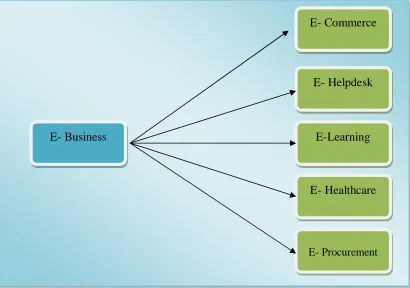
E- Business
E- Commerce
E- Helpdesk
E- Procurement E-Learning
E- Healthcare
Figure 1-1: E-Business and its components
6
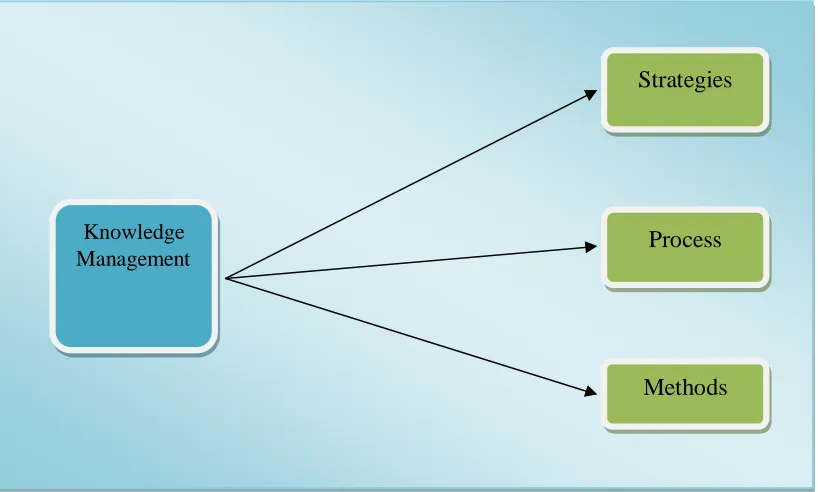
Knowledge Management
Strategies
Process
Methods
the effectiveness of knowledge management. Organizational behavior and team dynamics play major roles in knowledge management.
Figure 1- 2: Knowledge management components
Regarding the definition of knowledge management, specialists and scholars each have their own opinion.
Rosenberg (2001) divides knowledge management into three levels:
1. Document management
2. Information/knowledge creation, sharing and management 3. Enterprise intelligence
7
knowledge of an organization, we still need a third component to enable organizations to work together and yet be autonomous. That third component is collaboration. As it mentioned above collaborative computing enables people, groups of individuals, and organizations to work together to accomplish a task or a collection of tasks. These tasks could vary from participating in conferences, solving a specific problem, or working on the design of a system. Specific contributions to collaborative computing include the development of team workstations (where Groupware creates a shared workspace supporting dynamic collaboration in a work group), multimedia communication systems supporting distributed workgroups, and collaborative computing systems supporting cooperation in the design of an entity (such as an electrical or mechanical system).
1.3 Statement of the Problem
The problem statement from this project is:
How to develop an effective Knowledge management for collaborative commerce?
While conducting this project study, there are some important questions arise:
i. What are the elements of knowledge management in collaborative commerce? ii. How to analyze the effectiveness of the Knowledge management in collaborative
commerce?
8
1.4 Objective of the Project
The objectives must be based on the problem statement/questions.
i. To describe the effectiveness of knowledge management in collaborative commerce.
ii. To explore the major problem of collaborative commerce in using knowledge management
iii. To propose the strategy to improve the effectiveness of knowledge management in collaborative commerce
1.5 The Scope of the Project
Since the aspects of chosen problem area of collaborative commerce area many, the researcher has tried narrow down the focus. The aim of the research is to find out most efficient and applicable outcome in project base pedagogy areas and trying to understanding the relation between various areas. The outcome can be in a format of a new model to integrate all area that can be a guideline for developing new computer supported learning system. It is tried to use some learning theories and some useful guidelines have well formatted computer supported project base learning. The project scopes that have been identified are as follows:
9
ii. The study focus on collecting, analyzing and comparing effective approaches in using knowledge management
iii. This research try to understand the elements of knowledge management and the way to adopt and improve them into collaboration environment
iv. The aim of the project is to provide guideline for a person who involved in business to make more effective collaboration in his business
1.6 Importance of the Project
In the last few years, a significant growth has been noticed in collaboration between organizations. As mentioned before, the main element of collaboration between organizations is information. Nowadays, organizations not only need to exchange information, if they want more effective collaboration, they also need exchanging knowledge. Therefore, it is important to study the tools and methods of managing knowledge and using them to have more effective collaboration between organizations.
1.7 Summary
10