5
3D AVATAR MOVEMENT AND
NAVIGATION
Ahmad Hoirul Basori
Daut Daman
Abdullah Bade
INTRODUCTION
vatar is very essential on virtual reality game, especially 3D avatar that natural or emotional movement. Basically, numerous researchers are focusing on movements from input such as joystick, mouse, and keyboard. The other movement’s concepts come from artificial intelligence as a part of improving interactivity. This chapter intends to offer different method of controlling the virtual human characters movement that involves human emotion and haptic sensation, which are known as human haptic emotion. The scheme is engage human haptic emotion to control object life movements as a way to enhance simulation closer to reality and more immersive. Furthermore, the movement of 3D avatar is a feature in virtual reality game which is usually controlled by mouse or keyboard, but recently it is controlled by artificial intelligence which is built from particular rule (Mocholi et al. 2006).
into game modules. It also offers more information using messages, provides tutorial and experience like in real life (Michael 2006). From educational perspective,, VRG needs to be more interactive in order to deliver the material of study. This interaction can be come from interaction between virtual characters in virtual environment and also interaction between VRG applications with players (Rossou 2004; Greitzer 2007).
Human haptic emotion is an approach of applying human emotion on virtual human characters and transfers those human emotions to players through haptic devices. The players will sense the emotion of virtual human characters during playing session. This chapter describe about a different approach on handling movements of virtual human characters using human haptic emotion that will be used for as a feature on handle movement for virtual reality game in order to augmenting interactivity between virtual characters itself and also interactivity with players. The information of 3D avatar movements will be sent to the players through haptic device during play session. This approach will be expected to augment the virtual reality game on achieve smooth movements.
PREVIOUS WORK
Characters movements have already become important issues on virtual reality and game development. A lot of advanced game engines consider this as an important aspect for simulating real life case, especially when using a navigation to combine game entertaining with educational theory such as military theory, biology, surgery or medical theory and etc.(Rossou 2004; Greitzer et al. 2007; Virvou et al. 2006; Cai et al. 2006).
such as tour and looking for the track or path (Geiger et al. 2008). Characters movement is very useful for helping interactivity, especially on how to attract player’s attention during game session. Moreover, researchers give more focus on making communication between virtual characters through network computers in order to create interactivity and form human perception on virtual reality game or on real life simulation (Herrero et al. 2005; Li et al. 2005; Miranda et al. 2001).
THE MOVEMENT OF 3D AVATAR, NAVIGATION AND WAY FINDING
Figure 5.1 Virtual agent that communicated with other virtual object, picture by [http://blog.wired.com/photos/ uncategorized/2007/06/29/shift_second_life.jpg]
Way finding is a method inside VR system for helping the user which is doing some travel in virtual world to be able to determine the destination and the path to achieve the destination. One of the ways finding method is way finding aids. Way finding aid is an interface for traveler about the location information, distance and map information. Travel more on exploring and doing journey in virtual world during the certain times.
Human behaviors already become a consideration for researcher to bring it on virtual reality game to perform better visualization. This technique includes performing complex texture and animation to 3D models. Therefore, some 3D models are able to imitate the expression of real human emotion such as human mimic representation, lip representation and also mouth appearance, so as to determine the emotion of virtual human characters.
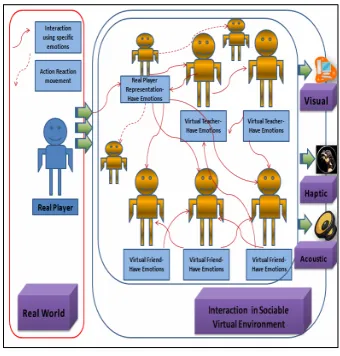
On other hand, researchers also want to improve the navigation and way finding of 3D avatar inside virtual environment. The 3D avatar navigation and movement which is happens between virtual human characters is based on specific emotion. This interaction can be described like this: teacher work together with students, then during the interaction teacher sometimes can feel “Joy” or “Angry” and student can feel “fear” or “joy”. This interaction is illustrated using “full line”. Second, Action-reaction movement based on stimulation is generated from emotional interaction.
This movement comes after some virtual human character triggers some action to the others. After that, the other characters will react to the particular action (illustrated using dot-line). Action-reaction on this virtual environment is derived from event-appraisal human emotion. Every action-reaction on this sociable environment will be transferred to players using Visual, Haptic and Acoustic. The details about this navigation and movement are illustrated on Figure 5.2.
3D AVATAR MOVEMENT AND NAVIGATION DEVELOPMENT
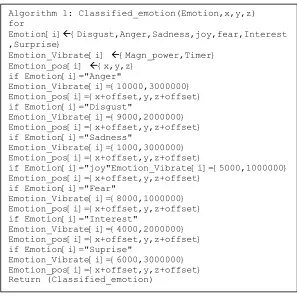
We model the movements of virtual human characters through combining the model from (Bailenson et al. 2007; Zagalo et al. 2004), the capabilities of DirectX forced feedback and XNA framework. The conducted experiment showed that the VHC movement can be controlled by the angle direction for each emotion. The proposed model has used the alteration of angle direction from human characters by considering the result of angle graph from Bailenson et al. (2007) and for magnitude and duration of the vibration by considering the diagram from Zagalo (2004). We have considered each of the emotion to accomodate the approximation degree of their path according to the angle from (Bailenson et al. 2007). For example in Bailenson et al. (2007), Anger expression has two possibilities: 50%° to Right- 50%° to Left, which means that this emotion has the same chance to go to the right route or left route. Other emotions will generate different path of movements. For example, surprise has the composition of 70%°Right- 30%° Left. This indicates that the surprise emotion slope to move to the right angle with approximation 70%. The magnitude vibration frequencies have ranged from (0-10000), but in the real experiment where we used Forced feedback joystick, it is very hard to experience this with the vibration below 1000. The vibrations is felt differently when it vibrates above 1000. Range distinction of the second vibration should be increment with 1000 to show the variation of vibration.
Figure 5.3 Algorithm for the whole generation process
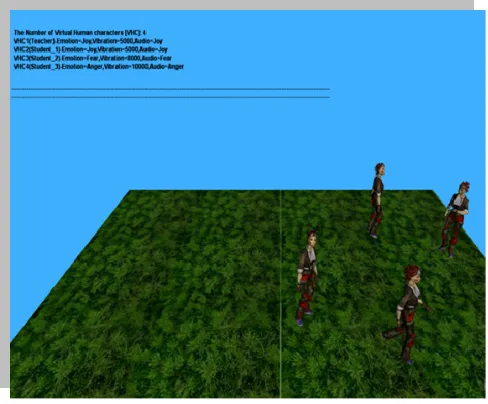
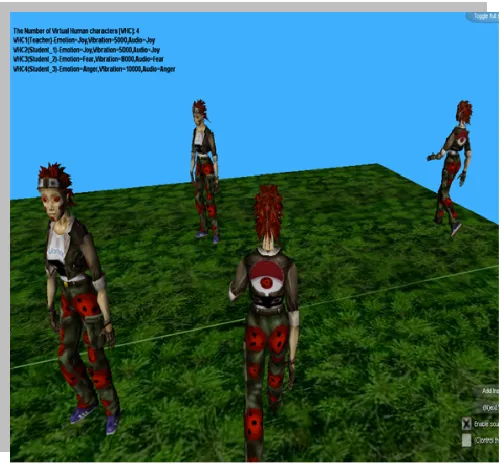
The visual immersion affects children from their visual perception. The visual immersion consists of movement based on the human haptic emotion, emotion information for each characters, magnitude vibration and duration for the vibration. First of all is the information about current emotion of each virtual human character. Second, the magnitude vibration is used as an expression of emotion whereas the third is the angle direction of movement. All of this information appears as texts in the desktop. Figure 5.3 and Figure 5.4 show the preliminary testing using XNA and DirectX Library for simulating the sociable virtual environment.
Algorithm 1: Classified_emotion(Emotion,x,y,z) for
Emotion[i]Å{Disgust,Anger,Sadness,joy,fear,Interest ,Surprise}
Emotion_Vibrate[i] Å{Magn_power,Timer} Emotion_pos[i] Å{x,y,z}
For the preliminary testing, we used Direct X as a library to communicate with forced feedback (haptic device) – joystick. On the other hand, for visualization we used XNA framework to visualize and demonstrate the methodology. The human model of this experiment (tinyanim.x) was taken from DirectX SDK. We still used visualization, however the visual immersion for user can be happen through some animation.
Figure 5.5 Visual Immersion- Camera near
CONCLUSION
basic senses (Haptic, Acoustic and Visual). Furthermore, we also added some emotion to these three senses in order to give user more immersion. Experiences such as uncomfortable feeling because of “Anger” emotions and good feeling like “joy” emotion from virtual environment are expected to encourage children become well behave. This is due to user have got more immersion when they are interacting and playing virtual environment. As a further research, we are in the process to integrate human haptic emotion with complex artificial intelligence in order to perform more immersion and interactivity in virtual reality game.
REFERENCE
Abasolo M. J. and Della J. M., 2007, “Magallanes: 3D Navigation for Everybody,” The Proceedings of GRAPHITE 2007, ACM Conference Proceeding", Perth Western Australia”, December 2007, pp.135-142.
Aylett R.S, Delgado C., Serna J.H, Stockdale R., Clarke H., Estebanez M., Goillau P. and Lynam T., 2005, “REMOTE: Desk-top Virtual reality for future command and control,” Springer-Verlag London Limited, pp.131-146.
Bailenson J.N., Yee N., Brave S., Merget D. and Koslov D., 2007, “Virtual Interpersonal Touch:Expressing and Recognizing Emotions Through Haptic Devices”, Human-Computer Interaction,Volume 22,pp.325-353,Lawrence Erlbaum Associates,Inc.
Geiger, Fritze R., Lehmann A. and Stocklein J., 2008, “HYUI- A Visual Framework for prototyping Hybrid User Interfaces”, Proceedings of the second International Conference on tangible anda embedded Interaction (TEI'08), February, 2008.pp.63-70.
Greitzer F.L., Kuchar O. A. and Huston K., 2007, “Cognitive Science Implications for Enhancing Training Effectiveness in a Serious Gaming Context, ”ACM Journal of
Educational Resources in Computing”, Vol. 7, No. 3, Art.2. Herrero P., Greenhalgh C. and Antonio A. D., 2005, “Modelling
the Sensory Abilties of Intelligent Virtual Agents”,Springer Science+Business media, pp. 361-385
Li T.Y., Liao M.-Y., and Tao P.-C., 2005 “IMNET:An
Experimental Tesbed for extensible Multi-user Virtual Enviroenment Systems ,” the International Conference on Computational Science and its Applications (ICCSA 2005)”, May, pp.957-966.
Mocholí J.A., Esteve J.M., Jaén J., Acosta R.,and Louis P. X., “An Emotional path Finding Mechanism for Augmented Reality Applications,” Proceedings of the 5th International
Conference on Entertainment
Computing(ICEC2006),September 2006 ,pp.13-24.
Michael D. and Chen S., 2006, “Serious Game, game that educate, train, and Inform “, Thomson Johnson technology,
Thomson Course Technology PTR, Boston, USA Miranda F. R., Kogler J. E., Hernandez E. M. and Netto M. L.,
2001, “An Artificial Life approach for the animation of cognitive characters”, Journal of Computer and Graphics- Elsivier, pp.955-964.
Marks S., Windsor J. and Wunsche B., 2007, “Evaluation of Game Engines for Simulated Surgical Training,” Proceedings of the 5th International Conference on Computer Graphics and Interactive Techniques in Australia and Southeast Asia(GRAPHITE ),December. pp.273-318
Rossou M., 2004,“Learning by Doing and Learning through Play: An Exploration of interactivity in Virtual Environments for Children,”ACM Journal of Computers in Entertainment”, Vol. 2, No.1, pp.1-23.
Takamura Y., Abe N., Tanaka K., Taki H., and He S., 2006, “A virtual Billiard game with Visual, auditory and haptic sensation,” Proceedings of International Conference on E-learning and Games(EDUTAINMENT 2006)-LCNS3942", April, pp.700-705.
Virvou M., and Katsionis G., 2006, “On the Usability and
likeability of virtual reality games for education: The case VR-ENGAGE” Journal of Computers and Education", Vol.50, pp.154-178.
Williams II R.L., Howell J. N. and Eland D. C., 2004, “The Virtual haptic back for palpatory Training,” Proceedings of 6th IEEE International Conference on Multimodal Interfaces (ICMI)",October, pp.191-197.
![Figure 5.1 Virtual agent that communicated with other virtual object, picture by [http://blog.wired.com/photos/ uncategorized/2007/06/29/shift_second_life.jpg]](https://thumb-us.123doks.com/thumbv2/123dok_us/1284246.1160925/4.432.92.330.72.321/figure-virtual-communicated-virtual-picture-photos-uncategorized-second.webp)