20th International Conference on Structural Mechanics in Reactor Technology (SMiRT 20) Espoo, Finland, August 9-14, 2009 SMiRT 20-Division 3, Paper 1828
CFD Based Numerical Modules for Safety Analysis at NPPs
Validation and Verification
Vladimir Chudanov
a, Anna Aksenova, Valerii Pervichko
a
Nuclear Safety Institute(IBRAE), Russian Academy of Sciences,52, B. Tulskaya, Moscow,115191, Russia,
e-mail:[email protected]
Keywords:
CFD, thermal hydraulics, fuel assembly, drops and bubbles flows.
1
ABSTRACT
A set of 3D unified numerical modules for safety analysis of the operated Nuclear Power Plants (NPPs) is developing. These modules are based on the developed algorithms with small scheme diffusion, for which the discrete approximations are constructed with use of finite-volume methods and fully staggered grids. Verification and validation is an important part of qualifying analysis software for nuclear safety and engineering applications. In this paper the examples of use of the developed software for modeling of a fuel assembly, namely, for research of a hydraulic resistance factor of a spacer are demonstrated. The calculations are carried out on a sequence of condensed grids with an amount of nodes from a range 107-108, for which the convergence was obtained. Moreover, the attention of this paper is focused on validation and verification of software with usage of such tests as: full turbulent flow of water in a round pipe, backward-facing step (BFS) flow.
2
INTRODUCTION
Recent IAEA activities are directed at increasing of the role of CFD methods in safety assessments of NPPs (Modro et al., 2006). Use of computer codes of the best estimate for the accident analysis does not justify itself. These codes are typically one dimensional approximation of phenomena and plant systems. These methods are not adequate for some applications, particularly where modeling of local flow and heat transfer phenomena is important. Therefore there is interest in the application of 3D CFD codes for safety analysis as a supplement or in combination with system codes. The CFD codes are capable of calculating local parameters. Due to this capability they contribute to a deep understanding of fluid flow physics, and thus may lead to better designs at reduced cost and/or to more precisely quantified safety margins. Verification and validation is an important part of qualifying analysis software for nuclear safety and engineering applications.
During some years in IBRAE a set of 3D unified numerical modules for safety analysis of the operated NPPs is developing Chudanov et al. (2002; 2007a; 2007b; 2008a; 2008b). These modules are based on the developed algorithms with small scheme diffusion, for which the discrete approximations are constructed with use of finite-volume methods and fully staggered grids. They were successfully used for solving of thermalhydraulics problem at modeling of corium retaining in a reactor vessel, modeling of molten core concrete interaction and spreading of the molten corium together with filling of core catcher. The given computing modules are created from the first principles. They can be used as on personal computers with common memory and cluster computers.
The developed modules were validated Chudanov et al. (2002; 2007a; 2007b; 2008a; 2008b) on a series of the
well known numerical tests in a wide range of Rayleigh numbers from a range 106-1016 and Reynolds numbers from a
range 103-105. The developed software has been applied to the simulation of tests conducted in the frame of OECD MASCA Project (Aksenova et al., 2004) and to the simulation of the SURC-4 MCCI test (Bolshov et al., 2007). As a result of numerical modeling of aforementioned experiments qualitative and quantitative agreement with experimental data was obtained including the diffusion of the components between phases and relocation of denser phase due to Rayleigh-Taylor instability. New area of software application appeared with the development of core catcher a device for melt retention and coolability. The software has been applied to the simulation of the phenomena in the core catcher designed for VVER-1000 reactor (Bolshov et al., 2007).
In this paper the examples of use of the developed software for modeling of a fuel assembly, namely, for research of a hydraulic resistance factor of a spacer are demonstrated. The calculations are carried out on a sequence of
condensed grids with an amount of nodes from a range 107-108, for which the convergence was obtained. Moreover, the
3
3D MODULES FOR SIMULATION OF NATURAL CONVECTION, MELTING AND
CORIUM RETAINING IN THE REACTOR VESSEL, CONV2D&3D CODES
For simulation of natural convection, melting and corium retaining in the reactor vessel the numerical algorithm using the fictitious domain method in natural variables (Chudanov et al., 2002) was developed. This algorithm is implemented in a two-dimensional and three-dimensional codes which were validated on a set of the experimental and numerical tests Chudanov et al. (2002; 2007a; 2007b; 2008a; 2008b). In particular, the hydrodynamic codes CONV2D and CONV3D were tested on a set of experimental data in a case laminar and turbulent flows of the melt, such as:
• Convection in a cavity with sidewalls supported under different temperature with Rayleigh number form a
range 104-1012;
• Rayleigh-Benard convection in a cavity with hot lower and cold upper boundaries at Rayleigh number from a
range 104-1010;
• Convection of a heat-generating fluid at Ra from a range 106-1016, including experiments in cylindrical and hemispherical geometry with various working liquids;
• Diffusion/convection with moving melting front.
In all cases the good coincidence of experimental data with numerical predictions was observed.
The developed technique is used for study of the heat and mass transfer process in a heat-generating fluid with phase changes. As a result of the carried out researches a series the important conclusions is obtained and the interesting singularities is marked which were successfully applied: for the analysis of experiments in the frame of the international project ISTC 2936, on LIVE facility, and also for theoretical and numerical support (Aksenova et al., 2004) of experiments fulfilled in the RRC of «Kurchatov Institute» (figure 1). They can be applied under development of the simplified codes for analysis both the separate stages of severe accident and retaining melted fuel mass inside of the reactor vessel.
Figure 1: 3D and 2D temperature fields in stratified melt. A comparison focusing effect of heat flux for a vertical boundary layer: measured and predicted by CONV code (Aksenova, 2004).
4
3D MODULES FOR SIMULATION OF THE MOLTEN CORE CONCRETE
INTERACTION, LAVA SPREADING AND FILLING OF CORE CATCHER
For study of the molten core concrete interaction new multi-dimensional mathematical model and software CONV/MCCI (Bolshov et al., 2007) are developed.
The mathematical model is based on the solving of the Navier-Stokes equations with variable properties with taking into account of the density jump under melting of concrete together with energy equation.
The developed software corresponds to modern level of development of computers and takes into account all phenomenology of molten core concrete interaction and allows to simulate such phenomena and processes as:
• multidimensional heat transfer in concrete for modeling of transients for an intermediate thermal flux to
concrete;
• direct erosion of concrete at a quasi-stationary regime of interaction with molten fuel masses;
• heat and mass transfer in corium and convective intermixing in a melt of corium accounting for its
stratification on two layers oxide and metallic components;
• heat transfer by radiation;
•
• chemical reactions of oxidation, which are accompanied by energy generation and transposition of mass;
• crust formation and influence of its on a solidification/melting of corium and heat exchange with enclosing
constructions;
• ablation of concrete.
Model is allowed to analyze the basic features of such experiments as SURC, ACE, BET and TURC which are used as validation tests for CONV/MCCI code (figure 2).
Figure 2: A comparison withTUCR1T experiment – Erosion in concrete. Temperature in concrete in a central section of the concrete piece on different depths counted from the upper edge of concrete.
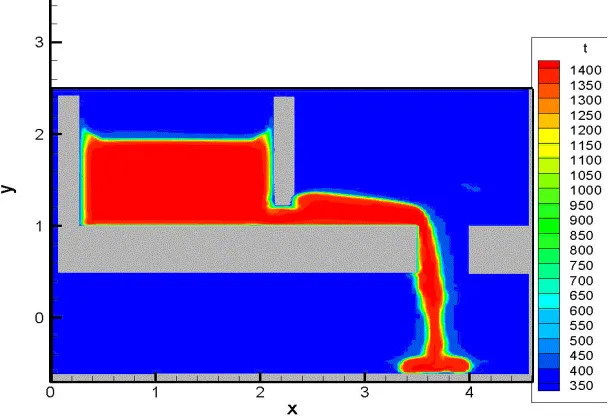
The developed code was applied in the frame of ISTC project 2916 for simulation and estimation of behavior of nuclear fuel during late phase of Chernobyl accident. In particular, simulation of spreading LFCM (Lava-like Fuel Containing Masses) in under reactor structures of RBMK-1000 reactor (Borovoi et al., 2008) was carried out. As a result of cooling LFCM in under reactor structures vertical lava flow was occurred and so-called “elephant leg” was formed. This fact was confirmed by results of numerical simulation (figure 3).
Figure 3: Results of numerical predictionsof a lava spreading in under reactor structures of RBMK-100 (side view). Temperature filed.
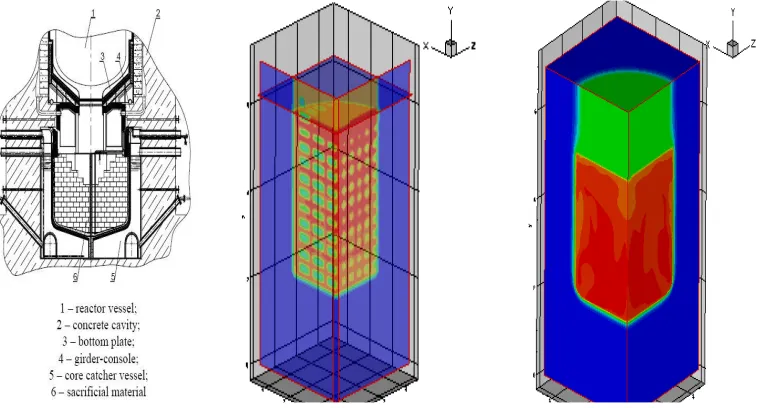
Figure 4: Sketch of core catcher(Bolshov et al., 2007) and initial and final filling stages of a core catcher.
5
3D MODULES FOR SIMULATION FLOWS IN THE FUEL ASSEMBLIES, DROP
AND BUBBLE FLOWS
The Large Eddy Simulation (LES) approach (used commutative filters) and Quasi Direct Numerical Simulation (QDNS) approach (Chudanov et al., 2007a; 2007b) are applied to simulate flows in the fuel assemblies. The technique has a high degree of effectiveness and now allows on AMD Opteron computer with four processors with 16 Gbytes of shared memory to fulfill CFD calculations on a grid with 107 nodes in a one iteration of CFD solver in a one minute CPU.
The developed numerical technique was validated in turbulent flows with use of the accessible tests. For these
tests the good qualitative and quantitative coincidence with numerical DNS predictions down to Re < =104 was
obtained. For these tests also coincidence was obtained with numerical predictions at Re > 104, using algebraic turbulence model and LES approach (Chudanov et al., 2007a; 2007b).
Numerical predictions of fully turbulent flow of water in a round pipe for Reynolds number from a range 4900-25000 (Toonder, 1997) are presented. In figure 5 the distribution of W-velocity in a round pipe is submitted, and also the distribution of a longitudinal component of a velocity on radius in comparison with experimental results (Toonder, 1997) is shown.
0.00 0.05 0.10 0.15 0.20 0.25 0.30 0.35 0.40 0.45 0.50
0 2 4 6 8 10 12 14 16 18 20
Predictions, Re=5100 Toonder, Re=4900
U
+
y/coordinate along radius
Figure 5: Three-dimensional distribution of W-velocity in a round pipe at Re=5100 and the distribution of a longitudinal component of a velocity on radius in comparison (Toonder, 1997).
At figure 6a the three-dimensional field of a W-velocity is shown. At figure 6b a comparison of measured and predicted (two-dimensional) reattachment disposition of BFS flow (Armaly, 1983) are shown.
0 400 800 1200 2
4 6 8 10 12 14 16
18 Predictions L
Exp. x/s
D
is
ta
n
s
e
Re
Figure 6: Three-dimensional field of a W-velocity and a comparison of measured and predicted (two-dimensional) reattachment disposition of BFS flow.
The developed technique is applied also for simulation of fuel assemblies, namely, for research of Hydraulic Resistance Factor (HRF) for grid spacer. The calculations are carried out on a sequence of fine grids with nodes quantity
from a range 107-108, for which the convergence was received. For calculations the Hydropress data
(http://www.atominfo.ru/news/air1749.htm) were used. The calculated domain was constructed by means 3dsMAX,
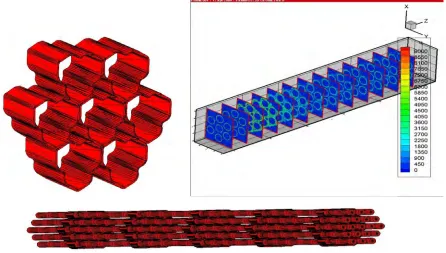
and calculated grid was received by means “Grid Office” program (Chudanov et al., 2008a). Figure 7 gives geometry for calculation HRF. Moreover, a vorticity there is shown. For comparison the Hydropress data for UTVS grid spacer were chosen, for which HRF equals 0.33. For calculated domain HRF equals 0.325 that is good agreement with Hydropress data. Validation will be continued.
Figure 7: A grid spacer, fuel assembly with grid spacers, a vorticity in sections with grid spacers.
Figure 8:3D simulation thermal hydraulics of fast assembly of wire-wrapped.
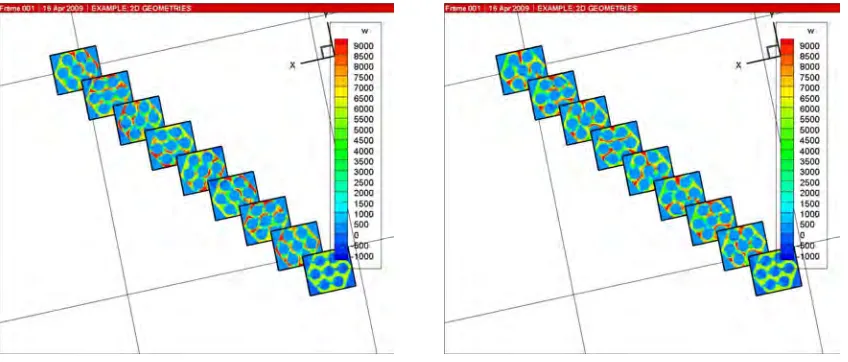
Figure 9: Fast assembly of wire-wrapped: clockwise and counter-clockwise. Velocity fields in sections with grid spacers.
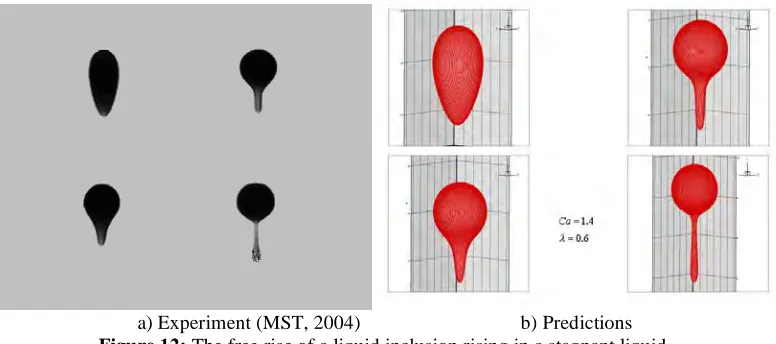
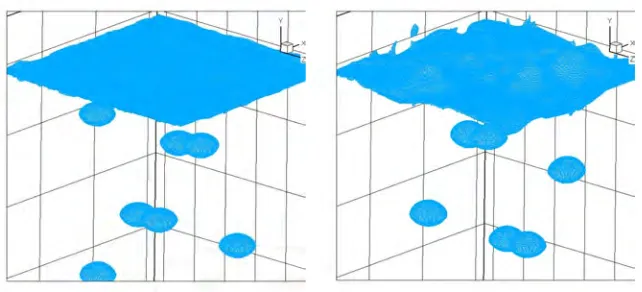
The effective numerical CFD algorithm (Chudanov et al., 2002; 2008a; Bolshov et al., 2006) for 3D calculation of two-phase flows with explicitly chosen of interface and taking into account of surface tension forces are offered for modeling of drop and bubble flows. The developed algorithm is applied to Navier-Stokes equations with energy equation in natural variable for incompressible and compressible flows at low Mach numbers. Numerical technique was validated on a set of experiments in Institute of Thermophysics (Bolshov et al., 2006) and data published in (MST, 2004).
Numerical predictions for test RISE OF A SPHERICAL CAP BUBBLE IN A STAGNANT LIQUID is presented. In figure 10 the comparison of numerical predictions with the data (MST, 2004) on growth rate of a bubble versus time is shown. The good coincidence is observed. In figure 11 2D (a) and 3D (b) flow patterns for single rising bubble are shown.
The FREE RISE OF A LIQUID INCLUSION IN A STAGNANT LIQUIDexperiment is devoted to the stability
Figure 10: Rise of a spherical cap bubble in a stagnant liquid.
Figure 11: Predicted flow patterns for single rising bubble.
a) Experiment (MST, 2004) b) Predictions
Figure 12: The free rise of a liquid inclusion rising in a stagnant liquid.
Figure 13: Bubble flow in a 3D channel.
6
CONCLUSIONS
For safety analysis of the operated Nuclear Power Plants during some years 2D and 3D numerical modules are developed.
They were successfully used for solving of thermalhydraulics problem at modeling of corium retaining in a reactor vessel, modeling of molten core concrete interaction and spreading of the molten corium together with filling of core catcher. Now successful simulation of fuel assembly and drop/bubble flows is carried out.
The developed modules were validated on a set of the well known numerical tests in a wide range of Rayleigh
numbers from a range 106-1016 and Reynolds numbers from a range 103-105.
REFERENCES
1. Aksenova A.E., et al. 2004. // Numerical simulation of heat and mass transfer processes in a stratified molten
pool. – In: Proc. MASCA seminar 2004, Aix-en-Provence, France June 10-11, 2004, vol.1, pp.241-249.
2. Armaly B.F. et al. 1983. // J. Fluid Mech., vol. 127, P. 473-496.
3. Bolshov L.A., et all. 2006. // Best estimate methodology for modelling bubble flows. Proc. ICONE14. 14th
International Conference on Nuclear Engineering July 17-20, 2006, Miami, Florida, USA. CDROM, Publisher ASME, Paper ICONE-89296.
4. Bolshov L.A., Chudanov V.V. 2007. // CFD approach to modelling of Core-Concrete interaction. SMIRT-19.
CD-ROM. Paper 2545.
5. Borovoi A., Bogatov S., Chudanov V., Strizhov V. 2008. //The Chernobyl corium: generation, interaction with
concrete and progression. Proc. ERMSAR 2008. 3rd European Review Meeting on Severe Accident Research, September 23 – September 25, 2008 – Nesseber (Bulgaria). Paper 2-1.
6. Chudanov V.V. et al. 2002. // 3D unified CFD approach to thermalhydraulic problems in safety analysis. Proc.
of IAEA Technical Meeting on Use of Computational Fluid Dynamics (CFD) Codes for Safety Analysis of Nuclear Reactor Systems, Including Containment, University of Pisa, Italy, 11-14 November, 2002. (CD-disk, Session-7).
7. Chudanov V.V. et al. 2007 . // Numerical investigations of natural-convective flows in solidifying liquid.
Proceedings of Nuclear Safety Institute RAS (IBRAE), Issue 2, Nauka, 286 p.
8. Chudanov V.V. et al. 2007b. // Methods of direct numerical simulation of turbulence with use DNS and LES
approaches in thermalhydraulics of fuel assembly. Izvestia Russain Academy of Sciences, Energy, 6,
pp.47-57.
9. Chudanov V.V. et al. 2008a. // Methods of computational hydrodynamics for the safety analysis of TEK ‘s
objects. Proceedings of Nuclear Safety Institute RAS (IBRAE), Issue 3, Nauka. 251 p.
10. Chudanov V.V. et al. 2008b. //Development of mathematical methods and 3D CFD code for direct numerical
simulation of one-phase flows. Thesis and reports interdepartmental seminar “Thermal hydraulics aspects of safety of active zones cooled by water and liquid metals”. October 15-17, 2008, Obninsk, Russia.
11. J.M.J. den Toonder and F.T.M Nieuwstadt 1997. // J. Phys. Fluids, vol.9, 11, P. 3398-3409.