(will be inserted by the editor)
Categorizing Defects in Infrastructure as Code
Akond Rahman · Sarah Elder · Faysal Hossain Shezan · Vanessa Frost · Jonathan Stallings · Laurie Williams
Received: date / Accepted: date
Abstract Infrastructure as code (IaC) scripts are used to automate the main-tenance and configuration of software development and deployment infrastruc-ture. IaC scripts can be complex in nature and can contain hundreds of lines of code, leading to defects that can be difficult to debug and to wide-scale system discrepancies, such as service outages. The use of IaC scripts is getting increasingly popular, yet the nature of defects that occur in these scripts have not been systematically categorized.The goal of this paper is to help software practitioners improve their development process of infrastructure as code (IaC) scripts by analyzing the defect categories in IaC scripts based upon a quali-tative analysis of commit messages and issue report descriptions. We collect 12,875 commits that map to 2,424 IaC scripts from four organizations, namely Mirantis, Mozilla, Openstack, and Wikimedia Commons. With 89 raters, we apply the defect type attribute of the orthogonal defect classification (ODC)
Akond Rahman
Department of Computer Science, North Carolina State University, Raleigh, NC, USA E-mail: [email protected]
Sarah Elder
Department of Computer Science, North Carolina State University, Raleigh, NC, USA E-mail: [email protected]
Faysal Hossain Shezan
Department of Computer Science, University of Virginia, Charlottsville, VA, USA E-mail: [email protected]
Vanessa Frost
Department of Computer Science, University of Florida, Gainesville, FL, USA E-mail: [email protected]
Jonathan Stallings
Department of Statistics, North Carolina State University, Raleigh, NC, USA E-mail: [email protected]
Laurie Williams
methodology to categorize the defects. We also review prior literature that has used ODC to categorize defects in non-IaC software systems, and compare the defect category distribution of IaC scripts with 26 non-IaC software systems. From our analysis, we observe the dominant defect category to be ‘assignment’, which includes defects related to syntax and configuration errors. Accordingly, the ODC process improvement guidelines recommend the teams allocate more code inspection, static analysis, and unit testing effort for IaC scripts. We also observe defects categorized as assignment to be more prevalent amongst IaC scripts compared to the 26 non-IaC software systems.
Keywords continuous deployment·defect categorization·devops·empirical study·infrastructure as code ·puppet·orthogonal defect classification
1 Introduction
Continuous deployment (CD) is the process of rapidly deploying software or services automatically to end-users (Rahman et al, 2015). The use of infras-tructure as code (IaC) scripts is essential to implement an automated deploy-ment pipeline, which facilitates continuous deploydeploy-ment (Humble and Farley, 2010). Companies such as Netflix 1, Ambit Energy 2, and Wikimedia Com-mons3, use IaC scripts to automatically manage their software dependencies and construct automated deployment pipelines (Parnin et al, 2017) (Puppet, 2018). The use of IaC scripts helps organizations to increase their deploy-ment frequency. For example, Ambit Energy uses IaC scripts to increase their deployment frequency by a factor of 1,200 (Puppet, 2018).
Defects in IaC scripts can have serious consequences as companies, such as Wikimedia, use these scripts to provision their servers and ensure availability of services4. IaC scripts are susceptible to human errors (Parnin et al, 2017) and bad coding practices (Cito et al, 2015), which make scripts susceptible to defects (Jiang and Adams, 2015) (Parnin et al, 2017). Any defect in a script can propagate at scale, leading to wide-scale service discrepencies. For example in January 2017, execution of a defective IaC script erased home directories of around 270 users in cloud instances maintained by Wikimedia5. Prior research studies (Jiang and Adams, 2015) (Parnin et al, 2017) and the above-mentioned Wikimedia incident motivate us to systematically study the defects that occur in IaC scripts.
Categorization of defects can guide organizations on how to improve their development process. Chillarege et al. (Chillarege et al, 1992) proposed the orthogonal defect classification (ODC) technique which included a set of defect categories. According to Chillarege et al. (Chillarege et al, 1992), each of these
1 https://www.netflix.com/ 2 https://www.ambitenergy.com/
3 https://commons.wikimedia.org/wiki/Main Page
4
https://blog.wikimedia.org/2011/09/19/ever-wondered-how-the-wikimedia-servers-are-configured/
defect categories map to a certain activity of the development process which can be improved. Since the introduction of ODC in 1992, companies such as IBM (Butcher et al, 2002), Cisco 6, and Comverse (Levy and Chillarege, 2003) have successfully used ODC to categorize defects. Such categorization of defects help practitioners to identify process improvement opportunities for software development. For example, upon adoption of ODC practitioners from IBM (Butcher et al, 2002) reported “The teams have been able to look at their own data objectively and quickly identify actions to improve their processes and ultimately their product. The actions taken have been reasonable, not requiring huge investments in time, money, or effort”. A systematic categorization of defects in IaC scripts can help in understanding the nature of IaC defects and in providing actionable recommendations for practitioners to mitigate defects in IaC scripts.
The goal of this paper is to help practitioners improve their development process of infrastructure as code (IaC) scripts by categorizing the defects in IaC scripts based upon a qualitative analysis of commit messages and issue report descriptions.
We investigate the following research questions:
RQ1: How frequently do defects occur in infrastructure as code scripts?
RQ2: By categorizing defects using the defect type attribute of orthogonal defect classification, what process improvement recom-mendations can we make for infrastructure as code development? RQ3: What are the differences between infrastructure as code (IaC) and non-IaC software process improvement activities, as deter-mined by their defect category distribution reported in the litera-ture?
We use open source datasets from four organizations, Mirantis, Mozilla, Openstack, and Wikimedia Commons, to answer the three research questions. We collect 20, 2, 61, and 11 repositories respectively from Mirantis, Mozilla, Openstack, and Wikimedia Commons. We use 1021, 3074, 7808, and 972 com-mits that map to 165, 580, 1383, and 296 IaC scripts, collected from Mirantis, Mozilla, Openstack, and Wikimedia Commons, respectively. With the help of 89 raters, we apply qualitative analysis to categorize the defects that occur in the IaC scripts using the defect type attribute of ODC (Chillarege et al, 1992). We compare the distribution of defect categories found in the IaC scripts with the categories for 26 non-IaC software systems, as reported in prior research studies, which used the defect type attribute of ODC and were collected from IEEEXplore7, ACM Digital Library8, ScienceDirect9, and SpringerLink10.
We list our contributions as following:
6 https://www.stickyminds.com/sites/default/files/presentation/file/2013/t12.pdf 7 https://ieeexplore.ieee.org/Xplore/home.jsp
8 https://dl.acm.org/
– A categorization of defects that occur in IaC scripts;
– A comparison of the distribution of IaC defect categories to that of non-IaC software found in prior academic literature; and
– A set of curated datasets where a mapping of defect categories and IaC scripts are provided.
We organize the rest of the paper as following: Section 2 provides back-ground information and prior research work relevant to our paper. Section 3 describes our methodology conducted for this paper. We use Section 4 to describe our datasets. We present our findings in Section 5. We discuss our findings in Section 6. We list the limitations of our paper in Section 7. Finally, we conclude the paper in Section 8.
2 Background and Related Work
In this section, we provide background on IaC scripts and briefly describe related academic research.
2.1 Background
IaC is the practice of automatically defining and managing network and system configurations, and infrastructure through source code (Humble and Farley, 2010). Companies widely use commercial tools such as Puppet, to implement the practice of IaC (Humble and Farley, 2010) (Jiang and Adams, 2015) (Sham-baugh et al, 2016). We use Puppet scripts to construct our dataset because Puppet is considered one of the most popular tools for configuration manage-ment (Jiang and Adams, 2015) (Shambaugh et al, 2016), and has been used by companies since 2005 (McCune and Jeffrey, 2011). Typical entities of Pup-pet include modules and manifests (Labs, 2017). A module is a collection of manifests. Manifests are written as scripts that use a .pp extension.
Puppet provides the utility ‘class’ that can be used as a placeholder for the specified variables and attributes, which are used to specify configura-tion values. For attributes, configuraconfigura-tion values are specified using the ‘=>’ sign. For variables, configuration values are provided using the ‘=’ sign. Simi-lar to general purpose programming languages, code constructs such as func-tions/methods, comments, and conditional statements are also available for Puppet scripts. For better understanding, we provide a sample Puppet script with annotations in Figure 1.
2.2 Related Work
1 #This is an example Puppet script 2 class (`example'
3 ){
4 token => ‘XXXYYYZZZ’ 5
6 $os_name = ‘Windows’ 7
8 case $os_name{
9 'Solaris': { auth_protocol => `http' }
10 'CentOS': { auth_protocol => getAuth() }
11 default: { auth_protocol => `https' }
12 }
13 }
Comment Attribute ‘token’
Variable ‘$os_name’
Case conditional Calling function ‘getAuth()’
1
Fig. 1: Annotation of an example Puppet script.
al. (Hanappi et al, 2016) investigated how convergence of Puppet scripts can be automatically tested, and proposed an automated model-based test frame-work. Jiang and Adams (Jiang and Adams, 2015) investigated the co-evolution of IaC scripts and other software artifacts, such as build files and source code. They reported IaC scripts to experience frequent churn. In a recent work, Rahman and Williams (Rahman and Williams, 2018) characterized defective IaC scripts using text mining and created prediction models using text fea-ture metrics. Bent et al. (van der Bent et al, 2018) proposed and validated nine metrics to detect maintainability issues in IaC scripts. In another work, Rahman et al. (Rahman et al, 2018) investigated the questions that practi-tioners ask on Stack Overflow to identify the potential challenges practipracti-tioners face while working with Puppet. We analyze the defects that occur in Puppet scripts and categorize them using the defect type attribute of ODC for the purpose of providing suggestions for process improvement.
408 IBM OS faults extracted and reported 37.7% and 19.1% of these faults to belong to the algorithm and assignment categories, respectively. Basso et al. (Basso et al, 2009) studied defects from six Java-based software namely, Azureus, FreeMind, Jedit, Phex, Struts, and Tomcat, and observed the most frequent category to be algorithm defects. Cinque et al. (Cinque et al, 2014) analyzed logs from an industrial system that belong to the air traffic con-trol system and reported that 58.9% of the 3,159 defects were classified as algorithm defects.
The above-mentioned studies highlight the research community’s interest in systematically categorizing the defects in different software systems. These studies focus on non-IaC software which highlights the lack of studies that investigate defect categories in IaC, and motivate us further to investigate defect categories of IaC scripts. Categorization of IaC-related defects can help practitioners provide actionable recommendations on how to mitigate IaC-related defects and improve the quality of their developed IaC scripts.
3 Categorization Methodology
In this section, we first provide definitions related to our research study and then provide the details of the methodology we used to categorize the IaC defects.
– Defect: An imperfection that needs to be replaced or repaired (IEEE, 2010).
– Defect-related commit: A commit whose message indicates that an ac-tion was taken related to a defect.
– Defective script: An IaC script which is listed in a defect-related commit.
– Neutral script: An IaC script which is not listed in any defect-related commit.
3.1 Dataset Construction
Our methodology of dataset construction involves two steps: repository collec-tion (Seccollec-tion 3.1.1) and commit message processing (Seccollec-tion 3.1.2).
3.1.1 Repository Collection
We use open source repositories to construct our datasets. An open source repository contains valuable information about the development process of an open source project, but the frequency of commits might be small indicating the repository’s dormant status (Munaiah et al, 2017). This observation mo-tivates us to apply the following selection criteria to identify repositories for mining:
– Criteria-2: At least 11% of the files belonging to the repository must be IaC scripts. Jiang and Adams (Jiang and Adams, 2015) reported that in open source repositories IaC scripts co-exist with other types of files, such as source code and Makefiles files. They observed a median of 11% of the files to be IaC scripts. By using a cutoff of 11%, we collect a set of repositories that contains a sufficient amount of IaC scripts for analysis.
– Criteria-3: The repository must have at least two commits per month. Munaiah et al. (Munaiah et al, 2017) used the threshold of at least two commits per month to identify repositories which include a lower amount of development activity.
3.1.2 Commit Message Processing
We use two artifacts from version control systems of the selected repositories from Section 3.1.1, to construct our datasets: (i) commits that indicate modi-fication of IaC scripts; and (ii) issue reports that are linked with the commits. We use commits because commits contain information on how and why a file was changed. Commits can also include links to issue reports. We use issue report summaries because they can give us more insights on why IaC scripts were changed to supplement what is found in commit messages. We collect commits and other relevant information in the following manner:
– First, we extract commits that were used to modify at least one IaC script. A commit lists the changes made on one or multiple files (Alali et al, 2008).
– Second, we extract the message of the commit identified from the previous step. A commit includes a message, commonly referred to as a commit message. The commit messages indicate why the changes were made to the corresponding files (Alali et al, 2008).
– Third, if the commit message included a unique identifier that maps the commit to an issue in the issue tracking system, we extract the identifier and use that identifier to extract the summary of the issue. We use regular expressions to extract the issue identifier. We use the corresponding issue tracking API to extract the summary of the issue; and
– Fourth, we combine the commit message with any existing issue summary to construct the message for analysis. We refer to the combined message as ‘extended commit message (XCM)’ throughout the rest of the paper. We use the extracted XCMs to categorize defects, as described in Section 3.2.
3.2 Categorization of Infrastructure as Code (IaC) Script Defects
(B), checking (C), documentation (D), function (F), interface (I), and tim-ing/serialization (T).
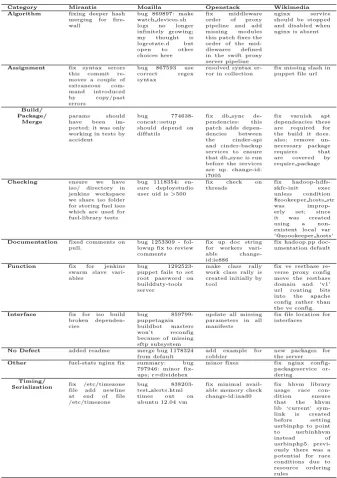
The collected XCMs derived from commits and issue report descriptions might correspond to feature enhancement or performing maintenance tasks, which are not related to defects. As an XCM might not correspond to a defect, we added a ‘No defect (N)’ category. An example XCM that belongs to the ‘No defect’ category is “add example for cobbler”, as shown in Table 2. Fur-thermore, a XCM might not to belong to any of the eight categories included in the ODC defect type attribute. Hence, we introduced the ‘Other (O)’ cate-gory. An example XCM that belongs to the ‘Other’ category is “minor fixes”, as shown in Table 2.
We categorize the XCMs into one of 10 categories. In the case of the eight ODC categories, we follow the criteria provided by Chillarege et al. (Chillarege et al, 1992) and used two of our own criteria for categories ‘No defect’, and ‘Other’. The criteria for each of the 10 categories are described in Table 1.
In Table 1, the ‘Process Improvement Activity Suggested By ODC’ col-umn corresponds to one or more software development activities which can be improved based on the defect categories determined by ODC. For example, according to ODC, algorithm-related defects can be reduced by increasing ac-tivities that are related to coding, code inspection, unit testing, and function testing.
We perform qualitative analysis on the collected XCMs to determine the category to which a commit belongs. We had raters with software engineering experience apply the 10 categories stated in Table 1 on the collected XCMs. We record the amount of time they took to perform the categorization. Af-ter applying qualitative analysis based on the 10 defect categories, we find a mapping between each XCM and a category. We list an example XCM that belongs to each of the 10 defect categories in Table 2.
We conduct the qualitative analysis in the following manner:
– Categorization Phase: We randomly distribute the XCMs so that each XCM is reviewed by at least two raters to mitigate the subjectivity intro-duced by a single rater. Each rater determines the category of an XCM using the 10 categories presented in Table 1. We provide raters with an electronic handbook on IaC (Labs, 2017), the IEEE Anomaly Classifica-tion publicaClassifica-tion (IEEE, 2010), and the ODC publicaClassifica-tion (Chillarege et al, 1992). We do not provide any time constraint for the raters to categorize the defects. We record the agreement level amongst raters using two tech-niques: (a) by counting the XCMs for which the raters had the same rating; and (b) by computing the Cohen’s Kappa score (Cohen, 1960).
– Resolution Phase: When raters disagree on the identified category, we use a resolver’s opinion to resolve the disagreements. The first author of the paper is the resolver and is not involved in the categorization phase.
Table 1: Determining Defect Categories Based on ODC adapted from (Chillarege et al, 1992)
Category Definition Process
Improve-ment Activity
Algorithm (AL) Indicates efficiency or correctness problems that affect task and can be fixed by re-implementing an algorithm or local data structure.
Coding, Code Inspec-tion, Unit Testing, Function Testing
Assignment (AS) Indicates changes in a few lines of code. Code Inspection, Unit Testing Build/Package/Merge
(B)
Indicates defects due to mistakes in change management, library systems, or version control system.
Coding, Low Level Design
Checking (C) Indicates defects related to data vali-dation and value checking.
Coding, Code Inspec-tion, Unit Testing Documentation (D) Indicates defects that affect
publica-tions and maintenance notes.
Coding, Publication
Function (F) Indicates defects that affect significant capabilities.
Design, High Level Design Inspection, Function Testing Interface (I) Indicates defects in interacting with
other components, modules, or control blocks.
Coding, System Test-ing
No Defect (N) Indicates no defects. Not Applicable Other (O) Indicates a defect that do not belong
to the categories: AL, AS, B, C, D, F, I, N, and T.
Not Applicable
Timing/Serialization (T)
Indicates errors that involve real time resources and shared resources.
Low Level Design, Low Level Design Inspection, System Testing
We ask the practitioners if they agree to our categorization of XCMs. High agreement between the raters’ categorization and practitioner’s feedback is an indication of how well the raters performed. The percentage of XCMs to which practitioners agreed upon are recorded and the Cohen’s Kappa score is computed.
From the qualitative analysis we determine which commits are defect-related. We use the defect-related commits to identify defective scripts.
3.3RQ1: How frequently do defects occur in infrastructure as code scripts?
We answer RQ1 by quantifying defect density and defects per month. We cal-culate defect density by counting defects that appear per 1000 lines (KLOC) of IaC script, similar to prior work (Battin et al, 2001) (Mohagheghi et al, 2004) (Hatton, 1997). We use Equation 1 to calculate defect density (DDKLOC).
Table 2: Example of Extended Commit Messages (XCMs) for Defect Cate-gories
Category Mirantis Mozilla Openstack Wikimedia Algorithm fixing deeper hash
merging for fire-wall
bug 869897: make watch devices.sh logs no longer infinitely growing; my thought is logrotate.d but open to other choices here
fix middleware order of proxy pipeline and add missing modules this patch fixes the order of the mid-dlewares defined in the swift proxy server pipeline
nginx service should be stopped and disabled when nginx is absent
Assignment fix syntax errors this commit re-moves a couple of extraneous com-mand introduced by copy/past errors
bug 867593 use correct regex syntax
resolved syntax er-ror in collection
fix missing slash in puppet file url
Build/ Package/
Merge
params should have been im-ported; it was only working in tests by accident
bug 774638-concat::setup should depend on diffutils
fix db sync de-pendencies: this patch adds depen-dencies between the cinder-api and cinder-backup services to ensure that db sync is run before the services are up. change-id: i7005
fix varnish apt dependencies these are required for the build it does. also; remove un-necessary package requires that are covered by require package
Checking ensure we have iso/ directory in jenkins workspace we share iso folder for storing fuel isos which are used for fuel-library tests
bug 1118354: en-sure deploystudio user uid is>500
fix check on threads
fix hadoop-hdfs-zkfc-init exec unless condition $zookeeper hosts str was improp-erly set; since it was created using a non-existent local var ’@zoookeeper hosts’
Documentation fixed comments on pull.
bug 1253309 - fol-lowup fix to review comments
fix up doc string for workers vari-able change-id:ie886
fix hadoop.pp doc-umentation default
Function fix for jenkins swarm slave vari-ables
bug 1292523-puppet fails to set root password on buildduty-tools server
make class rally work class rally is created initially by tool
fix ve restbase re-verse proxy config move the restbase domain and ‘v1’ url routing bits into the apache config rather than the ve config.
Interface fix for iso build broken dependen-cies bug 859799-puppetagain buildbot masters won’t reconfig because of missing sftp subsystem
update all missing parameters in all manifests
fix file location for interfaces
No Defect added readme merge bug 1178324 from default
add example for cobbler
new packages for the server
Other fuel-stats nginx fix summary: bug 797946: minor fix-ups; r=dividehex
minor fixes fix nginx config-packageservice or-dering
Timing/
Serialization fixfile /etc/timezoneadd newline
at end of file /etc/timezone
bug 838203-test alerts.html times out on ubuntu 12.04 vm
fix minimal avail-able memory check change-id:iaad0
industry standard to (i) establish a baseline for defect frequency; and (ii) helps to assess the quality of the software (Harlan, 1987) (McConnell, 2004).
DDKLOC = number of defects for all IaC scripts
count of lines for all IaC scripts 1000
(1)
Defects per month provides an overview on how frequently defects appear with the evolution of time. We compute the proportion of defects that occur every month to calculate defects per month. We use the metric ‘Defects per Month’ and calculate this metric using Equation 2:
Defects per Month (m) = number of defects in monthm
total commits in monthm ×100
(2)
To observe the trends for defects per month, we apply the Cox-Stuart test (Cox and Stuart, 1955). The Cox Stuart test is a statistical test that compares the earlier data points to the later data points in a time series to determine whether or not the trend observant from the time series data is increasing or decreasing with statistical significance. We apply the following steps:
– if Cox-Stuart test output shows an increasing trend with a p-value<0.05, we determine the temporal trend to be ‘increasing’.
– if Cox-Stuart test output shows a decreasing trend with a p-value <0.05, we determine the temporal trend to be ‘increasing’.
– if we cannot determine if the temporal trend as ‘increasing’ or ‘decreasing’, then we determine the temporal trend to be ‘consistent’.
3.4RQ2: By categorizing defects using the defect type attribute of orthogonal defect classification, what process improvement
recommendations can we make for infrastructure as code development?
We answer RQ2 using the categorization achieved through qualitative analysis and by reporting the count of defects that belong to each defect category. We use the metric Defect Count for Category x(DCC) calculated using Equa-tion 3.
Defect Count for Categoryx(DCC)=
count of defects that belong to categoryx
total count of defects
×100
Answers to RQ2 will give us an overview on the distribution of defect cat-egories for IaC scripts, which we use to determine what process improvement opportunities can be recommended for IaC development. In Table 1 we have provided a mapping between defect categorization and the corresponding pro-cess improvement activity, as suggested by Chillarege et al. (Chillarege et al, 1992).
3.5RQ3: What are the differences between infrastructure as code (IaC) and non-IaC software process improvement activities, as determined by their defect category distribution reported in the literature?
We answer RQ3 by identifying prior research that have used the defect type attribute of ODC to categorize defects in other systems such as safety critical systems (Lutz and Mikulski, 2004), and operating systems (Christmansson and Chillarege, 1996). We collect necessary publications based on the following selection criteria:
– Step-1: The publication must cite Chillarege et al. (Chillarege et al, 1992)’s ODC publication, be indexed by ACM Digital Library or IEEE Xplore or SpringerLink or ScienceDirect, and have been published on or after the year 2000. By selecting publications on or after the year 2000 we assume to ob-tain defect categories of software systems that are relevant and comparable against modern software systems such as IaC.
– Step-2: The publication must use the defect type attribute of ODC in its original form to categorize defects of a software system. We exclude publications that cite Chillarege et al. (Chillarege et al, 1992)’s paper as related work and not use the ODC defect type attribute for categorization. We also exclude publications that modify the ODC defect type attribute to form more defect categories, and use the modified version of ODC to categorize defects.
– Step-3: The publication must explicitly report the software systems they studied with a distribution of defects across the ODC defect type categories and the total count of bugs/defects/faults for each software system. Along with defects, we consider bugs and faults, as in prior work researchers have used the terms bugs (Thung et al, 2012) and faults interchangeably with defects (Pecchia and Russo, 2012).
Table 3: Filtering Criteria to Construct Defect Datasets
Criteria Dataset
Mirantis Mozilla Openstack Wikimedia
Criteria-1 26 1,594 1,253 1,638
Criteria-2 20 2 61 11
Criteria-3 20 2 61 11
Final 20 2 61 11
4 Datasets
We construct datasets using Puppet scripts from open source repositories maintained by four organizations: Mirantis, Mozilla, Openstack, and Wiki-media Commons. We select Puppet because it is considered as one of the most popular tools to implement IaC (Jiang and Adams, 2015) (Shambaugh et al, 2016), and has been used by organizations since 2005 (McCune and Jeffrey, 2011). Mirantis is an organization that focuses on the development and support of cloud services such as OpenStack11. Mozilla is an open source software community that develops, uses, and supports Mozilla products such as Mozilla Firefox 12. Openstack foundation is an open-source software plat-form for cloud computing where virtual servers and other resources are made available to customers13. Wikimedia Foundation is a non-profit organization that develops and distributes free educational content14.
4.1 Repository Collection
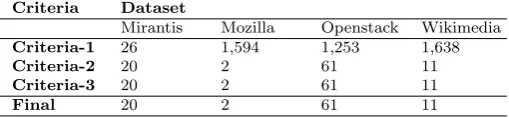
We apply the three selection criteria presented in Section 3.1.1 to identify the repositories that we use for analysis. We describe how many of the repositories satisfied each of the three criteria in Table 3. Each row corresponds to the count of repositories that satisfy each criteria. For example, 26 repositories satisfy Criteria-1, for Mirantis. Altogether, we obtain 94 repositories to extract Puppet scripts from.
4.2 Commit Message Processing
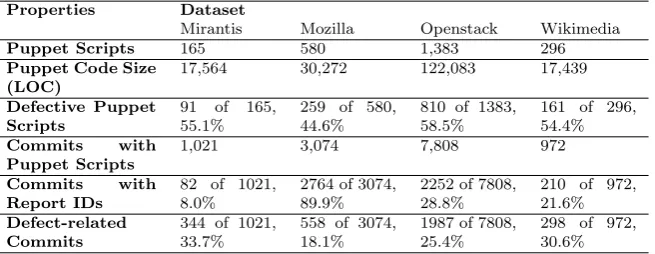
We report summary statistics on the collected repositories in Table 4. Ac-cording to Table 4, for Mirantis we collect 165 Puppet scripts that map to 1,021 commits. Of these 1,021 commits, 82 commits include identifiers for bug reports. The number of lines of code for these 165 Puppet scripts is 17,564.
Table 4: Summary Attributes of Defect Datasets
Properties Dataset
Mirantis Mozilla Openstack Wikimedia
Puppet Scripts 165 580 1,383 296
Puppet Code Size (LOC)
17,564 30,272 122,083 17,439
Defective Puppet Scripts
91 of 165, 55.1%
259 of 580, 44.6%
810 of 1383, 58.5%
161 of 296, 54.4%
Commits with
Puppet Scripts
1,021 3,074 7,808 972
Commits with
Report IDs
82 of 1021, 8.0%
2764 of 3074, 89.9%
2252 of 7808, 28.8%
210 of 972, 21.6%
Defect-related Commits
344 of 1021, 33.7%
558 of 3074, 18.1%
1987 of 7808, 25.4%
298 of 972, 30.6%
4.3 Determining Categories of Defects
We use 89 raters to categorize the XCMs, using the following phases:
– Categorization Phase:
– Mirantis: We recruit students in a graduate course related to soft-ware engineering via e-mail. The number of students in the class was 58, and 32 students agreed to participate. We follow Internal Review Board (IRB) protocol, IRB#12130, in recruitment of students and as-signment of defect categorization tasks. We randomly distribute the 1,021 XCMs amongst the students such that each XCM is rated by at least two students. The average professional experience of the 32 students in software engineering is 1.9 years. On average, each student took 2.1 hours.
– Mozilla: The second and third author of the paper, separately ap-ply qualitative analysis on 3,074 XCMs. The second and third author, respectively, have a professional experience of three and two years in software engineering. The second and third author, respectively, took 37.0 and 51.2 hours to complete the categorization.
– Openstack: The third and fourth author of the paper, separately, ap-ply qualitative analysis on 7,808 XCMs from Openstack repositories. The third and fourth author, respectively, have a professional experi-ence of two and one years in software engineering. The third and fourth author completed the categorization of the 7,808 XCMs respectively, in 80.0 and 130.0 hours.
– Resolution Phase:
– Mirantis: Of the 1,021 XCMs, we observe agreement for 509 XCMs and disagreement for 512 XCMs, with a Cohen’s Kappa score of 0.21. Based on Cohen’s Kappa score, the agreement level is ‘fair’ (Landis and Koch, 1977).
– Mozilla: Of the 3,074 XCMs, we observe agreement for 1,308 XCMs and disagreement for 1,766 XCMs, with a Cohen’s Kappa score of 0.22. Based on Cohen’s Kappa score, the agreement level is ‘fair’ (Landis and Koch, 1977).
– Openstack: Of the 7,808 XCMs, we observe agreement for 3,188 XCMs, and disagreements for 4,620 XCMs. The Cohen’s Kappa score was 0.21. Based on Cohen’s Kappa score, the agreement level is ‘fair’ (Landis and Koch, 1977).
– Wikimedia: Of the 972 XCMs, we observe agreement for 415 XCMs, and disagreements for 557 XCMs, with a Cohen’s Kappa score of 0.23. Based on Cohen’s Kappa score, the agreement level is ‘fair’ (Landis and Koch, 1977).
The first author of the paper was the resolver, and resolved disagreements for all four datasets. In case of disagreements the resolver’s categorization is considered as final.
We observe that the raters agreement level to be ‘fair’ for all four datasets. One possible explanation can be that the raters agreed on whether an XCM is defect-related, but disagreed on which of the 10 defect category of the defect is related to. For defect categorization, fair or poor agreement amongst raters however, is not uncommon. Henningsson et al. (Hennings-son and Wohlin, 2004) also reported a low agreement amongst raters.
Practitioner Agreement: We report the agreement level between the raters’ and the practitioners’ categorization for randomly selected 50 XCMs as following:
– Mirantis: We contact three practitioners and all of them respond. We observe a 89.0% agreement with a Cohen’s Kappa score of 0.8. Based on Cohen’s Kappa score, the agreement level is ‘substantial’ (Landis and Koch, 1977).
– Mozilla: We contact six practitioners and all of them respond. We observe a 94.0% agreement with a Cohen’s Kappa score of 0.9. Based on Cohen’s Kappa score, the agreement level is ‘almost perfect’ (Landis and Koch, 1977).
– Openstack: We contact 10 practitioners and all of them respond. We observe a 92.0% agreement with a Cohen’s Kappa score of 0.8. Based on Cohen’s Kappa score, the agreement level is ‘substantial’ (Landis and Koch, 1977).
We observe that the agreement between ours and the practitioners’ cate-gorization varies from 0.8 to 0.9, which is higher than that of the agreement between the raters in the Categorization Phase. One possible explanation can be related to how the resolver resolved the disagreements. The first author of the paper has industry experience in writing IaC scripts, which may help to determine categorizations that are consistent with practitioners. Another pos-sible explanation can be related to the sample provided to the practitioners. The provided sample, even though randomly selected, may include commit messages whose categorization are relatively easy to agree upon.
Dataset Availability: The constructed datasets used for empirical anal-ysis are available as online15.
5 Results
In this section, we provide empirical findings by answering the three research questions:
5.1RQ1: How frequently do defects occur in infrastructure as code scripts?
The defect density, measured in DDKLOC is respectively, 27.6, 18.4, 16.2, and 17.1 per 1000 LOC, respectively, for Mirantis, Mozilla, Openstack, and Wikimedia. We observe defect densities to vary from organization to another, which is consistent with prior research. For example, for a Fortran-based satel-lite planning software system, Basili and Perricone (Basili and Perricone, 1984) have reported defect density to vary from 6.4 to 16.0, for every 1000 LOC. Mo-hagheghi et al. (MoMo-hagheghi et al, 2004) have reported defect density to vary between 0.7 and 3.7 per KLOC for a telecom software system written in C, Erlang, and Java.
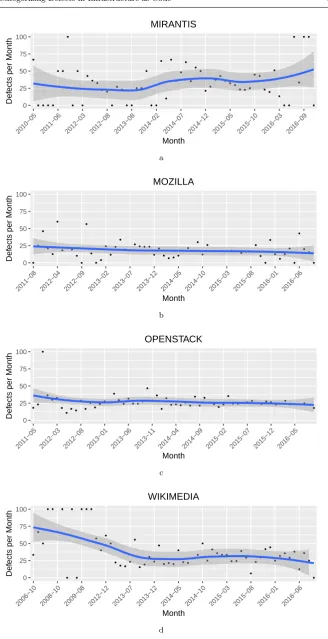
We report the defects per month values for the four datasets in Figure 2. In Figure 2, we apply smoothing to obtain visual trends. The x-axis and y-axis, respectively, presents the months and the defects per month values. According to our Cox-Stuart test results, as shown in Table 5, all trends are consistent. The p-values obtained from the Cox-Stuart test output for Mirantis, Mozilla, Openstack, and Wikimedia are respectively, 0.22, 0.23, 0.42, and 0.13. Our findings indicate that overall, frequency of defects do not significantly change across time for IaC scripts.
We use our findings related to defects per month to draw parallels with hardware and non-IaC software systems. For hardware systems researchers have reported the ‘bathtub curve’ trend, which states when initially hardware systems are put into service, the frequency of defects is high (Smith, 1993). As time progresses, defect frequency decreases and remains constant during the ‘adult period’. However, after the adult period, defect frequency becomes high
● ●● ●● ●● ● ● ● ● ● ● ● ● ● ● ● ● ● ● ●● ● ● ● ● ● ● ● ● ● ● ● ● ● ● ● ● ● ● ● ● ●● ●● ● ● ● ● ●● ● ● ●● ● 0 25 50 75 100
2010−05 2011−06 2012−03 2012−08 2013−08 2014−02 2014−07 2014−12 2015−05 2015−10 2016−03 2016−09 Month
Def
ects per Month
MIRANTIS a ● ● ● ● ● ● ●● ● ● ● ● ● ● ● ● ● ● ● ●● ● ●●● ● ● ● ● ●● ● ● ● ● ● ● ●●● ●●●● ●● ● ● ● ● ● ● ● ● ● ● ● ● ● 0 25 50 75 100
2011−08 2012−04 2012−09 2013−02 2013−07 2013−12 2014−05 2014−10 2015−03 2015−08 2016−01 2016−06 Month
Def
ects per Month
MOZILLA b ● ● ● ● ●● ● ● ● ● ● ● ● ● ● ●● ● ● ● ● ●● ● ● ● ● ● ● ●●● ● ● ● ● ● ●● ● ● ● ●●●● ●●● ●● ● ● ● ●●●●● ● 0 25 50 75 100
2011−05 2012−03 2012−08 2013−01 2013−06 2013−11 2014−04 2014−09 2015−02 2015−07 2015−12 2016−05 Month
Def
ects per Month
OPENSTACK c ● ● ● ● ● ● ● ● ● ● ● ●● ● ● ● ● ● ● ● ● ● ● ● ● ● ● ●● ● ● ●● ● ● ● ● ● ● ● ● ●● ● ● ● ● ● ●● ● ● ● ● ● ● ● ● ● 0 25 50 75 100
2006−10 2008−10 2009−08 2012−12 2013−07 2013−12 2014−05 2014−10 2015−03 2015−08 2016−01 2016−06 Month
Def
ects per Month
WIKIMEDIA
d
Table 5: Cox-Stuart Test Results for Defects per Month
Output Mirantis Mozilla Openstack Wikimedia
Trend Increasing Decreasing Decreasing Decreasing
p−value 0.22 0.23 0.42 0.13
again, as hardware systems enter the ‘wear out period’ (Smith, 1993). For IaC defects we do not observe such temporal trend.
In non-IaC software systems, initially defect frequency is high, which grad-ually decreases, and eventgrad-ually becomes low as time progresses (Hartz et al, 1996). Eventually, all software systems enter the ‘obsolescence period’ where defect frequency remains consistent, as no significant upgrades or changes to the software is made (Hartz et al, 1996). For Wikimedia, we observe a similar trend to that of non-IaC software systems: initially defect frequency remains high, but decreases as time progresses. However, this observation does not generalize for the other three datasets. Also, according to the Cox-Stuart test, the visible trends are not statistically validated. One possible explanation can be attributed to how organizations resolve existing defects. For example, while fixing a certain set of defects, practitioners may be inadvertently introducing a new set of defects, which results in an overall constant trend.
The defect density is 27.6, 18.4, 16.2, and 17.1 defects per KLOC respectively for Mirantis, Mozilla, Openstack, and Wikimedia. For all four datasets, we observe IaC defects to follow a consistent temporal trend.
5.2RQ2: By categorizing defects using the defect type attribute of orthogonal defect classification, what process improvement
recommendations can we make for infrastructure as code development?
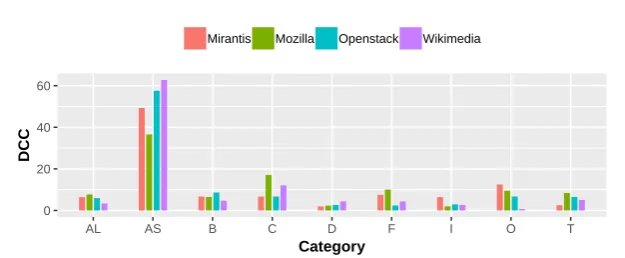
We answer RQ2 by first presenting the values for defect count per category (DCC) that belong to each defect category mentioned in Table 1. In Figure 3, we report the DCC values for the four datasets. In Figure 3, the x-axis presents the nine defect categories, whereas, the y-axis presents DCC values for each category. We observe the dominant defect category to be assignment. As shown in Figure 3, Assignment-related defects account for 49.3%, 36.5%, 57.6%, and 62.7% of the defects, for Mirantis, Mozilla, Openstack, and Wikimedia, respec-tively.
0 20 40 60
AL AS B C D F I O T
Category
DCC
Mirantis Mozilla Openstack Wikimedia
Fig. 3: Defect count per category (DCC) that belong to each defect cate-gory Algorithm (AL), Assignment (AS), Build/Package/Merge (B), Checking (C), Documentation (D), Function (F), Interface (I), Other (O), and Tim-ing/Serialization (T). Defects categorized as ‘Assignment’ is the dominant category.
practitioners might be inadvertently introducing defects. Fixing these defects involve few lines of code in IaC scripts, and these defects fall in the assign-ment category. Correcting syntax issues also involve a few lines of code and also belongs to the assignment category. Another possible explanation can be related to the declarative nature of Puppet scripts. Puppet provides syntax to declare and assign configurations. While assigning these configuration values practitioners may be inadvertently introducing defects.
As shown in Figure 3, for category Other, defect count per category is 12.5%, 9.4%, 6.7%, and 0.8%, for Mirantis, Mozilla, Openstack, and Wikime-dia, respectively. This category includes XCMs that correspond to a defect but the rater was not able to identify the category of the defect. One possible explanation can be attributed to the lack of information content provided in the messages. Practitioners may not strictly adhere to the practice of writ-ing detailed commit messages, which eventually leads to commit messages that do not provide enough information for defect categorization. For exam-ple, the commit message ‘minor puppetagain fixes’, implies that a practitioner performed a fix-related action on an IaC script, but what category of defect was fixed remains unknown. We observe organization-based guidelines to exist on how to write better commit messages for Mozilla 16, Openstack 17, and Wikimedia18. Another possible explanation can be attributed to the lack of context inherent in commit messages. The commit messages provide a sum-mary of the changes being made, but that might not be enough to determine the defect category. Let us consider two examples in this regard, provided in Figures 4a and 4b. Figures 4a and 4b respectively presents two XCMs
cat-16 https://developer.mozilla.org/en-US/docs/Mozilla/Developer guide/ 17 https://wiki.openstack.org/wiki/GitCommitMessages
- content => inline_template("This is <%= fqdn %> (<%= ipaddress %>)"); + content => inline_template("This is <%= fqdn %> (<%= ipaddress %>)\n");
1 a
- stdlib::safe_package[$nova_title] -> service[$nova_title] - stdlib::safe_package[$nova_title] ∼> service[$nova_title] + package[$nova_title] -> service[$nova_title]
+ package[$nova_title] ∼> service[$nova_title]
1
b
Fig. 4: Code changes in commits categorized as the ‘Other’ category. Figures 4a and 4b respectively presents the code changes for two commits marked as ‘Other’ obtained from Mozilla and Openstack.
egorized as ‘Other’, and obtained respectively from Mozilla and Openstack. In Figure 4b, we observe that in the commit, a newline is being added for printing purposes, which is not captured in the commit message ‘summary: bug 746824: minor fixes’. From Figure 4b, we observe that in the commit, the ‘stdlib::safe package’ is being replaced by the ‘package’ syntax, which is not captured by the corresponding commit message ‘minor fixes’.
Recommendations for IaC Development: Our findings indicate that assignment-related defects are the most dominant category of defects. Accord-ing to Chillarege et al. (Chillarege et al, 1992), if assignment-related defects are not discovered with code inspection and unit tests earlier, these defects can continue to grow at latter stages of development. Based on our findings, we recommend organizations to allocate more code inspection and unit testing efforts.
Assignment is the most frequently occurring defect category for all four datasets: Mirantis, Mozilla, Openstack, and Wikimedia. For Mirantis, Mozilla, Openstack, and Wikimedia, respectively 49.3%, 36.5%, 57.6%, and 62.7%, of the defects belong to the category, assignment. Based on our findings, we rec-ommend practitioners to allocate more efforts on code inspection and unit testing.
5.3RQ3: What are the differences between infrastructure as code (IaC) and non-IaC software process improvement activities, as determined by their defect category distribution reported in the literature?
We identify 26 software systems using the three steps outlined in Section 3.5:
ODC publication (Chillarege et al, 1992). Of the 818 publications, 674 publications were published on or after 2000.
– Step-2: Of these 674 publications, 16 applied the defect type attribute of ODC in its original form to categorize defects for software systems.
– Step-3: Of these 16 publications, 7 publications explicitly mentioned the total count of defects and provided a distribution of defect categories. We use these seven publications to determine the defect categorization of 26 software systems.
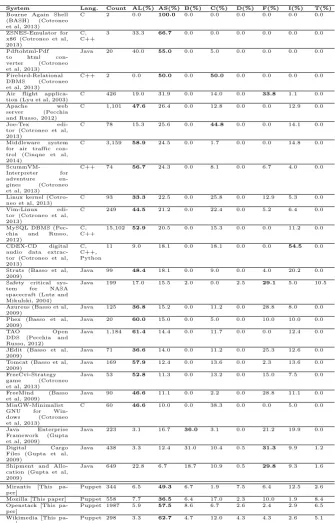
In Table 6, we present the categorization of defects for these 26 software systems. The ‘System’ column reports the studied software system followed by the publication reference in which the findings were reported. The ‘Count’ column reports the total count of defects that were studied for the software system. The ‘Lang.’ column presents the programming language using which the system is developed. The dominant defect category for each software sys-tem is highlighted in bold.
From Table 6, we observe that for four of the 26 software systems, 40% or more of the defect categories belonged to the assignment category. For 15 of the 26 software systems, algorithm-related defects are dominant. We also observe documentation and timing-related defects to rarely occur in the previously-studied software systems. In contrast to IaC scripts, assignment-related defects are not prevalent: assignment-related defects were the dominant category for 3 of the 26 software systems. We observe IaC scripts to have a different defect category distribution than non-IaC software system written in general purpose programming languages.
The differences in defect category distribution may yield different set of guidelines for software process improvement. For the 15 software systems where algorithm-related defects are dominant, based on ODC, software pro-cess improvement efforts can be focused on the following activities: coding, code inspection, unit testing, and functional testing. In case of IaC scripts, as previously discussed, software process improvement efforts can be focused on code inspection and unit testing.
Defects categorized as assignment are more prevalent amongst IaC scripts compared to that of non-IaC systems. Our findings suggest that process im-provement activities will be different for IaC development compared to that of non-IaC software development.
6 Discussion
Table 6: Defect Categories of Previously Studied Software Systems. Columns AL, AS, B, C, D, F, I, and T respectively correspond to the categories Algorithm, Assignment, Build/Package/Merge, Checking, Documentation,
Function, Interface, and Timing/serialization.
System Lang. Count AL(%) AS(%) B(%) C(%) D(%) F(%) I(%) T(%)
Bourne Again Shell (BASH) (Cotroneo et al, 2013)
C 2 0.0 100.0 0.0 0.0 0.0 0.0 0.0 0.0
ZSNES-Emulator for x86 (Cotroneo et al, 2013)
C, C++
3 33.3 66.7 0.0 0.0 0.0 0.0 0.0 0.0
Pdftohtml-Pdf to html con-verter (Cotroneo et al, 2013)
Java 20 40.0 55.0 0.0 5.0 0.0 0.0 0.0 0.0
Firebird-Relational DBMS (Cotroneo et al, 2013)
C++ 2 0.0 50.0 0.0 50.0 0.0 0.0 0.0 0.0
Air flight applica-tion (Lyu et al, 2003)
C 426 19.0 31.9 0.0 14.0 0.0 33.8 1.1 0.0
Apache web
server (Pecchia and Russo, 2012)
C 1,101 47.6 26.4 0.0 12.8 0.0 0.0 12.9 0.0
Joe-Tex edi-tor (Cotroneo et al, 2013)
C 78 15.3 25.6 0.0 44.8 0.0 0.0 14.1 0.0
Middleware system for air traffic con-trol (Cinque et al, 2014)
C 3,159 58.9 24.5 0.0 1.7 0.0 0.0 14.8 0.0
ScummVM-Interpreter for adventure en-gines (Cotroneo et al, 2013)
C++ 74 56.7 24.3 0.0 8.1 0.0 6.7 4.0 0.0
Linux kernel (Cotro-neo et al, 2013)
C 93 33.3 22.5 0.0 25.8 0.0 12.9 5.3 0.0
Vim-Linux edi-tor (Cotroneo et al, 2013)
C 249 44.5 21.2 0.0 22.4 0.0 5.2 6.4 0.0
MySQL DBMS (Pec-chia and Russo, 2012)
C, C++
15,102 52.9 20.5 0.0 15.3 0.0 0.0 11.2 0.0
CDEX-CD digital audio data extrac-tor (Cotroneo et al, 2013)
C, C++, Python
11 9.0 18.1 0.0 18.1 0.0 0.0 54.5 0.0
Struts (Basso et al, 2009)
Java 99 48.4 18.1 0.0 9.0 0.0 4.0 20.2 0.0
Safety critical sys-tem for NASA spacecraft (Lutz and Mikulski, 2004)
Java 199 17.0 15.5 2.0 0.0 2.5 29.1 5.0 10.5
Azureus (Basso et al, 2009)
Java 125 36.8 15.2 0.0 11.2 0.0 28.8 8.0 0.0
Phex (Basso et al, 2009)
Java 20 60.0 15.0 0.0 5.0 0.0 10.0 10.0 0.0
TAO Open
DDS (Pecchia and Russo, 2012)
Java 1,184 61.4 14.4 0.0 11.7 0.0 0.0 12.4 0.0
JEdit (Basso et al, 2009)
Java 71 36.6 14.0 0.0 11.2 0.0 25.3 12.6 0.0
Tomcat (Basso et al, 2009)
Java 169 57.9 12.4 0.0 13.6 0.0 2.3 13.6 0.0
FreeCvi-Strategy game (Cotroneo et al, 2013)
Java 53 52.8 11.3 0.0 13.2 0.0 15.0 7.5 0.0
FreeMind (Basso et al, 2009)
Java 90 46.6 11.1 0.0 2.2 0.0 28.8 11.1 0.0
MinGW-Minimalist GNU for Win-dows (Cotroneo et al, 2013)
C 60 46.6 10.0 0.0 38.3 0.0 0.0 5.0 0.0
Java Enterprise Framework (Gupta et al, 2009)
Java 223 3.1 16.7 36.0 3.1 0.0 21.2 19.9 0.0
Digital Cargo Files (Gupta et al, 2009)
Java 438 3.3 12.4 31.0 10.4 0.5 31.3 9.9 1.2
Shipment and Allo-cation (Gupta et al, 2009)
Java 649 22.8 6.7 18.7 10.9 0.5 29.8 9.3 1.6
Mirantis [This pa-per]
Puppet 344 6.5 49.3 6.7 1.9 7.5 6.4 12.5 2.6
Mozilla [This paper] Puppet 558 7.7 36.5 6.4 17.0 2.3 10.0 1.9 8.4 Openstack [This
pa-per]
Puppet 1987 5.9 57.5 8.6 6.7 2.6 2.4 2.9 6.5
Wikimedia [This pa-per]
6.1 Implications for Process Improvement
One finding our paper is the prevalence of assignment-related defects in IaC scripts. Software teams can use this finding to improve their process in two possible ways: first, they can use the practice of code review for developing IaC scripts. Code reviews can be conducted using automated tools and/or team members’ manual reviews. For example, through code reviews software teams can pinpoint the correct value of configurations at development stage. Automated code review tools such as linters can also help in detecting and fixing syntax issues of IaC scripts at the development stage. Typically, IaC scripts are used by organizations that have implemented CD, and for these organizations, Kim et al. (Kim et al, 2016) recommends manual peer review methods such as pair programming to improve code quality.
Second, software teams might benefit from unit testing of IaC scripts to reduce defects related to configuration assignment. We have observed from Section 5.2 that IaC-related defects are mostly related to the assignment cat-egory which includes improper assignment of configuration values and syntax errors. Practitioners can test if correct configuration values are assigned by writing unit tests for components of IaC scripts. In this manner, instead of catching defects at run-time that might lead to real-world consequences e.g. the problem reported by Wikimedia Commons 19, software teams might be able to catch defects in IaC scripts at the development stages with the help of testing.
6.2 Future Research
Our findings have the potential to facilitate further research in the area of IaC defects. In Section 5 we have observed the process differences that occur be-tween organizations, and future research can systematically investigate if there are process differences in IaC development and why they exist. We have ap-plied a qualitative process to categorize defects using the defect type attribute of ODC. We acknowledge that our process is manual and labor-intensive. We advocate for future research that can look into how the process of ODC can be automated. In future researchers can also investigate why the observed defects occur, and provide a causal analysis of IaC defects.
7 Threats To Validity
We describe the threats to validity of our paper as following:
– Conclusion Validity: Our approach is based on qualitative analysis, where raters categorized XCMs, and assigned defect categories. We ac-knowledge that the process is susceptible human judgment, and the raters’
experience can bias the categories assigned. The accompanying human sub-jectivity can influence the distribution of the defect category for IaC scripts of interest. We mitigated this threat by assigning multiple raters for the same set of XCMs. Next, we used a resolver, who resolved the disagree-ments. Further, we cross-checked our categorization with practitioners who authored the XCMs, and observed ‘substantial’ to ‘almost perfect’ agree-ment.
– Internal Validity: We have used a combination of commit messages and issue report descriptions to determine if an IaC script is associated with a defect. We acknowledge that these messages might not have given the full context for the raters. Other sources of information such as practitioner input, and code changes that take place in each commit could have provided the raters better context to categorize the XCMs.
In our paper, we have used a defect-related commit message as a defect. We acknowledge that in a defect-related commit message more than one defects can be fixed, but may not be expressed in the commit message and/or accompanied issue report description.
We acknowledge that we have not used the trigger attribute of ODC, as our data sources do not include any information from which we can infer trigger attributes of ODC such as, ‘design conformance’, ‘side effects’, and ‘concurrency’.
– Construct validity: Our process of using human raters to determine de-fect categories can be limiting, as the process is susceptible to mono-method bias, where subjective judgment of raters can influence the findings. We mitigated this threat by using multiple raters.
Also, for Mirantis and Wikimedia, we used graduate students who per-formed the categorization as part of their class work. Students who par-ticipated in the categorization process can be subject to evaluation appre-hension, i.e. consciously or sub-consciously relating their performance with the grades they would achieve for the course. We mitigated this threat by clearly explaining to the students that their performance in the categoriza-tion process would not affect their grades.
The raters involved in the categorization process had professional experi-ence in software engineering for at two years on average. Their experiexperi-ence in software engineering may make the raters curious about the expected outcomes of the categorization process, which may effect the distribution of the categorization process. Furthermore, the resolver also has professional experience in software engineering and IaC script development, which could influence the outcome of the defect category distribution.
– External Validity: Our scripts are collected from the OSS domain, and not from proprietary sources. Our findings are subject to external validity, as our findings may not be generalizable.
8 Conclusion
Use of IaC scripts is crucial for the automated maintenance of software delivery and deployment infrastructure. Similar to software source code, IaC scripts churn frequently, and can include defects which can have serious consequences. IaC defect categorization can help organizations to identify opportunities to improve IaC development. We have conducted an empirical analysis using four datasets from four organizations namely, Mirantis, Mozilla, Openstack, and Wikimedia Commons. With 89 raters, we apply the defect type attribute of the orthogonal defect classification (ODC) methodology to categorize the defects. For all four datasets, we have observed that majority of the defects are related to assignment i.e. defects related to syntax errors and erroneous configuration assignments. We have observed compared to IaC scripts, assignment-related defects occur less frequently in non-IaC software. We also have observed the defect density is 27.6, 18.4, 16.2, and 17.1 defects per KLOC respectively for Mirantis, Mozilla, Openstack, and Wikimedia. For all four datasets, we observe IaC defects to follow a consistent temporal trend. We hope our findings will facilitate further research in IaC defect analysis.
Acknowledgements The Science of Security Lablet at the North Carolina State University supported this research study. We thank the Realsearch research group members for their useful feedback. We also thank the practitioners who answered our questions.
References
Alali A, Kagdi H, Maletic JI (2008) What’s a typical commit? a charac-terization of open source software repositories. In: 2008 16th IEEE In-ternational Conference on Program Comprehension, pp 182–191, DOI 10.1109/ICPC.2008.24
Basili VR, Perricone BT (1984) Software errors and complexity: An empirical investigation0. Commun ACM 27(1):42–52, DOI 10.1145/69605.2085, URL http://doi.acm.org/10.1145/69605.2085
Basso T, Moraes R, Sanches BP, Jino M (2009) An investigation of java faults operators derived from a field data study on java software faults. In: Work-shop de Testes e Tolerˆancia a Falhas, pp 1–13
Battin RD, Crocker R, Kreidler J, Subramanian K (2001) Leveraging re-sources in global software development. IEEE Software 18(2):70–77, DOI 10.1109/52.914750
van der Bent E, Hage J, Visser J, Gousios G (2018) How good is your puppet? an empirically defined and validated quality model for puppet. In: 2018 IEEE 25th International Conference on Software Analysis, Evolution and Reengineering (SANER), pp 164–174, DOI 10.1109/SANER.2018.8330206 Butcher M, Munro H, Kratschmer T (2002) Improving software testing
Chillarege R, Bhandari IS, Chaar JK, Halliday MJ, Moebus DS, Ray BK, Wong MY (1992) Orthogonal defect classification-a concept for in-process measurements. IEEE Transactions on Software Engineering 18(11):943–956, DOI 10.1109/32.177364
Christmansson J, Chillarege R (1996) Generation of an error set that emulates software faults based on field data. In: Proceedings of Annual Symposium on Fault Tolerant Computing, pp 304–313, DOI 10.1109/FTCS.1996.534615 Cinque M, Cotroneo D, Corte RD, Pecchia A (2014) Assessing direct moni-toring techniques to analyze failures of critical industrial systems. In: 2014 IEEE 25th International Symposium on Software Reliability Engineering, pp 212–222, DOI 10.1109/ISSRE.2014.30
Cito J, Leitner P, Fritz T, Gall HC (2015) The making of cloud ap-plications: An empirical study on software development for the cloud. In: Proceedings of the 2015 10th Joint Meeting on
Foun-dations of Software Engineering, ACM, New York, NY, USA,
ESEC/FSE 2015, pp 393–403, DOI 10.1145/2786805.2786826, URL http://doi.acm.org/10.1145/2786805.2786826
Cohen J (1960) A coefficient of agreement for
nom-inal scales. Educational and Psychological
Measure-ment 20(1):37–46, DOI 10.1177/001316446002000104,
URL http://dx.doi.org/10.1177/001316446002000104,
http://dx.doi.org/10.1177/001316446002000104
Cotroneo D, Pietrantuono R, Russo S (2013) Testing techniques
selection based on odc fault types and software metrics. J
Syst Softw 86(6):1613–1637, DOI 10.1016/j.jss.2013.02.020, URL
http://dx.doi.org/10.1016/j.jss.2013.02.020
Cox DR, Stuart A (1955) Some quick sign tests for trend in location and disper-sion. Biometrika 42(1/2):80–95, URL http://www.jstor.org/stable/2333424 Duraes JA, Madeira HS (2006) Emulation of software faults: A field data study and a practical approach. IEEE Trans Softw Eng 32(11):849–867, DOI 10.1109/TSE.2006.113, URL http://dx.doi.org/10.1109/TSE.2006.113 Fonseca J, Vieira M (2008) Mapping software faults with web security vul-nerabilities. In: 2008 IEEE International Conference on Dependable Sys-tems and Networks With FTCS and DCC (DSN), pp 257–266, DOI 10.1109/DSN.2008.4630094
Gupta A, Li J, Conradi R, Rønneberg H, Landre E (2009) A case study com-paring defect profiles of a reused framework and of applications reusing it. Empirical Softw Engg 14(2):227–255, DOI 10.1007/s10664-008-9081-9, URL http://dx.doi.org/10.1007/s10664-008-9081-9
Hanappi O, Hummer W, Dustdar S (2016) Asserting
reli-able convergence for configuration management scripts.
SIG-PLAN Not 51(10):328–343, DOI 10.1145/3022671.2984000, URL
http://doi.acm.org/10.1145/3022671.2984000 Harlan D (1987) Cleanroom software engineering
Hatton L (1997) Reexamining the fault density-component size
con-nection. IEEE Softw 14(2):89–97, DOI 10.1109/52.582978, URL
http://dx.doi.org/10.1109/52.582978
Henningsson K, Wohlin C (2004) Assuring fault classification agreement ” an empirical evaluation. In: Proceedings of the 2004 International Sympo-sium on Empirical Software Engineering, IEEE Computer Society, Washing-ton, DC, USA, ISESE ’04, pp 95–104, DOI 10.1109/ISESE.2004.13, URL http://dx.doi.org/10.1109/ISESE.2004.13
Humble J, Farley D (2010) Continuous Delivery: Reliable Software Releases Through Build, Test, and Deployment Automation, 1st edn. Addison-Wesley Professional
IEEE (2010) Ieee standard classification for software anomalies. IEEE Std 1044-2009 (Revision of IEEE Std 1044-1993) pp 1–23, DOI 10.1109/IEEESTD.2010.5399061
Jiang Y, Adams B (2015) Co-evolution of infrastructure and source code: An empirical study. In: Proceedings of the 12th Working Conference on Mining Software Repositories, IEEE Press, Piscataway, NJ, USA, MSR ’15, pp 45– 55, URL http://dl.acm.org/citation.cfm?id=2820518.2820527
Kim G, Debois P, Willis J, Humble J (2016) The DevOps Handbook: How to Create World-Class Agility, Reliability, and Security in Technology Organi-zations. IT Revolution Press
Labs P (2017) Puppet Documentation. https://docs.puppet.com/, [Online; accessed 19-July-2017]
Landis JR, Koch GG (1977) The measurement of observer
agree-ment for categorical data. Biometrics 33(1):159–174, URL
http://www.jstor.org/stable/2529310
Levy D, Chillarege R (2003) Early warning of failures through alarm analysis a case study in telecom voice mail systems. In: 14th International Symposium on Software Reliability Engineering, 2003. ISSRE 2003., pp 271–280, DOI 10.1109/ISSRE.2003.1251049
Lutz RR, Mikulski IC (2004) Empirical analysis of safety-critical anomalies during operations. IEEE Transactions on Software Engineering 30(3):172– 180, DOI 10.1109/TSE.2004.1271171
Lyu MR, Huang Z, Sze SKS, Cai X (2003) An empirical study on testing and fault tolerance for software reliability engineering. In: 14th International Symposium on Software Reliability Engineering, 2003. ISSRE 2003., pp 119– 130, DOI 10.1109/ISSRE.2003.1251036
McConnell S (2004) Code complete - a practical handbook of software con-struction, 2nd edition
McCune JT, Jeffrey (2011) Pro Puppet, 1st edn. Apress, DOI 10.1007/978-1-4302-3058-8, URL https://www.springer.com/gp/book/9781430230571 Mohagheghi P, Conradi R, Killi OM, Schwarz H (2004) An empirical
Munaiah N, Kroh S, Cabrey C, Nagappan M (2017) Curating github for engineered software projects. Empirical Software Engineering pp 1–35, DOI 10.1007/s10664-017-9512-6, URL http://dx.doi.org/10.1007/s10664-017-9512-6
Parnin C, Helms E, Atlee C, Boughton H, Ghattas M, Glover A, Holman J, Micco J, Murphy B, Savor T, Stumm M, Whitaker S, Williams L (2017) The top 10 adages in continuous deployment. IEEE Software 34(3):86–95, DOI 10.1109/MS.2017.86
Pecchia A, Russo S (2012) Detection of software failures through event logs: An experimental study. In: 2012 IEEE 23rd International Symposium on Software Reliability Engineering, pp 31–40, DOI 10.1109/ISSRE.2012.24
Puppet (2018) Ambit energy’s competitive advantage? it’s
re-ally a devops software company. Tech. rep., Puppet, URL
https://puppet.com/resources/case-study/ambit-energy
Rahman A, Williams L (2018) Characterizing defective configuration scripts used for continuous deployment. In: 2018 IEEE 11th International Confer-ence on Software Testing, Verification and Validation (ICST), pp 34–45, DOI 10.1109/ICST.2018.00014
Rahman A, Partho A, Morrison P, Williams L (2018) What questions do programmers ask about configuration as code? In: Proceedings of the 4th International Workshop on Rapid Continuous Software Engineering, ACM, New York, NY, USA, RCoSE ’18, pp 16–22, DOI 10.1145/3194760.3194769, URL http://doi.acm.org/10.1145/3194760.3194769
Rahman AAU, Helms E, Williams L, Parnin C (2015) Synthesizing con-tinuous deployment practices used in software development. In: Proceed-ings of the 2015 Agile Conference, IEEE Computer Society, Washing-ton, DC, USA, AGILE ’15, pp 1–10, DOI 10.1109/Agile.2015.12, URL http://dx.doi.org/10.1109/Agile.2015.12
Shambaugh R, Weiss A, Guha A (2016) Rehearsal: A
configuration verification tool for puppet. SIGPLAN
Not 51(6):416–430, DOI 10.1145/2980983.2908083, URL
http://doi.acm.org/10.1145/2980983.2908083
Sharma T, Fragkoulis M, Spinellis D (2016) Does your configura-tion code smell? In: Proceedings of the 13th Internaconfigura-tional Con-ference on Mining Software Repositories, ACM, New York, NY, USA, MSR ’16, pp 189–200, DOI 10.1145/2901739.2901761, URL http://doi.acm.org/10.1145/2901739.2901761
Smith AM (1993) Reliability-centered maintenance, vol 83. McGraw-Hill New York
Thung F, Wang S, Lo D, Jiang L (2012) An empirical study of bugs in machine learning systems. In: 2012 IEEE 23rd International Symposium on Software Reliability Engineering, pp 271–280, DOI 10.1109/ISSRE.2012.22