Division VIII
A Phased Approach for Applying PHM Technology to NPPs
Yang-Seok Kim1, Ji-ho Min2, Byoung-oh Lee3, Dae-Woong Kim4, and Chi-Yong Park5 1
Principal Research Engineer, Equipment Engineering Lab., KHNP Central Research Institute, Korea 2
Assistant Research Engineer, Equipment Engineering Lab., KHNP Central Research Institute, Korea 3
Senior Research Engineer, Equipment Engineering Lab., KHNP Central Research Institute, Korea 4
Principal Research Engineer, Equipment Engineering Lab., KHNP Central Research Institute, Korea 5
Group Leader, Equipment Engineering Lab., KHNP Central Research Institute, Korea
ABSTRACT
Many industries have been trying to apply prognostics and health management (PHM) technology to their critical systems or components. The ultimate goal of PHM, which consists of condition monitoring, diagnostics, prognostics, and maintenance decision making support, is to maximize the operational availability and safety of the target. Therefore, the interest of PHM from nuclear industry has also been increased because of not only expectation of its role in keeping and improving system or component reliability but also the economics of maintenance. Some progress is being made in the area of online monitoring and equipment condition assessment in nuclear power plants (NPPs) with centralized diagnostic monitoring system. However, the state of practice does not include PHM technology, especially prognostics and decision support functions. This paper analyzes several reasons why it is difficult to implement PHM technology for NPPs, though a significant amount of research and developments on this matter has been performed. This paper also introduces a brief overview of the current research and challenges in PHM technology and then presents a phased approach to apply PHM technology to NPPs. The proposed approach could be used to implement each PHM function step by step for NPPs.
INTRODUCTION
Maintenance strategies for plant equipment, including nuclear power plants (NPPs), have been advancing from corrective maintenance to CBM (Condition-Based Maintenance). Recently, PHM (Prognostics and Health Management) has attracted much attention. Kothamasu et al. (2006) classify maintenance philosophies and review paradigms to improve reliability and to reduce unscheduled downtime by monitoring and predicting machine health. In order to lower maintenance costs and maximize available operating time, it is necessary to implement CBM and furthermore, PHM, where prognostic technology is essential. PHM technology has mainly been applied to the aerospace industry but it is expanding to the power plant, railway, automobile, and construction heavy equipment industries. PHM combines sensing to acquire data using sensors, diagnostics to monitor the status of the equipment or system and determine the type of failure, and prognostics to predict failure times. Most studies of prognostics have been limited to predicting residual useful life but there is a need to be interested in PHM that can manage the state of equipment in a comprehensive manner.
According to ISO 13381-1 (2015), the definition of prognostics is the evaluation of time to failure and risk for one or more existing and future failure modes. Therefore, in prognostics, it is necessary to evaluate all the failure modes that can be identified by diagnostics and provide RUL based on the evaluation. Each literature defines prognostics in various ways, but it is the same to predict the RUL for a specific failure mode. In this paper, we followed the definition of the prognostics by ISO 13381-1(2015).
Jardine et al. (2006) reviewed the findings of two important elements of the CMB program, diagnostics and prognostics. In particular, their review was focused on data acquisition, data processing, and maintenance decision-making. They said that the main reasons advanced maintenance technologies that are not well suited to industry were because of lack of data, effective communication with developers, and effective verification methods. They also mentioned that design of an intelligent device capable of continuous on-line health monitoring and fast and robust on-line signal processing algorithm are very important in the future R&D. Heng et al. (2009) reviewed the studies related to the prediction of rotating machinery failure, and classified it as a reliability model, a condition-based prognostics model, and a model integrating reliability and prognostics. They also noted that when applied in practice, it is difficult to predict the occurrence of equipment failure due to the inherent structural and operational complexities of the target equipment and no single tool can solve all problems. Recently Javed et al. (2017) also classify prognostic approaches and present application perspectives. In particular, they stated that managing reliability or uncertainty of RUL estimates would be a major challenge when implementing component level or system level prognostics.
In this paper, we examine the difficulties of applying the prognostics to the active components such as pumps in NPP, review the existing studies related to the diagnostics and prognostics, and summarize the results of the studies with high applicability. The passive components like pressure vessels, piping, structures, cables, etc. are excluded from consideration in this paper. Based on the review, a stepwise approach to develop the prognostic technology and apply it to the main equipment of NPP was proposed.
PHM TECHNOLOGY REVIEW
In this section, we review the existing researches on prognostics and draw out the technologies that can be applied to NPPs and then identify the prerequisites necessary for actual application. This is shown in Table 1.
In rotating machinery, acceleration and displacement signals are mainly used for fault diagnostics and prognostics which require high-sampling data. Fault diagnosis provides fault identification with diagnostic accuracy while the research for prognostics provides information on RUL (Deutsch & He, 2016; Kimotho & Sextro, 2014; Kim et al., 2016) or reliability (%)(Oh et al., 2016; Sinha & Elbhbah, 2013; Yunlong & Peng, 2012) of the component or part. In case of a heat exchanger, the inlet and outlet temperature and pressure signals and flow rate are required to estimate the characteristic parameters for lifetime prediction (Welz et al., 2014; Ardsomang et al., 2013). The result is a time-to-failure (TTF) of the heat exchanger tube. In the case of turbines, Panni et al. (2016) proposed life prediction techniques using high pressure turbine displacement signals and fault diagnosis techniques with condition monitoring variables to provide RUL and abnormal condition occurrence. In order to predict RUL of transformer winding insulator, Agarwal et al. (2015) used signal parameters such as operating time, ambient temperature, upper oil temperature, and hot spot temperature which affect the performance of the insulator. In the fault diagnosis and life prediction technology for windings and iron cores, Hu et al. (2012) calculated the RMS and RMSD values from the acceleration signal and finally provided the fault type and RUL information as the output. For electric motors, supplied motor current is used as the model input for stator winding fault diagnostics (D’Angelo et al., 2011) and rotor bar crack estimation (García-Escudero et al., 2011).
the laboratory verification, though field verification is indispensable for application to the field, especially to NPPs. Table 1 also shows that the prognostic function is concentrated on the wear of rotating components such as bearings and impellers, the fouling of heat exchangers, and the damage of generator insulation.
Table 1: Inputs and outputs for existing studies.
Component Failure or fault Scope Sensors or
Inputs Outputs References
Rotating Machinery
Ball bearing failure Diagnostics
Prognostics Accelerometer RUL
Deutsch & He (2016), Kimotho & Sextro (2014),
Unbalance, misalignment, improper contact
Diagnostics Displacement Tachometer
Fault Types/ Accuracy
Oh et al. (2016), Sinha & Elbhbah
(2013)
Bearing, impeller contact wear, rotor bar failure
Diagnostics
Prognostics Accelerometer
Fault Types/ Accuracy/
RUL
Kim et al.(2016)
Misalignment,
unbalance, looseness Diagnostics Accelerometer
Fault Types/ Accuracy
Yunlong & Peng (2012)
Heat
Exchanger Tube fouling Prognostics
Temperature, Pressure, Flow-rate TTF/ TTF Prediction Error
Welz et al. (2014), Ardsomang et al.
(2013)
Turbine Steam turbine
Abnormality Detection Prognostics
Displacement RUL Panni et al. (2016)
Transformer
Winding insulation
fault Prognostics
Operating Time, Environmental Temp., Oil Temp., Hot-spot Temp.
RUL Agarwal et al. (2015)
Winding, Core damage
Diagnostics
Prognostics Accelerometer
RMS/
RMSD/RUL Hu et al. (2012)
Motor
Stator winding fault Diagnostics Motor current
Probability of Indication of
Change Detection
D’Angelo et al. (2011)
CURRENT LIMITATIONS APPLYING TO NPPS
General Limitations
As described in the previous section, prognostics is a different concept from diagnostics. As a diagnostic method cannot be applied to all the engineering equipment, a prognostic method should also be different depending on the equipment and failure mode. Therefore, prognostics should be considered for the specific failure modes. When failure has been significantly reduced or there is no failure for an underlying failure mode, prognostic system should be developed for the next failure or new failure mode to highly affect the target equipment. In addition, it is difficult to apply prognostics to equipment whose performance may change suddenly, since the performance degradation must be predicted and the time for the action is required.
Urgency
Considering the reliability of current prognostics, the application is disadvantageous in terms of cost effectiveness and urgency. When design changes are needed to implement a system, it is not easy to apply to a power plant, especially an NPP, until reliability is improved to the acceptance level and sufficient application experience is gained.
Legacy Systems
In order to apply prognostics, it is necessary to acquire new data or operate a separate database. Some sensors already installed in the plant can be used for diagnostics but additional sensors are inevitable to ensure a certain level of prognostic reliability. Most existing systems run on independent platforms and the DB system is optimized for the purpose of the system. Therefore, when a new prognostic system is introduced, a separate database is inevitable even if the data source is the same. It is expected that data configuration management be inefficient.
Safety and Security
Due to the specific nature of nuclear power generation, when installing new systems or installing them in addition to existing systems, priority should be given to regulatory requirements, safety and cyber security rather than operational or economic efficiency. Conversely, application to secondary or non-safety related equipment is also disadvantageous considering the economic priority.
Verification
It is also a stumbling block that failure data and long time are required to verify the reliability of prognostics. Therefore, there are few cases in which the verification has been performed for actual application because the complete set of failure data is mostly not available.
PHASED APPROACH TO NPPS
Due to the limitations described above, it is effective to develop and apply PHM technology step by step according to current level, acceptability, and necessity of monitoring and diagnosis of application target. For example, depending on the target and failure mode, monitoring technology may be introduced first or both of monitoring and diagnostic technologies may be developed and applied at the same time.
technology for a specific field or component without burdening the sensor installation could be developed and applied first. The sensing system would be used to monitor the equipment condition and then gradually applied to diagnostics and prognostics. At the same time, the usability of the existing sensors may be improved by developing technologies for diagnostics and prognostics with those sensors only. Reliability of prognostics should be guaranteed but it is noted that reliability should be ensured in the long term. The whole prognostic system should be introduced strategically by policy decision rather than developer's position and approached from the aspect of asset management in the long run. The existing DBs for monitoring or diagnostics are considered to be used for diagnostics and/or prognostics. Once the platform and monitoring system for prognostics are implemented, the application areas, such as failure mode, target equipment, and plant, can be extended step by step.
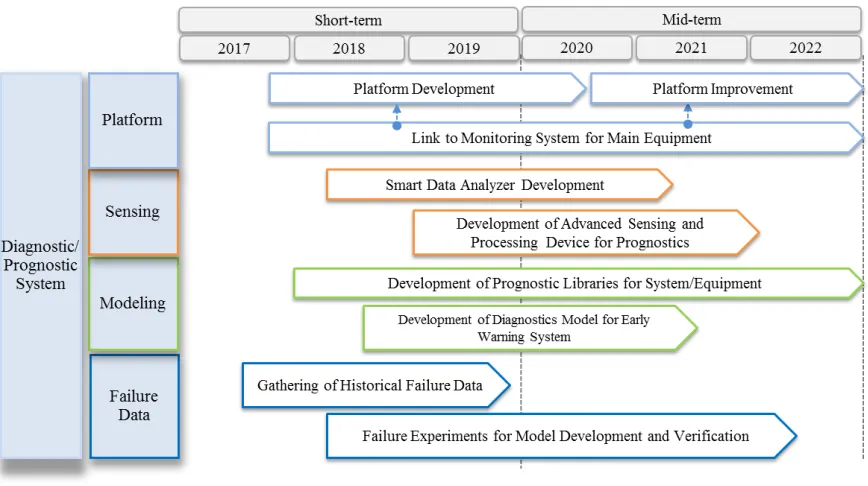
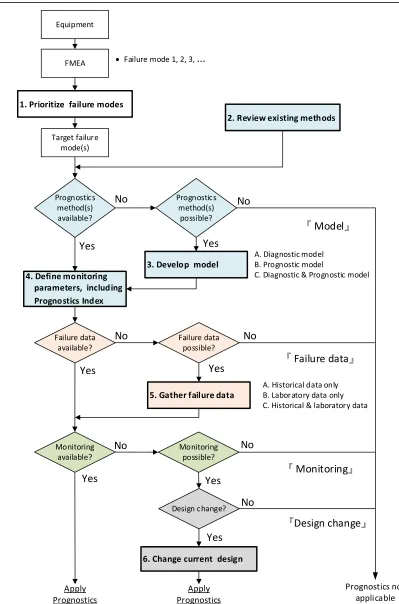
Figure 1 shows the roadmap for the application of the prognostics technology to NPPs. The main elements for diagnostic and prognostic system are supposed to be platform, sensing devices, diagnostic and prognostic models and failure data. It is desirable to introduce a platform in the mid to long term so that at least the prognostics and maintenance activities can be operated on the same platform. This platform can introduce commercial products or be developed but the minimum requirements for the platform should be to improve functions, extend target equipment, and link to existing monitoring systems. The smart data analyser, a device to measure and process the data for prognostics, would be developed. Furthermore, the smart sensor could be developed to apply more advanced sensing and processing technologies. To incorporate prognostics to the platform, the model libraries for systems/equipment are developed based on the existing models or newly developed models. Also for model development and verification, failure data should be obtained from the laboratory experiments and from the plant failure data of main equipment. Figure 2 shows a procedure to check whether prognostics are applicable or not to a NPP. This procedure can help select a target for prognostics. The key elements of the proposed procedure are: 1. Prioritize failure mode; 2. Review existing methods; 3. Develop model; 4. Define monitoring parameters; 5. Gather failure data; and finally, 6. Change current design. The most critical points to be noted are whether failure data is available and design change is supported by the plant to apply prognostics.
FMEA Equipment
Prognostics method(s) available?
Failure data available?
No No
Yes Yes
No
Yes
Monitoring
available? Monitoring possible? No
Yes No
Yes
Prognostics not applicable
Prognostics method(s)
possible?
Failure data possible? 3. Develop model
No
Yes
5. Gather failure data
『 Model』
『 Failure data』
『 Monitoring』
Design change?
Yes 6. Change current design
No
Apply
Prognostics PrognosticsApply
『Design change』
A. Diagnostic model B. Prognostic model
C. Diagnostic & Prognostic model
A. Historical data only B. Laboratory data only C. Historical & laboratory data Target failure
mode(s)
1. Prioritize failure modes
• Failure mode 1, 2, 3, ...
2. Review existing methods
4. Define monitoring parameters, including Prognostics Index
CONCLUSION
In this paper, we reviewed the existing prognostic technologies considered to be highly applicable to NPPs and found that failure data is critical for verification and application of the technology. We also described several limitations of applying the prognostics to NPPs mainly with respect to urgency, overlapping with legacy systems, safety & security, and reliability.
If high-sampling data and specific sensor signals are needed for the application and cannot be obtained from the existing system, new signal collecting devices and sensors should be installed. It is also found that the prognostic function has been mainly developed to prevent wear of parts such as bearings and impellers, fouling of heat exchangers, and insulation fault of transformers. However, it is difficult to apply them immediately to NPPs. The most important reason for this is that most of their verifications have been carried out in laboratory so that the reliability of the technology is not accepted. Therefore, we proposed to develop a prognostic platform, collect failure data, and then apply the prognostic model to the main equipment in NPPs. In the near future, we will introduce a platform for diagnostics and prognostics and secure failure data for main equipment in NPPs according to the stepwise development and application plan of the prognostic technology.
REFERENCES
Agarwal, V., Lybeck, N., Pham, B.T., Rusaw, R. and Bickford, R. (2015), “Prognostic and Health Management of Active Assets in Nuclear Power Plants,” International Journal of PHM.
Ardsomang, T., Hines, J.W. and Upadhyaya, B.R. (2013), “Heat Exchanger Fouling and Estimation of Remaining Useful Life,” Proceedings of the PHM Society 2013
D’Angelo, M.F.S.V., Palhares, R.M., Takahashi, R.H.C., Loschi, R.H., Baccarini, L.M.R. and Caminhas, W.M. (2011), “Incipient Fault Detection in Induction Machine Stator-Winding Using a Fuzzy-Bayesian Change Point Detection Approach,” Applied Soft Computing, Elsevier, UK, 11, 179-192. Deutsch, J. and He, D. (2016), “Using Deep Learning Based Approaches for Bearing Remaining Useful
Life Prediction,” Proceedings of the PHM Society 2016.
García-Escudero, L.A., Duque-Perez, O., Morinigo-Sotelo, D. and Perez-Alonso, M. (2011), “Robust Condition Monitoring for Early Detection of Broken Rotor Bars in Induction Motors,” ELSEVIER. Heng, A, Zhang, S, Tan, A.C.C. and Mathew, J. (2009), "Rotating Machinery Prognostics: State of the
Art, Challenges and Opportunities,” Mechanical Systems and Signal Processing, Elsevier, UK, 23, 724-739.
Hu, C., Wang, P., Youn, B.D., Lee, W.R. and Yoon, J.T. (2012), “Statistical Health Grade System against Mechanical failures of Power Transformers,” Proceedings of the PHM Society 2012.
ISO 13381-1 (2015), Condition Monitoring and Diagnostics of Machines – Prognostics – Part 1: General guidelines, International Organization for Standardization.
Jardine, A.K.S., Lin, D. and Banjevic, D. (2006), “A Review on Machinery Diagnostics and Prognostics Implementing Condition-Based Maintenance,” Mechanical Systems and Signal Processing, Elsevier, UK, 20, 1483-1510.
Javed, K., Gouriveau, R. and Zerhouni, N. (2017), “ State of the Art and Taxonomy of Prognostics Approaches, Trends of Prognostics Applications and Open Issues towards Maturity at Different Technology Readiness Levels,” Mechanical Systems and Signal Processing, Elsevier, UK, 94, 214-236.
Kim, H.E., Hwang, S.S., Tan, A.C.C., Mathew, J. and Choi, B.K. (2012), “Integrated Approach for Diagnostics and Prognostics of HP LNG Pump Based on Health State Probability Estimation,” Journal of Mechanical Science and Technology, Springer, 26, 3571-3585.
Kothamasu, R., Huang, S.H. and VerDuin, W.H. (2006), “System Health Monitoring and Prognostics – A Review of Current Paradigms and Practices,” International Journal of Advanced Manufacturing Technology, 28, 1012-1024.
Lee, J., Wu, F., Zhao, W., Ghaffari, M. and Liao, L. (2014), "Prognostics and Health Management Design for Rotary Machinery Systems - Reviews, Methodology and Applications,” Mechanical Systems and Signal Processing, Elsevier, UK, 42, 314-433.
Oh, H.S., Jeon, B.C., Jung, J.H. and Youn, B.D. (2016), “Smart Diagnosis of Journal Bearing Rotor Systems: Unsupervised Feature Extraction Scheme by Deep Learning,” Proceedings of the PHM Society 2016.
Panni, O., West, G., Catterson, V., McArthur, S., Shi, D. and Mogridge, I. (2016), “Implementation Of A Bayesian Linear Regression Framework For Nuclear Prognostics,” Proceedings of the PHM Society 2016.
Sinha, J.K. and Elbhbah, K. (2013), “A Future Possibility of Vibration Based Condition Monitoring of Rotating Machines,” Mechanical Systems and Signal Processing, Elsevier, UK, 34, 231-240. Welz, Z., Nam, A., Sharp, M., Hines, J.W. and Upadhyaya, B.R. (2014), “Prognostics for Light Water
Reactor Sustainability: Empirical Methods for Heat Exchanger Prognostic Lifetime Predictions,” Proceedings of the PHM Society 2014.