Generic Channel Overlap Calculations Algorithm
A. Oudah, T. Abd. Rahman and N. Seman
Faculty of Electrical Engineering, University of Technology Malaysia
[email protected], [email protected], [email protected]
Abstract
The ever-increasing shortage of the spectrum leaves fourth generation wireless technologies no choice but to use their existing spectra repeatedly by the so-called re-farming strategy. This alternative, nevertheless, increases overlap levels between cells and rapidly escalates into interference situations. In this paper, channel overlap in wireless systems is defined and quantified. The proposed models account for cross and adjacent types of overlap in almost any radio network.
Keywords: Channel overlaps, Cross channel overlap, adjacent channel overlap, Absolute radio frequency channel number
1. Introduction
The ever increasing penetration of cellular mobile devices along with innovative and emerging data applications has drained spectral resources and thus resulted in a constant search for new spectrum bands for mobile communications by regulatory bodies and/or mobile operators [1, 2]. A natural extension of this deprived situation is that mobile network operators are now forced to re-use their allocated frequency blocks to accommodate their new networks by the so-called re-farming strategy [3, 4]. Consequently, the inevitable pressure on spectrum resources promotes radio channels overlap between cells and thus elevates deteriorating interference levels.
Typically, the intersection of channels of the same or contiguous carrier frequency is referred to as an overlap [5–7].
Typically, the intersection of channels of the same or contiguous carrier frequency is referred to as an overlap [5–7]. Based on the contiguity of overlapped carriers, overlap can be broadly divided into two types: cross, i.e. co-channel, and adjacent, i.e. contiguous [8–10]. In this paper, we propose a verification algorithm; by which overlap type, i.e. cross or adjacent is identified, we then quantify that overlap based on victim and intruder bandwidths and Absolute Radio Frequency Channel Numbers (ARFCN).
2. Algorithm Formulation
The algorithm first verifies whether or not overlap exists for each type of overlap based on a type-specific criterion, as thoroughly explained below:
a) Cross Channel
For this type of overlap to take place, the start and end frequencies of overlapped channels must comply with the following criteria:
int int
< vic & > vic
start ch end ch end ch start ch
f f f f
Where
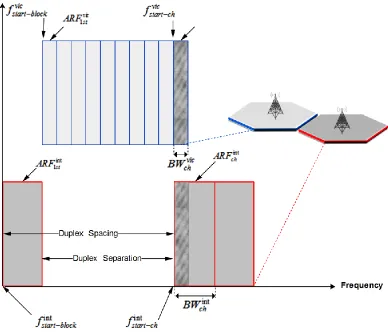
f
start chint andf
start chvic are the start frequencies (MHz) of intruder and victim,respectively, while
f
end chint and vic end chf
are the end frequencies (MHz) of intruder and victimchannels, respectively, and are found as follows:
int int int int int
1
start ch start block ch ch st
f f BW ARF ARF (1)
1 1
vic vic vic vic vic
end ch start block ch ch st
f f BW ARF ARF (2)
int int int int int
1
1
end ch start block ch ch st
f
f
BW
ARF
ARF
(3)
1
vic vic vic vic vic
start ch start block ch ch st
f f BW ARF ARF (4)
Where
f
start blockint andf
start blockvic are start frequencies (MHz) of intruder and victim blocks,int
ch
BW
andBW
chvic are intruder and victim channels bandwidths (MHz), respectively,int
ch
ARF and
ARF
chvicare Absolute Radio Frequency Channel Numbers ARFCN(s) of intruderand victim channels, respectively, and, finally, ARF1intst and
ARF
1vicst are ARFCN(s) of intruderand victim 1st channels in their corresponding blocks, respectively. As shown in Fig.1.
Accordingly, the cross-channel overlap bandwidth (MHz) can be found as follows:
int int
, ,
vic vic
cco end ch end ch start ch start ch
From Eq. (5), the cross-channel overlap factor is expressed as below: cco vic cco ch
BW
F
BW
(6)Where
F
ccois the cross channel factor,BW
ccois the cross channel overlap bandwidth (MHz)as found in Eq.(5) and
BW
chvicis the victim channel bandwidth (MHz).b) Adjacent Channel
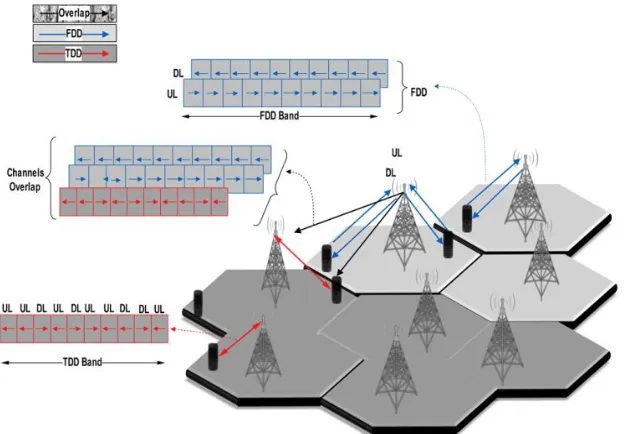
Cells can operate in frequency blocks that are higher or lower than other block-contiguous cells. Consequently, three types of adjacent channel overlap scenarios are possible: adjacently overlapped on higher frequency (victim channel left side) , lower frequency channel (victim channel right side) or on both sides; such as the case when a TDD block of an operator is confined by the downlink and uplink FDD-blocks of another operator. Therefore, the following conditions apply:
On higher frequency side
int int
<
&
>
vic vic vic
start ch ch end ch end ch end ch
f
BW
f
f
f
On lower frequency side
int int
< vic & > vic vic
start ch start ch end ch start ch ch
f f f f BW
When both logical statements return true values, corresponding overlap bandwidths are:
int int,
,
H vic vic vic
aco end ch ch end ch end ch start ch
BW
Min f
BW
f
Max f
f
(7)
int int
,
,
L vic vic vic
aco start ch end ch start ch ch start ch
BW
Min f
f
Max f
BW
f
(8)Where
BW
acoH andBW
acoL are adjacent overlap bandwidths on higher and lower frequency(MHz) sides, respectively.
From Equations (7) and (8), total adjacent overlap factor can be expressed as below:
H L aco aco aco vic ch
BW
BW
F
BW
F
(9)WhereFacois the total adjacent overlap factor andF is the adjacent channel attenuation
Figure 1.Algorithm’s Basic Parameters
3. Areas of Applications
Figure 2. Two Overlapped LTE Cells (LTE-TDD with LTE-FDD)
Table 1. Some LTE Frequency Bands and their Channel
E-UTRA Band Bandwidth
UL (MHz) E-ARFCN UL
Bandwidth
DL (MHz) E-ARFCN DL
Duplex Mode
1 1920-1980 13000 – 13599 2110-2170 0 – 599 FDD
2 1850-1910 13600 – 14199 1930-1990 600 - 1199 FDD
8 880-915 16450 – 16799 925-960 3450 – 3799 FDD
9 1749.9-1784.9 16800 – 17149 1844.9-1879.9 3800 – 4149 FDD
... ... ... ... ... ...
33 1900-1920 26000 – 26199 1900-1920 26000 – 26199 TDD 34 2010-2025 26200 – 26349 2010-2025 26200 – 26349 TDD 37 1910-1930 27550 – 27749 1910-1930 27550 – 27749 TDD
4. Conclusions
Frequency or channel overlapping scenarios are often incurred in wireless systems. However, the very congested spectrum along with re-farming strategies and coexistence deployments of communications networks escalate into more severe overlap values. In this paper, the two main types of overlap, cross and adjacent, have been tackled. The paper provided a means of diagnosing and measuring overlap occurrences in terms of affected bandwidth, victim’s adjacent overlap attenuation factor and relevant channel numbers.
References
[3] 3GPP TS 36.104, “Evolved Universal Terrestrial Radio Access (E-UTRA);Base Station (BS) radio transmission and reception(Release 8)”, (2008).
[4] R. Ghaffar and R. Knopp, “Fractional frequency reuse and interference suppression for OFDMA networks”, in Modeling and Optimization in Mobile, Ad Hoc and Wireless Networks (WiOpt), 2010 Proceedings of the 8th International Symposium on, (2010), pp. 273–277.
[5] C. B. Rodriguez-Estrello and F. A. Cruz-Perez, “System level analytical model for SDMA mobile cellular networks considering cochannel interference”, 2009 IEEE 20th International Symposium on Personal, Indoor and Mobile Radio Communications, (2009) September, pp. 1472-1476.
[6] Z. Yushu, H. Guo, X. Wang and X. Zhang, “Co-existence Analysis of LTE and WiMAX in Uplink”, in Wireless Communications Networking and Mobile Computing (WiCOM), 2010 6th International Conference on, (2010), pp. 1–4.
[7] R. Chávez-Santiago, E. Gigi and V. Lyandres, “Channel assignment for cellular mobile networks with nonuniform cells-an improved heuristic algorithm”, in Communications, IEE Proceedings-, vol. 153, no. 1, (2006), pp. 61–68.
[8] M. A. Nguyen and A. I. Zaghloul, “On the Characterization of Cochannel Interference in an Aeronautical Mobile Environment”, IEEE Transactions on Vehicular Technology, vol. 56, no. 2, (2007) March, pp. 837-848.
[9] M. Raghavendra, M. Juntti and M. Myllyla, “Co-channel interference mitigation for 3G LTE MIMO-OFDM systems”, in Communications, 2009. ICC’09, IEEE International Conference on, (2009), pp. 1–5. [10] H. R. Karimi and G. Lapierre, “On the impact of adjacent-channel interference from TDD terminal
stations to FDD terminal stations in the 2500–2690 MHz band”, 2009 Global Mobile Congress, (2009) October, pp. 1-6.
Authors
A. Oudah has received his B.sc degree in electrical engineering and his Master degree in wireless communications systems in 2005 and 2008, respectively. Currently, he is a researcher in wireless communications center at UTM. His current research areas are advanced and IMT-2000 coexistence and compatibility issues.
T. Abd. Rahman has received the B.Sc degree in Electrical Engineering from the University of Strathclyde UK in 1979. Then, he obtained his Masters of Science in Communication Engineering from UMIST, Manchester, UK in 1982; and Doctor of Philosophy in Mobile Radio Communication from University of Bristol, UK in 1988. He is a member of: URSI, MIEEE, ITU, IEEE, MCMC.