Article
Antimicrobial Activity of Lignin and Lignin-Derived
Cellulose and Chitosan Composites Against Selected
Pathogenic and Spoilage Microorganisms
Abla Alzagameem1,2, Stephanie Elisabeth Klein1, Michel Bergs1, Xuan Tung Do1, Imke Korte3, Sophia Dohlen3, Carina Hüwe3, Judith Kreyenschmidt3, Birgit Kamm2,4, Michael Larkins1,5 and Margit Schulze1*
1 Department of Natural Sciences, Bonn-Rhein-Sieg University of Applied Sciences, von-Liebig-Str. 20, D-53359 Rheinbach, Germany; [email protected] (A.A.); [email protected] (S.E.K); [email protected]; [email protected] (X.T.D.)
2 Brandenburg University of Technology BTU Cottbus-Senftenberg, Faculty of Environment and Natural Sciences, Platz der Deutschen Einheit 1, D-03046 Cottbus, Germany;
3 Rheinische Friedrich Wilhelms-University Bonn, Katzenburgweg 7-9, D-53115 Bonn, Germany; [email protected] (I.K.); [email protected]@uni-bonn.de (S.D.); [email protected]@uni-bonn.de (C.H.); [email protected] (J.K.)
4 Kompetenzzentrum Holz GmbH, Altenberger Strasse 69, A- 4040 Linz, Austria [email protected] (B.K.)
5 Department of Forest Biomaterials, North Carolina State University, 2820 Faucette Drive Biltmore Hall, Raleigh, NC 27695, USA [email protected] (M.L.)
* Correspondence: [email protected]; Tel.: +49-2241-865-566; Fax: +49-2241-865-8566
Abstract: The antiradical and antimicrobial activity of lignin and lignin-based films are both of great interest for applications such as food packaging additives. The polyphenol structure of lignin in addition to the presence of O-containing functional groups is potentially responsible for these activities. This study used DPPH assays to discuss the antiradical activity of HPMC/lignin and HPMC/lignin/chitosan films. The scavenging activity (SA) of both binary (HPMC/lignin) and ternary (HPMC/lignin/chitosan) systems was affected by the percentage of the added lignin: the 5% addition showed the highest activity and the 30% addition had the lowest. Both, scavenging activity and antimicrobial activity are depending on the biomass source showing the following trend: organosolv of softwood > Kraft of softwood > organosolv of grass. Testing the antimicrobial activities of lignins and lignin-containing films showed high antimicrobial activities against gram-positive and gram-negative bacteria at 35 °C and at low temperatures (0-7 °C). Purification of kraft lignin has a negative effect on the antimicrobial activity while storage has positive effect. The lignin release in the produced films affected the activity positively and the chitosan addition enhances the activity even more for both gram-positive and gram-negative bacteria. Testing the films against spoilage bacteria that grow at low temperatures revealed the activity of the 30% addition on HPMC/L1 film against both B. thermosphacta and P. fluorescens while L5 was active only against B. thermosphacta. In HPMC/lignin/chitosan films the 5% addition exhibited activity against both B. thermosphacta and P. fluorescens.
Keywords: antimicrobial activity; antiradical activity; chitosan; hydroxypropylmethylcellulose; lignin; pathogenic microorganisms; organosolv
1. Introduction
Due to the environmental problems caused by non-biodegradable synthetic plastic packaging materials, research has been focused to develop biodegradable packaging materials using renewable resources and biomass-derived waste. Thus, high strength oxygen-barrier films prepared from renewable forestry product waste (hot-water wood extract) were reported by Cheng et al. as an
industrial, scalable, simple and green processing approach [1]. Natural polysaccharides such as starch, cellulose and hemicellulose have been intensively investigated as appropriate raw materials for the development of novel biodegradable food packaging materials [2-5]. In this context, the search for appropriate starting compounds is supported by the establishment of biorefineries to exploit lignocellulose feedstock (LCF) and corresponding LCF-rich biomass and/or waste [6-8].
Besides cellulose and hemicellulose, lignin attracts scientific interest as source of aromatic compounds, representing 30% of all non-fossil organic carbon on earth. Lignin is produced in large quantities as a by-product of the pulp and paper industry wherein it is primarily burnt as a low-efficiency fuel to power paper mills [9]. Aside from its abundance and inexpensive supply, lignin is favorable for its numerous attractive properties, such as biodegradability, antioxidant activity, high carbon content, high thermal stability, and stiffness, comprehensively reviewed by Rinaldi et al. [10]. These important features of lignin can be synergistically combined with the advanced functionalities
of well‐defined polymers via covalent bond linkages [11]. Concerning the antibacterial properties of lignin, it seems to be also a promising green replacement for fossil-based agents useful against several dangerous microorganisms. Its biocidal activity makes it a more attractive compound than silver nanoparticles due to its reduced environmental impact. Some studies have shown that lignin has an antimicrobial effect [12]. The phenolic hydroxyl and methoxy groups contained in lignin have been reported to be biologically active. Different types of lignins possess different antimicrobial, antioxidant and UV absorption properties. Various investigations have suggested that lignins can be applied to stabilize food and feedstuffs because of their antioxidant, antifungal and antiparasitic properties [12-16]. Thus, Guo and others found that lignin extracts show considerable antimicrobial activity against Listeria innocua (a gram-positive bacteria) [17].
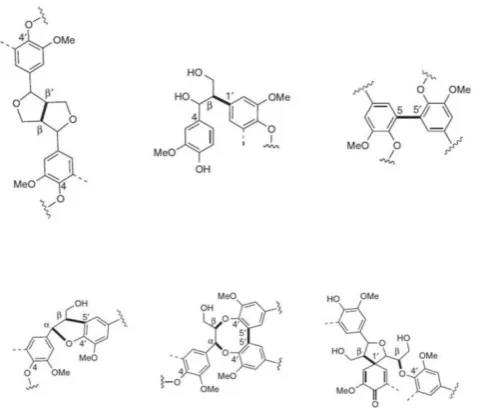
As a polyphenol, lignin has the potential as an antioxidant to prevent oxidation reactions in biofuels, animal feeds and polymeric composite materials. Structurally, lignin is a randomly crosslinked polymer consisting of three different phenylpropane derivatives mainly linked by ether bonds (Figures 1 and 2). Numerous studies were reported to elucidate the detailed 3D structure of lignin, including the formation of more complex bonds (as shown in Figure 2, last row) during biosynthesis, comprehensively reviewed by Lupoi et al. [18].
Figure 2. Most common monolignol linkages. First line: ether bonds (ß-O-4’, α-O-4’, 4-O-5’); second line: C -C-bonds (ß-ß’, ß-1’, 5-5’), and third line: more complex linkages (ß-5’/ α-O-4’, 5-5’/ ß-O-4’/ α-O-4’, ß-1’/ ß-O-4’). Reprinted from [15], published under a Creative Commons Attribution 4.0 International License.
The complex structure of lignin, composed of aromatic rings with hydroxy and methoxy functional groups, is responsible for this antioxidant potential, primarily due to the termination of the oxidation propagation reaction through hydrogen donation and single electron transfer reactions. The application of technical lignins as natural antioxidants has not been implemented in the industrial sector, mainly due to the highly non-homogenous, complex structure and high polydispersity of lignin. Typically, purification and fractionation steps are necessary to enhance its stabilizing effect [19,20]. Very recently, it could be shown that plant portions such as stem- and leaf-derived lignins significantly differ in their monolignol composition and connectivity [21,22]. In addition to their UV absorption properties, the free radical scavenging ability of phenolic groups gives lignin an excellent antioxidant property and can increase thermal and oxidation stability of polymers in blends [23]. Sugarcane bagasse lignin and modified lignins can serve as natural, safer and less expensive potential antioxidant substitutes for synthetic antioxidants such as BHT. Also, unmodified lignin from sugarcane bagasse and epoxy lignin could be used as natural antibacterials [24].
Cellulose coatings have already received widespread attention in the laboratory regarding their use in high-performance nanocomposite films that have a low environmental impact. These coatings may be used in optical, biological and medical sensors or in electronic applications. However, few coatings or nanocomposite films based on industrial lignins (e.g. lignosulfonates, kraft lignin and acetylated lignin) containing cellulose fibers, its commercial derivatives, or non-cellulosic polysaccharides, have been developed [25]. In the context of food preservation, few studies have been reported on the use of organic active principles (vegetal) against bacteria/fungi plant pathogens, while a large amount of literature is available on how these active agents can be incorporated in biobased polymeric matrices. It is important to remember how crop damage and the economic losses of agriculture production caused by plant pathogens both represent a serious worldwide problem that needs innovative and green strategies able to preserve important fresh productions during their transport and storage. Recently, the possibility of obtaining various functionalities by using the combination of different nanofillers, including antimicrobial activity, was also considered; cellulose nanocrystals and lignin nanoparticles for example were added to PLA films to both act as promising bioactive packaging for the preservation of fresh food products against food borne pathogens and to reinforce the PLA nanocomposites [26].
mechanical performance) and excellent gas and grease barrier properties, as well as its ability to retain a large amount of active compounds [27].
Chitosan, a copolymer of 2-glucosamine and N-acetyl-2-glucosamine units, is a polysaccharide isolated from crustacean shells, like crab and shrimp. It has been widely studied for application in biosensors, tissue engineering, separation films and water treatment, due to its excellent properties as an antioxidant and antibacterial agent, and for its good biocompatibility and biodegradability. However, some disadvantages, such as dissolution in highly acidic solutions, low surface area, high cost, poor thermal and mechanical properties, requires the combination with other components such as polyvinyl alcohol (PVA) to overcome the weakness [28].
In this work, lignin and chitosan were introduced in both binary (HPMC/lignin) and ternary (HPMC/lignin/chitosan) composite systems with different lignin types and weight loading using a solvent casting approach. The antiradical and antimicrobial activities of the prepared films were studied as well as the antimicrobial activities of added lignins.
2. Results and Discussion
2.1. Antimicrobial Activity of Lignin
Lignin purification fractions were tested against both gram-positive (S. aureus and L. monocytogenes) and gram-negative bacteria (E. coli) to test the effect of purification on the antibacterial activity. Unmodified lignins were found to be the most effective against Bacillus sp. (gram-positive bacteria) than against Klebsiella sp. (gram-negative bacteria) [24]. Rocca and others discussed the antibacterial activity of different lignins and nanocomposites containing lignin that have higher sugar content against S. aureus (known to present a thicker peptidoglycan layer) as a representative of gram-positive bacteria, and E. coli (contains more fatty acids) for gram-negative. They concluded that the interaction of the nanocomposites with the bacterial cell wall can be governed by the lignin structure helping not only the stability of the particles but also their selectivity towards different types of bacteria [29]. The disk diffusion method was applied on lignin purification fractions L1 to L4. The samples were dissolved first in ethanol and tested, then in acetone and tested and finally in DMSO and tested. The results showed that the inhibition zone of L1 increased from ethanol to acetone to DMSO. L2, L3 and L4 show no activity at all using ethanol and acetone while L2 showed slight activity against L. monocytogenes when dissolved in DMSO. This is due to the solubility of lignin in each solvent, where it is 100% soluble in DMSO, 60% soluble in acetone and 40% soluble in ethanol. This allows some small fraction to dissolve causing the antibacterial activity.
The effect of storage on the antibacterial activity of L1 was also studied, where a fresh sample of L1 was tested quantitatively against S. aureus. A fresh sample of L1 with a concentration of 0.1gml-1 gave a log10 reduction of 4.4, and 2.1 at the concentration of 0.001gmL-1. After storing L1 for 6 months, L1 showed better activity with a log10 reduction of 4.5 at 0.1gmL-1 and remained the same at 0.001gmL-1. This is demonstrated in Alzagameem et al. 2018 through the analytical analysis of fresh and stored fractions and the DPPH inhibitions as well as the total phenol contents of the studied fractions [13]. Lignin degradation by time produces low molecular weight species that have both antioxidant and antibacterial capacities.
Based on the effect of solvent on the antibacterial activity, further studies on lignin samples were done using DMSO to guarantee that all active species were dissolved and introduced to the tested platelets. Table 1 shows the result of the disk diffusion method of the studied purification fractions in addition to two softwood-based organosolv lignins: from spruce/pine (L5) and from beech (L6) as well as a grass-based organosolv lignin: from Miscanthus L7 for comparison purposes.
Table 1. Inhibition zones of lignin samples against S. aureus, L. monocytogenes and E. coli obtained by disk diffusion method.
Lignin platelets Bacteria
Reference DMSO
--
1x contaminated with yeast
--
L1 + (max 1-2mm) ++ (max 5mm)
L2 - + (max 1mm)
L3 - + (max 1mm), slight growth
in inhibition zone
L4 - -
L5 + (max 1mm) + (max 1-2mm)
L6 ++ (max 2-3mm) + (max 7mm)
L7 - -
- = no inhibition, overgrowth of platelets; - = no inhibition; + = Inhibition; ++ = strong inhibition; max = maximum: measured at the greatest distance from the plate.
The reference, which does not contain lignin, does not have any observed inhibiting effects on the bacteria, but is overgrown with colonies. L. monocytogenes has a higher antimicrobial efficacy than S. aureus. This can be seen by L1, L2, L5 and L6, in which inhibition zones around the platelets have formed on the L. monocytogenes plates. The tests show, as well, that the first fraction of the purification (L1 to L4) has the highest activity. Organosolv lignins obtained from softwood have certain activities while the lignin obtained from grass L7 has none. The beech based (L6) specifically has higher activity that the spruce/pine-based samples (L5); it actually has the highest activity among all the lignins studied. L1, on the other hand, as a Kraft lignin has higher activity than L5. The same with Organosolv lignins: gram-positive bacteria were inhibited more than gram-negative. In regard to E.coli, all studied lignins show no activity at all.
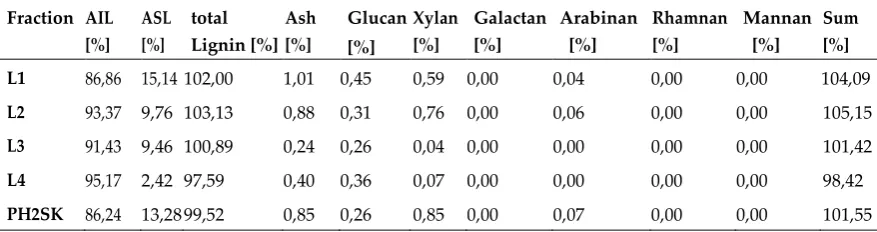
The antimicrobial mechanism may involve the generation of localized heat and reactive oxygen species (ROS) upon light irradiation. The sugar content of the lignin could be involved in the adhesion to the bacterial membrane, i.e. peptidoglycan layer present in the bacterial cell wall can help to attract sugars, and with them the nanocomposites attached, resulting in an increase in activity against S. aureus whereas it remains innocuous for E. coli. This shows good selectivity towards S. aureus [29]. The NREL results of the lignins L1 to L4 in Table 2 show that L1 has the lowest acid insoluble lignin content and the highest acid soluble content. Glucan content (polysaccharide) is the highest for L1. Also, only L1 and L2 have arabinan content. Xylan content for L1 and L2 as well was much higher than that for L3 and L4, but it seems that the effect of the acid soluble lignin content has the main role in the antibacterial activity since L1 was more active than L2 and it correlates with the antibacterial activity results. This supports the finding of Rocca et al. [29]. PH2 SK was extracted according to Klein et al. 2018 [15] at pH = 2 which has are almost the same NREL values as L2.
Table 2. Compositional analysis according to NREL procedure of kraft lignin fractions (L1 to L4, purified via solvent extraction and PH2SK, isolated at pH2 without further purification).
Fraction AIL [%] ASL [%] total Lignin [%] Ash [%] Glucan [%] Xylan [%] Galactan [%] Arabinan [%] Rhamnan [%] Mannan [%] Sum [%]
L1 86,86 15,14 102,00 1,01 0,45 0,59 0,00 0,04 0,00 0,00 104,09
L2 93,37 9,76 103,13 0,88 0,31 0,76 0,00 0,06 0,00 0,00 105,15
L3 91,43 9,46 100,89 0,24 0,26 0,04 0,00 0,00 0,00 0,00 101,42
L4 95,17 2,42 97,59 0,40 0,36 0,07 0,00 0,00 0,00 0,00 98,42
PH2SK 86,24 13,28 99,52 0,85 0,26 0,85 0,00 0,07 0,00 0,00 101,55
AIL = acid insoluble lignin; ASL = acid soluble lignin
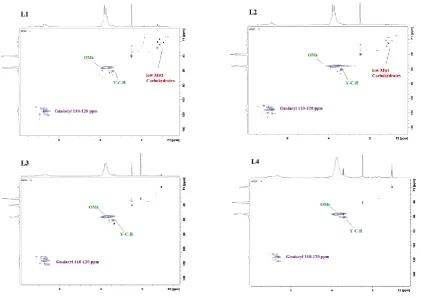
The HSQC analysis of the purification fractions in Figure 3 shows low molecular weight species
Figure 3. HSQC of lignin purification fractions: L1, L2, L3 and L4.
In addition, it could recently be shown that 2D HSQC NMR in combination with SEC measurements can be used to determine the molecular weights (Mw) of biopolymers using multivariate data analysis (i.e. principal component analysis) to simulate Mw data [30]. The 31P NMR analysis, on the other hand, shows the presence of aliphatic OH groups in all the purification fractions.
The number of OH groups in the lignin fractions (Table 3) was obtained from the 31P NMR analysis showing that the aliphatic OH number of the L1 samples was the highest, followed by L2, L3 and L4 which have half this number. Also, the number of the carboxylic acid OH groups for L1 was also the highest, demonstrating the antibacterial activity as it is usually related to its origin, and specifically due to the presence of phenolic compounds and different functional groups containing oxygen (methoxyl and epoxy groups) in its structure [18,19,24]. PH2SK was extracted according to Klein et al. 2018 [15]. Previous studies confirmed the degradation of lignin with temperature around 60 °C [13,19]. During the extraction of PH2SK, the black liquor was heated to 50-60 °C. The heating could have produced phenolic carboxylic acids, containing fragments which are demonstrated by the high number of phenolic carboxylic acid OH groups in Table 3. Primary antimicrobial activity tests showed certain activity of PH2SK against gram-positive bacteria which also matched with the NREL results.
Table 3. Number of OH in the lignin fractions as determined by 31P NMR analysis.
Aliphatic OH Condensed-OH G and dimethylated-OH
Carboxylic acids-OH
L1 8.70 5.04 6.30 0.59
L2 8.52 0.28 0.71 0.00
L3 3.81 2.99 2.91 0.16
L4 3.17 0.48 1.79 0.15
L5* 3.02 0.21 0.18 0.02
* L5 has S-OH: 0.01
In a previous study, X-ray diffraction (XRD) measurements confirmed the increase of the purification level from L1 to L4 [13]. For kraft lignin samples purified by selective extraction, the storage effects were observed to result in depolymerization being initiated by temperature and UV irradiation, respectively [31,32].
2.2. Preparation of Lignin-Derived Composites
Film preparation was based on the antibacterial activity results as well as the antioxidant activities of the lignins; the polymerization of HPMC-based films was limited to the selected active lignin samples: L1, L5 and L6 samples to be tested against gram-positive and gram-negative bacteria. The antioxidant activity of the lignins was studied using the DPPH assay [11]. Table 4 shows the DPPH inhibitions of the lignin samples. All of the lignin samples show a specific activity that varies from high (68.2% of L4) to low (31% of L7). Accordingly, lignins from L1 to L7 were added to HPMC and the antioxidant activity of the resulted films then was investigated.
Table 4. The DPPH inhibitions of kraft lignin fractions (L1 to L4) and organosolv lignins obtained from spruce/pine (L5), beech (L6) and Miscanthusx giganteus (L7).
L1 L2 L3 L4 L5 L6 L7
DPPH inhibition (%) 65.1 ± 3.7 66.8 ± 6.6 62.2 ± 9.5 68.2 ± 3.6 42 ± 1.9 64 ± 2.6 31±1.0
Figure 5. HPMC/lignin and HPMC/lignin/chitosan composite films.
2.3. Antiradical Activity of Lignin-Derived Films
radicals in the gas phase scavenged by essential oils supported on active packaging films containing essential oils [12]. The phenolic mobile hydrogen atom (ArO- H) plays the main role in the ability of
monomeric phenolic compounds to scavenge free radicals (R •). The process occurs according to the
following scheme: ArO- H + R • → ArO • + R- H [13]. In the plant cell wall, lignin is often associated with carbohydrate polymers. The nonphenolic carbohydrate impurities, which remain strongly associated with lignin during its isolation and purification, can decrease the concentration of active phenolic OH groups and negatively influence their reactivity (by increasing the O-H bond dissociation enthalpy). The phenoxy radicals in some lignins can take part in the reaction with oxidant radicals as secondary antioxidants [33]. Figure 6 shows the scavenging activity (SA) of free radical DPPH of the HPMC-based films. The films studied depended on the percentage of the lignin added; the lowest addition (5%), the highest addition (30%) and the lignin addition that produces the best film for each lignin sample.
Figure 6. Antioxidant activity of HMPC/lignin and HPMC/lignin/chitosan films. The measurements were held in triplets. The red data labels indicate the highest activity for each lignin type. The yellow points relate to the
standard deviation.
The results showed that the 5% addition of lignin had the highest SA% and the 30% had the lowest in which the UV absorption increased from the 5% to the 30% and the SA decreased. During the polymerization, lignin reacted with HPMC to form ether or ester bonds, when 5% of lignin was added; lignin is reactive to an extent where some phenolic OH groups are left free causing the SA, however, not every phenolic OH group takes part in the reaction with the free radical [33]. For the 30% addition, the high concentration of lignin increased the connectivity of HPMC-lignin, where it converted the phenolic OH groups to an ether or ester bond or even self-reacted; this decreased the number of active phenolic OH groups against oxidants and hence decreased the SA. Chitosan-lignin-HPMC films, in general, have higher SA than lignin-Chitosan-lignin-HPMC films because simply, the activity of neat chitosan, which is basically due to the hydroxyl and the amine groups [34], was added to the lignin-HPMC activity; also, the reaction between the components could happen on the α-position of the phenolic group in lignin, where an electron donating group (like methyl or methylene) increases the SA and an electron withdrawing group (like carbonyl or carboxyl) decreases the SA by increasing the polarization of the –OH bond and complicating its hemolytic dissociation [35,36]. The type of lignin added also affects the SA value. The trend of the SA of all the samples, based on the lignin type, was: organosolv of softwood > Kraft of softwood > Organosolv of grass. The Organosolv lignins, in general, had a higher methoxyl content than Kraft lignins which may act as a secondary antiradical
and the carbohydrates content is higher in kraft lignin than organosolv [37], resulting in a decreased SA value. Table 4 shows the DPPH inhibition of the added lignins, where L1 has the highest and grass-based organosolv lignin has lowest. This basically could be the reason why films with lignins from grass have lower antioxidant activity.
Small angle X-ray scattering (SAXS) studies are ongoing to obtain more detailed information regarding the film morphology including micro- and/or nanostructures as observed for lignin-derived polyurethanes [38,16].
2.4. Antimicrobial Activity of HPMC/Lignin and HPMC/Lignin/Chitosan Composites
The prepared films were tested against S. aureus and E. coli at 35 °C for 24 h in pure culture. In regard to Dohlen and coworkers those films that reached a log10-reduction Ø ≥ 2 log10 were tested
against B. thermosphacta (a gram-positive bacteria that is one of the most abundant spoilage organisms of fresh and cured meats, fish and fish products, due to its tolerance to high-salt and low-pH conditions, its ability to grow at refrigeration temperatures (4 °C), and its production of organoleptically unpleasant compounds and P. fluorescens (gram-negative bacteria that poses a significant spoilage problem in refrigerated (0-7 °C) meat and dairy products) [39,40]. A log10-reduction Ø ≥ 2 log10 units allowed the adaption of temperature and inoculated solution. The test was conducted at a constant temperature of 7 °C for 24 h. In case the Ø log10-reduction was ≥ 2 log10,
highly concentrated meat extract solution (18 μgmL-1) will be chosen as the reference media for perishable foods. Figure 7 shows the antimicrobial activities of the studied films against S. aureus and E. coli; while Figure 8 shows them against spoilage bacteria at low temperatures (B. thermosphacta and P. fluorescens).
Figure 7. Antimicrobial activity of HMPC/lignin and HPMC/lignin/chitosan films against S. aureus (above) and E. coli (below). All films are active against S. aureus. Columns in orange relate to non-active films against
E.coli. Chitosan incorporation increased the activity. L5 films showed highest activities against both bacteria.
The chitosan release did not have a significant effect on the samples and the activities of the chitosan films were close to each other. Also, the chitosan activity of the corresponding films dominates over the lignin activity. Thus, can be clearly seen from the chitosan-HPMC activity compared to the chitosan-HPMC-lignin activities, with the exception of the slight negative effect of lignin on the activity of the films in which more amino or OH groups of chitosan and/or lignin are involved in bonding with the HPMC blocking the antimicrobial activity for some of those functionalities.
Figure 8. Antimicrobial activity of HMPC/lignin and HPMC/lignin/chitosan films against B. thermosphacta
(above) and P. fluorescens (below). Columns in orange relate to non-active films against P. fuorescens.
In HPMC-lignin films, the 30% addition of L1 is the only active film against P. fluorescens; L5 and L6 showed no activity. In HPMC-lignin-chitosan films, the 5% addition of L5 had the highest activity. Strangely, activity of L1 against P. fluorescens was higher than that against B. thermosphacta; this may be due to the lignin release (which has to be clarified in ongoing studies).
3. Materials and Methods
3.1. Lignin Isolation and Purification
Industrial black liquor was obtained from Zellstoffwerk Blankenstein GmbH (Blankenstein, Germany). Kraft lignin was extracted via gradual acidic precipitation of black liquor using HCl and H2SO4 at specific pH, temperature and time of stirring variations. The results of these precipitation conditions were investigated for yield. The optimum acidification was the one using H2SO4 with stirring at room temperature and pH = 2 for 90–180 min to obtain the first fraction of lignin (L1). L1 was soaked with diethyl ether to produce the second fraction (L2). Selective extraction using acetone produced L3, another selective extraction of L3 using ethanol produced L4. Diethyl ether was used as a precipitating solvent for the selective extractions. The purification was monitored by thin layer chromatography (TLC): the fractions were dissolved in dimethyl sulfoxide (DMSO) for the spotting and a mixture of 10% n-hexane and 90% ethanol was used as the mobile face. Three organosolv lignins were prepared to be used for comparison studies: one from spruce/pine (L5), one from beech wood (L6) and one from Miscanthus (L7) according to an earlier published procedure [43].
The chemical composition (%, w/w) was determined according to the standard analytical procedures published by National Renewable Energy Laboratory (NREL) [44]. NREL measurements were performed by the BIOPOS Research Institute (Teltow-Seehof, Germany). HPLC analysis was conducted using water at a flow rate of 0.4 mL/min in a column (300 x 7.8 mm, Machery-Nagel, Germany) at a constant temperature of 90 °C. Structural carbohydrates in biomass and lignin samples were determined following NREL procedures [45-48].
3.3. 2D HSQC NMR Analysis
HSQC spectra were measured with 4 scans and 16 prior dummy scans. The data of 4k points were recorded with a spectral width of 7211 Hz, a receiver gain of 2050, and a total acquisition time of 0.28 s. O1 was set to 5 ppm (1H) and 80 ppm (13C).
3.4. 31P NMR Analysis
31P NMR spectra were acquired using 1H-31P decoupling experiment (Avance III 600, Bruker,
Karlsruhe, Germany) with 32 scans and 2 prior dummy scans. The data of 131,000 points were recorded with a spectral width of 12,175.324 Hz, a receiver gain of 2050, and a total acquisition time of 5.38 s.
3.5. Antioxidant Activity (DPPH Assay)
The DPPH inhibition was assessed by the procedure described by Alzagameem et al. [13]. The spectrophotometric method is based on the use of the free radical DPPH using a Jasco V-630 spectrophotometer. Extracted samples dissolved in dioxane/water (90:10, v/v) at a concentration of 1 g/L; 0.1 mL of the sample solution was mixed with 3.9 mL of a 6 10-5 M DPPH solution, and the absorbance at 518 nm of the mixture was measured at 15 min and 30 min, respectively.
3.6. Antimicrobial Activity of Lignins (Zone of Inhibition Test)
Inoculums of Staphylococcus aureus ssp. Aureus (DSM No 799), L. monocytogenes (DSM No 19094) and E. coli (DSM No 1576)were prepared by transferring a frozen culture to 10 mL of nutrient broth (Roth, Karlsruhe, Germany). Afterwards the broth was incubated at 37 °C for 24 h. In the beginning of each trial, the inoculum was diluted in physiological saline solution with tryptone (Oxoid, Hampshire, UK) to a final concentration of 107 cfu/mL. 1 mL of the suspension was spread with a sterile spatula over the surface of a plate count agar plate (Roth, Karlsruhe, Germany). Three filter papers were impregnated with the antimicrobial agent, 0.1g of lignin was dissolved in 1 ml DMSO and dried over a circular filter paper (0.5 cm of diameter) and three blank filter papers as references were applied on the inoculated agar plate. The agar plates were incubated for 24 h at 37 °C. A clear zone without microorganism growth (zone of inhibition) is related to the level of antimicrobial activity of the agent.
3.7. Film Formation
film forming solution, and stirred for 15 min at RT. 25 mL of the polymer solution were plated onto a glass and dried at RT for 36 h.
3.8. Antioxidant Activity (DPPH Test)
The DPPH radical scavenging activity for the studied films was determined according to the method proposed by Yang et al., with a slight modification [12]. Films (0.1 g) were cut into small pieces and immersed in 2 mL of methanol for 24 h at room temperature then centrifuged for 2 min. The obtained supernatant was analyzed for evaluation of DPPH radical scavenging activity: an aliquot of methanol extract (0.5 mL) was mixed with 0.5 mL of DPPH in methanol (50 mgL-1). The mixture was maintained at room temperature in the dark for 60 min. The absorbance was measured at 517 nm using a UV–Vis spectrometer (Jasco V-630 spectrophotometer, Silver Spring, MD, USA). The mixture solution of methanol extracted from neat HPMC and DPPH methanol was used as control. DPPH radical scavenging activity was calculated by using Eq. (1):
(RSA, %) = [(Acontrol – Asample)/ Acontrol] * 100, (1)
Where Asample was the absorbance of sample and Acontrol was the absorbance of the control.
3.9. Antimicrobial Activity of the Films
The antimicrobial activity of the samples was analyzed by modifying the Japanese Industrial Standard (JIS) Z 2801:2000 in order to test conditions typical for perishable products. The JIS is based on a comparison of bacteria counts (S. aureus, E. coli) in saline solution on reference and sample materials after a defined storage temperature and time (35 °C, 24 h) [50,51]. The material that shows a calculated log10-reduction ≥ 2.0 log10 units after 24 h is considered as an effective antimicrobial agent (JIS Z 2801:2000). If log10-reduction Ø ≥ 2 log10 units is reached, the antimicrobial activity against B. thermosphacta and P. fluorescens is then tested. The test will be conducted at a constant temperature of 7 °C for 24 h. In case the Ø log10-reduction is ≥ 2 log10, highly concentrated meat
extract solution (18 μgmL-1) will be chosen as the reference media for perishable foods [39,52,53].
4. Conclusion
In addition to antioxidant activity, lignins of different origins show distinct antimicrobial effects. Due to the obtained results, purification of Kraft lignin via solvent extraction has a negative effect on the antimicrobial activity against S. aureus and L. monocytogenes most obviously due to the presence of carbohydrate content and aliphatic OH groups which was supported by both NREL and NMR analysis. The biomass source (hard and soft wood, grasses) and pulping process influence both, antioxidant and antimicrobial activity. Organosolv lignins, in general, have a higher methoxyl content than Kraft lignins which may act as a secondary antiradical and the carbohydrate content is higher in kraft lignin than organosolv. In addition, the antimicrobial activity of the lignins depends also on the solvent polarity (as shown for ethanol, acetone and DMSO). Storage led to an increase in antimicrobial activity against S. aureus due to the degradation of lignin by time. The scavenging activity of both binary (HPMC/lignin) and ternary (HPMC/lignin/chitosan) systems was affected by the percentage of the added lignin. The lignin release in the produced films affected the activity positively and the chitosan addition enhances the activity even more for both gram-positive and gram-negative bacteria. Spoilage bacteria that grow at low temperatures such as B. thermosphacta and P. fluorescens were effected by lignin/chitosan composite films. The detailed mechanism .
Funding: Financial support via BMBF program “IngenieurNachwuchs” projects “LignoBau” (03FH013IX4).
Acknowledgments: Bonn-Rhein-Sieg University/Graduate Institute for scholar ship (A.A., M.B.) and Erasmus-Mundus Avempace-II scholar ship (A.A.); Bonn-Rhein-Sieg University/TREE institute (S.E.K.); North Carolina State University in conjunction with the DAAD RISE Scholarship Program (M.L.).
Conflicts of Interest: The authors declare no conflict of interest.
References
1. Chen, G.-G.; Fu, G.-Q.; Wang, X.-J.; Gong, X.-D.; Niu, Y.-S.; Peng, F.; Yao, C.-L.; Sun, R.-C. Facile synthesis of high strength hot-water wood extract films with oxygen-barrier performance. Scientific Reports 2017, 7,
41075, DOI:10.1038/srep41075.
2. Dilkes-Hoffman, L.S.; Pratt, S.; Lant, P.A.; Laycock, B. 19 - The Role of Biodegradable Plastic in Solving Plastic Solid Waste Accumulation. Plastics to Energy; Fuel, Chemicals, and Sustainability Implications Plastics Design Library 2019, pp. 469-505, DOI: 10.1016/B978-0-12-813140-4.00019-4.
3. Muthuraj, R.; Misra, M.; Kumar, A. Biodegradable compatibilized polymer blends for packaging applications: A literature review. J. Appl. Polym. Sci. 2018, DOI: 10.1002/app.45726.
4. Abdul Khalil H.P.S. Tye, Y. Y.; Leh, C. P.; Saurabh, C. K.; Ariffin, F.; Fizree, H. M.; Mohamed, A.; Suriani, A. B. (2018) Cellulose Reinforced Biodegradable Polymer Composite Film for Packaging Applications. In: Jawaid M., Swain S. (Eds.) Bionanocomposites for Packaging Applications. Springer, Cham, DOI:10.1007/978-3-319-67319-6_3.
5. Shankar, S.; Reddy, J. P.; Rhim, J-W. Effect of lignin on water vapor barrier, mechanical, and structural properties of agar/lignin composite films. Int. J. Biolog. Macromol. 2015, 81, 267-273, DOI: 10.1016/j.ijbiomac.2015.08.015
6. Kamm, B.; Kamm, M.; Hirth, T.; Schulze, M. Lignocelluloses Based Chemical Products and Product Family Trees. In Biorefineries-Industrial Processes and Products; Kamm, M., Kamm, B., Gruber, P.C., Eds.; Wiley-VCH: Weinheim, Germany, 2006; pp. 97–150, ISBN 3-527-31027-4.
7. Kamm, B.; Gruber, P.R.; Kamm, M. Biorefineries-Industrial Processes and Products. In Ullmann's Encyclopedia of Industrial Chemistry, Wiley-VCH: Weinheim, Germany, 2016; ISBN 9783527306732.
8. Su, Y.; Yang, B.; Liu, J. et al. Prospects for Replacement of Some Plastics in Packaging with Lignocellulose Materials: A Brief Review. BioResources 2018, 13, 4550-4576.
9. Ko, F. K.; Goudarzi, A.; Lin, L-T.; Li, Y.; Kadla, J. F. Lignin-Based Composite Carbon Nanofibers. Lignin in Polymer Composites 2016, 167-194, DOI: 10.1016/B978-0-323-35565-0.00009-6
10. Rinaldi, R., Jastrzebski, R., Clough, M. T., Ralph, J., Kennema, M., Bruijnincx, P.C.A., Weckhuysen, B.M. Paving the Way for Lignin Valorisation: Recent Advances in Bioengineering, Biorefining and Catalysis.
Angew. Chem. Int. Ed. 2016, 55, 2–54, DOI:10.1002/anie.201510351.
11. Liu, H. L.; Chung, H. Y. Lignin-Based Polymers via Graft Copolymerization. J. Polym. Sci. 2017, 55, 3515–
3528, DOI:10.1002/pola.28744
12. Yang, W.; Fortunati, E.; Dominici, F.; Kenny, J. M. ; Giovanale, G.; Mazzaglia, A.; Balestra, G. M.; Puglia, D. Effect of cellulose and lignin on disintegration, antimicrobial and antioxidant properties of PLA active films. Internat. J. Biolog. Macromol. 2016, 89, 360-368, DOI: 10.1016/j.ijbiomac.2016.04.068
13. Alzagameem, A.; El Khaldi-Hansen, B.; Büchner, D.; Larkins, M.; Kamm, B.; Witzleben, S.; Schulze M. Lignocellulosic Biomass as Source for Lignin-Based Environmentally Benign Antioxidants. Molecules 2018,
23, 2664, DOI:10.3390/molecules23102664.
14. Witzler, M.; Alzagameem, A.; Bergs, M.; El Khaldi-Hansen, B.; Klein, S.E.; Hielscher, D.; Kamm, B.; Kreyenschmidt, J.; Tobiasch, E.; Schulze, M. Lignin-Derived Biomaterials for Drug Release and Tissue Engineering. Molecules 2018, 23, 1885, DOI:10.3390/molecules23081885.
15. Klein, S.E.; Rumpf, J.; Kusch, P.; Albach, R.; Rehahn, M.; Witzleben, S.; Schulze, M. Utilization of Unmodified Kraft Lignin for the Preparation of Highly Flexible and Transparent Polyurethane Coatings.
RSC Adv. 2018, 8, 40765, DOI:10.1039/c8ra08579j.
16. Klein, S.E.; Rumpf, J.; Rehahn, M.; Witzleben, S.; Schulze, M. Biobased Flexible Polyurethane Coatings Prepared from Kraft Lignin: One-Pot Synthesis and Antioxidant Activity. J. Coat. Technol. Res., Manuscript ID: JCTR-D-18-00729 (accepted/in press).
Anhydrous Ammonia and Enzymatic Hydrolysis Process. Appl. Biochem. Biotechnol.2018, 184,350–365, DOI: 10.1007/s12010-017-2550-0
18. Lupoi, J.S.; Singh, S.; Parthasarathi, R.; Simmons, B.A.; Henry, R.J. Recent innovations in analytical methods for the qualitative and quantitative assessment of lignin. Renew. Sustain. Energy. Rev.2015, 49, 871–906, DOI:10.1016/j.rser.2015.04.091.
19. Alzagameem, A.; El Khaldi-Hansen, B.; Kamm, B.; Schulze, M. Lignocellulosic biomass for energy, biofuels, biomaterials, and chemicals. In Biomass and Green Chemistry, 1st ed.; Vaz, S., Jr., Ed.; Springer International Publishing: Basel, Switzerland, 2018; pp. 95–132, ISBN 978-3-319-66736-2, DOI:10.1007/978-3-319-66736-2. 20. Hansen, B.; Kamm, B.; Schulze, M. Qualitative and quantitative analysis of lignins from different sources
and isolation methods for an application as a biobased chemical resource and polymeric material. In
Analytical Techniques and Methods for Biomass Products; Vaz Jr, S., Seidl, P., Eds., Springer: Berlin, Germany, 2017; pp. 15–44, ISBN 978-3-319-41414-0, DOI:10.1007/978-3-319-41414-0.
21. Bergs, M. Einfluss von Miscanthus-Genotyp und Erntezeit auf Gehalt und Struktur von Lignin aus Organosolv-Verfahren. PhD thesis, Rheinische Friedrich-Wilhelms-University, Bonn, December 20, 2018. 22. Bergs, M.; Völkering, G.; Kraska, T.; Do, X.T.; Kusch, P.; Monakhova, Y.; Konow, C.; Pude, R.; Schulze, M.
Miscanthus X giganteus Stem versus Leave-derived Lignins Differing in Monolignol Ratio and Linkage. Int. J. Mol. Sci. 2019, 20, 1200, DOI:10.3390/ijms20051200
23. Sadeghifar, H.; Venditti, R.; Jur, J.; Gorga, R. E.; Pawlak, J. J. Cellulose-Lignin Biodegradable and Flexible UV Protection Film. ACS Sust. Chem. Eng. 2017, 5, 625−631, DOI: 10.1021/acssuschemeng.6b02003
24. Kaur, R.; Uppal, S. K.; Sharma, P. Antioxidant and Antibacterial Activities of Sugarcane Bagasse Lignin and Chemically Modified Lignins. Sugar Tech. 2017, 19, 675–680, DOI: 10.1007/s12355-017-0513-y 25. Hambardzumyan, A.; Foulon, L.; Bercu, N.B.; Pernes, M.; Maigret, J.E.; Molinari, M.; Chabbert, B.;
Aguié-Béghin,V. Organosolv lignin as natural grafting additive to improve the water resistance of films using cellulose nanocrystals. Chem. Eng. J. 2015, 264, 780–788, DOI: 10.1016/j.cej.2014.12.004
26. Yang, W.; Fortunati, E.; Dominici, F.; Giovanale, G.; Mazzaglia, A.; Balestra, G.M.; Kenny, J.M.; Puglia D. Synergic effect of cellulose and lignin nanostructures in PLA based systems for food antibacterial packaging. Europ. Polymer J. 2016, 79, 1-12, DOI: 10.1016/j.eurpolymj.2016.04.003
27. Rhimi, W.; Boulila, A.; Gheribia, R.; Khwaldia K. Development, characterization and application of hydroxypropylmethylcellulose films enriched with cypress seed extract. RCS Adv.2018, 8, 23615-23622, DOI: 10.1039/c8ra04369h
28. Yang, W.; Owczarek, J.S.; Fortunati, E.; Kozanecki, M.; Mazzaglia, A.; Balestra, G.M.; Kenny, J.M.; Torre, L.; Puglia D. Antioxidant and antibacterial lignin nanoparticles in polyvinyl alcohol/chitosan films for active packaging. Ind. Crops Prod. 2016, 94, 800-811, DOI: 10.1016/j.indcrop.2016.09.061
29. Rocca, D. M.; Vanegas, J. P.; Fournier, K.; Becerra, M. C.; Scaiano, J. C.; Lanterna, A. E. Biocompatibility and photo-induced antibacterial activity of lignin-stabilized noble metal nanoparticles. RSC Adv. 2018, 8, 40454–
40463, DOI: 10.1039/C8RA08169G
30. Monakhova, Y.; Diehl, B.W.K.; Do, X.T.; Witzleben, S.; Schulze, M. Novel method for the determination of average molecular weight of natural polymers based on 2D DOSY NMR and chemometrics: Example of heparin. J. Pharm. Biomed. Anal. 2018, 149, 128–132, DOI:10.1016/j.jpba.2017.11.016.
31. Do, X.T.; Nöster, J.; Weber, M.; Nietsch, A.; Jung, C.; Witzleben, S.; Schulze, M. Comparative Studies of Lignin Depolymerisation: Photolysis versus Ozonolysis in Alkaline Medium. In Proceedings of the Annual Conference of the GDCh Division Sustainable Chemistry, Aachen, Germany, 17–19 September, 2018. 32. Do, X.T.; Nietzsch, A.; Jung, C.; Witzleben, S.; Schulze, M. Lignin-Depolymerisation via UV-Photolysis and
Titanium Dioxide Photocatalysis. Preprints 2017, 2017100128, DOI:10.20944/preprints201710.0128.v1. 33. Ponomarenko, J.; Lauberts, M.; Dizhbite, T.; Lauberte, L.; Jurkjane, V.; Telysheva G. Antioxidant activity of
various lignins and lignin-related phenylpropanoid units with high and low molecular weight.
Holzforschung 2015, 69, 795-805, DOI: 10.1515/hf-2014-0280
34. Rajalakshmi, A.; Krithiga, N.; Jayachitr, A. Antioxidant Activity of the Chitosan Extracted from Shrimp Exoskeleton. Middle-East Journal of Scientific Research 2013, 16, 1446-1451, DOI: 10.5829/idosi.mejsr.2013.16.10.12033
35. Shen, D.K., Gu, S., Luo, K.H., Wang, S.R., Fang, M.X. The pyrolytic degradation of wood-derived lignin from pulping process. Bioresource Technol. 2010, 101, 6136-6146, DOI: 10.1016/j.biortech.2010.02.078 36. Dizhbite, T., Telysheva, G., Jurkjane, V., Viesturs, U. Characterization of the radical scavenging activity of
37. El Mansouri, N-E.; Salvadó, J. Structural characterization of technical lignins for the production of adhesives: Application to lignosulfonate, kraft, soda-anthraquinone, organosolv and ethanol process lignins. Ind. Crops Prod. 2006, 24, 8-16, DOI: 10.1016/j.indcrop.2005.10.002
38. Witzleben, S.T.; Walbrück, K.; Klein, S.E.; Schulze, M. Investigation of Temperature Dependency of Morphological Properties of Thermoplastic Polyurethane Using WAXS and SAXS Monitoring. J. Chem. Chem. Eng. 2016, 9, 494-499.
39. Dohlen, S., Braun, C., Brodkorb, F. Fischer, B., Ilg, Y., Kalbfleisch, K., Kreyenschmidt, M., Lorenz, R., Robers, O., and Kreyenschmidt, J. (2016) Potential of the polymer poly-[2-(tert-butylamino) methylstyrene] as antimicrobial packaging material for meat products. . J. Appl. Microbiol. 2016, 4, 1059-1070, DOI: 40. Stanborough, T.; Fegan, N.; Powell, S. M.; Tamplin, M.; Chandry, P. S. Insight into the Genome of
Brochothrix thermosphacta , a Problematic Meat Spoilage Bacterium. Appl. Environ. Microbiol. 2017, 83, 1-20, DOI: 10.1128/AEM.02786-16
41. Garrido-Maestu, A.; Ma, Z.; Paik, S-Y-R.; Chen, N.; Ko, S.; Tong, Z.; Jeong, K. C. C. Engineering of chitosan-derived nanoparticles to enhance antimicrobial activity against foodborne pathogen Escherichia coli O157:H7. Carbohydrate Polymers 2018, 197, 623-630, DOI: 10.1016/j.carbpol.2018.06.046
42. Kurniasih, M.; Purwati; Dewi, R. S. Toxicity tests, antioxidant activity, and antimicrobial activity of chitosan. The 12th Joint Conference on Chemistry, September 19-20, 2017, Semarang, Indonesia.
43. Qualitative and quantitative analysis of lignin produced from beech wood by different conditions of the Organosolv process. J. Polym. Environ. 2016, 24, 85–97, DOI:10.1007/s10924-015-0746-3.
44. Determination of Structural Carbohydrates and Lignin in Biomass. Available online:
https://www.nrel.gov/docs/gen/fy13/42618.pdf (accessed on 10 October 2018).
45. Sluiter, A.; Hames, B.; Ruiz, R.; Scarlata, C.; Sluiter, J.; Templeton, D.; Crocker, D. Determination of structural carbohydrates and lignin in biomass. Laboratory analytical procedure 2008, 1617.
46. Sluiter, A.; Ruiz, R.; Scarlata, C.; Sluiter, J.; Templeton, D. Determination of extractives in biomass (NREL/TP-510-42619). National Renewable Energy Laboratory, Golden 2008.
47. Sluiter, A.; Hames, B.; Hyman, D.; Payne, C.; Ruiz, R.; Scarlata, C.; Sluiter, J.; Templeton, D.; Wolfe, J. Determination of total solids in biomass and total dissolved solids in liquid process samples. National Renewable Energy Laboratory, Golden, CO, NREL Technical Report No. NREL/TP-510-42621 2008, 1–6.
48. Sluiter, A.; Hames, B.; Ruiz, R.; Scarlata, C.; Sluiter, J.; Templeton, D. Determination of ash in biomass (NREL/TP-510-42622). National Renewable Energy Laboratory, Golden 2005.
49. Sebti, I.; Chollet, E.; Degraeve, P.; Noel, C.; Peyrol, E. Water Sensitivity, Antimicrobial, and Physicochemical Analyses of Edible Films Based on HPMC and/or Chitosan. J. Agricult. Food Chem. 2007, 55, 693–699, DOI: 10.1021/jf062013n.
50. Braun, C.; Dohlen, S.; Ilg, Y.; Brodkorb, F.; Fischer, B.; Heindirk, P.; Kalbfleisch, K.; Richter, T.; Robers, O.; Kreyenschmidt, M.; Lorenz, R.; Kreyenschmidt, J. Antimicrobial Activity of Intrinsic Antimicrobial Polymers Based on Poly((tertbutyl-amino)-methyl-styrene) Against Selected Pathogenic and Spoilage Microorganisms Relevant in Meat Processing Facilities. J Antimicrob Agents 2017, 3, 1000136, DOI: 10.4172/2472-1212.1000136.
51. Dohlen, S.; Braun, C.; Brodkorb, F.; Fischer, B.; Ilg, Y.; Kalbfleisch, K.; Kreyenschmidt, M.; Lorenz, R.; Kreyenschmidt, J. Effect of different packaging materials containing poly-[2-(tert-butylamino) methylstyrene] on the growth of spoilage and pathogenic bacteria on fresh meat. Internat. J. Food Microbiol.
2017, 257, 91-100, DOI: 10.1016/j.ijfoodmicro.2017.06.007.
52. Hüwe, C.; Schmeichel, J.; Brodkorb, F.; Dohlen, S.; Kalbfleisch, K.; Kreyenschmidt, M.; Lorenz, R.; Kreyenschmidt, J. Potential of antimicrobial treatment of linear low-density polyethylene with poly((tert-butyl-amino)-methyl-styrene) to reduce biofilm Formation in the Food industry.Biofouling 2018, 34, 378-387, DOI: 10.1080/08927014.2018.1453926.
53. Strotmann, C.; Göbel, C.; Friedrich, S.; Kreyenschmidt, J.; Ritter, G.; Teitscheid, P. A Participatory Approach to Minimizing Food Waste in the Food Industry—A Manual for Managers. Sustainability 2017, 9, 66-87, DOI:10.3390/su9010066.