PROBLEMS IN DEFINING AND ELICITING
'SCIENTIFIC' PROCESSES USING PRACTICAL
TASKS WITH PRIMARY SCHOOL CHILDREN.
ANGEL DANIEL LOPEZ Y MOTA
ABSTRACT
The inclusion of science in the primary school curriculum makes it necessary to have plausible scientific activities that fulfil certain educational objectives. The purpose of this study is to show to what extent it is possible to combine such criteria.
Tasks have been constructed, each in two versions - Structured and Investigation plus Goal - in each four topic domains. Levels of success are given for both versions of the tasks, both overall and in relation to their cognitive demands.
The tasks are constructed so as to elicit, as far as possible, a number of 'scientific processes'. This notion is not, however, taken for granted. The study looks at processes in the context of the tasks; at when it makes sense to label processes as such or when they are better considered as content bound, and at the nature of what in fact has been elicited from children.
It has been possible to answer some questions related to children's 'scientific' behaviour such as, How complete are children's investigations?, Do children notice relevant phenomena? Do they draw conclusions from what they noticed? How well do children identify and control variables?, How good are children at using 'what-if reasoning', What explanations of the phenomena do children give? and, Do children make notes when doing an investigation?
ACKNOWLEDGEMENTS.
TABLE OF CONTENTS:
Page No.
Abstract. 2
Dedication. 3
Acknowledgements. 4
INDEX OF FIGURES. 10
INDEX OF TABLES. 14
CHAPTER 1: A FRAMEWORK FOR THE STUDY. 16
1.1 A linear model. 17
1.2 A critical model. 18
1.2.1 Problems of transfer from the nature of science. 19
1.2.1.1 Concerning processes. 20
1.2.1.2 Concerning the eliciting tasks or devices 23
1.2.2 Problems of defining and matching. 24
1.2.3 Problems of eliciting and discriminating. 25
1.2.3.1 Processes and performance. 25
1.2.3.2 Tasks and performance. 27
1.2.4 Children's performance and the nature of science. 27
1.3 Summary. 27
CHAPTER 2: MAIN ISSUES IN RELATION TO 'SCIENCE
PROCESSES' AS ELEMENTS OF THE ELEMENTARY SCIENCE
CURRICULUM. 30
2.1 Importance given to science processes and practical activities. 31 2.2 Scientific processes and practical activities in some curriculum
projects and assessment schemes. 37
2.2.1 Curriculum development projects. 37
2.2.2 Assessment schemes. 45
2.3 Main issues in relation to 'scientific' processes in elementary
schools. 50
2.3.1 Problems of transfer from the nature of science. 50
2.3.2 Problems of defining and matching. 53
2.4 Problems of defining and eliciting 'scientific' processes using a
more detailed example. 57
2.4.1 Description of APU work on 'Performing Investigations'. 57 2.4.2 Critical discussion of APU's work on 'Performing
Investigations'. 61
2.4.3 Summary. 71
CHAPTER 3: RATIONALE AND STRUCTURE OF TASKS. 72
3.1 Rationale for structure and selection of tasks. 72
3.1.1 Rationale of tasks. 72
3.1.2 Criteria for the design of tasks. 74
3.1.3 Task content. 75
3.1.4 Investigation plus Goal tasks. 76
3.1.5 Structured tasks. 77
3.2 The form given to all tasks. 77
3.2.1 Investigation plus Goal tasks. 77
3.2.1.1 Structure of tasks. 77
3.2.1.2 Procedure used for tasks. 78
3.2.1.3 Description of tasks. 79
3.2.1.4 Observation records. 80
3.2.2 Structured tasks. 81
3.2.2.1 Structure and description of tasks. 81
3.2.2.2 Procedure used for tasks. 84
3.3 What do teachers think about the tasks? 84
CHAPTER 4. DATA COLLECTION. 89
4.1 Design of the study. 89
4.2 Collection of data. 92
CHAPTER 5: CONSTRUCTING DATA IN TERM OF PROCESSES. 93
5.1 Investigation plus goal tasks. 93
5.1.1 Searching. 93
5.1.2 Controlling variables and replicating. 100
5.1.3 Making notes. 103
5.2 Structured tasks. 104
5.2.1 Noticing. 105
5.2.2 What-if reasoning. 109
5.2.3 Remaining 'processes'. 111
CHAPTER 6: TASKS AS PRACTICAL ACTIVITIES. 113
6.1 What age were the pupils? 113
6.2 How long do they take? 113
6.3 Can children succeed? 115
6.4 Are some tasks more difficult than others? 117
6.5 How consistent are levels of performance across tasks? 118 6.6 Do levels of success between both kind of tasks relate? 119 6.7 Are there signs of learning effects by performing different kind of
task? 120
6.8 How do teachers expectations relate to children's performance? 122
CHAPTER 7: HOW MUCH DO PROCESSES DEPEND ON TASKS? 125
7.1 Structured version of the tasks. 125
7.1.1 What is the nature and extent of processes? 125
7.1.1.1 Noticing. 126
7.1.1.2 Making generalizations. 128
7.1.1.3 Identifying variables. 129
7.1.1.4 Imagining causes. 131
7.1.1.5 Understanding. 134
7.1.1.6 'What-if reasoning. 136
7.1.1.7 Processes across tasks. 138
7.1.2 What would be expected from processes within a task? 139
7.1.2.1 Balancing. 139
7.1.2.2 Floating. 141
7.1.2.3 Rolling. 142
7.1.2.4 Black Boxes. 142
7.1.2.5 Processes within a task. 144
7.2 Investigation plus Goal version of the tasks. 145
7.2.1 What is the nature and extent of processes? 145
7.2.1.1 Searching. 145
7.2.1.3 Replicating. 147
7.2.1.4 Making notes. 147
7.2.1.5 Processes across tasks. 149
7.2.2 What would be expected from processes within a task? 149
CHAPTER 8: TASKS AND PROCESSES: WHAT DID CHILDREN
ACTUALLY DO? 151
8.1 How complete and are children's investigations? 151
8.2 Do children observe or notice relevant phenomena and draw
conclusions from them? 158
8.2.1 How good are children at noticing relevant phenomena? 158 8.2.2 How good are children at drawing conclusions by making
generalizations? 162
8.3 How well do children identify and control variables? How does
this relate to their understanding of the task. 167
8.3.1 How good are children at identifying variables? 167
8.3.1.1 What would count as a variable? 167
8.3.1.2 What is the nature of a variable? 169
8.3.1.3 How well do children identify variables? 170 8.3.1.4 How well do children justify what they identify as a
variable? 171
8.3.1.5 How well do children perform in identifying
variables? 172
8.3.2 How good are children at controlling variables? 174 8.3.2.1 How systematic are children in controlling variables
when changing configuration? 175
8.3.2.2 How systematic are children in controlling variables
within the same configuration? 177
8.3.2.3 How systematic are children overall? 179
8.3.2.4 How well do children control variables and replicate
results? 182
8.4 How are children in 'what-if reasoning? 184
CHAPTER 9: DO PROCESSES RELATE TO PERFORMANCE IN
SOLVING THE TASKS? 200
9.1 Do spontaneous processes relate to success in the investigation? 200 9.2 Do requested processes relate to success in the investigation tasks? 202
CHAPTER 10: CONCLUSIONS. 208
10.1 Tasks. 209
10.1.1 As potentially pedagogic devices. 209
10.1.2 As potentially diagnostic devices. 210
10.2 Processes. 211
10.2.1 Problems of defining. 212
10.2.2 Problems of eliciting. 212
10.3 Children's behaviour. 213
10.3.1 Some commonsense features of children's behaviour. 213
10.4 Summary. 215
REFERENCES. 216
BIBLIOGRAPHY. 221
APPENDICES.
A. Instruments (Investigation plus Goal tasks). 223
B. Instruments (Structured tasks). 240
C. Instrument (Teacher's questionnaire). 261
D. Search-space tables. 264
E. Categories and results. 270
F. Correlation tables for all questions (Structured tasks). 297 G. Means and standard deviations for learning results. 302
H. Tables for 'controlling changes'. 304
INDEX OF FIGURES.
Page No. 1.1 Linear model of defining and eliciting children's scientific
behaviour. 17
1.2 Critical model of defining and eliciting children's 'scientific'
behaviour. 19
3.1 Teacher's expectations of children's problem-solving performance
by tasks in percentages. 85
3.2 Amount of teachers that would use the tasks as teaching devices. 86 3.3 Teacher's reasons why they would use the Investigation plus Goal
tasks. 86
3.4 Teacher's rating of Investigation plus Goal tasks difficulty. 86 3.5 Teacher's expectations of children's performance on certain
scientific processes by percentages. 87
3.6 Teacher's levels of agreement on the importance of certain science
processes as educational aims in percentages. 87
4.1 Model of the design of the study. 90
5.1.1 Search space, formed by configurations, for the Balancing task. 95 5.1.2 Configurations for the Balancing task; showing sample
combinations of bricks and positions of bricks for each
configuration. 96
5.1.3 Search space, formed by configurations, for the Floating task. 97 5.1.4 Search space, formed by configurations, for the Rolling task. 98 5.1.5 Search space, formed by configurations, for the Black Boxes
task taking boxes as entities. 99
5.1.6 Search space, formed by configurations, for the Black Boxes
task taking boxes as analytically comparable. 99
6.1 Distribution of children's age in months. 113
6.2 Distribution of average times of performance in minutes. 114 6.3 Distribution of time's performance in minutes for the Investigation
plus Goal tasks. 114
6.4 Distributions of time's performance for the Structured tasks. 115 6.5 Levels of success per task in the Investigation plus Goal version. 116 6.6 Distribution of proportional levels of performance on the Structured
tasks. 116
6.7 Average performances on the Investigation plus Goal tasks. 117 6.8 Children's performance on the Investigation plus Goal tasks in
6.9 Children's levels of performance on certain processes in percentages. 123 8.1.1 Number of attempts made in each group of configurations
indicating the number of children performing on each one of them
in the Balancing task. 152
8.1.2 Percentage of attempts made depending on success/failure and
group of configurations in the Balancing task. 153
8.1.3 Number of attempts made per configuration and group of
configurations in the Black Boxes task. 154 8.1.4 Number of attempts made in each configuration within each
solution or group of configurations in the Floating task. 154 8.1.5 Number of attempts made in each group of configurations
indicating the number of children on each one in the Rolling
task. 156
8.1.6 Rate of success within each group of configurations depending whether the open section of the trap was facing the gun or not in
the Rolling task. 156
8.1.7 Extent of the investigation through the search space per task. 157 8.2.1.1 Number of children noticing some phenomena in the Balancing
task. 159
8.2.1.2 Number of children noticing a ball moving across different
distances in the Black Boxes task. 159
8.2.1.3 Number of children noticing some phenomena in the Floating
task. 160 8.2.1.4 Number of children noticing some trajectories in the Rolling
task. 161 8.2.1.5 Number of children scoring on Noticing some Phenomena
depending on level of performance, question and task. 162 8.2.2.1 Number of children making generalizations in the 1st and 2nd
questions per task. 163 8.2.2.2 Fraction of sound generalizations according to type in the
Balancing task. 163 8.2.2.3 Fraction of children that made certain type of sound
generalizations in the Floating task. 164 8.2.2.4 Fraction of children that made certain type of sound
generalizations in the Rolling task. 165 8.2.2.5 Fraction of children making certain type of sound
depending on level of performance and task. 166 8.3.1.1 Number of children answering 'what do you think makes
the straws float differently?'. 168
8.3.1.2 Number of children that identified some trajectories of the
ball as possible. 168 8.3.1.3 Children's answers to the question 'what do you think
makes the balance level?'. 170
8.3.1.4 Number of children that identify a specific variable in each task. 170 8.3.1.5 Number of children that identify a variable in first and second
places. 171
8.3.1.6 Number of children identifying a particular variable in 1st and
2nd instance per task. 171
8.3.1.7 Number of children per task and instance that identify a variable
and justify it. 172
8.3.1.8 Number of children identifying a variable and giving a sound
justification per task and question. 173
8.3.1.9 Percentage of children on Identifying Variables depending on
band of performance and task. 174 8.3.2.1 Fraction of attempts made when changing configuration and
changing 1, 2, 3 or 4 variables per task. 175 8.3.2.2 Fraction of attempts made within the same configuration
changing 0, 1 or 2 variables per task. 178 8.3.2.3 Fraction of attempts made in all conditions and changing
0, 1, 2, 3 or 4 per task. 179
8.3.2.4 Fraction of attempts made in all conditions depending on number of changes introduced and whether there is success or
failure per task. 180
8.3.2.5 Level of systematism in controlling variables when changing
configurations per task. 182
8.3.2.6 Fraction of attempts made changing configuration and changing
1, 2, 3 or 4 variables after success or failure per task. 182
8.3.2.7 Level of replicating results per task. 183
8.4.1 Number of children compensating by weight or distance in the
Balancing task. 185
8.4.2 Number of children justifying their prediction in the Balancing
task. 185
8.4.3 Number of children predicting correctly the highest and the lowest
8.4.4 Number of children justifying the highest and lowest floating
levels in the Floating task. 186
8.4.5 Number of children choosing a place for 'gun' and 'trap' being
fixed either the place of the 'gun' or the 'trap' in the Rolling task. 187 8.4.6 Number of children predicting a plausible path when either the
'gun' or the 'trap' is fixed in the Rolling task. 187
8.4.7 Number of children justifying their prediction depending on whether the 'gun' or the 'trap' was already fixed in the Rolling
task. 188
8.4.8 Number of children that practically set the ball in a certain number
of corners in the Black Boxes task. 189
8.4.9 Number of children making an identification depending on form
and result in the Black Boxes task. 190 8.4.10 Number of children that establish a test in order to make a
discrimination of one of three boxes in the Black Boxes task. 190 8.4.11 Number of children scoring on 'What-if Reasoning depending
on band of performance and task. 191 8.5.1 Number of children imagining a cause for the balance being tilted
or level in the Balancing task. 192
8.5.2 Proportion of children that identified an agent of causation in the
Black Boxes task. 193 8.5.3 Proportion of children that assigned or not a role to water in
keeping the straw up in the Floating task. 194 8.5.4 Proportion of children giving an explanation for why things float
or sink in the Floating task. 194 8.5.5 Number of children that give a reason to why a liquid that makes
everything float in it could exist according to having answered yes
or not in the floating task. 195
8.5.6 Number of children identifying a cause for two different rollings
in the Rolling task. 195
8.5.7 Number of children imagining a cause depending on their
performance and the task. 196
8.6.1 Number of children that make notes depending on how relevant
they were and the task. 197
8.6.2 Levels of performance on Making Notes in all the tasks. 199 10.1 Critical model of defining and eliciting children's 'scientific'
INDEX OF TABLES.
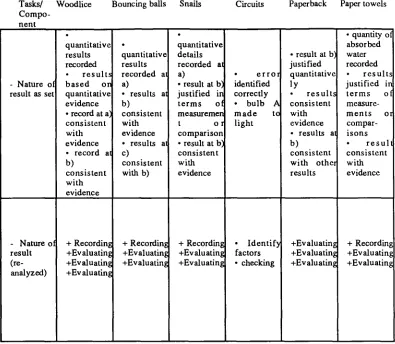
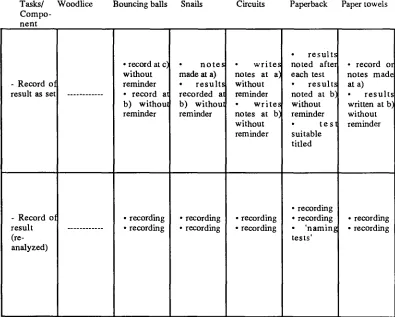
Page No. 2.4.1.1 Description and re-analysis of some features of the tasks of the
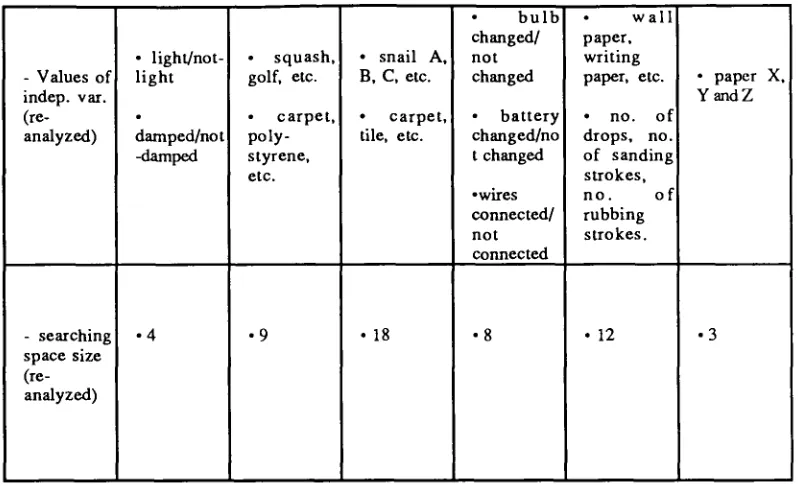
1982 APU survey. 63
2.4.1.2 Description and re-analysis of the check-points for 'General
approach' in all tasks. 64-65
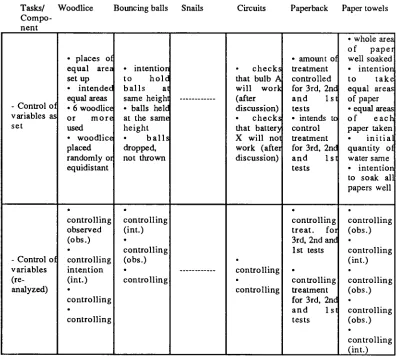
2.4.1.3 Description and re-analysis of the check-points for 'Control
of variables' in all the tasks. 66
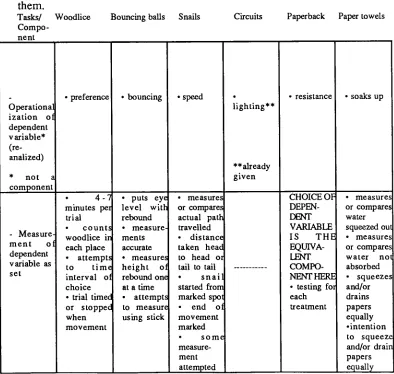
2.4.1.4 Description and re-analysis of the check-points for 'Measurement
of dependent variable' in all the tasks. 67-68
2.4.1.5 Description and re-analysis of the check-points for 'Nature of
result' in all the tasks. 69
2.4.1.6 Description and re-analysis of the check-points for 'Record of
result' in all the tasks. 70
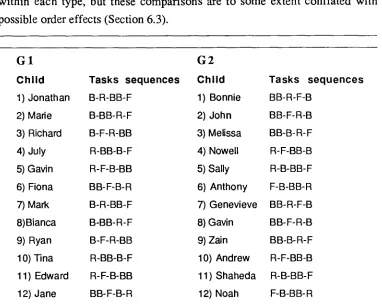
4.1 Order (of performance) in which children did the tasks. 91 5.2.1 Contingency tables for 'noticing' within a task. 108
5.2.2 Contingency tables for 'what-if reasoning. 110
5.2.3 Description of how subtasks were added up in each 'process'
and task. 112
6.1 Pearson product-moment correlations between levels of
performance on the Structured tasks. 118
6.2 Contingency tables for levels of performance on the Investigation
plus Goal tasks, per task. 119
6.3 Contingency tables for levels of success on both versions, per task. 119 6.4a Analysis of variance for children's performance on the Balancing
task. 121
6.4b Analysis of variance for children's performance on the Black
Boxes task. 121
6.4c Analysis of variance for children's performance on the Floating
task. 121
6.4d Analysis of variance for children's performance on the Rolling
task. 121
7.1.1 Contingency tables for 'noticing'. 127
7.1.2 Contingency tables for 'making generalizations'. 129
7.1.3 Contingency tables for 'identifying variables'. 130
7.1.4 Contingency tables for 'imagining causes'. 132
7.1.5 Contingency tables for 'understanding'. 136
7.1.7 Relationships between 'processes' in Balancing. 140
7.1.8 Relationships between 'processes' in Floating. 141
7.1.9 Relationships between 'processes' in Rolling. 142
7.1.10 Relationships between 'processes' in the Black Boxes. 143
7.2.1 Contingency tables for 'searching'. 146
7.2.2 Contingency tables for 'control of variables'. 146
7.2.3 Contingency tables for 'replicating'. 147
7.2.4 Contingency tables for 'making notes'. 148
7.2.5 Contingency tables for 'searching' and 'making notes' in all
four tasks. 150
8.3.1 Percentage of attempts changing configuration as opposed to staying in the same configuration, depending on success or
failure, for all tasks except Black Boxes. 181
8.3.2 Percentage of attempts changing 2 or more variables, as opposed to changing 0, 1, depending on success or failure, for all tasks
except Black boxes. 181
9.1 Contingency tables showing the relationships between 'spontaneous' processes derived from the Investigation plus Goal tasks and
performance in solving the problem on such tasks. 201
9.2 Contingency tables showing the relationships between 'noticing' an 'identifying variables' with success in solving the problem in
the Investigation plus Goal tasks. 203
9.3 Contingency tables showing the relationships between 'making generalizations' and success in solving the problem in the
Investigation plus Goal tasks. 204
9.4 Contingency tables showing the relationships between 'what-if reasoning and 'imagining causes' with success in solving the
problem in the Investigation plus Goal tasks. 205
9.5 Contingency tables showing the relationships between 'understanding' and success in solving the Investigation plus
Chapter 1.
A FRAMEWORK FOR THE STUDY.
This chapter discusses some of the problems concerning so called 'scientific processes', especially those concerning primary school children, in order to establish a framework for the research.
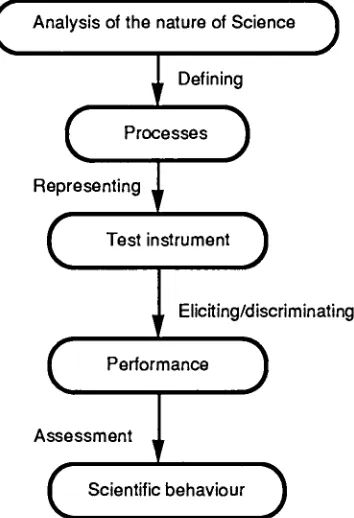
Interest in 'scientific processes', as a framework within which to plan and think about the meaning of 'science' for primary school science activities, has been and continues to be strong. There has been a continuing debate between the importance of 'process' and 'content', the latter usually understood as acquiring scientific concepts. The particular way in which 'scientific processes' have been understood by different curriculum development projects and researchers has certainly been varied (see chapter 2). A common approach has been to identify 'scientific processes' from the philosophy of science, whether in the context of justification or of discovery, and then to derive from this their importance for primary school children. The main feature of this approach is that the possibility of the existence of the chosen 'science processes' in children, given suitable teaching, is in a sense taken for granted, due to the way they are defined: indeed they define what is taken to be important for children to learn. The logic of this position is essentially linear, as illustrated in Figure 1.1: pre-defined 'processes' are to be taught to children and then to be elicited from them in some valid and reliable way. This way of proceeding tends to assume that there is nothing essentially problematic about defining 'scientific processes' in one context (science and scientists) and looking for them, or something like them, in another (the child and the school). What the child can or should do need not be the mirror image of what a scientist does.
1.1 A LINEAR MODEL.
This extreme and perhaps unrealistic model (Figure 1.1), represents as a logical sequence the derivation from a source which defines the nature of 'scientific processes', through an instrument to elicit such behaviours, and measurement of performance of children. Seen as such it discourages us from questioning the relationships between all these elements.
In this model the purpose of engaging children in 'scientific'
activities, whatever this means, tends to be seen as evaluating or assessing how well they do in such activities, in order to judge the attainment of some educational objectives. Two elements that stand out in this model are the test instrument and its function of summary assessment.
( Analysis of the nature of Science
Defining
( Processes )
Representing
( Test instrument )
1 Eliciting/discriminating
( Performance )
Assessment
( Scientific behaviour •
1
Figure 1.1: linear model of defining and eliciting children's scientific behaviour.
elicited and to be measured. That is, because the 'scientific processes' are taken as being pre-defined, the appropriate strategy seems to be to use the best psychometric resources available, so as to measure them reliably and validly. Looked in this way, the model of Figure 1.1 seems to offer a way of knowing how children perform on some 'scientific processes', often implemented by means of 'paper and pencil' tests, and therefore being in a position to judge to what extent certain educational objectives have been achieved.
In this linear model, the elements and relations between them can be taken as problematic. There are, for example, different analyses of the nature of science which can be (and have been) taken as starting point. There can be differences about the basic nature of the test instrument (paper and pencil, versus practical tasks). The linear nature of the model, however, represents these issues as needing to be resolved in a logical progression, solving each before proceeding to the next. In addition, the model has no way of starting from acceptable, interesting, or valuable pedagogical activities as they actually exist. It does not allow for deriving a rationale from existing practice.
1.2 A CRITICAL MODEL.
Practice of science/analysis of the nature of science Scientific behaviour?
Transfer?
Transfer?
Defining/matchin
Pedagogical practice (TASKS)
Eliciting/
discriminating Eliciting/ discriminating
(
Performance
)
4
Figure 1.2: critical model of defining and eliciting children's 'scientific' behaviour.
The model shows essentially the same elements as those depicted in the linear model, with the addition of mutual interactions between them, the incorporation of scientific practice as source of reference and the setting of tasks in the context of pedagogical practice.
The elaboration of this viewpoint can be divided into two main branches, one theoretical and one experimental. The theoretical one includes the relationships of the philosophy and practice of science with 'processes', and with the choice of tasks in relation to pedagogical practice. That is, what teachers and scientists do is taken as an essential point of reference. Tasks given to children need to be justified from both points of view. The experimental, concerns the relationships between 'processes' and tasks, the relationships of both of these with children's actual performance, and the relationship of children's performance with scientific practice.
The discussion will begin with the theoretical issues, and continue with the experimental ones.
1.2.1 PROBLEMS OF TRANSFER FROM THE NATURE OF SCIENCE.
1.2.1.1 Concerning processes.
There is a reason why 'processes' are currently so prominent in thought about science education for primary school children. It is the movement towards emphasizing the active role of individuals in constructing knowledge that has been restored in opposition to a passive view of learning. That is, active methods based on the methods of science have been implemented and preferred to those that emphasize learning the 'facts' of particular subject matters; leading to the stress on the so called 'scientific processes', and to their use as fundamental elements in structuring the curriculum, indeed lying behind the metaphor of children as scientists.
Having accepted that it is desirable to promote children's engagement in science activities, particularly those concerning the method or methods of science, two problems have to be faced. The first concerns the assumption that science can be characterized by its methods, and the second the problem of deciding from what analysis of science to draw the 'processes'. The question whether science can be characterized by its methods (and whether they 'assure' true knowledge ) is beyond the scope of this research needing an answer within the domain of philosophy of science or epistemology. The question of how valid it is to represent scientific activity by 'science processes' ('method') in the classroom is a different one. Science processes as part of learning about "How can we find out?" and "How do we know?", represent one line of development in science education (Ogborn, 1988a, 1988b); other lines being learning about "What are things like?" or "What are they made of?" (the ontological line), "How does it work?" (the causation line), "What does it mean?" (the communication line) and "What can we do ?" (the pragmatic line).
Assuming that 'scientific processes' can, to certain a extent, validly represent scientific activity in the classroom two problems arise:
1) whether it can be assumed that a simple and direct transfer from a logical reconstruction of scientific activity (philosophy of science: whether from context of justification or discovery) to an educational environment (science education) is possible and,
2) whether it is appropriate, as has happened, that 'scientific processes' can be identified by drawing mainly on one position, namely the inductivist-empiricist tradition.
by professional scientists have the same nature in children's educational activities with a 'scientific' content inside the classroom, neglecting their differences in nature, purpose and constraints. To make explicit this distinction Martinand uses the term 'practice of reference' ('pratique de reference') to refer to a context (practice of professional scientists) different from the educational one (Martinand, 1983, 1986). A distinction has also to be made between the actual performance of scientists when engaged in a scientific problem and the logical reconstruction of their actions by philosophers in trying to address the problem of how scientific knowledge is achieved - that the context of discovery is not the same as the context of justification (Ziman, 1984). Similar distinction has to be made between the actual children's performance and the representations made to explain how children go from one level of understanding to a more complex one, as part of a different practice, the educational one.
To better understand the differences between a professional practice and a pedagogical or educational one, the three differences mentioned will be described further. The professional practice usually implies a specific training to become a member of a particular community in a given field of study; it is a way of living. Children at school are at best just trying to grasp the basics of science; they do not make their living by performing the tasks set in the laboratory or in the classroom. The purpose of the two practices is different. One is trying to generate reliable and valid knowledge which stands replication and criticism, and the other one is trying to gain some learning or 'insight' in relation to knowledge that has already been 'produced' elsewhere. The constraints are different as well, because in professional practice scientists are helped in their purpose of getting reliable knowledge by criticism from within the scientific community; something which makes the scientific enterprise not only a personal activity but also a social one. On the other hand children's work is judged individually, not as to whether it stands criticism or not; but by evaluating if they attained particular learning goals. That is, scientific activities for children are to be seen as contributing to their personal development; for scientists as contributing to the production of knowledge. This difference will inform the discussion of the empirical work undertaken in this study.
('decontextualisation') - because of changing context - and a process of 'recontextualization' ('recontextualization') - because of adapting to a different context -, if an appropriate transfer is desired. It may well be that both practices could be 'similar', but analytically they are qualitatively different. Obviously, there remain the problems of deciding what the didactic transposition acts upon (what processes would be proper for young children), and of finding out experimentally how effectively and appropriate they are for children at a given age. This last is central to the present research.
The second problem, of whether the inductivist-empiricist tradition should be the main primary source of ideas about possible 'processes' in the educational context leads us to consider whether at least two more should be recognized: the rationalist and social constructivist traditions. It is certainly not my intention to solve this problem at the level of epistemology or philosophy of science, but I shall adopt the view that there is no such thing as 'the scientific method'; but that there is a diversity of them.
Within the inductivist-empiricist tradition it was assumed that there was a unique method, the so called 'scientific method', that could whatever the content of the science, be applied in order to assure reliable and valid knowledge; a view that now seems to be history. Nevertheless, the effects of such a conceptualization reached the educational context in the form of assuming that processes are independent of content; allowing for structuring entire curriculums based on this idea (Science- A Process Approach (Gagne, 1965); Warwick Process Science (Screen, 1986). Because the content is seeing as being processed by a method which gives automatic assurances of reliability and validity, these processes appear to be a secure basis for a curriculum. The present study is designed to produce evidence of the relationship between process and content. Even if it were the case that in the context of science there was one valid scientific method, independent of content, such an assumption is not necessarily valid in the educational context: experimental evidence would be needed to support any claims that the transposed 'processes' also exist independent of content.
two examples clearly show that the source of processes is not limited to just one tradition, and that there is no reason why they should not be mixed in the same model within an educational context. Further, it can be admitted that valid processes can also be found, not in science, but in pedagogical practice. Classroom practice may have a rationality of its own, independent of that of any source discipline.
1.2.1.2 Concerning the eliciting tasks or devices.
In the linear model, the test or eliciting instrument derives its nature from something else - as discussed above. If the nature of a task is to be taken as problematic, this raises the possibility of looking to existing valued classroom practice as a source of tasks. To do this would be to rely on the intuitions of teachers as to what it is appropriate to ask children to do. Of course, this could not be the only criterion: the point of the alternative model is to allow such a possibility to exist, but then to require tasks devised in this way also to be looked at in relation to an analysis of science and its practice and in relation to possible 'processes'. But now tasks are allowed to suggest processes or to select aspects of science for attention. Further, as in the case of 'processes', there are several ways to interpret the essence of the scientific enterprise that can provide with inspiration for pedagogical tasks, such as an activity that discovers the laws of nature, as a historic reconstruction of knowledge, as an investigating process or as a problem solving activity for example; the study implements tasks as an investigating process plus a clear goal to be achieved. The arrows linking tasks to the nature of science and to processes go in both directions.
In the present work therefore, tasks will be proposed and investigated, which start at least in part from 'scientific' activities to be found in primary schools. Data about their acceptability to teachers will be taken as one criterion of appropriateness. Put fundamentally, this means that the design of the tasks places as much emphasis on the rationality of practice as it does on the rationality derived from some analysis of science.
A further problem is that a task chosen as a valid classroom activity for children will not necessarily be well adapted to generating clear cut data about all aspects of processes which one may need to investigate. Indeed, this is the case in the present study, leading to the development of two forms of tasks, one of which produces clearer-cut data but which has less evident validity as a classroom activity.
1.2.2 PROBLEMS OF DEFINING AND MATCHING.
Even if the previous problems can be solved, there still remains the problem of representing processes and images of science in the tasks; with the inherent problems of defining and matching processes and tasks if the question of whether processes are in any sense independent of content is to be addressed.
Let us address the problems of defining processes and matching them to tasks, first. One way which has been used of going from processes to tasks is to develop a paper and pencil instrument, often with the intention of meeting some psychometrical criteria. In such a situation the definition of processes is constrained, basically, by the feasibility of representing physical situations by written and graphic means and, by children's ability to understand these. Such a procedure may well facilitate important assessment characteristics like reliability, but faces problems of validity (understood as the closeness between the nature of what is elicited by the instrument and the use of the ability in 'real' situations).
It is of course not necessary to use a paper and pencil instrument. But the direction of matching processes to tasks necessarily tends to produce relatively artificial and fragmented tasks, each piece matching a process but not necessarily integrated as a whole.
The alternative direction of defining and matching is from task to process - to choose a task which as a whole has the possibility of stimulating and eliciting a number of processes. This produces different problems: there is no guarantee that such a task will elicit all of the processes one may hope to investigate or assess and, some processes may be difficult to elicit because of the spontaneity and continuity required in the task. There is a price to pay for 'validity'!
share the same content it will be possible to bring out some evidence about the differences and connections between such forms of task.
1.2.3 PROBLEMS OF ELICITING AND DISCRIMINATING.
These problems, as shown in Figure 1.2, concern the relations between performance and tasks and performance and processes. Both involve children's actual performances. Having decided about where to draw processes and images of science from, having selected the appropriate processes and tasks (which also means deciding about their didactic transposition), there remains the question of comparing what is actually elicited against what was intended to be elicited.
In the linear model, where processes are pre-defined, the job of the test instrument is to realise them operationally. Of course, the attempt to construct the instrument may fail, in which case one might want to conclude that the processes have no real 'existence' in the way children actually function.
In the alternative model one can, as above, succeed or fail in getting evidence of previously defined processes. But in this model, the definition of 'processes' is taken as problematic, so that evidence from performance can be used to alter the definition of a 'process', or even to introduce a previously undefined process. So data on performance, on this model, is not just data to be reported, assessing children, but contributes to the critical discussion about the nature of 'scientific processes in children'.
1.2.3.1 Processes and performance.
The basic question here is to know to what extent children's behaviour resembles the intended processes to be elicited. This question becomes increasingly important if the problem of content independence is addressed, because the idea of the intended processes rests on a supposed similarity exhibited across different contents.
What can be elicited also depends on the form of the task or instrument.
matching between the adults bias towards what is considered as important and the child's intention to discover what the adult wants as an answer. The same applies when the same item is set across different contents. If on the other hand, the task permits a free response, whether in writing or in actions, the problems are different. A task requiring writing, although offering children the opportunity to express themselves and putting the teacher or the researcher in a position to judge children's responses in the light of how near they are or not to what was expected, poses the difficulty of expressing thoughts in writing, and the restrictions imposed by the use of the language. But the important thing in common with tasks requiring actions as a response, they allow us to compare what is expected to what is actually elicited. As a consequence, they can offer evidence to decide whether professional performance (coming from scientists) differs qualitatively from children's performance. The problem becomes more interesting when elicitation of the 'same' process by this means, involves different contents; allowing it to be seen whether children give the same kind of answers or produce the same kind of actions.
From the point of view of Figure 1.1, the question whether a process exists or not is to be decided essentially on statistical grounds: do performances correlate or not? Psychometric theory requires a certain degree of variability in children's responses in order to be able to detect correlations, and so as to maximize individual differences for assessment purposes. Therefore, in statistical terms, very easy or very difficult 'processes' can not exist in this sense, regardless of how consistent they might be across contents. A curious consequence is that a 'process' which has this statistical 'existence' at a certain level of development (when it shows an appropriate degree of variability), can cease to 'exist' once everyone achieves it. Following this line of reasoning, somebody who has the ability to speak Spanish would not be detected as having this ability among the Spanish population, but it would certainly be among an Anglo-Saxon population. Results from the study will confront this issue, because certain 'processes' turned out to be very easy, and others very hard.
1.2.3.2 Tasks and performance.
Eliciting 'scientific' behaviour from activities such as doing an investigation, has its own problems. If children are working spontaneously on their own, it is difficult to ask directly some questions. Some of their 'scientific' behaviour can perhaps be inferred from what they do, but there still remains the problem of what is to be considered as 'scientific' behaviour. It still has to be seen whether professional and educational performances are qualitatively different or not.
1.2.4 CHILDREN'S PERFORMANCE AND THE NATURE OF SCIENCE.
This section concerns the last link in Figure 1.2, between what children do, and what scientists do. The discussion is important because of its significance for critical thought about 'children as scientists' used frequently in approaches to primary science.
The linear model assumes that what is being elicited is indeed scientific behaviour, and the question is just quantitative: how much of it is there? But the deeper question is to what extent children's behaviour in any way resembles a professional one. Is it the case that children have their own distinct and different ways to solve problems and to investigate 'scientific' problems? To address this problem, it is essential to treat it as problematic how far children's performance matches, or otherwise, some expected kinds of behaviour. This the study is designed to permit.
1.3 SUMMARY.
The chapter has described and analyzed the problems of defining and eliciting 'scientific processes in children', starting with sources of possible processes and ending with evaluating the nature of children's responses; using the opportunity to mention in each case where the study hopes to contribute. It is clear that the study has different levels of concern at different points of the description and analysis. Here it is intended to summarise the problems with which the study is concerned, and to state where they are going to be discussed in more detail.
- Problems of transferring:
It should be stressed, first, that this study is concerned with procedural knowledge (processes); although some aspects related to conceptual knowledge are not ruled out as a consequence of addressing the problem of whether performance is independent of content or not.
The question whether 'scientific' activities can validly be thought of as just method independent of content is not going to be discussed here, but it is assumed that such a representation is not complete if conceptual knowledge is not taken into consideration as well. The literature review will discuss attempts to represent science, in an educational context, uniquely by its methods, as well as the more popular sources from which processes have been drawn, and will discuss the problem of identifying as actual processes a logical reconstruction of scientific activity.
In relation to the use of tasks based in part on classroom practice instead of tests instruments relying on pre-defined processes the literature review will describe attempts to implement both modes. The attempt in this research to build feasible practical activities as tasks to elicit processes will be dealt in Chapter 3, and the main results are given in Chapter 6. The questions of what 'scientific processes' were elicited and how they relate to success on the tasks can be found in Chapters 7 and 9 respectively.
Given the decision to construct tasks taking classroom practice into account it was important to show how far they agreed with such practice. Primary science teachers were asked about their expectations of children's performance on the tasks, and on their ratings of scientific processes as educational objectives. Results can be found in Chapter 3.
-
Problems of defining and matching:The problem of defining processes starts when a definition of what is intended to be elicited is given and continues through the different subtasks designed to elicit the same putative process and the decisions to combine scores as part of the same dimension. This is discussed in Chapter 5, in which the construction of scores is both described and taken as problematic.
The question of matching processes for different contents is addressed in Chapters 3 and 5 where the problems in constructing tasks and defining scores for the same intended process for different contents are discussed.
-
Problems of eliciting and discriminating:extent it is possible to elicit spontaneous processes coming directly from the tasks.
- The problem of the nature of children's 'scientific' behaviour:
Chapter 2.
MAIN ISSUES IN RELATION TO 'SCIENCE PROCESSES' AS ELEMENTS OF THE ELEMENTARY SCIENCE CURRICULUM.
The inclusion of scientific processes, giving them various meanings, as educational objectives in elementary schools has a long tradition. Their appearance in elementary curriculum developments as the main learning targets has been intermittent, depending on the emphasis given to learning the concepts, content or facts of science.
The importance given to science processes and practical activities by science curriculum development projects, assessment schemes, educational researchers and governmental agencies, will first be reviewed in general terms.
Secondly, the role of science processes and the importance of practical activities, in some of the most important curriculum projects for elementary schools (with preference given to those particularly addressed to primary schools), and for assessment schemes, will be reviewed in more detail.
2.1 IMPORTANCE GIVEN TO SCIENCE PROCESSES AND PRACTICAL A CTIV rms.
For a long time, teaching and learning the processes used by professionals of science has been one of the major objectives of science education in schools.
Since the middle of the 19th century, science educators have argued that the processes of science should be taught as part of the school curriculum; in this country Thomas H. Huxley among others. That period is described in Laytons's book 'Science for the people', quoted by Finley (1983):
"The unique characteristic of science as branch of learning was the method by which knowledge was acquired [and that] the inductive aspects of science activity, rather than the conclusions were of most significance from an educational point of view. Science was [to be] studied in the school not for its informational benefits but because it trained the power of observation and reasoning". [Layton, 1973, p. 172]
In 1867 the British Association for the Advancement of Science (BAAS) published a report "On the Best Means of Promoting Scientific Education in Schools", and as Jenkins (1989) points out, its rationale was underpinned by a sharp distinction between 'literary acquaintance' with scientific facts and the knowledge of methods that may be gained by studying the facts at first hand.
experimental psychologists whose investigations undermined the transfer of training upon which heurism rested' (Jenkins, 1989).
By the end of the 1950's, the demand for more qualified scientists and the space race brought 'processes' back again to elementary curriculum developments: the Nuffield Science Teaching Project in the U.K. and the 'Science - A process approach' (SAPA) in the U.S.A.. In this climate, 'training in "scientific method" as a curriculum objective was strongly reasserted' (Jenkins, 1989). In his view science curriculum developments in many parts of the world at that time can be characterized by their emphasis on scientific procedures and attitudes ('investigative', 'open ended' or 'discovery' learning). Jenkins (1989) agrees with Richmond and Quraishi in characterizing the early years of the 1960's as 'neo heurism' (referring to Armstrong's heuristic approach to science).
Supported by the Nuffield Foundation, the Junior Science Teaching Project started in 1964. It emphasized practical experience (exploring and experimenting) guided by a Piagetian perspective. In 1967 the Schools Council and the Nuffield Foundation sponsored the 'Science 5-13' project; it shared the concern for matching children's cognitive development and educational demands, as well as the emphasis on practical activities of the Nuffield Junior Science Project (Harlen, 1975).
although drawing more from Piaget than from Gagne for its psychological basis.
Other projects that appeared in the 1960's in the U.S.A. were 'Elementary Science Study' (ESS) developed by Educational Services Incorporated, and 'Science Curriculum Improvement Study' (SCIS) established by Karplus, professor of theoretical physics at the University of California in Berkeley. The first, backed by Bruner, 'stresses the child's involvement with the phenomena and is confident that he will thereby gain practice with the processes and achieve understanding of valuable concepts even though these are not made explicit' (Karplus & Thier, 1967). The second, SCIS, is described by Karplus and Thier (1967) as a project that 'stresses the concepts and phenomena, with process learnings an implicit by-product of the children's experimentation, discussion and analyses'. It too is supported by a Piagetian framework.
There is another project, relevant to incorporating science processes in the curriculum, which has recently appeared (1986) in the U.K.: the 'Warwick Process Science Project'. As defined by Screen (1986), it is 'a process-led (rather than a knowledge-led ) science course' (my italics). Its similarity with SAPA, in relation to the processes advocated, is remarkable.
At the end of this list of curriculum projects comes a recent one (1990) called 'Science Processes and Concept Exploration Project' (SPACE). It is a classroom-based project that intends to map the ideas which primary school children have in particular concept areas, and to establish the possibility of children modifying their ideas as a result of relevant experiences (SPACE, 1990). Eight concept areas have been studied so far, with no reports on science processes yet.
The Assessment of Performance Unit (APU) has surveyed 11 year olds (and others) since 1981, and has 'processes' as one of the 'facets of science performance' to be assessed in its scheme, as well as concepts and attitudes (DES/APU, 1988). Although it is not a curriculum project, its inclusion here is justified on the grounds of its influence on science teaching through the publication of its monitoring results and of the kind of tasks used to assess processes on a national scale. Particularly interesting is the attempt to assess performance on practical investigations.
restricted to manipulative dexterity (Bryce & Robertson, 1983; 1985). The way they conceptualize practical skills 'in accord with the way in which teachers think and act in the the school laboratory' is interesting; it looks like a more pragmatic approach, rather distant from the philosophical ideas which have influenced others.
In the same assessment perspective, the Dutch Institute for Educational Measurement (CITO) is said (Hellingman, 1982) to be moving from paper-and-pencil-tests towards more or less open-ended pupil achievements, including those in practical work; thus facing the problem inherent in open-ended practical investigations, that 'of blurring the distinctions between practical and theoretical work' (Hellingman, 1982).
Governmental agencies, such as the Department of Education and Science (DES), have also expressed their concern about science processes. As is made explicit in 'Science 5-16: A statement of policy' (DES, 1985): 'the essential characteristic of education in science is that it introduces pupils to the methods of science' (my italics).
Recently, some science researchers have published their views about science processes: Finley's 'Science Processes' (1983), Adey & Harlen's 'A Piagetian Analysis of Process Skill Test Items' (1986) and Millar & Driver's 'Beyond Processes' (1987). Finley concentrates on the epistemological foundation of Gagne's conception of science processes, deriving some possible consequences for learning science, such as that 'there is a clear danger that students will be presented with an inaccurate and inadequate view of science processes' (Finley, 1983). He criticizes the empiricist and inductivist view of science held by Gagne, and argues in favour of a view that is 'conceptually driven' - seen as more hypothetic-deductive rather than inductive. By doing so, he attacks at an epistemological level the notion of a single 'scientific method' (that involves certain processes) used by scientists in different disciplines and topics, and points out the unlikelihood that 'there will be content-free intellectual skills that are generalizable across multiple enquiries'.
& Adey, 1983) as the instrument to determine the level of test item cognitive demand. Their main claim is that strong evidence was found of the predictability of the difficulty of item testing process skills using the CAT, based on Piagetian ideas of stage development. Another claim is that 'there is support for the notion of a hierarchy of process skills'; which may remind us of Gagne's (1963, 1965) hierarchy of 'basic' types of process skill and of the other higher level 'integrated' type of process skill (a hierarchy for which Gagne does not offer empirical evidence; see below). But what is interesting is the fact that the CAT uses a very different set of 'processes' in its approach, based on Piagetian work. Their 'processes' are divided into two groups: a) psychological characteristics of children's thinking relevant to the understanding of science, and b) intellectual elements or schemas specific to different types of science activity (Shayer & Adey, 1981). Thus, Gagne's list of 'processes' is but one of several that can be set; his list has five 'integrated' processes, compared to CATS list of nine schemas and rather little overlapping (see below). This points out that the selection of processes to attend to is problematic.
practice. Millar & Driver are sceptical of the idea of cognitive skills being taught and transferred from the context where they were learnt to a different one, and challenge the meaning of progression in learning or performing such skills. Certainly teaching cognitive abilities for their own sake, presents problems of transfer and progression. More important is the question, "What for?". In my opinion, such abilities only make sense when applied in a more or less open situation containing some kind of problem or requiring some kind of practical investigation, that is in a task to be used in the classroom.
It can be concluded at this stage of the review that:
i) great importance has been attributed to 'science processes' as educational objectives, as targets of assessment, as structuring elements of elementary curricula, and as matters of educational policy, but with too much variety for such a movement to be integrated or coherent;
ii) science processes can have different sources of inspiration and can be discussed at different levels of analysis (epistemological, psychological and pedagogical);
iii) the use of practical activities in learning science in elementary school is recognized as of prime importance;
iv) after so much advocacy of science processes, we are still unsure how such processes come to exist. And, if they do, what is their pedagogical meaning?
v) there seems to be a relationship between science processes as educational objectives, as practical activities implemented in the classroom and for assessment, but what this relationship is is not clearly established;
vi) there seem to be two main views of teaching science in elementary education: one puts emphasis on the 'results' or 'products' of scientific activity, that is on knowledge - complicated by the fact that children bring their 'own knowledge' with them -, and the other focuses on the 'means of getting knowledge', that is on ways to 'shape' children's minds -complicated by evidence of commonsense modes of reasoning in children. The big challenge seems to be to understand how they are connected.
2.2 SCIENTIFIC PROCESSES AND PRACTICAL ACTIVITIES IN SOME CURRICULUM PROJECTS AND ASSESSMENT SCHEMES.
Science processes have been an important element in educationalists' attempts to make children acquire certain behaviours deployed by scientists, by introducing certain kinds of task into the curricula. Thanks to Bloom's intention to provide a rationale for education, behavioural objectives are now part of the educational culture. Accordingly, assessment of such objectives is often seen as an essential part of a curriculum. But, there seems to be a gap between the curriculum objectives, the assessment of such objectives, and the tasks carried out in the classroom. The emphasis has been either on the objectives or on the assessment, and not on what it is possible to do or to elicit from activities performed in the classroom; where the individual's construction of school knowledge is supposed to occur.
A closer review of the role of processes, of their origin and construction, of the kind of tasks encouraged, and of the way curriculum materials are evaluated in certain curriculum development projects and schemes of assessment, will now be given, focusing on the gap already indicated.
2.2.1 CURRICULUM DEVELOPMENT PROJECTS.
Nuffield Junior Science (NJS):
The purpose of this project was to develop teaching materials, which took the form of a series of published books addressed to primary schools teachers (mainly the lower grades) offering them information and guidance.
Science 5-13:
This project focused on children from primary to early secondary school. It wanted to help teachers in selecting experiences and activities appropriate to children's stages of development - to gain firsthand experience through discovery methods. It wanted to establish clear objectives to guide pedagogical practice. A list of scientific concepts, specific knowledge, 'processes' and attitudes was drafted indicating what might be expected at different Piagetian stages of development. Following the Bloomian idea and structure of objectives, specific objectives were logically derived from more general ones for example: 0.40 'posing questions and devising experiments or investigations to answer them'; 1.42 'ability to make comparisons in terms of one variable'; 2.43 'appreciation of the need to control variables and use control in investigations'; 3.42 'ability to design experiments with effective controls for testing hypothesis'. Other 'processes' being: 'observing', 'communicating', 'appreciating patterns and relationships' and 'interpreting findings critically' (without any claim attaching them to a specific method in science) (Schools Council, 1972). Following the first draft of the objectives, they were tried in schools, discussed with teachers, modified and tried again. The project relied heavily on Piagetian findings to establish the 'specific aims', showing now in retrospective the problems of knowing with any certainty what could be expected in relation to 'processes' in different contents.
why there had been no progress or indicate ways in which these sections might be changed'.
Science - A Process Approach (SAPA):
This project set out to develop an elementary science curriculum, including a model for curriculum evaluation. The materials developed include learning units (with their objectives, activities and materials), their relationships with other units ('processes'), group and individual competency measures (tasks designed to measure levels of attainment) with corresponding acceptable behaviours (AAA, 1967), and the Science Process Instrument (a longitudinal test with diagnostic purposes, which remained in an experimental phase because of lack of funds). Processes are defined 'as those activities common to scientists of all scientific descriptions when they are practicing science' (AAAS, 1968). The evaluation of the curriculum is based on the assessment of instructional aims, expressed in Bloomian terms, as objective behaviours; these are organized as learning hierarchies. To establish these, the project stated the formal requirements for the designed tasks (organized around 'science skills') and then derived subsets of behaviours formally required to do the exercise, going from the most complex to the simplest (exactly as 'Science 5-13' did, but with different psychological basis). The project described how this was done as
follows:
'The terminal behaviors have been identified from the set of behaviors for a given process. For each of these terminal behaviors, this question was asked-- what should the learner be able to do before it is highly probable that he will be able to acquire this behavior? This led to the
identification of one or more subordinate behaviors. Repeating the question for each subordinate behaviour led to further identifications until all the behaviors associated with a given process were ordered into a dependency sequence'
(Gagne, 1962, 1965; AAAS, 1968).
An evaluation model was developed to assess the curriculum materials. Tasks (individual and group competency measures) were developed to assess the behavioural objectives established for each process. The individual competency measures consists of two parts: a set of instructions which describes the assessment situation, specifies the tasks required of each child -usually requiring the use of apparatus - and describes the acceptable responses, and a standard response sheet on which to record results (AAAS, 1967). An experimental attempt was made to validate the learning hierarchies within each process (AAAS, 1968), but no attempts are reported to establish the relationships between processes, nor on their consistency within individuals in different contexts. Learning hierarchies have been severely critized for the way such hierarchies have been designed as logical pre-requisites rather than as a psychological sequence (Phillips & Kelly, 1975; Posner & Strike, 1976).
Science Curriculum Improvement Study (SCIS):
results of observation' (my italics) (Karplus & Thier, 1967). The most difficult decisions on each unit, they say, were about things that cannot be discovered by experiment: 'the man-made constructs'. To overcome such difficulties, it is said, one would have to have in mind 'what constructs are already available to the pupils and what constructs must be introduced to enable the pupils to make the discoveries potentially derivable from the experimental observations' (Karplus & Thier, 1967); in marked contrast with SAPA's view of science and children's intellectual features, where methods are far more important than concepts.
attainment were considered, they only give group results for different grades and the comparison group that did not followed the teaching unit.
Warwick Process Science (WPS):
This project, in the words of Screen (1986), 'is a guide for teachers to process work in science and it provides teachers with ideas, materials and detailed instructions for a process-led (rather than a knowledge-led) science course, developing from the 11+ stage through to 16' (my italics). Processes, in this project, as in SAPA, are structuring elements of the curriculum; learning units are organized around each process. They are conceived as 'the sequence of events which are engaged when researchers take part in a scientific investigation', although they also consider other processes relevant for problem solving (Screen, 1986). The first set is: 'observing', 'inferring', classifying', 'predicting', 'controlling variables' and 'hypothesizing', forming a hierarchy of increasing intellectual activity and independence (although no experimental basis to substantiate this assertion is given). The others are 'planning', 'performing', 'interpreting' and 'communicating'.
Concepts in Secondary Mathematics and Science Programme (CSMS):
this dimension of the taxonomy: one which deals with six 'psychological characteristics of children's thinking' at each five stages of development, which 'is alternative and complementary to' the second that 'concentrates on the intellectual elements or schemas specific to different types of science activity' (Shayer & Adey, 1981). The first category contains: 'interest and investigation style', 'reasons for events', 'relationships', 'use of models', 'type of categorization', and 'depth of interpretation' (of descriptive passages). The second includes: 'conservation', 'proportionality', 'equilibria of systems', 'mathematical operations', 'control of variables', 'exclusion of variables', 'probabilistic thinking', 'correlational thinking', and 'measurement skills'. For each intersection of these categories and the cognitive stages of development, a description is given of what might be expected from children's performance. Although such descriptions have empirical basis (in Piagetian work), to my knowledge all categories have not been represented in different contents and children's behaviours elicited; what is reported (Shayer & Adey, 1981) is their attempt to validate Piaget's formal operations construction (basically that there is unity between schemas), by testing consistency between schemas in different contents (only three schemas are present in two tasks out of five, with five just in one task). What is interesting to note, however, is the possibility of representing 'science process' on a basis different from an inductivist-empiricist view of science; something also done by Tobin (1984) and Garnett et al. (1985). In fact Padilla et al. (1983) show an overall significant relationship between integrated science processes and formal thinking abilities. Yeany et al. (1986) report hierarchical relationships among modes of reasoning (Piagetian) and integrated processes skills (SAPA), using as Padilla et al., a multiple choice format for the instruments; such claims are also made by Adey & Harlen (1986).
Permantapan Kerja Guru (PKG) - Improvement of Science Teaching in the Secondary General Schools Project:
This project made 'learning by doing' its major objective and developed, and classroom tested 350 experiments for junior secondary science and senior secondary physics, biology and chemistry curricula. The intention was to create lasting experiences for students in applying science knowledge and in learning science skills.
students to collaborate, in their usual lab-groups, to solve new practical problems in a scientific way' (Aylward & Eggleston, 1986). In total ten practical tasks were developed, and a scoring system was constructed by studying video tapes of trial groups attempts at the tasks. Supported by repeated viewings of the tapes, the team constructed 'low inference check lists of observed items of behaviour'; allowing a qualitative and quantitative comparison of performance between different groups tackling the same tasks. The potential pedagogic value of such tasks was recognized by the team when looking at the videos, but their main purpose was to be used as diagnostic devices.
The tasks require the students 'to follow instructions, plan and organize their work, to observe, to make inferences from data recorded from their observations and to report their results and answers to the problems' (Aylward & Eggleston, 1986). The team examined each task focusing on the processes demanded for its 'definition', 'planning', 'execution', and 'interpretation'. It reports high levels of internal consistency for each of the practical tasks (Eggleston, 1984; Aylward & Eggleston, 1986). Although it is clear that the tasks had no intention to be used as tests and that they are group tasks, they might offer (with some changes) the opportunity for individual assessment and a chance to analyze the nature of the 'processes' elicited in each task (reflected in the check lists). the fact that tasks were devised for different contents makes it possible to see whether more general statements can be made about children's performance at this schooling level; particularly if these tasks are recognized as having a pedagogical potential.
Science Processes and Concept Exploration (SPACE):
children to test their ideas' and 'testing the "right" idea alongside the children's own ideas' (in which 'children were given activities which involved solving a problem'), but no explicit hint is made of the project's view of the nature of science processes (SPACE, 1990).
2.2.2 ASSESSMENT SCHEMES.
Assessment of Performance Unit (APU):
The Science monitoring programme is one of the groups, within the Assessment of Performance Unit (APU) that belongs to the Department of Education and Science (DES), in charge of surveying performance in different educational areas. Its task was to carry out national sample surveys of pupils' performance levels in science. The review of this programme will contain two parts, one related to the work of the programme as a whole, and the other in relation to the assessment of 11 year olds.
One of the major challenges undertaken by the Monitoring Team was to construct an assessment framework. Additionally, it inherited an across-the