Habitat fragmentation effects on community composition of carabid in steppes of Northwest China
Shu-hua Wei1,2, Wen-guang Huang3, Meng-meng Zhu2, Li-yuan gao2, Ying Wang2, Rong Zhang2, Zhi-hong Li1, Zi-hua Zhao1
1 Department of Entomology, College of Plant Protection, China Agricultural
University, Beijing 100193;
2 Institute of Plant Protection, Ningxia Academy of Agriculture and Forestry,
Yinchuan 750002;
3 Grassland Station of Ningxia, Yinchuan 750002;
Correspondence: [email protected] (ZZ), [email protected] (ZL),
[email protected] (RZ)
Abstract It is well known that human activities and climate change have increased steppe habitat loss and fragmentation in Northwest China. Carabid beetles are often used as bioindicators of environmental change because they are extremely sensitive to disturbance. We chose 42 landscapes (18 fragmented and 24 continuous) in both desert and typical steppes of Northwest China to examine the influence of habitat loss and fragmentation on carabid beetle communities. The results showed the largest correlation coefficient between carabid communities and landscape compositions within a 7-km spatial scale in both desert and typical steppes. Further, the response of carabid communities to habitat fragmentation was species-specific in both desert and typical steppes. Habitat fragmentation in the desert steppe had positive effects on the richness and abundance of carabid communities, while in the typical steppe, the effects were negative. Additionally, habitat fragmentation significantly decreased the abundance of two common carabid species in the desert steppe. Therefore, the effects of habitat fragmentation on carabid biodiversity differ with species characteristics and habitat traits, where plant communities, soil structure, and microclimate vary in the different steppe types. The results of this study provide experimental evidence and technical support for biodiversity conservation management in the steppes of Northwest China.
1. Introduction
In Northwest China, the steppe is the largest terrestrial ecosystem and of great importance in socio-economics, culture, ecology, and environmental quality, because it harbors highly diverse landscape types and rich species communities, such as plants, soils, and insects [1-4]. However, the continued loss and fragmentation of natural habitats following increasing intensity of land use and climate change have caused the degeneration of the steppe and relevant ecosystem function in the past few decades, which has led to widespread concern around the world [5,6].
Fragment size and the degree of isolation have been identified as key determinants of species diversity in fragmented systems [7-9]. Moreover,
fragmentation per se is a landscape level phenomenon, which not only decreases habitat size and quality but also raises isolation and causes ecological boundaries that are extremely distinct from true core habitats [10]. Therefore, there are widespread and increasing concerns about the impact of habitat loss and fragmentation on biodiversity [7,11].
there was another point of view that species response to fragmentation can change when habitat conditions are altered through disturbances [20], such as livestock grazing [21] and road proximity [22]. May et al. suggested that there is a difference between geometric and demographic fragmentation influences on biodiversity [23]. Therefore, the effect of habitat fragmentation on biodiversity is uncertain due to different biological species and ecological conditions of habitats [20].
Meanwhile, researchers were concerned about the effects of habitat patch and boundaries on biology and thought that particular spatial traits of patches and
boundaries influence organism communities [24-30]. In theory, ecologists determined that boundaries generally delimitate habitat patches. The boundaries identify patch shapes and signal the change to a non-patch habitat [31]. As there can be many shape descriptions, patch perimeter-to-area ratios affect animal movement into and out of habitat patches within different spatial scales. Relevant research has shown that emigration increased with increasing perimeter-to-area ratios [32].
North China steppes have been subjected to loss and fragmentation to a greater extent than most other ecosystems [33]. Nevertheless, they have acquired
their distributional patterns and community structure being strongly affected by landscape fragmentation [36-41]. Given the expectation of various habitat loss and fragmentation effects, the importance of the different types of steppes, and carabid beetle characteristics, we addressed the following questions: (1) What size spatial scale has the greatest influence on carabid communities? (2) Are carabid species richness and abundance affected by habitat fragmentation in the different steppe types? (3) How does habitat loss and fragmentation impact the richness and diversity of carabid communities in the different steppe types? (4) Are the responses of
different carabid groups to habitat loss and fragmentation similar within the same steppe?
2. Materials and Methods
2.1 Study area
The study area was in the Ningxia Hui Autonomous Region of Northwest China (104°17´-107°39´E, 35°14´-39°23´N; total area of 6.64×10⁶ hm2), which is part of the Eurasian Steppe. The steppe is the largest terrestrial ecosystem in Ningxia, comprises about 2.44×10⁶ hm2, and occupies 36.75% of the national land area of Ningxia. The region has a typical continental climate [42]. The average yearly temperature is 8.22℃, and the effective accumulated temperature (≥10℃) range is from 1,500 to 2,000 day degrees in Ningxia. The average yearly evaporation and annual
precipitation are 2,075.1 mm and 276 mm, respectively. The precipitation is unevenly distributed throughout the year and about 70% falls from June to September [43,44].
55% and 24% of the total steppe area, respectively. These two steppe types consist of significantly different plants and species communities. Thus, each type is further divided into different community types according to the constructive plant species [1,44].
As the most arid grassland ecosystem type in China, desert steppe is distributed in areas with an annual precipitation below 200 mm and under the influence of continental climatic conditions. In desert steppe, the effective accumulated temperature (≥10℃) is 1,500 to 1,700 day degrees and constructive plant species mainly include Stipa breviflora, Convolvulus tibetica, Salsola passerine, Reaumuria soongorica, Glycyrrhiza uralensis, and Sophora alopecuroide. The desert steppe
spreads into the middle and northern parts of Ningxia [1,44].
Typical steppe occurs in regions with an annual precipitation from 250 to 450 mm and altitudes ranging from 1,000 to 1,500 m. The effective accumulated
temperature (≥10℃) is 1,600 to 1,800 day degrees. The dominant constructive plant species are Stipa bungeana, Artemisia gmelinii, Potentillae chinensis, Lespedeza potaninii, and Thymus serpyllum var. mongolica (Kang et al., 2007; Zhao et al.,
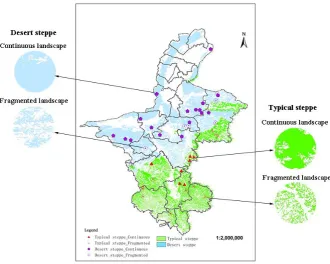
2018a). There are many typical steppes in the middle and southern parts of Ningxia. In the entire steppe, a total of 42 landscapes, including 24 desert steppe
landscapes and 18 typical steppe landscapes, were monitored for carabid beetles and sampled for vegetation from July 20 to August 20 between 2016 to 2018. Landscapes were separated by at least 1 km from each other (Figure 1). All experimental
disturbances and human activity, such as grazing and excavating. 2.2 Carabid beetle collection
At every landscape sampling site, we collected carabid beetles using a random five-point sampling method, which is an empirical method for insect collection [45,46]. Each sampling point included 10 pitfall traps that were comprised of plastic jars (caliber 75 mm,depth 90 mm) dug into the ground with the rim level with the soil surface, filled with 100 ml of attractant solution (1:2 glycol-water mixture), and arranged in a circle [47]. After 10 days, the trapped beetles were collected and conserved in 75% ethanol, and then taken back to the laboratory for identification. Carabid beetles were determined to species level according to the Carabidae of the World web service (www.carabidage.org) for classification system and nomenclature and referring to Wang et al. [48,49].
2.3 Vegetation collection
At each sampling site, three quadrates (1×1 m) on the diagonal were selected for plant community sampling. In each quadrate, we measured three variables that included plant dry biomass (PB, g/m2), cover (PC, percent of soil covered by plants), and richness (PR, number of plants per m2). Plant cover was estimated using the projection method and visual investigation (one component of four degrees and one determination method) [50]. For the plant cover data, we recorded species identity and frequency within each quadrate. All plants were identified to the species level.
determine the dry biomass. 2.4 Landscape data
Candidate landscape variables consisted of patch five different fragmentation levels from 1 km to 11 km (Table 1). Patch area (hectare) and perimeter (kilometer) were extracted from a digital terrain map from 2009 (1:50,000). A base digital map (vectorized) of the Ningxia steppe was obtained from the China Resource Satellite Application Center (http://www.cresda.com). For fragmentation level, we used ratios of perimeter to area as a following measure [32,51] (Equation 1), which is a non-species-specific measure incorporating both sampling patch perimeter and area.
𝐹𝑖𝑗 =𝑃𝑖𝑗
𝐴𝑖𝑗× 100%……….(1)
In the above equation, 𝑃𝑖𝑗 and 𝐴𝑖𝑗 are the perimeter and area of sampling site i under j fragment level, respectively. All landscape variables were calculated using ArcGIS 10.2.2 (ESRI, Redlands, CA, USA).
2.5 Statistical analysis
For each sampling point, we counted the number of carabid individuals captured in the field and calculated the mean value ± SE for five points in each sampling site. Based on species level, we applied the Shannon-Wiener index (H =
significant differences.
We conducted a split-plot analysis, as our designed experiments have different treatments applied to plots of varying sizes. The steppe types were treatments, and sampling points within each type were replicated five times. The function lme was called because the explanatory variables were a mixture of fixed effects (management treatment: fragmented and continuous landscapes) and random effects (steppe types). All analyses were performed using the statistical software SAS.v8, and all figures were drawn with Origin 8.0.
3. Results
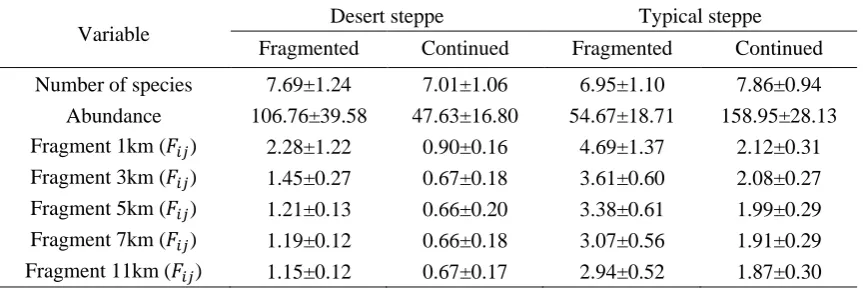
Habitat fragmentation decreased with increasing spatial scales. The habitat fragmentation index was highest within a 1-km spatial scale, but lowest within an 11-km spatial scale in both fragmented and continuous landscapes of the two steppe types. The degree of habitat fragmentation was larger in a fragmented typical steppe than in a fragmented desert steppe (Table 1).
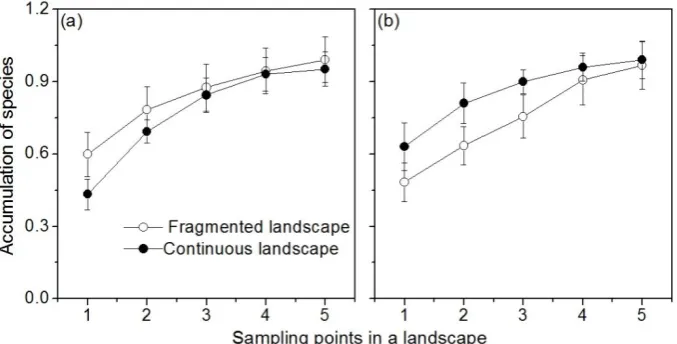
More species were collected with increasing sampling point numbers in both fragmented and continuous desert steppe landscapes (Figure 2a). Four pitfall traps (sampling points) in both continuous and fragmented desert steppe landscapes could cover more than 90% of the species, and five pitfall traps could account for more than 95% of the species (Figure 2a). Similarly, the sampling results in the typical steppe were consistent with those in the desert steppe (Figure 2b).
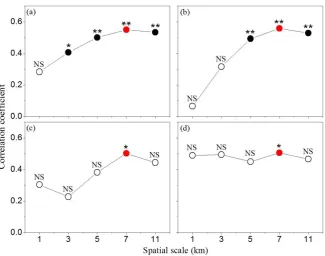
a 7-km spatial scale in the two steppe types (desert and typical) (Figure 3a-d).
However, the varying tendencies were discrepant in the two steppe types. In the desert steppe, the correlation coefficient increased when the spatial scale expanded from 1 km to 7 km and reached the maximum at a 7-km spatial scale in not only richness but also abundance (Figure 3a-b). Additionally, the relevance between the number of species differed at every spatial scale, such that relevance was not significant within a 1-km spatial scale; significant within a 3-km spatial scale; very significant within 5-km and 11-5-km spatial scales; and most significant within a 7-5-km spatial scale (correlation coefficient=0.55, p<0.01) (Figure 3a). Similarly, individuals differed in relevance with varying spatial scales, such that there was no significant correlation within 1-km and 3-km spatial scales; a very significant correlation within 5-km and 11-km spatial scales; and a most significant correlation within a 7-km spatial scale (correlation coefficient=0.5581, p<0.01) (Figure 3b). However, in the typical steppe, there was no regular correlation between carabid communities and spatial scale (Figure 3c-d). Both the number of species and individuals had only a significant correlation within a 7-km spatial scale, but no significant correlation within 1-km, 3-km, 5-3-km, and 11-km spatial scales (Figure 3c-d).
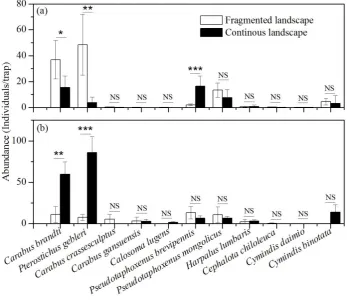
The responses of different groups and species to fragmented and continuous landscapes varied due to species diversity in the different steppe types (Figure 4). The abundance of two common species, Carabus brandti Faldermann and Pterostichus gebleri Dejean, in the desert steppe was significantly higher in a fragmented
these two common species in the typical steppe was significantly lower in a
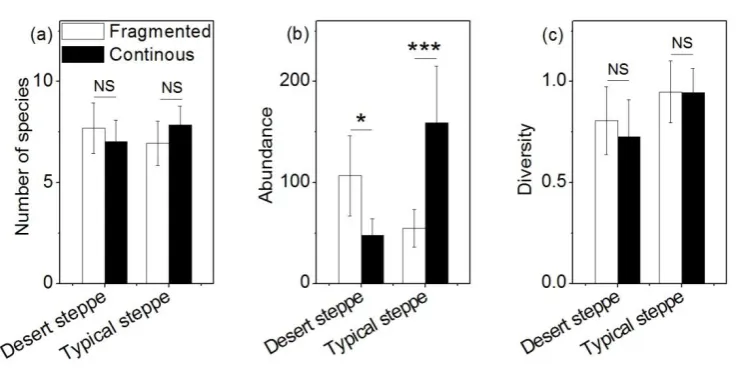
fragmented landscape than in a continuous landscape (Figure 4b). The abundance of most of the nine rare species had no significant variation between fragmented and continuous landscapes in both the desert and typical steppes (Figure 4a-b), but the abundance of the rare species Pseudotaphoxnus brevipennis Semenov varied significantly between fragmented and continuous landscapes. Its abundance in the desert steppe was significantly lower in a fragmented landscape than in a continuous landscape (Figure 4a). In the desert steppe, the number of species, abundance, and diversity of carabid communities in a fragmented landscape were all higher than in a continuous landscape (Figure 5a-c), and abundance was also significantly different between the two landscapes (t=-2.31, p=0.02) (Figure 5b). In the typical steppe, the number of species and abundance in a fragmented landscape were all lower than in a continuous landscape (Figure 5a-b), and abundance was also significantly different between the two landscapes (t=3.60, p<0.001) (Figure 5b). On the contrary, diversity in the typical steppe was higher in a fragmented landscape than in a continuous landscape, and there was no significant difference in diversity between the two landscapes (Figure 5c).
4. Discussion
but a negative correlation in the typical steppe. On one hand, this illustrates that habitat fragmentation was advantageous to carabid immigration in the desert steppe. Bowman et al. suggested that the total immigration rate should be higher in a
landscape that includes a larger number of small patches (i.e., higher fragmentation) than in one containing a smaller number of large patches [53]. On the other hand, habitat fragmentation was instrumental in carabid emigration in the typical steppe due to more fragmented landscapes, including more edge in certain habitats, which could encourage individuals to leave the habitat [10].
This research found that the effect of habitat fragmentation on carabid biodiversity was distinguishable in the different steppe types. In the desert steppe, habitat fragmentation had a positive effect on carabid communities due to the richness, abundance, and diversity being higher in a fragmented landscape than in a continuous landscape. In particular, the abundance of carabid communities and common species in a fragmented landscape was significantly higher than in a continuous landscape in the desert steppe. In contrast, the effect of habitat
two steppe types. The vegetation structure affected the ground beetle community because it affected the microenvironment climate [54]. The soil characteristics affected the distribution of ground beetles because the larvae of most carabid species grow within the soil [55]. Tsafack et al. reported that soil compaction and temperature had negative influences on carabid richness at a regional level [56].
In the identical fragmented landscapes, habitat fragmentation had different effects on different species due to specific characteristics [57]. In general, our experiments showed that habitat fragmentation had more significant influence on common carabid species than on rare species in the two steppe types. However, the effect of habitat fragmentation on the abundance of the rare species P. brevipennis Semenov was contrary compared to the common species in the two steppe types, and its abundance in the desert steppe was significantly lower in a fragmented landscape than in a continuous one.
Therefore, the effects of habitat fragmentation on biodiversity should be decided by landscape structure, species characteristics, patch shape, environmental variation, and other factors [26]. Meanwhile, it should also depend on habitat management patterns [35,58-60]. The researchers indicated that carabid beetles were extremely sensitive to agroecosystem and grassland management from taxonomical and functional approaches [59,61].
5. Conclusion
groups in the two steppe types, as well as on different groups within the same steppe type. Habitat fragmentation had significant positive effect on carabid communities and common species in the desert steppe, but extremely negative influence in the typical steppe. On the contrary, the influence of habitat fragmentation on the rare species P. brevipennis Semenov was exceedingly negative in the desert steppe, yet positive in the typical steppe. In summary, the effects of habitat fragmentation on biodiversity are different due to varying environmental factors and species characteristics.
Aknowledgment
We would like to thank Zhanjun Wang, Jianlong He, Hongqian Yu, Bo Ji,
Xiaobin Ren, Jianming Du, Qi Jiang from Institute of Desertification Control, Ningxia Academy of Agriculture and Forestry, for their technical assistance of data collection in the field. We are grateful to Caixia Yang for her in the carabid identification. We would also thank the anonymous reviewers whose comments have markedly
improved the quality of this manuscript. This study was supported by whole industry chain innovation demonstration project in Ningxia of China (No. NKYZ-16-1003) and the National Natural Science Foundations of China (31760705).
Conflict of interest
Authors have no competing interests to declare.
Authors contributions
field. S Wei analyzed the data and wrote the first draft. S Wei, Z Zhao, W Huang, Z Li and R Zhang revised the manuscript and approved the final draft.
References
1. Kang, L., Han, X., Zhang, Z. and Sun, O.J. Grassland ecosystems in China: review of current
knowledge and research advancement. Philos. T. R. Soc. B. 2007, 362, 997-1008.
2. Ren, J.Z.; Hu, Z.Z.; Zhao, J.; Zhang, D.G.; Hou, F.J.; Lin, H.L.; Mu, X.D. A grassland classification
system and its application in China. Rangeland J. 2008, 30, 199-209.
3. Tropek, R.; Hejda, M.; Kadlec, T.; Spitzer, L. Local and landscape factors affecting communities of
plants and diurnal Lepidoptera in black coal spoil heaps: Implications for restoration management.
Ecol. Eng., 2013, 57, 252-260.
4. Kőrösi, Á.; Szentirmai, I.; Batáry, P.; Kövér, S.; Örvössy, N.; Peregovits, L. Effects of timing and
frequency of mowing on the threatened scarce large blue butterfly – A fine-scale experiment. Agr.
Ecosyst. Environ., 2014,196, 24-33.
5. Shang, Z.H.; Gibb, M.J.; Leiber, F.; Ismail, M.;Ding, L.M.; Guo, X.S.;Long, R.J. The sustainable
development of grassland-livestock systems on the Tibetan plateau: Problems, strategies and
prospects. Rangeland J., 2014, 36, 267-296.
6. Schindler, S.; O'neill, F.H.; Biro, M.; Damm, C.; Gasso, V.; Kanka, R.;van der Sluis, T.; Krug, A.;
Lauwarrs, S.G.; Sebesvari, Z. Multifunctional floodplain management and biodiversity effects: a
knowledge synthesis for six European countries. Biodivers. Conserv., 2016, 25, 1349-1382.
7. Saunders, D.A.; Hobbs, R.J.; Margules, C.R. Biological consequences of ecosystem fragmentation A
review. Conserv. Biol., 1991, 5, 18-32.
fragmentation?In Nature Conservation Series,3; The reconstruction of fragmented ecosytems;
Saunders, D. A.; Hobbs, R. J.; Ehflich, P. R.; Surrey Beatty and Sons Pty Ltd {a}, 45 Rickard Road,
Chipping Norton, New South Wales, Australia, 1993; pp. 45-55.
9. Wilcox, B.A.; Murphy, D.D. Conservation strategy-the effects of fragmentation on extinction. Am.
Nat., 1985,125, 879-887.
10. Fahrig, L. Effects of habitat fragmentation on biodiversity. Annu. Rev.f Ecol. Evol. S., 2003, 34,
487-515.
11. Doherty, P.F.; Grubb, T.C. Survivorship of permanent-resident birds in a fragmented forested
landscape. Ecology, 2002, 83, 844-857.
12. Wilcove, D.S.; Mclellan, C.H.; Dobson, A.P. Habitat fragmentation in the temperate zone.In
Conservation biology. The science of scarcity and diversity; Soule, M.E.; Sinauer Associates, Inc.,
Sunderland, Massachusetts, 1986; pp. 237-256.
13. Noss, R.F. Landscape connectivity-different functions at different scales. In Landscape Linkages
and Biodiversity; Hunson, W. E.;Island Presds, Washington, 1991; pp. 27-39.
14. Tscharntke, T. Fragmentation of phragmites habitats, minimum viable population-size, habitat
suitability, and local extinction of moths, midges, flies, aphids, and birds. Conserv. Biol., 1992, 6,
530-536.
15. He, C.Y.; Liu, Z.F.; Tian, J.; Ma, Q. Urban expansion dynamics and natural habitat loss in China: a
multiscale landscape perspective. Global Change Biol., 2014, 20, 2886-2902.
16. Zhao, Z.H.; Sandhu, H.S.; Ouyang, F.; Ge, F. Landscape changes have greater effects than climate
changes on six insect pests in China. Sci. China Life Sci., 2016, 59, 627-633.
landscape ecology. Ecol. Appl., 2002,12, 321-334.
18. Mcgarigal, K.; Mccomb, W.C. Relationships between landscape structure and breeding birds in the
oregon coast range. Ecol. Monogr., 1995, 65, 235-260.
19. Tscharntke, T.; Steffan-Dewenter, I.; Kruess, A.; Thies, C. Contribution of small habitat fragments
to conservation of insect communities of grassland-cropland landscapes. Ecol. Appl., 2002, 12,
354-363.
20. Driscoll, D.A.; Weir, T. Beetle responses to habitat fragmentation depend on ecological traits,
habitat condition, and remnant size. Conserv. Biol., 2005, 19, 182-194.
21. Petit, S.; Usher, M.B. Biodiversity in agricultural landscapes: the ground beetle communities of
woody uncultivated habitats. Biodivers. Conserv., 1998, 7, 1549-1561.
22. Forman, R.T.T.; Alexander, L.E. Roads and their major ecological effects. Annu. Rev. Ecol. Syst.,
1998, 29, 207-231.
23. May, F.; Rosenbaum, B.; Schurr, F.M.; Chase, J.M. The geometry of habitat fragmentation: Effects
of species distribution patterns on extinction risk due to habitat conversion. Ecol. Evol., 2019, 9,
2775-2790.
24. Wiens, J.A.; Stenseth, N.C.; Vanhorne, B.; Ims, R.A. Ecological mechanisms and landscape ecolgy.
Oikos, 1993, 66, 369-380.
25. Mazerolle, M.J.; Villard, M.A. Patch characteristics and landscape context as predictors of species
presence and abundance: A review. Ecoscience, 1999, 6, 117-124.
26. Collinge, S.K. Effects of grassland fragmentation on insect species loss, colonization, and
movement patterns. Ecology, 2000, 81, 2211-2226.
1-150.
28. Tischendorf, L.; Fahrig, L. How should we measure landscape connectivity? Landscape Ecol.,
2000,15, 633-641.
29. Tischendorf, L. Can landscape indices predict ecological processes consistently? Landscape Ecol.,
2001, 16, 235-254.
30. Laurance, W.F.; Didham, R.K; Power, M.E. Ecological boundaries-a search for synthesis. Trends
Ecol. & Evol., 2001, 16, 70-71.
31.Collinge, S.K.; Palmer, T.M. The influences of patch shape and boundary contrast on insect
response to fragmentation in California grasslands. Landscape Ecol., 2002, 17, 647-656.
32. Kareiva, P. Finding and losing host plants by phyllotreta-patch size and surrounding habitat.
Ecology, 1985, 66, 1809-1816.
33. Wang, X.M.; Chen, F.H.; Dong, Z.B. The relative role of climatic and human factors in
desertification in semiarid China. Global Environ. Chang., 2006, 16, 48-57.
34. Keller, I.; Largiader, C.R. Recent habitat fragmentation caused by major roads leads to reduction of
gene flow and loss of genetic variability in ground beetles. P. Roy. Soc. B-Biol. Sci., 2003,270,
417-423.
35. Petit, S.; Burel, F. Effects of landscape dynamics on the metapopulation of a ground beetle
(Coleoptera, Carabidae) in a hedgerow network. Agr. Ecosyst. Environ., 1998, 69, 243-252.
36. Eyre, M.D.; Luff, M.L.; Staley, J.R.; Telfer, M.G. The relationship between British ground beetles
(Coleoptera, Carabidae) and land cover. J. Biogeogr., 2003, 30, 719-730.
37. Eyre, M.D.; Luff, M.L. Ground beetle species (Coleoptera, Carabidae) associations with land cover
38. Gobbi, M.; Fontaneto, D.; Bragalanti, N.; Pedrotti, L.; Lencioni, V. Carabid beetle (Coleoptera:
Carabidae) richness and functional traits in relation to differently managed grasslands in the Alps.
Ann. Soc. Entomol. Fr., 2015, 51, 52-59.
39. Kotze, D.J.; Brandmayr, P.; Casale, A.; Dauffy-Richard, E.; Dekoninck, W.; Koivula, M.J.; Lovei,
G. L.; Mossakowski, D.; Noordijk, J.; Paarmann, W.; Pizzolotto, R.; Saska, P.; Schwerk, A.;
Serrano, J.; Szyszko, J.; Taboada, A.; Turin, H.; Venn, S.; Vermeulen, R.; Zetto, T. Forty years of
carabid beetle research in Europe - from taxonomy, biology, ecology and population studies to
bioindication, habitat assessment and conservation. Zookeys, 2011, SI, 55-148.
40. Lafage, D.; Petillon, J. Relative importance of management and natural flooding on spider, carabid
and plant assemblages in extensively used grasslands along the Loire. Basic Appl. Ecol., 2016,17,
535-545.
41. Lyons, A.; Ashton, P.A.; Powell, I.; Oxbrough, A. Impacts of contrasting conservation grazing
management on plants and carabid beetles in upland calcareous grasslands. Agr. Ecosyst. Environ.,
2017,244, 22-31.
42. Chen, J.; Qian, H.; Wu, H.; Gao, Y. Y.; Li, X. Y. Assessment of arsenic and fluoride pollution in
groundwater in Dawukou area, Northwest China, and the associated health risk for inhabitants.
Environ. Earth Sci., 2017, 76, 314-328.
43. Fang, Y.; Qian, H.; Chen, J.; Xu, H. Characteristics of Spatial-Temporal Evolution of
Meteorological Drought in the Ningxia Hui Autonomous Region of Northwest China. Water, 2018,
10,992-1013.
44. Zhao, Z.H.; Reddy, G.V.P.; Wei, S.H.; Zhu, M.M.; Zhang, K.Y.; Yu, H.Q.; Wang, Z.J.; Jiang, Q.;
insect community composition in steppes of Northwest China. J. Asia-Pac. Entomol., 2018, 21,
361-366.
45. Zhao, Z.H.; Hui, C.; Li, Z.H.; Li, B.L. Habitat heterogeneity stabilizes the spatial and temporal
interactions between cereal aphids and parasitic wasps. Basic Appl. Ecol., 2015, 16, 510-518.
46. Zhao, Z.H.; Sandhu, H.S.; Gao, F.; He, D.H. Shifts in natural enemy assemblages resulting from
landscape simplification account for biocontrol loss in wheat fields. Ecol. Res., 2015, 30, 493-498.
47. Burgess, R.L.; Sharpe, D.M. Forest island dynamics in man-dominated landscapes. J. Ecol., 1981,
71, 1265-1270.
48. Anichtchenlo, A. Carabidae of the world. http://www.carabidae.org., [Internet], 2007-2019.
49. Wang, X. Q.; Fang, H.; Zhang, Z. L. Primary color map of Liaoning beetle; Science and
Technology Press, Shenyang, 2012;.pp. 20-58.
50. Daubenmire, R. A canopy-coverage method of vegetational analysis. Northwest Sci., 1959, 33,
43-64.
51. Morgan, B.J.T. Diffusion and ecological problems-mathematical-models-Okubo, A. Biometrics,
1981, 37, 413-414.
52. Zhao, Z. H.; Wei, J.; Zhang, K. Y.; Li, H.; Wei, S.H.; Pan, X. B.; Huang, W.G.; Zhu, M.M.; Zhang,
R. Asymmetric response of different functional insect groups to low-grazing pressure in Eurasian
steppe in Ningxia. Ecol. Evol., 2018, 8, 11609-11618.
53. Bowman, J.; Cappuccino, N.; Fahrig, L. Patch size and population density: the effect of
immigration behavior. Conserv. Ecol., 2002, 6, 11.
54. Burel, F. Landscape structure effects on carabid beetles spatial patterns in western France.
55. Eyre, M.D. Strategic explanations of carabid species distributions in Norther England. In Carabid
Beetles: Ecology and Evolution; Desender K., Dufrene M., Loreau M., Luff M.L., Maelfaits J.P.;
Kluwer Academic Publ, Dordrecht, 1994; pp. 267-275..
56. Tsafack, N.; Rebaudo, F.; Wang, H.; Nagy, D.D.; Xie, Y.; Wang, X.P.; Fattorini, S. Carabid
community structure in northern China grassland ecosystems: Effects of local habitat on species
richness, species composition and functional diversity. Peerj, 2019, 6.
57. Reeve, J.D. and Cronin, J.T. Edge behaviour in a minute parasitic wasp. J. Anim. Ecol., 2010, 79,
483-490.
58. Gobbi, M.; Fontaneto, D. Biodiversity of ground beetles (Coleoptera : Carabidae) in different
habitats of the Italian Po lowland. Agr. Ecosyst. & Environ., 2008, 127, 273-276.
59. Cole, L.J., Mccracken, D.I., Dennis, P., Downie, I.S., Griffin, A.L., Foster, G.N., Murphy, K.J.;
Waterhouse, T. Relationships between agricultural management and ecological groups of ground
beetles (Coleoptera : Carabidae) on Scottish farmland. Agr. Ecosyst. Environ., 2002, 93, 323-336.
60. Rainio, J.; Niemela, J. Ground beetles (Coleoptera: Carabidae) as bioindicators. Biodivers.
Conserv., 2003, 12, 487-506.
61. Cole, L.J.; Pollock, M.L.; Robertson, D.; Holland, J.P.; Mccracken, D.I. Carabid (Coleoptera)
assemblages in the Scottish uplands: the influence of sheep grazing on ecological structure.
Legends
Figure 1 Map of Ningxia steppe, Northwest China (total 42 landscapes; 24 landscapes in desert steppe and 18 landscapes in typical steppe). Solid pentagons and triangles are continuous landscapes; empty pentagons and triangles are fragmented landscapes.
Figure 2 Species accumulation of sampling points in a site ((a) desert steppe; (b) typical steppe). Empty circles are fragmented landscapes; solid circles are continuous landscapes.
Figure 3 Correlation analysis between landscape composition and carabid community (number of species (a) and abundance (b) in desert steppe; number of species (c) and abundance (d) in typical steppe). Empty circles were not significant while solid circles were significant. Asterisks above circles indicate
significance levels (**, p<0.01; *, p<0.05).
Figure 4 Mixed linear analysis of carabid species communities in the two steppe types (desert steppe (a), typical steppe (b)). Asterisks above the bars indicate differences between fragmented and continuous landscapes (***, p<0.001; **, p<0.01; *, p<0.05). White columns indicate a fragmented landscape; black columns indicate a continuous landscape.
p<0.05). White columns indicate a fragmented landscape; black columns indicate a continuous landscape.
Table 1 Summary data for all variables included in the study
Variable Desert steppe Typical steppe
Fragmented Continued Fragmented Continued
Number of species 7.69±1.24 7.01±1.06 6.95±1.10 7.86±0.94
Abundance 106.76±39.58 47.63±16.80 54.67±18.71 158.95±28.13
Fragment 1km (𝐹𝑖𝑗) 2.28±1.22 0.90±0.16 4.69±1.37 2.12±0.31
Fragment 3km (𝐹𝑖𝑗) 1.45±0.27 0.67±0.18 3.61±0.60 2.08±0.27
Fragment 5km (𝐹𝑖𝑗) 1.21±0.13 0.66±0.20 3.38±0.61 1.99±0.29
Fragment 7km (𝐹𝑖𝑗) 1.19±0.12 0.66±0.18 3.07±0.56 1.91±0.29