Type of the Paper (Article)
1
3-D Printable Polymer Pelletizer Chopper for Fused
2
Granular Fabrication-based Additive Manufacturing
3
Aubrey L. Woern 1 and Joshua M. Pearce 2,3*
4
1 Department of Mechanical Engineering–Engineering Mechanics, Michigan Technological University,
5
Houghton, MI, 49931; [email protected]
6
2 Department of Material Science & Engineering and Department of Electrical & Computer Engineering,
7
Michigan Technological University, Houghton, MI, 49931; [email protected]
8
3 Department of Electronics and Nanoengineering, School of Electrical Engineering, Aalto University,
9
Espoo, Finland, FI-00076; [email protected]
10
11
* Correspondence: [email protected]; Tel.: +01-906-487-1466
12
13
Abstract: Although distributed additive manufacturing can provide high returns on investment the
14
current markup on commercial filament over base polymers limits deployment. These cost barriers
15
can be surmounted by eliminating the entire process of fusing filament by 3-D printing products
16
directly from polymer granules. Fused granular fabrication (FGF) (or fused particle fabrication (FPF))
17
is being held back in part by the accessibility of low-cost pelletizers and choppers. An open-source
3-18
D printable invention disclosed here provides for precise controlled pelletizing of both single
19
thermopolymers as well as composites for 3-D printing. The system is designed, built and tested for
20
its ability to provide high tolerance thermopolymer pellets from a number of sizes capable of being
21
used in a FGF printer. In addition, the chopping pelletizer is tested for its ability to chop
multi-22
materials simultaneously for color mixing and composite fabrication as well as precise fractional
23
measuring back to filament. The US$185 open-source 3-D printable pelletizer chopper system was
24
successfully fabricated and has a 0.5 kg/hr throughput with one motor, and 1.0 kg/hr throughput
25
with two motors using only 0.24 kWh/kg during the chopping process. Pellets were successfully
26
printed directly via FGF and indirectly after being converted into high-tolerance filament in a
27
recyclebot.
28
Keywords: 3-D printing; additive manufacturing; distributed manufacturing; open-source;
29
polymers; recycling; waste plastic; extruder; upcycle; circular economy
30
31
1. Introduction
32
Adopting an open-source model of technological development by the founding members of the
33
self-replicating rapid prototyper (RepRap) 3-D printer [1-3] community radically reduced the costs
34
of additive manufacturing (AM). With the costs of prosumer (producing consumer) desktop 3-D
35
printers dropping low enough, the phenomenon of distributed manufacturing with AM emerged
[4-36
6]. Using commercial polymer filament 3-D printing enables prosumers significant savings over
37
purchasing of mass-manufactured products such as glasses [7], alternative energy mechanical parts
38
[8], flexible products [9], toys and games [10], and a wide range of other consumer products [11,12].
39
The business community recognizes the potential shift in manufacturing with AM [13-15] because of
40
millions of freely shared digital design files for 3-D printable products [12]. A high return on
41
investment (ROI) is found for prosumer distributed manufacturing with commercial polymer 3-D
42
printing filament based on downloaded substitution values [16,17]. These savings are somewhat
43
muted by the markup on commercial filament over base commercial polymers, which is currently
44
about five to ten times the cost of the raw plastic pellets. This reduces deployment of distributed
45
manufacturing to accelerate the adoption of AM at the prosumer level [18] as well as limiting the vast
46
majority of 3-D printed articles to small objects.
47
One method of overcoming these cost barriers is to skip the entire process of fusing filament into
48
a 3-D printed object by printing directly from polymer granules. Fused granular fabrication (FGF) or
49
the more generic fusedparticle fabrication (FPF) (indicating any size or shape of polymer feedstock)
50
has been developed and designs are flourishing in maker communities [19-21] as well as in industry
51
with commercialized printers [21-26]. Academia has also taken a keen interest in the technology
52
[27,28] for virgin [29] and recycled materials [30,31] including multi-head [32], industrial robot
53
adaptations [33], electronics printing [34], flexible materials printing [35], and biopolymer printing
54
[36]. To date, however, only a small subset of the thermoplastic materials capable of being printed by
55
such systems have been investigated and there has been almost no research into printing with the
56
nearly unlimited variety of obvious composited 3-D printing materials [37].
57
Potential applications available from coupling materials science with FGF is being held back in
58
part by the accessibility of low-cost pelletizers and choppers. In general, these are large industrial
59
machines not conducive for research or prosumer use because of their high throughputs and capital
60
costs. There have been some attempts at making such systems on the small scale by the maker
61
community [38-41]. These systems have several deficiencies. First, with current solutions, the feed
62
rate is fixed at a constant speed meaning the size of the granules cannot be changed. The current
63
solutions also only allow one inlet for filaments, meaning you can only chop one type of filament at
64
a time. The throughput of material can be slower as well, because of the single input on the currently
65
available machines.
66
In order to provide a low cost tool for making precise chopped pellets of both single
67
thermopolymers as well as composites this study follows the open-source hardware design paradigm
68
[42,43]. It thus provides open-source designs of a 3-D printable polymer pelletizer chopper for
FGF-69
based AM. The system is designed, built and tested for its ability to provide high tolerance
70
thermopolymer pellets from a number of sizes capable of being used in a FGF printer. In addition,
71
the chopping pelletizer is tested for its ability to chop multi-materials simultaneously for color mixing
72
and composite fabrication as well as precise fractional measuring. The results are presented and
73
discussed.
74
2. Materials and Methods
75
2.1 Designs
76
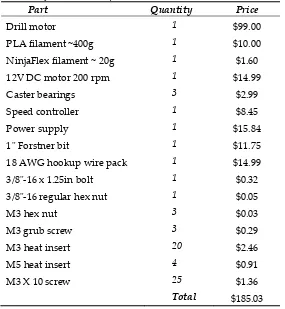
The bill of materials (BOM) summary can be seen in Table 1 and the tools and consumables are shown
77
in Table 2. As Table 1 shows a single motor version of the system can be fabricated for US$185. A
78
more detailed BOM along with the STP (STandard for the Exchange of Product files for redesign in
79
FreeCAD) and STL files (Standard Triangle Language file for direct 3-D printing on any RepRap-class
80
FFF 3-D printer) are available in the Open Science Framework [44]. All STL parts unless specifically
81
labeled to be printed with NinjaFlex can be printed with PLA or any other hard FFF thermoplastic.
Table 1. Bill of Materials for 1 motor setup
84
Part Quantity Price
Drill motor 1 $99.00 PLA filament ~400g 1 $10.00 NinjaFlex filament ~ 20g 1 $1.60 12V DC motor 200 rpm 1 $14.99 Caster bearings 3 $2.99 Speed controller 1 $8.45 Power supply 1 $15.84 1" Forstner bit 1 $11.75 18 AWG hookup wire pack 1 $14.99 3/8"-16 x 1.25in bolt 1 $0.32 3/8"-16 regular hex nut 1 $0.05 M3 hex nut 3 $0.03 M3 grub screw 3 $0.29 M3 heat insert 20 $2.46 M5 heat insert 4 $0.91 M3 X 10 screw 25 $1.36
Total $185.03
85
Table 2. Tools and Consumables
86
Description Use
5-gallon bucket or tote Pellet collection 3-D printer Part manufacturing Zip ties Wire management
Super glue Mounting Ninjaflex to bearings Wire strippers (10-18 AWG) Stripping motor, controller wires Electronic solder Soldering wires to motor
Soldering iron Heat set inserts and wire soldering Heat shrink tubing For covering solder joints on motor Adjustable wrenches Tightening 3/8" nuts
Micro screwdriver set Screwing wires into terminals Allen wrench set (hex key) For m3 bolts, and m3 grub screws
87
2.1.1 Mechanical
88
3-D printable parts were manufactured on a Lulzbot Taz 6 (Aleph Objects, Loveland, Co) with 50%
89
fill for PLA and 100% Ninjaflex (Ninjatek, St. Manheim, PA). After 3-D printing all of the STLs located
90
at [44] with a RepRap class 3-D printer from NinjaFlex (for gripping wheels) and PLA (all other parts),
91
and purchasing the components in Table 1, assembly can begin. In order to comply with open-source
92
hardware design guidelines detailed assembly instructions are provided in this section. The
93
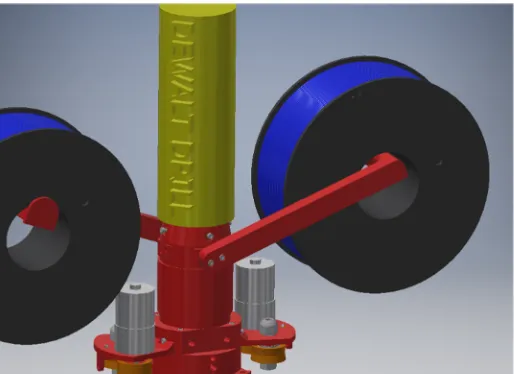
mechanical assembly can be guided by a rendering of the major components shown in Figure 1.
95
Figure 1. Rendering of major components of the 2x version of the open-source 3-D printable
96
pelletizer chopper.
97
Filament is fed through Ninjaflex gripper wheels into the main assembly where it is chopped by the
98
Forstner bit driven by the drill motor. The size of the pellets is controlled with the speed controller
99
governing the NinjaFlex wheels and the motor.
100
101
The basic mechanical assembly instructions:
102
1. Subassembly preparation for grabbing wheels.
103
a. Glue Ninjaflex wheels to double stack of bearings
104
b. Glue Ninjaflex wheels to printed motor wheel
105
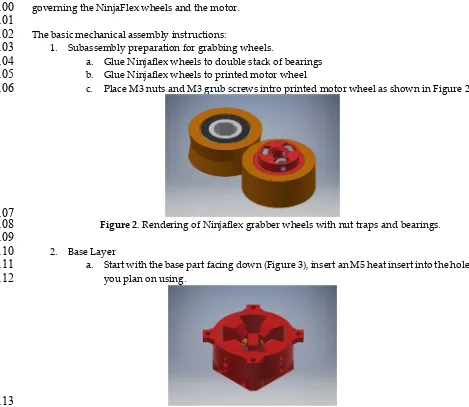
c. Place M3 nuts and M3 grub screws intro printed motor wheel as shown in Figure 2.
106
107
Figure 2. Rendering of Ninjaflex grabber wheels with nut traps and bearings.
108
109
2. Base Layer
110
a. Start with the base part facing down (Figure 3), insert an M5 heat insert into the holes
111
you plan on using.
112
113
Figure 3. Rendering of base of the open-source 3-D printable pelletizer chopper.
b. Flip the base over and insert M3 heat inserts into the sides and top. Only insert where
115
needed (e.g. One motor only needs one side, four motors need all sides)
116
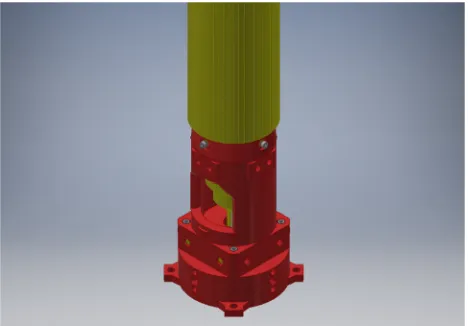
c. Once complete (Figure 4), insert bearing into the top as shown, then insert Forstner
117
bit through the bottom
118
119
Figure 4. Rendering of assembled base of the open-source 3-D printable pelletizer chopper.
120
121
3. Middle Layer
122
a. Place middle section on top of base, secure using m3 x 10 mm screws.
123
b. Insert m3 heat set inserts into the top four holes, and the angled holes for the spool
124
holders (Only need to insert into sides being used).
125
c. Make sure the Forstner bit is through both the middle and the base as in Figure 5.
126
127
Figure 5. Rendering of middle section of the open-source 3-D printable pelletizer chopper.
128
129
d. Put drill motor in through the top and use included chuck key to tighten onto
130
Forstner bit (Figure 6).
131
132
133
Figure 6. Rendering of assembled middle section of the open-source 3-D printable pelletizer
134
chopper.
4. Filament Drivers
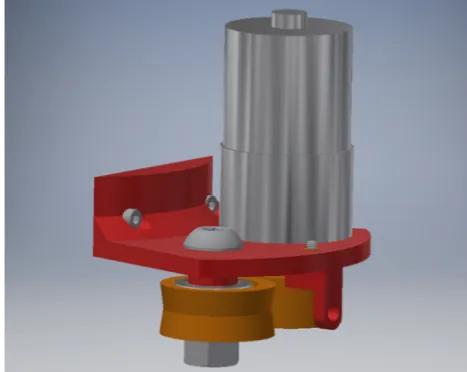
136
a. Screw motor into the bracket using m3x10mm screws, then place the printed motor
137
wheel onto the shaft.
138
b. Screw in the filament guide using an m3x10mm screw and heat set insert as shown
139
in Figure 7.
140
141
Figure 7. Rendering of filament driver of the open-source 3-D printable pelletizer chopper.
142
143
c. Assemble the idler wheel by the following sequence: Bolt head, bracket, printed
144
spacer, NinjaFlex wheel, and nut.
145
146
Figure 8. Rendering of the assembled filament driver with motor of the open-source 3-D
147
printable pelletizer chopper.
148
149
d. Secure filament driver assembly onto the rest of the main assembly as shown in
150
Figure 8.
151
152
5. Spool Holder
153
a. Use m3x10 mm bolts to attach the spool holder arms (Figure 9).
155
Figure 9. Rendering of the details of the spool arms of the open-source 3-D printable pelletizer
156
chopper.
157
158
2.1.2 Electrical
159
Figure 10 shows the wiring schematic for the open-source 3-D printable pelletizer chopper.
160
161
Figure 10. Pelletizer wiring schematic.
162
163
2.2 Materials
164
For testing, 1.75 mm polylactic acid (PLA) from Matterhackers, 1.75mm acrylonitrile butadiene
165
styrene (ABS) from Matterhackers, 2.85mm PLA and ABS from Ultimachine were used.
166
167
2.3 System Performance Quantification
168
The size characteristics of the particles for each starting material as a function of drive speed
169
from 200RPM to 100RPM to 50RPM were quantified using digital imaging and the open-source
170
Fiji/ImageJ [45].The rate of pellet production (kg/hour) was timed with a digital watch and
171
determined with an electronic scale (+/- 0.05). Electricity consumption was monitored with a
172
multimeter (±0.005 kW h) for each material during processing.
173
174
2.4 FPF 3-D Printing
175
A prototype Gigabot X [46,47] was used to print the materials. 3-D models were sliced with
176
2.5 Pellets as Recyclebot feedstock
178
A RepRapable recyclebot [50] (an open-source waste plastic extruder [51,52]) was used to make
179
PLA filament from pellets. The extrusion temperature was set at 170oC with cooling enabled at
180
100% and a fixed puller rate.
181
3. Results
182
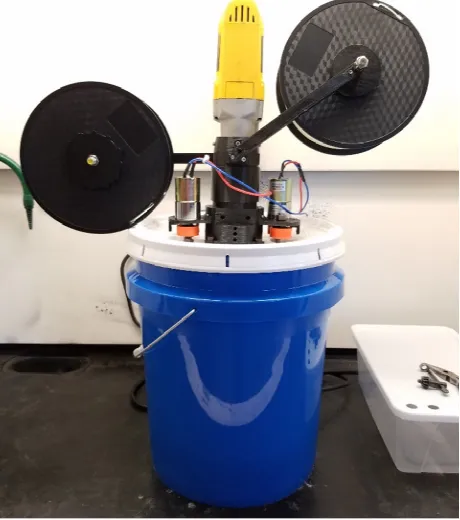
The open-source 3-D printable pelletizer chopper system was successfully fabricated as shown
183
in Figure 11 and operated as demonstrated in supplemental video 1. It has a 0.5 kg/hr throughput
184
with one motor and 1.0 kg/hr throughput with two motors. Electricity consumption was found to be
185
0.24 kWh/kg during the chopping process with 2 motors. It should be noted that the power draw
186
from the feeder motors did not have an impact on energy utilization of the entire device.
187
188
Figure 11. Fully assembled open-source 3-D printable pelletizer chopper system.
189
3.1 Pellet Manufacturing
190
The system could control the particle size by changing the speed. The particle size distributions
191
are shown in Figure 12.
194
Figure 12. Photograph of particle sizes for 200, 100 and 50 RPM with the particle size
195
distributions shown in the inset.
196
197
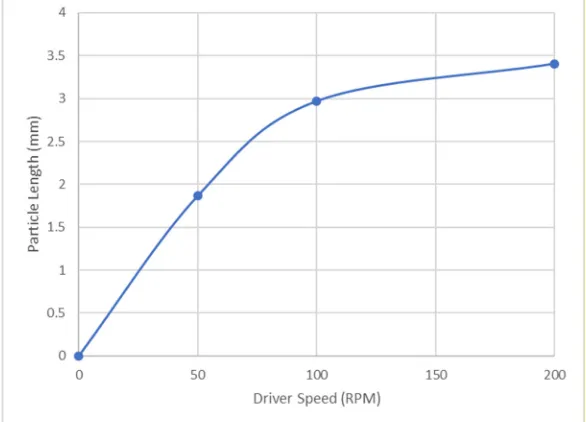
A graph of the mean particle size and the speed of the system is shown in Figure 13.
198
199
Figure 13. Mean particle size as a function of the speed of the filament driver.
200
201
The pellet production rate in kg/hr is function of speed of the motor and is linear: 0.5 kg/hr at full
202
speed 1 motor, 0.25 at 100 rpm and 0.125 at 50 rpm.
203
3.1.1. Pellets for FGF
204
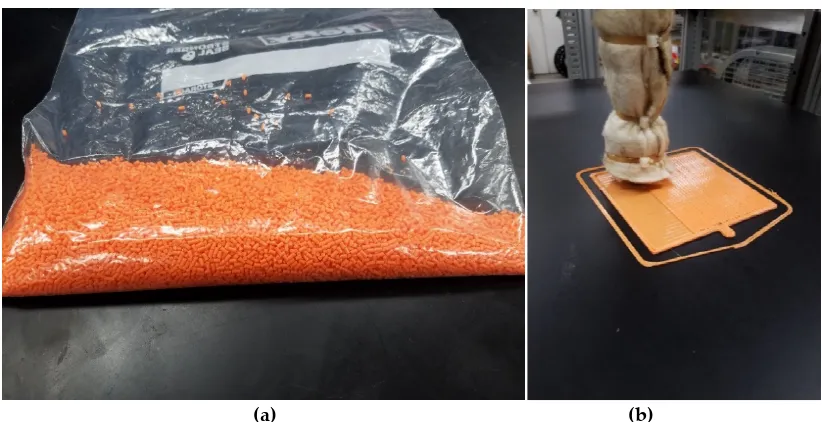
PLA pellets (Figure 14a) were fed into the prototype Gigabot X and no issues were detected
205
during the printing process (Figure 14b). The small size, and cylindrical shape of the uniform pellets
206
made it very easy to flow through the hopper and down into the extrusion screw.
208
(a) (b)
209
Figure 14. a) PLA pellets made with the pelletizer b) printing with ease on the Gigabot X.
210
211
3.1.2 Pellets for Recyclebot
212
The results from making filament from the pelletized PLA are shown in Figure 15. Feeding into
213
the hopper was consistent and no issues occurred during the filament extrusion process. The filament
214
came out with a diameter of 1.75mm +/- 0.10mm which is the same result when using the virgin PLA
215
pellets from NatureWorks LLC.
216
217
Figure 15. Example filament with a diameter of 1.75mm +/- 0.10mm made from RepRapable
218
recyclebot from pelletized filament shown in bag.
219
3.2 Fractional Control of Color and Composite Mixing
220
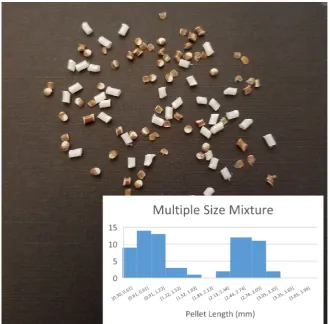
Multi materials can be chopped simultaneously as shown in supplemental video 2.
223
224
Figure 16. Image analysis of multiple size palletization demonstrated with large (white) and small (
225
brown) filament.
226
227
In addition, the system can do multi material size chops as shown in different size distribution in
228
Figure 16 to change color or other properties using mixing in the composition.
229
230
4. Discussion
231
4.1 Pellet manufacturing
232
4.1.1. Pellets for FGF
233
There were no issues with feeding the pellets into the hopper or having the auger push the pellets
234
into the barrel of the Gigabot X. This process could be used when trying to extrude ground up
235
plastic flakes or chunks to convert them into more uniform shape for better feeding into the auger
236
such as was done by Pringle et al. for waste wood-PLA composites [66]. Each time a polymer is
237
heated and extruded (whether in the recyclebot filament making process or during conventional
238
fused filament fabrication (FFF)/ fused deposition modeling (FDM) 3-D printing) the mechanical
239
properties of the thermopolymer are degraded [53-56]. FGF reduces the number of melt-solidify
240
cycles a polymer must go through to get to a finished product. Thus, FGF printing has advantages
241
of better economics and environmental footprint than conventional FFF 3-D printing [30,31].
242
4.1.2 Pellets for Recyclebot Filament Manufacturing
243
3-D printing with filament is still by far the most widespread method of AM [18]. Thus, this is a
244
form of downcycling [57] that is acceptable for about five cycles [53,54]. To maintain acceptable
245
mechanical properties, the recycled filament must be blended with virgin materials or reinforce with
more robust materials. Despite these drawbacks, life cycle analysis of materials processed with a
247
recyclebot found a 90% decrease in the embodied energy of the filament compared to traditional
248
filament manufacturing [58-60]. Thermopolymers already demonstrated to be acceptable to the
249
recyclebot process include successfully recycled as single component thermoplastic filaments such as
250
polylactic acid (PLA) [50,53,54,61,62], high-density polyethylene (HDPE) [52,63,64], acrylonitrile
251
butadiene styrene (ABS) [64-66], elastomers [9] as well as composites like waste wood biopolymers
252
[67] and carbon fiber reinforced plastics [68]). With commercial versions of recyclebots becoming
253
more prevalent [51] there is an opportunity to drive a tighter loop for the circular economy [60]. The
254
system here was shown to be able to produce pellets for the recyclebot, which could be used for
255
making composites and altering the properties of filament (e.g. change color).
256
4.2 Fractional Control of Color and Composite Mixing
257
However, producing pellets from these systems for complex composites like waste wood
258
biopolymer composites [67], provide an even larger ecologically beneficial opportunity. The device
259
disclosed and characterized supports this aim. So for example in an industrial or quasi-industrial
260
granulator [69] is used to make flakes or chips it can be converted to low-quality filament, which can
261
then be subsequently chopped by the invention discussed here and then converted to high-quality
3-262
D printing filament. This filament can be tuned for specific properties like those needed for scientific
263
hardware [70-73]. This becomes important as manufacturers begin to disclose the materials they are
264
made from [74] in order to facilitate recycling and/or market opportunities from consumers
265
understanding the material ingredients that make up their products. Some countries like China
266
already aid more aggressive recycling by having a detail-rich recycling code system and this has
267
already been adapted to the 3-D printing community [75]. The invention of the open-source 3-D
268
printable pelletizer chopper system can speed research and development in these areas. Also, in large
269
scale niche 3D printing markets, the need for more material in the printer is essential to cutting out
270
human intervention for changing out empty spools. When changing over to pellet fed systems, huge
271
hoppers full of pellets can be stored next to the printer, with simple vacuum systems used to feed the
272
printer as needed. This solution removes the need for large, 8-10 kg spools, which cause strain on the
273
extruder motors for large 3-D printers and can almost provide an endless source of feedstock [76].
274
These features generally enable the technical and economic potential of large-scale polymer 3-D
275
printing.
276
4.3 Future Work
277
This study investigated both single- and double-line use of the open-source 3-D printable
278
pelletizer chopper system. This is adequate for matching the majority this generation of polymer 3-D
279
printing available on the market (e.g. colorants or simple composites like glitter or glow-in-the-dark
280
filaments). The current design can hold up to 4 incoming lines, which can be used to make more
281
complex composites such as those designed to be used for sintering metal or other higher
282
temperature materials. In addition, the open-source 3-D printable pelletizer chopper systemcan be
283
easily expanded to even increase upon that using the STP file (STandard for the Exchange of Product).
284
Future designs should also look into replacing the expensive and proprietary drill motor with a
285
cheaper dc gear motor or other alternative including the distributed manufacturing of the motor
286
itself.
287
5. Conclusions
288
This study disclosed a low-cost open-source 3-D printable invention of a pelletizer chopper for
289
precise control of pelletizing of both single thermopolymers as well as composites for 3-D printing
290
applications. The system was successfully developed using open-source design strategies and
291
fabricated using low-cost open-source 3-D printers. The invention provided high tolerance
292
thermopolymer pellets from a number of sizes capable of being used in a FGF printer as well as for
recyclebot reformulation of 3-D printing filament. It has a 0.5 kg/hr throughput with one motor, and
294
1.0 kg/hr throughput with two motors using only 0.24 kWh/kg during the chopping process. Pellets
295
were successfully 3-D printed directly via FGF and indirectly after being converted into
high-296
tolerance filament in a recyclebot.
297
Supplementary Materials: The following are available online, Video S1: Open-source 3-D printable pelletizer
298
chopper system during production and Video S2: Multi materials chopped simultaneously by the open-source
299
3-D printable pelletizer chopper system.
300
Author Contributions: Conceptualization, Joshua M. Pearce; Data curation, Aubrey L. Woern; Formal analysis,
301
Aubrey L. Woern and Joshua M. Pearce; Funding acquisition, Joshua M. Pearce; Methodology, Aubrey L. Woern
302
and Joshua M. Pearce; Writing – original draft, Joshua M. Pearce; Writing – review & editing, Aubrey L. Woern
303
and Joshua M. Pearce.
304
Funding: This research was funded by the National Science Foundation SBIR Phase I grant number: 1746480,
305
re:3D, Aleph Objects, and the Richard Witte Endowment.
306
Conflicts of Interest: The authors declare no conflict of interest. The funders had no role in the design of the
307
study; in the collection, analyses, or interpretation of data; in the writing of the manuscript, and in the decision
308
to publish the results.
309
References
310
1. Sells, E.; Bailard, S.; Smith, Z.; Bowyer, A.; Olliver, V. RepRap: The Replicating Rapid
Prototyper-311
Maximizing Customizability by Breeding the Means of Production. Proceedings in the World Conference
312
on Mass Customization and Personalization, 2010. Cambridge, MA, USA, 7-10 October 2007.
313
2. Jones, R.; Haufe, P.; Sells, E.; Iravani, P.; Olliver, V.; Palmer, C.; Bowyer, A. RepRap-the Replicating Rapid
314
Prototyper. Robotica2011, 29 (01): 177–91.
315
3. Bowyer, A. 3D Printing and Humanity’s First Imperfect Replicator. 3D Printing and Additive Manufacturing
316
2014, 1 (1): 4–5.
317
4. Scan, B. 2005. How to Make (almost) Anything. The Economist. Available from internet:
318
http://www.economist.com/node/4031304.
319
5. Gershenfeld, N. 2012. How to Make Almost Anything: The Digital Fabrication Revolution. Available from
320
internet: http://cba.mit.edu/docs/papers/12.09.FA.pdf.
321
6. Markillie, P. 2012. A Third Industrial Revolution. The Economist. Available from internet:
322
http://www.economist.com/node/21552901.
323
7. Gwamuri, J.; Wittbrodt, B.; Anzalone, N.; Pearce, J. Reversing the Trend of Large Scale and Centralization
324
in Manufacturing: The Case of Distributed Manufacturing of Customizable 3-D-Printable Self-Adjustable
325
Glasses. Challenges in Sustainability2014, 2(1), 30-40.
326
8. Wittbrodt, B.; Laureto, J.; Tymrak, B.; Pearce, J. Distributed Manufacturing with 3-D Printing: A Case Study
327
of Recreational Vehicle Solar Photovoltaic Mounting Systems. Journal of Frugal Innovation2015,1 (1): 1-7.
328
9. Woern, A. L.; Pearce, J. M. Distributed Manufacturing of Flexible Products: Technical Feasibility and
329
Economic Viability. Technologies2017, 5, 71, doi:10.3390/technologies5040071.
330
10. Petersen, E. E.; Kidd, R. W.; Pearce, J. M. Impact of DIY Home Manufacturing with 3D Printing on the Toy
331
and Game Market. Technologies2017, 5, 45, doi:10.3390/technologies5030045.
332
11. Petersen, E. E.; Pearce, J. Emergence of Home Manufacturing in the Developed World: Return on
333
Investment for Open-Source 3-D Printers. Technologies2017, 5, 7, doi:10.3390/technologies5010007.
334
12. Wittbrodt, B. T.; Glover, A. G.; Laureto, J.; Anzalone, G. C.; Oppliger, D.; Irwin, J. L.; Pearce, J. M. Life-cycle
335
economic analysis of distributed manufacturing with open-source 3-D printers. Mechatronics2013, 23, 713–
336
726, doi:10.1016/j.mechatronics.2013.06.002.
337
13. Anderson, P.; Sherman, C.A. A discussion of new business models for 3D printing. International Journal of
338
Technology Marketing2007. 2(3), pp.280-294.
339
14. Laplume, A.; Anzalone, G.; Pearce, J. Open-source, self-replicating 3-D printer factory for small-business
340
manufacturing. International Journal of Advanced Manufacturing Technology 2015, 85(1), 633-642.
341
15. Laplume, A.; Petersen, B.; Pearce, J. Global value chains from a 3D printing perspective. Journal of
342
International Business Studies2016, 47(5), 595–609.
343
17. Pearce, J.M. Return on investment for open source scientific hardware development. Science and Public
345
Policy2016, 43(2), pp.192-195.
346
18. Wohlers Report 2016: 3D Printing and Additive Manufacturing State of the Industry Annual Worldwide
347
Progress Reports Associates Inc: Fort Collins, CO, USA, 2016.
348
19. Horne, R. Reprap development and further adventures in DIY 3D printing: No more filament? - Quest for
349
a Universal Pellet Extruder for 3D Printing. Reprap development and further adventures in DIY 3D
350
printing 2014. https://richrap.blogspot.com/2014/12/no-more-filament-quest-for-universal.html
351
20. Universal Pellet Extruder. http://upe3d.blogspot.com/
352
21. Braanker, G.B., Duwel, J.E.P., Flohil, J.J. and Tokaya, G.E., Developing a plastics recycling add-on for the
353
RepRap 3D-printer. Delft University of Technology, 2010.
354
22. The PartDaddy - Large Format Delta 3D Printer - Custom Available online:
355
https://www.seemecnc.com/products/partdaddy-large-format-delta-3d-printer (accessed on Jul 9, 2018).
356
23. Cheetah Pro Large Format 3D Printer by Hans Fouche Available online: http://www.fouche3dprinting.com
357
(accessed on Jul 9, 2018).
358
24. Introducing David Available online: /pages/david (accessed on Jul 9, 2018).
359
25. Erecto-Struder 24v, ErectorBot Store Available online:
360
http://www.erectorbot.com/store/product_info.php?cPath=23&products_id=65 (accessed on Jul 9, 2018).
361
26. Gigabot X: Large-Scale, Recycled Plastic Pellet 3D Printer Available online:
362
https://www.kickstarter.com/projects/re3d/gigabot-x-your-direct-pellet-extrusion-3d-printer (accessed on
363
Jul 9, 2018).
364
27. Giberti, H.; Sbaglia, L.; Silvestri, M. Mechatronic Design for an Extrusion-Based Additive Manufacturing
365
Machine. Machines2017, 5, 29, doi:10.3390/machines5040029.
366
28. Liu, X.; Chi, B.; Jiao, Z.; Tan, J.; Liu, F.; Yang, W. A large-scale double-stage-screw 3D printer for fused
367
deposition of plastic pellets. Journal of Applied Polymer Science2017, 134, 45147, doi:10.1002/app.45147.
368
29. Volpato, N., Kretschek, D., Foggiatto, J.A. and da Silva Cruz, C.G., Experimental analysis of an extrusion
369
system for additive manufacturing based on polymer pellets. The International Journal of Advanced
370
Manufacturing Technology,2015. 81(9-12), pp.1519-1531.
371
30. Woern, A.; Byard, D.; Oakley, R.; Fiedler, M.; Snabes, S.; Pearce, J.; Woern, A.L.; Byard, D.J.; Oakley, R.B.;
372
Fiedler, M.J.; Snabes, S.L.; Pearce, J.M. Fused Particle Fabrication 3-D Printing: Recycled Materials’
373
Optimization and Mechanical Properties. Materials2018, 11, 1413, doi:10.3390/ma11081413.
374
31. Byard, D.J.; Woern, A.L.; Oakley, R.B.; Fiedler, M.J.; Snabes, S.L; Pearce, J.M. Green Fab Lab Applications
375
of Large-Area Waste Polymer-based Additive Manufacturing (to be published).
376
32. Beaudoin, A., JMS-1704: Multihead 3D Printer (Doctoral dissertation, Worcester Polytechnic Institute) 2016.
377
33. Wang, Z.; Liu, R.; Sparks, T.; Liou, F. Large-Scale Deposition System by an Industrial Robot (I): Design of
378
Fused Pellet Modeling System and Extrusion Process Analysis. 3D Printing and Additive Manufacturing2016,
379
3, 39–47, doi:10.1089/3dp.2015.0029.
380
34. Kumar, N.; Jain, P. K.; Tandon, P.; Pandey, P. M. Additive manufacturing of flexible electrically conductive
381
polymer composites via CNC-assisted fused layer modeling process. J Braz. Soc. Mech. Sci. Eng.2018, 40,
382
175, doi:10.1007/s40430-018-1116-6.
383
35. Kumar, N.; Jain, P. K.; Tandon, P.; Pandey, P. M. Extrusion-based additive manufacturing process for
384
producing flexible parts. J Braz. Soc. Mech. Sci. Eng. 2018, 40, 143, doi:10.1007/s40430-018-1068-x.
385
36. Whyman, S.; Arif, K. M.; Potgieter, J. Design and development of an extrusion system for 3D printing
386
biopolymer pellets. The International Journal of Advanced Manufacturing Technology, 2018, 96, 3417–3428,
387
doi:10.1007/s00170-018-1843-y.
388
37. Pearce, J. M. A novel approach to obviousness: An algorithm for identifying prior art concerning 3-D
389
printing materials. World Patent Information2015, 42, 13–18, doi:10.1016/j.wpi.2015.07.003.
390
38. Barbosa, F. Thingiverse.com High speed filament pelletizer by fred_barbosa Available online:
391
https://www.thingiverse.com/thing:397524 (accessed on Nov 1, 2018).
392
39. Hada, W. Thingiverse.com 3D Filament Pelletizer Powered by Drill by wahada Available online:
393
https://www.thingiverse.com/thing:288465 (accessed on Nov 1, 2018).
394
40. Scott, C. Shred-Buddy 3D Recycler Turns Your Old Filament, Bottles, and Even Fishing Line into Brand
395
New 3D Printing Material. 3DPrint.com | The Voice of 3D Printing / Additive Manufacturing 2016.
396
41. Filament Pelletizer (Page 1) — Filastruder — SoliForum - 3D Printing Community Available online:
397
42. Gibb, A. Building Open Source Hardware: DIY Manufacturing for Hackers and Makers; Pearson Education, 2014;
399
ISBN 978-0-321-90604-5.
400
43. Oberloier, S. and Pearce, J.M., 2017. General Design Procedure for Free and Open-Source Hardware for
401
Scientific Equipment. Designs, 2(1), p.2. doi:10.3390/designs2010002.
402
44. 3-D Printable Polymer Pelletizer Chopper. 2018, Open science framework. https://osf.io/6t4dn/
403
45. Fiji is just ImageJ Available online: https://fiji.sc/ (accessed on Jul 9, 2018).
404
46. Re:3D https://github.com/Gigabot-Labs/Pellet-Extruder (accessed on Jul 21, 2018).
405
47. re:3D | Life-Sized Affordable 3D Printing. https://re3d.org/ (accessed on Jul 9, 2018).
406
48. Slic3r - G-code generator for 3D printers - Available online: http://slic3r.org (accessed on Jul 10, 2018).
407
49. Marlin Firmware - Available online: http://marlinfw.org (accessed on Jul 10, 2018)
408
50. Woern, A. L.; McCaslin, J. R.; Pringle, A. M.; Pearce, J. M. RepRapable Recyclebot: Open source 3-D
409
printable extruder for converting plastic to 3-D printing filament. HardwareX 2018, 4, e00026,
410
doi:10.1016/j.ohx.2018.e00026.
411
51. Recyclebot. Appropedia. http://www.appropedia.org/Recyclebot (accessed 12.19.2017).
412
52. Baechler, C.; DeVuono, M.; Pearce, J. M. Distributed recycling of waste polymer into RepRap feedstock.
413
Rapid Prototyping Journal 2013, 19, 118–125, doi:10.1108/13552541311302978.
414
53. Cruz Sanchez, F., Lanza, S., Boudaoud, H., Hoppe, S., & Camargo, M. Polymer Recycling and Additive
415
Manufacturing in an Open Source context: Optimization of processes and methods. In 2015 Annual
416
International Solid Freeform Fabrication Symposium-An Additive Manufacturing Conference, Austin, Texas
417
(USA) 2015 (pp. 10-12).
418
54. Cruz Sanchez, F. A. C., Boudaoud, H., Hoppe, S., & Camargo, M. Polymer recycling in an open-source
419
additive manufacturing context: Mechanical issues. Additive Manufacturing 2017, 17, 87-105.
420
55. Oblak, P.; Gonzalez-Gutierrez, J.; Zupančič, B.; Aulova, A.; Emri, I. Processability and mechanical
421
properties of extensively recycled high density polyethylene, Polymer Degradation and Stability, 2015.
422
114, https://doi.org/10.1016/j.polymdegradstab.2015.01.012
423
56. Hyung Lee, J.; Sub Lim, K.; Gyu Hahm, W; Hun Kim, S. Properties of recycled and virgin poly(ethylene
424
terephthalate) blend fibers, Applied Polymer Science2012. 128, 2, https://doi.org/10.1002/app.38502
425
57. McDonough, W.; Braungart, M. Cradle to Cradle: Remaking the Way We Make Things; Farrar, Straus and
426
Giroux, 2010; ISBN 978-1-4299-7384-7.
427
58. Kreiger, M., Anzalone, G. C., Mulder, M. L., Glover, A., & Pearce, J. M. Distributed recycling of
post-428
consumer plastic waste in rural areas. MRS Online Proceedings 2013, 1492, 91-96.
429
59. Kreiger, M. A., Mulder, M. L., Glover, A. G., & Pearce, J. M. Life cycle analysis of distributed recycling of
430
post-consumer high density polyethylene for 3-D printing filament. Journal of Cleaner Production, 2014, 70,
431
90-96.
432
60. Zhong, S., Rakhe, P., & Pearce, J. M. Energy Payback Time of a Solar Photovoltaic Powered Waste Plastic
433
Recyclebot System. Recycling, 2017, 2(2), 10.
434
61. Anderson, I. Mechanical Properties of Specimens 3D Printed with Virgin and Recycled Polylactic Acid. 3D
435
Printing and Additive Manufacturing2017, 4, 110–115, doi:10.1089/3dp.2016.0054.
436
62. Pakkanen, J., Manfredi, D., Minetola, P., Iuliano, L. About the Use of Recycled or Biodegradable Filaments
437
for Sustainability of 3D Printing. In Sustainable Design and Manufacturing2017; Smart Innovation, Systems
438
and Technologies; Springer, Cham, 2017; pp. 776–785.
439
63. Chong, S., Pan, G.-T., Khalid, M., Yang, T. C.-K., Hung, S.-T., Huang, C.-M. Physical Characterization and
440
Pre-assessment of Recycled High-Density Polyethylene as 3D Printing Material. Journal of Polymers and the
441
Environment, 2017, 25(2), 136-145. doi:10.1007/s10924-016-0793-4.
442
64. Mohammed, M. I., Mohan, M., Das, A., Johnson, M. D., Badwal, P. S., McLean, D., Gibson, I. A low carbon
443
footprint approach to the reconstitution of plastics into 3D-printer filament for enhanced waste reduction.
444
KnE Engineering, 2017, 2, 234–241.
445
65. Mohammed, M. I., Das, A., Gomez-Kervin, E., Wilson, D., Gibson, I. EcoPrinting: Investigating the use of
446
100% recycled Acrylonitrile Butadiene Styrene (ABS) for Additive Manufacturing. Solid Freeform
447
Fabrication 2017. Proceedings of the 28th Annual International Solid Freeform Fabrication Symposium. 2017.
448
http://sffsymposium.engr.utexas.edu/sites/default/files/2017/Manuscripts/EcoprintingInvestigatingtheUs
449
66. Zhong, S., & Pearce, J. M. Tightening the loop on the circular economy: Coupled distributed recycling and
451
manufacturing with recyclebot and RepRap 3-D printing. Resources, Conservation and Recycling, 2018, 128,
452
48-58.
453
67. Pringle, A. M.; Rudnicki, M.; Pearce, J. Wood Furniture Waste-Based Recycled 3-D Printing Filament. Forest
454
Products Journal. 2018, 68, 1, 86-95.https://doi.org/10.13073/FPJ-D-17-00042
455
68. Tian, X.; Liu, T.; Wang, Q.; Dilmurat, A.; Li, D.; Ziegmann, G. Recycling and remanufacturing of 3D printed
456
continuous carbon fiber reinforced PLA composites. Journal of Cleaner Production2017, 142, 1609–1618,
457
doi:10.1016/j.jclepro.2016.11.139.
458
69. OSHE Granulator MKII, Open Science Framework, Available online: https://osf.io/auswp/ (accessed on
459
July 10, 2018).
460
70. Baden, T.; Chagas, A.M.; Gage, G.; Marzullo, T.; Prieto-Godino, L.L.; Euler, T. Open Labware: 3-D
461
Printing Your Own Lab Equipment. PLOS Biology2015, 13, e1002086, doi:10.1371/journal.pbio.1002086.
462
71. Winters, B.J.; Shepler, D. 3D printable optomechanical cage system with enclosure. HardwareX2018, 3,
463
62–81, doi:10.1016/j.ohx.2017.12.001.
464
72. Hietanen, I.; Heikkinen, I.T.S.; Savin, H.; Pearce, J.M. Approaches to open source 3-D printable probe
465
positioners and micromanipulators for probe stations. HardwareX2018, 4, e00042,
466
doi:10.1016/j.ohx.2018.e00042.
467
73. Bellon, J.A.; Pino, M.J.; Wilke, N. Low-cost equipment for electroformation of Giant Unilamellar
468
Vesicles. HardwareX2018, 4, e00037, doi:10.1016/j.ohx.2018.e00037.
469
74. Pearce, J.M., Expanding the Consumer Bill of Rights for material ingredients. Materials Today2018. 21(3),
470
197-198.
471
75. Hunt, E. J.; Zhang, C.; Anzalone, N.; Pearce, J. M. Polymer recycling codes for distributed manufacturing
472
with 3-D printers. Resources, Conservation and Recycling2015, 97, 24–30, doi:10.1016/j.resconrec.2015.02.004.
473
76. Stevenson, K. The Other Reason for 3D Printing Pellets. Fabbaloo. Available online:
474
http://www.fabbaloo.com/blog/2018/5/10/the-other-reason-for-3d-printing-pellets (accessed on Jul 9,