Motion Vector Estimation Using Line-Square Search
Block Matching Algorithm for Video Sequences
Ding Gui-guang
Broadband Networks & digital Media Lab, Automation Department, Tsinghua University, Beijing 100084, China Email:[email protected]
Guo Bao-long
School of Electromechanical Engineering, Xidian University, Xi’an 710071, China Email:[email protected]
Received 19 May 2003; Revised 16 December 2003; Recommended for Publication by Reha Civanlar
Motion estimation and compensation techniques are widely used for video coding applications but the real-time motion estima-tion is not easily achieved due to its enormous computaestima-tions. In this paper, a new fast moestima-tion estimaestima-tion algorithm based on line search is presented, in which computation complexity is greatly reduced by using the line search strategy and a parallel search pat-tern. Moreover, the accurate search is achieved because the small square search pattern is used. It has a best-case scenario of only 9 search points, which is 4 search points less than the diamond search algorithm. Simulation results show that, compared with the previous techniques, the LSPS algorithm significantly reduces the computational requirements for finding motion vectors, and also produces close performance in terms of motion compensation errors.
Keywords and phrases:motion estimation, diamond search algorithm, video coding.
1. INTRODUCTION
In video coding, the high correlation between successive frames can be exploited to improve coding efficiency, which is usually achieved by using motion estimation (ME) and motion compensation technology. Many ME methods have been studied in an effort to reduce the computational com-plexity of the ME, such as block matching algorithms (BMA), parametric/motion models, optical flow, and pel-recursive techniques. Among these methods, BMA seems to be the most popular method due to its effectiveness and simplic-ity for both software and hardware implementations. BMA is also widely adopted by various video coding standards, such as MPEG-1 [1], MPEG-2 [2], MPEG-4 [3], H.261 [4], H.263 [5], and H.26L [6].
It is obvious that in using BMA, the simplest and most accurate strategy is the full search algorithm (FS), sometimes referred to as the exhaustive search of the brute-force search. The FS algorithm gives an optimum solution, in terms of prediction quality, by exhaustively searching over all possi-ble blocks within the search window. However, the compu-tational complexity of FS has motivated a host of subopti-mal but faster search strategies. Thus, efficient algorithms such as the three-step search algorithm (TSS) [7], the four-step search algorithm (FSS) [8], the two-dimensional loga-rithmic search algorithm (TDL) [9], the cross search
algo-rithm (CS) [10], and the diamond search algorithm (DS) [11] have been developed to reduce the computational com-plexity. Among the proposed fast algorithms, the DS algo-rithm recommended by verify model (VM) of MPEG-4 [12] became the most widely used technique because of its sim-plicity and effectiveness [13]. According to the character-istics of the center-biased motion vector distribution, the DS algorithm employs two search patterns as illustrated in
Figure 1. The first pattern, called large diamond search
pat-tern (LDSP), comprises nine checking points of which eight points surround the center one to compose a diamond shape, while the second pattern consisting of five checking points forms a small diamond shape, called small diamond search pattern (SDSP). In the searching procedure of the DS algo-rithm, LDSP is repeatedly used until the step in which the minimum block distortion (MBD) occurs at the center point. The search pattern is then switched from LDSP to SDSP to reach the final search stage. Among the five checking points in SDSP, the position yielding the MBD provides the motion vector of the best matching point.
−7−6−5−4−3−2−1 0 1 2 3 4 5 6 7
−7 −6 −5 −4 −3 −2 −1 0 1 2 3 4 5 6 7
1
1 1
1 1 1
1 1
1
(a)
−7−6−5−4−3−2−1 0 1 2 3 4 5 6 7
−7 −6 −5 −4 −3 −2 −1 0 1 2 3 4 5 6 7
1 1 1 1
1
(b)
Figure1: Two search patterns are employed in the DS algorithm: (a) LDSP and (b) SDSP.
of the sum of absolute difference (SAD) distribution to de-termine the area at which the best matching point is, which results in a mass of search redundancy.
According to the above questions, this paper presents a novel line-square parallel search (LSPS) algorithm for sub-optimal block ME. The number of search points could be reduced by introducing the parallel processing idea and line search strategy. Simulation results show that the LSPS algo-rithm is not only reducing computational complexity but also improving the quality performance when compared to the DS algorithm.
The organization of this paper is as follows. Section 2
describes the basic properties of the block motion fields and the SAD distribution, and then explains how to use these properties in the LSPS algorithm. A performance anysis is also carried out to demonstrate why the LSPS al-gorithm is fast and effective.Section 3presents some sim-ulation results of the LSPS algorithm in comparison with FS, TSS, FSS, and DS. Finally, the conclusions are given in
Section 4.
2. THE LINE-SQUARE PARALLEL SEARCH ALGORITHM
2.1. Basic properties
Generally speaking, the search pattern and search strategy employed in the fast algorithm jointly determine not only its search speed but also the resulting performance. In order to design the best optimal pattern and strategy, it is very impor-tant to investigate the basic properties of the block motion fields and the SAD distribution. Following are some of the basic properties of the BMA when applied to typical video sequences.
Property 1. The distribution of the block motion fields is
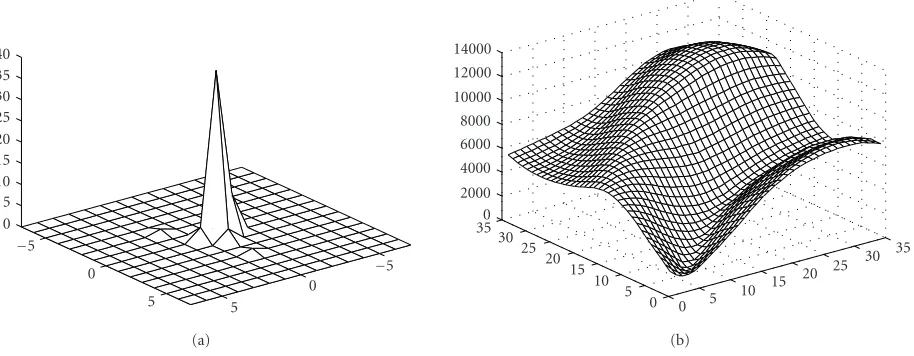
center-biased. This means that smaller displacements are more probable and the motion vector (0,0) has the highest probability of occurrence. Namely, most blocks are station-ary or quasi-stationstation-ary [13]. This is depicted inFigure 2a, in which more than 80% of the blocks are stationary or quasi-stationary (within a central 3×3 area) in the Foreman se-quence.
Property2. The error surface formed by the block distortion
(or the matching error) is usually multimodal. In most cases, the error surface will contain one or more local minimas. This can be due to a number of reasons like the textured local frame content or the luminance change between frames [14].
Property3. The distribution of the SAD is spacial
direction-ality, that is to say, the value of the SAD will decrease to the minima in some direction. This is illustrated inFigure 2b, in which the best matching area is around the origin. The value of SAD at other positions falls down to the best matching value in some direction. If the search strategy is the same at every area, a mass of search redundancy is generated. Accord-ing to the property, the BMA should use the line search in or-der to quickly determine the best matching area and then em-ploy accurate search strategy to find the best matching point in the area.
2.2. Algorithm development of the LSPS
40
Figure2: The basic properties of the block motion fields and the SAD distribution: (a) center-biased motion vector distribution character-istic and (b) spacial direction SAD distribution charactercharacter-istic.
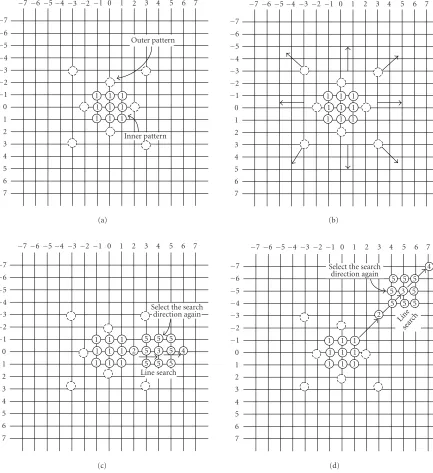
is a waste of time for stationary blocks. The LSPS algorithm would also solve the problem by employing the parallel pro-cessing idea to realize the coarse orientation and the accu-rate search in the same step.Figure 3depicts a basic search-point configuration used in LSPS.Figure 3ais a square pat-tern (SP), which is used to determine the direction of theline
searchand process the accurate search. The SP includes 17
search points. The outside 8 search points are suppositional points, which are referred to as the “outer pattern.” The other 9 search points form the “inner pattern.” Firstly, the SAD val-ues of the search points on the inner pattern are computed. If the position of the MBD is at the center point, it is the es-timated motion vector. If the position of the MBD is not at the center point, the SAD value of the nearest suppositional point on the outer-pattern will be computed. If the value of the suppositional point is smaller than that of the MBD,
line search is executed in the direction, which is illustrated
inFigure 3b. In this step, accurate search and search
direc-tion selecdirec-tion are accomplished at the same time, which is the embodiment of the parallel processing idea. When the SAD value of search point in this direction does not decline, the SP is reused to do accurate search and select the new search direction. Figures3cand3dshow the line search strategy and the positions of the SP, with respect to the previous position, for the next search step along the SP’s face and vertex, respec-tively.
The above search path strategy using the LSPS algorithm can be summarized as follows.
Starting.The SP (Figure 3a) is placed at (0,0), the
cen-ter of the search window. The cencen-ter of the SP is called the original point.
Selecting the search direction.The block distortion
mea-sure (BDM) is evaluated for each of the nine candidate search points on the inner pattern. If the minimum BDM point is found at the center of the SP, proceed to Ending; Else, the BDM is evaluated for the nearest suppositional point on the outer pattern. If the block distortion value of the
sup-positional point is smaller than that of the minimum BDM point, let the suppositional point be the line search point, proceed toLine Search. Else, let the minimum BDM point be the center of the SP, proceed toSelecting the search
direc-tion.
Line Search.The BDM is evaluated for the next checking
point in the direction determined by the original point and line search point, which is illustrated in Figures3cand3d. If the SAD value of the checking point is smaller than that of the
line search point, then let the line search point be the original
point and the checking point (like the point 3 inFigure 3c) be the line search point, proceed toLine Search; Else, let the line search point be the center of the SP, proceed toSelecting
the search direction.
Ending.The center point is the estimated motion vector.
The current block’s search process is completed.
2.3. Performance analysis of the LSPS
We have explained earlier the algorithm development of LSPS in this paper. This subsection aims to investigate how accurate search and speed improvement could be obtained over the search algorithm. In particular, we are comparing the LSPS algorithm with the DS algorithm.
Table 1shows the number of the search points of two
−7−6−5−4−3−2−1 0 1 2 3 4 5 6 7
Figure3: The pattern and search strategy of the LSPS algorithm: (a) square pattern (SP), (b) eight directions of the line search, (c) next step along the SP’s face, and (d) next step along the SP’s vertex.
Figure 4illustrates an example of the search path using
the DS algorithm and the LSPS algorithm. To locate a motion vector at (+7,−2), the DS algorithm has performed 28 block evaluations and the LSPS algorithm has only performed 24 block evaluations. The speed improvement of the LSPS al-gorithm is mainly because the line search is used. The LSPS algorithm performs line search for the unimportant area to reduce the number of the search points. After the important area is arrived at, the square search pattern comprising nine checking points is performed to improve the prediction quity. This example shows that the search speed of the LSPS
al-gorithm is also higher than that of the DS alal-gorithm for large motion blocks.
Table 1andFigure 4show that the computational
Table1: Comparison between LSPS and DS in terms of the number of the search points for quasi-stationary block.
Algorithm The position of the best matching point
The center The radius is 1 The radius is√2 The radius is 2 The radius is 3
DS 13 13 16 18 18
Figure4: Example of a search path strategy using DS and LSPS to locate a motion vector at (+7,−2). (a) The search path using DS (28 search points). (b) The search path using LSPS (23 search points).
3. SIMULATION RESULTS AND DISCUSSIONS
In this section, we are going to give actual experimental re-sults on the performance of the proposed LSPS from the viewpoint of the computational complexity as well as the accuracy of the estimated vectors. In all of our simulations, block sizeN=16, search window sizeW=7, and the SAD-BDM were used. The SAD is given by
SAD(i,j)= M
In our simulations, four various types of test sequences were used: the “Claire,” the “Flower Garden,” the “Foreman”, and the “Football” sequences. The “Claire” sequence is a typical videoconferencing scene with limited object motion and a stationary background. The Flower Garden sequence consists mainly of stationary objects, but with a fast camera panning motion. The Foreman sequence has large local object tions. Finally, the Football sequence consists of complex mo-tions and the movement of the momo-tions is big. In each of the four test sequences, the first 100 frames were used. We com-pared the LSPS against four other BMAs–FS, TSS, FSS, and DS.
For BMA, computational complexity could be measured by average number of search points required for each mo-tion vector’s estimamo-tion. Table 2shows the average number of search points and the speedup ratio of each algorithm with reference to the FS algorithm. Table 3, on the other hand, compares the prediction quality of the simulated BMA al-gorithms in terms of average luma PSNR in decibels. As ex-pected, the FS algorithm provides the best prediction quality, but at the expense of a very high computational complex-ity. From the result ofTable 2, we can find that the LSPS al-gorithm provides the highest speedup ratios. For the image sequence with small motion content, such as “talking-head” sequences (e.g., Claire), it is remarkable that the LSPS algo-rithm provides the speedup ratio up to 23.41. A reasonable explanation for this is that the parallel processing idea is in-troduced in the LSPS algorithm. From the result ofTable 3, it can be concluded that the LSPS algorithm provide the better prediction quality for the image sequence with large motion content (e.g., Foreman). The above observations are further emphasized inFigure 5, which shows the actual performance for 100 frames of Football sequence.
4. CONCLUSION AND FUTURE RESEARCH
Table2: Comparison between different BMAs in terms of the average search points per block.
Algorithm
Claire Flower Garden Foreman Football
Avg. search
points Speedup
Avg. search
points Speedup
Avg. search
points Speedup
Avg. Search
Points Speedup
FS 225 1.00 225 1.00 225 1.00 225 1.00
TSS 25 9.00 25 9.00 25 9.00 25 9.00
FSS 16.56 13.59 19.06 11.80 19.36 11.62 19.39 11.60 DS 13.38 16.82 17.01 13.23 16.56 13.58 16.84 13.36 LSPS 9.61 23.41 15.06 14.94 15.03 14.97 14.99 15.01
Table3: Comparison between different BMAs in terms of prediction quality.
Algorithm Claire Flower Garden Foreman Football
PSNR ∆PSNR PSNR ∆PSNR PSNR ∆PSNR PSNR ∆PSNR
FS 41.46 0.00 25.64 0.00 34.71 0.00 22.56 0.00 TSS 41.14 −0.32 23.41 −2.23 32.19 −2.52 21.53 −1.03 FSS 41.40 −0.06 25.02 −0.62 33.81 −0.90 21.77 −0.79 DS 41.45 −0.01 25.30 −0.34 34.11 −0.60 21.74 −0.83 LSPS 41.46 0.00 25.35 −0.29 34.38 −0.33 21.81 −0.75
26
24
22
20
18
16
14
12
Sear
ch
point
per
b
loc
k
0 10 20 30 40 50 60 70 80 90 100
Frame number
TSS FSS
DS LSPS
(a)
24
23.5
23
22.5
22
21.5
21
20.5
20
19.5
19
PSNR
(dB)
0 10 20 30 40 50 60 70 80 90 100
Frame number
FS DS LSPS
(b)
Figure5: Performance comparison between different BMAs when applied to 100 frames of the Football sequence: (a) computational com-plexity and (b) prediction quality.
and the parallel processing idea, a new LSPS algorithm for fast block matching ME is developed. Like DS, the proposed techniques can be applied to any block-based compression standard and GOP structure, and the search window size is not restricted by the searching strategy in the LSPS algo-rithm. Experimental results show that, compared with the DS algorithm, the LSPS algorithm achieves close prediction quality as well as greatly reduces its computational complex-ity.
There are still several areas of work to be conducted. (1) The predictive quality of the LSPS algorithm is not as
good as that of the FS algorithm. The problem can be tackled by adopting the multiple candidates. For this, we have done some preliminary researches.
ACKNOWLEDGMENT
This work was supported by the National Science Founda-tion of China (Grant 69975015).
REFERENCES
[1] ISO/IEC CD 11172-2 (MPEG-1 Video), Information technology—Coding of moving pictures and associated audio for digital storage media at up to about 1.5 Mbits/s: Video, 1993. [2] ISO/IEC CD 13818-2 (ITU-T H.262, MPEG-2 Video),
In-formation technology—Generic coding of moving pictures and associated audio information: Video—Part 2, 2000.
[3] ISO/IEC CD 14496-2 (MPEG-4), Information technology— Coding of audio-visual objects—Part 2: Video, 2001.
[4] CCITT SGXV, Video Codec for Audiovisual Services at p∗64 kbit/s Recommendation H.261, Geneva, Switzerland, 1993. [5] International Telecommunication Union, Video Coding for
Low Bitrate Communication, ITU-T Recommendation H.263, 1996.
[6] ISO/IEC 11496-10, Advanced Video Coding. ITU-T Rec-ommendation H.264, Final Committee Draft, Document JVT-E022, September 2002.
[7] R. Li, B. Zeng, and M. L. Liou, “A new three-step search algo-rithm for block motion estimation,”IEEE Trans. Circuits and Systems for Video Technology, vol. 4, no. 4, pp. 438–442, 1994. [8] L.-M. Po and W.-C. Ma, “A novel four-step search algorithm for fast block motion estimation,” IEEE Trans. Circuits and Systems for Video Technology, vol. 6, no. 3, pp. 313–317, 1996. [9] J. Jain and A. Jain, “Displacement measurement and its appli-cation in interframe image coding,”IEEE Trans. Communica-tions, vol. 29, no. 12, pp. 1799–1808, 1981.
[10] M. Ghanbari, “The cross-search algorithm for motion esti-mation [image coding],” IEEE Trans. Communications, vol. 38, no. 7, pp. 950–953, 1990.
[11] S. Zhu and K.-K. Ma, “A new diamond search algorithm for fast block-matching motion estimation,” IEEE Trans. Image Processing, vol. 9, no. 2, pp. 287–290, 2000.
[12] “Special issue on MPEG-4,” IEEE Trans. Circuits and Systems for Video Technology, vol. 7, no. 1, 1997.
[13] J. Y. Tham, S. Ranganath, M. Ranganath, and A. A. Kassim, “A novel unrestricted center-biased diamond search algorithm for block motion estimation,” IEEE Trans. Circuits and Sys-tems for Video Technology, vol. 8, no. 4, pp. 369–377, 1998. [14] M. E. Al-Mualla, C. N. Canagarajah, and D. R. Bull,
“Sim-plex minimization for single- and multiple-reference motion estimation,” IEEE Trans. Circuits and Systems for Video Tech-nology, vol. 11, no. 12, pp. 1209–1220, 2001.
Ding Gui-guangwas born in 1976. He re-ceived the B.S. degree in measurement con-trol engineering and apparatus, the M.S. degree in information and communication engineering, and the Ph.D. degree in circuit and system from Xidian University in 1999, 2002, and 2004, respectively. He is currently a postdoctor with the Broadband Networks & Digital Media Lab of Automation Depart-ment, Tsinghua University. His research
in-terests include image and video coding, image processing, and mul-timedia communication.