Volume 2006, Article ID 54148, Pages1–8 DOI 10.1155/WCN/2006/54148
Efficient Low Bit-Rate Low-Latency Channelization in DECT
Rohit Budhiraja1and Bhaskar Ramamurthi2
1Midas Communication Technologies Pvt. Ltd., Chennai 600 041, India
2Telecommunication and Computer Networking (TeNet) Group, Department of Electrical Engineering, IIT-Madras, Chennai 600 036, India
Received 12 September 2005; Revised 6 January 2006; Accepted 12 February 2006
Recommended for Publication by Bhaskar Krishnamachari
In a TDMA standard such as DECT, low bit-rate transmission is feasible either at the cost of efficiency (shorter slots with fixed overhead per slot) or increased latency (longer frames). This paper proposes a new scheme for low bit-rate low-latency channeliza-tion in the DECT standard, in which data can be efficiently transmitted at rates as low as 10 kbps. This could be useful for sending acknowledgments for a high-speed data communication link, or for vocoder/VoIP traffic. The proposed scheme enables efficient low bit-rate transmission by dividing a DECT channel into four subbands, and by employing a new slot structure wherein TDMA overhead is kept to a minimum. It is shown that the proposed scheme can coexist with the DECT system and can be implemented using existing IMT-2000 DECT hardware with minor modifications. A comparison is also made of the proposed scheme with existing options for low bit-rate channelization in DECT.
Copyright © 2006 R. Budhiraja and B. Ramamurthi. This is an open access article distributed under the Creative Commons Attribution License, which permits unrestricted use, distribution, and reproduction in any medium, provided the original work is properly cited.
1. MOTIVATION
In today’s scenario, advanced voice coding algorithms en-able the transmission of toll quality voice at a bit rate as low as 6–8 kbps [1]. Instant messaging and always-on Inter-net connectivity are also very popular. Low bit-rate channels are needed to enable efficient scheduling of internet traffic in high-speed shared downlinks such as HSDPA and HDR [2], and for sending acknowledgments (ack) for downlink pack-ets. The uplinkack traffic for IP packets is of the order of few kilobits per second when the downlink is of the order of 500 kbps. Further, link-layer ARQ may be implemented to improve the efficiency of the radio link. This will necessitate link-layeracksin every frame or two. Thus, low bit-rate low-latency channels are also required in addition to the channels with ever higher data rates.
For example, the IMT-2000 digital enhanced cordless telecommunications (DECT) standard [3] can support a bit rate of 500 kbps per user (with 64-QAM as modulation scheme). The high data rates offered by the standard could be used to offer a shared downlink. With this data rate, transmission of an average IP-packet size of 5000 bytes for a file download will take 80 ms. With the DECT frame size of 10 ms, anack will have to be transmitted every 8 to 16 frames. Now, it requires a minimum of two frames in DECT
to establish/tear down a bearer connection. Hence it is not practical to set up/tear down the uplinks and transmitacksin bursts. It is also not possible to delay theacksunduly. There is thus a need to create an efficient low bit-rate low-latency channel in this case.
In this paper, we propose modifications to the IMT-2000 DECT standard to provide low bit-rate low-latency chan-nels by dividing a DECT channel into four subbands, and by employing a new slot structure. The proposed scheme calledmodified DECT with subbands(mDECT-SB) can co-exist with the DECT system, and can be implemented us-ing existus-ing IMT-2000 DECT hardware with minor modifi-cations.
2. BACKGROUND
slot. Additionally, each slot may carry a fixed amount of sig-nalling/control information. The guard symbols, which ac-count for the propagation delay between the portable part (PP) and the radio fixed part (RFP), and allow time for power ramping, further add to the overhead of each slot. Thus, the fixed overhead per slot in TDMA makes the provision of low bit-rate channels inefficient. For example, in a DECT half-slot [3], the payload (80 bits) is only 33% of the total (240 bits).
An alternative for creating low bit-rate channels with-out the inefficiency associated with the use of short bursts, is to increase the frame duration. This, however, increases la-tency. For example, with a DECT full slot and QPSK mod-ulation, the frame duration should be extended by 8 times to 80 ms, if an 8 kbps channel is desired. Such high latency cannot be tolerated for applications such as telephony or for sending acknowledgments in a TCP link. There is an option of creating the low bit-rate channels by reducing the high TDMA overhead by sharing it across multiple users in con-secutive frames. This option also introduces latency in the system. There is a related but less appreciated problem as-sociated with increasing the frame duration. If the duty cy-cle of a TDMA channel isα, and the required energy/bit is Eb, the peak transmit power is (Eb/α)·Rf, whereRf is the frame rate. Asαgoes down, the peak power goes up. Thus, there is a problem in providing low bit-rate TDMA channels having link performance comparable with FDMA or CDMA systems.
In principle, therefore, while providing for low bit-rate channels, one should simultaneously employ as little band-width as possible without increasing the latency. The efficient utilization of uplink bandwidth could thus increase the sys-tem capacity for asymmetric traffic as proposed in the DECT packet radio service [5]. A scheme has been proposed in [6], wherein four OFDM subcarriers in one of DECT channels are used by one user in a DECT time slot. Here, OFDM is employed to improve the receiver performance in a multi-path channel. However, to maintain symbol synchronization, all subcarriers have to be transmitted by one user. Thus this scheme cannot be used for multiple users to create multiple low bit-rate channels in one DECT channel, as in the scheme proposed here.
3. IMT-2000 DECT PHYSICAL LAYER
As mentioned above, DECT uses a TDMA-TDD radio trans-mission method. A basic DECT TDMA frame consists of 24 slots over 10 ms, with each frame divided into two halves of twelve contiguous slots, one half each for the uplink and downlink directions. Each full slot is of 480 symbols, with a 32-symbolS-field for synchronization, 64-symbolA-field for signaling, 320-symbolB-field for payload, 8-symbolZ-field for the CRC, and 56-symbol guard time. DECT also defines a half slot to provide low bit-rate services [3].
DECT operates in the 1880–1935 MHz band with a car-rier spacing of 1.728 MHz. In DECT, a dynamic channel se-lection procedure (DCS) [7] is used to select a channel from the set of available channels, based on the received signal
f0 f1 0 f2 f3
Figure1: Spectrum of four subbands at baseband.
strength indication (RSSI) measurements. For example, with 10 carriers and 12 slots, there are 120 channels to choose from.
4. MDECT-SB PRINCIPLES
In the proposed mDECT-SB scheme, a DECT channel of 1.728 MHz is divided into four equal subbands, as shown in Figure 1. The subbands so obtained each have 1/4th of the bandwidth of a DECT channel. Correspondingly, the symbol duration in the subband is elongated by a factor of four. The frame structure of DECT, that is, the frame duration, num-ber of slots, and slot durations, is kept unchanged. With the increase in symbol duration, the number of symbols in one full slot comes down by a factor of four (i.e., 480/4) to 120. With the new slot format proposed inSection 7, it will be shown that the new scheme enables the efficient transmission of rates as low as 10 kbps in one slot by using BPSK/QPSK modulation as specified in the IMT-2000 DECT standard.
With the slot and frame durations unchanged, there is no increase in latency. However there is the over-arching issue of how mDECT-SB can coexist, and inter-operate, with existing DECT systems. Even if mDECT-SB cannot inter-operate, it must at least be benign towards other DECT systems. Benig-nity is maintained by preserving the existing slot and frame boundaries, and crucially, by suitably modifying the DECT channel selection algorithm for the subbands, as discussed next.
The slot and frame boundaries of DECT are maintained in mDECT-SB, so that it can coexist with existing DECT systems.The presence of a signal in one or more subbands of a DECT channel will result in any DECT-compliant receiver showing RSSI as if a conventional DECT signal is occupying the full channel, as far as the DCS procedure is concerned. Thus if one or more mDECT-SB subbands in a DECT channel are occupied in a time slot, the DCS algorithm in a DECT system will treat the entire DECT channel as being occupied in that time slot. This is as it ought to be for correct functioning of DCS in the DECT system. The RSSI measurement thus gives the level of interference seen by the DECT system, irrespec-tive of whether an entire DECT channel, or only one or more subbands, is occupied.
time slot can be estimated by combining the RSSI measure-ment of the full channel obtained from the transceiver, with relative energy estimates of the subbands obtained after sub-band separation in the digital domain.
If a DECT channel is occupied in a time slot by a DECT system, the SB system will see all the four mDECT-SB channels in the DECT channel as being occupied dur-ing that time slot. If, on the other hand, one or more sub-bands is not being used by another mDECT-SB links in the vicinity, the RSSI for the subband estimated as described will make this apparent. The system implementing mDECT-SB can thus select this low bit-rate subband for a user who needs such a link.
5. ARCHITECTURE OF THEMDECT-SB SCHEME
5.1. Uplink channelization
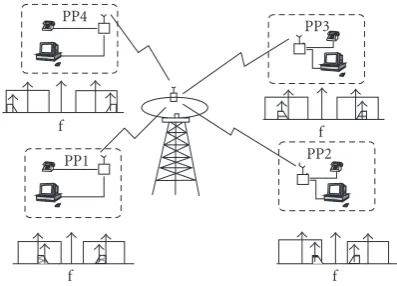
In a time slot, any PP transmits only one of the four available subbands, or the full channel as in DECT. At the RFP, the sub-bands received in the same time slot belongs to different PPs. Depending on the distances between the RFPs and the PPs, the received subband signals can have significantly different power levels. Since the channel selection filter (Figure 3) se-lects a full channel, the input to the analog to digital con-verter (ADC) will consist of the desired subband in the pres-ence of possibly much stronger interferers in the other sub-bands. The ADC should provide adequate resolution for the desired, but possibly weak, subband.
In an IMT-2000 DECT receiver, the ADC resolution needed is around 5 bits (for a signal-to-quantization-noise ratio of∼30 dB). However, when the channel selection filter selects more than one subband and different subbands are received with different power levels, the resolution needed is higher. If the resolution of the samples of the desired subband is to be of the order of 5 bits as before, the ADC resolution re-quired depends on the level of adjacent channel interference (ACI) the RFP is expected to tolerate. For example, with an 8-bit ADC, 18 dB ACI can be tolerated for the subbands put together.
ACI at RFP is controlled by introducing power control for the subbands at the PPs. Since the channel selection filter provides the necessary suppression for adjacent DECT chan-nels, it is enough if the power control is applied to the sub-bands belonging to the same DECT channel. Since DECT is a TDD system, it is easy to estimate the desired transmit power level from the received signal level and implement the power control. This control needs be only with a resolution of 1-2 dB.
The received signal level varies due to shadowing and fading. Transmit power control at PPs compensates for the shadowing loss. Increased ADC resolution (by about 3 bits) would still be needed to account for fading (∼10–15 dB). Since a PP has to estimate the desired transmit power level from the signal it receives from the RFP (on the same car-rier),it is necessary that the PPs using the subbands in a time slot should be communicating with the same RFP, as shown in
Figure 2.
Figure2: Uplink architecture for the mDECT-SB scheme.
Now, the received signal is the sum of four subbands centered at different frequencies. The channel selection filter used in DECT receivers has a sharp cutoffwith a bandwidth of 1.152 MHz. In a normal IMT-2000 DECT system, distor-tion caused by the transidistor-tion band of the filter is equalized by designing a suitable equalizer. For mDECT-SB, the distor-tion caused in the subbands towards the edges of the channel selection filter will be higher and the equalizer performance will be poor.
In order to avoid this distortion for the subbands along the edge, the desired subband must be first translated to the passband of the channel selection filter. The synthesizer used in the IMT-2000 DECT receivers normally generate carrier frequencies in the steps of 1.728 MHz (DECT channel spac-ing). The synthesizer stepsize now needs to be suitably mod-ified as discussed below.
With a synthesizer stepsize of 864 kHz, the subbands cen-tered at f1andf2(Figure 1) can be translated to the passband
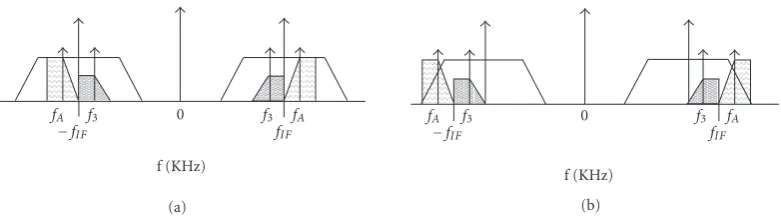
of the filter. With this stepsize, when translating the subbands at the channel edge (f0/ f1), an undesired subband (fA)
be-longing to the adjacent DECT channel (possibly being used by another RFP) will also translate into the passband of the filter, as shown in Figure 4(a). The power of this subband may be far greater than that of desired subband, as power is controlled only by the RFP under consideration for subbands belonging to the same DECT channel. In order to avoid this ACI problem, the mDECT-SB system should employ a syn-thesizer stepsize of 432 kHz. With this stepsize, a desired sub-band at the channel edge is translated only by 432 kHz, and the undesired subband from the adjacent DECT channel is partially filtered out by the transition band of the DECT fil-ter, as shown inFigure 4(b). A synthesizer stepsize of 432 kHz thus reduces the uncontrolled ACI, compared to a stepsize of 864 kHz.
Band select filter
LNA BPF
Downconversion Channel selection filter
AGC ADC
Signal processing
in digital domain
Figure3: Block diagram of a generic IMT-2000 DECT receiver.
fA f3
fIF
0 f3 fA
fIF
f (KHz)
(a)
fA f3
fIF
0 f3 fA
fIF
f (KHz)
(b)
Figure4: Downconversion of subbands using synthesizer stepsize of 432 kHz.
5.2. Downlink channelization
The differential modulation schemes specified by IMT-2000 DECT standard [3] have restricted envelope variations. The PA on the transmitter needs to be thus linear for a limited range. The transmission of more than one subband in a time-slot at the RFP will lead to large envelope variations and will necessitate the use of a higher PA backoff. This can be avoided by eschewing mDECT-SB in the downlink. Instead, an IMT-2000 DECT full slot at normal symbol rate is time-multiplexed among four users, as shown inFigure 5.A neces-sary condition for this architecture is that all the four PPs should be connected to the same RFP.
The A-,B-, and Z-fields of a time slot are considered as one field and partitioned into four different subslots for different users. Each sub-slot will have separateAk- andBk -fields, as shown inFigure 6. The four PPs receive a common time slot and each selects the data meant for itself.
6. RSSI CALCULATION FOR THE INDIVIDUALS SUBBANDS
The ADC samples the received signal amplified by an auto-matic gain control (AGC) amplifier (Figure 3). The AGC am-plifier amplifies the received signal to a predetermined power level, independent of the received signal power. This implies that only relative energy estimates of the individual subbands can be determined in the digital domain. These relative en-ergy estimates can be combined with RSSI measurement of the full channel (obtained from the transceiver) to determine the absolute energy levels as shown next.
LetEcbe the RSSI measurement of the full channel as ob-tained from the transceiver. Also, letEkbe the RSSI estimates
of the individual subbands. Therefore,
k=3
k=0
Ek=Ec fork=0, 1, 2, 3. (1)
DefineEk=mk∗(E0), withm0=1. That is,mkis the relative
energy of thekth subband with respect to the first subband. Thus,
E0 k=3
k=0
mk
=Ec. (2)
Now,mk,k = 1, 2, 3, can be determined in the digital domain after subband separation. The RSSIE0can be solved
from (2), and henceEk,k=1, 2, 3.
7. SLOT STRUCTURE FORMDECT-SB
7.1. Uplink
As mentioned earlier, the number of symbols in mDECT-SB in a full slot is reduced by a factor of four, from 480 to 120 symbols. The efficiency of TDMA can be poor if the TDMA overhead is not carefully kept to a minimum. In this section, we propose a new slot structure for mDECT-SB by reducing the overhead associated withS-,A-fields and guard symbols.
7.1.1. Signalling field
PP4
PP1
PP3
PP2
G S G
480
G S G
480
G S G
480
G S G
480
Figure5: Downlink architecture for the mDECT-SB scheme.
For PP1 For PP2 For PP3 For PP4 Full slot
G S A1 B1 A2 B2 A3 B3 A4 B4 G+Z
Figure6: Time-multiplexed full slot for the downlink.
(irrespective of half, full, or double slot). It is proposed to use DQPSK for theA-field, instead of DBPSK as in IMT-2000 DECT [3]. We then need only 32 symbols for theA-field as shown inFigure 7.
7.1.2. Guard symbols
The guard time between time slots in a TDMA system is meant for power ramping and differential propagation de-lay between the PPs and RFP. In existing DECT systems, out of 56 symbols guard time, 12 symbols are required for power ramping. In mDECT-SB, the same guard time as in DECT would now correspond to 56/4=14 symbol duration. With autoranging [8] and timing advance as in GSM [9], the re-quired number of guard symbols can be reduced to 8 bols. The active portion of the slot can therefore be 112 sym-bols.
7.1.3. Synchronization field
DECT systems use a 32-symbol synchronization field, out of which 16 symbols are used by the preamble and 16 symbols for synchronization. In the pre-IMT-2000 DECT systems, hardware clock acquisition and data detection circuitry are commonly employed, in which the signal can be processed in one pass itself. The settling time of the clock recovery phase locked loop (PLL) necessitates the use of a 16-symbol
Preamble Sync
S–field
A–field B–field
Guard band Guard band
Guard band=(4 14) symbols
S–field=16 symbols{preamble (8) and sync (8)} A–field=32 symbols
B–field=(58 69) symbols
π/2-DBPSK π/4-DQPSK
D(B/Q)PSK Differentially modulated PR sequence
Figure7: Uplink slot structure for mDECT-SB.
0 5 10 15 20 25 30 35
τ
0 0.1 0.2 0.3 0.4 0.5 0.6 0.7 0.8 0.9 1
Rxx
(
τ
)
Figure8: Autocorrelation function of present DECT synchroniza-tion word.
that a bit rate of 12.8 kbps can be made available for user pay-load.
7.2. Downlink
As discussed inSection 5(Section 5.2), we typically do not employ subbands in the downlink, but use the conventional IMT-2000 DECT channel. We also retain the S-field as in IMT-2000 DECT in order to make the PP receiver common for all bit rates. In a DECT full slot, the guard field and the CRC field are common, as shown inFigure 6, and theA-,B -andZ-fields constitute 64 + 320 = 384 symbols out of the total of 480 symbols. These 384 symbols are partitioned for four different users. Each user now has 384/4=96 symbols. TheA-field for each PP is QPSK modulated as on uplink, re-quiring only 64/2=32 symbols. The remaining 96−32=64 symbols can provide a bit rate of 12.8 kbps/user
8. COMPLEX SYNCHRONIZATION WORD FOR MDECT-SB
In the present DECT system, a 16 bit word (0X1675) is used as the synchronization word [3], and it has an equal num-ber of ones and zeros. The autocorrelation (Rxx(τ)) of this PRN sequence is plotted inFigure 8. It can been be seen that Rxx(τ) gives a sharp peak forτ =0 and small side lobes for any otherτ.
The IS-54 standard [10] defines 14-symbol long diff eren-tially-encoded complex synchronization words. A simulation study was done to study the autocorrelation of a synchroniza-tion word obtained by truncating the 14-symbol synchro-nization word to 8 symbols (by dropping 3 symbols on either side). The peak magnitude ofRxx(τ) of either of the synchro-nization words, thus measured forτ=0 (Figure 9), is nearly the same when compared withRxx(τ) for 0X1675. Any of the above-mentioned complex sequences suitably truncated can be used as a synchronization word for mDECT-SB
0 5 10 15
τ
0.1 0.2 0.3 0.4 0.5 0.6 0.7 0.8 0.9 1
Rxx
(
τ
)
Figure9: Autocorrelation function of new sequence.
3 4 5 6 7 8 9 10
Eb/N0 (dB) 10 5
10 4 10 3 10 2 10 1
BER
Ideal DBPSK 16-symbol preamble 8-symbol preamble
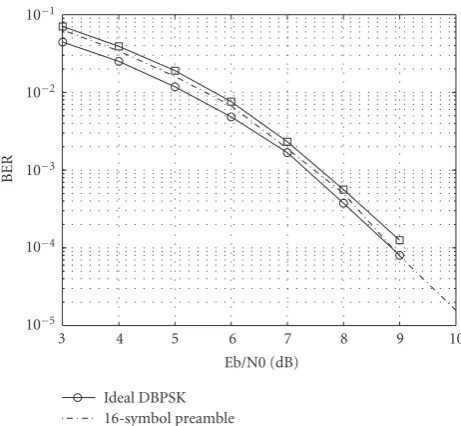
Figure10: BER performance.
9. PERFORMANCE OF RECEIVER ALGORITHMS
Table1: Comparison between IMT-2000 DECT and mDECT-SB.
Bit rate (kbps) Options NOU TDMA efficiency (%)
IMT-2000 mD IMT-2000 mD IMT-2000 mD IMT-2000 mD
8 6.4 1 HS(B) 1 FS(B) 2 4 33.33 53.33
16 12.8 1 HS(Q) 1 FS(Q) 2 4 50 70
degradation for the 8-symbol preamble is only 0.1 dB, when compared to the 16-symbol preamble. This deterioration is due to the fact that noise is now averaged only over 8 sym-bols. This gap can be further reduced if the synchronization word is also used for refining the estimate.
10. COMPARISON OFMDECT-SB WITH IMT-2000 DECT
InTable 1, improvements obtained by using mDECT-SB in-stead of IMT-2000 DECT for data rates between 6.4– 12.8 kbps are presented. In this table, NOU is number of users per full slot and HS/FS is half/full slot with BPSK/QPSK (B/Q) as modulation scheme. The use ofπ/8-D8PSK in a full slot mDECT-SB will provide 19.2 kbps/user, which is an in-termediate bit rate not normally available in DECT. The only application for bit rates higher than 8 kbps is Internet access, for which the higher the bit rate, the better. Since IMT-2000 DECT provides a range of much higher bit-rates, this mode is not expected to be useful.
It can be seen fromTable 1that a low-latency 12.8 kbps channel is supported by mDECT-SB with a TDMA effi -ciency of 70%. This is a little higher than the efficiency of conventional GFSK-based DECT for a 32 kbps channel. At 12.8 kbps, an mDECT-SB channel can easily support vocoded voice traffic at 6 to 8 kbps with sufficient excess capacity for coding. Coding greatly improves link reliabil-ity for vocoded voice and IP traffic; and is part of mod-ern air-interface standards. The lowest bit rate supported by mDECT-SB is 6.4 kbps, using spectrally inefficient BPSK modulation. Although the TDMA efficiency at 53% is higher than for an 8 kbps channel in IMT-2000 DECT, it is not rec-ommended for widespread use.
In an IMT-2000 DECT transmitter, the baseband sig-nal is generated by storing precalculated samples in a read-only memory (ROM) and then using a digital-to-analog con-verter (DAC) to reconstruct the analog signal. A higher ca-pacity ROM (to store the samples for four subbands at the PP) can be used to generate the transmit signal for mDECT-SB without any other hardware modifications. As mentioned inSection 5, the synthesizer stepsize for an mDECT-SB re-ceiver should be reduced to 432 kHz. The minor hardware modifications required to implement the mDECT-SB on a IMT-2000 DECT platform has been summarized inTable 2.
11. CONCLUSIONS
In summary, mDECT-SB when combined with low bit-rate voice coding can provide much higher voice traffic capacity
Table2: Hardware modifications for mDECT-SB.
Hardware mDECT-SB IMT-2000 DECT
ROM Increased size —
Synthesizer stepsize 432 kHz 1728 kHz ADC resolution 8–14 bits 8 bits
with minimal modifications to the existing IMT-2000 DECT hardware. It can also provide efficient low bit-rate feedback channels for acknowledgments in asymmetric data links. An example of this is the GF channel, which is used to carry acknowledgments for asymmetric connections in the DECT packet radio service [5]. As shown inTable 2, the mDECT-SB scheme can be implemented using an IMT-2000 DECT transceiver with only baseband software modifications and minimal hardware modifications. The same platform thus al-lows low bit rates with mDECT-SB, in addition to the high bit rates specified in the IMT-2000 DECT standard. The mDECT-SB scheme thus provides a simple and efficient way to provide low rate channels in addition to the high bit-rate channels of IMT-2000 DECT without increasing the la-tency.
REFERENCES
[1] J. P. Woodward, J. M. Torrance, and L. Hanzo, “A low-delay multimode speech terminal,” inProceedings of IEEE 46th Ve-hicular Technology Conference (VTC ’96), vol. 1, pp. 213–217, Atlanta, Ga, USA, April-May 1996.
[2] 3GPP, “Technical Specification Group (Radio Access Net-work): High Speed Downlink Packet Access,” TR25.858, v5.0.0, March 2002.
[3] ETSI, Digital Enhanced Cordless Telecommunications, Physi-cal Layer, ETSI EN 300175-2, 2003.
[4] S. Ramachandran, A. Jhunjunwala, and B. Ramamurthi, “Re-lay base station for DECT based wireless in local loop to serve sparse rural areas,” inProceedings of IEEE International Con-ference on Personal Wireless Communications, pp. 349–353, Jaipur, India, February 1999.
[5] ETSI, DECT Packet Radio Service, ETSI EN 301 649 V1.3.1. (2003-03).
[6] R. O’Neill and L. Lopes, “A study of novel OFDM transmis-sion schemes for use in indoor environments,” inProceedings of IEEE 46th Vehicular Technology Conference (VTC ’96), vol. 2, pp. 909–913, Atlanta, Ga, USA, April-May 1996.
[8] D. Sridhara, “Auto Ranging for the CorDECT WLL system,” B.Tech Project Report, Department of Electrical Engineering, IIT Madras, Tamil Nadu, India, June 1998.
[9] 3rd Generation Partnership Project; Technical Specification Group GSM/EDGE Radio Access Network; Radio subsystem synchronization (Release 6), 3GPP TS 45.010 V6.3.0 (2004-11).
[10] Dual-Mode Mobile Station-Base Station Compatibility Stan-dard, IS-54 Rev. A (incorporating EIA/TIA 553) TIA/EIA Project Number 2398, October 1990.
Rohit Budhirajagot his B.Tech in electron-ics and communications from Kurukshetra University in 2000 and M.S. in electrical en-gineering from IIT-Madras in 2004. For his Masters thesis, he worked on the design and implementation of PHY layer algorithms for the IMT-2000 DECT systems. Immedi-ately after graduating from IIT-Madras, he joined Midas Communication Technologies Pvt. Ltd., Chennai. Presently he is leading a
team that is designing a hardware platform for 802.16e standard. His areas of interest are communications, signal processing, and wireless system design.
Bhaskar Ramamurthi got his B.Tech in electronics from IIT-Madras in 1980, and his M.S. and Ph.D. in electrical engineering from the University of California at Santa Barbara, in 1982 and 1985, respectively. Af-ter working at AT & T Bell Laboratories for a couple of years, he joined the faculty of IIT-Madras in 1986, where he is currently a Professor in the Electrical Engineering De-partment, and Dean of Planning for the