Volume 2006, Article ID 85495, Pages1–14 DOI 10.1155/WCN/2006/85495
Multiple-Channel Security Architecture
and Its Implementation over SSL
Yong Song, Konstantin Beznosov, and Victor C. M. Leung
Department of Electrical and Computer Engineering, Faculty of Applied Sciences, University of British Columbia, 2356 Main Mall, Vancouver, BC, Canada V6T 1Z4
Received 2 October 2005; Revised 18 April 2006; Accepted 21 April 2006
This paper presents multiple-channel SSL (MC-SSL), an architecture and protocol for protecting client-server communications. In contrast to SSL, which provides a single end-to-end secure channel, MC-SSL enables applications to employ multiple channels, each with its own cipher suite and data-flow direction. Our approach also allows for several partially trusted application proxies. The main advantages of MC-SSL over SSL are (a) support for end-to-end security in the presence of partially trusted proxies, and (b) selective data protection for achieving computational efficiency important to resource-constrained clients and heavily loaded servers.
Copyright © 2006 Yong Song et al. This is an open access article distributed under the Creative Commons Attribution License, which permits unrestricted use, distribution, and reproduction in any medium, provided the original work is properly cited.
1. INTRODUCTION
While the Internet is advancing from wireline to wireless networks, a growing number of handheld devices—such as cellular phones, PDAs, and palmtops—can access In-ternet applications, for example, Web, e-mail, multimedia, and so forth. Securing client-server communication between resource-constrained handheld devices and heavily loaded Internet servers has been a challenge. A handheld device has many more constraints than an ordinary computer in terms of power, processor, memory, display, and other re-sources. The access channels of handheld devices range from 2 G/2.5 G/3 G cellular networks, wireless LAN, and bluetooth to dial-up and LAN. Some of these are slow, unreliable, and expensive. A handheld device is still resource-constrained, even though it uses a wireline interface such as LAN for com-munication. Besides, the operating system and software of a handheld device often have fewer functions than those of an ordinary computer. However, many Internet applications and protocols are designed mainly for ordinary computers. For these reasons, handheld devices pose challenges to secure client-server communications.
This paper presents a new security architecture and protocol for securing client-server communications, named multiple-channel SSL (MC-SSL). Although this work fo-cuses on wireless handheld or mobile devices, MC-SSL is designed as a general security protocol for a wide range
of client-server applications. It supports multiple channels between a client and a server. Each channel can be either a direct or a proxy channel with one or more intermedi-ary proxies; moreover, each channel can have its own ci-pher suite and data-flow direction. During an application session, a client and a server establish channels according to their specific needs for data protection and selectively use the channels to communicate directly or through prox-ies.
C SSL S
C SSL P1 SSL
Pn SSL
S
Figure1: The point-to-point and proxy-chain models of SSL.
The rest of this paper is organized as follows:Section 2 describes the problems and limitations of SSL. Section 3 outlines related work. Section 4 presents the MC-SSL ar-chitecture.Section 5discusses the MC-SSL protocol design. Section 6 demonstrates implementation. Section 7 draws conclusions.
2. PROBLEM MOTIVATION
Although SSL is the de facto application security protocol for the Internet, it has several limitations. First, SSL cannot help applications protect information from partially trusted application proxies, which leads to the necessity of uncon-ditionally trusting proxies. Second, due to the high cost of changing a cipher suite once an SSL connection is estab-lished, all data, independent of differences in security re-quirements, is protected unvaryingly, resulting in either over-protection or underover-protection. Third, SSL does not contain sufficient negotiation capabilities to support selective protec-tion of data and the negotiaprotec-tion of proxy use. After a brief description of SSL, this section discusses these limitations in detail.
Figure 1illustrates a simplified communication model of SSL. The upper part of the figure shows a point-to-point se-cure channel over a TCP connection between client Cand serverS. Channel security is achieved by making use of a ci-pher suite, which defines a key exchange algorithm, a bulk encryption algorithm, and a hash algorithm. For example, TLS RSA WITH IDEA CBC SHA cipher suite uses RSA al-gorithm [2,3] to perform authentication and key exchange, IDEA (international data encryption algorithm) [2, 3] to perform encryption and decryption, and SHA-1 (secure hash algorithm) [2,3] to generate MAC (message authentication code) [1]. MAC protects data integrity. CBC (cipher block chaining) [2, 3] is a mode of operation for block ciphers such as IDEA. Please refer to RFC 2246 [1] for the details of SSL/TLS. The following subsections use the above model to explain the limitations of SSL addressed by MC-SSL.
2.1. Problem with trusted proxies
Application proxies pose security risks. Due to their con-straints, many handheld devices require application proxies to perform content transformation or scanning. For exam-ple, most Web sites do not provide Web pages designed for handheld devices, and so the Web browser of a handheld de-vice is likely unable to display a Web page not transformed by
WAP device
WAE WSP WTP WTLS WDP Bearer
WAP gateway
WSP WTP WTLS WDP Bearer
HTTP
SSL TCP IP
Web server WAE
HTTP
SSL TCP IP
Figure2: WAP 1.X gateway architecture (adapted from [4]).
an intermediary proxy. Even desktop computers sometimes usenapplication proxies, for example, an application fire-wall for virus scanning/filtering.
The need for an application proxy is not in itself a lim-itation, but for sensitive information in transit, it becomes difficult to achieve end-to-end security between a client and a server. Although SSL is the de facto security protocol on the Web, it cannot prevent information leakage, tampering, and impersonation by an application proxy.
As illustrated in the lower part ofFigure 1, SSL enables point-to-point protection of the communication between any two directly connected entities through unconditionally trusted proxies. SSL is vulnerable to malicious proxies, as any proxy in the chain can read and/or modify data. In other words, a proxy can compromise the end-to-end security be-tween CandS. The use of proxies with SSL implicitly re-quires that at least one endpoint (CorS) has unconditional trust in the proxies used between the endpoints. This require-ment can be satisfied only if the proxies are administered by the organization or individual that also administers the trust-ing endpoint. Note that if a proxy works below the applica-tion layer, for example, at the transport layer, thenCandS can still establish an end-to-end SSL session. For this reason, SOCKS proxy mechanism and network address translation (NAT) do not affect the normal operation of SSL. In this pa-per, the term “proxy” designates a proxy or gateway at the application layer.
A typical example of using proxies with SSL is the WAP 1.X gateway architecture shown inFigure 2. The communi-cation between a WAP device and a WAP gateway is pro-tected by WTLS, a variant of the SSL protocol for wireless communications. Clearly, the WAP 1.X gateway shown in Figure 2is an application proxy because it performs content transformation, recoding, and/or compression for the con-tent carried by HTTP or WSP/WTP protocols. Since this ar-chitecture is a proxy arar-chitecture that employs SSL, it has the same limitation as the SSL proxy chains. The architecture is secure only when the gateway is trustworthy, for instance, when the Web server owner provides the gateway.
2.2. Limitation of cipher suites and channel direction
Cryptographic algorithms such as RSA [2], 3DES [2], and AES are computationally expensive, especially for a hand-held device or a heavily loaded server. If a processor is fully dedicated to security processing, the processing requirements for 3DES, AES, SHA (secure hash algorithm) [2], and MD5 (message digest 5) [2] at 10 Mbps are 535.9, 206.3, 115.4, and 33.1 MIPS (millions of instructions per second), respec-tively [5]. In comparison, a handset processor such as Intel’s StrongARM processor SA-1110 can deliver around 235 MIPS at 206 MHz [5]. A common goal of designing hardware and software for wireless handheld devices is to reduce battery power use and processor time as much as possible.
During an SSL session, only one cipher suite can be used at any time. Although SSL can change the cipher suite with a full handshake, doing so is inefficient because a full hand-shake entails communicationally expensive message inter-action and computationally expensive public key certificate verification. Besides, SSL does not support restriction on channel directions, such as a simplex channel. SSL provides only a duplex channel, in which the cipher suites for both directions are identical. When requests and responses need different types of data protection, for example, an applica-tion cannot flexibly employ different cipher suites. In fact, few applications can change their cipher suites during an SSL session. This limitation is partially due to the high cost of changing cipher suites. As a result, data protection is coarse-grained.
There are several types of redundant protection. First, not all information is confidential, but it is still encrypted with confidential information using the same cipher in an SSL session. For example, a Web page for online banking contains confidential information, including account num-bers and balances; however, other parts of the Web page, including HTML tags, JavaScript/Java code, images, adver-tisements, are not confidential. For example, after examining the HTML pages sent to Web browsers by one of the online-banking systems, we have determined that only around 4% of the data requires both integrity and confidentiality protec-tion, with the rest needing just integrity or no protection at all [6]. For that latter data, expensive encryption operations are unnecessary, and HMAC (keyed-hash message authenti-cation code) based on MD5 or SHA-1 can be adequate for providing data integrity. Our experiments with Java secure socket extension (JSSE) show that CPU savings could be up to 37% in those cases when 96% of data is nonconfidential and can be sent over an integrity-only channel [6]. This value could translate to a battery-life saving, but the relationship is different for each platform and user style.
Second, some information is already secured at the ap-plication layer. For example, some software, e-mail messages, and documents are already digitally signed or encrypted with digital certificates, PGP, or XML security. Extra protection by SSL is likely redundant in those cases. Third, many ap-plications require authentication but do not need data pro-tection after the login stage. In fact, different users and ser-vice providers have different security requirements. In sum-mary, there is a need to supportselective protection. Although choosing or switching between HTTP and HTTPS URL links
can provide selective protection to some degree, it works only for Web applications at coarse granularity [7]. Applications require selective protection at finer granularity.
2.3. Weak negotiation capabilities
The third problem with SSL is the lack of sufficient infor-mation provided during the negotiation phase. To decide whether or not and how to use proxies, multiple cipher suites, and simplex channels,C andSmust exchange suffi-cient information to make the right decisions that optimize the combination of different channels. Generally,Cneeds to inform S of its device capabilities and security policy. For example,C may define whether proxies are allowed to pro-cess data with sensitivity below a certain level, what cipher suites are strong enough to protect data with a certain level of sensitivity, and so on. Lack of negotiation support is SSL’s third limitation. Moreover, the core of these limitations is that the negotiation and decision process of SSL does not take the security policies, device capabilities, and other important factors into account. These functional limitations constitute a mismatch between SSL and the diverse requirements of client-server applications. When handheld devices and mo-bile applications become more popular, this gap will likely become more apparent.
3. RELATED WORK
There are other methods for addressing the limitations de-scribed inSection 2, namely, changing cipher suites in SSL each time a different level of data protection is required, es-tablishing several independent SSL connections, using SSL extension for a cleartext channel, employing ITLS, selectively protecting data using XML security technologies, and re-ducing associated costs by accelerating cryptographic oper-ations. This section explains why none of these methods ad-dresses the problems as adequately as MC-SSL.
There are several reasons why frequently changing cipher suites in SSL is unsuitable. First, an SSL client and SSL server do not have enough information—such as security policies and device capabilities—to decide if a new cipher suite is ap-propriate. Second, a full SSL handshake, including authen-tication and key exchange, is very inefficient for changing a cipher suite. Third, messages traveling in opposite directions often need different levels of protection, but it is very ineffi-cient to change the cipher suite for each request or response by doing a full handshake. MC-SSL does not have these draw-backs.
public key certificate for authentication. In contrast, proxies in MC-SSL are negotiated through the direct—also referred to in this paper as the “end-to-end”—channel beforeCstarts to set up a proxy channel withS. Moreover,Pcan then use the session ID received fromCfor authenticating withS. In brief, a proxy in MC-SSL is authenticated as a proxy, not as a client.
Portmann and Seneviratne [7] propose a simple exten-sion to SSL to obtain an extra cleartext channel. Their new record-type cleartext application data (CAD) adds a clear-text channel to an SSL connection. To some degree, this channel resembles a cleartext end-to-end channel in MC-SSL; however, their channel is permanent and independent, which makes it insecure with proxies even if no sensitive data goes through it, because undetected data can be in-jected into the channel by any proxy. Without MAC or a digital signature, a cleartext channel cannot prevent infor-mation tampering or injection, and nonsensitive data could be displayed side by side with sensitive data. For this rea-son, an obvious drawback of the CAD-based approach is that it is always present, even if it is considered both un-necessary and insecure for some applications. Moreover, a CAD-based approach can create only cleartext channels. In comparison, MC-SSL can provide a variety of chan-nels, including proxy channels and end-to-end channels created with various cipher suites. Moreover, every chan-nel is securely negotiated among client, server, and prox-ies.
Kwon et al. [9] propose integrated transport layer se-curity (ITLS) to avoid information leakage at a WAP gate-way. The goal of ITLS is to prohibit the WAP gateway from having access to the plaintext of messages exchanged be-tweenCandS. To achieve this,Cencrypts a message twice forS andPusing KCS and KCP, in that order.Pdecrypts the cipher text using KCP and then sends it to S, which decrypts the data with KCS. In reverse, S encrypts a mes-sage using KCS and sends it to P.P encrypts it again us-ing KCP and then forwards it to C. C decrypts it twice using KCP and KCS to get the message. With ITLS, the gateway cannot perform content transformation and scan-ning, a limitation that MC-SSL does not have. In addi-tion, ITLS requires a handheld device to perform encryp-tion/decryption twice as often as SSL, further increasing the CPU time.
XML-based solutions to data protection such as XML security [10, 11] and Web services security (WS-security) [12–15] have the potential to solve the problems addressed by SSL. XML-based solutions are different from MC-SSL in several aspects. First, they are not self-contained se-curity protocols for client-server applications. That is, with just XML-based encryption/signing, mutual authentication and key exchange among client, server, and proxies can-not be performed individually; one has to rely on the secu-rity infrastructure. Second, XML-based solutions do not de-fine mechanisms for negotiating different types of channels, while MC-SSL has such mechanisms. Third, XML-based so-lutions generally belong to the application layer. As such, they require both client and server to support XML and XML
security, which is not optimal for those applications that ex-change mostly binary data.
MC-SSL defines a protocol between transport and appli-cation layers, and works for a variety of appliappli-cations, includ-ing Web services. Besides the above differences, MC-SSL has some advantages over XML-based solutions. First, MC-SSL is more efficient than XML-based solutions: the latter com-monly require binary data to be transformed into text using base 64 encoding, which could significantly increase network traffic and CPU consumption for certain applications. Sec-ond, MC-SSL is an extension of SSL, and SSL is the de facto application security protocol with its implementations be-coming commodities in most modern distributed environ-ments. Therefore, we expect the cost of the transition from SSL to MC-SSL to be much smaller than to XML security.
SSL splitting [16] is a technique for guaranteeing the in-tegrity of data served from proxies without requiring changes to Web clients. This technique reduces the bandwidth load on the server, while allowing an unmodified Web browser to verify that the data served from proxies is endorsed by the originating server. With SSL splitting, the Web server sends the SSL record authenticators, and the proxy merges them with a stream of message payloads retrieved from the proxy’s cache. The merged data stream that the proxy sends to the client is indistinguishable from a normal SSL connection be-tween the client and the server. SSL splitting is geared towards secure public file downloads, in which the concern is data in-tegrity rather than confidentiality.
SSL splitting is similar to MC-SSL in that it is able to pro-vide data integrity in the presence of a partially trusted proxy. In addition, MC-SSL can provide confidentiality by routing sensitive data via a direct channel, and less or nonsensitive data through a proxy channel. An MC-SSL proxy channel can have several proxies, whereas SSL splitting supports only one. Even though SSL splitting does not require modifications to the client as MC-SSL does, both approaches make changes to the protocol between the server and the proxy.
4. MC-SSL ARCHITECTURE
MC-SSL improves end-to-end security in the presence of ap-plication proxies by establishing proxy channels, and reduces redundant cryptographic protection by supporting channels with different cipher suites. MC-SSL can provide an applica-tion session with multiple-virtual channels. The negotiaapplica-tion of channels is based on security policies, device capabilities, and the security attributes of application data of both client and server.
In MC-SSL, a cipher suite consists of only two elements: a cipher for data encryption and decryption, and a hash al-gorithm for MAC, and hence can be denoted as follows:
cipher and key size, hash algorithm for MAC. (1)
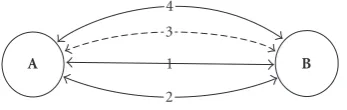
As shown inFigure 3, a connection in MC-SSL can have multiple cipher suites. We characterize a point-to-point con-nection as follows:{endpoint 1, endpoint 2, key exchange
al-gorithm,{cipher suite 1, cipher suite 2,. . .}}, where each
A B 4
3 1 2
Figure3: Multiple cipher suites inside a connection.
C S
P1 Pn
Figure4: Proxy channel model of MC-SSL.
SHA-1) to form the primary channel, which provides the backbone for setting up and controlling other channels in the same connection. A primary channel is the first chan-nel in an MC-SSL connection, and it can be set up with the unchanged SSL protocol. Other channels in an MC-SSL con-nection are referred to as secondary channels. They are new channels added to an SSL connection to support multiple ci-pher suites. The sample connection inFigure 3can be char-acterized as{A,B, RSA,{CS1, CS2, CS3, CS4}}, where RSA is the key exchange algorithm, and CS1 through CS4 are cipher suites for channels 1 to 4, respectively. Among them, channel 1 is the primary channel.
The proxy channel model of MC-SSL is illustrated in Figure 4, in which the point-to-point connections collec-tively form an arc.C-Sis termed an end-to-end channel, and C-P1-· · ·-Pn-Sis called aproxy channel. In this model,C-P1
-· -· -·-Pn-Sis a channel that relies on theC-Schannel to per-form channel negotiation and to transport application data.
Anend-to-end channelmust exist before the proxy channel
negotiation is started. Through an end-to-end channel, C andSexchange messages about what proxies they want and the other parameters of the proxy channel. After that,Cand Sinteract with proxies to set up the proxy channel. TheC -Schannel is also used to control data transmission through the proxy channel.CorScan deliberately choose one of the two channels to transport data according to the data’s secu-rity requirements. For example, sensitive information, such as passwords and credit card numbers, can be transported using the end-to-end channel. An MC-SSL session can have zero or more proxy channels. Each of them and the corre-sponding end-to-end channel reflect the proxy architecture shown inFigure 4.
Combining the proxy-channel architecture and multiple cipher suites leads to the multiple-channel architecture illus-trated inFigure 5, with distinct SSL connections shown as cylinders. In MC-SSL, a channel is a protected communica-tion “pipe,” with a certain cipher suite and a number of appli-cation proxies. If there is no appliappli-cation proxy in the channel, then it is an end-to-end channel; if there is no cipher suite for the channel (the cipher suite is null), then it is aplaintext
C S
P1 Pn
5 4
5 4
2 1 3
5 4
Figure5: Multiple-channel architecture of MC-SSL.
channel. Additionally, a channel can beduplex,simplex, or
inactive. The restriction on channel direction applies only to
application data messages, not to channel control messages. An MC-SSL channel can be characterized as follows:
channel≡ID,E1,E2, CS,
P1,P2,. . .,Pn,D. (2)
ID is a channel’s identity number.E1 andE2 are either
DNS names or the IP addresses of the corresponding end-points. Cipher suite, CS, is defined by expression (1). A proxy (Pi) is identified by its DNS name or IP address. A chan-nel can have zero or more proxies. Direction, D, indicates whether a channel is a duplex, an inactive, or a simplex one pointing to one of the two endpoints. An inactive chan-nel cannot be used to transmit application data, but it can be used for transmitting channel control messages if it is a primary channel. Channel control messages can only go through primary channels.
We illustrate the MC-SSL architecture withFigure 5. The sample MC-SSL session has five channels. Among them, channels 1 and 4 are primary channels, and the others are secondary channels. Furthermore, channel 1 is the primary end-to-end channel, and channel 4 is a primary proxy chan-nel; channels 2 and 3 are secondary end-to-end channels, and channel 5 is a secondary proxy channel. Note that an MC-SSL session can have multiple-primary channels. The number of primary channels in an MC-SSL session is equal to the num-ber of SSL connections withSas an endpoint. Channels 2, 3, and 4 are negotiated through channel 1, and channel 5 is ne-gotiated through channel 4. Additionally, only channel 1 is a duplex channel for application data; others are simplex chan-nels fromStoC. In this application scenario,Cuses channel 1 to send encrypted requests toS, andSmay choose one of the five channels to send back responses.
4.1. Application case study
C S P
4 2
3 1
4 2
Figure6: Channel planning for online banking.
can MC-SSL address this issue? First, let us consider what channels are required in this scenario. The primary end-to-end channel (channel 1 inFigure 6) is always necessary in an MC-SSL session. Moreover, channel 1 can be used to protect the ID/password pair and other sensitive data, including pay-ment information, account number, and bank statepay-ments. Channel 3 is a MAC channel without encryption. The hash algorithm could be MD5 or SHA-1. The purpose of channel 3 is to transport content that needs end-to-end authenticity and integrity protection. To make use of the proxy service, the handheld device must negotiate a single-hop proxy chan-nel (chanchan-nel 4 inFigure 6) with the Web server. This chan-nel is a simplex chanchan-nel that only allows data traffic from the Web server to the handheld device. All HTTP requests gener-ated by the handheld device are sent through channel 1, since it is hard for a Web browser, which does not know about spe-cific application logic, to judge the sensitivity of data. Chan-nel 4 is also chanChan-nel protected only with MAC. ChanChan-nel 2 is a primary proxy channel, which is used by MC-SSL to set up and manage channel 4, but it is not employed for transport-ing application data. Channels 3 and 4 can significantly re-duce redundant encryption if they are used in the right way. For example, in a typical Web page for paying a bill, only the account number and payees’ information is confidential. Other page content does not have to be encrypted by the Web server. On the other hand, if someone is not concerned about battery life and prefers extra data security, the Web server can simply use channel 2 without negotiating channel 4. More-over, one can always choose not to use an application proxy, whether the handheld device can access a server or not.
A Web page contains roughly three types of content: the first type is the data that a Web page is created to carry, such as text, URL links, images, and sound; the second type is the data format, including HTML tags, fonts, size, colours; the third type is executable code such as JavaScript and Java. The first type can be sensitive or nonsensitive. The second type is relatively nonsensitive. The third type generally (with some exceptions) requires authenticity and integrity, but does not require confidentiality. Since all HTTP requests go through channel 1, the problem is how to send a Web page toC. It seems thatScan simply use channel 1 to send all the sensitive data, channel 3 to send executable codes, and channel 4 to send formats of data toPfor transforming, but how canC put data and codes back to a Web page after a Web page has been changed byP?
To solve this new problem, we can use HTML and XML tags and attributes to separate data from its formats and posi-tions in an HTML page. Data can be kept in the same HTML
page or be moved to a new URL. HTML attributes such as “datasrc,” “datafld,” and “src” can achieve this objective. The following is an example that separates data in a table from its tabular form.
<html>
<body>
<xml id=“bs data” src=“bs data.xml”> </xml>
<table border=“1” datasrc=“#bs data”>
<tr>
<td> <span datafld=“DATE”> </span> </td>
<td> <span datafld=“DETAILS”> </span> </td>
<td> <span datafld=“DC”> </span> </td>
<td> <span datafld=“BALANCE”> </span> </td>
</tr>
</table>
</body>
</html>
The following is bs data.xml, which is the data source of the table.
<?xml version=“1.0” encoding=“ISO-8859-1”?>
<ST DATA>
<TRANS>
<DATE>2004-09-28</DATE>
<DETAILS>payroll 23456</DETAILS>
<DC>3000.00</DC>
<BALANCE>51678.26</BALANCE>
</TRANS>
<TRANS>
<DATE>2004-10-01</DATE>
<DETAILS>cheque 00135</DETAILS>
<DC>−600.00</DC>
<BALANCE>51078.26</BALANCE>
</TRANS>
</ST DATA>
In this example, S can use channel 1 to transport the XML file, and channel 4 to process the HTML formats. How-ever, “datasrc,” “datafld,” and “src” are not standard HTML attributes, even in the latest HTML 4.01 [17], although Microsoft Internet Explorer supports these attributes. For-tunately, XHTML (extensible hypertext markup language) [18], the successor of HTML, has defined embedding at-tributes: “src=URI” and “type=ContentTypes.” These two at-tributes are used to embed content from other resources into the current element. The “src” attribute specifies the location of a source for the contents of the element, and the “type” at-tribute specifies the allowable content types of the relevant URI. The following are two examples:
(i) <div src=“bs data.xml” type=“application/xml”> </div>,
(ii) <script src=“popwin” type= “application/x-javascript”/>.
provided with tampered data. For the following reasons, this risk is minimal. First, Web browsers will not use URL links that point to a different Web site in a Web page protected by SSL or MC-SSL. Second,Pcannot get confidential data be-cause all data goes through the end-to-end channel. Third,C orSshould choose a relatively trustworthy proxy to reduce this risk. In our example of online banking, a proxy server provided by a telecommunications company should be good enough, although a proxy server of the associated bank is bet-ter, if available. There are still some methods for minimizing the risk. For example, Scan collect all URI/URL in a Web page and send a copy toCthrough channel 1 or 3. Alterna-tively,Scan send the hash value of all URI/URL toC.
This data (de)multiplexing does require the additional cost of application development. However, the MC-SSL API designers could preserve the transparency between (Web) applications and SSL by providing an abstraction of several independent sockets for transmitting data between the client and server. Such modern software development techniques as aspect-oriented software development (AOSD) [19] have the potential for reducing the development effort by separat-ing the concerns of data processseparat-ing and transmission.
The benefit of selective protection is also demonstrated by using the channel planning illustrated inFigure 6. Chan-nels 3 and 4 are used for nonconfidential data, and channel 1 for confidential data. Suppose that channel 1 uses 128-bit AES for encryption and MD5 for MAC, and channels 3 and 4 use MD5 for MAC protection. If 95 percent of a Web page is nonconfidential, 71% of the CPU time can be saved by chan-nels 3 and 4. If the nonconfidential part is 80%, then MC-SSL can save 57% of the CPU time that is spent on crypto-graphic operations. In many cases, nonconfidential informa-tion could contribute to more than 95% of a Web page se-cured by SSL. Depending on what algorithms are negotiated for data encryption and MAC protection, MC-SSL channels can commonly save 45% to 90% of the CPU time spent on cryptographic operations.
5. PROTOCOL DESIGN
This section presents the MC-SSL protocol that implements the multiple-channel architecture. The MC-SSL protocol consists of seven protocols: initial handshake, primary proxy channel, secondary channel, channel cancellation, alert pro-tocol, abbreviated handshake, and application data. Among them, initial handshake, primary proxy channel, and sec-ondary channel are key protocols for establishing different types of MC-SSL channels. The following subsections de-scribe the MC-SSL architecture and these three key protocols. Interested readers can refer to [20] for a detailed description of all MC-SSL protocols.
5.1. Protocol architecture
The left part of Figure 7shows the Internet protocol stack with SSL, and the right part shows the protocol stack with MC-SSL. The MC-SSL-protocol is deliberately designed to consist of two layers: (1) the upper layer is a new layer—
Application SSL TCP IP
Application MC SSL TCP IP
MC-SSL
Figure7: Two-layer architecture of MC-SSL.
C S
SSL connection setup CLIENT HELLO SERVER HELLO CLIENT SECURITY POLICY
CLIENT CAPABILITIES
Figure8: Initial handshake protocol.
inserted between SSL and the application layers—that pro-vides the application with new MC-SSL specific functional-ity, and (2) the lower layer is SSL. The upper layer of MC-SSL is responsible for the negotiation and control of chan-nels, and is thus called the “MC” (multiple channel) layer.
The lower layer of MC-SSL, that is, SSL, remains un-touched. SSL is therefore the basis of MC-SSL in terms of protocol design, software implementation, and security properties. Specifically, SSL is used for negotiating primary channels in MC-SSL. Although the MC-SSL protocol is im-plemented over SSL, the multiple-channel architecture of MC-SSL is not bound to SSL. For example, we believe that one can develop a new protocol from the MC architecture using XML security [10,11] at the application layer.
5.2. Initial handshake protocol
The initial handshake protocol sets up the first channel, namely, the primary end-to-end channel.Figure 8illustrates the handshake process. First, an SSL session is established be-tweenCandS. After that,CandSexchange messages to ini-tiate an MC-SSL session. These messages, CLIENT HELLO and SERVER HELLO, contain the following information: protocol version, session ID, MAC key, and the hash algo-rithm for end-to-end MAC. The protocol version is the MC-SSL version number ofCorS. The session ID is a crypto-graphically random string generated by the server to identify an MC-SSL session. The MAC key is used by the application data protocol to generate end-to-end MAC. Please refer to [20] for the message formats of the initial handshake proto-col.
C P S
PROXY SUGGESTION S2C PROXY REQUEST C2S PROXY REQUEST RESPONSE S2C 1
SSL connection setup PROXY REQUEST C2P CLIENT AUTHEN REQ P2C
CLIENT AUTHEN RESP C2P
CLIENT CAPABILITIES
2
SSL connection setup
PROXY REQUEST P2S 3
PROXY FINISH
4 PROXY FINISH
PROXY FINISH
Indicates optional messages
Figure9: Primary proxy channel protocol.
level of sensitivity. The device capabilities include hardware and software information of a device such as CPU, power, memory, screen resolution, OS, browser capabilities. With such information aboutC,Sis expected to make correct sug-gestions about what proxy channels and secondary channels are needed.
As can be seen fromFigure 8, the MC-SSL initial hand-shake protocol carries communication cost of four messages, in addition to the SSL handshake, which costs 12 messages [1].
5.3. Proxy channel protocol
This section describes the proxy channel protocol, which can negotiate primary proxy channels—the backbone channels for negotiating and controlling secondary proxy channels. We first consider the protocol for a single-hop primary proxy channel, and then extend this protocol to the general case of a multihop primary proxy channel.
5.3.1. Single-hop proxy channel protocol
Figure 9 illustrates a complete protocol for establishing a single-hop proxy channel. It includes four stages:C-S hand-shake, C-P handshake, P-S handshake, and negotiation feedback. Apart from the SSL channel between C and S,
which is set up by the initial handshake protocol, a single-hop proxy channel needs to set up two more SSL chan-nels.
SorCcan start the proxy-channel negotiation any time after the initial handshake of MC-SSL. In part 1 ofFigure 9, S starts the negotiation by sending C a proxy-suggestion message (PROXY SUGGESTION S2C), which contains in-formation about the proxy channel, such as the purpose of the proxy, the host name/address, and the certificate of the proxy, and channel direction.Cthen responds to S with a proxy request message (PROXY REQUEST C2S), which car-ries similar information about the proxy channel. In this message,Ccan use the proxy and channel parameters sug-gested by S, change some parameters, or even use a differ-ent proxy.Sresponds with the proxy request response mes-sage (PROXY REQUEST RESPONSE S2C) to give its final decision. Please refer to [20] for the format of primary proxy channel protocol messages.
own (possibly application-specific) logic for determining the above parameters of the proxy channel.
TheC-Phandshake starts with theC-PSSL handshake. After that, C sends P a proxy-request message (PROXY REQUEST C2P), which contains the following informa-tion: the session ID, the proxy services needed, the channel direction, the authentication methods preferred by C, the handshake type, the IP address, and the port number of S. CLIENT AUTHEN REQ P2C and CLIENT AUTHEN RESP C2P are a pair of messages for P to authenticate C. The former informs C of the required authentication method, such as user ID/password, chal-lenge/answer, or PKI certificate, and the latter returns the corresponding authentication data toP. IfPdoes not require authentication or if it can authenticateC in a special way, these two messages may be omitted. Additionally, ifCneeds to provide its capabilities toPforPto perform its service, a CLIENT CAPABILITIES message will follow. These optional messages are indicated inFigure 9by an asterisk beside their names.
If C passes the authentication, P will set up an SSL connection withS, and then send a proxy request message (PROXY REQUEST P2S) toS. This message carries a session ID forSto bind the proxy channel with the end-to-end chan-nel in the same session. The last three messages inFigure 9 return the result of this negotiation.
In theP-Shandshake stage, there is no message for au-thentication. IfPis a public or commercial proxy server,P can authenticate itself using its PKI certificate in the hand-shake process of SSL. However, P could be a home com-puter, which usually does not have a PKI certificate with a signature chain leading to a root CA (certificate author-ity). In this case, how canPauthenticate itself toS? We be-lieve that the session ID alone is sufficient for P’s creden-tial. Because session ID is a cryptographically random bit string generated by S, and because it is exchanged as a se-cret using one of the primary channels among S, C, and P, it can serve as an acceptable token for authenticating P toS. Therefore,Pdoes not have to possess a certificate ac-ceptable by S. This is a useful feature because, for exam-ple, a handheld device user can designate a home computer as a proxy. For a handheld device to authenticate a home computer in the C-P handshake stage, a user can simply generate a certificate and its accompanying private key on the home computer, and import this “homemade” certifi-cate into the handheld device before using the home com-puter as a proxy. The home comcom-puter can then authenticate to the server at the service provider site with the channel ID.
5.3.2. Multihop proxy channel protocol
A single-hop proxy channel is normally simpler and more secure than a multihop one. By using a proxy “cluster,” in which one proxy works as the representative of other prox-ies to interact with C and S, one can substitute a hop proxy channel with a single-hop one. However, multi-hop proxy channels are sometimes unavoidable for various
reasons. This section describes the protocol for establishing a multihop proxy channel.
First, we consider the simplest way to extend the pro-tocol described in the previous section: we can iteratively reuse the P-S handshake (i.e., stage 3 in Figure 9) on any two neighbouring proxies inFigure 4, for instance, fromPi toPi+1. Similar to a single-hop proxy channel, this forward process starts at Cand ends at S. The proxy-request mes-sages need small changes: they have to carry the parame-ters of all proxies, not just one. In the C-S handshake, C andSneed to exchange information about DNS names, lis-tening TCP ports, and even the certificates (or their URLs) of all the proxies. Likewise, the proxy-request message in the C-P1 handshake is extended to contain information
about multiple proxies. The means of configuring client or server with the information about proxies is an important issue that has to be addressed by the system developers, no matter which approach is used to support multiproxy sys-tems. This issue is, however, beyond the scope of this pa-per.
After theC-P1 handshake is performed,P1 connects to
P2, and theP-Shandshake occurs in the single-hop
proxy-channel protocol. This forward process continues until the last proxy,Pn, establishes a channel withS. The feedback pro-cess (i.e., stage 4 inFigure 9) can be easily extended for a mul-tihop proxy channel without much change.
In addition to the handshake protocol described in the previous section, the total number of messages exchanged in sequential order is 4p + s(1 + p) + 7, where s is the number of messages used for establishing an SSL connec-tion and p is the number of proxies. If the cost of the MC-SSL initial handshake protocol also counted, the to-tal cost becomes 4p+s(2 + p) + 11 messages. For exam-ple, the overall communication cost of establishing a proxy channel with two proxies using SSL handshake (s is 12 messages) is 67 messages versus 36 messages needed for client and server to connect through the same two prox-ies using just three point-to-point SSL channels.Figure 10 shows the total communication cost (computed using the latter expression) of establishing a multihop connection for both MC-SSL and SSL. It suggests that the estab-lishment of MC-SSL connections with few proxies costs twice as much as for SSL. However, the overhead of MC-SSL relative to MC-SSL reduces as the number of proxies in-creases.
After this extended handshake process is completed, if we treat the structure inFigure 4as a ring we can assure that ev-ery entity has authenticated its two neighbours. As a result,C can trust proxies fromP2toPn, andScan trust proxies from
P1toPn−1, assuming the trust relation created through
1 2 3 4 5 6 7 8 9 10 Number of proxies
0 20 40 60 80 100 120 140 160 180 200
MC-SSL SSL
C
o
mm
unication
cost
in
m
essages
Figure10: Communication cost of establishing simple multihop proxy MC-SSL and SSL connections with transitive trust assump-tion.
C S
P1 Pn
RC
RC+RP1 RC+RP1++RP
n
R=RC+RP1++RP
n+RS
(a)
C S
P1 Pn
R,SC
R,SC,SP1 R,SC,SP
1,SP2,,SP
n
SC,SP1,SP2,,SPn
(b)
Figure11: The enhanced authentication: (a) generating random stringR, (b) signingR.
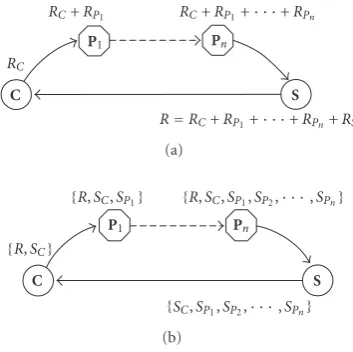
We can exclude the assumption of transitive trust by ex-panding the above negotiation process. IfCand all proxies have their own certificates, the modified protocol would con-sist of the two stages illustrated inFigure 11. The intuition is simple: generate a random number and askCand all proxies to sign the number using their private keys. The signatures are circulated and used to verify the public key of each par-ticipant by, potentially, each other.
Figure 11(a)shows the first stage, which generates a ran-dom string that is a concatenation of ranran-dom numbers pro-duced by all the entities in the loop. The resulting string can be denoted asR =RC+RP1+RP2+· · ·+RS, whereRiis a 32-bytecryptographically randomstring generated by entity X, and “+” denotes the concatenation of two strings. This process starts and ends atC. The message fromCtoP1
con-tains onlyRC, while the last message, whichCreceives from
S, is stringR. In other words, each entity creates a random numberRi. All numbers merge into a single stringR, which is then signed by each entity using the corresponding private keys in the second stage. This method is actually an extension of SSL, where only two entities (i.e.,CandS) are involved in the ring.
Figure 11(b) shows the second stage.Sidenotes the sig-nature generated by theith entity.CsendsP1a message that
contains the random string (R) generated in the first stage, the certificate ofC, and the digital signature (SC) generated uponR withC’s private key. The signature can prove that Cis the key owner. Each proxy adds a new signature using its private key; meanwhile, each proxy can verifyC’s identity usingC’s certificate. When the message arrives atS, it has col-lected the signatures of all proxies, and thereforeScan verify all of them using their certificates.Scan also forward them toCif Cwants to verify them as well.Section 5.3.1claims that the proxy in a single-hop proxy channel may not need a PKI certificate since the session ID is randomly generated byS. This is not true for a multihop proxy channel, however, because any two neighbouring proxies have to authenticate each other. A multihop proxy channel is more complex than a single-hop one, and thus needs more support, such as pub-lic keys, from the security infrastructure.
For the first stage, we add a new field in proxy-request messages (PROXY REQUEST∗ in Figure 9) and the S-C proxy finish message to carry the random string, a flag field to indicate ifSorCrequire verification of proxies’ certificates, and another flag field to indicate if any proxy requires veri-fication ofC’s certificate. If no verification is requested, the second stage will not start. For the second stage, we also in-troduced a new message called CP VERIFICATION to carry forward all the necessary information, which ends with a verification finish message (CP VERI FINISH) fromCtoS. While the messages of the first stage piggyback on proxy-request messages, the second stage comes with an additional cost of 2p+ 2 messages and the same number of signature generation and verification operations.
The protocol described above concerns the authentica-tion of proxies and the client. We may also need to consider the security issues of transporting and processing application data through multiple proxies. For example, an application might require that every chunk of data goes through every designated proxy. To achieve this kind of data authenticity, the client/server can ask proxies to “sign” a data chunk us-ing their private key or MAC key. However, this requirement introduces heavy computational costs in the case of many proxies. Since a proxy channel is not supposed to transport highly sensitive data unless all the proxies in the channel are sufficiently trusted, we decided not to have additional data authenticity protection at every proxy.
5.4. Secondary channel protocol
C P1 Pn S
SEC CHAN REQ
SEC CHAN RESP A
SEC CHAN REQ
B
SEC CHAN RESP SEC CHAN REQ
SEC CHAN RESP
SEC CHAN RESP SEC CHAN REQ
SEC CHAN RESP
Figure12: Negotiating secondary channels.
Message type
Protocol
version Channel ID Length Payload MAC
Coding / decoding {Cipher, hash algorithm}
Cipher suite Mapping
Figure13: Adding channel ID in an SSL packet.
This section describes the protocol for establishing secondary channels. As defined inSection 4, every channel can have its own cipher suite and channel direction.
5.4.1. Negotiation of secondary channels
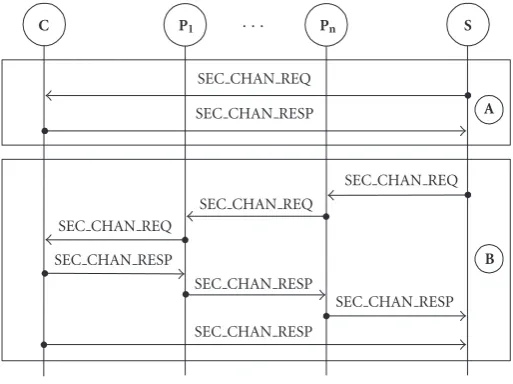
Figure 12 shows the process of negotiating of secondary channels. The negotiation of secondary direct channels is shown in part A, and the negotiation of secondary proxy channels is shown in part B. This protocol adds two mes-sages to MC-SSL: the secondary-channel request message (SEC CHAN REQ) and the secondary-channel response message (SEC CHAN RESP). These messages are designed to carry requests and responses for multiple secondary chan-nels to reduce message interactions if an application session needs multiple secondary channels. Additionally, they are designed to travel through primary channels. In MC-SSL, channel-control messages never travel through secondary channels, so that channel negotiation or management is as secure as through primary channels provided by SSL.
A SEC CHAN REQ message can specify the multiple secondary channels to be requested. The message carries the following information for each channel: the channel ID, a list of cipher suites preferred by the message sender, and the channel direction. It also carries the channel ID of the col-laborative direct channel if the secondary channel is a proxy
channel. The collaborative direct channel of a proxy chan-nel is the chanchan-nel that an APP DATA CONTROL PROXY message travels through, and it can be the primary direct channel or a secondary direct channel. An SEC CHAN RESP message carries the responses for channel requests in an SEC CHAN REQ message. Please refer to [20] for the mes-sage formats of the secondary channel protocol. The overall communication cost of establishing a secondary proxy chan-nel is 2p+ 5, wherepis the number of proxies in the channel. For MC-SSL to efficiently support multiple cipher suites, a small extension is introduced to SSL. This extension is dis-cussed in the next section. However, it is possible that the actual SSL implementation atCorSdoes not support the ex-tension. In this case, the above negotiation process will either fail or not start, and secondary channels will not be available.
5.4.2. Extending SSL to support secondary channels
Application layer
? ?
MC
SSL
Application layer
? ?
MC
SSL
Figure14: Implementation of channel directions.
Introducing a channel ID necessitates several changes to the SSL protocol. First, the calculation of MAC includes a channel ID. Second, an SSL implementation needs to choose the right cipher suite for each incoming packet according to the channel ID field. Third, some functions in the SSL library application programming interface (API) change: the write function has a channel ID as an input parameter, and the read function returns as an output parameter the ID of the channel from which the data comes.
Adding a channel ID field is a simple approach for sup-porting multiple cipher suites, but the downside is that the SSL header format has to be extended with an additional field. In [20], we describe an alternative for realizing sec-ondary channels. The advantage of this approach is that it keeps the SSL protocol intact by “switching” the working ci-pher suites with a simple handshake protocol at the upper layer of MC-SSL. This technique changes a duplex channel into two simplex channels with two working cipher suites. Each endpoint maintains its own set of working cipher suites. Since two working cipher suites are maintained for two op-posite directions of SSL, MC-SSL does not need to switch ci-pher suites in case one cici-pher suite is used for requests and a different one for responses. In brief, this method can reduce the frequency of switching cipher suites with the handshake protocol, but it cannot eliminate channel renegotiation if an application uses more than two simplex channels.
5.5. Restriction on channel directions
MC-SSL can restrict a channel’s data-flow direction. The protocol defines four channel directions: duplex, client to
server,server to client, andnone.Duplexindicates a two-way
channel. The next two directions indicate a simplex channel that allows application data to flow only fromCtoSor from StoC. Directionnoneis used for deactivating a channel. MC-SSL inhibits any application data flow over an inactive chan-nel. Note that a primary channel can be used for channel-control messages in both directions even if it is marked as
client to server,server to client, ornone. This is because
restric-tion on channel direcrestric-tions applies only to applicarestric-tion data messages.
As shown in Figure 14, the restriction on channel di-rections is enforced at the interface between the application and the MC layers. If a channel is not duplex, it will reject receiving data from and/or delivering data to the application
Initial state
Initial handshake of MC-SSL
0 0
1
2 Data
reading
Data writing
4 6
3 5
Channel control
Send proxy or secondary
channel request Recieve
proxy or secondary
channel request
Handshake is finished
Figure15: Basic state diagram of an MC-SSL session at a client or server.
layer according to the specified channel direction. The under-lying SSL layer is not aware of the channel directions imposed by the MC layer. In fact, there could be another duplex chan-nel inside the same SSL connection that allows both receiving and delivering application data.
6. PROTOTYPE IMPLEMENTATION
To assess the feasibility of the MC-SSL architecture and protocol, we have developed its prototype on Linux using OpenSSL [21]. Based on the protocol design, the prototype implementation has specified the message formats of MC-SSL protocol as listed in [20, Appendix B]. The message for-mats are defined using the language of TLS 1.0 specification [5].
After the initial MC-SSL handshake, the client and server applications establish the primary end-to-end channel through which they can start transporting application data or negotiating other channels.Figure 15shows the basic state diagram of an MC-SSL session atCorS. There are four states in the diagram. The exit state is omitted since an MC-SSL session can exit from any state.
Starting from the initial state, an application could trans-fer to the data-reading or data-writing state, depending on the actual application protocol. For instance, an HTTP client enters a data-writing state, and an HTTP (Web) server enters a data-reading state. Applications atCorScan transfer be-tween data-reading and data-writing states according to their predefined application protocol.
http proxy1 P1
5677
TC P
Http client C
TCP
5677http proxy2 P2
TC P
5677http serverp File pipe
Http server S
5678 TCP
Figure16: Prototype system diagram.
application data. When a channel-control process is finished, MC-SSL immediately returns to the state it was in before en-tering the channel-control state. As shown in Figure 15, if MC-SSL enters the channel-control state via edge 3, it goes back to the data-reading state via edge 4; similarly, it goes back to a data-writing state if it enters the channel-control state via edge 5.
6.1. Prototype configuration
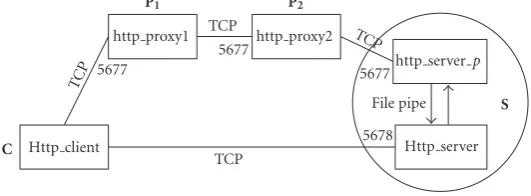
Figure 16 shows the system diagram of the prototype. Server S is composed of two processes, http server and http server p, both residing on the same host. The http server p is responsible for listening to and setting up a connection between http proxy2 and http server; there-fore, it works like a local proxy at S. The http server and http server p processes communicate using a pair of file pipes. The prototype assigns TCP port 5677 for proxy chan-nels and TCP port 5678 for end-to-end chanchan-nels. All server and proxy server processes in the prototype are implemented as multithreaded servers to provide HTTP over MC-SSL ser-vices to several concurrent clients.
The prototype demonstrates that the proxy and sec-ondary channels of MC-SSL can be implemented over SSL and its extension. The prototype implementation of MC-SSL can be further extended or simplified according to a spe-cific application scenario. For instance, theC-P1connection
could run over the WTLS/WDP protocol stack if bothCand P1support the WAP protocol stack. Other details about the
proof-of-concept prototype can be found in [20].
7. CONCLUSIONS
This paper proposes multiple-channel SSL, a new architec-ture and protocol that is an extension of SSL. MC-SSL has three main features: first, it improves end-to-end security in the presence of partially trusted application proxies; second, MC-SSL supports secondary channels and channel direction restrictions so that appropriate data protection can be se-lectively applied to different data or content; third, MC-SSL supports channel negotiation according to security policies, device capabilities, and the security attributes of content. The MC-SSL architecture is more flexible than SSL, and hence it can better satisfy diverse requirements in different applica-tion scenarios, especially for emerging mobile applicaapplica-tions.
MC-SSL comes with its costs and gains. The higher per-formance overhead is mainly due to the additional mes-sages exchanged by the client, server, and proxies on top of the established SSL channels. Once MC-SSL channels are created, the only other performance cost is in the data (de)multiplexing over multiple channels, which is very much specific to the particular application and the number of sec-ondary channels. Establishing a primary proxy channel costs 4p+s(2 +p) + 11 messages, wherepis the number of proxies andsis the communication cost (in number of messages) of establishing each underlying SSL connection. Furthermore, creating a secondary proxy channel costs another 2p+2 mes-sages. A server experiences a total increase of 10 messages (in addition to the SSL connections) that it has to either generate or process when a client connects to it via proxies. On the other hand, selective protection, as we discussed in Section 4.1, can save CPU resources, a valuable asset for con-strained mobile devices and overloaded servers. Depending on what algorithms are negotiated for data encryption and MAC protection, MC-SSL channels can commonly save 45% to 90% of the CPU time spent on cryptographic operations. We expect that the benefits due to MC-SSL and the amortiza-tion of the costs over long-lasting connecamortiza-tions will outweigh the costs of establishing channels and (de)multiplexing data. The MC-SSL protocol presented in this paper is only one possible implementation of MC-SSL architecture. The prin-ciples and the architecture can be applied to improve WTLS protocol or develop a counterpart protocol of MC-SSL for UDP applications. One can develop a similar security proto-col on top of UDP so that applications such as VoIP can make use of proxy channels and multiple cipher suites. If two wire-less terminals communicate with VoIP over RTP but do not support the same voice coding or compression scheme, they can use MC-SSL to set up a proxy for translating the voice encoding. In addition, they can use different cipher suites for user authentication and voice traffic.
ACKNOWLEDGMENTS
REFERENCES
[1] T. Dierks and C. Allen, “The TLS Protocol Version 1.0,” RFC 2246, January 1999.
[2] B. Schneier,Applied Cryptography, John Wiley & Sons, New York, NY, USA, 2nd edition, 1996.
[3] M. Y. Rhee,Internet Security : Cryptographic Principles, Algo-rithms and Protocols, John Wiley & Sons, New York, NY, USA, 2003.
[4] WAP Forum, WAP 2.0 Specifications, http://www.openmo-bilealliance.org/.
[5] S. Ravi, A. Raghunathan, and N. Potlapally, “Securing wireless data: system architecture challenges,” inProceedings of the In-ternational Symposium on System Synthesis, pp. 195–200, Ky-oto, Japan, October 2002.
[6] J. Lee, V. C. M. Leung, and K. Beznosov, “Analysis of scal-able security–MC-SSL savings,” Tech. Rep. LERSSE-TR-2005-02, Laboratory for Education and Research in Secure Systems Engineering (LERSSE), University of British Columbia, Van-couver, BC, Canada, October 2005.
[7] M. Portmann and A. Seneviratne, “Selective security for TLS,” inProceedings of the 9th IEEE International Conference on Net-works (ICON ’01), pp. 216–221, Bangkok, Thailand, October 2001.
[8] D. J. Kennedy, “An architecture for secure, client-driven de-ployment of application-specific proxies,” M.S. thesis, Univer-sity of Waterloo, Waterloo, Ontario, Canada, 2000.
[9] E. K. Kwon, Y. G. Cho, and K. J. Chae, “Integrated transport layer security: end-to-end security model between WTLS and TLS,” inProceedings of 15th International Conference on Infor-mation Networking, pp. 65–71, Oita, Japan, January-February 2001.
[10] W3C, XML Signature Recommendations, February 2002, http://www.w3.org/Signature/.
[11] W3C, XML Encryption Recommendations, December 2002, http://www.w3.org/Encryption/.
[12] OASIS Open, “Web Services Security: SOAP Message Security,”http://www.oasis-open.org/committees/documents. php?wg abbrev=wss, August 2003.
[13] OASIS Open, “Web Services Security X.509 Certificate To-ken Profile,” working draft 11, October 2003, http://www. oasis-open.org/committees/documents.php?wg abbrev=wss. [14] OASIS Open, “Web Services Security Kerberos Certificate
To-ken Profile,” working draft 03, January 2003, http://www. oasis-open.org/committees/documents.php?wg abbrev=wss. [15] OASIS Open, “Web Services Security Username Token
Pro-file,” working draft 04, October 2003,http://www.oasis-open. org/committees/documents.php?wg abbrev=wss.
[16] C. Lesniewski-Laas and M. Frans Kaashoek, “SSL splitting: se-curely serving data from untrusted caches,” inProceedings of the 12th USENIX Security Symposium, pp. 187–200, Washing-ton, DC, USA, August 2003.
[17] W3C, HTML 4.01, December 1999,http://www.w3.org/TR/ html4/.
[18] W3C, XHTML 2.0, July 2004,http://www.w3.org/TR/xhtml2/. [19] G. Kiczales, J. Lamping, A. Mendhekar, et al., “Aspect-oriented programming,” inProceedings of the 11th European Conference on Object-Oriented Programming, pp. 220–242, Jyvaskyla, Fin-land, June 1997.
[20] Y. Song, “Multiple-channel security model and its implemen-tation over SSL,” M.S. thesis, University of British Columbia,
Vancouver, BC, Canada, 2004, http://lersse-dl.ece.ubc.ca/ search.py?recid=94.
[21] OpenSSL Project, 2004,http://www.openssl.org/.
Yong Song is a Database Engineer at Datawave Services Inc., Richmond, BC, Canada. He completed his Master’s degree at the UBC in 2004 with the thesis on “Multiple-Channel Security Model and Its Implementation over SSL.” Prior to UBC, Yong was a Software Engineer at Guang-dong Telecommunication Academy of Sci-ence and Technology, China. He also re-ceived a Master’s degree from South China
University of Technology, and a Bachelor’s degree from Huazhong University of Science and Technology, China.
Konstantin Beznosovis an Assistant Pro-fessor at the Department of Electrical and Computer Engineering, the University of British Columbia, where he founded and directs the Laboratory for Education and Research in Secure Systems Engineering (lersse.ece.ubc.ca). His primary research in-terests are distributed systems security, se-curity and usability, secure software engi-neering, and access control. Prior to UBC,
Dr. Beznosov was a Security Architect with Quadrasis, Hitachi Computer Products (America) Inc., where he designed and devel-oped products for security integration of enterprise applications, as well as consulted large telecommunication and banking com-panies on the architecture of security solutions for distributed terprise applications. Dr. Beznosov did his Ph.D. research on en-gineering access control for distributed enterprise applications at the Florida International University. He actively participated in standardization of security-related specifications (CORBA Secu-rity, RAD, SDMM) at the Object Management Group, and served as a co-chair of the OMG’s Security SIG. Having published research papers on security engineering in distributed systems, he is also a coauthor ofEnterprise Security with EJB and CORBAandMastering Web Services Securityboth by John Wiley & Sons, Inc.
Victor C. M. Leung received the B.A.S. (honors) and Ph.D. degrees, both in elec-trical engineering, from the University of British Columbia (UBC) in 1977 and 1981, respectively. He was the recipient of many academic awards, including the APEBC Gold Medal as the head of the 1977 grad-uating class in the Faculty of Applied Sci-ence, UBC, and the NSERC Postgraduate Scholarship. From 1981 to 1987, Dr. Leung
![Figure 2: WAP 1.X gateway architecture (adapted from [4]).](https://thumb-us.123doks.com/thumbv2/123dok_us/916072.1110858/2.600.334.525.72.200/figure-wap-x-gateway-architecture-adapted.webp)