Volume 2007, Article ID 23917,14pages doi:10.1155/2007/23917
Research Article
Bandwidth Optimization in Centralized WLANs for
Different Traffic Types
R. J. Haines, N. Fanning, T. Lewis, and J. Coon
Telecommunications Research Laboratory, Toshiba Research Europe Ltd., 32 Queen Square, Bristol BS1 4ND, UK
Received 31 May 2006; Revised 24 November 2006; Accepted 10 January 2007
Recommended by Wei Li
Allocating bandwidth between different forms of coexisting traffic (such as web-browsing, streaming, and telephony) within a wireless LAN is a challenging and interesting problem. Centralized coordination functions in wireless LANs offer several advan-tages over distributed approaches, having the benefit of a system overview at the controller, but obtaining a stable configuration of bandwidth allocation for the system is nontrivial. We present, review, and compare different mechanisms to achieve this end, and a number of different means of obtaining the configurations themselves. We describe an analytical model of the system un-der consiun-deration and present two mathematical approaches to un-derive solutions for any system configuration and deployment, along with an adaptive feedback-based solution. We also describe a comprehensive simulation-based model for the problem, and a prototype that allows comparison of these approaches. Our investigations demonstrate that a self-adaptive dynamic approach far outperforms any static scheme, and that using a mathematical model to produce the configurations themselves confers several advantages.
Copyright © 2007 R. J. Haines et al. This is an open access article distributed under the Creative Commons Attribution License, which permits unrestricted use, distribution, and reproduction in any medium, provided the original work is properly cited.
1. INTRODUCTION
The IEEE802.11 protocols [1] have become the dominant standard for wireless local area networks (WLANs). These protocols have evolved to support a variety of traffic types, which benefit from different scheduling and control mecha-nisms. There are two common forms of traffic encountered by WLANs. The first is sporadic, bursty data traffic, which is most efficiently served by highly distributed contention-based access schemes. The second is traffic with stringent quality-of-service (QoS) requirements, such as bandwidth, delay and/or jitter, which needs a more structured approach to provide guarantees of access.
There are two complementary approaches to serving QoS-sensitive traffic: distributed and centralized access [2]. Distributed approaches have largely focused on diff erenti-ated access that prioritizes different traffic types but then re-lies on statistical guarantees of access for each priority level, although more recent developments also incorporate a dis-tributed reservation mechanism [3]. Centralized approaches, where a central controller allocates resources, benefit from having a global view of the entire system, and from being able to concentrate complexity in a single (more feature-rich, more expensive, higher-powered) device.
The IEEE802.11 standards offer both centralized and dis-tributed controls. In this work, we concentrate on the cen-tralized point coordination function (PCF), which can be seen as a specialized case of the more flexible and complex hybrid coordination function (HCF) of IEEE802.11e [4]. These centralized approaches are most attractive in single-access-point scenarios such as commonly found in the home, as there are scheduling complexities that arise with multiple-access-point scenarios. The PCF allows the coexistence of both QoS-sensitive traffic and bursty data traffic through the polling of the former and the direct contention of the latter. This is achieved by overlaying a repeating time-division su-perframe onto the medium, with distinct phases for polled and contending traffic.
The configuration of this superframe directly affects the system’s ability to support the two types of traffic effectively. If the configuration is badly wrong, then the QoS require-ments may be missed, or the data traffic starved of access. Balancing these two competing classes of traffic in an opti-mal way is the fundamental subject of this work.
of superframe configurations [5]. This work improves upon these studies with a more comprehensive and accurate sim-ulation model, and then goes on to propose novel solutions to this problem that have sound mathematical foundations and offer a more dynamic approach. This more flexible and adaptable approach allows a continuous optimized set of su-perframe parameters to be derived and the more theoretical basis permits greater confidence in the optimal nature of the values being employed than is possible with purely experi-mental results.
This paper is structured as follows: in Section 2 the IEEE802.11 PCF is explained to give a background to this problem area. InSection 3we examine related work in this area and highlight how this contribution differs from, and improves upon, what has gone before. Section 4 presents our simulation model that improves upon that in the lit-erature, whilst Sections 5 and 6 describe our mathemati-cal approaches to this problem. InSection 7 we describe a simulation prototype that allows direct comparison of all of these approaches. Finally, inSection 8, we conclude this pa-per.
2. IEEE802.11 CENTRALIZED CONTROL
The IEEE802.11 standard [1] was created as a wireless al-ternative to wired local area networks (LANs), which at that time were predominately deployed in office environ-ments to carry internet data traffic. Nonetheless, even at that time, it was recognized that support for QoS-sensitive traf-fic would be required. To achieve this, two complementary access schemes were specified, the best-effort contention-based distributed coordination function (DCF) for delay-insensitive traffic, and the optional centralized polling-based point coordination function (PCF) for time-bounded traffic, such as audio/video streams and voice over internet protocol (VoIP) traffic.
DCF is the mandatory access mechanism in IEEE802.11. For sporadic bursty data traffic, this offers a very efficient means of access: devices (stations, STA, in IEEE802.11 parlance) can compete for access to the medium as soon as they have a packet to transmit. The underlying access scheme is carrier-sense multiple access with collision avoid-ance (CSMA/CA). Multiple access and collision avoidavoid-ance are achieved with a combination of prerequisite quiet peri-ods on the medium (hence the carrier sense) followed by ran-dom backoffs to avoid collisions. The durations of the quiet periods (termed interframe spaces) prioritize access onto the medium. For example, the shortest interframe space (short interframe space, SIFS) is used between the transmission of a packet and the transmission by the receiving station of its ac-knowledgment. Transmission of this acknowledgement has the highest priority of any packet (as it is the only means by which the transmitting station can be aware of successful de-livery, and therefore not retransmit the original packet), so it is allowed onto the medium with the shortest possible inter-frame space following the end of the original packet trans-mission. Stations newly contending for access must wait for a much longer interframe space (the DCF interframe space,
Beac
o
n
CFP CP
Beac
o
n
CFPMAX
CFPREP
Figure1: Superframe structure.
DIFS) before even being able to contend for access with the random backoffprocedure.
However, for QoS-sensitive traffic where a packet must be sent at a guaranteed time, contending for access (and po-tentially losing) with every packet quickly becomes impos-sible under all but the lightest of network loads. To guar-antee packet transmission, reservation and polling schemes must be considered. In these cases, the additional overhead of reserving a transmission in advance becomes acceptable. The centralized PCF of the original IEEE802.11 standard, and its progeny, the hybrid coordination function (HCF) in the IEEE802.11e standard [4], both introduce centralized co-ordination of resources to allow this QoS-sensitive traffic to coexist alongside contention-based data exchanges. The dif-ference between the two is that HCF allows a more flexible allocation of transmission opportunities compared to PCF, although this is at the cost of increased complexity.
Centralized coordination imposes a time-based repeat-ing superframe onto the medium (as illustrated inFigure 1), characterized by the transmission of a broadcast beacon, fol-lowed by a contention-free (polled) period (CFP) and then a contention-based access period (CP). The process of overlay-ing this structure onto the otherwise anarchic access mech-anism of DCF is possible through the aforementioned inter-frame spaces: the central controller is able to use the PCF in-terframe space (PIFS), of shorter duration than the DIFS, to preempt contending stations and seize the medium to begin the superframe.
The structure of the superframe is determined by two parameters, its duration and the proportion of time spent in the contention-free phase. This duration (i.e., the bea-con and CFP repetition rate) and the relative size of the CFP to the rest of the superframe, typically termed CFPREP and
CFPMAX, respectively, are both configurable by the point
con-troller (PC) entity located at the access point (AP). These two values are broadcast in the beacon to all stations.
These parameters determine the success of a given WLAN deployment from the perspective of the polled traf-fic, the contention-based traffic, or both. A badly configured system will fail to deliver the performance that the end user has the right to expect, irrespective of the headline data rate of the product.
3. RELATED WORK
IEEE802.11e HCF [4] and in the WiMedia MAC [3] (formed from one of the survivors of the now-defunct IEEE802.15.3a standard). The latter offers extensions to the IEEE802.11e EDCA subset including a fully distributed solution includ-ing both hard and soft reservations of slots (soft reservation being the ability for a station to tentatively reserve a slot, and for it to be made available for other stations if unused). The performance of the WiMedia MAC has been evaluated, and the soft-reservation scheme is found to be particularly effi -cient [6]. A number of extensions and enhancements to these distributed schemes have been proposed from a number of different perspectives, the sheer number of which suggesting that there are several shortcomings to this approach. These extensions have included the use of admission control [7] by the higher layers, the addition of hybrid automatic repeat request (ARQ) mechanisms [8] and variable backoffs (con-tention windows) [9,10] to the MAC protocol, and cross-layer schemes linking the differentiated access categories to the modulation and coding schemes of the physical layer [11].
The centralized approach has been less well studied, often because a distributed solution is viewed as being inherently more scalable and less complex [12]. However, under heavy and asymmetric loads such as would result from stream-ing high-definition television and similar demandstream-ing appli-cations, it has been observed that the distributed approach results in a severe impact on the coexisting traffic streams [13, 14]. The complexity of the 802.11e HCF scheme has been highlighted as an issue, and an enhanced PCF (EPCF) has been proposed [15] to address some issues with PCF that HCF also addresses, whilst not imposing all of the complexity of HCF.
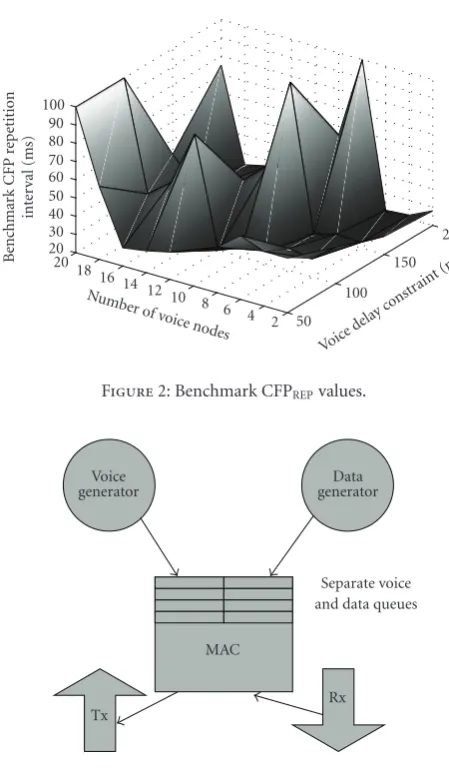
A self-adaptive scheme to configure the PCF superframe has been proposed [5]. This proposed scheme selects param-eters from predefined lookup tables indexed by a quantized number of active polled stations and stepped values for the maximum allowable delay of the applications. The values populating the lookup tables are derived through experimen-tal simulation results, which result in values of an almost ran-dom nature, as depicted inFigure 2.
These results do not take into account the minimum CFP and CP sizes mandated by the standard [1,16], and crucially, there is no means of generating values outside of the simula-tion scenarios considered. Nonetheless, these values provide a valuable benchmark for the approaches considered herein. The traffic considered in this benchmark study is a combi-nation of data and VoIP flows, an important area for inves-tigation as internet telephony applications continue to gain popularity.
4. IMPROVED EMPIRICAL RESULTS
An improved (standard-compliant) simulation model, us-ing the configuration proposed in [5], has been developed in OPNET.
The network model is constrained to 16 STAs and an AP throughout the study presented herein, with all stations lo-cated within a 300 m diameter. All 16 STAs produce voice
100 90 80 70 60 50 40 30 20
Benc
hmar
k
C
FP
re
p
etition
int
er
val
(ms)
20 18 16
14 12 10
8 6 4 2
Number
of voicenodes 50
100 150
200
Voice delay c
onst raint
(ms)
Figure2: Benchmark CFPREPvalues.
Voice
generator generatorData
Separate voice and data queues
Tx
Rx MAC
Figure3: Node model.
traffic but only 6 of them produce data traffic. The PC func-tion is performed in the AP which is the destinafunc-tion for all transmissions. The AP transmits only MAC control and management frames, such as ACKs, polls, and beacons.
An STA based on a generic node model (Figure 3) gen-erates voice and potentially data application traffic along with the necessary MAC control frames. The different traf-fic streams are buffered in individual queues until the frames are transmitted. The data queue is served during the CP and the voice queue is served during the CFP. The interval be-tween successive data MAC service data unit (MSDU) gener-ations varies exponentially with a mean of 7.5 frames per sec-ond (fps). The data MSDUs vary exponentially in size with a mean of 1000 bytes. Brady’s model [17] is employed for the voice traffic generator, which produces 200-byte MSDUs. To prevent idle CFPs and sudden traffic surges, the start times of the voice generators are random over the first two seconds of the simulation.
Table1: Summary of model parameters.
Parameter Value Parameter Value
Slot 20μs Mean data MSDU 1 kbyte SIFS 10μs Mean data rate 7.5 fps PIFS 30μs Voice MSDU 200 bytes DIFS 50μs Voice mean on : off 1 s : 1.35 s CWMIN 31 slots Voice on rate 64 kbps
PLCP time 192μs Beacon 160 bytes MAC header 28 bytes ACK 14 bytes
Data rate 2 Mbps Poll\CFend 20 bytes
Control rate 1 Mbps Queue sizes 250 Kbits
The AP responds to received data MPDUs with acknowledge-ments (ACKs) during the CPs. The QoS performance is also measured in the AP model as it provides sinks for the two types of traffic. The polling list, which consists of all 16 STAs, is cycled through continuously during the CFP. When a voice MPDU has been received in response to a poll frame, the AP acknowledges its reception in the proceeding poll frame by setting the frame type field to be a combined poll and ac-knowledgment. If a node does not have any voice packets queued when polled, it responds with a null data frame. At the beginning of a CFP, the polling is resumed where the pre-vious CFP ended. If sufficient time remains in a CFP after all nodes have been polled, the polling cycle begins again. Intel-ligent polling schemes, such as biasing the polling to nodes that did not previously respond [18–20], are not utilized in this study. A check is made to ensure that sufficient time re-mains in the CFP to accommodate a polled voice frame ex-change (i.e., poll + voice MSDU + 2SIFS + CF-END) prior to every poll transmission. An early CF-END is transmitted if insufficient time remains.
No check is made during the CP to ensure that the DCF access mechanism frame exchange sequence (DIFS + CW + data + SIFS + ACK) will be complete before the next ex-pected beacon transmission. This will occasionally result in CP stretching which will shorten the duration of the proceed-ing CFP.
An IEEE802.11b physical layer (PHY) is assumed as this provides a fair comparison with the referenced work in this area. The fundamental behavior of a MAC is largely inde-pendent of the PHY technology, and when performing com-parisons between different MAC solutions, the specifics of the PHY are not particularly relevant. The physical layer is modeled so that packet losses due to link errors do not occur. Packet losses occur due to collisions only, and so observa-tions on the performance can be described purely in terms of MAC behavior. It is also assumed that there are no hidden stations, the capture effect does not occur, and none of the stations are in power-saving mode. The model parameters are summarized inTable 1.
Table2: Simulated CFPMAXand CFPREPvalues.
Parameter Values
CFPMAX(%) 5, 10, 15, 20, 25, 30, 35, 40, 45, 50, 55,60, 65, 70, 75, 80, 85, 90, 95
CFPREP(ms)
50, 60, 70, 80, 90, 100, 110, 120, 130, 140, 150, 160, 170, 180, 190, 200, 210, 220, 230, 240, 250
0.5
Figure4: Mean voice throughputs.
Generally, the voice traffic has the more stringent perfor-mance requirements of the two traffic types. Therefore, the performance of the CFP, and that of the associated voice traf-fic, is focused on in the presentation of the results. Failure to satisfy these requirements results in wasted transmissions as packets received outside of the QoS constraints will proba-bly be dropped at the transport or application layer. The ap-proach taken is to determine how to configure the system so that the time-dependent voice traffic is satisfied whilst en-suring that the maximum possible amount of medium time remains for data traffic.
Simulations have been performed for all permutations of the CFPMAXand CFPREP settings contained inTable 2. This
provided 399 simulations each covering 5 minutes of simu-lated time. However, some of the CFPMAXand CFPREP
com-binations will result in CP and CFP durations that are less than the minimum mandated by the standard. These invalid permutations can be discounted at a later stage.
The first set of simulation results is the mean voice traffic throughputs, which are illustrated inFigure 4. Sixteen STAs produce approximately 435 kbps of voice traffic within the network. The voice traffic throughput results show that the CFPMAXvalue has to be around 45% and above so that all of
the voice traffic generated can be accommodated.
103
interval(ms) 95 90 85
80 75 70 65 60
CFPmaxim
um ratio (%)
Figure5: Mean voice delays.
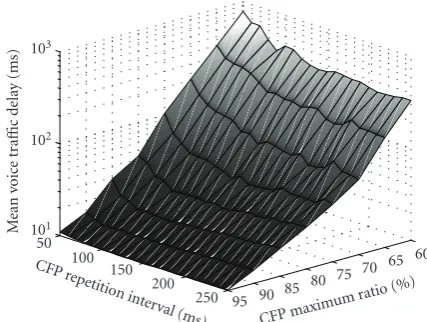
simulations are illustrated inFigure 5. CFPMAXvalues below
60% incur significant delays so only a subset of the CFPMAX
results is included. The CFPMAXvalue of 45% suggested by
the mean voice throughput results will result in voice delays in excess of three seconds, which is unacceptable for tele-phony services. Voice transmission requires delays below 25 milliseconds if echo cancellation is not available, 150 mil-liseconds for high quality with echo cancellation, and 400 milliseconds for acceptable quality with echo cancellation [21]. The results show that CFPMAXvalues in the region of
70% and above are required to achieve mean delays below 150 milliseconds.
The mean voice delay results can generate a lookup ta-ble to select CFPMAXand CFPREPvalues that result in a given
delay. They can also predict the performance of a particu-lar superframe configuration generated by an optimization algorithm. This allows different optimization techniques to be compared. The most interesting observation of Figure 5 is the apparent immunity to CFPREPvariations that the near
horizontal contours suggest.
Despite having similar mean delays, the probability den-sity functions (PDFs) of instantaneous voice packet delays for given CFPREP values are quite different.Figure 6 illustrates
the distribution of delays that were experienced for a sub-set of the CFPREP values with a constant CFPMAX of 70%.
This value of CFPMAXprovides mean delays in the region of
150 milliseconds. The distributions contain two peaks, the first occurring at (nodes/2)×polled-exchange duration and the second occurring at CFPREP×(1−CFPMAX). The former
occurs due to the average wait experienced during a polling period, equal to half the time to poll all twelve stations and the latter due to packets having to wait for a CP to pass.
Figure 7presents the cumulative distribution functions (CDFs) of the voice packet delays, and shows the percent-age that satisfies a given delay constraint. A CDF is required if the maximum instantaneous delay is the important per-formance parameter. The CDF can predict the percentage of frames that may be dropped due to the delay constraints not being met. For a 400-millisecond instantaneous delay
thresh-old, a CFPMAXsetting of 70% requires a CFPREP in the
re-gion of 170 milliseconds and above. This will provide a voice service of acceptable quality only if echo cancellation is in-cluded [21,22]. The CDFs illustrate that delay distributions can be highly CFPREP sensitive in certain regions. Figure 7
shows that the percentage of packets within the constraint of 100-millisecond maximum delay varies from 65 to 85 de-pending on the CFPREPsetting.
Focusing on the CFP and its associated voice traffic pre-vents valuable medium time from being wasted. However, it is also important to understand the effect of superframe configuration on the CP and the associated data traffic. Bi-asing resource allocation to the voice traffic is only sensible to the point where the voice services have their QoS con-straints satisfied. Further biasing in the direction of voice traffic provides no noticeable improvements in the perfor-mance of voice services but it results in a noticeable degrada-tion of the data services.
The data traffic throughput results, illustrated inFigure 8, show that values of CFPMAX below approximately 80%
are required to support all of the data traffic (360 Kbps) generated in the given scenario. The CDF of instantaneous voice traffic delays,Figure 7, has demonstrated that for 70% CFPMAX, a minimum CFPREPof 170 milliseconds is required
for acceptable voice transmission. This superframe configu-ration provides sufficient CP capacity to fully accommodate the generated data traffic. Higher-quality voice transmissions demanding delays in the region of 150 milliseconds will re-quire the superframe configuration to be biased further in favor of the CFP. CFPMAXvalues in excess of 80% will reduce
the amount of data traffic that can be supported. Reducing the proportion of medium time available for the CP increases the likelihood of CP stretching as there is a greater probabil-ity that data packets will be awaiting transmission at the end of the CP. This CP stretching will have a negative impact on the CFP albeit smaller than the positive impact of increasing the amount of resource allocated to the CFP.
5. NONLINEAR OPTIMIZATION
The first mathematical technique we propose as a candidate solution as a verifiable theoretical model is that of nonlinear optimization of an abstracted model of the data exchanges on the superframe [23]. Nonlinear optimization theory pro-vides a number of means to optimize a number of variable parameters to provide a stable system solution. These tech-niques have been applied to a number of areas within com-munications, including wireless sensor network access [24] and deriving training sequences for orthogonal-frequency division multiplexing (OFDM) systems [25]. We use the bar-rier method [26] in this work.
100 ms CFP repetition interval
Voice packet delay (ms) (a)
120 ms CFP repetition interval 5
Voice packet delay (ms) (b)
170 ms CFP repetition interval 5
Voice packet delay (ms) (c)
200 ms CFP repetition interval 5
Voice packet delay (ms) (d)
Figure6: PDFs of voice packet delays at 70% CFPMAX.
constraints, such that the two phases’ utilizations are traded-offagainst each other. Therefore, expressions for these two phases must be carefully developed to represent the efficiency of the resource allocation in each phase, such that the result-ing objective function can determine how far from the ideal each component is.
Before the model is developed, as with the preceding simulation study, we make assumptions of a reliable physi-cal layer channel (no link errors, no collisions), and exclude hidden terminals, the capture-effect, and the power-saving mechanism, and assume that all stations are fully backlogged (i.e., they always have data to send).
Each phase is affected by two inefficiency components. The first is the efficiency of an individual exchange (which scales linearly with the number of exchanges) and the second is the efficiency of the whole phase, taking into account any unused airtime at the end of the phase.
Firstly, consider the QoS-sensitive polled traffic in the CFP (as illustrated inFigure 9). In the case of the first
com-ponent, due to the assumption that all stations are fully back-logged, no poll is wasted, so each packet polled from station incurs an overhead comprising just the interframe spaces be-tween contention-free packets (SIFS):
Ca=2∗SIFS. (1)
The second component is the wastage at the end of the CFP if it is configured to any size not divisible exactly by the frame exchange duration (although note that, in practice, the central controller can terminate the CFP early and make this “wasted” period available to the CP). The overall efficiency for the CFP can be calculated as
VNP
whereCbis the entire polled exchange duration (ms) andCa
is the polled exchange overhead from (1), andxand yare CFPMAXand CFPREP, respectively. These parameters are
100
Figure7: CDFs of voice packet delays at 70% CFPMAX.
0.4
Figure8: Mean data throughputs for various CFPMAX.
PLCP
Figure9: Polling frame model.
Table3: Model parameter definitions and values.
Parameter Definition (value)
Ms Standardized data exchange overhead (0.674 ms)
Hs Standardized data exchange (4.978 ms)
Ca Polled exchange overhead (0.02 ms)
Cb Polled exchange duration (2.228 ms)
Nc Number of data stations (11)
Np Numbers of polling stations considered (2, 4,. . ., 20)
D Polling rates under consideration
(75, 87.5, 100, 112.5,. . ., 200 ms)
Pr Contending traffic packet generation rate (0.0075 s−1)
CFPMIN Minimal CFP size (39.922 ms) CPMIN Minimal CP size (21.404 ms)
PLCP
(CW∗slots) Contention frame SIFS ACK frame (c) Medium occupancy
Figure10: Contending frame model.
The number of polled terminals,Np, is a parameter that
the AP can reasonably be expected to know as all stations must associate with the AP if polling service is required.
For the CP (as illustrated inFigure 10), recall the oper-ation of the DCF. Stoper-ations must wait for the DIFS period of silence on the medium (with the 802.11b physical layer, this is 50μs). If this period has elapsed without any activity on the medium, the station then performs a random back-offfor a random number of slots (each of 20-microsecond duration in 11b) drawn from the range [0, CW], where CW (contention window) begins at 31 (11b again) and can in-crease as a binary exponential up to the limit 1023.
This gives the first efficiency component of the CP as
MS=DIFS + backoff+ SIFS + ACK frame. (3)
The second efficiency component (wastage at the end of the phase) can be determined from the effective number of contending stations. This in turn depends on the traffic level and the total number of contending stations,Nc. If we know
the approximate packet rate of this traffic,Pr, the effective
number of concurrently sending stations will bey×Pr×Nc.
Hence, the overall efficiency of the CP simplifies to
LNc
whereHsis the entire standardized contended exchange
du-ration (ms),Msis the standardized contended exchange
over-head (ms) from (3),Ncis the number of contending stations, yis CFPREP, andxis CFPMAX. We must further constrain this
expression by the frame-generation rate of the traffic, other-wise this becomes almost a “self-optimizing” model that will always fill the CP to capacity. We can use the utilization func-tionsLandVin the following objective function:
f0(x,y)=
spond to good performance (in contrast to high values ofV, which indicate poorer performance), and square both terms to ensure that both are positive and continuously diff eren-tiable over the whole domain of interest. Substituting the ex-pressions forV andLgiven in (2) and (4), respectively, and simplifying gives
A number of constraints on this solution can be identi-fied. CFPMAXis a ratio of two time periods, so it must be
pos-itive and less than one. CFPREPis bounded by the worst-case
polling frequency (“delay,” D) specified by the application. Additionally, both the CFP and CP are subject to minimum duration constraints (“CFPMIN” and “CPMIN,” resp.)
accord-ing to the standard [1]. The CFP has to be at least big enough to contain one polled exchange comprising the largest pay-load possible in each direction, plus a beacon and a CF-end. The CP has to be large enough to contain an acknowledged exchange of the largest payload possible.
Mathematically, the problem reduces to an optimization problem over two variables,xandy: minimize f0(x,y) from
(6), subject to the set of constraints:
CFPMIN−xy≤0,
CPMIN−(1−x)y≤0,
0≤x≤1, 0≤y≤D.
(7)
5.1. Nonlinear vector optimization of model
Before standard optimization techniques can be unleashed on the problem, the objective function must be first refor-mulated in vector form with a single variable. Letz=(x,y)T,
and define the two unit vectorse1=(1, 0)T ande2=(0, 1)T.
We can then rewrite the objective function as
f0(z)= e1eT2. Other parameters are defined inTable 3, along with the
values used in the application of this model. The constants are determined by the physical layer under consideration and the characteristics of the traffic flows.
In vector notation, the constraints can be restated as fol-lows:
1z≤0: third constraint, lower bound;
(v) eT2z−D≤0: forth constraint, upper bound;
(vi) −eT2z≤0: forth constraint, lower bound.
Before the barrier method [26] can be used to solve this problem, there is one more hurdle to overcome. This objec-tive function is not convex, and furthermore may have mul-tiple solutions (local minima). Two of these minima may occur at the extreme values of the feasible set, with a third local minimum from the objective function. Feasible start-ing points must be determined to guide the solution in the right direction. By examining the inequality constraints of the original problem, it is possible to find feasible starting points x0 and y0 that can be used to initialize the barrier
method. Consider the following two inequalities:
CFPMIN≤xy,
CPMIN≤(1−x)y=y−xy.
(9)
These are obtained by rearranging the first two inequal-ities of the original problem statement. Solving the second inequality forxyenables the composite inequality to be writ-ten as CFPMIN≤xy≤y−CPMIN.
and the following feasible starting point constraint must be met:
CFPMIN> y0−CPMIN. (11)
5.2. Application of model
0.7 0.6 0.5 0.4 0.3 0.2
Optim
u
m
C
FP
MA
X
200 180
160 140
120 100 80
D 0
5 10
15 20
Np
Figure11: CFPMAXoptimization results.
200 150 100 50
Optim
u
m
C
FP
REP
200 180
160 140 120
100 80
D 0
5 10
15 20
Np
Figure12: CFPREPoptimization results.
some concrete values. These parameters are given in Tables1, and3gives the resulting concrete values for the constants in the model. The starting point constraint in (11) can be met for these values when, for example, CFPMIN=39.922, CPMIN
=21.404, andy0=48.
Three local minima were discovered using the following set of initialxvalues:
(1) 1.2∗(CFPMIN)/y;
(2) 0.5∗(1−CPMIN−CFPMIN)/y;
(3) 0.8∗(1−(CPMIN−CFPMIN))/y.
The first of these is a point near the lower end of the fea-sible set, the second a point in the middle, and the third a point towards the top end of the feasible set forx. For many values ofDandNp, all of these local minima were found to
be identical, indicating that the local minimum is a global minimum. In the case where a number of local minima were found, the objective function was evaluated at each one and the true minimum chosen. The minimum values obtained are illustrated in Figures11and12—compare the relatively smooth surface ofFigure 12with that of the benchmark re-sults shown inFigure 2. These configurations have been ver-ified by comparison with comprehensive simulation [23].
The optimum values of CFPMAX are fairly variable,
es-pecially for larger values ofDand the smaller values ofNp.
This variability seems to occur mainly when the objective is most flat: in that it does not vary much over a wide range of CFPMAX values. This means that the instability happens
in exactly the situations where choosing a precise value of CFPMAX is least important. The CFPREP optima tend to be
close to the maximumD, especially for smallerDwhere the constraints do not permit much variation anyway. For larger
D, the optimum values are significantly smaller thanD, this is in line with the fact that there is much more potential to fit the polled and contention periods within a smaller repetition time.
6. QUEUING THEORY APPROACH
Queuing theory models can be used to analyze the perfor-mance of many aspects of wireless networks. Here we apply this approach to the polling phase of the PCF procedure. In these models, the system is thought of as a queue which is filled with packets by an arrivalprocess and is emptied by aserving process. In this application, the arrival process is the voice packet generation system, and the serving process is the polling mechanism as implemented by the AP. Queu-ing models aim to provide information about the distribu-tions of the time spent in the queue (thewaitingtime) and queue length distributions. The waiting time depends on the mixture of arrival time distribution and service time distri-bution. The arrival time model for this application is a simple Poisson process when the voice stream is in “on” mode; we assume here that the switch from “on” to “off” occurs suf-ficiently infrequently to not influence the waiting time dis-tribution. The service time distribution is dependent on the exact polling process used by the AP.
A specific use of this technique to packet delay of polled protocols can be found in [27]. The technique of Laplace-Stieltjes transforms (LST) allows the treatment of the service time distributions to be as general as possible and provides more detailed information about the full distribution of the waiting times. We present the analysis in this form here pri-marily for the first reason, since we do not use information beyond the mean waiting time explicitly in this paper. The service time distribution is given either as a cumulative dis-tribution function (CDF), or its derivative, the probability density function (PDF). The LST of a CDF of a random vari-ableF(t) is given by
φ(s)=
∞
0 e
−stdF(t). (12)
These CDFs (and corresponding LSTs) are used to cap-ture the distributions of service times and waiting times. A central result [28] in queuing theory analysis for a queue with exponential arrival times (mean rateλ) and general service time distribution (with LSTη(s) and meanτ) is that the LST of the waiting time is given by
w(s)= s(1−λτ)
This is known as the Pollaczek-Khintchine (PK) formula. Inverting the corresponding LST to get back to the more use-ful PDF of the waiting times is often intractable. However, we can readily extract the set ofmoments(Mn) of the PDF
dis-tribution using the following formula:
Mn(F)=(−1)n
dn dsnφ(s)
s=0.
(14)
All the properties of a distribution can be deduced from its full set of moments, but this may require computation of a large number of them. The mean (μ) and variance (σ2) can
be calculated directly from just the first and second moments:
μ=M1(F),
σ2=M
2(F)−μ2.
(15)
6.1. Application to PCF delay model
This theory can be applied to analyze the delay times of the polling procedure in 802.11 PCF. The polling procedure that the AP runs flips between two states, polling and contending. We make two assumptions in this model.
(1) Service times of the polling mechanism are indepen-dent.
(2) The time to poll and receive responses from the com-plete set of stations is constant.
The first is not strictly the case here since there is a deter-ministic switch between polling and CP modes. This means that the short delay that occurs in polling mode is very likely to be followed by an equally short delay, and similarly longer delays will tend to follow longer delays when the system is in CP mode. In practice, this assumption should only restrict the range of parameters over which the results are valid, since the deterministic process is likely to be more stable in the face of configurations that would otherwise cause the polling mechanism to break down with unacceptably large delays.
The second is an approximation since if a station has a packet, its response will take longer than if it is returning a null frame. Thus it will take longer to poll the full set of stations at the beginning of the CFP when most stations are waiting with a packet than it does at the end when most have empty queues. In the model, we approximate such a delay by looking at the expected number of stations that has packets and combining it with the with-packet and without-packet polling times, building a weighted average for the polling time, which we denote byr. This constant rate assumption will have greatest effect on large superframe configurations since the variation in total time to poll will be the largest across the whole frame in these configurations.
Next we construct a CDF for the service time for the polling traffic. Each station gets polled a total numbernpoll=
xy/rof times each superframe. As in the previous section, we usexto denote CFPMAXandyto denote CFPREP. In each
of these occasions, the service time isr. In the following time slot, the CFP ends and the service time is equal to the length of the CP,y(1−x). So the service time has valuerwith prob-ability npoll/(npoll+ 1), and value y(1−x) with probability
150
100
50
0
Me
an
d
el
ay
(m
s)
0.5 0.6 0.7 0.8 0.9
CFPMAX Nv=16
Nv=14 Nv=12
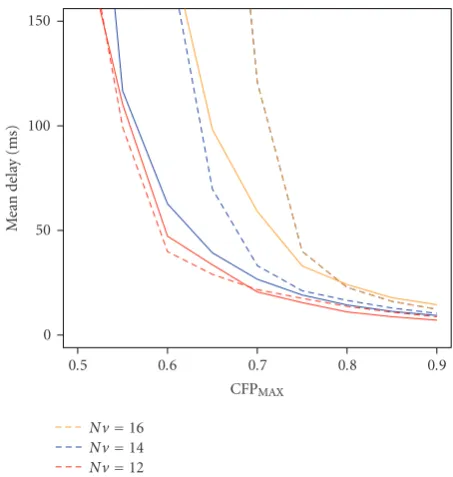
Figure13: Mean packet delays for a range of voice stations. Solid lines show model predictions, dotted lines show simulated values.
1/(npoll+ 1). This translates to a PDF for the service times of
ServPDF(t)= δ(t−r)npoll
npoll+ 1
+δ
t−y(1−x)
npoll+ 1 .
(16)
Here we useδ(t) the Dirac delta function to represent in the PDF what would be discontinuities in the CDF. The required CDF is given by the integral of this function. This service time has corresponding LST given by
LSTServ(s)=e −rsn
poll
npoll+ 1+
esy(x−1)
npoll+ 1. (17)
We insert this in the PK formula (13), assuming that the voice source is in talk-spurt mode with a Poisson arrival rate of packets with mean λ. If we compute the first moment using (14), we obtain the following formula for the mean packet delay:
D(x,y,r,λ)= λ
npollr2(x−1)2y2
2λ(x−1)y+ (1−λr)npoll+ 1
. (18)
Once suitable values of λ and r are set from the sce-nario parameters, the mean packet delay can be computed. Figure 13 shows the mean delay predicted by this method compared to the mean delay observed from OPNET simula-tion. Here we fix CFPREPto be 120 milliseconds and show the
delays for a range of CFPMAXvalues from 50% to 90%. For
12 voice stations, there is very close agreement between the model and the simulations. For larger numbers of stations, there is more discrepancy for smaller values of CFPMAX, but
Nv=10, delay requirements=25 ms 2
1.5
1
0.5
0
U
tilit
y
0.4 0.5 0.6 0.7 0.8 0.9 CFPMAX
(a)
Nv=10, delay requirements=150 ms 2
1.5
1
0.5
0
U
tilit
y
0.4 0.5 0.6 0.7 0.8 0.9 CFPMAX
(b) Nv=16, delay requirements=25 ms
2
1.5
1
0.5
0
U
tilit
y
0.4 0.5 0.6 0.7 0.8 0.9 CFPMAX
(c)
Nv=16, delay requirements=150 ms 2
1.5
1
0.5
0
U
tilit
y
0.4 0.5 0.6 0.7 0.8 0.9 CFPMAX
(d)
Figure14: Objectives for a set of different network sizes and delay requirements. The blue dotted line shows the polled traffic utility, the
green gives the data utility. The black line is the combined objective; red dotted line is the optimum CFPMAX.
Generally though, the agreement is close enough to an-swer the kind of questions that are required to optimize the performance of this system. For example, the value of CFPMAX that is required to bring the average delay below
50 milliseconds for 14 voice stations is approximately 0.67 for both model predictions and simulations.
6.2. Selection of optimalCFPMAX
This approach does not yet provide enough information to optimize for the values of CFPREP. Future work would look
at the higher moments provided by the LST approach and uses these to more accurately predict the percentage of pack-ets satisfying delay requirements. However, we can still use the mean packet delay to select CFPMAXvalues.
We can combine this packet delay model with a DCF throughput model derived from the one described in [29] to produce a combined performance objective function. The
polled component of the objective is constructed from the required and predicted delay in the following way:
Objpolled=U
delayreq. delaypredicted
. (19)
HereU(x) is a utility function designed to map the region [0,∞) onto [0, 1) (here we use (Axk+x)/(Axk+x2+ 1), with
A=18,k=6). Similarly for the data traffic, with predicted and required levels of throughput,
Objdata=U
throughputpredicted throughputreq.
. (20)
The total objective is simply the sum of these two com-ponents; maximizing the value of this function provides op-timum CFPMAXvalues.
set of 16 voice stations are only partially given since the de-lay model is not applicable to values of CFPMAXless than 0.6
with this number of stations. Note also that with the level of data traffic described inSection 4(with 6 data nodes), the performance for these devices does not drop offsignificantly until CFPMAXreaches beyond 0.8. This causes the optimum
CFPMAXvalues to be driven chiefly by the polled traffic. The
optima do change in an intuitive fashion, since increasing the number of voice stations and tightening the delay restriction both force a higher value of CFPMAXin order to give higher
priority to the voice traffic.
7. APPLICATION
So far in this paper, we have presented a number of alterna-tive means for configuring the PCF superframe. Clearly, what is needed is a means for fairly comparing these different ap-proaches. To achieve this, a prototype has been developed in OPNET, embodying an adaptive mechanism that reconfig-ures the superframe as needed. This model can be configured to use a fixed superframe structure (and thereby, replicate the results of the aforementioned simulations), but can also be configured to react to changes in traffic conditions. Addi-tionally, the model can provide benchmark results, it can be configured to use the results from Li et al. [5], or can carry all traffic via the contention-based DCF mechanism.
7.1. Adaptive model
The key to any adaptive model is the provision of a feedback path, in this case to feed back information on the degree to which QoS requirements are being met, such as the end-to-end delays are experienced. In this model, this feedback path is abstracted as a statistic wire in OPNET, although a real im-plementation would, of course, require additional signaling to transfer this information.
The adaptation mechanism comprises a check as to whether the QoS requirements are being met as the super-frame is started. This check is performed periodically, the period dictated by the tolerance to jitter. If the requirements have drifted, then the reconfiguration process is triggered.
The reconfiguration process supports multiple data sets. These data sets can either be a fixed lookup table (as it is the case with the Li results), or can be generated dynamically by an online optimization algorithm. This approach models the range of possible implementations that could be considered, from simple products with a limited number of lookup tables to more complex adaptive solutions.
The entire adaptation algorithm can be disabled (thereby supporting a predefined fixed superframe configuration), and the traffic streams can all be diverted to DCF to show the effect of not having a polling mechanism at all.
7.2. Scenarios
In this paper, we concentrate on two specific scenarios of in-terest. To allow comparison with the benchmark results, the physical layer rates are those supported by 802.11b physical
102
101
100
10−1
10−2
10−3
End-t
o
-end
dela
y
(s)-log
scale
0 100 200 300 400 500 600 700 800 900 Simulation time (s)
DCF
Fixed, polling stream
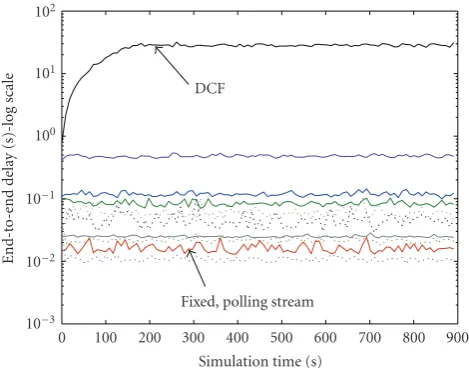
Figure15: End-to-end delays for scenario 1.
layer (2 Mbps for data and 1 Mbps for control messages). The first scenario comprises an AP plus:
(i) 6 STA: local file transfer (DCF, 1500-byte mean); (ii) 10 STA: carrying voice traffic (30-millisecond
maxi-mum delay, fixed MSDU 200 bytes, 64 kbps to corre-spond to a G.711-style voice CODEC, duty cycle 1 : 2.35).
The second scenario is an extension of the first. In this second scenario, an additional “glut” of QoS-sensitive traffic is initiated halfway through the simulation, in the form of an additional six voice traffic streams.
7.3. Results
The first scenario is a static scenario in terms of the traffic stream profile, as no new traffic streams begin and no ex-isting traffic streams end in the course of the simulation. It would be expected that measurements of performance pa-rameters will soon reach a fairly steady state, and this is borne out by results shown in Figures15and16.
The results are for a DCF-only configuration (i.e., all traf-fic having to contend for access), a fixed superframe scheme and adaptive schemes using data from the benchmark (Li), and the results from Sections 4,5, and6. In the following traces, in all but the DCF case, there are separate traces for the polling and contending traffic flows, the polling results are marked by solid lines, the contending are marked by dashed lines. Specific traces of interest are highlighted in the figures. The DCF benchmark configuration shows increasing in-stantaneous end-to-end delay, but offers the best receive rate of all the contention schemes as no time is spent polling. The other schemes all achieve the required end-to-end de-lay requirements of the voice traffic, including the fixed su-perframe configuration because it has an “ideal” configura-tion selected for this scenario (CFPMAXof 85% and CFPREP
200
Contending traffic
Figure16: Receive rates for scenario 1.
102
Contending traffic delay increases DCF
Polled traffic delay remains bounded
Figure17: End-to-end delays for scenario 2.
300
Figure18: Receive rates for scenario 2.
The benefits of PCF and of having an adaptive scheme soon become apparent when the second scenario is consid-ered. Firstly, let us consider the disadvantages of a DCF-only system. As can be seen inFigure 18, the received data rate for DCF does not change when the system is further loaded with additional traffic, and, inFigure 17, the end-to-end delay in-creases.
The adaptive schemes are able to respond to the change in traffic stream demand and reconfigure to provide a nearly constant end-to-end delay for the polling traffic, sacrificing some of the end-to-end delay performance of the contending traffic, which is an acceptable and even sensible tradeoff.
A more detailed examination of the adaptive schemes reveals that the nonlinear optimization approach offers the most stable configurations, but the queuing-theory-based approach offers comparable results and has the benefit of having more potential for distributed solutions in this area. The nonlinear optimization approach does well on the polled delays, but that is at the expense of the contention traf-fic, which incurs a greater penalty than with the other ap-proaches. There is the clear benefit with models that cater for all of the constraints of the IEEE802.11 specification, making any solution based on those results fully compliant with the standard.
8. CONCLUSIONS
This paper has described the IEEE802.11 centralized control schemes, concentrating on the PCF. There has been a consid-erable amount of research into the support of QoS-sensitive traffic in more distributed aspects of IEEE802.11, but much less investigation into centralized solutions. An existing su-perframe configuration solution has been described and op-portunities for improvement have been identified.
A number of solutions for configuring the PCF super-frame have been presented. Firstly, an improved simulation model has been used to provide an accurate set of results for any lookup-table-oriented solution. This model confers the advantage over the literature available to date of being fully compliant with the standard. This approach demonstrates the need to focus on the time-dependent services and shows the importance of considering several performance measure-ments.
Secondly, two mathematical models have been devel-oped, resulting in optimized sets of values for a given config-uration, and, critically, general purpose algorithms that pro-vide optimal results for any set of model constraints.
Finally, an adaptive prototype has been presented that can show each approach in active use, highlighting the effects of changes in traffic requirements. This prototype has high-lighted the consistency of the more mathematically based approaches, as well as demonstrating the benefits of both centralized control and adaptive solutions.
REFERENCES
[1] IEEE (Institute of Electrical Electronics Engineers), “IEEE Standard 802.11: Wireless LAN Medium Access Control (MAC) and Physical Layer (PHY) Specifications,” 1999. [2] Y. Xiao, “QoS guarantee and provisioning at the
contention-based wireless MAC layer in the IEEE 802.11e wireless LANs,”
IEEE Wireless Communications, vol. 13, no. 1, pp. 14–21, 2006. [3] WiMedia-Alliance (Ecma International (Ecma)), “Standard ECMA-368 High Rate Ultra Wideband PHY and MAC Stan-dard,” 2005, http://www.wimedia.org/en/resources/eis.asp?
id=res.
[4] IEEE (Institute of Electrical Electronics Engineers), “IEEE Standard 802.11e—Part 11 Amendment 8: Medium Access Control (MAC) Quality of Service Enhancements,” 2005. [5] C. Li, J. Li, and X. Cai, “A study of self-adaptive
transmis-sion for integrated voice and data services over an IEEE 802.11 WLAN,” in Proceedings of 15th IEEE International Sympo-sium on Personal, Indoor and Mobile Radio Communications (PIMRC ’04), vol. 3, pp. 1922–1926, Barcelona, Spain, Septem-ber 2004.
[6] Y. Zang, G. Hiertz, J. Habetha, B. Otal, H. Sirin, and H.-J. Reumerman, “Towards high speed wireless personal area network - efficiency analysis of MBOA MAC,” in Proceed-ings of International Workshop on Wireless Ad-Hoc Networks (IWWAN ’05), pp. 10–20, London, UK, May 2005.
[7] Y. Xiao and H. Li, “Evaluation of distributed admission con-trol for the IEEE 802.11 e EDCA,”IEEE Communications Mag-azine, vol. 42, no. 9, pp. S20–S24, 2004.
[8] J. Wall and J. Y. Khan, “An adaptive ARQ enhancement to support multimedia traffic using 802.11 wireless LANs,” inProceedings of IEEE Global Telecommunications Conference (GLOBECOM ’04), vol. 5, pp. 3037–3041, Dallas, Tex, USA, November 2004.
[9] P. Chatzimisios, A. C. Boucouvalas, and V. Vitsas, “IEEE 802.11 wireless LANs: performance analysis and protocol re-finement,”EURASIP Journal on Wireless Communications and Networking, vol. 2005, no. 1, pp. 67–78, 2005.
[10] L. Gannoune and S. Robert, “Dynamic tuning of the con-tention window minimum (CWmin) for enhanced service dif-ferentiation in IEEE 802.11 wireless ad-hoc networks,” in Pro-ceedings of 15th IEEE International Symposium on Personal, In-door and Mobile Radio Communications (PIMRC ’04), vol. 1, pp. 311–317, Barcelona, Spain, September 2004.
[11] M. Bandinelli, F. Chifi, R. Fantacci, D. Tarchi, and G. Van-nuccini, “A link adaptation strategy for QoS support in IEEE 802.11e-based WLANs,” inProceedings of IEEE Wireless Com-munications and Networking Conference (WCNC ’05), vol. 1, pp. 120–125, New Orleans, La, USA, March 2005.
[12] A. Iera, G. Ruggeri, and D. Tripodi, “Providing throughput guarantees in 802.11e WLAN through a dynamic priority assignment mechanism,”Wireless Personal Communications, vol. 34, no. 1-2, pp. 109–125, 2005.
[13] D. Chen, D. Gu, and J. Zhang, “Supporting real-time traffic with QoS in IEEE 802.11e based home networks,” in Proceed-ings of 1st IEEE Consumer Communications and Networking Conference (CCNC ’04), pp. 205–209, Las Vegas, Nev, USA, January 2004.
[14] G. Smith and D. Dillon, “QOS over IEEE 802.11e: the need for HCCA for video applications,”Bermai, pp. 1–13, 2004. [15] J. N. Al-Karaki and J. M. Chang, “Quality of service support
in IEEE 802.11 wireless ad hoc networks,”Ad Hoc Networks, vol. 2, no. 3, pp. 265–281, 2004.
[16] S. Mangold, S. Choi, G. R. Hiertz, O. Klein, and B. Walke, “Analysis of IEEE 802.11 e for QoS support in wireless LANs,”
IEEE Wireless Communications, vol. 10, no. 6, pp. 40–50, 2003. [17] P. Brady, “A model for generating on-offspeech patterns in two-way conversation,”Bell System Technical Journal, vol. 48, pp. 2445–2472, 1969.
[18] J. Zheng and E. Regentova, “An improved polling scheme for voice support in IEEE 802.11 wireless network,” inProceedings of International Conference on Information Technology: Coding and Computing (ITCC ’05), vol. 2, pp. 603–608, Las Vegas, Nev, USA, April 2005.
[19] X. Ma, C. Du, and Z. Niu, “Adaptive polling list arrangement scheme for voice transmission with PCF in wireless LANs,” inProceedings of Joint Conference of the 10th Asia-Pacific Con-ference on Communications and the 5th International Sympo-sium on Multi-Dimensional Mobile Communications Proceed-ings (APCC/MDMC ’04), vol. 1, pp. 21–25, Beijing, China, August-September 2004.
[20] R. Y. W. Lam, V. C. M. Leung, and H. C. B. Chan, “Polling-based protocols for packet voice transport over IEEE 802.11 wireless local area networks,”IEEE Wireless Communications, vol. 13, no. 1, pp. 22–29, 2006.
[21] ITU-T (International Telecommunications Union - Telecom-munication Standardisation Sector), “Transmission systems and media: general characteristics of international telephone connections and international telephone circuits: one-way transmission time,” 1996.
[22] X. Ma, Y. Wu, Z. Niu, and T. Sato, “Performance analysis of the packetized voice transmission with PCF in an IEEE802.11 infrastructure wireless LAN,” inProceedings of 9th Asia-Pacific Conference on Communications (APCC ’03), vol. 2, pp. 571– 575, Penang, Malaysia, September 2003.
[23] R. J. Haines, T. Lewis, J. Coon, and N. Fanning, “Non-linear optimization of IEEE 802.11e super-frame configuration,” inProceedings of 63rd IEEE Vehicular Technology Conference (VTC ’06), vol. 3, pp. 1211–1215, Melbourne, Australia, May 2006.
[24] B. Krishnamachari and F. Ord ´o˜nez, “Analysis of energy-efficient, fair routing in wireless sensor networks through non-linear optimization,” in Proceedings of 58th IEEE Vehicular Technology Conference (VTC ’03), vol. 5, pp. 2844–2848, Or-lando, Fla, USA, October 2003.
[25] M. Sandell and J. Coon, “Near-optimal training sequences for MIMO OFDM systems with nulled subcarriers,” in Proceed-ings of IEEE Global Telecommunications Conference (GLOBE-COM ’05), pp. 2244–2249, St. Louis, Mo, USA, November-December 2005.
[26] S. Boyd and L. Vandenberghe, Convex Optimization, Cam-bridge University Press, CamCam-bridge, Mass, USA, 2004. [27] L. Wang, M. Hamdi, R. Manivasakan, and D. H. K. Tsang,
“Multimedia-MAC protocol: its performance analysis and ap-plications for WDM networks,”IEEE Transactions on Commu-nications, vol. 54, no. 3, pp. 518–531, 2006.
[28] R. B. Cooper,Introduction to Queueing Theory, Elsevier/North Holland, Amsterdam, The Netherlands, 1981.