R E S E A R C H
Open Access
Hybrid scheme to enable DTN routing
protocols to efficiently exploit stable MANET
contacts
Silvia Krug
1,2*, Matthias Aumüller
1and Jochen Seitz
1Abstract
Disaster communication is still challenging due to the unpredictable nature and high variance in possible scenarios. Hybrid networking solutions that integrate principles from mobile ad hoc networks (MANETs) and delay tolerant networks (DTN) have been suggested to guarantee a certain robustness for the communication service in case of partial or complete failure of infrastructure. Real-time communication remains however challenging and the goal of any system is to minimize the message delay. One common approach is to provide better connectivity by including additional nodes and exploit the resulting contacts as efficiently as possible. Well-known DTN protocols are however not able to guarantee that, because they are unaware of connections that last for a relatively long time and thus provide stable connectivity. This results from general design assumptions of the DTN protocols and is crucial for the performance of hybrid MANET-DTN solutions. In this paper, we provide a review to this situation and suggest a hybrid solution concept based on layer 3 service discovery and a contact-aware utility scoring mechanism for DTN protocols and implement our concept as an example in one DTN protocol. Using simulations, we are able to show that this combination of mechanisms is able to provide better overall performance in the presence of long-lasting stable contacts.
Keywords: Delay tolerant networks, Hybrid routing protocols, Contact utilization, Performance evaluation
1 Introduction
Robust and timely communication between all partici-pants is essential for efficient first responder mission exe-cution. Infrastructure-based mobile communication tech-nologies might not be available for this if the disastrous event damages parts of the infrastructure. Therefore, first responders have to build their own network with whatever devices are available. This leads to a highly heterogeneous network structure and often ad hoc style communication paradigms [1]. Pure mobile ad hoc network (MANET) communication is however suffering from frequent dis-ruptions due to node mobility limiting the coverage of the network and forcing the users to repeat messages, as soon as communication is possible again. To avoid this, mecha-nisms from delay tolerant networks (DTNs) can be added
*Correspondence:[email protected]
1Communication Networks Group, Technische Universität Ilmenau, PF 100565, 98684 Ilmenau, Germany
2IMMS Institut für Mikroelektronik- und Mechatronik-Systeme gemeinnützige GmbH, Ehrenbergstrasse 27, 98693 Ilmenau, Germany
to the devices enabling them to store messages until the nodes are within coverage again [2,3]. However, this also increases the delay to a level that might not be acceptable in first responder communications [1,4].
In our previous work [5], we already studied differ-ent options to mitigate the experienced delay due to DTN mechanisms by analyzing hybrid DTN-MANET approaches. Such a hybrid network can consist of both mobile and stationary nodes in the MANETs where all nodes are DTN-capable. Besides that, it is possible to con-nect the nodes to the remaining infrastructure network if suitable devices that can act as gateway are present. This general network structure is widely discussed in literature as a good option for efficient disaster communication (e.g., in [1]).
The results of our previous study showed that the DTN protocol plays a crucial role in the overall system per-formance if it is placed on layer 5. In that case, the DTN protocol defines when messages are handed down
to the MANET protocols on layer 3 for further trans-mission. However, we observed that current protocols are not able to efficiently exploit the underlaying MANET connections, especially if these represent stable, long-lasting contacts that would be available and ready to use immediately.
Previous studies on DTN protocols or hybrid MANET-DTN solutions did not observe this behavior because the focus there was on rather random scenarios leading to contact patterns according to the DTN design assump-tions or, if interacassump-tions with infrastructure or other fully connected parts of the network are studied (e.g., in [6]), the assumption often is that the messages have to reach this well-connected part for success as the last node acts as gateway. However, these assumptions are not valid in disaster scenarios. The contacts are not random as nodes move according to tactical requirements of the mission. This leads to well connected groups that meet infre-quently with others but have to communicate with the mission coordinators frequently and in a timely fashion. In such scenarios, it is important to utilize every com-munication opportunity and short-cut other parts of the network without the need for special gateways.
In this paper, we extend our work [5, 7] to enable a true hybrid scheme that is capable of efficiently exploiting any available contact opportunity by adding two mech-anisms to the system. One is the integration and usage of a layer 3 service discovery mechanism that allows a DTN node to discover all connected nodes with DTN capabilities on layer 3. The other one is an algorithm that triggers the recalculation of the utility score in DTN protocols and thus is able to produce better scores for sta-ble connections. By doing this, we are asta-ble to enhance the awareness of the DTN protocols of underlying con-tacts and effectively reduce the experienced delay, as far as that is possible based on the given topology. The algo-rithm is integrated into an enhanced version of the RAPID (Resource Allocation Protocol for Intentional DTN) pro-tocol [8].
The paper is organized as follows. In Section 2, we will first give a more detailed review of communication in disaster scenarios and the applicability of hybrid DTN approaches to these scenarios. Afterwards, we review gen-eral design assumptions of DTN protocols with a focus on the calculation of utility values. Based on that discus-sion, we then introduce our concept to enable an efficient exploitation of underlying MANET multi-hop contacts and present relevant implementation details. In Section3, we present results regarding three sets of simulations. The first is a proof of concept study, showing the impact of the different mechanisms of our approach. The second compares our modified protocol version to the original performance and the analytically obtained optimal solu-tion. The third evaluation targets the robustness of the
modified approach with respect to random node failures. Finally, we conclude the paper and indicate future work.
2 Methods
In this section, we introduce the methodology leading to our hybrid MANET-DTN approach as well as the simula-tion setup used during the further evaluasimula-tions.
2.1 Disaster scenario review
Disaster scenarios involve many different types of events that threaten the life of people. The range lasts from large scale man-made terror attacks or natural events such as floods and wildfires to smaller scale events as, for exam-ple, search and rescue missions. Even if all scenarios are different, there are some common characteristics.
The geographical area of the event is usually large, denying an efficient coverage by one communication tech-nologies only, if long-range communication such as public land mobile networks are not available. Infrastructure-based communication would be ideal, but is likely to be affected by the disastrous event as well. Even if the infrastructure is not hit directly, it might be overloaded and thus not reliable enough for disaster communication. However, communication between all participating rescue forces is essential for efficient recovery and response pro-cesses in order to prevent further damage. This not only includes communication to coordinate and distribute of resources but also frequent reports from users in the field. Especially, the reports of possible findings or changes in the overall situation have to be communicated fast and reliably.
As a result, the rescue forces often build their own networks, based on nodes they carry or that are other-wise part of their equipment (e.g., mounted on vehicles or special unmanned aerial vehicles). The combination of mobile nodes carried by the users and stationary nodes, e.g., mounted on vehicles creates an environment with two types of connectivity, even if pure MANET principles are used between all nodes.
The first type spans a local network with rather good connectivity between the participants resulting in stable routes. It is build from stationary nodes, but exists also between groups of nodes that move together. Here, a pure MANET solution would be sufficient.
To overcome the second point, several works suggest to add additional nodes to enhance the connectivity between groups or use dedicated message ferries to deliver mes-sages. The crucial aspect here is to exploit all avail-able communication opportunities as efficient as possible. This ultimately results in a heterogeneous and hybrid network.
We chose to use a Search and Rescue scenario as an example for our evaluations. This represents a rather small event but shows all the elements of a bigger scenario at a better observable scale. Figure1shows an example screen-shot of the scenario with both mobile and stationary nodes.
The fixed nodes in this scenario form a central back-bone of fully connected nodes resulting in an area of stable MANET connectivity. In that case, all nodes were DTN-capable, and the multi-hop communication both on MANET and DTN level is enabled.
As an evaluation metric, we chose a composite met-ric that covers both the reliability and the timeliness of the message delivery in the network. First respon-der communication is time critical in most cases and requires a high delivery ratio. In German rules and reg-ulations, it is mentioned that messages between differ-ent participants should be acknowledged within 3 min, otherwise a broken communication has to be assumed. Therefore, we use a deadline of 90 s to decide whether
a message arrives late in one direction. We use the error ratio (ratioerror) as evaluation metric that is calculated
according to Eq.1, including both messages that do not get delivered and messages that get delivered too late. It therefore covers both mentioned metrics relevant in the scenario.
ratioerror=
numlost+numlate(90s)
numsent
(1)
However, when we performed simulations using this setup, we observed that other than expected there was no performance improvement with an increasing number of additional nodes, both carefully placed at fixed positions or mobile. Figure2shows the results and the gap between the simulation and an analytically obtained ideal solution based on perfect knowledge of the contacts as well as 95% confidence intervals around the results. The optimal solution (red) was calculated via our analytical framework introduced in [9] and represents the lower bound on the error ratio of that particular scenario.
While analytical results showed that there are more and longer lasting connections that enhance the connectivity, the protocols under test were not able to exploit them [5]. When looking closer at the resulting paths of the mes-sages, we observed that some of the contacts were not considered at all. These were the long-lasting contacts, that were established between the backbone nodes once
Fig. 2Gap between current DTN protocol performance and ideal result [5]
they are in place and are disconnected at the end of the mission, when the equipment gets collected. The result is a large gap between the actual performance and what is theoretically possible.
2.2 DTN utility scoring
To better illustrate the problem, let us review general design assumptions for DTN protocols and their utility functions.
DTN protocols were designed for situations where nodes get frequently disconnected from the network and these disconnections can last for a long time [10]. In order to be still able to communicate and send/receive data, the nodes store otherwise undeliverable messages persis-tently until they meet another DTN-enabled node. Such a meeting is called a contact between two DTN nodes or a communication opportunity.
Traditional approaches assume that a contact is a direct point-2-point contact as depicted in Fig.3a. This contact will last as long as the two nodes are within communica-tion range of each other.
a
b
Fig. 3Contact types in principle.aPoint-2-pointbMulti-hop
When two nodes are in contact with each other, utility-based DTN routing protocols first calculate a utility score, which is then used to decide whether to for-ward a message to the other currently reachable node. This can also include transitive contact patterns, e.g., if a node B meets nodes A and C frequently, then also nodes Aand C meet frequently, even if they are never in direct contact with each other [11]. Based on the utility score, the nodes in contact then exchange the relevant messages for which the peer node has the bet-ter score. Whether all messages in that category can be exchanged, is depending on the duration of the contact. Therefore, the recognition and exploitation of such contacts is essential for the performance in DTN networks [12].
Multi-hop communication is considered on the DTN plane as well. In this case, it is possible to forward the message along a chain of DTN nodes, as long as the utility score at each hop indicates to forward the mes-sage and if the routing scheme supports further transfers. This should be the case with the backbone nodes in our example scenario. Using these mechanisms, many of the traditional DTN use cases can be handled well. The base assumption is, however, that the contacts are relatively short and partially predictable.
To enhance the network performance, the natural choice is to add more nodes and ideally position them in a way to create additional contact opportunities. This results in a higher node density and eventually will create more and longer lasting contacts. However, the require-ment that all nodes have to be DTN-enabled might be too limiting in some cases, as it requires additionally installed software on the respective devices. If it is impor-tant to actually exploit any communication opportunity, even if the nodes have heterogeneous capabilities, also non-DTN nodes should be used as relay. This is pos-sible without changes, if a suitable MANET protocol is used at layer 3 and the DTN functionality is added on top.
b a
Fig. 4Illustration of underlay/overlay interdependencies for multi-hop contacts.aLayer 2 topologybActual DTN contacts
As mentioned above, this was however not the case in the SAR scenario. This observation was surprising and to our knowledge it has not been reported before.
The reason for this behavior is only partly related to the choice of scenario which is however a typical hybrid MANET-DTN setup and thus represents a class of scenar-ios with mixed connectivity types. The other part comes from the way DTN protocols actually calculate the util-ity score. As mentioned above, this score is calculated whenever two nodes meet or when the contact breaks.
Besides that, approaches targeting DTNs as means to bridge the communication to otherwise connected parts of the network (e.g., to connect to remaining or rebuilt infrastructure networks) mostly focus on the routing towards the connected network [6] and then assume that this will finally deliver the message to its destination within the connected network. Therefore, the goal is to reach that part, but not use it as a part of the DTN network in order to reach other DTN nodes. However, also the routing towards those parts requires efficient discovery of the contacts involved.
Regarding multi-contacts, cases in which a node is in contact with multiple other nodes simultaneously, there has been one study showing that this can have a positive impact as well, but is also usually not considered in the current design of DTN protocols [16].
2.3 Hybrid solution concept
In this section, we will present our concept to enable effective utilization of stable layer 3 contacts via a hybrid interaction of the DTN and MANET instances of a node. To achieve that, two things are required. The first is that the DTN layer is aware of any multi-hop contacts and the second is to enable the protocols to exploit stable long-lasting contacts.
In order to enable DTN protocols to exploit logical DTN contacts that are available only via a multi-hop connec-tion on the underlying MANET and also to efficiently utilize multi-hop DTN connections, the respective routes on layer 3 have to be known. Direct, point-2-point DTN contacts are usually recognized by the DTN instances as is. In case of logical contacts, an efficient MANET routing approach on layer 3 is required that is capable of finding routes to all available nodes under various and changing network conditions. Depending on the type of MANET routing protocol applied on the node, this is either done pro-actively as part of the routing procedure or has to be triggered on demand by an upper layer.
However, the routing protocols provide a route to another IP node. This does not include information on whether the corresponding node has DTN capabilities or not. If such heterogeneous setups are considered, additional service discovery mechanisms are required to identify which subset of reachable nodes actually has DTN capabilities. In previous projects [7, 17], we devel-oped a suitable MANET routing framework as well as mechanisms for effective service discovery. These two mechanisms enable the DTN node to effectively discover multi-hop contacts to other DTN nodes that are directly reachable via an existing route on layer 3.
Secondly, the DTN protocol has to be enabled to use these contacts efficiently. The same applies to any other direct DTN contacts as well. Currently, this is not the case for rather stable networking conditions.
Another problem is that the check for a message exchange is also only executed if a new contact comes up. This further decreases the utilization of stable connections and affects also protocols that do not use a utility-based routing scheme. It is therefore another crucial effect.
To solve both problems, it should be sufficient to peri-odically re-initiate the calculations and checks done oth-erwise for newly discovered contacts. Such a re-initiation would imitate the effect of shorter contact durations or more frequent interruptions leading to a better utility score and also check for possible messages more often. Using a quite simple enhancement would allow the pro-tocols to overcome both drawbacks of the current design. On the other hand, the simple re-initiation does not affect the performance of the protocol towards other scenarios with the typical short contact duration. These contacts are still handled in the same way. Algorithm 1 shows a generic version of the combined process.
Algorithm 1General idea for contact-aware scoring func-tion
Input: contactCheckInterval
Periodic contact discovery:
1: if(currentTime - lastDiscoveryTime) > contactCheck-Intervalthen
2: start ServiceDiscovery Request 3: forall new contactsdo
4: add to active contacts list
5: collect statistics associated to contact 6: calculate utility score
7: end for
8: forall closed contactsdo 9: cleanup and remove from list 10: end for
Periodic update of already active contacts: 11: forall existing contactsdo
12: collect statistics associated to contact 13: recalculate utility score
14: end for
15: check possible message transfers 16: end if
The recalculation can be achieved by integrating a func-tion to periodically monitor active contacts and, if a connection has been active for a certain period of time, trigger the recalculation of the score. Ideally this is inte-grated in the existing function of the service discovery procedure to get up-to-date routing information. Such an approach therefore makes the utility scoring algorithm aware of contact durations and enables any protocol to handle long-lasting contacts as well. Using this mecha-nism is preferable as it does not require changes to the way
a DTN routing protocol calculates the utility score. There-fore, the mechanism can be integrated into any available DTN routing protocol.
A periodic check on the DTN layer is needed anyway, in order to efficiently discover changes in available nodes, even if on-demand approaches are used as MANET rout-ing. Otherwise, the DTN instance relies on notification on connections with ongoing traffic from the MANET instance. Besides the periodic triggering of the service discovery procedure, the same function could trigger the recalculation of the scoring values. Whether the same intervals are used in both cases has to be decided based on the scenario and explicitly based on the introduced over-head to the network for each service discovery request. Depending on the chosen update period, the contact-aware utility scoring will favor the stable conditions because their score will increase and thus be sufficiently high to initiate the forwarding of messages.
Finally, the periodic procedure should trigger a check whether additional messages can be transfered based on the updated information. This aspect makes the approach even more versatile, as it allows a more transitive behav-ior over stable connections. For example, if a neighbor on a long-lasting contact has new messages or contacts that enable transfers that were not indicated under the original conditions when the nodes met initially.
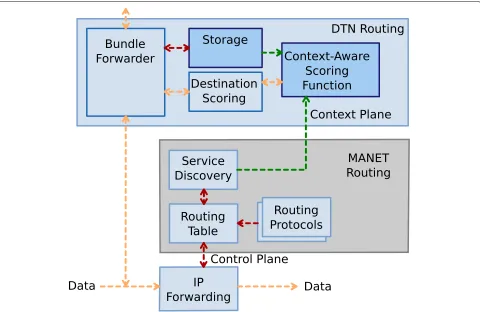
Figure 5 shows the general interaction between the different protocol components and instances in a corre-sponding node.
The presented concept is however an example solution specifically designed for the requirements of first respon-der communication networks by integrating our adap-tive routing framework and extending nodes with DTN capabilities. The result is a communication system that fulfills the requirements of a robust and adaptive commu-nication under heterogeneous conditions. However, the mechanisms in general are applicable to other scenarios and architectures as well, if these are able to collect the required information on layer 3 and provide it to the DTN instance.
2.4 Simulation setup and implementation
To validate the concept of our approach, we first repeated the simulations of the mentioned SAR scenario with backbone nodes in Opportunistic Network Environment (ONE) [18] and collected the corresponding connectivity traces that get reported by one of the default reporting tools in ONE. The detailed list of simulation parameters is given in Table1.
Fig. 5Conceptual design of hybrid interaction between DTN protocols with contact-aware scoring and MANET service discovery
delivery ratio and the timely delivery of messages are the crucial performance metrics. To enhance both met-rics, additional DTN-enabled backbone nodes were added subsequently to the scenario and carefully positioned to be fully connected at all times and cover a large part of the search area. Even though RAPID was designed with
Table 1Simulation parameters in ONE
Parameter Value
Simulation area 6000 m×5000 m
Simulation time 12000 s
Number of first responder nodes 62
Movement Patterns [19]
Traffic Application [20]
Number of backbone nodes 0 – 35
Movement Fixed
Communication range 150 m
Data rate 2 Mbit/s
Buffer size 10 MByte
Message size 500 Byte
Message TTL 300 min
Routing protocol RAPID [8]
the typical contact distribution in mind, its features with variable optimization goals make it an interesting can-didate for first responder communications too. Besides that, RAPID was also designed with hybrid operations in mind [8].
2.4.1 Proof of concept
We first performed a study to prove the base assump-tions of our work. Simulation results with the above setup show that both service discovery from MANET instances as well as periodic score recalculations are required.
To validate the concept, the resulting contact trace from ONE was altered by adding/deleting contacts to represent the following variants:
Variant 1 representing theoriginalconnection history.
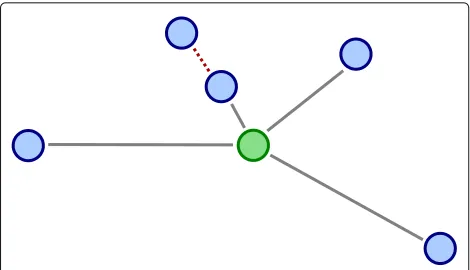
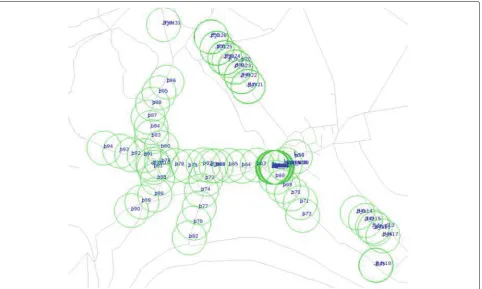
Variant 2 featuring avirtual DTN noderepresenting the backbone in order to allow the backbone to act as storage. Figure6shows the resulting topology.
Fig. 6Topology with virtual DTN node (green) representing the backbone
In variant 2, all nodes of the backbone have been replaced by one single, virtual node. Afterwards, con-nections overlapping in time, arising from this process, have been merged to one contact. For the third variant, we combined all appropriate connections to create new contacts, in order to reproduce all possible layer 3 con-nections. Therefore, we created an algorithm which joins two simultaneous connections with one common node to compute a new indirect contact. Just like in the variant 2, we merged overlapping connections. These two steps have been repeated until no new connection was found. In this way, we found all indirect connections, independent of the hop count.
For each variant, we included artificial interrupts in the connectivity to check whether a pure boost of the utility score is sufficient to better utilize available contacts. To do so, we created modified traces for each variant with no additional breaks and breaks every 500, 100, 50, 10, or 5 s, respectively. With this modification, one long-lasting con-tact get represented by a series of shorter concon-tacts. The change of the connection state automatically triggers the mentioned recalculation of the DTN utility score.
2.4.2 Implementation of context-aware scoring in RAPID Finally, we applied our idea to periodically trigger the recalculation of the utility score by making the scor-ing mechanism aware of long-lastscor-ing contacts to the RAPID protocol. This protocol features three different utility algorithms that can be selected based on applica-tion requirements [8]. It allows to minimize the average delay of all messages to minimize the number of messages missing their deadlines in terms of time to live associated with the messages or to minimize the maximum delay of all messages and uses information on previous contacts as well as the currently transmitted messages as context information, which gets stored in tables accordingly. The calculation of the score is triggered by detected changes in the connection status. For example, if a new contact is
discovered for the first time, a dummy entry is created in the respective table. Once the contact ends, this dummy entry gets updated with statistical information about this contact, such as average duration (for re-occurring con-tacts) and messages transferred via this contact. This statistical data is then used to calculate the utility score with variations depending on the optimization goal.
The update mechanism based on the contact status is however the reason why RAPID showed no benefit from long-lasting stable contacts in its original form. Long-lasting contacts as they are created by the backbone nodes become active once and might stay so throughout the sim-ulation or at least change very rarely. This leads to missing statistics and thus a bad utility score for any node reach-able via such a connection. It is however rather simple to avoid this situation. To do this, all active contacts have to be monitored. Once the last update to an entry referring to a still active contact is older than a certain configurable threshold value, the statistics should be reported for this entry including a reset of the interval. By doing this, the utility calculation itself remains unaltered, it is however provided with more statistical information based on the actual contact history. Algorithm 2 shows the algorithm describing the implementation in ONE.
Algorithm 2Contact-aware trigger for utility calculations in RAPID
Input: ConnectionList at node v
Input: MaxUtilityInterval
Periodic check:
1: forall active connections con from v→udo
2: get MeetingEntry e for v→u
3: ife is older than currentTime - MaxUtilityInterval
then
4: collect statistics associated to con 5: update MeetingEntry e
6: end if 7: end for
Our modified version of the protocol is available on GitHub1.
3 Results and discussion
In this section, we will first present and discuss the results of a general proof of concept study, showing that the proposed mechanisms are providing better results. After-wards, we compare and discuss these theoretical results with the results of an example protocol-specific imple-mentation of the concept.
3.1 Proof of concept
b
a
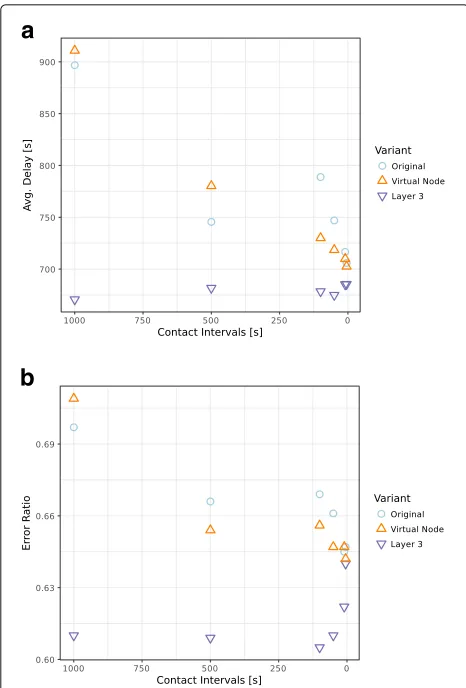
Fig. 7Performance resulting from different variants.aDelaybError ratio
error ratio (b) respectively. Original contact intervals in this figure represent the dataset without artificially added contact interrupts.
Regarding the average delay, all variants show an improved situation, except variant 3 where the delay remains more or less constant due to the availability and awareness of the layer 3 multi-hop connections. The aver-age delay is however quite high and significantly above the desired deadline of 90 s for all cases. We show these results nonetheless to illustrate the effect of periodic updates on the delay and thus the impact of periodic recalculation of the utility score.
The better metric is however the error ratio. Based on Fig.7b, we can observe that relatively long contact inter-vals of 500 s already show an improvement and that the error ratio is only slightly decreased further by adding shorter intervals. More interestingly, the impact of differ-ent variants is quite significant, withvariant 3 showing the best results. In case of shorter intervals, the perfor-mance of this variant is decreased due to contacts that do
not last long enough to cover the complete multi-hop con-nection and thus leading to failed transmission attempts that have to be repeated at a later point in time. Even if the performance gets worse, this variant still outperforms the others. This shows that efficient service discovery, revealing the current contacts to all available nodes is required.
Another critical point is the overhead introduced by ser-vice discovery requests at a certain interval. If only layer 3 service discovery is used to determine the connection sta-tus as shown with the artificial breaks, this has to be done periodically which can create a high additional load to the network. To limit this, the interval length for such peri-odic requests has to be selected carefully. Based on the previous analysis, a value between 500 and 100 s should represent a good compromise between recent updates and overhead limitation.
To further study the benefit of different contact inter-vals, we repeated this preliminary experiment by stepwise adding further backbone nodes. Figure8shows the results for 0 to 35 backbone nodes.
In this diagram, we compare the performance of RAPID based on the modified traces without artificial interrupts as well as artificial break intervals of 500, 100, and 50 s. Please note that all results from these traces are between the original protocol performance and the ideal solution presented in Fig.2. Even if the theoretical result cannot be reached, the improvement is quite significant, espe-cially for the cases with many additional nodes. There, the error ratio can be reduced by around 25%. The exact values of the curve are application dependent, because further gains might be possible if nodes get repositioned or use different technologies. However, it is important to show that an improvement is possible by adding nodes, as expected.
When comparing the interval length, the performance differences are less significant and partially contradicting. But this actually might result from the artificial breaks, which tear down the connections for 0.1 s and re-establish them afterwards. Any message that is in mid transfer would be lost at this occasion and has to be repeated later on, leading to an unnecessary overhead. Therefore, an actual artificial breaking of the connections is not desired for the implementation of the concept in a real protocol.
3.2 Context-aware utility calculation in RAPID
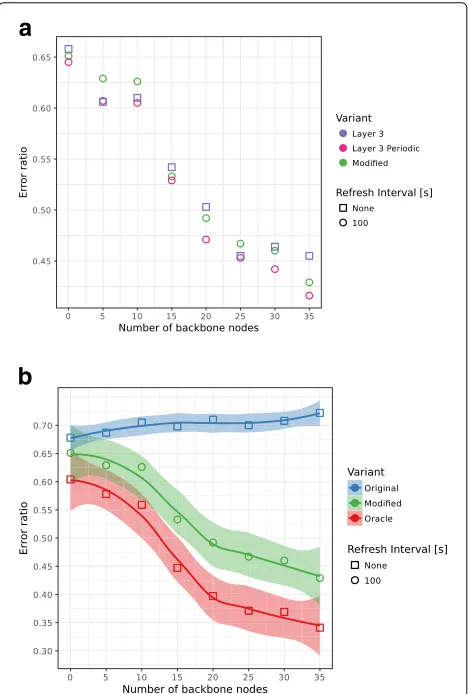
The implementation was finally tested against previous results from the original protocol version, the theoretical bound and two trace versions of variant 3. Both traces with the modified connections were added in order to show the effectiveness of the implementation in comparison to the proof of concept. The first trace uses no artificial breaks and thus represents the case when only service discovery is used without periodic contact-aware utility calculation. Since we want to study the effect of a hybrid solution, this trace was also used as base for the modified proto-col too. Otherwise, the knowledge on possible multi-hop contacts would be missing. The second trace includes arti-ficial breaks with the same contact interval as configured for the contact-aware utility function, which was set to 100 s. Figure9shows the corresponding results.
As seen before, the artificial traces and the modified protocol are able to follow the general trend with a decreasing error ratio if the number of backbone nodes increases. This shows that our proposed concept is able to reproduce the behavior that is based on artificially gen-erated traces and that it is outperforming the original protocol version.
A bit more attention should be paid to the result in Fig. 9a however. Out of the remaining three data sets, two are artificially generated to proof the need for both service discovery and periodic recalculation of the utility score are needed. These results are obtained by artificially adding connections to all multi-hop reachable nodes and artificial breaks forcing an unaltered version of RAPID to recalculate the scoring. Both version are therefore idealized. The final data set covers the performance of our modified version of RAPID, based on the original contacts.
While the general trend is the same for both artifi-cial data sets, the set without periodic breaks shows a slightly worse performance especially for cases with a higher number of backbone nodes. This indicates that a pure service discovery scheme alone is not able to enhance the performance as expected, if more and longer lasting contacts are present as it is the case in more dense net-works. Therefore, our decision to utilize two mechanisms is justified.
All three sets show a similar performance, where the two artificial versions are slightly better than the real implementation. However, since these values are gener-ated artificially based on perfect future knowledge and actually forced breaks of the connection, they are idealized as well. It was to be expected, that the enhanced RAPID implementation does not reach the same performance in any case, if the routing takes its own decisions based on the knowledge it has at that time. This most likely results from differences in the treatment of physically interrupted connections and the periodic contact-aware recalculations.
However, the overall improvement of the network per-formance is significant as shown in Fig.9b. Nevertheless, further optimizations on the interval length of the peri-odic updates could help enhance the performance further and fine tune the results.
Besides that, it should be noted that similar concepts can be applied to any other DTN routing protocol as well, since we do not require a change in the fundamental utility
a
b
scoring algorithms but rather force the protocols to trig-ger the corresponding calculations more often. Another possible enhancement for the given scenario could be the exploitation of resulting multi-contacts as already sug-gested in [16].
3.3 Robustness evaluation
In order to evaluate the impact of the modified protocol version on the network robustness, we added simulations with random failures of 20% of the backbone nodes for each trace configuration. The nodes are chosen using a random number generator (RNG) with uniform distribu-tion supporting equal probability for all backbone nodes of the given trace to be selected as inactive. The selected nodes are then configured as inactive in the simulation using the existing functionality of ONE. We chose this setup, as the focus of the work is to present a hybrid scheme that is actively exploiting additional nodes and its ability to adapt to changed conditions regarding these nodes.
For each backbone configuration, we executed several runs with different seeds for the RNG resulting in differ-ent distributions of inactive nodes each. The runs however only reflect a subset of all possible combinations of fail-ing nodes. Despite the random selection, we ensured that nodes at the edge of the spectrum are also considered.
For each run, we then calculated the average number of messages considered as error (numlost+numlate(90s)) as
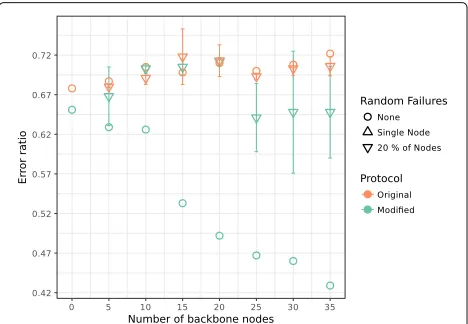
well as the standard deviation of that to show the variance. Based on these numbers, we calculated the correspond-ing average error ratio and the percentage of variance. Figure10shows the corresponding results in comparison to the performance without node failures.
The variance is in all cases quite high, indicating that nodes with different criticality to the overall performance exist in the tree-like backbone topology. This is expected due to the topology and the expected message flow along
Fig. 10Impact of random node failures on the overall performance
the backbone. If the random selection targets nodes closer to the root of the tree, this is more crucial for the overall network performance than failures at the leaf-level of the tree.
Besides that, both variants with node failures show a better performance than the original fully connected backbone. This might sound surprising at first, as a smaller number of nodes is available. However, the failure of individual nodes in this case breaks the original struc-ture with long-lasting contacts resulting in new additional contact opportunities as nodes move between the gaps. As mentioned before, these changes in the contact distribu-tion trigger the normal utility calculadistribu-tion. This results in better overall performance and raises the question on an optimal backbone node placement.
Since the focus of this work is not on the optimal dis-tribution of the backbone nodes, we concentrate more on the resulting performance in general. There, the modified RAPID implementation outperforms the original version in all cases except if ten backbone nodes are used how-ever with a high variance. The gap between both variants is not as large as with a continuous backbone, but still the enhancement is clearly visible for scenarios with a large number of backbone nodes. The reduced gap size was expected as the random failures add unpredictabil-ity to the network and thus limit the effect of long-lasting contacts.
The results from this evaluation show clearly that the proposed scheme is robust in terms of random node fail-ures, as the benefits are clearly visible for well-connected parts of the network, while not reducing the perfor-mance in case of random failures compared to the original protocol.
The observation that certain nodes are more critical than others and that different node distributions have a significant impact of the overall network performance was expected based on the scenario setup. For future work, it is however an interesting question to exploit this behavior further. Knowledge on vulnerable nodes in a network both in terms of traffic load and criticality, and the optimization of the deployment strategies can help further enhance the communication capabilities of first responders.
4 Conclusions
In this paper, we discussed the design assumptions of DTN routing protocols and how they affect the over-all network performance if the protocols are applied in hybrid DTN-MANET scenarios featuring partially stable and long-lasting contacts on layer 3. While this is desired for efficient routing on layer 3, it proved to be problematic in the DTN context, as the utility scoring is often unaware of such contacts and thus unable to exploit them.
and adding contact-awareness to the utility scoring algo-rithm. Following a case study with artificially generated traces to validate our design assumptions, we devel-oped a modified version of RAPID as an example using the contact-aware utility scoring mechanism. Compar-isons with the original version of the protocol show the effectiveness of the concept and a significant improve-ment of the overall network performance.
The presented enhancement helps significantly close the gap between the original RAPIDs performance and the ideal performance of continuous backbones. Especially, the effective utilization of stable contacts qualifies the presented solution for the application in heterogeneous networking environments with zones of stable connectiv-ity and common disruptions as in disaster scenarios. In case of random node failures, the concept shows a better performance than the original version for a large number of backbone nodes and otherwise a similar performance and is thus considered as robust solution.
Moreover, our concept is not limited to the RAPID pro-tocol, even if that was chosen as an example here. The general ideas apply to any other DTN protocol as well that uses utility scoring to decide whether to forward messages to a peer node. Considering the periodic triggering of the forwarding check, this also applies to any other protocol.
As future work, we plan to work on an optimized parameter set for the contact-aware utility scoring algo-rithm to exploit the limits of this approach. Besides that, we want to apply our solution to further proto-cols as the concept itself is not depending on a single implementation and can be applied to any protocol that calculates a utility score based on contact statistics in some form.
The mentioned optimization of the backbone struc-ture and analysis of vulnerable nodes in the topology should be targeted to better understand the impact of the chosen deployment on the communication systems performance. Finally, the efficient utilization of additional contacts should be evaluated further for mobile message ferries as well.
Endnote
1https://github.com/Waldgeist84/one_extensions
Abbreviations
DTN: Delay tolerant network; IP: Internet protocol; MANET: Mobile ad hoc network; ONE: Opportunistic network environment; OSI: Open systems interconnection; RAPID: Resource allocation protocol for intentional DTN; SAR: Search and rescue
Availability of data and materials
The code for the modified version of RAPID as well as an example scenario for a given trace set is available on gitHub:https://github.com/Waldgeist84/one_ extensions.
Authors’ contributions
SK, MA, and JS contributed equally in the conception or design of the work, data analysis and interpretation, drafting, and critical revision of the article. SK
and MA contributed equally in the data collection. All authors read and approved the final manuscript.
Competing interests
The authors declare that they have no competing interests.
Publisher’s Note
Springer Nature remains neutral with regard to jurisdictional claims in published maps and institutional affiliations.
Received: 4 April 2018 Accepted: 18 September 2018
References
1. D. Reina, M. Askalani, S. Toral, F. Barrero, E. Asimakopoulou, N. Bessis, A survey on multihop ad hoc networks for disaster response scenarios. Int. J. Distrib. Sens. Netw.11(10), 647037 (2015).https://doi.org/10.1155/2015/ 647037
2. C. Raffelsberger, H. Hellwagner, in3rd International Workshop on Pervasive Networks for Emergency Management (PerNEM). A hybrid MANET-DTN routing scheme for emergency response scenarios (IEEE, San Diego, 2013).https://doi.org/10.1109/PerComW.2013.6529549
3. M. Matis, L. Doboš, J. Papaj, An enhanced hybrid social based routing algorithm for MANET-DTN. Mob. Inf. Syst.2016, 1–12 (2016). Article ID 4803242.https://doi.org/10.1155/2016/4803242
4. A. Martín-Campillo, J. Crowcroft, E. Yoneki, R. Martí, Evaluating opportunistic networks in disaster scenarios. J. Netw. Comput. Appl.
36(2), 870–880 (2013)
5. S. Krug, J. Seitz, in12th ACM MobiCom Workshop on Challenged Networks (CHANTS). Utilization of additional nodes in hybrid DTN-MANET scenarios (ACM, New York, 2017).https://doi.org/10.1145/3124087.3124099
6. C. P. Mayer, O. P. Waldhorst, Routing in hybrid delay tolerant networks. Comput. Commun.48, 44–55 (2014)
7. S. Schellenberg, A. Saliminia, S. Krug, J. Seitz, T. Finke, J. Schroeder, in28th International Conference on Information Networking (ICOIN). Routing-based and location-aware service discovery in mobile ad-hoc networks (IEEE, Phuket, 2014).https://doi.org/10.1109/ICOIN.2014.6799474
8. A. Balasubramanian, B. Levine, A. Venkataramani, DTN routing as a resource allocation problem. ACM SIGCOMM Comput. Commun. Rev.
37(4), 373–384 (2007)
9. S. Krug, J. Seitz, in23rd European Wireless (EW). A framework to calculate delay-optimal oracle solutions based on DTN contact graphs (VDE Verlag, Dresden, 2017)
10. K. Fall, inConference on Applications, Technologies, Architectures, and Protocols for Computer Communications (SIGCOMM). A delay-tolerant network architecture for challenged internets (ACM, New York, 2003).
https://doi.org/10.1145/863955.863960
11. A. Lindgren, E. Davies, S. Grasic, A. Doria, Probabilistic routing protocol for intermittently connected networks. RFC 6693 (Experimental) (2012).
http://www.ietf.org/rfc/rfc6693.txt. Accessed 20 March 2018 12. O. R. Helgason, S. T. Kouyoumdjieva, G. Karlsson, in7th International
Conference on Wireless On-demand Network Systems and Services (WONS). Does mobility matter? (IEEE, Kranjska Gora, 2010).https://doi.org/10.1109/ WONS.2010.5437138
13. R. Pant, A. Tunpan, P. Mekbungwan, R. Virochpoka, K. Kanchanasut, in6th Asian Internet Engineering Conference (AINTEC). DTN Overlay on OLSR Network (ACM, New York, 2010).https://doi.org/10.1145/1930286. 1930294
14. Z. Wang, E. Bulut, K. S. Boleslaw, inGLOBECOM Workshops. Service discovery for delay tolerant networks (IEEE, Miami, 2010).https://doi.org/ 10.1109/GLOCOMW.2010.5700162
15. M. Pitkänen, T. Kärkkäinen, J. Ott, inInternational Workshop on the Impact of Human Mobility in Pervasive Systems and Applications (PerMoby). Mobility and service discovery in opportunistic networks (IEEE, Lugano, 2012).
https://doi.org/10.1109/PerComW.2012.6197480
16. H. Wennerström, C. Rohner, D. Smith, in10th ACM MobiCom Workshop on Challenged Networks (CHANTS). Considering multi-contact encounters in opportunistic networks (ACM, New York, 2015).https://doi.org/10.1145/ 2799371.2799378
framework for self-organized adaptive routing in disaster scenarios (IARIA, Athens, 2017)
18. A. Keränen, J. Ott, T. Kärkkäinen, in2nd International Conference on Simulation Tools and Techniques (SIMUTools). The ONE simulator for DTN protocol evaluation, (Brussels, 2009).https://doi.org/10.4108/ICST. SIMUTOOLS2009.5674
19. S. Krug, M. F. Siracusa, S. Schellenberg, P. Begerow, J. Seitz, T. Finke, J. Schröder, in15th International Symposium on a World of Wireless, Mobile and Multimedia Networks (WoWMoM). Movement patterns for mobile networks in disaster scenarios (IEEE, Sydney, 2014).https://doi.org/10. 1109/WoWMoM.2014.6918914
20. S. Krug, S. Schellenberg, J. Seitz, in10th ACM MobiCom Workshop on Challenged Networks (CHANTS). Impact of traffic and mobility patterns on network performance in disaster scenarios (ACM, New York, 2015).
![Fig. 2 Gap between current DTN protocol performance and idealresult [5]](https://thumb-us.123doks.com/thumbv2/123dok_us/917537.1111083/4.595.58.292.589.713/fig-gap-current-dtn-protocol-performance-idealresult.webp)