Volume 2007, Article ID 78907,10pages doi:10.1155/2007/78907
Research Article
An Overview of Multigigabit Wireless through Millimeter Wave
Technology: Potentials and Technical Challenges
Su Khiong Yong1and Chia-Chin Chong2
1Communication and Wireless Connectivity Labarotory, Samsung Advanced Institute of Technology, P.O. Box 111, Suwon 440-600, South Korea
2NTT DoCoMo USA Labs, 3240 Hillview Avenue, Palo Alto, CA 94304, USA
Received 14 June 2006; Revised 11 September 2006; Accepted 14 September 2006
Recommended by Peter F. M. Smulders
This paper presents an overview of 60 GHz technology and its potentials to provide next generation multigigabit wireless commu-nications systems. We begin by reviewing the state-of-art of the 60 GHz radio. Then, the current status of worldwide regulatory efforts and standardization activities for 60 GHz band is summarized. As a result of the worldwide unlicensed 60 GHz band allo-cation, a number of key applications can be identified using millimeter-wave technology. Despite of its huge potentials to achieve multigigabit wireless communications, 60 GHz radio presents a series of technical challenges that needs to be resolved before its full deployment. Specifically, we will focus on the link budget analysis from the 60 GHz radio propagation standpoint and high-light the roles of antennas in establishing a reliable 60 GHz radio.
Copyright © 2007 S. K. Yong and C.-C. Chong. This is an open access article distributed under the Creative Commons Attribution License, which permits unrestricted use, distribution, and reproduction in any medium, provided the original work is properly cited.
1. INTRODUCTION
Despite millimeter wave (mmWave) technology has been known for many decades, the mmWave systems have mainly been deployed for military applications. With the advances of process technologies and low-cost integration solutions, mmWave technology has started to gain a great deal of momentum from academia, industry, and standardization body. In a very broad term, mmWave can be classified as electromagnetic spectrum that spans between 30 GHz to 300 GHz, which corresponds to wavelengths from 10 mm to 1 mm [1]. In this paper, however, we will focus specifi-cally on 60 GHz radio (unless otherwise specified, the terms 60 GHz and mmWave can be used interchangeably), which has emerged as one of the most promising candidates for multigigabit wireless indoor communication systems [2]. 60 GHz technology offers various advantages over current or existing communications systems [3]. One of the decid-ing factors that makes 60 GHz technology gaindecid-ing significant interest recently is due to the huge unlicensed bandwidth (up to 7 GHz) available worldwide. While this is compara-ble to the unlicensed bandwidth allocated for ultra wideband (UWB) purposes [4], 60 GHz bandwidth is continuous and less restricted in terms of power limits. This is due to the fact
10G
Figure1: Data rates and range requirements for WLAN and WPAN standards and applications. Millimeter wave technology, that is, IEEE 802.15.3c is aiming for very high data rates.
Despite the various advantages offered, mmWave based communications suffer a number of critical problems that must be resolved.Figure 1shows the data rates and range re-quirements for number of WLAN and WPAN systems. Since there is a need to distinguish between different standards for broader market exploitation, the IEEE 802.15.3c is posi-tioned to provide gigabit rates and longer operating range. At these rate and range, it will be a nontrivial task for mmWave systems to provide sufficient power margin to ensure reli-able communication link. Furthermore, delay spread of the channel under study is another limiting factor for high speed transmissions. Large delay spread values can easily increase the complexity of the system beyond the practical limit for equalization.
The remainder of the paper is organized as follows:
Section 2 describes the worldwide regulatory efforts and standardization activities;Section 3presents a number of ap-plication scenarios and highlights the requirements for a spe-cific application namely uncompressed high definition video streaming;Section 4analyses the achievable data rate in both additive white Gaussian noise (AWGN) and fading channel based on the application requirements described inSection 3
and the roles of antenna in 60 GHz communications are also discussed; Section 5describes the technical challenges that need to be resolved ahead for the full deployment of 60 GHz radio; finally, inSection 6appropriate conclusions wrap up this paper.
2. WORLDWIDE REGULATIONS AND STANDARDIZATION
This section discusses the current status of worldwide regula-tion and standardizaregula-tion efforts for 60 GHz band. Regulatory body in United States, Japan, Canada, and Australia have al-ready set frequency bands and regulations for 60 GHz oper-ation while in Korea and Europe intense efforts are currently underway. A summary for the issued and proposed frequency allocations and main specifications for radio regulation in a number of countries is given inTable 1.
2.1. 60 GHz regulations in North America
In 2001, the United States Federal Communication Commis-sions (FCC) allocated 7 GHz in the 54–66 GHz band for unli-censed use [6]. In terms of the power limits, FCC rules allow emission with average power density of 9μW/cm2at 3
me-ters and maximum power density of 18μW/cm2at 3 meters,
from the radiating source. These figures translate to average equivalent isotropic radiated power (EIRP) and maximum EIRP of 40 dBm and 43 dBm, respectively. FCC also specified the total maximum transmit power of 500 mW for an emis-sion bandwidth greater than 100 MHz.
The devices must also comply with the radio frequency (RF) radiation exposure requirements specified in [6, Sec-tions 1.307(b), 2.1091, and 2.1093]. After taking the RF safety issues into account, the maximum transmit power is limited to 10 dBm. Furthermore, each transmitter must transmit at least one transmitter identification within one-second inter-val of the signal transmission. It is important to note that the 60 GHz regulation in Canada, which is regulated by Indus-try Canada Spectrum Management and Telecommunications (IC-SMT) [7], is harmonized with the US.
2.2. 60 GHz regulations in Japan
In year 2000, the Ministry of Public Management, Home Af-fairs, Posts, and Telecommunications (MPHPT) of Japan is-sued 60 GHz radio regulations for unlicensed utilization in the 59–66 GHz band [8]. The 54.25–59 GHz band is however allocated for licensed use. The maximum transmit power for the unlicensed use is limited to 10 dBm with maximum al-lowable antenna gain of 47 dBi. Unlike in North America, Japanese regulations specified that the maximum transmis-sion bandwidth must not exceed 2.5 GHz. There is no spec-ification for RF radiation exposure and transmitter identifi-cation requirements.
2.3. 60 GHz regulation in Australia
Following the release of regulations in Japan and North America, the Australian Communications and Media Au-thority (ACMA) has taken a similar step to regulate 60 GHz band [9]. However, only 3.5 GHz bandwidth is allocated for unlicensed use, that is, from 59.4–62.9 GHz. The maximum transmit power and maximum EIRP are limited to 10 dBm and 51.7 dBm, respectively. The data communication trans-mitters that operate in this frequency band are limited to land and maritime deployments.
2.4. 60 GHz regulation in Korea
Table1: Frequency band plan and limits on transmit power, EIRP, and antenna gain for various countries.
Region Unlicensed Tx Power EIRP Max. Antenna Ref Comment
bandwidth (GHz) gain
USA 7 GHz (57–64) 500 mW (max) 40 dBm (ave)
43 dBm (max)# NS [6]
For bandwidth>100 MHz
+Translate from average
PD of 9 uW/cm2at 3 m #Translate from average
PD of 18 uW/cm2at 3 m
Canada 7 GHz (57–64) 500 mW (max) 40 dBm (ave)
43 dBm (max)# NS [7]
For bandwidth>100 MHz
+Translate from average
PD of 9 uW/cm2at 3 m #Translate from average
PD of 18 uW/cm2at 3 m
Japan 7 GHz (59–66), max 10 mW (max) NS 47 dBi [8] 2.5 GHz
Australia 3.5 GHz (59.4–62.9) 10 mW (max) 150 W (max) NS [9] Limited to land and maritime deployment
Korea 7 GHz (57–64) 10 mW (max) TBD TBD [10]
Frequency allocation expected in Jun, 06 Radio regulation expected
by End of 06
Europe 9 GHz (57–66), min 20 mW (max) 57 dBm (max) 37 dBi [11] Recommendation by ETSI 500 MHz
60 GHz regulation efforts in Korea are in the final stage of public hearing forum [10] in which the frequency band allo-cation is expected to take place in June 2006. The final radio regulation is scheduled to be completed by December 2006.
2.5. 60 GHz regulation in Europe
The European Telecommunications Standards Institute (ETSI) and European Conference of Postal and Telecommu-nications Administrations (CEPT) have been working closely to establish a legal framework for the deployment of unli-censed 60 GHz devices. In general, 59–66 GHz band has been allocated for mobile services without specific decision on the regulations. The CEPT Recommendation T/R 22–03 has pro-visionally recommended the use of 54.25–66 GHz band for terrestrial and fixed mobile systems [13]. However, this pro-visional allocation has been recently withdrawn.
The European Radiocommunication Committee (ERC) considered the use of 57–59 GHz band for fixed services without requiring frequency planning [14]. Later, the Elec-tronic Communications Committee (ECC) within CEPT recommended the use of point-to-point fixed services in the 64–66 GHz band [15]. In the most recent develop-ment, ETSI proposed 60 GHz regulations to be considered by ECC for WPAN applications [11]. Under this proposal, 9 GHz unlicensed spectrum is allocated for 60 GHz opera-tion. This band represents the union of the bands currently
approved and under proposed as described fromSection 2.1
to Section 2.4. In addition, a minimum spectrum of
500 MHz is required for the transmitted signal with mum EIRP of 57 dBm. No specification is given for the maxi-mum transmit power and maximaxi-mum antenna gain. This pro-posal is expected to be submitted to ECC by September 2006 and ETSI would request ECC to finalize the new deliverable proposal by the end of 2006.
2.6. Industrial standardization efforts
The first international industry standard that covers 60 GHz band is the IEEE 802.16 Standard for local and metropoli-tan area networks [16]. However, this is a licensed band and is used for line-of-sight (LOS) outdoor communica-tions for last mile connectivity. In Japan, two standards re-lated to 60 GHz band were issued by Association of Radio Industries and Business (ARIB), that is, the ARIB-STD T69 [17] and ARIB-STD T74 [18]. The former is the standard for mmWave video transmission equipment for specified low-power radio station (point-to-point system), while the latter is the standard for mmWave ultra high-speed WLAN for specified low-power radio station (point-to-multipoint). Both standards cover the 59–66 GHz band defined in Japan.
2005, the IEEE 802.15.3c Task Group (TG3c) was formed to develop an mmWave-based alternative physical layer (PHY) for the existing IEEE 802.15.3 WPAN Standard 802.15. 3-2003 [2]. The developed PHY is aimed to support minimum data rate of 2 Gbps over few meters with optional data rates in excess of 3 Gbps. This is the first standard that addresses multigigabit wireless systems and will form the key solutions to many data rates starving applications especially related wireless multimedia distribution.
In other development, WiMedia Alliance has recently an-nounced the formation of WiMedia 60 GHz Study Group with the aim to provide recommendations to the WiMe-dia Board of Directors on the feasibility issues related to 60 GHz technology. Decision will be taken in the near future about WiMedia direction and involvement in 60 GHz market [19].
3. APPLICATION SCENARIOS
With the allocated bandwidth of 7 GHz in most coun-tries, mmWave radio has become the technology enabler for many gigabit transmission applications that are tech-nically constrained at lower frequency. Due to the higher path loss and oxygen absorption of 15 dB/km around 60 GHz band, 60 GHz radio is thus limited for indoor applica-tions. A number of applications are envisioned such as high definition multimedia interface (HDMI) cable replace-ment/uncompressed high definition (HD) video stream-ing, mobile distributed computstream-ing, wireless docking sta-tion, wireless gigabit Ethernet, fast bulky file transfer, wire-less gaming, and so forth. However, as shown in the IEEE 802.15.3c meeting in Jacksonville, FL, USA, TG3c envisaged the wireless HD streaming is the most attractive application among the others [20]. We will therefore concentrate on this particular application scenario and describe the technical re-quirements for its operation.
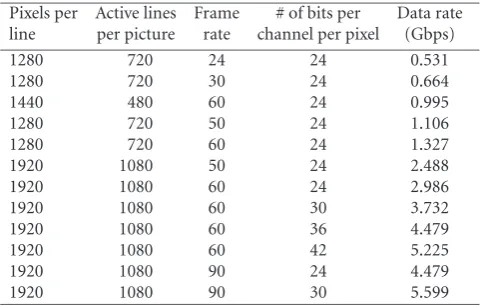
Depending on the progressive scan resolution and num-ber of pixels per line, the data rates required varies from several hundreds Mbps to few Gbps. The latest commer-cially available high definition television (HDTV) resolution is 1920 1080 with refresh rate of 60 Hz. Considering RGB video formats with 8 bits per channel per pixel, the required data rates turns out to be approximately 3 Gbps. In the fu-ture, a higher number of bits per channel as well as higher refresh rates are expected to improve the quality of next gen-eration HDTV. This easily scales the data rate to well be-yond 5 Gbps. Table 2 summarizes data rates requirements for some current and future HDTV specifications. Further-more, uncompressed HD streaming is an asymmetry trans-mission with significantly different data flow in both up-link and downup-link directions. This application also requires very low latency of tens of microseconds and very low er-ror probability down to 10 12to ensure high quality video. Table 3recapitulates the key requirements for uncompressed HD video streaming as well as outlines the large scale param-eters for home environment and conference room within an office environment [21], which this application is mainly de-ployed.
Table2: Data rate requirements for different resolutions, frame rates, and numbers of bits per channel per pixel for HDTV stan-dard.
Pixels per Active lines Frame # of bits per Data rate line per picture rate channel per pixel (Gbps)
1280 720 24 24 0.531
1280 720 30 24 0.664
1440 480 60 24 0.995
1280 720 50 24 1.106
1280 720 60 24 1.327
1920 1080 50 24 2.488
1920 1080 60 24 2.986
1920 1080 60 30 3.732
1920 1080 60 36 4.479
1920 1080 60 42 5.225
1920 1080 90 24 4.479
1920 1080 90 30 5.599
4. FEASIBILITY STUDY
In this section, we perform a basic feasibility study on the 60 GHz radio technology. The study is based on the applica-tion scenarios described inSection 3for the uncompressed HD video streaming. We begin by analyzing the achievable Shannon capacity for an omni-directional antenna at both sides of the transmitter (Tx) and receiver (Rx). Then, we determine what is the minimum gain required in order to operate under certain environment and target specifications. The analysis also considers the effect of multipath and inves-tigates the role of antenna to provide sufficient power margin for 60 GHz wireless communications. Unless otherwise spec-ified, the parameters inTable 4are assumed in our analysis.
4.1. Power margin
Using the above parameters, one can compute the ratio of signal power to noise power at the Rx as given by
SNR=PT+GT+GRPL0PL(d)IL
KT+ 10 log10(B)NF
, (1)
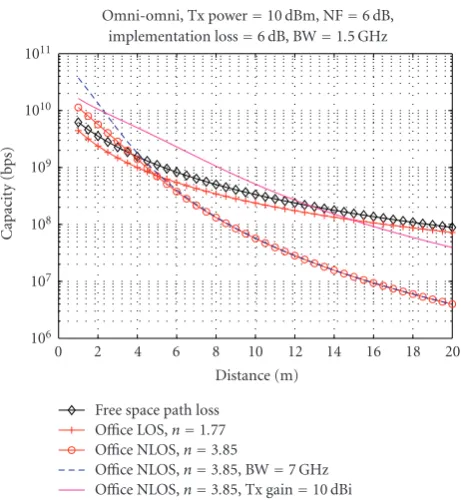
whereGT andGRdenote the transmit and received antenna gain, respectively. Inserting (1) into the well-known Shannon capacity formula, that is,C=Blog2(SNR +1), the maximum achievable capacity in AWGN can be computed. Figure 2
shows the Shannon capacity limit for indoor office in LOS and non-LOS (NLOS) case using omni-omni antenna setup. It can be observed that for LOS condition, a 5 Gbps data rates is impossible at any distance. On the other hand, the oper-ating distance for NLOS condition is limited to below 3 m though the capacity for NLOS decreases more drastically as a function of distance. To improve the capacity for a given operating distance, one can either increase the bandwidth or signal-to-noise ratio (SNR) or both. It can also be seen from
Table3: Key requirements for uncompressed HD video streaming application and the large scale fading parameters for conference room and home environment, respectively.
Applications Data Rate BER Data type Environment n Shadowing Ref
Uncompressed
Table4: Parameters used in the analysis.
Tx Power, PT 10 dBm
Center frequency, fc 60 GHz
Noise figure, NF 6 dB
Implementation loss, IL 6 dB Thermal noise, N 174 dBm/MHz
Bandwidth, B 1.5 GHz
Distance 20 m
Pah loss at 1 m, PL0 57.5 dB
the SNR at the Rx is reduced considerably at longer distance due to higher path loss. On the other hand, the overall capac-ity over the considered distance increases notably if a 10 dBi transmit antenna gain is employed as compared to the omni-directional antenna for both 1.5 GHz and 7 GHz bandwidths. This clearly shows the importance of antenna gain in provid-ing a very high data application at 60 GHz which is not pos-sible to be provided with omni-omni antenna configuration. But the question remains, how much gain is required?
To answer that question, the capacity as a function of combined Tx and Rx gain for operating distance at 20 m is plotted as depicted inFigure 3. To achieve 5 Gbps at 20 m, a combined gain of 25 dBi and 37 dBi are required for LOS and NLOS, respectively. This seems to be practical value since it is a combined Tx and Rx gain. However, to achieve the same data rates in multipath channel, higher gain is needed to overcome the fading margin. Now consider what addi-tional gains are required in a more realistic scenario where the propagation channel is corrupted by multipath fading in-stead of AWGN. To ease the analysis, we use the closed-form bit error probability (BEP) results for the noncoherent binary frequency-shift keying (BFSK) [22]. Specifically, we use
Pb= 1 +K
where K and γb are the Ricean K-factor and the average energy-per-bit-to-noise ratio, respectively. Equation (2) can be reduced to the case of Rayleigh fading whenK = 0 and simultaneously approximates the AWGN case whenK.
Clearly fromFigure 4, one can see that for uncoded sys-tem, the required additional combined Tx-Rx gain becomes prohibitively impractical in order to achieve BEP of 10 12in
Ricean and Rayleigh fading channels, respectively, over the AWGN case. Thus, coded systems, diversity systems or/and
20
Figure2: Shannon capacity limits for the case of indoor office using omni-omni antenna setup.
high gain antenna systems have to be used in order to reduce the fading margin associated with the multipath channel. For diversity technique employing maximum ratio combining in a flat Rayleigh fading channel, the BEP for uncoded BFSK can be expressed as [22]
whereLis the number of diversity channels that are assumed to be statistically independent Rayleigh fading andμis given as
μ= γc
γc+ 2, (4)
where γc is the average SNR per channel. As shown in
80
Figure3: The required combined Tx-Rx antenna gain to achieve a target capacity.
practice these gains are expected to be much lower as chan-nel is not independent and identical distributed and subject to fading correlation. Similarly, the use of channel coding can improve the BEP significantly over the uncoded case. In our example, the use of Golay (24,12) code (with Hamming dis-tancedmin = 8) is shown to have coding gain of approxi-mately 92 dB over the single channel Rayleigh fading case.
For the cases discussed above, to achieve 5 Gbps data rate at BEP of 10 12, in the case of Rayleigh fading channel and
assuming that bandwidth is equal to the data rate, one can compute the power margin as the difference between the re-ceivedEb/N0 over the requiredEb/N0 to achieve the target BEP. The power margin for the case of Rayleigh channel with coding and diversity as well as AWGN can be shown to be given by
MRay Coded=GT+GR61,
MRay Div=GT+GR73,
MAWGN=GT+GR37.
(5)
For high quality video transmission link at 60 GHz, a suffi -ciently large link margin is required due to the highly vari-able shadowing and human blockage effects. Experiments show that the shadowing effect is log-normally distributed with zero mean and standard deviation as high as 7–10 dB [23, 24]. On the other hand, the effect of human block-age varies between 18–36 dB [25,26]. Assuming a margin of 10 dB is required, then the required combined Tx-Rx gain for the three cases given in (5) are 71 dB, 83 dB, and 47 dB, respectively. From the regulatory standpoint, we see that the maximum transmit antenna gain that is allowed for a Tx
120
Uncoded, 2 indepent Rayleigh channels Uncoded, 4 indepent Rayleigh channels AWGN
Figure4: The BEP for the case of uncoded, coded, and diversity systems in Rayleigh fading channel.
power of 10 dBm is 33 dBi. This sets the Rx gain to be very high, namely, 38 dBi, 50 dBi, and 14 dBi, respectively, for the three cases considered above.
4.2. The role of antenna
For a single antenna element with antenna gain more than 30 dBi with half power beamwidth (HPBW) of approxi-mately 6.5Æ
, a reliable communication link is difficult to es-tablish even in LOS condition at 60 GHz. This is due to the human blockage which can easily block and attenuate such a narrowbeam signal. To overcome this problem, a switched beam antenna array or adaptive antenna array is required to search and beamform to the available signal path. The ar-ray is subsequently required to track the signal path period-ically. One might be interested to know how many antenna elements are required to achieve the intended antenna gain. This is different from the array gain which referred to the per-formance improvement in terms of SNR over single antenna. On the other hand, the gain of the antenna array can be de-scribed by the product of the directivity of the array with the efficiency of the antenna array. The directivity of the linear array is given by [27]
D= 4π
Fn(φ,θ)2sinθ dθ, (6)
2
10 element ULA with element power pattern cosm(θ)
m=1 m=5 m=10
m=20 Isotropic
Figure5: The antenna array gain as a function of antenna spacing for 10 elements ULA with different element gains.
array (ULA), the normalized array factor can be expressed as
fn(φ,θ)= sin
(N/2)(kdcosθ+β)
Nsin(1/2)(kdcosθ+β), (7)
where N, d, and β are the number of antenna elements, antenna spacing between two adjacent elements, and phase shift, respectively. For omni-directional antenna, it can be shown that up to 100 elements are required to achieve only 23 dBi gain which is far from the required specification shown previously. Hence a more directive element is required to improve the overall gain of the array. As shown inFigure 5, to achieve a 40 dBi gain, 10 elements ULA with 16 dBi ele-ment spaced aroundλ/2 is required.
5. TECHNICAL CHALLENGES
Despite many advantages offered and high potentials appli-cations envisaged in 60 GHz, there are number of technical challenges and open issues that must be solved prior to the successful deployment of this technology. These challenges can be broadly classified into channel propagation issues, an-tenna technology, RF solution, and choice of modulation.
Channel propagation
Although many channel measurements and modeling ef-fort have been reported in the literature for various fre-quency range such as the 5 GHz WLAN band [28–30] and 3–10 GHz UWB band [31–39], there are still lack of chan-nel measurements and modeling effort for the frequency range at 60 GHz. In general, the path loss at 60 GHz is sig-nificantly higher than those at lower frequencies. This is also true for transmission loss at 60 GHz for many materials
[23,24,40,41]. The higher path loss and transmission loss at 60 GHz effectively limits the operation to one room. In order to have wider coverage, relays or regenerative repeaters are required. Furthermore, as described inSection 4, the use of high gain antenna is necessary to compensate the high path loss incurred, and the use of this single high gain antenna is only feasible if clear LOS condition is always guaranteed. In scenario where clear LOS is not guaranteed due to, for ex-ample, a movement of human, the antenna arrays solution becomes highly desirable. Unfortunately, there is no specific channel model at 60 GHz that sufficiently addresses the spa-tial properties and effect of human movement. Recent con-tributions which measured the angle of arrival of the received signal using antenna array [42] and rotational of directive an-tenna [43] show that an angle spread of approximately 14Æ
in corridor and desktop environment, respectively. However, more measurements are required to further characterize and validate these results.
Furthermore, all of the channel models available areradio channelwhich are antenna dependent and are only valid for the particular antenna setups used in the measurement. To overcome this limitation, apropagation channelis required which excludes the effects of antenna [44] and allows the in-vestigation of the effects of different type of antenna setups with different gain/beamwidth on the 60 GHz system perfor-mance. This is very important as measurements and ray trac-ings have shown that the use of high gain antenna can signif-icantly reduce the delay spread of the radio channel when the Tx and Rx antennas are aligned [45]. However, a detrimental effect would be resulted for a slight pointing error of the main lobe of the antenna offthe direction of arrival of the signal [46,47]. In addition, measurements also demonstrated the effects of multipath suppression using circular polarization over linear polarization [48], but more extensive measure-ments are needed to affirm these results and to what extent this suppression occurs at 60 GHz.
Antenna technology
Many types of antenna structures are considered not suit-able for 60 GHz WPAN/WLAN applications due to the re-quirements for low cost, small size, light weight, and high gain. In addition, 60 GHz antennas also require to be oper-ated with approximately constant gain and high efficiency over the broad frequency range (57–66 GHz). The impor-tance of beamforming at 60 GHz has been discussed in
Section 4, which can be achieved by either switched beam arrays or phase arrays. Switched beam arrays have multiple fixed beams that can be selected to cover a given service area. It can be implemented much easier compared to the phase arrays which required the capability of continuously varying the progressive phase shift between the elements. The com-plexity of phase arrays at 60 GHz typically limits the num-ber of elements. In [49], a 2 2 beam steering antenna with circular polarization at 61 GHz is developed. The gain is ap-proximately 14 dBi with 20Æ
channels. The implementation of larger phase array, how-ever, presents some technical challenges such as requirement for higher feed network loss, more complex phase control network, stronger coupling between antennas as well as feed-lines, and so forth. These challenges make the design and fabrication of the larger phase arrays become more complex and expensive. Hence, more research are required to develop a low cost, small size, light weigh, and high gain steerable antenna array that can be integrated into the RF front end electronics.
Integrated circuit technology
The choice of integrated circuit (IC) technology depends on the implementation aspects and system requirements. The former is related to the issues such as power consumption, efficiency, dynamic range, linearity requirements, integration level, and so forth, while the later is related to the trans-mission rate, cost and size, modulation scheme, transmit power, bandwidth, and so forth. At mmWave, there are three competing IC technologies, namely: (1) group III and IV semiconductor technology such as Gallium Arsenide (GaAs) and Indium Phosphide (InP); (2) Silicon Germanium (SiGe) technology such as HBT and BiCMOS; and (3) Silicon nology such as CMOS and BiCMOS. There is no single tech-nology that can simultaneously meet all the objectives de-fined in the technical challenges and system requirements. For example, GaAs technology allows fast, high gain, and low noise implementation but suffers poor integration and ex-pensive implementation. On the other hand, SiGe technol-ogy is a cheaper alternative to the GaAs with comparable per-formance. In [51], the first mmWave fully antenna integrated SiGe chip has been demonstrated.
Typically, as have been witnessed in the past, for broad market exploitation and mass deployment, the size and cost are the key factors that drive to the success of a particu-lar technology. In this regard, CMOS technology appears to be the leading candidate as it provides low-cost and high-integration solutions compared to the others at the expense of performance degradation such as low gain, linearity con-straint, poor noise, lower transit frequency, and lower maxi-mum oscillation frequency. Recent advances in CMOS tech-nology [52] have demonstrated the feasibility of bulk CMOS process at 130 nm for 60 GHz RF building blocks, active and passive elements. More future research and investigations in developing a fully integrated CMOS chip solution have to be performed. Future technology should also aim at 90 nm and 65 nm CMOS processes in order to further improve the gain and lower power consumption of the devices.
Modulation schemes
The choice of modulation schemes for 60 GHz radio will be highly dependent on the propagation channel, the use of high gain antenna/antenna array, and the limitations imposed by the RF technology. For instance, if the delay spread of the underlying propagation channel is high, then an orthogo-nal frequency division multiplexing (OFDM) is an obvious
choice of modulation since OFDM can effectively turn the frequency selective channel into flat fading channel by divid-ing the high-rate stream into a set of parallel lower rate sub-streams. This simplifies the equalization technique for multi gigabit wireless system. On the other hand, high gain or cir-cular polarized antenna systems can be used to significantly reduce the effect of multipath and therefore will favor simple modulation such as single carrier to save power consumption and cost.
Typically, in CMOS circuit implementation, the 60 GHz power amplifier has lower power and higher linearity re-quirement. This implies that the use of simple modulation than the OFDM system which suffers large peak-to-average ratio (PAPR) and can greatly reduce the efficiency of the power amplifier. Furthermore, the poor phase noise charac-teristic of 60 GHz CMOS also restricts the use of higher order modulation for quadrature amplitude modulation (QAM), phase shift keying (PSK), and frequency shift keying (FSK) to less than 16 QAM/16 PSK/16 FSK. The use of lower order modulation is also motivated by the huge unlicensed band-width available at 60 GHz. Hence, the choice of modulation is clearly a tradeoffof a number of issues which need to be well understood and characterized before a robust modula-tion scheme can be sought.
6. CONCLUSION
In this paper, an overview of the 60 GHz technology is pre-sented. The huge unlicensed bandwidth coupled with higher allowable transmit power, small form factor, and advances in integrated circuit technology have made 60 GHz a very promising candidate for multigigabit applications. Intense efforts are underway to expedite the commercialization of this fascinating technology from standardization activities, industrial alliances and regulatory bodies. A simple feasi-bility study on wireless uncompressed video streaming on HDTV using realistic parameters revealed the roles of an-tenna in establishing a reliable 60 GHz communication link. The importance of antenna system are to provide suffi -cient power margin through array gain as well as to beam-form the signal to other significant paths in case of hu-man blockage of the main path. Despite the clear advan-tages of 60 GHz system, a number of open issues and tech-nical challenges have yet to be fully addressed. The propaga-tion and implementapropaga-tion issues are the two aspects that re-quire further optimization and research in order to obtain a truly efficient and low cost 60 GHz communication sys-tem.
REFERENCES
[1] A. D. Oliver, “Millimeter wave systems - past, present and fu-ture,”IEE Proceedings, vol. 136, no. 1, pp. 35–52, 1989. [2] http://www.ieee802.org/15/pub/TG3c.html.
[3] S. K. Yong, “Multi gigabit wireless through millimeter wave in 60 GHz band,” inProceedings of Wireless Conference Asia, Singapore, November 2005.
[5] C.-C. Chong, F. Watanabe, and H. Inamura, “Potential of UWB technology for the next generation wireless communi-cations,” inProceedings of IEEE 9th International Symposium on Spread Spectrum Techniques and Applications (ISSSTA ’06), pp. 422–429, Manaus, Amazon, Brazil, August 2006.
[6] FCC, “Code of Federal Regulation, title 47 Telecommunica-tion, chapter 1, part 15.255,” October 2004.
[7] Spectrum Management Telecommunications, “Radio Stan-dard Specification-210, Issue 6, Low-Power Licensed-Exempt Radio Communication Devices (All Frequency Bands): Cate-gory 1 Equipment,” September 2005.
[8] Regulations for enforcement of the radio law 6-4-2 specified low power radio station (11) 59-66GHz band.
[9] ACMA, “Radiocommunications (Low Interference Potential Devices) Class License Variation 2005 (no. 1),” August 2005. [10] Ministry of Information Communication of Korea,
“Fre-quency Allocation Comment of 60 GHz Band,” April 2006. [11] ETSI DTR/ERM-RM-049, “Electromagnetic compatibility
and Radio spectrum Matters (ERM); System Reference Doc-ument; Technical Characteristics of Multiple Gigabit Wireless Systems in the 60 GHz Range,” March 2006.
[12] Korean Frequency Policy & Technology Workshop, Session 7, pp. 13–32, November 2005.
[13] CEPT Recommendation T/R 22-03, “Provisional recom-mended use of the frequency range 54.25-66 GHz by ter-restrial fixed and mobile systems,” in Proceedings of Euro-pean Postal and Telecommunications Administration Collection (CEPT ’90), pp. 1–3, Athens, Greece, January 1990, http:// www.ero.dk/documentation/.
[14] ERC Recommendation 12-09, “Radio Frequency Channel Ar-rangement for Fixed Service Systems Operating in the Band 57.0 - 59.0 GHz Which Do Not Require Frequency Planning, The Hague 1998 revised Stockholm,” October 2004.
[15] ECC Recommendation (05)02, “Use of the 64-66 GHz Fre-quency Band for Fixed Services,” June 2005.
[16] IEEE Standard 802.16 2001, “IEEE Standard for Local and Metropolitan Area Networks—Part 16 - Air Interface for Fixed Broadband Wireless Access Systems,” 2001.
[17] ARIB STD-T69, “Millimeter-Wave Video Transmission Equipment for Specified Low Power Radio Station,” July 2004. [18] ARIB STD-T69, “Millimeter-Wave Data Transmission Equip-ment for Specified Low Power Radio Station (Ultra High Speed Wireless LAN System),” May 2001.
[19] R. Roberts, “WiMedia 60 GHz Study Group,” IEEE 802.15-05-0248-00-003c, Jacksonville, Fla, USA, May 2006.
[20] A. Sadri, “802.15.3c Usage Model Document,” IEEE 802.15-06-0055-14-003c, Jacksonville, Fla, USA, May 2006.
[21] S. K. Yong, “TG3c Channel Modeling Sub-Committee Final Report (Draft),” IEEE 802.15-06-0195-02-003c, Jacksonville, Fla, USA, May 2006.
[22] M. K. Simon and M. S. Alouini,Digital Communication over Fading Channels, Wiley-IEEE Press, New York, NY, USA, 2nd edition, 2004.
[23] M. Fiacoo and S. Saunders, “Final report for OFCOM - indoor propagation factors at 17 GHz and 60 GHz,” August 1998. [24] C. R. Anderson and T. S. Rappaport, “In-building wideband
partition loss measurements at 2.5 and 60 GHz,”IEEE Trans-actions on Wireless Communications, vol. 3, no. 3, pp. 922–928, 2004.
[25] S. Collonge, G. Zaharia, and G. E. Zein, “Influence of the hu-man activity on wide-band characteristics of the 60 GHz in-door radio channel,”IEEE Transactions on Wireless Communi-cations, vol. 3, no. 6, pp. 2396–2406, 2004.
[26] P. F. M. Smulders,Broadband wireless LANs: a feasibility study, Ph.D. thesis, Eindhoven University of Technology, Eindhoven, The Netherlands, 1995.
[27] C. A. Balanis,Antenna Theory: Analysis and Design, John Wiley & Sons, New York, NY, USA, 2nd edition, 1997.
[28] C.-C. Chong, C.-M. Tan, D. I. Laurenson, S. McLaughlin, M. A. Beach, and A. R. Nix, “A new statistical wideband spatio-temporal channel model for 5-GHz band WLAN systems,” IEEE Journal on Selected Areas in Communications, vol. 21, no. 2, pp. 139–150, 2003.
[29] C.-C. Chong, D. I. Laurenson, and S. McLaughlin, “Spatio-temporal correlation properties for the 5.2-GHz indoor prop-agation environments,”IEEE Antennas and Wireless Propaga-tion Letters, vol. 2, no. 1, pp. 114–117, 2003.
[30] C.-C. Chong, C.-M. Tan, D. I. Laurenson, S. McLaughlin, and M. A. Beach, “A novel wideband dynamic directional indoor channel model based on a Markov process,”IEEE Transac-tions on Wireless CommunicaTransac-tions, vol. 4, no. 4, pp. 1539–1552, 2005.
[31] M. Z. Win and R. A. Scholtz, “On the robustness of ultra-wide bandwidth signals in dense multipath environments,” IEEE Communications Letters, vol. 2, no. 2, pp. 51–53, 1998. [32] M. Z. Win and R. A. Scholtz, “On the energy capture of
ultra-wide bandwidth signals in dense multipath environments,” IEEE Communication Letters, vol. 2, no. 9, pp. 245–247, 1998. [33] R. J. Cramer, R. A. Scholtz, and M. Z. Win, “An evaluation of
the ultra-wideband propagation channel,”IEEE Transactions on Antennas and Propagation, vol. 50, no. 5, pp. 561–570, 2002. [34] D. Cassioli, M. Z. Win, and A. F. Molisch, “The ultra-wide bandwidth indoor channel: from statistical model to simu-lations,”IEEE Journal on Selected Areas in Communications, vol. 20, no. 6, pp. 1247–1257, 2002.
[35] M. Z. Win and R. A. Scholtz, “Characterization of ultra-wide bandwidth wireless indoor channels: a communication-theoretic view,”IEEE Journal on Selected Areas in Communica-tions, vol. 20, no. 9, pp. 1613–1627, 2002.
[36] C.-C. Chong and S. K. Yong, “A generic statistical-based UWB channel model for high-rise apartments,”IEEE Transactions on Antennas and Propagation, vol. 53, no. 8, pp. 2389–2399, 2005. [37] C.-C. Chong, Y.-E. Kim, S. K. Yong, and S.-S. Lee, “Statistical characterization of the UWB propagation channel in indoor residential environment,”Wireless Communications and Mo-bile Computing, vol. 5, no. 5, pp. 503–512, 2005.
[38] C.-C. Chong, “UWB channel modeling and impact of wide-band channel on system design,” inUWB Wireless Communi-cations, H. Arslan and Z. N. Chen, Eds., chapter 8, John Wiley & Sons, New York, NY, USA, 2006.
[39] A. F. Molisch, D. Cassioli, C.-C. Chong, et al., “A comprehen-sive standardized model for ultrawideband propagation chan-nels,”IEEE Transactions on Antennas and Propagation, vol. 54, no. 11, pp. 3151–3166, 2006.
[40] E. J. Violette, R. H. Espeland, R. O. DeBolt, and F. K. Schw-ering, “Millimeter-wave propagation at street level in an ur-ban environment,”IEEE Transactions on Geoscience and Re-mote Sensing, vol. 26, no. 3, pp. 368–380, 1988.
[41] B. Langen, G. Lober, and W. Herzig, “Reflection and transmis-sion behaviour of building materials at 60GHz,” inProceedings of the 5th IEEE International Symposium on Personal, Indoor and Mobile Radio Communications (PIMRC ’94), vol. 2, pp. 505–509, The Hague, Netherlands, September 1994.
Indoor and Mobile Radio Communications (PIMRC ’05), vol. 1, pp. 599–603, Berlin, Germany, September 2005.
[43] C. S. Liu, et al., “NICTA Indoor 60 GHz Channel Measure-ments and Analysis update,” IEEE 802.15-06-222-00-003c, Jacksonville, Fla, May 2006.
[44] M. Steinbauer, A. F. Molisch, and E. Bonek, “The double-directional radio channel,” IEEE Antennas and Propagation Magazine, vol. 43, no. 4, pp. 51–63, 2001.
[45] H. Yang, P. F. M. Smulders, and M. H. A. J. Herben, “Fre-quency selectivity of 60 GHz LOS and NLOS indoor radio channels,” inProceedings of IEEE Vehicular Technology Confer-ence (VTC ’06), Melbourne, Australia, May 2006.
[46] M. R. Williamson, G. E. Athanasiadou, and A. R. Nix, “In-vestigating the effects of antenna directivity on wireless in-door communication at 60GHz,” inProceedings of IEEE In-ternational Symposium on Personal, Indoor and Mobile Radio Communications (PIMRC ’97), vol. 2, pp. 635–639, Helsinki, Finland, September 1997.
[47] T. Manabe, Y. Miura, and T. Ihara, “Effects of antenna direc-tivity and polarization on indoor multipath propagation char-acteristics at 60 GHz,”IEEE Journal on Selected Areas in Com-munications, vol. 14, no. 3, pp. 441–448, 1996.
[48] T. Manabe, K. Sato, H. Masuzawa, et al., “Polarization depen-dence of multipath propagation and high-speed transmission characteristics of indoor millimeter-wave channel at 60 GHz,” IEEE Transactions on Vehicular Technology, vol. 44, no. 2, pp. 268–274, 1995.
[49] K.-C. Huang and Z. Wang, “Millimeter-wave circular polar-ized beam-steering antenna array for gigabit wireless com-munications,”IEEE Transactions on Antennas and Propagation, vol. 54, no. 2, part 2, pp. 743–746, 2006.
[50] J.-Y. Park, Y. Wang, and T. Itoh, “A 60 GHz integrated an-tenna array for high-speed digital beamforming applications,” inProceedings of IEEE MTT-S International Microwave Sympo-sium Digest, vol. 3, pp. 1677–1680, Philadelphia, Pa, USA, June 2003.
[51] B. Gaucher, “Completely Integrated 60 GHz ISM Band Front End Chip Set and Test Results,” IEEE 802.15-15-06-0003-00-003c, Big Island, Hawaii, USA, January 2006.