Volume 2006, Article ID 47453, Pages1–19 DOI 10.1155/WCN/2006/47453
Static and Dynamic 4-Way Handshake Solutions to Avoid
Denial of Service Attack in Wi-Fi Protected Access
and IEEE 802.11i
Floriano De Rango, Dionigi Cristian Lentini, and Salvatore Marano
Department of Electronics Informatics and Systems (D.E.I.S.), University of Calabria, Via P. Bucci, 87036 Rende, Cosenza, Italy
Received 10 October 2005; Revised 2 April 2006; Accepted 13 June 2006
This paper focuses onWPAandIEEE 802.11iprotocols that represent two important solutions in the wireless environment. Sce-narios where it is possible to produce aDoS attackandDoS floodingattacks are outlined. The last phase of the authentication process, represented by the4-way handshakeprocedure, is shown to be unsafe from DoS attack. This can produce the undesired effect of memory exhaustion if a flooding DoS attack is conducted. In order to avoid DoS attack without increasing the complexity of wireless mobile devices too much and without changing through some further control fields of the frame structure of wireless security protocols, a solution is found and an extension of WPA and IEEE 802.11 is proposed. A protocol extension with three “static” variants and with a resource-aware dynamic approach is considered. The three enhancements to the standard protocols are achieved through some simple changes on the client side and they are robust against DoS and DoS flooding attack. Advantages introduced by the proposal are validated by simulation campaigns and simulation parameters such as attempted attacks, success-ful attacks, and CPU load, while the algorithm execution time is evaluated. Simulation results show how the three static solutions avoid memory exhaustion and present a good performance in terms of CPU load and execution time in comparison with the stan-dard WPA and IEEE 802.11i protocols. However, if the mobile device presents different resource availability in terms of CPU and memory or if resource availability significantly changes in time, a dynamic approach that is able to switch among three different modalities could be more suitable.
Copyright © 2006 Floriano De Rango et al. This is an open access article distributed under the Creative Commons Attribution License, which permits unrestricted use, distribution, and reproduction in any medium, provided the original work is properly cited.
1. INTRODUCTION
One of the greatest challenges to any organisation is secur-ing its data against unauthorised access, particularly those organisations that use wireless network technologies to man-age information.
Wireless networks offer organisations and user benefits such as portability, flexibility, increased productivity, and lower installation costs. However, risks are inherent in any technology. Some of the wireless risks are similar to those of wired networks, some are exacerbated, and some are new.
The most significant source of risks in wireless networks is the use of radio waves to transmit data. Radio waves move through the air and can be intercepted by any attacker with the appropriate equipment.
Security measures prevent and reduce the risk of unau-thorised access into wireless network resources. On the other hand, these measures can reduce productivity, by creating additional processes and work.
protocols to be used and to avoid the possible issues of DoS attacks. Simulation results show the benefits introduced by these static solutions in terms of CPU and memory load. However, as experienced by simulation results, the best solu-tion does not exist if one of these static approaches are used because mobile-devices can present different characteristics and resource availability. Thus, a dynamic resource-oriented approach is proposed (solution IV). This approach tries to take full advantage of the single solutions through a dynamic thresholds mechanism that is able to switch among the three previously analysed solutions. In order to implement this mechanism, just some modifications to the mobile device need to be performed such as a monitoring software that is able to account for the current CPU and memory load and a switching center that permits the 4-way handshake messages exchange modality to be changed in accordance with solu-tions I, II, and III.
The paper is organised as follows:Section 2presents a brief overview of the work related to the security of wire-less LAN; WPA and IEEE 802.11i are presented inSection 3; the 4-way handshake is introduced in Section 4;Section 5 presents some DoS and DoS flooding attack scenario dur-ing the 4-way handshake phase of the WPA/IEEE 802.11i; in Section 6three static solutions to avoid DoS attacks are presented (two of them have been qualitatively and without simulations considered in [8,9]) and a fourth dynamic so-lution is proposed; FSA modelling is reported inSection 7; Section 8presents the simulation results; finally the conclu-sions are summarised in the last section.
2. RELATED WORK
In the last few years the attention of industry and the aca-demic world has been focused on security protocols over wireless networks and specifically on WLAN. A lot of au-thentication protocols, in particular EAP (extension access protocol), such as transport layer security (TLS), MD5, tun-nelled TLS (TTLS), light extensive access protocol (LEAP), protected EAP (PEAP), SecureID, SIM, GTC, and AKA have been proposed in the literature [10].
In order to offer data confidentiality equivalent to a wired network, the IEEE 802.11 standard [11] defined wired equiv-alent privacy (WEP). However, numerous researchers have shown that none of the data confidentiality, integrity, and au-thentication could be achieved through the intrinsic mecha-nism of this protocol [7,12].
WEP is based on a cryptography system that was alleged to offer privacy, authentication, and integrity.
A secret key K of 40 bits is shared by APs and clients of the wireless network and it is queued at an initialisation vec-tor (IV) of 24 bits. The string, obtained by this process, is encrypted by RC4 in order to obtain the encoding key (key stream) of messages in clear.
The authentication process is onlyone-way(client-side). This means that only the client needs to be authenticated by the AP and not vice versa. This behaviour does not give guar-antees about the network that the client is referring to.
WEP uses the RC4 algorithm that is well known to be un-safe if the same keys are used several times in it. The
initialisa-tion vector, applied to the RC4, is 24 bits and this determines the repetition of the keys after a while permitting a known-plaintextattack [13]. A further characteristics of WEP is the restarting of VI (or IV) if a packet collision occurs.
Another issue of WEP protocol is the manual distribu-tion of keys over all AP stadistribu-tions. In this key management scheme, all clients of the same basic service set (BSS) use the same key, thereby reducing the privacy of the other users.
The authentication phase is not very safe because it makes use of the same key as the encryption in input to RC4 to authenticate the client. Another bad use of the mechanisms in WEP protocol is the integrity check through the CRC-32 algorithm. Cyclic redundancy check (CRC) is a noncryptographic function f that has the linearity property. This means that the function f is linear if f(a)XOR f(b)=
f(aXORb). Details of CRC techniques can be found in [4]. This linearity property can be used by the hackers to vio-late the integrity of packets.
All these security issues were analysed by the inter-net security, applications, authentication, and cryptography (ISAAC) of University of California and then, by three people (Fhurer et al.) in a famous paper [14]. The failure of WEP is due to the choice of the project managers in the security ar-chitecture deployment.
Although WEP fails to satisfy any security requirements, it is not practical to anticipate users to completely discard their devices with WEP already implemented. Hence, Wi-Fi alliance proposed interim solution, called protected ac-cess (WPA), to ameliorate the vulnerabilities by reusing the legacy hardware. WPA adopts a temporal key integrity pro-tocol (TKIP) for data confidentiality and the Michael algo-rithm, a weak keyed message integrity code (MIC), for im-proved data integrity under the limitation of the computa-tion power available in the devices. Moreover, in order to detect replayed packets, WPA implements a packet sequenc-ing mechanism by bindsequenc-ing a monotonically increassequenc-ing se-quence number to each packet. In addition, WPA provides two improved authentication mechanisms. For more details about WPA, see [1]. Despite these security enhancements of WPA, a weakness is predestined since WPA appears ow-ing to the limitations of reusow-ing the legacy hardware. Al-though TKIP key-mixing function has stronger security than WEP key-scheduling algorithm, it is not so strong as ex-pected [15]. Moreover, Michael algorithm is designed to pro-vide only 20 bits (or possibly slightly more) of security in order to minimise the impact on the performance, which means an adversary can construct one successful forgery ev-ery 219 packets. Some countermeasures have been adopted
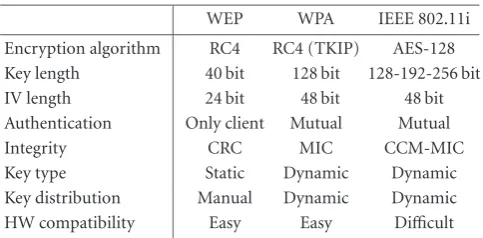
Table1: Comparison of WEP, WPA, and IEEE802.11i features.
WEP WPA IEEE 802.11i
Encryption algorithm RC4 RC4 (TKIP) AES-128 Key length 40 bit 128 bit 128-192-256 bit
IV length 24 bit 48 bit 48 bit
Authentication Only client Mutual Mutual
Integrity CRC MIC CCM-MIC
Key type Static Dynamic Dynamic
Key distribution Manual Dynamic Dynamic
HW compatibility Easy Easy Difficult
performed to mutually authenticate the devices and generate a fresh session key for data transmissions. However, also the IEEE 802.11i can present some weakness to possible DoS at-tacks such as shown by the authors in [8,9]. This paper start-ing from the He and Mitchell’s work focuses on the 4-way handshake procedure giving some implementation guide to simulate the DoS attacks on the WLAN networks and show-ing the performance degradations when DoS or DoS flood-ing attacks are led to the mobile devices. Moreover, a variant with memory release and a dynamic approach that tries to combine the different solutions analysed in this paper is pro-posed. In the following a brief overview of WPA and IEEE 802.11i and 4-way handshake will be given.
3. OVERVIEW OF WPA AND IEEE 802.11i
When the security bugs of WEP were outlined, it was clear that the big issue was to find a right solution to the security in a short time as possible.
Wi-Fi alliance and the IEEE 802.11i agree with the need to develop a novel standard, able to overcome all the security bugs. This standard was the IEEE 802.11i [6]. However, this novel protocol would have caused an incompatibility with 200 million wireless devices around the world. Thus in order to resolve WEP bugs and to offer backward compatibility and a migration toward the IEEE 802.11i, the Wi-Fi protected ac-cess (WPA) has been proposed. Even if in June 2004 the more complete IEEE 802.11i was released; WPA represents till now the most used security standard. It resolves WEP bugs and offers a light-weight transition toward more complex secu-rity protocol such as 802.11i.
WPA arose as a solution to WEP inconsistency and it is considered one of the best security dynamic protocols; the novel standard IEEE 802.11i is also calledWPA2[16].
Differently from the WEP,Wi-Fi protected access(WPA) implements a set of functions calledrobust security network association (RSNA) that offers a greater security level, au-thentication, and integrity check functions.
For data encryption, WPA uses the defaulttemporary key integrity protocol(TKIP), maintaining backward compatibil-ity through further WEP support.
TKIP makes four distinct enhancements to WEP (Table 1). Firstly, it increases the IV size from 24 to 48 bits, meaning that key reuse is no longer a worry. Secondly, it forces the sequence number to increase monotonically to
End device 802.1X supplicant
E.g. RAS, 802.11 AP, ethernet, etc.
802.1X authenticator
Authenticator server (AS) AAA server
Figure1: Supplicant, authenticator, and authentication server in IEEE802.1X/EAP.
avoid replay. Thirdly, it mixes the sequence number and transmits the address with the WEP base key to derive a per-frame key. Finally, it includes a message authentication code (MIC) of the source and destination addresses, the priority, and the plaintext data, to allow forgeries to be detected.
Regarding the authentication phase, WPA has its strong point in the 802.1X/EAP architecture that offers mutual au-thentication between the AP and the client, the negotiation of the authentication scheme and dynamic key distribution (this avoids the manual configuration of the static key).
The 802.1X architecture provides three entities involved in the communication: the supplicant (S) that represents the client or the peer that asks for network access; the authen-ticator (A) that is the AP that offers the access service; the authentication server (AS) that is represented by the server that realises the authentication and the authorization phases toward the client such asremote authentication dial in user service(RADIUS), and DIAMETER [17,18] (seeFigure 1).
However, WPA permits the use, alternatively to the stan-dard authentication mode with 802.1X/EAP, of the preshared key (PSK) mode. This modality defines a preconfiguration of the secret key, set manually or through other agreements on devices, that had been introduced by WPA (and main-tained in 802.11i) in order to permit its use in small office home-based networks (SOHO) environment and in overall environments where it is not possible to use a structured and hierarchical structure such as RADIUS [17].
Three logically distinct subphases can be observed inside the 802.1X authentication phase:
(i) EAP initialising, (ii) EAP-TLS handshake, (iii) 4-way handshake.
In this work attention will be focused on the4-way handshake phase.
If WPA withpreshared key(PSK) is applied, the PMK will be equal to the PSK and the previous phases will be com-pletely jumped. From this point the server, through the send-ing of PMK, delegates A to do overall security functions to-ward S.
Once S and A share PMK, they can complete the authen-tication phase with the4-way handshake. This last sub-phase is the core of the key management scheme of the WPA pro-tocol. Starting from the common PMK, S and A are able to obtain thetemporary keythat is useful for the data encryp-tion. It is possible to get this temporary key without explic-itly exchanging it among the sides. The temporary key is one component of thepairwise transient key(PTK).
Specifically, the first 128 bits of the PTK is called session “key confirmation key” (KCK), which is used to prove pos-session of the PMK. The second 128 bits is the pos-session “key encryption key” (KEK), which is used to distribute the cur-rent broadcast key. The temporal key is the remaining bits of the PTK.
Through the 4-way handshake, 802.1X/EAP permits dif-ferent temporary keys to be obtained for each user, for each session, and also for each packet. In this way WPA resolves the security issue of WEP associated with the static keys and with the manual distribution of these keys among partici-pants to protect communication; WPA permits configura-tion parameters to be negotiated, to generate a temporary key, and to change this key on the packet basis in a secure manner.
In 2004, the “IEEE Task Group i” released the final ver-sion of the IEEE 802.11i protocol. Because this protocol is based on RSNA architecture of WPA and it guarantees back-ward compatibility with WPA, it is also called WPA2 [6].
The main difference between WPA and IEEE 802.11i is the cryptography algorithm applied to data transmission. WPA uses TKIP (based on RC4), while 802.11i applies a novel protocol called CCMP (countermode with CBC-MAC protocol). The latter is based on AES. CCMP represents an extension of 802.11i because TKIP is still supported but it needs a change in the hardware architecture. CCMP im-proves the security level of wireless communication but it produces computational overhead needing hardware up-grading and new coprocessors able to manage the cryptog-raphy processing load in real time. On the contrary TKIP in WPA can be executed mostly by low-power processors that are supported in the overall existing APs and, moreover, TKIP reuses the WEP hardware to offload most of the com-putational expenses from the software.
Because WPA is light in comparison with WPA2, it better meets the needs of wireless devices (palmtop or other little devices) with few available resources. Another characteristic of WPA against WPA2 is the interoperability between IEEE 802.11b (but not only) and IEEE 802.11i devices. These rea-sons slow down the migration from WPA to WPA2.
4. THE 4-WAY HANDSHAKE
In previous sections we have focused on the interesting novel aspect of the authentication phase of WPA and 802.11i,
PMK
[AA, ANonce, SN, msg1] 1
[SPA, SNonce, SN, msg2, MICPTK(SNonce, SN, msg2)]
2
[AA, ANonce, SN+1, msg3, MICPTK(ANonce, SN+1, msg3)]
3
[SPA, SNonce, SN+1, msg4, MICPTK(SNonce, SN+1, msg4)]
4
Figure2: The 4-way handshake messages.
where it is possible to generate and dynamically distribute different temporary keys on session, user, and packet basis. This assures a high robustness against hacker attacks versus WEP. After 802.1X authentication is completed, 802.11i be-gins to secure the link by executing the 4-way handshake.
The 802.11i 4-way handshake procedure makes the fol-lowing steps.
(a) It derives a fresh session key (TKIP).
(b) Through transmission and receiver timers manage-ment and handshake messages it synchronises its op-erations.
(c) It distributes a broadcast key from the AP to the sta-tion.
(d) It verifies that peer is live.
(e) It confirms that peer possesses the station.
(f) It binds the MAC addresses of the station and AP to this key.
In the 4-way handshake only 4 types of messages are con-sidered and structured as follows (seeFigure 2):
(i) Msg 1: [AA, ANonce, SN, Msg1];
(ii) Msg 2: [SPA, SNonce, SN, Msg2, MIC(SNonce, SN, Msg2)];
(iii) Msg 3: [AA, ANonce, SN + 1, Msg3, MIC(ANonce, SN + 1, Msg3)];
(iv) Msg 4: [SPA, SNonce, SN + 1, Msg4, MIC(SNonce, SN + 1, Msg4)];
where
(1) AA represents the MAC address of AP (A) wireless card; (2) SPA is the MAC address of S wireless card;
(3) ANonce is a random value generated by A; (4) SNonce is a random value generated by S;
The protocol starts with the generation of a random bits string called “nonce.” This nonce is generated only once. At the beginning A generates this nonce (ANonce) and it puts this one inside the first message (Msg1) sent to S. After re-ceiving Msg1, S will know AA, SN, and Anonce. These values can be useful in the generation of PTK. S will produce a novel noncecalled SNonce that will be used with PMK and ANonce to generate the PTK in the following way:
PTK=PRF (PMK, ANonce, SNonce, AA, SPA), (1)
where PRF is a pseudorandom cryptographic function. After calculating PTK, S will store ANonce, SNonce, and PTK and it will send the Msg2 to A. In Msg2 the MIC of other fields that travel in clear on the wireless channel will be also inserted. It is important to observe that the MIC value is calculated through the PTK previously obtained value and for this reason it is univocally dependent by PTK.
At the reception of Msg2, A has to calculate the novel PTK with the same procedure adopted by S. It is possible to calculate the PTK because S, after the reception of Msg2, knows SNonce. Through the PTK value it is possible to cal-culate again the MIC value associated with the PTK and to compare this new value with the MIC inserted in the Msg2. If MICmsg2is the same of MIC calculated by A, the sender of
Msg2 is identified and A can be sure to have sent ANonce to the right node (S) and to share with him the same PMK.
At this phase of the procedure, S and A share PTK and they have to only give confirmation of the applied sharing among them. Thus A sends to S the Msg3 (with ANonce and MIC values) and S and, after verifying the integrity, con-cludes the handshake with the sending of Msg4.
Moreover, the 4-way handshake provides an asymmetric scheme of alert as presented below:
(i) if S and A receive a message with invalid SN or MIC values, they will discard the message; this approach avoids the “man-in-the-middle” attack [2];
(ii) if S does not receive the Msg1 within a time stamp (TS), it will disassociate, deauthenticate, and start the authentication procedure again;
(iii) if A does not receive the Msg2 (or Msg4) within TS, it will try to send the Msg1 (or Msg3) again; so afterk attempts, it will deassociate S.
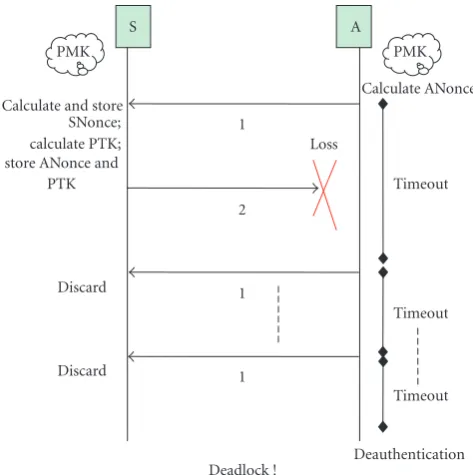
This asymmetric behaviour is necessary to avoid deadlock as shown inFigure 3: if Msg2 is lost before arriving at its destination and A does not send the Msg1 again, the hand-shake procedure will terminate without completing its task; the same issue could happen if A sends Msg1 again but S is not available to accept Msg1 because it is waiting for Msg3 (Figure 3).
WPA resolves WEP bugs but it does not represent a uni-versal model of invulnerability. As all session-oriented pro-tocols, WPA also is sensitive to a specific category of attack.
It is important to observe how WPA in preshared key mode offers the same key sharing issues as WEP. If the pri-vacy issues of the key are not considered, it is important to configure PSK on the AP and on all stations that have to com-municate with the AP. However, because the PSK is the same
PMK S
Calculate and store SNonce; calculate PTK; store ANonce and
PTK
Discard
Discard
A
1
Loss
2
1
1
PMK Calculate ANonce
Timeout
Timeout
Timeout
Deauthentication Deadlock !
Figure3: Deadlock situation after packet loss in the case of sym-metric behaviour.
as PMK in the starting phase of the 4-way handshake, the overall authentication phase is not executed and only the fi-nal 4-way handshake is applied. This mechanism does not offer high security and thus the producers of Wi-Fi suggest using WPA in preshared key only in the home of the SOHO environment or in environments where there is a low proba-bility of attempting attacks on security [8,9].
During 2002, when WPA started to appear on the market, some important publications denounced the security bugs of WPA in standard mode (e.g., authentication 802.1X/EAP) and in PSK mode. These bugs create a lot of problems were provided. The denounced bugs offer the possibility of trying attacks such as man-in-the-middle, session hijack, and denial of service (DoS). The first two types of attacks were possible only if a one-way authentication was used (e.g., EAP-TLS and PEAP). The third type consisted of spoofing of 4 types of EAP protocol messages. So in this case the possibility of hacking referred to
(i) floodingassociate requests orEAOPL-start packets to AP (even if EAPOL-start messages is not a serious problem in practice);
(ii) falsifying theEAP-failuremessages;
(iii) falsifying theEAP-logoff or disassociate-request mes-sages;
(iv) falsifying thedeauthenticationmessage.
PMK S
Calculate and store SNonce; calculate PTK; store ANonce and
PTK
A PMK Calculate ANonce
Calculate PTK; verify MIC [AA, ANonce, SN, msg1]
1
[SPA, SNonce, SN, msg2, MICPTK(SNonce, SN, msg2)]
2
[AA, ANonce¼, SN, msg1]
1¼
H
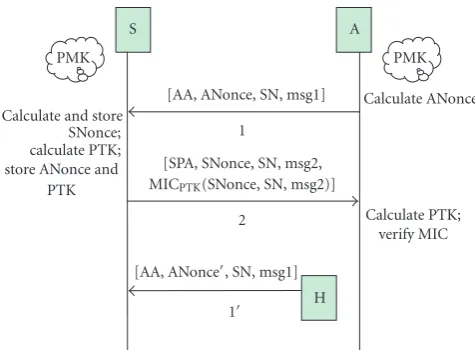
Figure4: Hacker intrusion after Msg2 forwarding.
be considered a theoretical conjecture and with few chances to be applied in a real context. This potential attack was avoided through the adoption of AES-CCMP rather than RC4-TKIP in WPA2.
Contrary to previous works, in this paper, after a deep analysis of WPA and WPA2 protocol dynamics attention is focused on the4-way handshakeprocedure and even when it is used in standard mode (not only in PSK mode). If a hacker is able to successfully attack the key generation and distribution process, then the overall security system will be damaged.
5. DoS AND DoS FLOODING ATTACKS AGAINST IEEE 802.11i 4-WAY HANDSHAKE
In the current WLAN systems, DoS attacks are very easy to mount; furthermore, once an adversary successfully mounts a DoS attack, more advanced attacks, such as MitM [2], could be subsequently constructed. Therefore, it is necessary to de-ploy a security mechanism that can defend against DoS at-tacks. In the following, in accordance with the works [8,9], some possible DoS attack scenario is presented.
The weak point of 4-way handshake is represented by the first message (Msg1). It is the only message that does not use the MIC field that is very important to guarantee the integrity and the authenticity of A.
Thus, Msg1 can be falsified and a hacker can easily know all its fields such as the MAC address, ANonce, SN, and mes-sage type. We recall, as explained in the previous section, that S calculates and stores PTK together with ANonce and Snonce (see formula (1)). Through PTK, S calculates the MIC to be inserted in Msg2 and sends it to A. After receiving the Msg2, A calculates its PTK and then MIC. At this point, hacker (H) can play a role that prepares Msg1 to the mes-sage similar to that sent from A to S (Figure 4). This new Msg1message differs from Msg1 only in the nonce because this value is randomly generated locally in the device.
The device S calculates the PTK in the knowledge of ANonce received with Msg1. Let the value generated by H be
indicated with ANonceso that it is possible to discriminate this from the value created by A (ANonce).
If H is able to send its message (Msg1) after S sends Msg2 and before S receives Msg3, S should accept Msg1and it will calculate a novel value PTK that will be indicated by PTK. In other terms PTKwill be a function of PMF, ANonce, and SNonce:
PTK=PRF (PMF, ANonce, SNonce, AA, SPA). (2) The effect produced by the hacker is the storing of two new values (ANonceandPTK) and the sending of a new mes-sage (Msg2) from S to A. This new message will besilently discardedby A in accordance with the protocol specification. In this time A will send the message Msg3 to S with its own ANonce value. After receiving the Msg3, S will notify a failure in the integrity check because MICPTK =MICPTK.
This is due to the PTK, derived by ANonce, which produces a different MIC at S. Thus a discarding of Msg3 is produced without giving any communication to A.
We recall how thesilent discardingwas appositely intro-duced by the project manager of WPA in order to avoid at-tacks such as MITM (man-in-the-middle attack).
Aftertimestamp expiration, the authenticator A, because it does not receive the Msg4, will send Msg3 again. This novel Msg3 will again be discarded by S. After thenth attempt at transmission and timestamp expiration, A will deauthenti-cate S and the hacker will achieve his task:to make a DoS attack[9,10,19–21] (Figure 5).
It is important to observe that after each reception of Msg1, supplicant S stores ANonce and PTK values in its own station. Thus, if the hacker achieves a multiple attack, it is possible to achieve aDoS flooding orDoS memory exhaus-tion attack (such as shown inFigure 6); if the attack is re-peated through flooding by the hacker, S is forced to store a lot of ANonce and PTK values producing memory exhaus-tion. This attack is possible with both WPA and 802.11i pro-tocols.
On reflection, the standard IEEE 802.11i supports a mechanism to avoid the modification of PTK on S. This mechanism forces S to calculate a PTK and atemporary PTK (TPTK), after receiving the Msg1. In this way S can modify only the TPTK for each reception of Msg1 and PTK can be modified only after the reception of Msg3 and the verifica-tion of its integrity.
This approach resolves the security issue only if the mul-tiple instances of connection are sequentially executed; in a scenario such as that previously described, the DoS attack continues to be applicable because S will calculate its own MIC through the TPTK value, while the received Msg3 will carry in a MIC calculated through the PTK value. Thus, be-cause ANonce is different from ANonce, then PTK=TPTK and the MIC verification will fail with subsequent Msg3 dis-carding (Figure 7).
PMK S
Calculate and store SNonce; calculate PTK; store ANonce and
PTK
Calculate PTK¼=PRF
(PMK, Anonce¼
, SNonce); store ANonce¼
and PTK¼
Verify MIC Wrong MIC !
Discard
A
[AA, ANonce, SN, msg1] 1
[SPA, SNonce, SN, msg2, MICPTK(SNonce, SN, msg2)]
2
[AA, ANonce¼, SN, msg1]
H 1¼
[AA, ANonce, SN+1, msg3, MICPTK(ANonce, SN+1, msg3)]
3
PMK Calculate ANonce
Calculate PTK; verify MIC
Timeout
Deauthentication
Figure5: DoS attack in 4-way handshake phase.
PMK S
Calculate and store SNonce; calculate PTK; store ANonce and
PTK
A
[AA, ANonce, SN, msg1] 1
[SPA, SNonce, SN, msg2, MICPTK(SNonce, SN, msg2)]
2
[AA, ANonce¼
, SN, msg1] 1¼
[AA, ANonce¼¼
, SN, msg1] 1¼
[AA, ANonceN, SN, msg1] 1¼
PMK Calculate ANonce
Calculate PTK; verify MIC
H
H
H Calculate PTK¼;
store ANonce¼
and PTK¼
Calculate PTK¼¼
; store ANonce¼¼
and PTK¼¼
Calculate PTKN; store ANonceNand PTKN
Figure6: DoS flooding attack in 4-way handshake phase.
The PMKID is a further field included in all Msg1 sent from A to S. It is calculated as follows:
PMKID=SHA (PMK, T), (3)
where T = [“PMK name”AASPA] and SHA is the well-knownone-way hash functionSHA-1 at 128 bits. This value cannot be reproduced by the hacker because he cannot know
the PMK and he cannot think of inverting the hash function. Thus H cannot send Msg1 to S before A sends its Msg1 oth-erwise H could be discovered.
PMK S
Calculate and store Nonce; calculate PTK; TPTK=PTK;
store ANonce, PTK e PTK
Recalculate TPTK=PRF (PMK, ANonce¼
, SNonce); store ANonce¼
e TPTK
Verify MIC: MICTPTK=MICPTK
Errobousmic !
Discard
A
[AA, ANonce, SN, msg1] 1
[SPA, SNonce, SN, msg2, MICPTK(SNonce, SN, msg2)]
2
[AA, ANonce¼
, SN, msg1] H 1¼
[AA, ANonce, SN+1, msg3, MICPTK(ANonce, SN+1, msg3)]
3
PMK
Calculate ANonce
Calculate PTK; verify MIC
Timeout
Deauthentication
Figure7: DoS attack in 4-way handshake phase with TPTK extension.
LLDE is a mechanism that permits, after having obtained the PTK from both sides, encryption of the following in-stances of 4-way handshake. All messages after the first 4 messages (first instance) are encrypted through the tempo-rary keys of PTK. This approach noticeably reduces the ac-tion range of the hacker to the first instance.
Thus, the combined action of PMKID and LLDE reduces the time interval in which the hacker can operate, that is, at the only first 4-way handshake instance, and after sending the first Msg1. Even if the action range of a hacker is very small, the potential risk of DoS attachment is still present. Through correct devices such as scanners, sniffers, and packet gener-ators, the process can be automatised and synchronised and the probability of success can be high.
6. STATIC VERSUS DYNAMIC RESOURCE-ORIENTED SOLUTIONS FOR THE 4-WAY HANDSHAKE
The main issue in the 4-way handshake procedure is the inca-pability to discriminate the new Msg1 request coming from the real node and the messages generated by H. If the capabil-ity of discrimination is introduced, the handshake procedure could be completed. The second issue to be overcome is the memory exhaustion. In fact, even if the hacker’s messages are discriminated, H could still produce aDoS floodingattack. A solution to this second issue can be the avoidance of storing ANonce and PTK for each Msg1 offering the correct work-ing of the 4-way handshake. At first glance, a further control field in the frame format could be added but this approach requires too much change in the original protocol.
In this work a slight change to the terminal is proposed in order to avoid the deauthentication determined by a DoS attack and memory exhaustion after the DoS flooding attack.
6.1. Static standard solution (solution I)
The proposal is easily presented in the following:
(i) on reception of the first message Msg1, S takes 3 ac-tions, it
(a) generates and stores SNonce;
(b) computes PTK in the same way provided by the standard protocol;
(c) creates and sends Msg2 (no stores ANonce and PTK);
(ii) on each reception of a new Msg1, S only calculates without storing the novel PTK (PTK); through this new PTKit can produce the MIC value;
(iii) on reception of Msg3, in order to verify the MIC, S computes the PTK again through the SNonce value that has previously memorised and the ANonce value obtained by Msg3; in this way the identification pro-cess gives a positive response and the attack attempt is avoided (Figure 8).
The replication of Msg3 by H is not applicable because in this message the MIC field that assures the identity is present.
Also memory exhaustion is avoided because it is suffi -cient to store only SNonce rather than ANonce and PTK val-ues after any reception of Msg1.
PMK
[AA, ANonce, SN, msg1] 1
[SPA, SNonce, SN, msg2, MICPTK(SNonce, SN, msg2)]
2
[AA, ANonce¼
, SN, msg1] H 1¼
[AA, ANonce, SN+1, msg3, MICPTK(ANonce, SN+1, msg3)]
3 [SPA, SN+1, msg4, MICPTK(SN+1, msg4)]
4
Figure8: Proposal in DoS attack scenario.
PMK
[AA, ANonce, SN, msg1] 1
Loss [SPA, SNonce, SN, msg2, MICPTK(SNonce, SN, msg2)]
2 [AA, ANonce¼
, SN, msg1] 1¼
[SPA, SNonce, SN, msg2, MICPTK(SNonce, SN, msg2)]
2¼
[AA, ANonce¼, SN+1, msg3,]
[SPA, SNonce, SN+1, msg4, msg3)] MICPTK(SNonce, SN+1, msg4)]
3¼
[SPA, SN+1, msg4, MICPTK(SN+1, msg4)]
4
Figure9: Proposal in packet loss scenario.
However, the proposed solution can occur in a CPU exhaustion issue rather thanmemory exhaustionbecause it forces the recalculation of PTK for each handshake instance (e.g., after the reception of Msg3). This should be avoided for low-power processors.
In this case, it is possible to apply a trade-offpolicy be-tween the standard IEEE 802.11i and the presented proposal.
6.2. Static solution with trade-off variant (solution II)
In particular, the steps to be followed are presented below.
(i) On reception of the first Msg1, S has to perform the following actions:
(a) generate and store SNonce; (b) calculate PTK;
(c) create and send Msg2; (d) store ANonce and PTK.
(ii) On reception of each new message Msg1, S calculates PTKin accordance with the standard proposal. (iii) After the reception of Msg3, S compares the ANonce
value in Msg3 with the stored ANonce. If the two ANonce values (ANonce and ANonceMsg3) are the
same, S will verify the MIC of Msg3 using the stored PTK. Otherwise if the two ANonce values are different, the PTK will be recomputed and after that the MIC will be verified (Figure 10).
In this way the variant avoids storing ANonce and PTK (memory exhaustion) each time and recomputing PTK after each Msg3 arrival (CPU exhaustion).
6.3. Static solution with trade-off variant and memory release (solution III)
A further change that could be applied to the latter exten-sion is the deallocation of memory space associated with SNonce and ANonce storage if S does not receive new Msg1s. In other terms, if S receives Msg3 after sending Msg2, it can erase SNonce and ANonce values freeing memory space. At this point S can verify the MIC values without checking the ANonce value. This new variant to the proposal should pro-duce lower performance than the first solution (or standard proposal) but better performance than trade-offsolution (or proposal with trade-offvariant) in the no-hacking scenario.
In case of DoS attack the handshake is the same of the proposal without memory release and so performances should be the same. In order to test the efficacy and the im-provement of the proposed solution, a simulation campaign was conducted as presented in the next section.
Figures11and12represent the last proposal handshakes in no-hacking and in DoS attack scenarios.
6.4. Memory and CPU load aware dynamic solution
Through benefits and drawback analysis of three mecha-nisms for IEEE 802.11i protocol, it is possible to propose a solution that tries to unify the benefits of the single mech-anisms. For example, the supplicant could be equipped of an intelligent software module that monitors system param-eters (or network paramparam-eters) and on their basis it decides to adopt the mechanism I, II, or III. If the supplicant wants to control the CPU and memory load levels, threshold levels could be introduced and if the device overcomes these levels the system can switch among solution I, II, or III.
PMK S
Calculate and store SNonce; calculate PTK; store Anonce and PTK
Calculate PTK¼
If msg3. ANonce=ANonce - verify MIC
else
recalculate PTK and verify MIC
PTK
A
[AA, ANonce, SN, msg1] 1
[SPA, SNonce, SN, msg2, MICPTK(SNonce, SN, msg2)]
2
[AA, ANonce¼, SN, msg1]
H 1¼
[AA, ANonce, SN+1, msg3, MICPTK(ANonce, SN+1, msg3)]
3 [SPA, SN+1, msg4, MICPTK(SN+1, msg4)]
4
PMK
PTK Calculate ANonce
Calculate PTK; verify MIC
Verify MIC
Figure10: Proposal with trade-offvariant.
PMK S
Calculate and store SNonce; calculate PTK; store ANonce and PTK ArrivedMsg1¼=FALSE;
If ArrivedMsg1¼ =FALSE; deallocate ANonce and SNonce; verify MIC
PTK
A
[AA, ANonce, SN, msg1] 1
[SPA, SNonce, SN, msg2, MICPTK(SNonce, SN, msg2)]
2
[AA, ANonce, SN+1, msg3, MICPTK(ANonce, SN+1, msg3)]
3
[SPA, SNonce, SN+1, msg4, MICPTK(SNonce, SN+1, msg4)]
4
PMK Calculate ANonce
Calculate PTK; verify MIC
PTK Verify MIC
Figure11: Proposal with trade-offvariant and memory release variant in no-hacking scenario.
As previously explained, the solution I avoids the risk of memory exhaustion but it can produce an excessive CPU load.
Thus its usage depends of the device characteristics or de-vice’s resource availability. On the other hand, solution II re-duces the CPU load requested by the protocol execution to offer a good security level. However this solution needs more memory usage. Thus if the device uses its memory for other operations or it is limited in the memory, it can be unsuit-able. The third solution tries to reduce the memory storage when no-hacking scenario is present. Obviously to use the solution III, some mechanism to be aware of the no-hacking
scenario should be implemented on the system. This last so-lution represents a trade-offof two previous solutions if no attack is led to the system. The solution I is the best approach if the device can use a good CPU resource with low mem-ory storage. The solution II is the optimal solution if limited memory availability is present and the device needs to avoid the memory exhaustion issue.
InTable 2, a qualitative evaluation of three solutions with the possible attacks are considered.
Table2: Qualitative evaluation of attacks and CPU/mem exaustion risks in three solutions (I, II, and III).
Avoid DoS attack Avoid DoS-F attack Mem load (risk ofmem exhaustion) CPU load (risk ofCPU exhaustion)
Solution I No-hack Scenario Yes Yes — ∗∗
DoS attack scenario Yes Yes — ∗ ∗ ∗
Solution II No-hack scenario Yes Yes ∗ —
DoS attack scenario Yes Yes ∗ ∗
Solution III No-hack scenario Yes Yes — —
DoS attack scenario Yes Yes ∗ ∗
PMK S
Calculate and store SNonce; calculate PTK; store Anonce and PTK ArrivedMsg1¼
=FALSE;
Calculate PTK¼
; ArrivedMsg1¼
=TRUE
If (ArrivedMsg1¼
=TRUE && Msg3. ANonce=ANonce)
verify MIC else
recalculate PTK and verify MIC
PTK
A
[AA, ANonce, SN, msg1] 1
[SPA, SNonce, SN, msg2, MICPTK(SNonce, SN, msg2)]
2
[AA, ANonce¼
, SN, msg1] H 1¼
[AA, ANonce, SN+1, msg3, MICPTK(ANonce, SN+1, msg3)]
3
[SPA, SNonce, SN+1, msg4, MICPTK(SNonce, SN+1, msg4)]
4
PMK
PTK Calculate ANonce
Calculate PTK; verify MIC
Verify MIC
Figure12: Proposal with trade-offand memory release variant in DoS attack scenario.
a time window. This case could be more suitable to adopt a dynamic approach where solutions I, II, and III can be im-plemented in the supplicant and they are adopted if some conditions are verified. Thus it is possible to introduce a con-troller in the mobile device that continuously checks everyX millisecond the risk threshold levels associated to the CPU or memory resources. This CPU and memory levels are com-pared with risk threshold levels that are computed through a system analysis and that can be given by the device manufac-turer. For example, it is possible for the supplicant to start the 4-way handshake following the solution I. However if some risk threshold is overcome, it can switch in the other modal-ities (solution II or III). InTable 3the switching scenario for CPU and memory loads is presented.
For example, if at time t1 a sensible increase of CPU load is observed, the device will adopt the 4-way handshake of so-lution II and it will keep this soso-lution also if an overcome of the memory load threshold is verified under DoS attack. Af-ter the attack, if the warning levels of the device are under the alert values, it is unuseful to waste memory and it is possible
Table3: Choice of suitable solution under normal and high CPU and memory threshold values in hacking and no-hacking scenarios.
Normal mem load
High
mem load —
Normal CPU load
I I No-hack
scenario
I I DoS attack
scenario
High CPU load
II III No-hackscenario
II II DoS attack
scenario
START
Normal CPU load
High mem load & DoS attack
High CPU load High mem load
High mem load & high CPU load & no attack
High mem load/ no attack Normal CPU load
Normal mem load or (high mem load & DoS attack)
Figure 13: Flowchart diagram of the dynamic resource-oriented approach.
In the pseudocode presented below (seeAlgorithm 1), it is possible to understand the resource-oriented switching policy among the three solutions. Two thresholds are con-sidered (mem and CPU thresholds). For example, in the ex-ample below they are fixed to 100. Two variables (memLoad and cpuLoad) need to be used in order to account the cur-rent resource usage. Two functions (readCPUload and read-MEMload) are applied to get the current resource availability values.
7. FSA MODELLING
In this paragraph we will attempt to create a mathematical model that can summarise what has been dealt with discur-sively up to now. The aim is to arrive systematically at the simulation phase, where for “simulation” is intended the em-ulation of the real system through a preliminary study of the mathematical model representing the system.
The finite state automa (FSA) can therefore provide an optimum model with which to point out the important char-acteristics of the 4-way handshake protocol and from which to begin a discrete simulation, through java “actors,” of the working of the said protocol.
Specifically, since the simulation phase sets the objective of testing the speculative theories formulated in the previous paragraph, the modelling will deal with both the dynamics of the WPA protocol as it is today (obviously with the necessary simplifications already seen) and those of how it would be with the proposed changes (general proposal, compromise proposal, and compromise proposal with variant).
For each of the cases there should be three-orientated graphs: one for the supplicant, one for the authenticator, and one for the hacker.
In reality, since the proposed changes only affect the client’s behaviour, it is felt unnecessary to repeat the identical automa of the authenticator and the hacker.
ActionS1
ActionS3
Msg1
Msg2
Msg3
Msg4
ActionAS
ActionA2
Figure14: Actions and message exchange of the automata.
CREATED
INITED
STATER1
STATER2
FINISHED Init/actionSI
Start/actionSS
Msg1/actionS1
Msg3/actionS3
Resume/actionSR Supplicant
Msg1/actionS11
Figure15: FSA of supplicant in WPA protocol.
To facilitate understanding of the automa refer to Figures 15,16,17, and18.
Before implementing the simulation program, a finite state automata (FSA) formalism was applied to define the entities involved in the communication process and to simu-late the actions of possible attackers (e.g., hackers). The FSA are used to outline the characteristics of the 4-way hand-shake protocols. Specifically, a supplicant, authenticator, and hacker FSA are defined. In this paper, the FSA and their ac-tions are presented.
To formalise the actions carried out by the automa we will use the following notations (seeFigure 14):
(i) actionAS: action effected by A before sending Msg1; (ii) actionS1: action effected by S immediately after the
re-ception of Msg1;
(iii) actionA2: action effected by A after the reception of Msg2;
const MEM thershold=100; const CPU threshold=100; bool attack←false; Double memLoad←0; Double cpuLoad←0; begin main:
goto prop1; end main;
begin prop1:
attack←isAttack(); cpuLoad←readCPUload(); memLoad←readMEMload(); if (cpuLoad>CPU threshold)
if ((memLoad>MEM threshold) AND (attack=false)) goto prop3;
else goto prop2; else
goto prop1; end prop1;
begin prop2:
attack←isAttack(); cpuLoad←readCPUload(); memLoad←readMEMload();
if ((memLoad>MEM threshold) AND (attack=false)) goto3;
if (cpuLoad≤CPU threshold) goto prop1;
else
goto prop2; end prop2;
begin prop3:
attack←isAttack(); cpuLoad←readCPUload(); memLoad←readMEMload();
if ((memLoad≤MEM threshold) OR ((memLoad>MEM threshold) AND (attack=true))) goto2;
if (cpuLoad≤CPU threshold) goto prop1;
else
goto prop3; end prop3;
Algorithm1: Pseudocode.
At this point the automa of the supplicant, authenticator, and hacker can be represented, along with their respective semantic tables.
Each automa should be read in the following way: (i) if S is in the CREATED state (starting state) and
re-ceives an “init”-type signal, then it carries out action SI and immediately after that it passes to the INITED state;
(ii) if S is in the INITED state and receives a message of the “start”-type, then it effects the actionSS and passes to the STATER1 state;
(iii) if S is in state STATER1 and receives a “Msg1”-type message, then it carries out the actionSS and passes to the STATER2 state;
and so on. For example, for the FSA of the supplicant, see Figure 15; for the authenticator and the hacker see Figures 16and17. The actions are outlined in Tables4–6.
The actions are outlined inTable 4.
CREATED
INITED
STATER1
STATER2
FINISHED Init/actionAI
Start/actionAS
Msg2/actionA2
Msg4/actionA4
Resume/actionSR Authenticator
Timeout & count<=k/ actionAT2 Timeout & count<=k/
actionAT3 Timeout & count<=k/
actionAT1
Timeout & count> k/ actionAT2
Figure16: FSA of authenticator in WPA protocol.
CREATED
INITED
STATER1
STATER2
FINISHED Init/actionHI
Start/actionHS
Msg1/actionH1
Msg2/actionH2
Hacker
Figure17: FSA of hacker in WPA protocol.
The automa of hacker H is the most linear since it re-flects the ease with which it can mechanically sniffthe com-munication between S and A and introduce itself at a suitable moment (after the sending of Msg2) to carry out the attack (actionH2).
Now let us see how the actions of S and A change them-selves according to what is introduced by the 3 proposals pre-sented (Tables7–9).
The FSA are not shown because they have the same states as the standard WPA automas.
0 1000 2000 3000 4000 5000 6000 7000
0 5000 10000 15000 20000 25000 30000
Without attack With attack With 10 attacks Mem load 948.9 1582.46 7284.5
Time exec 110 20129 20449
CPU load 2674.97 4485.19 23371.42
Figure18: WPA protocol performance in no-hacking, DoS attack, and DoS flooding attack scenarios.
Table4: Actions of supplicant FSA.
ActionSI Associate a specific A to S
ActionSS NOP (no operation)
ActionS1
Generate and store SNonce Calculate PTK
Send Msg2
actionS11 Calculate PTK Send Msg2
ActionS3
Calculate PTK Verify MIC,
(i) if positive ACK is verified, send Msg4, (ii) otherwise, NOP
ActionSR Send resume
Table5: Actions of authenticator FSA.
ActionAI Association of a specific S to A
ActionAS
Generation and storing of ANonce Msg1 forwarding
Start of timer
ActionA2
SNonce; storing PTK; calculation MIC validation Msg3 forwarding Start of timer
ActionA4
MIC validation,
(i) if positive result, termination; (ii) otherwise, NOP
ActionAT1
ANoncegenearation Msg1 forwarding Start of the timer
ActionAT2 NOP
ActionAT3 A new forwarding of Msg3 The timer starts
Table6: Actions of hacker FSA.
ActionHI Associate a specific S to A ActionHS NOP (no operation) ActionH1 Store AA and SN
ActionH2 Generate ANonceand send Msg1
Table7: Actions of supplicant FSA of static standard solution.
ActionSI Associate to S a specific A ActionSS NOP (no operation)
ActionS1
Generate and store SNonce Calculate PTK
Store ANonce and PTK Send Msg2
ActionS11
Calculate PTK Store ANonce and PTK Send Msg2
ActionS3
Verify MIC,
(i) If positive verification, send Msg4; (ii) otherwise, NOP;
ActionSR Send resume
Table8: Actions of supplicant FSA of static solution with trade-off variant.
ActionSI Associate a specific A to S ActionSS NOP (no operation)
ActionS1
Generate and store SNonce Calculate PTK
Store ANonce and PTK Send Msg2
ActionS11 Calculate PTK Send Msg2
ActionS3
If ANonce=Msg3. ANonce verify MIC, (i) if positive ack, send Msg4, (ii) otherwise, NOP
Else
Calculate PTK, Verify MIC,
(i) if positive ack, send Msg4, (ii) otherwise, NOP
ActionSR Send resume
8. PERFORMANCE EVALUATION
After the definition of the FSA, a discrete event simulator was built in JAVA ver.1.4.2 in order to verify the benefits and the drawbacks of the proposed approach.
Starting therefore from an ASF model the code of the simulazione∗.javafile was designed, with which the suppli-cant, authenticator, and hacker classes were implemented by means of technique and “actors.”
Table9: Actions of supplicant FSA of static solution with memory release.
ActionSI Associate a specific A to S ActionSS NOP (no operation)
ActionS1
Generate and store SNonce Calculate PTK
Store ANonce and PTK Send Msg2
ActionS11
ArrivedMsg1=TRUE Calculate PTK Send Msg2
ActionS3
If ArrivedMsg1=FALSE, then Release ANonce and SNonce, Verify MIC,
(i) if positive ack, send Msg4, (ii) otherwise, NOP
Else
if ANonce=Msg3. Anonce, then Verify MIC,
(i) if positive ack, send Msg4, (ii) otherwise, NOP, Else
Calculate PTK Verify MIC,
(i) if positive ack send Msg4; (ii) otherwise, NOP ActionSR Send resume
The dynamic behaviour of the three actors was simulated in 4 different protocol architectures: standard WPA/IEEE 802.11i protocol, other three static solutions (solution I, II, and III). Then, a comparison between static solutions and dynamic resource-oriented approach (solution IV) has been carried out.
8.1. Simulation scenario and parameters
The simulation task is the performance evaluation of the 4-way handshake of WPA and IEEE 802.11i in the case of DoS attack like the scenario defined inSection 5.
The simulation parameters are
(i) attack result:it represents the number of completed at-tacks towards the mobile devices;
(ii) memory load:1it represents the cost associated to the
memory consumption;
(iii) CPU load:1it represents the cost associated to the CPU
usage;
(iv) execution time:it is the time necessary to complete the 4-way handshake procedure.
Table10: Costs (mem and CPU loads) associated to the 4-way handshake operations.
Cost associated to the storage (mem load) and
computation (CPU load) Value
Nonce cost associated with memory storage 315 PTK cost associated with the memory storage 318 MIC cost associated with the CPU operations 288 PTK cost associated with the CPU operations 1810
There are 12 possible cases that are implemented and they are described below.
(i) Standard protocol (WPA/IEEE 802.11i) without at-tack, WPA/IEEE802.11i with DoS atat-tack, and WPA/ IEEE 802.11i with DoS flooding attack.
(ii) Solution I without attack, with DoS attack, and with DoS flooding attack.
(iii) Solution II without attack, with DoS attack, and with DoS flooding attack.
(iv) Solution III without attack, with DoS attack, and with DoS flooding attack.
The simulation parameters adopted in our environment are presented inTable 10.
Also if the value above has been arbitrarily chosen, the approach has a general validity because the cost associated with the CPU and memory consumption need to be referred to the availability of memory and CPU. This availability can change in a mobile device depending on the other opera-tions that device is performing. Thus it is important to fo-cus on the possibility to reduce the resource availability for a prefixed cost associated with CPU or memory storage op-erations. In order to validate proposals, simulation data are represented in histograms.
Specifically, with reference to modelling by means of FSA, it is easy to understand that the critical operations which affect performances of the client-side protocol are without doubt “actionS1,” “actionS3,” and “actionS11;” in these in fact the greatest memory and CPU loads occur.
8.2. Simulation results
Simulation results depicted in Figure 18 show the perfor-mance of the WPA/IEEE 802.11i standard protocol. It is possible to observe the positive result of both DoS attacks (simple DoS and DoS flooding) and the consequent system degradation in terms of memory and CPU loads: the mem-ory load doubles in DoS attack case and it is 8 times the ini-tial memory load in the case of a DoS flooding attack (with 10 flooding messages); the execution time changes from 110 milliseconds (with no attack) to 20000 milliseconds in the DoS attack scenario and this is reputable to the positive re-sult of the attack.
As can be seen inFigure 19, the solution I presents a bet-ter performance than standard protocol (WPA/IEEE 802.11i) in terms of memory load with and without attacks. The memory load value is constant in all the scenario because the
0
Without attack With attack With 10 attacks Mem load 315.34 315.34 315.34
Time exec 110 140 270
CPU load 4485.19 6583.66 25469.89
Figure19: Solution I performance in no-hacking, DoS attack, and DoS flooding attack scenarios.
0
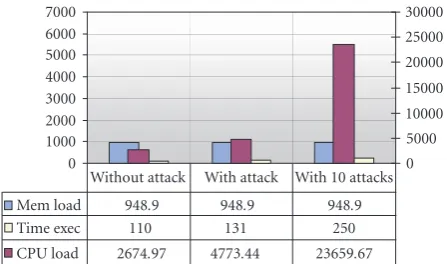
Without attack With attack With 10 attacks Mem load 948.9 948.9 948.9
Time exec 110 131 250
CPU load 2674.97 4773.44 23659.67
Figure20: Performance of trade-offsolution (solution II) in no-hacking, DoS attack, and DoS flooding attack scenarios.
operations that S effects are similar. Good improvements can be verified also for the execution time in the case of intru-sion because DoS attack and DoS flooding attack are now avoided. However, the CPU load values increase as shown in Figure 19and as outlined in the previous section.
Thus, in order to avoid CPU exhaustion in the case where the hacker can attempt DoS flooding attacks with a high rate, trade-off(solution II) is considered and simulation results are presented inFigure 20.
Memory consumption is lower than the standard pro-posal in the hacking scenario and the CPU load is maintained low as in the standard WPA/IEEE 802.11i protocol.
In other terms, the proposal with trade-offvariant offers the following advantages:
(i) DoS attack and DoS flooding attack are avoided; (ii) CPU load equals that of the WPA/IEEE 802.11i
stan-dard 4-way handshake;
(iii) memory load independent of attack type;
(iv) execution time similar to that of standard proposal.
0 1000 2000 3000 4000 5000 6000 7000
0 5000 10000 15000 20000 25000 30000
Without attack With attack With 10 attacks Mem load 318.21 948.9 948.9
Time exec 141 140 271
CPU load 2674.97 4773.44 23659.67
Figure21: Performance of trade-offwith memory release solution (solution III) in no-hacking, DoS attack, and DoS flooding attack scenarios.
Mem load
Time exec CPU load
0 1000 2000 3000 4000 5000
Exec time CPU load Mem load Standard protocol 110 2674.67 948.9 Solution I 110 4485.19 315.34 Solution II 110 2674.97 948.9 Solution III 141 2674.97 318.21
Figure22: Standard protocol simulation parameter values, stan-dard proposal simulation values, trade-offproposal, and trade-off with memory release variant proposal simulation values in a no-hacking scenario.
by the mobile device after a monitoring of the 4-way hand-shake procedure. If the previous handhand-shake procedure had been executed without observing malicious messages for a certain amount of time, the risk threshold of the device can be reduced and a no-attack scenario can be considered. The threshold setting and the no-attack scenario evaluation are outside the scope of this paper. Anyway, through this con-sideration, further advantages offered by proposed solution III can be verified in a lower memory load in the no-hacking scenario such as the one depicted inFigure 21. The other pa-rameters reflect the same performance as the trade-off pro-posal without memory release.
Thus, the previous graphics above, permit quantification of the CPU load, memory load, and 4-way handshake execu-tion time when the three soluexecu-tions (I, II, and III) are adopted. Now, in Figures22,23, and24data have been reelabo-rated in order to give a more complete picture of parame-ter values related to the standard WPA/IEEE 802.11i proto-col, the standard proposal (solution I), the trade-offproposal (solution II), and the trade-offwith memory release variant proposal in no-hacking scenarios (solution III).
In Figure 22 where no-hacking scenario is considered, if the most important resource to be considered is the CPU load, it is possible to observe the best performance
Mem load
Time exec CPU load
0 5000 10000 15000 20000
Standard protocol 20129 4485.19 1582.46 Solution I 140 6583.66 315.34 Solution II 131 4773.44 948.9 Solution III
Figure23: Simulation parameter values of standard protocol, stan-dard proposal, trade-off proposal, and trade-off proposal with memory release variant in a DoS attack scenario.
Mem load
Time exec CPU load
0 5000 10000 15000 20000 25000
Time exec CPU load Mem load Standard protocol 20449 23371.42 7284.5 Solution I 270 25469.89 315.34 Solution II 250 23659.67 948.9 Solution III 271 23659.67 948.9
Figure24: Simulation parameter values of standard protocol, stan-dard proposal, trade-offproposal, and trade-offwith memory re-lease variant proposal in a DoS flooding attack scenario.
of WPA/IEEE 802.11 protocol without the He and Mitchell extension (solution I). On the other hand, if the memory load is considered the most important, solution I and so-lution III perform better. If we have a wide resource avail-ability, and the execution time can be important, WPA/IEEE 802.11i without enhancements, solutions I, and II are the best. Obviously the WPA/IEEE 802.11i protocol without He and Mitchell extension can not be considered because the system would be weak to a DoS attack. Thus, a DoS attack and DoS flooding attacks have been simulated and their ef-fects have been depicted inFigure 23. Also in this case, de-pending on the importance given to resources consumption, in some case solution I can be the best or some times solution II or solution III.
Mem load
Time exec CPU load
0 1000 2000 3000 4000 5000 6000 7000 Time exec CPU load Mem load
Solution IV 134 5012 340.23
Solution III 140 4773.44 948.9 Solution II 131 4773.44 948.9 Solution I 140 6583.66 315.34
Figure25: Simulation parameter values of static solutions (I, II, and III) and dynamic solution (IV) in a DoS flooding attack scenario.
9. CONCLUSIONS
Two well-known security protocols WPA and IEEE 802.11i are evaluated. WPA and IEEE 802.11i are robust to a lot of at-tacks and they overcome the security bugs of WEP protocol. However, in some specific scenarios, these protocols are not able to avoid a DoS attack. After defining the potential risk situation, which can occur in the last phase of the authenti-cation process (the 4-way handshake), three static solutions that avoid the attack and realise different CPU and memory consumptions are investigated and evaluated through simu-lations. Simulation results validate the proposal to enhance the WPA protocol and avoid a DoS attack and DoS flood-ing attack. However, efficiency in terms of CPU load and memory exhaustion depends on the specific adopted solu-tion. Specifically, we suggest to adopt a dynamic resource-oriented approach that tries to get the best behaviour of the three distinct solutions. This mechanism is based on CPU and memory load thresholds and it can meet the different re-source availabilities of mobile devices during the data trans-mission.
REFERENCES
[1] J. Edney and W. A. Arbaugh, Real 802.11 Security: WiFi-Protected Access and 802.11i, Addison Wesley, New York, NY, USA, 2003.
[2] A. Mishra and W. A. Arbaugh, “An initial security analysis of the IEEE 802.1X standard,” Tech. Rep. CS-TR-4328, University of Maryland, College Park, Md, USA, February 2002. [3] A. Mishra, N. L. Petroni Jr., W. A. Arbaugh, and T. Fraser,
“Se-curity issues in IEEE 802.11 wireless local area networks: a sur-vey,”Wireless Communications and Mobile Computing, vol. 4, no. 8, pp. 821–833, 2004.
[4] W. Stallings,Cryptography and Network Security, Prentice Hall, Englewood Cliffs, NJ, USA, 3rd edition, 2003.
[5] W. A. Arbaugh, N. Shankar, J. Wang, and K. Zhang, “Your 802.11 network has no clothes,” inProceedings of the 1st IEEE International Conference on Wireless LANs and Home Net-works, Suntec City, Singapore, December 2001.
[6] IEEE Standard for Information technology—Telecommu-nications and Information exchange between systems—Local
and metropolitan area networks - Specific requirements, Part 11, Amendment 10: Medium Access Control (MAC) Security Enhancements, IEEE Std 802.11i-2005.
[7] N. Borisov, I. Goldberg, and D. Wagner, “Intercepting mobile communications: the insecurity of 802.11,” inProceedings of the 7th Annual International Conference on Mobile Computing and Networking (MOBICOM ’01), pp. 180–188, Rome, Italy, July 2001.
[8] C. He and J. C. Mitchell, “Analysis of the 802.111 4-way hand-shake,” inProceedings of the ACM Workshop on Wireless Se-curity (WiSe ’04), pp. 43–50, Philadelphia, Pa, USA, October 2004.
[9] C. He and J. C. Mitchell, “Security analysis and improvements for IEEE 802.11i,” inProceedings of the 12th Annual Network and Distributed System Security Symposium (NDSS ’05), San Diego, Calif, USA, February 2005.
[10] J. Bellardo and S. Savage, “802.11 Denial of service attacks: real vulnerabilities and practical solutions,” inProceedings of the 12th USENIX Security Symposium, Washington, DC, USA, August 2003.
[11] IEEE Standard 802.11-1999, Information technology—Tele-communications and Information exchange between sys-tems—Local and metropolitan exchange between systems— Local and metropolitan area networks—Specific require-ments—Part11: Wireless LAN Medium Access Control and Physical Layer Specifications,1999.
[12] J. S. Park and D. Dicoi, “WLAN security: current and future,” IEEE Internet Computing, vol. 7, no. 5, pp. 60–65, 2003. [13] W. A. Arbaugh, “An inductive Chosen Plaintext Attack, against
WEP/WEP2,” Presentations to IEEE 802.11 TGi, May 2001. [14] S. Fhurer, I. Mantin, and A. Shamir, “Weaknesses in the key
scheduling algorithm of RC4,” inProceedings of the 8th An-nual Workshop on Selected Areas in Cryptography (SAC ’01), Toronto, Canada, August 2001.
[15] V. Moen, H. Raddum, and K. J. Hole, “Weaknesses in the tem-poral key hash of WPA,”ACM SIGMOBILE Mobile Computing and Communications Review, vol. 8, no. 2, pp. 76–83, 2004. [16] B. Adoba, “WEP2 Security Analysis,” IEEE
doc.:802.11-00/253, May 2001,http://www.cs.umd.edu/waa/attack/frame. htm.
[17] C. Rigney, S. Willens, A. Rubens, and W. Sympson, “Remote Authentication Dial In User Service (RADIUS),” RFC 2865, June 2000.
[18] P. R. Calhoun, S. Farrell, and W. Bulley, “Diameter CMS Security Application,” March 2002,http://www.diameter.org/ drafts/latest/draft-ietf-aaa-diameter-cms-sec-04.txt.
[19] C. L. Schuba, I. V. Krsul, M. G. Kuhn, E. H. Spafford, A. Sun-daram, and D. Zamboni, “Analysis of a denial of service attack on TCP,” inProceedings of the IEEE Computer Society Sympo-sium on Research in Security and Privacy, pp. 208–223, Oak-land, Calif, USA, May 1997.
[20] CERT, “DoS Attack,”http://www.cert.org/tech tips/denial of service.html.
[21] D. B. Faria and D. R. Cheriton, “DoS and authentication in wireless public access networks,” inProceedings of the ACM Workshop on Wireless Security (WiSe ’02), pp. 47–56, Atlanta, Ga, USA, September 2002.
Floriano De Rangowas born in Cosenza (CS), Italy, in 1976. He received the degree in computer science engineering in Octo-ber 2000, and a Ph.D. degree in electron-ics and communications engineering in Jan-uary 2005, both from the University of Cal-abria, Italy. From January 2000 to October 2000 he worked in the Telecom Research Lab CSELT in Turin as Visiting Scholar Stu-dent. From March 2004 to November 2004
he was a Visiting Researcher at the University of California at Los Angeles (UCLA). Since November 2004 he joined the DEIS, Uni-versity of Calabria, as a Research Fellow. He served as a Reviewer of VTC’03, ICC’04, WCNC’05, Globecom’05, WTS’05, Wireless-COM’05, IEEE Communication Letters, and JSAC. His interests include satellite networks, IP QoS architectures, adaptive wireless networks, and ad hoc networks.
Dionigi Cristian Lentiniwas born in Mot-tola (TA), Italy, in 1980. In July 2005 he graduated in computer science engineering (course in electronic and telecommunica-tions) from the University of Calabria, Italy, where he began the research activity. He was qualified for engineering profession in Jan-uary 2006 and he joined the Engineers So-ciety of Province of Taranto, Italy. Since Oc-tober 2005 he works in Capgemini SpA., in
Rome, as an Analist Consultant Programmer for Hi-Tech/Space and Defence Services unit. Web and RIA applications program-ming, relational DB design, network security, and cryptographic algorithms and protocols represent some of his major interests in the technology field. Webpage:http://www.ingegnere.135.it.