Spreading Sequence Design and Theoretical Limits
for Quasisynchronous CDMA Systems
Pingzhi Fan
Institute of Mobile Communications, Southwest Jiaotong University, Chengdu 610031, China Email:[email protected]
Received 4 November 2003; Revised 1 March 2004
For various quasisynchronous (QS) CDMA systems such as LAS-CDMA system which emerged recently, in order to reduce or eliminate the multiple access interference and multipath interference, it is required to design a set of spreading sequences which are mutually orthogonal within a designed shift zone, called orthogonal zone. For traditional orthogonal sequences, such as Walsh sequences and orthogonal Gold sequences, the orthogonality can only be achieved at the inphase point; in other words, the orthogonality is destroyed whenever there is a relative shift between the sequences, that is, their orthogonal zone is 0. In this paper, new concepts of generalized orthogonality (GO) and generalized quasiorthogonality (GQO) for spreading sequence design in both direct sequence (DS) QS-CDMA systems and time/frequency hopping (TH/FH) QS-CDMA systems are presented. Besides, selected GO/GQO sequence designs and general theoretical periodic and aperiodic limits, together with several applications in QS-CDMA systems, are also reviewed and analyzed.
Keywords and phrases: sequences design, generalized orthogonality, generalized quasiorthogonality, sequence bounds, QS-CDMA.
1. INTRODUCTION
In a typical direct sequence (DS) code division multiple ac-cess (CDMA) system, all users use the same bandwidth, but each transmitter is assigned a distinct spreading sequence [1]. The importance of the spreading sequences to spread spectrum CDMA is difficult to overemphasize, for the type of sequences used, its length, and its chip rate set bounds on the capability of the system that can be changed only by changing the spreading sequences [2,3].
The well-known binary Walsh sequences or variable-length orthogonal sequences have perfect orthogonality at zero time delay, and are ideal for synchronous CDMA (S-CDMA) systems, such as the forward link transmission. Or-thogonal spreading sequences can be used if all the users of the same channel are synchronized in time to the accuracy of a small fraction of one chip, because the crosscorrelation between different shifts of normal orthogonal sequences is normally not zero. Apart from the synchronization problem, in mobile communication environment, multipath propaga-tion also introduces relatively nonzero time delays that de-stroy the orthogonality between Walsh or other orthogonal sequences [4,5,6,7,8].
For asynchronous CDMA (A-CDMA) system, no syn-chronization between transmitted spreading sequences is re-quired, that is, the relative delays between the transmitted spreading sequences are arbitrary [1]. Therefore, in order to
eliminate the multiple access interference, it is required to de-sign a set of spreading sequences with impulsive autocorre-lation functions (ACFs) and zero crosscorreautocorre-lation functions (CCFs). Unfortunately, according to Welch bounds [9] and other theoretical limits [3, 10, 11, 12, 13, 14,15,16,17], in theory, it is impossible to construct such an ideal set of sequences. In A-CDMA system, therefore, the spreading se-quences are normally designed to have low autocorrelation sidelobes and low crosscorrelations, such as Gold sequences, Kasami sequences, and so forth [2,3,18].
To overcome these difficulties, the new concepts, gener-alized orthogonality(GO) andgeneralized quasiorthogonality
also calledlow correlation zone(LCZ) [50]; and the concept is also related toalmost perfect autocorrelation[32], pseudo-periodicity[21],semiperfect autocorrelation and semiorthogo-nality[33] in earlier investigations.
Up to now, a number of GO/GQO sequence sets for QS-CDMA applications have been derived. For single GO se-quence design, it is likely that Wolfmann was the first to consider the problem, and he did obtain a list of GO se-quences with half sequence length orthogonal zone, that is, the so-calledalmost perfect sequences[32]. Later, more such sequence designs and their applications in channel measure-ment (estimation) have been considered, such as the work by Popovic [33] and Han, Deng, and so forth [34,35,36,37]. An early work contributed to the set of GO sequences and their applications in QS-CDMA (or AS-CDMA) system was done by Suehiro who proposed apseudoperiodicityconcept and gave a construction of pseudoperiodic polyphase se-quences [23]. The first systematic investigation on binary GO (or ZCZ) sequence designs was given in [38], where sev-eral classes of binary GO sequences with arbitrarily large GO zone are derived based on complementary pairs/sets; inde-pendently, Saito, Cha, and Matsufuji et al. also obtained a couple of binary GO sequence sets [29, 40, 41]. In order to provide an alternative CDMA technology, Li proposed a set of large area (LA) ternary sequences and a set of loosely synchronous (LS) ternary sequences having generalized or-thogonal zone (or IFW) [42,43,44]. Based on LA and LS sequences, a so-called large area synchronous CDMA (LAS-CDMA) system, which was chosen by 3gpp2 as a candidate for next generation mobile communication technology, is proposed [19,20,21]. Later, other ternary GO sequence sets were proposed by a number of researchers [45,46,47]. Simi-larly, nonbinary GO sequences can also be derived [4,48,49]. In order to provide larger number of sequences, based on the GQO (or LCZ) concept, Tang and Fan constructed sev-eral classes of GQO sequences [50,51]. By extending the GO concept to the two-dimensional case, families of GO arrays, where the one-dimensional GO zone becomes a rectangular GO zone, can also be synthesized [52,53]. For the application of frequency/time hopping CDMA systems, similar ideas can be employed, forming the GO (or NHZ) hopping sequences [54,55].
In order to evaluate the theoretical performance of the GO/GQO sequences, it is important to find the tight theo-retical limits that set bounds among the sequence length, se-quence set size, quasiorthogonal zone (or orthogonal zone), and the maximum value of correlations within quasiorthog-onal zone (or low correlation zone LCZ). First, Tang and Fan established bounds on the periodic and aperiodic cor-relations of the GO/GQO sequences based on Welch’s tech-nique [56,57], which include Welch bounds as special cases. In 2001, Peng and Fan [3, pages 99–106] obtained new lower bounds on aperiodic correlation of the GO/GQO se-quences, which are stronger than the Tang-Fan bounds. Fur-ther study shows that even tighter aperiodic bounds for GO/GQO sequences can be derived [58]. Recently, periodic bound named generalized Sarwate bounds, for GO/GQO se-quence design was obtained [59]. It has been shown that
all the previous periodic and aperiodic sequence bounds, such as Welch bound [9], Sarwate bound [11], Levenshtein bounds [13], and previous GO/GQO bounds [3,56,57], are special cases of the new bounds [14,58,59]. As for the fre-quency/time hopping sequences, early in 1974, Lempel and Greenberger established some bounds on the periodic Ham-ming correlation of FH sequences for single or pair of hop-ping sequences [15]. Several years later, Seay derived a bound for set of hopping sequences [16]. Recently, several new pe-riodic and apepe-riodic lower bounds that are more general and tighter than the known Lempel-Greenberger and Seay bounds for hopping sequences have been derived [17]. By using similar technique, the corresponding GQO hopping bounds have also been obtained, which includes the GO hop-ping bound (NHZ bound) presented in [54] as a special case. In QS-CDMA systems, also called approximately syn-chronous CDMA(AS-CDMA) systems [21], the correlation functions of the GO spreading sequences employed take zero or very low values for a continuous correlation shift zone (GO zone or GQO zone) around the in-phase shift. The sig-nificance of GO sequences to QS-CDMA systems is that, even there are relative delays between the received spreading sig-nals due to the inaccurate access synchronization and the multipath propagation, the orthogonality between the sig-nals is still maintained as long as the relative delay does not exceed certain limit [27]. It has been shown that the GO sequences are indeed more robust in the multipath prop-agation channels, compared with the normal spreading se-quences [4,19,21,24,27,28].
There are several promising QS-CDMA technologies em-ploying GO/GQO spreading sequences, which have attracted much attention and research interests in recent years [19, 20, 21, 22, 23, 24, 25, 26, 27, 28, 29, 30, 31]. The typi-cal example of QS-CDMA system is the well-known LAS-CDMA system employing LA and LS spreading sequences or
[63]. Besides, GO/GQO sequences can also be used to ac-curately and efficiently perform channel estimation in single and multiple antenna communication systems [34,35,36, 37].
Based on the GO/GQO concepts, it is the aim of this pa-per to present recent advances in GO/GQO sequence design and the related theoretical limits, as well as several applica-tions in QS-CDMA systems. The rest of the paper is orga-nized as follows. InSection 2, basic concepts, that is, orthog-onality, quasiorthogorthog-onality, GO, and GQO are given; then Section 3presents various binary and nonbinary GO/GQO spreading sequences. In Sections 4,5, and 6, periodic and aperiodic bounds for GO/GQO spreading sequences includ-ing GO/GQO hoppinclud-ing sequences are reviewed and analyzed, respectively; in Section 7, several applications of GO/GQO spreading sequences in QS-CDMA systems are discussed; and finally Section 8 concludes the paper with some re-marks. lengthN, and each sequence elementanis a complex
num-ber with unity amplitude. Then a sequence set is said to be or-thogonal and generalized oror-thogonal (GO orZo-orthogonal)
if the set has the following periodic correlation characteris-tics, respectively, [4],
where the subscript additionn+τ is performedmoduloN, a∗n denotes the complex conjugate of sequence elementan.
The corresponding sequence sets are denoted by G(N,M) and GO(N,M,Zo), respectively. Obviously, GO(N,M, 0) =
G(N,M).
For normal orthogonality defined in (1), it is clear that the valueφr,s(τ) betweenrth andsth members of the set is
equal to zero only at zero-time delay. Theφr,s(τ) at nonzero
time delay is normally nonzero, as is the case of Walsh se-quences. This will cause problems in sequence acquisition and tracking, and generate large amounts of multipath in-terference.
For GO defined in (2), the zero zoneZo represents the
degree of the GO. It is clear that the bigger the length Zo,
the better the sequence set, and hence the more general the orthogonality. WhenZo = 0, the GO becomes the normal
orthogonality, and the GO sequence set becomes the normal orthogonal sequence set. In addition, φr,s(τ) can be of any
value whenτis outside the range (−Zo,Zo).
In order to obtain larger set of sequences with mini-mum interference between users, another concept, named quasiorthogonality (QO), is defined by Yang et al. [8]. The major condition for a sequence set,{a(nr)}, which should
con-tain Walsh sequences as a subset, to be quasiorthogonal is
φr,s(τ)=
where,εis a very small number compared withN. It is re-quired that the inner product between any two distinct se-quences in the QO set, denoted by QO(N,M,ε), should be as small as possible.
In practice, it may be difficult to synthesize a set of GO sequences with the desired parameters because of the strict condition of GO. Therefore, based on the QO concept, a more general concept, called GQO, is defined in this paper, that is,
where Lo is called the periodic generalized
quasiorthog-onal zone. It is clear that the GQO set, denoted by GQO(N,M,ε,Lo), becomes a QO set whenLo = 0, a GO
set whenε = 0, and a normal orthogonal set whenLo =0
andε = 0. Similar to autocorrelation and crosscorrelation functions, it is necessary in some occasions to differentiate the maximum valueεasφafor allr =s, andφcfor allr=s,
φm=max{φa,φc}.
As for the aperiodic GQO case, we have the following similar definition,
where, for simplicity, only positive time shifts are considered in this paper. The aperiodic GQO becomes aperiodic GO whenε = 0. It is clear that the aperiodic QO and periodic QO are the same, so they are the normal aperiodic orthogo-nality and periodic orthogoorthogo-nality, as there is no relative shift between the sequences.
As for TH/FH sequence design, five parameters are nor-mally involved, the sizeqof the time/frequency slot setF, the sequence lengthN, the family sizeM, the maximum Ham-ming autocorrelation sidelobeHa, and the maximum
Ham-ming crosscorrelationHc, whereHm =max{Ha,Hc}. Given
a hopping sequence set with family size M and sequence lengthN, that is,{a(nr)},r=1, 2,. . .,M,n=0, 1, 2,. . .,L−1,
where the subscript addition is also performed modulo N and the Hamming producth[x,y] is defined as
h[x,y]=
0, x=y,
1, x=y, (7)
and the corresponding GQO (or low hit zone, LHZ) for hop-ping sequences can be defined similarly as
Hrs(τ)= N−1
n=0 ha(r)
n ,a(nr+)τ
=N, forτ=0, r=s,
≤ε, forτ=0, r=s,
≤ε, for 0<|τ| ≤Lo,
(8)
where the GQO hopping sequence set, denoted by GQO(N,M,q,ε,Lo), becomes a GO hopping set, or NHZ set
when ε = 0, and a normal orthogonal hopping set when Lo = 0 andε = 0. Similarly, one can also define aperiodic
Hamming correlation functions and aperiodic GQO. In the following sections, the GQO and GO sequence de-signs and the related periodic and aperiodic bounds will be discussed in details.
3. SPREADING SEQUENCES WITH GO/GQO CHARACTERISTICS
In this section, a number of orthogonal sequences, GO se-quences, and GQO sequences are briefly described. Due to the limited space, only basic ideas and selected constructions are given without proofs.
Walsh sequences
The well-known binary orthogonal sequences, that is, Walsh-Hadamard sequences, can be generated from the rows of spe-cial square matrices, called Hadamard matrices. These matri-ces contain one row of all zeros, and the remaining rows each have equal numbers of ones and zeros. The Walsh sequences of lengthN=2ncan also be generated recursively.
Variable-length orthogonal sequences
The variable-length orthogonal binary sequences, also called orthogonal variable spreading factor (OVSF) sequences, can be generated recursively by a layered tree diagram [5]. An in-teresting property of the OVSF sequences is that not only the sequences in the same layer are orthogonal, but also any two sequences of different layers are orthogonal except for the case that one of the two sequences is a mother sequence of the other. In applying these sequences, the number of available sequences is not fixed, but depends on the rate and spreading factor of each physical channel, therefore supporting multi-rate transmission.
Quadriphase and polyphase orthogonal sequences
Based on a set of quadriphase sequences, a general construc-tion for the orthogonal sets is recently developed [6]. It is shown that a subset of the quadriphase sequences can be transformed into an orthogonal set simply by extending each
sequence by the same arbitrary element. The same construc-tion can also be extended to polyphase orthogonal sequences over the integer ringZpkfor any primepand integerk.
It should be noted that for any primepand even num-bern, Matsufuji and Suehiro also gave a construction which can generate orthogonal polyphase sequences of length pn,
including binary and quadriphase orthogonal sequences [7].
Generalized orthogonal binary sequences Given a sequence matrixF(n)withM
nrows, each row consists
ofMnsequences, each of lengthNn, one can derive a matrix
F(n+1) with 2M
nrows, each row consists of 2Mnsequences,
each of length 2Nn, that is,
F(n+1)=
F(n)F(n)
−F(n)F(n)
−F(n)F(n) F(n)F(n)
, (9)
where−F(n)denote the matrix whosei jth entry is thei jth negation ofF(n),F(n)F(n)denotes the matrix whosei jth entry is the concatenation of thei jth entryF(n)and thei jth entry ofF(n).
Our construction of generalized orthogonal binary se-quences is based on a starterF(0)consisting of a pair of com-plementary sequence mates [2] defined below [38],
F(0)=
F11(0) F12(0) F21(0) F
(0) 22
=
−Xm Ym
−←−Ym −←−Xm
2×2m+1
, (10)
where←−Ymdenotes the reverse of sequenceYmand−Ymis the
binary complement of Ym. The two sequencesXmandYm,
each of lengthN0=Nm, are defined recursively by
X0,Y0
=[1, 1],
Xm,Ym
=Xm−1Ym−1,−Xm−1Ym−1, (11)
where the length ofX0andY0isN0=20=1, and the length ofXmandYm, isN’m=2m.
If m = 2,n = 1, then we can generate the following F(1)(N,M,Z
o), that is, GO(N,M,Zo)=GO(32, 4, 4),
a(1)
n = {+ +−+ + +−+− − −+− − −+− −+−+
+−+ + + +− − − −+},
a(2)
n = {− −+−+ +−+ + + +− − − −+ + +−+ +
+−+− − −+− − −+},
a(3)
n = {+− − −+− − − −+− − −+− − −+ + + +
− − −+−+ +−+− −},
a(4)
n = {−+ + + +− − −+−+ +−+− −+− − −+
− − − −+− − −+− −},
φr,r= {xxxxxxxxxxxx0000 32 0000xxxxxxxxxxxx},
φr,s= {xxxxxxxxxxxx0000 0 0000 xxxxxxxxxxxx}.
Table1: Primary LA code sequences (N,M,N0).
N M N0 Basic Intervals
18 4 3 3, 4, 6, 5
156 8 16 16, 17, 18, 20, 19, 22, 23, 21
731 16 38 52, 53, 54, 38, 39, 40, 41, 42, 43, 44, 45, 46, 47, 48, 49, 50 760 16 40 45, 46, 47, 48, 49, 50, 51, 41, 40, 42, 43, 44, 52, 53, 54, 55 792 16 42 47, 48, 49, 50, 51, 52, 53, 43, 42, 44, 45, 46, 54, 55, 56, 57 826 16 44 49, 50, 51, 52, 53, 54, 55, 45, 44, 46, 47, 48, 56, 57, 58, 61 856 16 46 51, 52, 53, 54, 55, 56, 57, 47, 46, 48, 49, 50, 58, 59, 60, 61
2473 32 32 44, 45, 46, 47, 48, 32, 33, 34, 37, 35, 38, 36, 41, 40, 42, 52, 49,56, 51, 97, 43, 55, 63, 126, 75, 142, 176, 58, 79, 66, 122, 565
2562 32 34 47, 48, 49, 50, 51, 52, 53, 54, 55, 34, 35, 37, 36, 38, 40, 41, 44,42, 80, 59, 45, 65, 61, 57, 39, 173, 70, 58, 91, 264, 60, 634
· · · · · · · · · · · ·
From a generalized orthogonal sequence set
F(n+1)N,M,Z
o
=GO22n+m+1, 2n+1, 2n+m−1, (13) we can construct a shorter generalized orthogonal sequence setF(n−t+1)(N,M,Z
o) =GO(22n+m−t+1, 2n+1, 2n+m−t−1) with
the same number of sequences by truncation technique, that is, by simply halving each sequence t times in set F(n+1), wheret < nforn >0, ort < mforn=0. WhenN=M, we haveZo =0, thusF(n+1)(N,M,Zo)=GO(N,N, 0), which is
a Walsh sequence set. For any GO binary and GO polyphase sequences, it can be shown later thatZo≤N/M−1.
Further study shows that the above construction can be extended to a larger class of generalized orthogonal binary se-quences, by using a set of complementary binary mates, in-stead of a pair of complementary binary mates, as a starter [2]. Other binary GO sequences can be obtained from Gold sequences, Hadamard matrices, and so forth [29,40].
The generalized orthogonal sequences can also be ex-tended to higher-dimensional generalized orthogonal arrays [52,53].
Generalized orthogonal quadriphase sequences
In order to synthesize generalized orthogonal quadriphase sequences, the same methods, as shown in the construc-tion of generalized orthogonal binary sequences, can be em-ployed. Unlike the binary complementary pairs, the quad-riphase complementary pairs exist for many more sequence lengths. For lengths up to 100, only the quadriphase comple-mentary pairs of lengths 7, 9, 11, 15, 17 do not exist.
LA and LS sequences used by LAS-CDMA systems
LA sequences are derived from the so-called primary code, whose construction is similar (but not equivalent) to the method used for optical sequences with small sidelobes of aperiodic correlation functions, but with a GO zone Zo
[42,43,44]. A partial list of primary LA code sequences, each of lengthN, havingMintervals (pulses) with the minimum interval length beingN0, is given inTable 1.
Here, given parametersM andN0, a theoretical propo-sition is how to generate a primary code sequence with the minimum length. In general, the shorter the length N for the fixed number of intervals,M, and the minimum interval lengthN0, the better the LA code constructed. For this the-oretical aspect, related bounds have been derived and, based on an efficient algorithm, more efficient primary codes have been obtained, which will be reported later on.
In definition, LA code is a class of ternary GO sequences GO(N,M,Zo),Zo = N0, which is constructed from a given primary code (N,M,N0). The generation of LA code can be done in two steps, firstly, choose an orthogonal sequence set of length M, and secondly, insert zero strings between the elements (pulses) of the orthogonal sequences with diff er-ent intervals (length) according to the primary code listed inTable 1.
The resultant LA sequences have the following character-istics, (1) all but one length of intervals between nonzero el-ements are even; (2) each length of interval between nonzero elements can only appear once; (3) no length or length mation of intervals between nonzero elements can be a sum-mation of others; (4) the periodic/aperiodic autocorrelation sidelobes and crosscorrelations take only three possible val-ues, +1, 0, and−1; (5) there is an orthogonal zone of length Zoaround the in-phase position.
It is clear that LA code sequences have large intervals (zero gaps) between two adjacent pulses, where the minimal interval is equal toN0. For instance, choosing (N,M,N0)= (18, 4, 3) and an orthogonal Walsh set of order 4, one can ob-tain the following four LA sequences GO(18, 4, 3):
a(1)= {1 0 0 1 0 0 0 1 0 0 0 0 0 1 0 0 0 0}, a(2)= {1 0 0 −1 0 0 0 1 0 0 0 0 0−1 0 0 0 0}, a(3)= {1 0 0 1 0 0 0 −1 0 0 0 0 0−1 0 0 0 0}, a(4)= {1 0 0 −1 0 0 0 −1 0 0 0 0 0 1 0 0 0 0},
(14)
Figure1: Construction ofC(k)i andS(k)i subsequences.
C(k)
C(k)
S(k)
S(k)
0Z−1
Figure2: Zero insertion to form an LS sequence.
Due to the large number of zeros existed, or the low duty ratioM/N, in LAS-CDMA, LA code has to be combined with LS code sequences in a way to provide excellent antiinterfer-ence behavior.
Interestingly, LS sequences can also be constructed from Golay complementary pairs [42,43,44]. Given a Golay pair (C1S1), each sequence is of lengthLo, one can find another
Golay pair (C2 S2), so that two pairs are mates [2]. An LS sequence set of lengthN=2kL
ohas 2ksequences, each
con-sists of two subsequences,C(k)andS(k), which can be gener-ated recursively by a starter (C1S1)=(+ +−+, +− −−) and (C2S2)=(+ + +−, +−++),Lo=4,k=1,N’=8, as shown
inFigure 1. At levelkinFigure 1, the arrows split each Golay pair (C(k)S(k)) into two Golay pairs (mates) (C(k+1)S(k+1)), (C’(k+1)S’(k+1)) for the next levelk+ 1.
In fact, the actual LS sequence LSi, 0≤i <2k, is defined
as the concatenation ofC(k)andS(k)subsequences withZ−1 zeros inserted between them, as shown inFigure 2. The rea-son for the zero insertion is to avoid overlapping between the subsequences so as to form the desired aperiodic orthogonal zone.
Therefore, an LS code set GO(N,M,Zo) is a class of
ape-riodic ternary GO sequences of length N = 2kL
o+Z−1,
family size M = 2k and aperiodic orthogonal zone Z o =
min(N/M,Z), where·denotes the integer part of a real number, each sequence has 2nL
ononzeros, andZ−1 zeros.
WhenLo = 4,k = 5,Z = Zo = 4 (i.e., 3 zeros should be
inserted),N =128 + 3,M=32, which is the recommended LS sequence set for LAS-CDMA system.
The fact that there are only 32 LS sequences of length 128 + 3 andZo = 4 (orZo = 7 if double-sided orthogonal
zone is defined) is known as a bottleneck for LAS-CDMA technology. Unfortunately, from the theoretical bounds to be discussed later, one can hardly obtain more LS sequences while maintaining the orthogonal zone, since the current LS family is already nearly optimal. In order to provide larger system capacity and higher adjacent cell/sector interference reduction for LAS-CDMA, one solution is to try to con-struct several LS code sets, each with the same GO property but having minimum crosscorrelation between any two se-quences from different LS code sets. Fortunately, it has been shown theoretically that one can construct a number of such LS code sets, each set having 32 LS codes of length 128 and Zo =4, and the crosscorrelation function between any two
generalized LS codes from different set is zero within the or-thogonal zone except for a small in-phase crosscorrelation value in some cases, as will be reported later on. In addi-tion, the connection between the LS codes, Hadamard ma-trices, bent function, and the Kerdock codes is also estab-lished.
Other generalized orthogonal nonbinary sequences
Based on the GO concept, it is also possible to generate other generalized orthogonal nonbinary sequences, such as the GO polyphase or GO multilevel sequences [41,48,49].
Generalized quasiorthogonal sequences
In addition to the GO sequences, several classes of GQO se-quences have also been constructed.
is a set with lengthN = pn−1,n= pm−1, small nonzero
value ε = −1, and GQO zoneLo = (pn−1)/(pm−1). As
for GQO set sizeM, it has been shown that, for two special cases, we haveM=pm−pm−f andM=(pm−pm/2)/2, f is an intermediate parameter as explained in [50]. Forp=2, as a special case, a class of binary GQO sequence set GQO(2n−
1, (2m−2m/2)/2,−1, (2n−1)/(2m−1)) can be obtained.
Recently, other interesting GQO sequence sets have been obtained based on interleaving, multiplication, and other techniques [51].
It is believed that there are still lots of work which can be done in various GQO sequence constructions and the related theory.
GO hopping or NHZ hopping sequences
There are many ways to construct GQO hopping sequences for applications in quasisynchronous TH/FH CDMA sys-tems. One way is by mapping a set of known binary GO sequences with elements in the field GF(2) to the sequence set with elements in the extension field GF(pm)=GF(22n+1) [55]. Another construction is based on the known conven-tional FH sequences and many-to-one mapping [54]. An NHZ sequence set GO(12, 5, 3) is given below,
a(1)= {1 6 11 2 7 12 4 9 14 3 8 13},
Besides, one can also construct GO and GQO hopping sequences by using directly matrix permutation and other al-gorithms.
4. THEORETICAL PERIODIC LIMITS FOR GO/GQO SEQUENCES
Because the traditional bounds, such as Welch bounds [9], Sidelnikov bounds [10], Sarwate bounds [11], Massey bounds [12], Levenshtein bounds [13], and so forth, cannot directly predict the existence of the GO and GQO sequences, it is important to derive the theoretical bounds for GO and GQO sequences, which are not previously known because of the new concept.
This section discusses mainly the periodic bounds for the new sequence design, such as Tang-Fan bounds [56] and Peng-Fan bounds [14,59], and points out the generality of the new bounds which include the previous periodic bounds for normal sequence design as special cases.
For binary sequences, we have derived a new periodic bound for GQO sequences [59],
1
then for binary sequences, we have
φ2
m≥MLo
+M−N MLo+M−1N
, (19)
which was derived by Tang and Fan and is suitable for any sequences with equal energy [56].
In addition, for binary sequences, we have
1
which was derived by Sarwate, that is, Sarwate bound [11]. Further, letφm=max{φa,φc}then (21) becomes
φm2 ≥
(M−1)N2
MN−1 , (22)
which is the famous Welch bound [9]. It is worth notice that from Welch bound equation (22),φmcan be zero if and only
if M = 1andN =1; for binary case, there is only one se-quence of length 4 satisfyingφm=0, that is,{an} =(1110).
However, from Tang-Fan GQO-bound equation (19), φm
may take the zero value for allM(Lo+ 1)≤N. By replacing
the GQO zone Lowith GO zoneZo, we have the following
periodic bound for GO sequences,
Zo≤ N
M −1. (23)
In addition, if the lengthN is a multiple of 4, in most cases, there exist binary sequences withZo = N/2−1 [4],
which is not covered by Welch bound.
5. THEORETICAL APERIODIC LIMITS FOR GO/GQO SEQUENCES
Peng-Fan bound (2002) [14]:
Peng-Fan bound (2001) [3, pages 99–106]:
δ2
Tang-Fan bound (2001) [57]:
δ2
WhenLo =N, the new bounds for GQO sequences become
normal sequence bounds as follows.
Peng-Fan bound (2002) [14]:
3(N−1) It should be noted that all the previous known aperiodic bounds for normal spreading sequences can be considered as special cases of the new bounds for generalized quasiorthog-onal sequences, and in fact, weaker than the new bounds. These previous known bounds are as follows.
Levenshtein bound (1999) [13]:
δm2 ≥
Sarwate bound (1979) [11]:
2(N−1)
6. THEORETICAL LIMITS FOR GO/GQO HOPPING SEQUENCES
Early in 1974, Lempel and Greenberger established some bounds on the periodic Hamming correlation of FH se-quences forM=1 or 2 [15]. LetM=qk+1, wherekdenotes the maximum number of coincidences between any pair of hopping sequencesS, Seay derived a different bound in 1982 [16].
Given a set of FH sequences with family sizeMand length Nover a given frequency slot setFwith sizeq, GQO zoneLo,
Lo=Zo, we have the following periodic GO hopping bound
obtained by Ye and Fan [54],
MZo+ 1
≤q, whenN=kZo,k=1, 2,. . . . (32)
WhenLo = N−1, we have the following normal hopping
sequence bound (only one is given here for simplicity) [17],
q(N−1)Ha+q(M−1)NHc≥N(NM−q). (33)
This result was derived firstly by Lempel and Greenberger in 1974 [15].
WhenM=1, we have
Ha≥pn−k−1, (37)
which is also a Lempel-Greenberger bound [15]. Letk=Hm, ifM=qk+1, then
k≥ Nqk−1
Nqk+1−1×N, (38) which is tighter than the following Seay bound [16],
k≥ qk−1
qk+1−1×N. (39) Similarly, one can also investigate aperiodic hopping bounds [17]. However, unlike the normal correlations, the periodic Hamming correlation is generally worse (bigger) than the aperiodic one, therefore, it is normally enough to consider the periodic hopping case.
7. APPLICATIONS OF GO/GQO SPREADING SEQUENCES TO QS -CDMA SYSTEMS
In practice, for a multipath fading channel, the synchro-nization would be very difficult to achieve between different users, because very accurate timing synchronization at net-work level must be achieved, which is in general not easy. Further, to hold a perfect orthogonality between different codes at the receiver is a highly challenging task. Traditional CDMA systems employ almost exclusively Walsh-Hadamard or OVSF orthogonal codes, jointly with m-sequences, and Gold/Kasami sequences, and so forth. In these systems, due to the difficulty in timing synchronization and the large crosscorrelation values around the origin, there exists a “near far” effect, such that fast power control has normally to be employed in order to keep a uniform received signal level at the base station. On the other hand, in forward channel all the signals’ power must be kept at a uniform level. Since the transmitting power of a user would interfere with others and even itself, if one of the users in the system increases its power unilaterally, all other users power should be simultaneously increased.
In a QS-CDMA system, it is normally assumed that each user experienced an independent delay of τk, which obeys
|t’k| ≤ τmax = ZoTc, where τk is relative delay of the kth
signal, TC is the chip period, and Zo is the predefined
or-thogonal zone. This maximum quasisynchronous access de-layτmax =ZoTccan be achieved in several ways, such as by
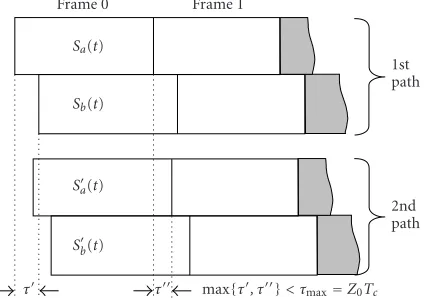
invoking a global positioning system (GPS) assisted synchro-nization protocol. If multipath effect exists, however, the fol-lowing condition should be maintained, that is,
max{τ,τ}< τmax=ZoTc, (40)
whereτkis relative delay due to quasisynchronous access, and
τkis the delay due to multipath transmission, as shown by
the received QS-CDMA signal r(t) in a 2-path channel in
Frame 0 Frame 1
Sa(t)
Sb(t)
Sa(t)
Sb(t)
τ τ max{τ, τ}< τmax=Z0Tc
1st path
2nd path
Figure 3: Received OS-CDMA signalr(t) in a 2-path channel, r(t)=sa(t) +sb(t) +sa(t) +sb(t) +n(t).
Figure 3. Therefore, in designing a QS-CDMA system, in or-der to reduce or eliminate the multiple access interference and multipath interference, it is generally required to design a set of spreading sequences having an orthogonal zoneZo
satisfying (40).
For a typical LAS-CDMA2000 system [19], the key design parameters are frame length: 20 ms, chip rate: 1.2288 Mcps, channel spacing: 1.25 MHz, LA code number: 8, LA “pulse” number/LA code: 16, LS code number/LA “pulse”: 32 × 2 (Zo = 4), modulation: 16 QAM (high mobility up to
500 km/h), 32 QAM (medium mobility up to 100 km/h), duplex: 2×1.25 MHz frequency-division duplex (FDD) or time-division duplex (TDD), maximum apparent data rate 1634.4 kpbs (high mobility) and 2048 kbps (medium mobil-ity). By excluding the encoding rate and other costs, such as pilot symbols and frame overheads, the spectral efficiency of LAS-CDMA2000 can be obtained as 1.31072 bps/Hz (high mobility) and 1.6384 bps/Hz (medium mobility), which is higher than the spectral efficiency of cdma2000-1x by about 0.6144 bps/Hz in medium mobility environment under the same assumptions. This advantage is due to the employment of the GO sequences, that is, the LA/LS codes.
dk(t) Sk(t)
ak(t)
ak(t)
ak(t)
cos(ω1t)
cos(ω2t)
cos(ωMt)
. . .
ck(t)
Figure4: QS-MC-CDMA transmitter.
dk(t) S P Sk(t)
d0,k
dS−1,k
ck(t)
ck(t)
a0(t)
aS−1(t)
+ .
. .
. . .
Figure5: Two-level spreading QS-CDMA transmitter.
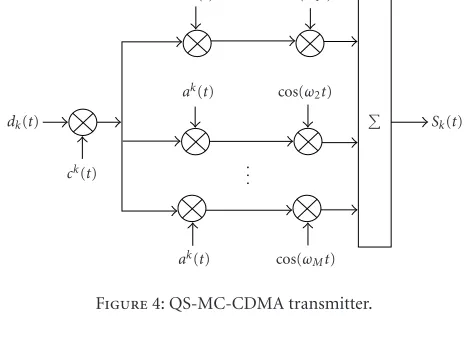
a proper system operation is how to keep the orthogonality between subcarriers of MC/OFDM signals. For the multicar-rier CDMA, instead of the time-domain correlation which is not a proper interference measure, one may use spectral cor-relation, together with crest factor and the dynamic range of the corresponding multicarrier waveforms [61]. Therefore, in order to make full use of the nice time-domain correla-tion properties of GO/GQO, one may consider the hybrid time/frequency spreading multicarrier CDMA systems, as shown inFigure 4(only transmitter is drawn for simplicity), whereck(t) of sizeM
1, andak(t) of sizeM2are the time and frequency domain spreading sequences, respectively, where ck(t) is chosen from a set of GO/GQO sequences, andak(t)
is chosen from a set of sequences with good spectral corre-lation and crest factor properties, such as multilevel Huff -man sequences, Zadoff-Chu sequences, Legendre sequences, or another set of GO/GQ sequences. Here, it is clear that the total number of users supported would beM=M1M2.
Figure 5describes a two-level scheme [31], where con-catenated WH/m-sequencesck(t) are used as the first-level
(FL) codes to provide the user and cell division, and a class of GO sequencesak(t) are employed as the second-level (SL)
se-quences to distinguish channels belonging to the same user. The data bit of thesth channelds,kis first spread by the FL
codeck(t) toL
1chips with the chip duration ofT1=Tb/L1, whereTbis the bit duration. Then each FL chipds,kckn,n =
0, 1,. . .,L1−1, is further spread by the SL codea’(s)of length
a(1) a(1)
a(2) a(2)
a(3) a(3)
a(4) a(4)
Data symbols
Data symbols
Data symbols
Data symbols
Data symbols
Data symbols
Data symbols
Data symbols
Figure6: MIMO channel estimation with GO sequences,a(1),a(2),
a(3), anda(4).
L2and the resultant chip durationTc=Tb/(L1×L2). It can be shown that, compared with that of the conventional single-level spreading system, the two-single-level QS-CDMA system em-ploying GO sequences and partial interference cancellation exhibits better system performance.
In order to accurately and efficiently perform channel estimation in single- and multiple-antenna communication systems, single GO sequence [34,35] and set of GO/GQO sequences [36,37] can be used. In particular, for a multiple-input multiple-output (MIMO) channel estimation system shown inFigure 6, if the training sequencea(i),i=1, 2, 3, 4, allocated to each antenna is not only orthogonal to its shifts withinZotaps but also orthogonal to the training sequences
in other antennas and their shifts within Zo taps, then the
mutual interference among different antennas will be kept minimum, which makes the GO sequence set an excellent candidate. In fact, for MIMO channel estimation, it is shown in [36,37] that the use of the GO sequences,or (P,V,M) sequences as named by Yang and Wu [36], can effectively reduce the mutual interference among different transmit-ting antennas, compared with the pseudorandom binary se-quences and arbitrarily chosen sese-quences.
8. CONCLUDING REMARKS
It is clear that the new GO/GQO concepts have opened a new direction for the spreading sequence design, and a potential promising application for the new GO/GQO spreading se-quences is the quasisynchronous CDMA systems, in partic-ular the quasisynchronous multicarrier CDMA systems and LAS-CDMA systems. In addition, other suitable application areas are still under investigation by many researchers.
It is noted in this paper that the new theoretical bounds for the GO/GQO sequences include the bounds for con-ventional spreading sequences as special cases. Furthermore, stronger bounds can be obtained for conventional sequences in certain cases. However, for specific GO/GQO sequence de-sign, such as ternary LA/LS codes and binary GO/GQO se-quences, there are still many theoretical limit issues that need further attention and investigation. Besides, the relationship between the GO/GQO theoretical limits and other research fields such as error correction coding, combinatorics, alge-braic theory, and so forth is not yet clear.
the desirable optimal GO/GQO spreading sequences satis-fying the theoretical bounds for different lengths, such as binary and nonbinary GO/GQO sequences, two- or higher-dimensional GO/GQO sequences, GO/GQO hopping se-quences, and so on. Even for the construction of single bi-nary sequence case (M = 1), it is still an open problem for finding a GO sequence withZo = N/2 for arbitrary length
N, since only partial solutions have been found for short and specific lengths.
ACKNOWLEDGMENTS
The author would like to thank his colleagues and stu-dents, Dr. Xiaohu Tang, Prof. Daiyuan Peng, Dr. Li Hao, Dr. Xinmin Deng, Dr. Junsong Xie, Mrs. Wenxia Ye, and Mrs. Xiaoning Wang, for their related excellent work and assistance. The author also thanks Professor Naoki Suehiro and Dr. Shinya Matsufuji (Japan), Professor Mike Darnell (UK), Dr. Wai Ho Mow (Hong Kong), Dr. Branislav M. Popovi´c (Sweden), Prof. Daoben Li (China), and Dr. William C. Y. Lee (USA) for their fruitful and insightful discus-sions on this research. This work was supported in part by the National Science Foundation of China (NSFC) and the Research Grants Council of Hong Kong (RGC) joint research scheme (No.60218001/N HKUST617-02), NSFC (No.60302015), and the Royal Society, UK. This work was partially presented as an invited plenary speech at the 2002 International Conference of Communications, Circuits and Systems (IEEE ICCCAS ’2002), June 29–July 1, 2002, Chengdu, China.
REFERENCES
[1] M. B. Pursley, “Performance evaluation for phase-coded spread-spectrum multiple-access communication—Part I: System analysis,” IEEE Trans. Communications, vol. 25, no. 8, pp. 795–799, 1977.
[2] P. Z. Fan and M. Darnell, Sequence Design for Communica-tions ApplicaCommunica-tions, Research Studies Press (RSP), John Wiley & Sons, London, UK, 1996.
[3] D. Peng and P. Z. Fan, Sequence Design and Applications for CDMA Systems,P. Z. Fan and N. Suehiro and M. Darnell, Eds., Southwest Jiaotong University Press, Chengdu, China, 2001.
[4] P. Z. Fan and L. Hao, “Generalized orthogonal sequences and their applications in synchronous CDMA systems,” IE-ICE Trans. Fundamentals, vol. E83-A, no. 11, pp. 1–16, 2000. [5] F. Adachi, M. Sawahashi, and K. Okawa, “Tree-structured
generation of orthogonal spreading codes with different lengths for forward link of DS-CDMA mobile radio,” Elec-tronics Letters, vol. 33, no. 1, pp. 27–28, 1997.
[6] B. M. Popovic, N. Suehiro, and P. Z. Fan, “Orthogonal sets of quadriphase sequences with good correlation properties,” IEEE Transactions on Information Theory, vol. 48, no. 4, pp. 956–959, 2002.
[7] S. Matsufuji and N. Suehiro, “Complex Hadamard matrices related to Bent sequences,” IEEE Transactions on Information Theory, vol. 42, no. 2, pp. 637, 1996.
[8] K. Yang, Y.-K. Kim, and V. P. Kumar, “Quasi-orthogonal sequences for code-division multiple-access systems,” IEEE Transactions on Information Theory, vol. 46, no. 3, pp. 982– 993, 2000.
[9] L. R. Welch, “Lower bounds on the maximum cross correla-tion of signals (Corresp.),” IEEE Transactions on Information Theory, vol. 20, no. 3, pp. 397–399, 1974.
[10] V. M. Sidelnikov, “On mutual correlation of sequences,” So-viet Math. Dokl., vol. 12, no. 1, pp. 197–201, 1971.
[11] D. Sarwate, “Bounds on crosscorrelation and autocorrelation of sequences (Corresp.),” IEEE Transactions on Information Theory, vol. 25, no. 6, pp. 720–724, 1979.
[12] J. L. Massey, “On Welch’s bound for the correlation of a se-quence set,” inProc. IEEE International Symposium on Infor-mation Theory, p. 385, Budapest, Hungary, June 1991. [13] V. I. Levenshtein, “New lower bounds on aperiodic
crosscor-relation of binary codes,” IEEE Transactions on Information Theory, vol. 45, no. 1, pp. 284–288, 1999.
[14] D. Y. Peng and P. Z. Fan, “Generalized Sarwate bounds on the aperiodic correlation of complex roots of unity sequences,” to appear inIEE Proceedings on Communications.
[15] A. Lempel and H. Greenberger, “Families of sequences with optimal Hamming-correlation properties,”IEEE Transactions on Information Theory, vol. 20, no. 1, pp. 90–94, 1974. [16] T. S. Seay, “Hopping patterns for bounded mutual
interfer-ence in frequency hopping multiple access,” inProc. IEEE Mil-itary Communications Conference, pp. 22.3.1–22.3.6, Boston, Mass, USA, October 1982.
[17] D. Y. Peng and P. Z. Fan, “New lower bounds on the Ham-ming correlations of frequency-hopping sequences,” inProc. 7th International Symposium on Communication Theory and Applications, pp. 307–310, Ambleside, Lake District, UK, July 2003.
[18] P. Z. Fan and M. Darnell, “Construction and comparison of periodic digital sequence sets,” IEE Proceedings Communica-tions, vol. 144, no. 6, pp. 361–366, 1997.
[19] D. B. Li, “The perspectives of large area synchronous CDMA technology for the fourth-generation mobile radio,” IEEE Communications Magazine, vol. 41, no. 3, pp. 114–118, 2003. [20] W. C. Y. Lee, “The most spectrum-efficient duplexing system: CDD,” IEEE Communications Magazine, vol. 40, no. 3, pp. 163–166, 2002.
[21] W. C. Y. Lee, “Analysis and realization of a physical CDD sys-tem,”Wireless Communications and Mobile Computing, vol. 3, no. 5, pp. 571–583, 2003.
[22] P. Z. Fan, J. Li, and Y. Pan, “Special issue: coding and its appli-cations in CDMA wireless systems,”Wireless Communications and Mobile Computing, vol. 3, no. 5, pp. 549–551, 2003. [23] N. Suehiro, “A signal design without co-channel interference
for approximately synchronized CDMA systems,”IEEE Jour-nal on Selected Areas in Communications, vol. 12, no. 5, pp. 837–841, 1994.
[24] H.-H. Chen, J.-F. Yeh, and N. Suehiro, “A multicarrier CDMA architecture based on orthogonal complementary codes for new generations of wideband wireless communica-tions,” IEEE Communications Magazine, vol. 39, no. 10, pp. 126–135, 2001.
[25] J. S. Xie and P. Z. Fan, “On the multicarrier DS CDMA system with generalized orthogonal spreading sequences,” to appear inChinese Journal of Electronics, (English version).
[26] V. M. DaSilva and E. S. Sousa, “Multicarrier orthogonal CDMA signals for quasi-synchronous communication sys-tems,”IEEE Journal on Selected Areas in Communications, vol. 12, no. 5, pp. 842–852, 1994.
[28] L. Hao and P. Z. Fan, “On the performance of synchronous DS-CDMA systems with generalized orthogonal spreading codes,” Chinese Journal of Electronics, vol. 12, no. 2, pp. 219– 224, 2003, (English version).
[29] M. Saito, T. Yamazato, H. Okada, M. Katayama, and A. Ogawa, “Generation of sets of sequences suitable for multi-code transmission in quasi-synchronous CDMA systems,” IE-ICE Trans. on Communication, vol. E84-B, no. 3, pp. 576–580, 2001.
[30] P. Z. Fan, N. Suehiro, and N. Kuroyanagi, “A novel interference-free CDMA system,” in Proc. 10th Interna-tional Symposium on Personal, Indoor and Mobile Radio Com-munications, pp. 440–444, Osaka, Japan, September 1999, B8-13.
[31] L. Hao and P. Z. Fan, “On a two level spreading system (In-vited talk),” Tech. Rep. 2001-51, IEICE SST, Japan, 2001, pp. 19–22.
[32] J. Wolfmann, “Almost perfect autocorrelation sequences,” IEEE Transactions on Information Theory, vol. 38, no. 4, pp. 1412–1418, 1992.
[33] B. P. Popovic, “Class of binary sequences for mobile channel estimation,” Electronics Letters, vol. 31, no. 12, pp. 944–945, 1995.
[34] Y. Han, “On the minimization of overhead in channel im-pulse response measurement,”IEEE Trans. Vehicular Technol-ogy, vol. 47, no. 2, pp. 631–636, 1998.
[35] X. M. Deng, P. Z. Fan, and Y. Han, “Comments on “on the minimization of overhead in channel impulse response mea-surement” [and reply],”IEEE Trans. Vehicular Technology, vol. 49, no. 5, pp. 2039–2040, 2000.
[36] S.-A. Yang and J. S. Wu, “Optimal binary training sequence design for multiple-antenna systems over dispersive fading channels,” IEEE Trans. Vehicular Technology, vol. 51, no. 5, pp. 1271–1276, 2002.
[37] P. Z. Fan and W. H. Mow, “On optimal training sequence design for multiple-antenna systems over dispersive fading channels and its extensions,” to appear inIEEE Trans. Vehicu-lar Technology.
[38] P. Z. Fan, N. Suehiro, N. Kuroyanagi, and X. M. Deng, “Class of binary sequences with zero correlation zone,” Electronics Letters, vol. 35, no. 10, pp. 777–779, 1999.
[39] X. M. Deng and P. Z. Fan, “Spreading sequence sets with zero correlation zone,”Electronics Letters, vol. 36, no. 11, pp. 993– 994, 2000.
[40] J. S. Cha, S. Kameda, M. Yokoyama, H. Nakase, K. Masu, and K. Tsubouchi, “New binary sequences with zero-correlation duration for approximately synchronised CDMA,”Electronics Letters, vol. 36, no. 11, pp. 991–993, 2000.
[41] S. Matsufuji, “Two families of sequence pairs with zero cor-relation zone,” inProc. 4th International Conference on Par-allel and Distributed Computing, Applications and Technolo-gies, P. Z. Fan and H. Shen, Eds., pp. 899–903, IEEE Press, Chengdu, China, August 2003.
[42] D. B. Li, “A high spectrum efficient multiple access code,” Chinese Journal of Electronics, vol. 8, pp. 221–226, July 1999. [43] X. B. Zhou and W. K. Lu, “Performance analysis of LA codes
in LAS-CDMA,” inProc. 6th International Conference on Sig-nal Processing, vol. 2, pp. 1307–1311, Beijing, China, August 2002.
[44] B.-J. Choi and L. Hanzo, “On the design of LAS spreading codes,” inProc. 56th IEEE Vehicular Technology Conference, vol. 4, pp. 2172–2176, Vancouver, Canada, September 2002. [45] K. Takatsukasa, S. Matsufuji, Y. Watanabe, N. Kuroyanagi, and
N. Suehiro, “Ternary ZCZ sequence sets for cellular CDMA systems,” IEICE Trans. Fundamentals, vol. E85-A, no. 9, pp. 2135–2140, 2002.
[46] J. S. Cha, “Class of ternary spreading sequences with zero cor-relation duration,”Electronics Letters, vol. 37, no. 10, pp. 636– 637, 2001.
[47] H. M. Donelan and T. O’Farrell, “Large families of ternary sequences with aperiodic zero correlation zones for a MC-DS-CDMA system,” inProc. 13th IEEE International Symposium on Personal, Indoor and Mobile Radio Communications, vol. 5, pp. 2322–2326, Lisbon, Portugal, September 2002.
[48] S. Matsufuji, N. Kuroyanagi, N. Suehiro, and P. Z. Fan, “Two types of polyphase sequence sets for approximately synchro-nized CDMA systems,”IEICE Trans. Fundamentals, vol. E86-A, no. 1, pp. 229–234, 2003.
[49] X. M. Deng, P. Z. Fan, and N. Suehiro, “Sequences with zero correlation over Gaussian integers,”Electronics Letters, vol. 36, no. 6, pp. 552–553, 2000.
[50] X. H. Tang and P. Z. Fan, “A class of pseudonoise sequences over GF(P) with low correlation zone,” IEEE Transactions on Information Theory, vol. 47, no. 4, pp. 1644–1649, 2001. [51] X. H. Tang and P. Z. Fan, “Generalized d-form sequences and
LCZ sequences based on the interleaving technique,” inProc. 7th International Symposium on Communication, Theory and Applications, pp. 276–281, Ambleside, Lake District, UK, July 2003.
[52] X. H. Tang, P. Z. Fan, D. B. Li, and N. Suehiro, “Binary array set with zero correlation zone,”Electronics Letters, vol. 37, no. 13, pp. 841–842, 2001.
[53] T. Hayashi, “A class of two-dimensional binary sequences with zero-correlation zone,” IEEE Signal Processing Letters, vol. 9, no. 7, pp. 217–221, 2002.
[54] W. X. Ye and P. Z. Fan, “Two classes of frequency hopping sequences with no-hit zone,” inProc. 7th International Sym-posium on Communications Theory and Applications, pp. 304– 306, Ambleside, Lake District, UK, July 2003.
[55] X. N. Wang and P. Z. Fan, “A class of frequency hopping se-quences with no hit zone,” inProc. 4th International Confer-ence on Parallel and Distributed Computing, Applications and Technologies, P. Z. Fan and H. Shen, Eds., pp. 896–898, IEEE Press, Chengdu, China, August 2003.
[56] X. H. Tang, P. Z. Fan, and S. Matsufuji, “Lower bounds on correlation of spreading sequence set with low or zero corre-lation zone,” Electronics Letters, vol. 36, no. 6, pp. 551–552, 2000.
[57] X. H. Tang and P. Z. Fan, “Bounds on aperiodic and odd cor-relations of spreading sequences with low and zero correlation zone,”Electronics Letters, vol. 37, no. 19, pp. 1201–1203, 2001. [58] D. Y. Peng and P. Z. Fan, “Bounds on aperiodic auto- and cross-correlations of binary sequences with low or zero cor-relation zone,” inProc. 4th International Conference on Par-allel and Distributed Computing, Applications and Technolo-gies, P. Z. Fan and H. Shen, Eds., pp. 882–886, IEEE Press, Chengdu, China, August 2003.
[59] D. Y. Peng and P. Z. Fan, “Generalised Sarwate bounds on periodic autocorrelations and crosscorrelations of binary se-quences,” Electronics Letters, vol. 38, no. 24, pp. 1521–1523, 2002.
[60] S. Hara and R. Prasad, “Overview of multicarrier CDMA,” IEEE Communications Magazine, vol. 35, no. 12, pp. 126–133, 1997.
[61] B. M. Popovic, “Spreading sequences for multicarrier CDMA systems,”IEEE Trans. Communications, vol. 47, no. 6, pp. 918– 926, 1999.
[63] M. Z. Win and R. A. Scholtz, “Ultra-wide bandwidth time-hopping spread-spectrum impulse radio for wireless multiple-access communications,” IEEE Trans. Communica-tions, vol. 48, no. 4, pp. 679–689, 2000.
Pingzhi Fanis a Senior Member of IEEE. He received his Ph.D. degree from the Uni-versity of Hull, UK. He is currently a pro-fessor and director of the institute of Mo-bile Communications, Southwest Jiaotong University, China, and a Guest Professor at Leeds University (UK) and Shanghai Jiao-tong University (China). He was a recipi-ent of the UK ORS Award (1992), and the NSFC Outstanding Young Scientist Award