Attribution Case Studies with Elite Junior Australian Footballers and Their Coach
Alyse K. Wilcox
Thesis submitted in partial fulfilment of the requirements of the Doctor of Applied Psychology (Sport) Degree
September 2015
College of Social Sciences and Psychology Faculty of Arts, Education, and Human Movement
DECLARATION
I, Alyse Wilcox, declare that the Doctor of Applied Psychology (Sport) thesis entitled “Attribution Case Studies with Elite Junior Australian Football Players and Their Coach” is no more than 40,000 words in length including quotes and exclusive of tables, figures, appendices, bibliography, references and footnotes. This thesis contains no material that has been submitted previously, in whole or in part, for the award of any other academic degree or diploma. Except where otherwise indicated, this thesis is my own work.
ABSTRACT
The purpose of the current research was to extend knowledge of attribution processes in sport. Specifically, the attribution processes of coach-athlete dyads were investigated over several weeks of competition, focusing on the application of theoretical
frameworks (i.e., Heider, 1958; Kelley, 1967; Rees, Ingeldew, & Hardy, 2005a; Weiner, 1985) to attribution processes. Attribution change and the influence of coach feedback and post-game review procedures on attribution processes were also investigated. Three elite junior Australian Football (AF) players (18-19 years) and their head coach (45 years) were interviewed on multiple occasions through an attribution lens. Each athlete was interviewed on three occasions (pre-game, post-game, post-feedback) and the athletes’ coach was also interviewed two days post performances for the same three games. Player-participants’ stories are presented as case studies, with attention given to how their stories related to the literature. Participants’ stories reflected several aspects of theoretical frameworks (i.e., Heider, 1958; Kelley, 1967; Weiner, 1985). There was evidence of actor and observer divergence with the coach-participant providing more dispositional causal ascription than player-participants. Player-participants
demonstrated attribution change after their post-game feedback possibly revealing the influence of review processes for mediating attributions. For example, after coach feedback, athletes used the coach’s attributions to explain their performance outcome. In addition, their attributions tended towards using more dispositional causes in their post-coach feedback interviews than were used in their post-game interviews. The findings may demonstrate the strong influence that coaches have on athletes’
DEDICATION
AKNOWLEDGEMENTS
I would like to extend my sincerest thanks to the following people who have assisted me and supported me throughout my efforts to complete this thesis, and my studies. I would like to thank my supervisor, Daryl Marchant, for providing me with support and encouragement. I am grateful for the opportunities you have given me and the time you dedicated to my thesis.
I would like to extend many thanks to Andrew Jago who has always been there when I needed some advice. The support you have given me over the last five years is priceless. You never stopped believing in my capabilities. Thank you to Mark and Harriet for the support you have provided in my development as a psychologist and for encouraging me to reflect on, and learn from, my experiences. Special thanks to Mark for laughing with me when my insecurities entered the room and for helping me see the value of my work with my clients. Thank you for the time, patience, and unconditional love you have given me throughout the doctorate process.
To my parents, Chris and Kathy, sister Stephanie, brother Sam, and partner Tom, thank you for your unconditional love and patience over the four years. You have encouraged me, kept me on track, and without your support I may not have completed my studies. To my friends who have endured my absence over the last four years, thank you for constantly reminding me why I am still at university when I complain about my studies. You have kept me motivated throughout the journey and I will be forever grateful. Thank you to my peers, the ‘arbitrary metrics’, for the laughs, support, and encouragement you have given me. Only we can understand the journey we have been on and I look forward to working with you all in the future.
TABLE OF CONTENTS
DECLARATION ... ii
ABSTRACT ... iii
DEDICATION ... iv
AKNOWLEDGEMENTS ... v
TABLE OF CONTENTS ... vi
LIST OF FIGURES ... xi
LIST OF TABLES ... xii
CHAPTER 1: INTRODUCTION ... 1
The Current Research ... 5
The Research Aims ... 6
Context ... 7
CHAPTER 2: REVIEW OF THE LITERATURE ... 8
Theoretical Perspectives on Attributions ... 8
The Basic Assumptions Underlying Attribution Theories ... 8
The motive to link events causally. ... 8
Desire to make realistic attributions. ... 9
Attribution theory as a cognitive approach. ... 10
Attribution Theories ... 10
Antecedents of Causal Attribution Theories ... 11
Naïve psychology of action. ... 11
Correspondent inference theory. ... 13
Co-variation principle. ... 13
Consequences of Causal Attribution Theories ... 16
Achievement motivation theory (AMT). ... 17
Attribution theory of emotion and motivation. ... 18
Outcome-dependent affect. ... 19
Causal antecedents. ... 21
Causal ascriptions. ... 22
Psychological consequences. ... 23
Overall Summary of Theoretical Perspectives on Attributions ... 25
Theoretical Perspectives on Attributions in Sport ... 26
Antecedents of Causal Attribution Theories in Sport ... 26
Naïve psychology of action in sport. ... 27
Co-variation principle in sport. ... 27
Consequences of Causal Attribution Theories Applied to Sport ... 29
Outcome-dependent affect in sport. ... 30
Causal antecedents in sport. ... 31
Causal ascriptions in sport... 37
Causal dimensions in sport. ... 39
Psychological and affective consequences in sport... 39
Behavioural consequences. ... 42
Overall Summary of Attribution Theories in Sport ... 44
Attributions and Australian Football ... 44
Rationale for the Current Research ... 45
CHAPTER 3: METHOD ... 48
Participants ... 48
Procedure ... 49
Ethical Considerations ... 52
Design ... 53
Interviews ... 53
Game Statistics ... 54
Field Notes ... 55
Data Analysis and Interpretation ... 55
Presentation of Data ... 56
CHAPTER 4: CASE STUDY 1 ... 57
Sam’s Story ... 57
Introduction ... 57
Pre-Game Mental State ... 58
Pre-game emotions. ... 58
Causal dimensions. ... 61
Summary of pre-game mental state. ... 62
Post-Game Mental State ... 63
Outcome-dependent affect. ... 63
Causal antecedents. ... 68
Actor and observer differences. ... 69
Attribution biases. ... 74
Causal ascription. ... 76
Attribution Change and the Coach-Athlete Dyad ... 77
Sam and I: Reflections on the Research Process ... 81
CHAPTER 5: CASE STUDY 2 ... 83
Ollie’s Story ... 83
Introduction ... 83
Pre-Game Mental State ... 83
Pre-game emotions. ... 84
Preparation. ... 84
Perceptions of leadership. ... 85
Deflection and false humility ... 86
Antecedent influences. ... 86
Game importance. ... 87
Summary of pre-game mental state. ... 88
Post-Game Mental State ... 89
Outcome-dependent affect. ... 89
Causal antecedents ... 90
Actor and observer differences. ... 91
Attribution biases. ... 97
Causal ascription and positional changes. ... 98
Attribution Change and the Coach-Athlete Dyad ... 99
Ollie and I: Reflections on the Research Process ... 102
CHAPTER 6: CASE STUDY 3 ... 104
Pre-Game Mental State ... 104
Pre-game emotions. ... 105
Team cohesion. ... 106
Pre-game... 107
Summary of Pre-Game Mental State ... 109
Post-Game Mental State ... 109
Outcome-dependent affect ... 110
Causal antecedents. ... 112
Actor and observer differences. ... 113
Attribution biases. ... 116
Causal ascription. ... 117
Attribution Change and the Coach-Athlete Dyad ... 118
Lucas and I: Reflections on the Research Process ... 122
CHAPTER 7: OVERALL DISCUSSION ... 124
The Research Questions ... 124
Theoretical Frameworks and Athlete Attributions ... 124
Athlete Attributions ... 124
Theoretical frameworks... 125
Research Findings ... 127
Outcome-Dependent Affect ... 128
Causal Antecedents ... 130
Actor and observer differences ... 130
Attribution bias. ... 132
Perfectionism. ... 135
Performance Expectancy and Competition Importance ... 136
Causal Ascriptions ... 136
Attribution Change ... 138
Reliance on Statistics ... 139
Overall Analysis of the Research Findings ... 139
The Researcher in the Process ... 140
Final Thoughts ... 145
REFERENCES ... 147
APPENDIX A: INTERVIEW GUIDE ... 167
Athlete Pre-Game Interview Guide ... 167
Athlete Post-Game Interview Guide ... 167
APPENDIX B: CHAMPION DATA STATISTICS ... 170
Statistics for Sam ... 170
Statistics for Ollie ... 173
Statistics for Lucas ... 175
APPENDIX C: INFORMATON TO PARTICIPANTS ... 178
LIST OF FIGURES
LIST OF TABLES
CHAPTER 1: INTRODUCTION
For almost sixty years, social psychology researchers have been interested in the influence of attribution processes on the everyday lives of people. Exploration of
people’s attributions can be fascinating as attribution processes infiltrate virtually all aspects of their lives and dictate future behaviours. For example, peoples’ attribution styles influence their interpretation of past events, establish meaningfulness in their social environment, and influence their motivation levels (Heider, 1958; Weiner, 1979). People also engage in attribution processes to maintain consistency between their thoughts and beliefs, and prevent adverse effects of internal inconsistencies. People use attributions to make their everyday circumstances understandable, predictable, and controllable (Försterling, 2001).
Researchers have used several explanations to describe and define attributions (e.g., Försterling, 1988; Kelley, 1967). Hazelwood and Burke (2011) defined
attributions as individuals “strive(ing) to explain, understand, and predict events based on their cognitive perceptions and appraisals such as internality, powerful others, and luck, which influence the level of attainment in cognitive, affective, or motor tasks” (p. 330). Peoples’ cognitive interpretations of the events in their lives influence their wellbeing and interactions with others in their environment. The desire of individuals to understand and predict future events is essentially the premise of attribution theories.
Attribution theories in mainstream psychology represent conceptual frameworks used to understand how the layperson interprets and explains events, and the
rather they focus on the perceived reasons for behavioural outcomes (Försterling, 2001). Researchers have used attribution theories to explore achievement behaviour,
helplessness and depression, and social affiliation (e.g., Försterling, 1988; Kelley, 1967; Weiner, 1985). Attribution researchers have also analysed close interpersonal
relationships from an attribution perspective to evaluate how intimate partners interpreted and explained their social affiliations. Finally, researchers have used their exploration of attribution processes in interpersonal relationships to develop conflict resolution strategies, to enhance partner satisfaction and relationship longevity (e.g., Rempel, Ross, & Holmes, 2001).
In the 1980’s researchers began investigating attribution processes in
achievement settings and sport. Generally, sport psychology researchers adapted social psychologists’ definitions of attributions and applied them to a sport context. Grove and Prapavessis (1995) defined attribution theory in a sporting context as a “cognitive approach to motivation that focuses on how to interpret causes of success and failure” (Prapavessis, 1995, p. 92). Athletes and coaches have desires to understand performance outcomes so they can predict and plan for future performances. For example, an
unsuccessful performance outcome attributed to poor skill execution may lead to an adjustment in training strategies. Whereas, following poor performances, attributions of luck are likely to result in frustration but are unlikely to cause alterations to training strategies. Causal ascriptions, therefore, have implications for future behaviour and performance expectancy. Sport psychology researchers generally focus on the
and losing (e.g., Allen, 2011; Duda & Treasure, 2006). Possibly, a stronger focus on the broader benefits of sport beyond success and failure is needed to broaden the research lens. Attribution theories could be applied to physical wellbeing, psychological wellbeing, and social wellbeing, and particularly to why people start, continue, and eventually quit sport.
Sport attribution theorists have reconstructed and modified theories (e.g., Kelley’s Covariance Theory, 1967; Weiner’s Achievement Motivation Theory, 1979) initially proposed by social psychologists to explain and understand casual attributions in sport. More recently, researchers have re-reconceptualised attribution theories in sport (e.g., Allen, Coffee, & Greenlees, 2012; Rees, Ingledew, & Hardy, 2005a). For example, Rees, Ingledew, and Hardy (2005a) proposed a more contemporary and sophisticated framework to encompass the complexities of sport environments based on Abramson, Seligman, and Teasdale’s (1978) reformulation of the learned helplessness hypothesis. Despite the fresh approach by Rees and colleagues, additional research is needed to determine the applicability of attribution theories in different contexts.
The numerous theories proposed to explain and understand attribution processes have not necessarily translated or readily been applied to guide practitioners. Some researchers, however, (e.g., Chodkiewicz, & Boyle, 2014; Haynes-Stewart, Clifton, & Daniels, 2011; Kelley, 1967) have discussed attribution interventions designed to correct maladaptive attribution styles. Broadly, attribution retraining has been
extensively adopted by educational, clinical, and social psychologists. There are several similarities between attribution theories and cognitive psychology (i.e., focus on
retraining strategies include cognitive behavioural strategies, positive reinforcement, persuasion, and modelling (Sinnott & Biddle, 1998). These attribution retraining strategies are generally designed to prevent the adverse effects linked to maladaptive attribution styles (e.g., learned helplessness, depression, low self-esteem, and low motivation) (Försterling). Although there are several attribution retraining strategies, Chodkiewicz and Boyle (2014) questioned the limited application of retraining strategies to applied contexts. Specifically, they argued there has been a significant decline in attribution retraining strategies since the early 1990’s, and suggested that researchers have consistently conducted studies in laboratory settings rather than naturalistic settings. Finally, they argued that to better understand the effectiveness of attribution retraining strategies, researchers and practitioners need to reduce the theory to practice gap. More concentrated and definitive research is consequently needed to determine the most applicable retraining strategies to facilitate adaptive attribution styles.
Some attribution retraining strategies have been investigated by sport
with a consequent greater effort and focus on applied settings to better explain athletes’ attribution processes.
The Current Research
The role of attributions in individual and team performances needs further exploration (Allen, 2011). Many of the published studies have focused on
unidimensional reasons for achieving desired performance outcomes. Conceivably, the focus on unidimensional casual ascription is due to the scarcity of attribution research conducted between 1990 and 2005. Research designs have also become more
sophisticated and diverse allowing for a broader exploration of attribution processes than were conducted in the early stages. Attribution researchers in sport have primarily used quasi-experimental studies (e.g., Bukowski & Moore, 1980; Le Foll, Rascle, & Higgins, 2008; Orbach, Singer, & Price, 1999; Taylor & Doria, 1981; Taylor & Tyler, 1986). Athlete, coach, and team attributions are invariably dynamic with several key characteristics for performance outcomes. When researchers compact multi-faceted phenomena into a narrow conceptualisation of performance outcomes, the results can be overly specific and lack external validity. Faulkner and Findlay (2005) highlighted the need to explore attributions using qualitative methods as feasibly more detail regarding athlete and team attributions may be elucidated through use of interviews than relying solely on quantitative studies. In addition, the use of qualitative methods may allow for greater exploration of player-participants’ attribution expectations regarding
performance outcomes through understanding the influence of emotions and time on athlete attributions.
evaluative, motivational, and behavioural nature. It may, therefore, be beneficial to explore attributions in sport using qualitative methods to gain additional and specific insights into coach-athlete relationships, the influence of such relationships on Attribution change, the influence of emotional responses and time on Attribution processes. Specifically, in the current research, attribution processes in coach-athlete dyads and attribution change were investigated with elite junior Australian Football (AF) players and their coach. Shapcott, Carron, Greenlees, and El Hakim (2008) suggested that performance review processes within teams influenced athletes’
attribution changes in the days following competition. The current study was also used to investigate the influence of post-performance feedback on athletes’ attributions (e.g., is a shift in athletes’ attributions following feedback from coaches) and determined the impact of coach feedback on athletes’ perceptions of performance outcomes.
The Research Aims
The overarching aim was to present realistic in-depth representations of the lived experience of AF players from an attribution perspective. The primary aim was to explore the attribution processes of coach-athlete dyads over several weeks of competition. In addition, there were four secondary aims:
(1) To explore attribution processes in applied settings using tenants of Kelley’s (1967) co-variation theory, Weiner’s (1985) theory of attribution and emotions, and Rees et al.’s (2005a) re-conceptualisation of attribution theories as research lenses.
(3) To explore possible convergence and divergence between actors (players) and observer (coach) in casual ascription for players’ performances.
(4) To explore the influence of performance feedback on attribution change in the days following performances.
Context
Australian Football (AF) was chosen because I [student researcher] have an intimate knowledge of the game and have connections to high level participants. I have been a mental skills coach for a number of years and have consulted extensively with elite junior AF players and their coaches. I have observed young athletes experience successes and failures on their journeys and in striving to reach their often lofty goals. The pressures for young elite AF players, many of whom have desires to transition to the open aged professional level, are numerous. Athlete attributions of performance outcomes can influence motivation, self-esteem, and emotions generally (Anderson & Riger, 1991). The complexity of athlete attributions is heightened in a team context, with the potential to examine how multiple explanations are constructed and used to explain an event or a series of events. I have seen young athletes ‘stumble at the final hurdle’ while some contemporaries have flourished in the open age professional national competition. From my perspective as an early career applied sport
CHAPTER 2: REVIEW OF THE LITERATURE Theoretical Perspectives on Attributions
Since attributions in social and sport contexts became the focus of research attention, attempts have been made to provide a formal framework for understanding attribution processes. Researchers in sport psychology have used mainstream
psychology theories and applied them to the attribution processes of athletes, coaches, and teams (Allen, 2012). A brief overview of the most widely used theories, their application to attributions in sport, and relevant research findings is provided. The Basic Assumptions Underlying Attribution Theories
Researchers have developed a number of theories to explain attribution processes and these theories are empirically linked and share several commonalities (e.g., Heider, 1944, 1958; Kelley, 1967; Weiner, 1985). Försterling (1988) suggested that common to all attribution theories are three central assumptions: First, people are motivated to link events causally; second, people seek to make realistic attributions; and third, cognitions are central for behaviour, affect, and experiences.
The motive to link events causally. Individuals make causal inferences about outcomes of events because they want to understand why things happen in their lives. Försterling (1988) suggested that making causal inferences about the outcome of an event has hedonic value. For example, people are likely to experience pleasurable states of consciousness (e.g., satisfaction) when they can determine the causes that led to event outcomes. People that are unable to understand causal ascription for events can
individuals are unable to reach consistency in their beliefs about event outcomes, they can become agitated. Consequently, they are motivated to reduce inconsistencies and the negative emotions (Cooper, 2007). Indecisiveness about causal inferences has been linked to self-doubt, uncertainty, and feelings of worthlessness (Försterling, 1988). When people are able to understand their causal judgements they are better placed to predict future outcomes and behave appropriately in given situations. Associated with this, people engage in reflective processes to find consistency in their beliefs and event outcomes.
Desire to make realistic attributions. A basic assumption often applied to attribution research is that individuals attempt to construct realistic causal ascriptions based on events in their personal domains. Heider (1958) described people as ‘lay scientists’ who search for answers about why they respond to events in particular ways. People are motivated to use the information available to them for their causal
attributions by weighing the information rationally before making decisions on the causes for performance outcomes (Försterling, 1988). For example, an individual who fails an exam may consider study time, the teacher’s proficiency, and their own mental state before they determine the likely causes of failure.
these people are more inclined to disengage and also exhibit avoidance coping behaviour to avoid unpleasant and unsuccessful outcomes.
Attribution theory as a cognitive approach. Researchers use cognitive-based psychological theories to “specify how individuals select, process, store, recall, and evaluate information about the self and the environment” (Försterling, 1988, p. 11). Individuals use reflective practices to determine the causes of, and explanations for, behavioural outcomes, thus generating expectancies for future results. The information individuals choose to store and recall may be determined through attribution recall processes (Försterling, 1988). In their attribution cognitions, people may choose to include feedback from superiors, others in their interpersonal relationships, information from the environment, and others perceptions of event outcomes. They may, however, choose to omit feedback from external sources that contradict their perceptions of themselves (Carron, Burke, & Prapavessis, 2004). The interplay between individual perceptions of the social setting and the analysis of others in the social environment influences peoples’ conclusions about the causes of an event (Cooper, 2007). Attribution Theories
Attribution researchers have generally explored attributions from two perspectives. For example, Försterling (1988) suggested that the main “concern of attribution theories is to analyse the antecedent conditions of different causal
ascriptions” (p. 32). More recent researchers have suggested that attribution theories provide frameworks for analysing behavioural, affective, and cognitive consequences of attributions (e.g., Allen, Jones, & Sheffield, 2009; Ball, 2013; Weiner, 1985).
theories (Weiner et al., 1971; Weiner, 1979, 1985). Both attribution theory classifications are discussed in the following section.
Antecedents of Causal Attribution Theories
Initially, researchers were interested in the antecedents of causal attributions and developed theories to explain intent and motives (Heider, 1958; Kelley, 1967). People were motivated to gain mastery and understanding of why ‘things’ occurred for themselves, and to understand the motives of others within their social environment (Weiner, 1985). There are two predominant theories that explain the antecedents of causal attributions; Heider’s (1958) naïve psychology of action, and Kelley’s (1967) co-variation principle. Heider (1958) and Kelley (1967) base their theories on the
presumption that people search for mastery and understanding. They focus mainly on attributions related to interpersonal relationships presumably because of the centrality of human relations to overall wellbeing (Heider, 1958).
Naïve psychology of action. Heider (1944, 1958), a pioneer of attribution research, first considered the influence of the causes of behaviour on motivational and emotional processes. Heider (1958) described attribution process as the naïve
ascriptions about behavioural outcomes are finite. Once individuals believe they have identified the causes of behaviour they stop asking causal questions.
Heider (1958) suggested there are nine underlying concepts that influence peoples’ interpretation of their environment; (1) the subjective environment, individuals and other people are responsive to their environment and relative events; (2) perceiving, people engage in an interpretive process based on existing frameworks within their social environment; (3) suffering,experiencing, or being affected by, people or events in their environment; (4) causing, people need to attribute events to causal sources to explain and understand their reaction to their surroundings; (5) can, is related to the possibility of change and is linked to causation; (6) trying, the specific act of trying to change; (7) wanting, is linked to causation because when a person wants something, they aim to bring about certain actions and results; (8) sentiments, the positive or negative valuation attached to people and objects; (9) belonging, the concept of belonging is applied when separate entities form a unit.
Heider (1958) also suggested that in “common-sense psychology, the result of an action depends on two sets of conditions; factors within the person and factors within the environment” (Heider, 1958, p. 82). He proposed a bipolar construct termed
causality, whereby people attribute the outcomes of behaviour to either dispositional causes or situational causes. Outcomes of individuals’ behaviours that are attributed to dispositional causes are associated with factors within the person. These dispositional characteristics are relatively stable over time (i.e., motivation, ability, personality and effort). Conversely, outcomes of individuals’ behaviours that are attributed to
a theoretical basis for the ensuing work of Jones and Davis (1965), Kelley (1967) and Weiner (1971, 1979, 1985) who both further developed the premise of dispositional and situational causes for behavioural outcomes and developed the locus of causality
concept.
Correspondent inference theory. The correspondent inference theory was developed to continue the work of Heider (1958) and represents a theory that accounts for a perceiver’s inferences about what an actor is trying to achieve with a particular action. They suggested that people make correspondent inferences about another person when their actions are freely chosen, are unexpected, and undesirable. Observers seek to identify circumstances under which a behavior is interpreted as a reflection of an
internal and personal disposition of the actor (Jones & Davis, 1965). Jones and Davis (1965) emphasised that the less likely the event, the greater the level of information obtained if this event occurs. When a person acts in a manner that is different to what is expected, observers make more confident attributions about their behavior than if an event is expected (Jones & Davis, 1965). For example, when an observer observes someone acting in an aggressive manner, the correspondent inferences is that they are an aggressive person. If, however, the observations of the aggressive act are ‘out of character’ and non-correspondence is observed, there is a tendency to take more notice of the actor’s behaviour. Jones and Davis’ model provided insight into the Attribution processes of observers, however, it has not been cited regularly in sport research possibly due to Kelley’s (1967) advances on the attribution theory.
suggested there are three classes of causal attributions for effects that are relevant in social psychology: First, attributions to persons (ability); second, attributions to entities (task ease); and third, attributions to circumstance (time, chance). Kelley suggested that attribution processes refer to peoples’ perceptions of dispositional properties,
interactions, and events in the social environment. Kelley argued that when individuals seek to determine locus of causality, they attempt to acquire information about three aspects of behaviour; consistency, the frequency of behaviour exhibited by an individual in particular settings; distinctiveness, the frequency of a behaviour exhibited in other settings by the individual and; consensus, the number of other individuals also demonstrating the behaviour in particular settings. Determinations of consistency, distinctiveness, and consensus in causal ascriptions and behaviours will lead to either internal or external attributions being made (Wann, 1997; Wann & Dolan, 2001).
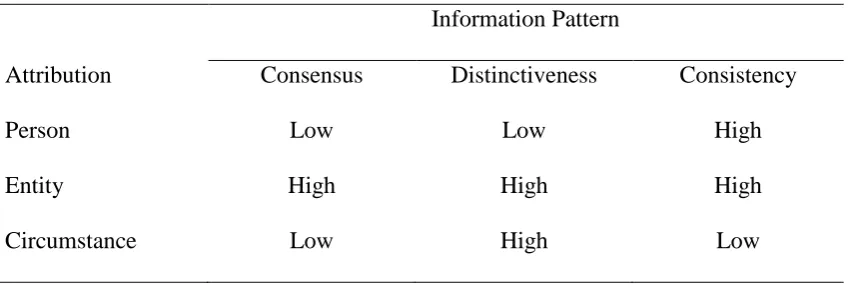
The information pattern in attribution processes using the co-variation principle effects causal inference (see Table 2.1). Orvis, Cunningham, and Kelley (1975)
suggested that:
The pattern of high consensus, high distinctiveness, and high consistency typically indicates something about the relevant stimulus; that the pattern of low consensus, low distinctiveness, and high consistency was interpreted in terms of something about a person; and that a pattern of low consensus, high
distinctiveness, and low consistency was usually interpreted as something about the particular circumstances (p. 606).
If an outcome (e.g., the person’s failure) only co-varies with entity (task) and not with the person or circumstances, attributions that focus on the task are primarily made. When task attributions are made there is high distinctiveness (e.g., they only failed at that task and not others), high consensus (e.g., everyone failed at that task), or high consistency (e.g., they failed at this task every time) (Orvis, Cunningham, & Kelley, 1975).
Table 2.1
Orvis, Cunningham, and Kelley’s Information Patterns for the Three Attributions(1975,
p. 607)
Information Pattern
Attribution Consensus Distinctiveness Consistency
Person Low Low High
Entity High High High
Circumstance Low High Low
Consequences of Causal Attribution Theories
Researchers in the 1980’s moved away from the antecedents of attributions and focused more on the consequences of causal attributions. Weiner and Kukla (1970) and Weiner et al. (1971) used previous attribution theories to develop a theory of
achievement motivation. They extended Kelley’s (1979) work on the locus of control and focused on the behavioural and motivational consequences of attributions rather than focusing on the processes that individuals use to arrive at specific types of attributions. Researchers, in using consequences of attribution theories have sought to determine the influence of attributions on behaviour, affect, and cognitive processes (Ball, 2013; Rees et al., 2005a; Stoeber & Becker, 2008). Weiner and colleagues were particularly interested in the role that attributions play in expectancy for future success in achievement settings.
determine the influence of the locus of causality on expectancy for future successes. They asked participants to play the role of a teacher by administering an exam to a class. These ‘teachers’ evaluated students’ performances and administered rewards (1-5 gold stars) or punishments (1-5 red stars). Teachers rewarded high effort in achievement settings, whereas they punished students’ low effort (Weiner & Kukla, 1970).
Conversely, Weiner and Kukla found that ability had little bearing on the provision of rewards or punishment in outcome evaluation. They emphasised that ability is relatively fixed whereas effort was variable. Ability, therefore, has limited influence on reward versus punishment. From their research, Frieze and Weiner (1971) subsequently made a distinction between ability and effort and formed the dimension of stability to signify differences.
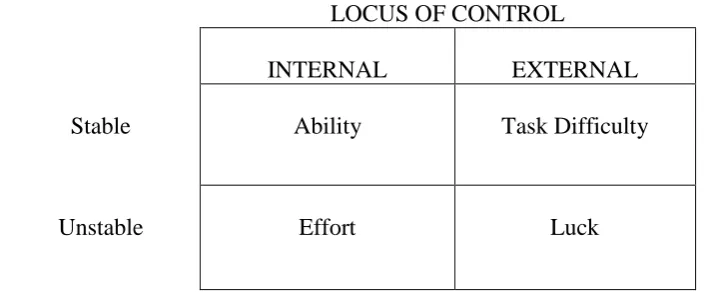
Achievement motivation theory (AMT). Weiner (1972) initially constructed his initial two-dimensional model (locus of control, and stability) that included four determinants of behavioural outcomes (ability, effort, task difficulty and luck), and the linkages of value (incentive, affect). The four determinants of behaviour are “placed along two dimensions: (a) an internal/external dimension that differentiates between causes that are within the person (e.g., ability and effort) and causes that are outside of the person (e.g., luck and task difficulty); (b) a stable/unstable dimension that
Figure 2.1. The Weiner (1972) four dimensional original attribution model
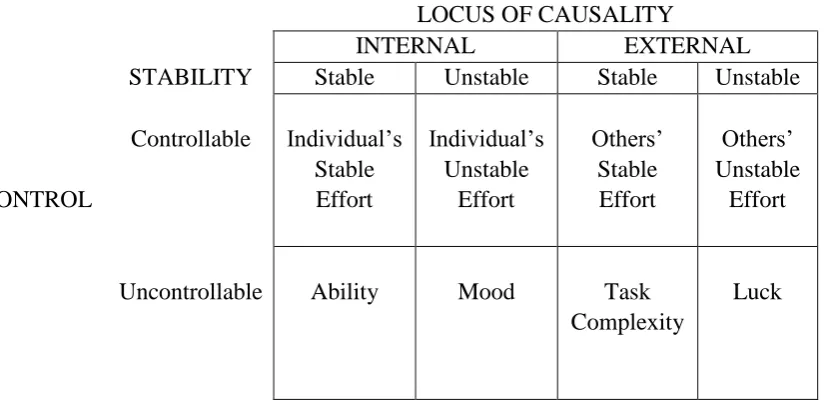
Later, Weiner (1979) proposed a third dimension, controllability, after poor strategy was considered the cause of failure and contrasted with a lack of effort. Both strategy and effort are considered as internal and variable. A lack of effort, however, leads to greater punishment for failure than poor strategy. The proposed additional dimension, controllability, is the extent that individuals believe their behaviour is under voluntary control (see Figure 2.2). Weiner (1985, 2010) argued that attributions falling on the controllability dimension are vital for individuals’ motivation, decision-making, and future performance.
Attribution theory of emotion and motivation. Central to Weiner’s (1979)
research was the influence of attribution processes on emotions following performance outcomes. Weiner (1985), therefore, proposed a comprehensive attribution theory of motivation and emotion that has been widely used in research to explain the influence of attribution processes on expectancy. Weiner (1985) suggested that expectancies for
STABILITY
LOCUS OF CONTROL
INTERNAL EXTERNAL
Stable Ability Task Difficulty
LOCUS OF CAUSALITY
INTERNAL EXTERNAL
STABILITY Stable Unstable Stable Unstable
CONTROL
Controllable Individual’s Stable Effort Individual’s Unstable Effort Others’ Stable Effort Others’ Unstable Effort
Uncontrollable Ability Mood Task
Complexity
Luck
Figure 2.2 The Weiner (1979) reformulated causal attribution model.
future performance outcomes were influenced primarily by the stability dimension, and emotions (incentives) by the locus of causality dimension. With further research, Weiner (1985) found that emotions were also linked to controllability of future
performance outcomes (see Figure 2.3). The components of Weiner’s (1985) attribution theory of motivation and emotion are discussed in the following sections.
Outcome-dependent affect. Emotional responses following success or failure
promoted. She further analyses missing the promotion and reasons that Julie deserved the promotion because she was with the company for four years longer than Lucy. A number of attribution specific emotions follow causal ascription. For example, Lucy may experience frustration and sadness about missing out on a promotion; however, she may also experience happiness for her colleague Julie. Third, the attributions for success and failure can be classified into causal dimensions (i.e., locus of causality, stability, controllability) (Weiner et al., 1979).
Causal antecedents.There are several antecedent factors that influence
attribution processes following success or failure. For example, social comparison, past outcome history, attribution biases, and effort expenditure influence casual decisions (Weiner, 1985). Some researchers have investigated social comparison and sought to determine whether there are differences between actors and observers in attributions after event outcomes (e.g., Jones & Nisbett, 1972; Miller & Norman, 1975). Apparently, there is a tendency for actors to attribute their actions to situational requirements,
whereas observers tend to attribute the same actions to stable, personal dispositions. Miller and Norman (1975)suggested that there should be a distinction made between passive and active observers. Passive observers are those who neither influence nor are influenced by the actors they are observing. Active observers are those persons who influence and are influenced by the actors they are observing (e.g., teacher).
Attribution biases are another key component of casual antecedents. People use attribution biases to protect, maintain, or enhance their self-esteem, a tendency linked to motivation for future participation and performances (Weiner, 2010). Individuals who use attribution biases demonstrate a propensity to make dispositional (internal)
unsuccessful outcomes (Allen, 2010). People generally feel a sense of pride and satisfaction if they attribute successful outcomes to internal causes, and maintain their feelings of self-esteem, and protect against negative emotions (i.e., embarrassment, sadness) by attributing failure to external sources (Weiner, 1985).
Causal ascriptions. Goal attainment influences emotional responses after
outcomes in achievement settings, such as subsequent thoughts and future actions. Weiner (1985, 2010) suggested that following the outcome of an event there is a general positive or negative reaction based on perceived success or failure. Primitive emotions are influenced by the attainment (e.g., happiness) or nonattainment (e.g., sadness, frustration) of a desired goal. People then engage in a causal search after goal
attainment or non-attainment to determine why the outcome occurred (Weiner, 1985). Causal ascription to an event outcome is made following primary appraisal and
immediate affective emotions. Causal ascription leads to a new set of emotions labelled as attribution-dependent; these emotions are determined by the cause of the prior outcome. Weiner (1985) suggested that the “the causal decision is biased towards a relatively small number of causes such as stability and effort in the achievement domain” (Weiner, 1985, p. 564). The cause is located in dimensional space (i.e., locus of causality, stability, controllability) once casual ascription has been made (Weiner, 1985).
Causal dimensions. There are three causal dimensions consistently referred to in
bad strategy” (Weiner, 1985, p. 554). For example, a student who crams for an exam may not purposefully use this strategy of revision, rather, they may have several exams and have poor time management skills. Weiner (1985) found that intent and
controllability co-varied highly despite the initial promise of an independent
intentionality dimension. He argued that although there are conceivable distinctions between controllability and intentionality, there are several empirical issues with the dimension of intentionality and thus excluded it from his attribution theory of motivation and emotion (Weiner, 1985). Abramson, et al. (1978) proposed the
dimension of globailty by arguing that some causes are specific to a situation, whereas other causes generalise across settings. For example, an individual may perceive failure at an archery task due to poor archery skills (specific) or to poor co-ordination (general).
Psychological consequences. There are several psychological consequences
associated with dimension-related emotions (Weiner, 1985). Weiner (2008, 2014) suggested that attributions assigned to the locus of causality relate to self-directed emotions (i.e., pride, self-esteem). If a successful outcome is attributed to dispositional (internal) causes, or an unsuccessful outcome is attributed to situational (external) causes, the person is likely to experience heightened or stable self-esteem levels and a sense of pride. If, however, failure is attributed to dispositional (internal) causes, or success to situational (external) causes, they will likely experience lowered or stable self-esteem.
Causal ascriptions that are suggestive of the stability dimension are related to the psychological consequence of expectancy of success. Attributions influencing
will likely influence the emotions experienced. For example, an attribution made to internal and stable causes (e.g., aptitude deficiency) will likely lead to feelings of lowered self-esteem, hopelessness, and lowered expectancy. Attributions made to internal and unstable causes (e.g., low effort) will likely lead to individuals’ remaining hopeful of performance improvements; however, it may lower self-esteem in the short term. Conversely, attributions made to external and stable causes (e.g., poor teacher) are unlikely to lower self-esteem but lead to feelings of hopelessness. Finally, individuals making external and unstable attributions (e.g., bad luck) will likely maintain or increase hope (Weiner, 2014).
Causal ascriptions related to the dimension of controllability are generally related to other-directed emotions (Weiner, 1985, 2014). People who feel in control of unsuccessful outcomes may feel a sense of guilt or shame. Conversely, they may experience anger or pity if they feel others have caused the unsuccessful outcome (personally uncontrollable). For example, individuals’ receiving poor maths results may feel anger towards their teachers if they believe their teachers were largely responsible for the poor result. In this scenario, students lack perceived control regarding the performance outcome and thus assign blame to others in their social environment (Weiner, 2014). People may manipulate attributions to protect the self and maintain self-esteem. Attribution manipulation for self-protection may lead people to be unaware of repeated behavioural consequences and lead to learned helplessness (Seligman, 1975).
Behavioural consequences. The behavioural consequences of causal ascription
consequences for their performance outcomes, and who feel in control of their future performances, are likely to persist in tasks and continue to work towards goal
attainment. People who experience negative psychological consequences, and who do not feel in control of future performances, may avoid similar tasks in the future and the consequent feelings of helplessness (Weiner, 1985).
Judgements of responsibility. Weiner (1995) furthered his attribution theory of
motivation and emotion and proposed that judgements of causal responsibility should be included to better understand Attribution processes. He suggested that researchers should determine differences between attributions of controllability and responsibility. For example, Weiner suggested that controllability “refers to the characteristics of a cause – such as the absence of effort or lack of aptitude, and are not subject to volitional alteration” (p. 8). Responsibility, however, refers to “a judgement made about a person – he or she ‘should’ or ‘ought’ to have done otherwise”. He suggested that causality should only be assigned if people are referring to the characteristics of a cause rather than judgements about a person. Although Weiner proposed the inclusion of judgements of responsibility in his theory of motivation and emotion, it has rarely been adapted by researchers in sport attribution.
Overall Summary of Theoretical Perspectives on Attributions
peoples’ social interactions and Weiner’s (1985) model provides a framework for understanding the causes of events in everyday lives. Both theories contain particular strengths and do not necessarily represent fundamentally different processes (Martinko & Thomson, 1998). The major strength of the antecedent theories of causal attribution is the consideration of the social environment’s influence on the motives for future
behaviour. The major strength of the consequences of casual attributions theories is the focus on expectancy, behavioural and affective outcomes. Thus, considering both antecedent factors and consequences of causal ascription should provide a more holistic understanding of peoples attribution processes.
Theoretical Perspectives on Attributions in Sport
Attribution research in sport was considered a ‘hot topic’ in the 1980’s. There was, however, a significant decline in the popularity of attribution research in the 1990’s (Allen, 2012). It is difficult to determine why there was a decline of attribution research in sports contexts. Nevertheless, attributions remain a central body of
knowledge with strong links between theory and practice. Attribution inquiry has, to some extent, re-emerged as an area of interest for sport psychology researchers in the last decade. Several sport psychology researchers have re-examined aspects of attribution theory and the practical application of working with athletes in the attribution area (e.g., Ball, 2013; Coffee & Rees, 2008; Rees et al., 2005a). Antecedents of Causal Attribution Theories in Sport
the antecedent theories people gain mastery of their environments by understanding motives of others (i.e., coaches, teammates) (Heider, 1958; Kelley, 1967). Given the central role of social interactions (e.g., coach-athlete dyads) in sport contexts, it is surprising antecedent theories of attributions have been scarcely referenced in the sport psychology literature. There may be merit in applying antecedent theories to sport considering the central role that coach-athlete interactions have on motives for future participation. Furthermore, antecedent theories may be applied to the social interactions of athletes and sport psychologists.
Naïve psychology of action in sport. Heider’s (1958) naïve psychology of
action has also not been directly applied to attributions in sport possibly because he considered every day attributions for behavioural outcomes rather than sport
environments. He suggested that individuals did not continue to ask causal questions about behavioural outcomes once causal ascription has been determined. In sport, however, athletes and coaches do not necessarily have ‘final causes’ for events. They continually ask causal questions to determine the behaviours that led to performance outcomes. Therefore, it is unsurprising that Heider’s theory has not been directly applied to sport.
using consistency information, the psychologist might ask about other times the player performed well. Using distinctiveness information, the psychologist might ask about aspects of her (their) performance that were good, even though she (they) lost the match. Using consensus information, the psychologist might ask whether other players have been in a similar situation, had similar feelings, but pulled through. The psychologist might use all three types of information (or just one or two, depending on the most important aspect to work on) to help the performer develop a clearer and potentially more adaptive and functional way of thinking (Rees et al, 2005a, p. 190).
Rees et al. (2005a) suggested that using the co-variation theory of attributions may assist sport psychologists working with athletes to overcome the negative influence of habitual or frequent maladaptive attributions by using consistency, distinctiveness, and consensus information to probe further and focus on what athletes can control (Rees et al.).
consistency by comparing their athletes’ performances (e.g., effort). Coaches that determine athletes’ effort as stable generally make confident predictions about athletes’ effort in future performances (Rees et al., 2005a). The co-variation principle accounts for social interactions between coaches and athletes in causal ascription, and future performance outcomes. It does not, however, account for expectancy of future success, affective reactions to, and behavioural consequences following performances.
Consequences of Causal Attribution Theories Applied to Sport
Contemporary sport psychology researchers have generally explored athletes’, coaches’, and teams’ attributions by focusing on the consequences of causal attribution theories (e.g., Allen et al., 2009; Coffee & Rees, 2008). As noted earlier, Weiner’s (1972, 1985) theories (i.e., achievement motivation theory and attribution theory of emotion and motivation) have been applied extensively to attributions in sport. Sport psychology researchers did not begin using attribution theories as frameworks for understanding casual ascription until the late 1970’s. Due to this somewhat delayed application of attribution theories to sport, most sport attribution researchers’ have used Weiner’s (1985) attribution theory of motivation and emotion to understand and explain attributions in sport (e.g., Grove, Hanrahan, & McInman, 1991; Rascle, Le Foll, & Higgins, 2008; Scanlan & Passer, 1980). Rees et al. (2005a) furthered Weiner’s (1985) work and proposed an expanded conceptualisation of attribution theories. They
conceptualisation of attribution theories to sport contexts are discussed in the following sections.
Outcome-dependent affect in sport. Initially, emotional responses to performances are attribution free as there is little time to reflect on the reasons for performance outcomes (Weiner, 2010). That is, athletes will experience a primitive emotion related to their performance outcomes immediately after completion of a task. Similarly to Weiner, Anderson and Lindsay (1998) suggested that some attributions are generated rapidly and automatically, while others take time, effort, and gathering of information before causal ascription is made. In addition, Vallerand (1987) proposed that in sport, there are two types of cognitive appraisal: (1) intuitive-appraisal,
between game outcomes and emotions was not straightforward. For example, they suggested that several factors, including cognitions, pre-game arousal levels, and coping mechanisms influence event appraisal along with performance outcomes. In addition, athlete emotions can affect their career decisions, training methods, routines and approach to subsequent competitions (Rejeski & Lowe, 1980a, 1980b).
dispositional traits, whereas observers use situational or external factors when explaining the outcome of an event.
There have been very few sport psychology researchers investigating differences between coaches’ and athletes’ perceptions of performance outcomes since the 1980’s. Coaches are not necessarily objective observers because they are not independent onlookers. Coaches can directly influence the performance of athletes because they speak with athletes in vivo, that is, during a performance. Coaches construct their own attributions for athletes’ performances, just as athletes assign causal inferences for their coaches’ performances (Amrose & Weiss, 1998). Nevertheless, examining both athlete and coach attributions may provide further insight into the complexities of athlete attributions.
(1984) beliefs about the influence of situational norms on causal ascription. In addition, Carron, Burke, and Prapavessis (2004) suggested that social influences may contribute to the use of attribution biases. They suggested that athletes selectively present aspects of them or omit information to optimise the probability that a favourable social
impression will be created and an undesirable impression will be avoided (Carron, Burke, & Prapavessis, 2004). Similarly, Hanrahan and Cerin (2009) found that athletes in individual sports made more internal, stable, global, and uncontrollable attributions for positive outcomes, and more internal attributions for negative outcomes than team sport athletes. These findings reflect the reality that in teams, people have teammates to potentially credit or blame for sporting outcomes and “people manage the attributions they make to others in order to gain public approval and avoid public embarrassment” (Rejeski & Brawley, 1983, p. 87). Furthermore, researchers suggested that athletes public appraisal of their performance outcomes may not reflect their private perceptions of their performances (e.g., Rejeski & Brawley, 1983; Shapcott & Carron, 2010).
Attribution conflict is another area of interest for researchers exploring
superior performers. Coaches also believed that natural ability was important in successful outcomes. In addition, Rejeski, et al. (1981) found that coaches
underestimated athletes’ ratings of perceived exertion. Effort is a key factor in athlete motivation. For example, if athletes believe they are exerting significant effort but their coaches believe they are lacking in effort, conflict may arise and athletes may become disenchanted with the training program. Further research is needed in the area of Attribution conflict to determine possible strategies to prevent the negative consequences of such conflict.
Team-serving bias has also been investigated by sport psychology researchers. Similar to the self-serving bias, team-serving biases exist when individuals in teams collectively attribute successful performance outcomes to internal, stable, and
(2008) suggested that team members attributed team success to internal, stable, and controllable factors, and failures to external, uncontrollable, and unstable factors reflecting a team-serving bias. They believed that the team serving bias is a product of collective beliefs rather than idiosyncratic processes. They also suggested that team meetings may lead to greater consensus than attributions advanced immediately following events. Athletes are likely to adopt coach’s attributions for performance outcomes following team meetings due to coaches’ authority and insights into performance outcomes.
Martin and Carron (2012) conducted a meta-analysis to determine team-serving biases in sport given the inconsistencies in previous findings. Generally, the overall trend showed that when athletes made attributions for teams’ performances, they were team-serving. Athletes emphasised internal factors for successful outcomes and downplayed the role of internal factors in unsuccessful outcomes, and focused on external factors for failures. In addition, Naquin and Tynan (2003) suggested there may be a halo effect in teams whereby team members demonstrate a tendency towards provision of more credit to teams for successful outcomes and responsibility to individuals for their failures.
cohesion and performance. Furthermore, Taylor et al. (1983) suggested that team cohesion remained high because of a team-serving pattern of attribution. Taylor et al. concluded that good interpersonal relationships within teams are pertinent to long-standing groups and may explain the use of the team-serving pattern of attributions. Taylor and Tyler (1986) conducted a follow-up study by investigating the social influence of team-serving bias. They found that athletes who used team-serving bias were considered to be high contributors to team-cohesion. Possibly, the team-serving bias was used by athletes in the study, either intentionally or unintentionally, to maintain group cohesion, satisfaction, motivation, and collective efficacy.
Coaches may adopt team-serving biases, or self-serving biases in their attribution processes. Brawley (1984) was particularly interested in determining whether athletes gave credit to their coaches for their performance outcomes. Brawley was also interested in whether coaches took more credit for successful performance outcomes than assigned to them by the athletes they coached. He found that both athletes and coaches focused more on their own personal contributions to their joint venture than the other contributing person. Researchers are yet to determine whether there are consistencies between athletes’ and coaches’ causal attributions for the same performance.
opponents, shape attributions before a performance. The influence of competition importance has also been investigated by sport psychology researchers. Greenlees, Lane, Thelwell, Holder, and Hobson (2005) found that competition importance influenced formation of attributions. They suggested that important competitions are more threatening to athlete self-esteem than unimportant outcomes. Allen (2010) found that over time, competitions become less important to athletes, thus are less threatening to self-esteem. Athletes’, therefore, emphasise controllable attributions rather than internal, self-serving casual ascriptions (Allen, 2010). Allen, Coffee, and Greenlees (2012) suggested that to understand team attributions, attribution models should include performance expectancy and competition importance as casual antecedents. Most researchers have explored performance expectancy and competition importance with teams rather than individual athletes, with evidence that both influence athlete causal ascriptions.
more internal in their attributions than losers. All participants in the Gill et al. (1982) study provided predominantly internal causes for success and failure. Gill et al. found that the main differences between winners and losers was on the dimension of
controllability, with winners citing more controllable causes for successes than losers for unsuccessful performances. Spink and Roberts (1980) suggested that in sport, winning and losing is not necessarily the same as perceived success and failure. They suggested that emotions may not only be influenced by attributions that are given for outcomes but also player performances, which may explain differences in researchers’ findings.
athletes. These findings further highlight the emphasis that personnel in sport place upon effort in performance outcomes.
Causal dimensions in sport. After a hiatus in attribution research in sport, Rees et al. (2005a) used Abramson, et al.’s (1978) reformulation of the learned helplessness hypothesis, and applied it to sport. They suggested that sport psychology researchers should examine how controllability “generalises across time
(consistency/stability), situations (distinctiveness/globality), and people
(consensus/universality)” (Abramson, et al., p. 195) as these dimensions may ultimately influence emotions, expectations, and performance. Rees et al.(2005a) also suggested that the “locus of causality was an epiphenomenon of the attribution process” (Rees et al., p. 195) because controllability it is not easily distinguished from the locus of causality and that in sport psychology, controllability of future performances was more important than where the cause lies (i.e., internal or external). Rees et al. proposed that
globality refers to causes that are perceived as localised or occurring across many situations, and universality refers to causes that are deemed either common among others or unique to the individual. Several researchers have used Rees et al.’s. (2005a) generalisability dimensions (stability, globality, universality) in their research (e.g., Allen et al., 2012; Coffee & Rees, 2008). Allen et al. (2012) used the expanded conceptualisation of generalisability dimensions in their theoretical framework for attribution processes in teams.
relationship. Researchers have also linked an internal locus of causality to self-esteem and pride when success is ascribed to internal causes (e.g., Allen et al., 2011; Cox, 2012). Internalised perceptions of success have also been linked to feelings of happiness, relief, and pleasure (Duda & Treasure, 2006; Robinson & Howe, 1989).
The dimension of stability has been linked to expectancy emotions including hope and fear (Weiner, 2010). Weiner (2010) also suggested that stability rather than locus of causality was linked to determination of outcome expectancy. In addition, athletes who feel their poor performance was linked to stable causes may experience fear of losing their position in the team. Athletes may, therefore, remain hopeful of future success if they attribute unsuccessful performance to unstable causes (Stoeber & Becker, 2008). The dimension of stability also contributes to understanding the
past performances when the athlete did perform well under pressure. Coach and sport psychologist feedback can help athletes reframe their maladaptive attribution styles and create realistic attributions for their performance outcomes.
Several social and sport psychology researchers have suggested attention should be focused on the controllability dimension, as it may have a greater psychological significance for athletes than locus of causality (e.g., Anderson & Riger, 1991; Coffee & Rees, 2009; Rees, 2007; Rees et al., 2005a). In addition, there are several affective responses related to perceptions of control that may influence outcome expectancy, interpersonal relationships, and future behaviour. For example, the dimension of controllability has been linked to feelings of anger, guilt, gratitude, and possibly depression, when failure is assigned to uncontrollable causes (Allen et al., 2011; Anderson & Riger, 1991).
The dimension of controllability has been linked to other-directed behaviour (Weiner, 1985). Researchers use controllability to explain athletes exhibiting anger, gratitude and sympathy towards others. For example, athletes may experience anger due to their teammates’ lack of effort or blame the coach for playing them out of position. Weiner (1985) suggested that anger is a blame attribution and is experienced when others are perceived as responsible for failure or when people feel personally responsible for failure (Allen et al., 2012).
The causal attribution dimensions may be considered as interactive or as
individual components of the attribution process (Coffee & Rees, 2009; Coffee, Rees, & Haslam, 2009). Researchers found that both stability and controllability were the
(2002) conducted two studies with youth sport participants. In their first study, they found that stability and personal control were predictors of positive emotions. In
addition, there was one primary causal predictor (either stability or locus of causality) of negative emotions. In the Graham et al., (2002) second study, conducted in a naturalistic setting, they found that causal dimensions were weak predictors of both positive and negative emotions, and found no support for theoretical links between specific causal dimensions and individual emotions. Graham et al. concluded measurement of discrete emotions in sport is difficult because of several influencing factors (i.e., interpersonal relationships, attribution feedback).
Coffee and Rees (2008, 2010) have extensively investigated attribution processes by examining the main and interactive effects of the controllability and generalisability dimensions. Specifically, they have investigated the influence of attribution processes on self-efficacy. Generally, Coffee and Rees reported that attributions of failure to controllable, unstable causes led to enhanced self-efficacy. Unfortunately, examination of self-efficacy and attribution processes was beyond the scope of the current research due to prescribed maximum word limit.
Behavioural consequences. Explorations into attribution change should result in a better understanding of the behavioural consequences of casual attributions rather than focusing solely on casual ascription at a singular point post-performance. Allen et al., (2009a, 2010) conducted research to determine affect-attribution changes over a 2-day period with a sample of golfers. They found that the intensity of anger receded over time after poor performance were attributed to unstable causes, however, when
determination to avoid failure in the future (Grove & Pargman, 1986). Allen, Jones, and Sheffield (2011) extended their previous research by using a pre-post competition design with golfers and found that locus of causality was important to the emotional states of golfers. The interaction of personal control and stability influenced golfers’ feelings of anger, happiness, and dejection. Stability of performance outcomes
influenced the intensity of emotions generated from perceptions of control. Golfers were likely to improve their future performances if they perceived causes of performance outcomes as controllable and unstable. Golfers may be left with feelings of
dissatisfaction and immobilisation to improve future outcomes if poor performance is attributed to controllable and stable factors. Not surprisingly, anger was exhibited more by golfers who identified themselves as personally responsible for poor performance (Allen, et al., 2011).
Overall Summary of Attribution Theories in Sport
Biddle (1999) suggested that attribution research has been somewhat myopic. He suggested that very little has been learned about attributions in sport since the 1980’s because of the focus on Weinerian theories. Possibly because of Biddle’s comments Rees et al. (2005a) have attempted to reconstruct and broaden the Weinerian theory to account for the dynamic sporting environment, however, the research has been sporadic. In addition, Biddle suggested there should be a broad focus on attributions in social contexts such as coach-athlete relationships and how these differ from individual attributions. Perhaps because of the popularity of attribution research in the 1980’s, Weiner’s (1985) attribution theory of motivation and emotion has been widely applied to sports contexts.
Attributions and Australian Football
attribution processes of AF players and coaches to determine possible attribution change resulting from feedback sessions in the week following a performance. Once further research has been conducted in the area of attribution change, there may be a possibility for development of interventions and retraining strategies to maximise performance persistence and minimise withdrawal from the sport.
Rationale for the Current Research
Most attribution researchers have used quasi-experimental designs with a focus on quantitative methods. Allen (2012), after conducting a systematic review of content themes in sport attribution, found that less than 1% of 167 studies reviewed had been a qualitative research design. Most of these 167 studies were conducted in naturally occurring sport settings that provided high external validity to findings. Further research using qualitative analysis in applied settings may provide a more detailed or nuanced picture of the formulation of attributions and possible influences of environmental factors on sport attribution processes. Coffee (2010) suggested several avenues for future research, including assessing athlete attributions at multiple time points over a competition to determine changes in attribution style, and investigating the influence of attribution feedback on individual athlete attributions.
performance outcomes when investigating athlete attributions, however, due to the complexity of sports environments, there may be more than one cause for event outcomes. Finally, sport psychology researchers have generally focused on a theory to practice approach to attribution research in sport. Theories to practice approaches have elucidated useful information for understanding the attribution processes of athletes and coaches. Using an applied practice to theory approach, however, may allow for further insights regarding the influence of social dialogue on attribution processes. Further research is needed to understand how to apply attribution theoretical frameworks to working with athletes in applied settings, rather than simply investigating how attributions of athletes might fit into theoretical frameworks.
Attributions in sport have been described in much of the research as multi-factorial with several influential factors determining athletes’ perceptions of
performance outcomes. The reasons athletes provide for their performance outcomes have been shown to influence future performance motivation and emotions associated with the interpretation of the events that preceded their attributions. Most attribution researchers until now have focused on the experiences of coaches, athletes, or teams without considering the sometimes lengthy process of performance reviews. A detailed review of performances often occurs at several time points after a performance, with several layers of information regarding a single athlete’s performance outcomes. Little is known about how regular and consistent feedback using different informational sources (e.g., statistical measures, coach feedback, and team feedback) influence athletes’ interpretations of their performance outcomes.