© 2015 IJEDR | Volume 3, Issue 2 | ISSN: 2321-9939
IJEDR1502103
International Journal of Engineering Development and Research (www.ijedr.org)560
Wi-Fi Based Smart Socket
1
Mahesh Dabhi, 2Brijesh Patel, 3Nipam Bhavsar
1M.E (VLSI & Embedded System Design), 2 Sr.Technical Lead.Teksun microsy Pvt Ltd , 3 Sr.Software Er, Teksun microsys 1Gujarat Technological University
1Ahmedabad, Gujarat, India
________________________________________________________________________________________________________
Abstract - Home automation is fast popularity nowadays .The smart socket based on Wi-Fi is presented in this paper can be considered as a part of home automation. This project covers the design and development of Smart Socket. Smart Plug is Capacitive Touch Socket product for Home Automation which is also having capability to control socket plugs using mobile devices. This socket will be helpful for saving and optimizing energy usage as it will also have energy measurement capabilities. Smart plug has some smart features like remotely accessible ,energy measurement, night lamp of different colour and brightness, scheduling events for particular appliances for energy saving. We used sn8200 wi-fi modul in our smart socket for wireless communication. We develop communication between wi-fi modules. So if, any socket is not in range of router then it connect with nearest wi-fi module of nearest socket.We used msp430 mirpcontroller of TI and develop firmware for Smart Socket.
Index Terms- Msp430, CCS, Wised Sdk, Router, Wi-Fi Module, Sn8200, Rgb led
________________________________________________________________________________________________________
I.INTRODUCTION
The technology is becoming an increasingly important part of our everyday life. Using new technology, everything at home can be automatically controlled. Thus home automation becomes much more popular now a days. Home automation brings interoperability: the temperature can be set to a certain value according to certain conditions, lighting can be turned on, off or may be dimmed based on daylight. Second, home automation implies remote access, such as monitoring the house using a laptop or even the own cell phone. The present traditional home automation systems were made using different home automation technologies like z-wave, zigbee, wi-fi, insteon, Enocean and some other technology. These all technologies have some advantages and some disadvantages as per working of that technology. As per present scenario, home automation technologies are incompatible with each other. Some smart home automation system contains good home automation features but these type of system are costly.
Smart Plug is Capacitive Touch Socket product for Home Automation which is also having capability to control socket plugs using mobile devices. This socket will be helpful for saving and optimizing energy usage as it will also have energy measurement capabilities. Smart Plug is provide power usage detail and provide remote access to turn ON/OFF any electric equipment. Smart Plug has rgb led strip, which changes colour as per power consumption of respective socket. Smart Plug also has 3 USB ports for mobile or iPAD charging. USB charging point insertion and removal based handling of other Smart Plug’s AC plug in same network. Smart Plug also have scheduling functionality, this is provide an ease of use to configure periodic events for particular electric appliance. More with all this automated functionality, Smart Plug can also be used as night-lamp as having rgb led strip on outer periphery.
This paper introduces Smart Plug using mcu card, touchpad card and Wi-Fi module. The rest of the paper is structured as this. The second chapter will show the idea of proposed system. The hardware and software will be design in the third chapter. This chapter explains about the architecture and interfacing of the components being used. Forth chapter is experimental results. Conclusions and benefits are summarized in fifth chapter. Finally, the acknowledgement and reference is stated in the last part.
II.PROPOSED SYSTEM ARCHITECHTURE
IJEDR1502103
International Journal of Engineering Development and Research (www.ijedr.org)561
Figure 1. Overview of Proposed systemIII.DESIGN & IMPLEMENTATION
This system can be design and implement by two parts:
A. Hardware Design
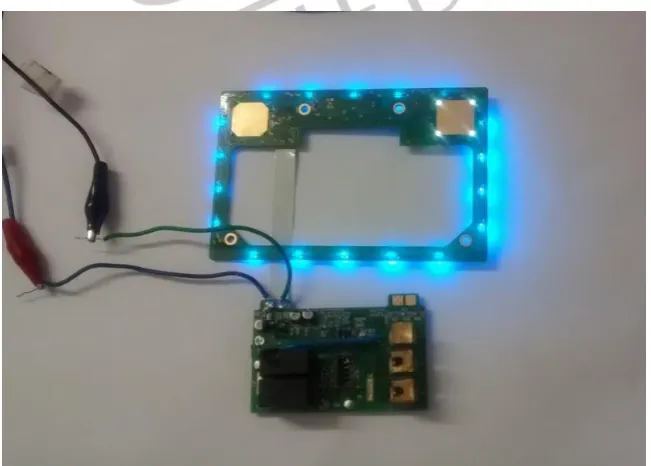
The basic hardware which I used in my project is wi-fi module and microcontroller unit. We used SN8200 wi-fi modules of murata. SN8200 is a complete low power self-contained embedded wireless solution to address the connectivity demand in M2M applications. It integrates micro-controller, Wi-Fi BB/MAC/RF IC,RF front end, clocks, and on-board antenna into a small form factor module. SN8200 can be controlled by a host device through a serial interface; it can also serve as a standalone Wi-Fi station or network controller. We used msp430 microcontroller in our application. Relays ,touchpad, rgb leds ,Wi-Fi module and other leds are interfaced with mcu. We made our own hardware mcu card and touchpad card.
Figure. 2 mcu card and touchpad card
© 2015 IJEDR | Volume 3, Issue 2 | ISSN: 2321-9939
IJEDR1502103
International Journal of Engineering Development and Research (www.ijedr.org)562
The software side of this system is divided into software related to Wi-Fi module and software related to mcu card. We used wiced sdk to develop software related to wi-fi module. We develop communication between wi-fi modules. If any smart plug is not in range of router then it connect with nearest other smart plug, so it communicate with router through other nearest smart plugs. Wi-Fi modules in the smart plug can be communicate with each other up to fifth hop .In this way, different smart plugs which are not in range of router can be added into our network.We used CCS to develop msp430 microcontroller programming. CCS is integrated development environment for TI embedded processors. It Includes debugger, compiler, editor, simulator, OS. The IDE is built on the Eclipse open source software frame work. We develop code for led interfacing, touchpad interfacing, uart, EEPROM interfacing, power consumption measurement, rgb led interfacing, rtc, usb detection and relay interfacing for msp430 controller using ccs. This code for msp430 fulfill the all required functionality of smart socket. We can turn on/off any electric equipment using touchpad or remotely using mobile app. Power consumption measurement circuit measure power using sigma delta adc and change the color of rgb led as per power consumption. Rgb is also useful as night lamp of different color. Usb ports are useful for mobile charging. RTC and EEPROM is used for different scheduling events.
IV.IMPLEMENTATION RESULTS
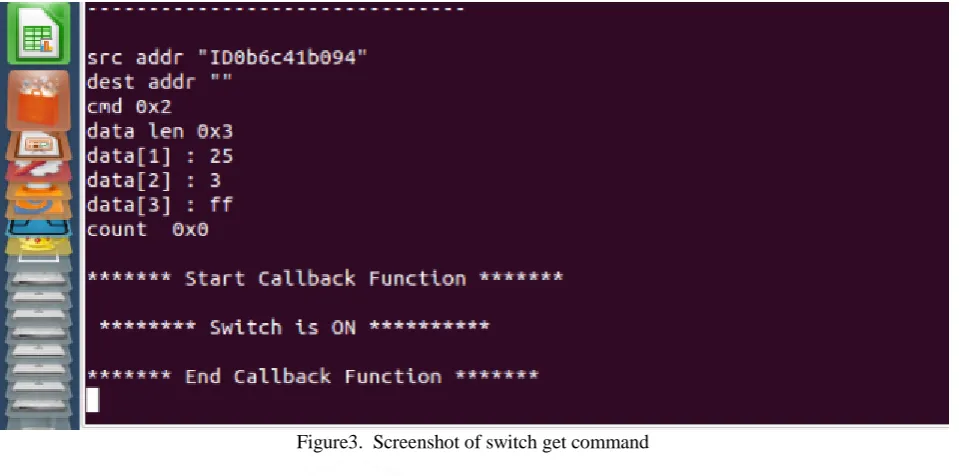
We make Linux app for testing of smart socket. We send command from Linux app to router and then router send that request to particular wi-fi module of socket in network. Then wi-fi module send command to mcu card and mcu card send response as per request. We can on or off plug, get status of plug, get power consumption, set rgb led as night lamp and some other features. Screenshot of Linux app results are as per below.
IJEDR1502103
International Journal of Engineering Development and Research (www.ijedr.org)563
Figure3. Screenshot of switch get commandFigure 5. Screenshot of power measurement command
V.CONCLUSION
We are looking for home automation system with low cost, high network coverage, no additional network setup and it must contain some smart feature, which make life easier. Communication between wi-fi modules developed so socket can communicate with nearest socket, so range of current network increase. Smart socket is capacitive touch socket which is controlled through touchpad or through remotely by android app. It contain smart features like power measurement ,change color and brightness of rgb led as per power consumption, rgb led is useful as night lamp, color and brightness of night lamp controllable through android app, different scheduling events and three usb type c charging port for mobile.
VI.ACKNOWLEDGMENT
© 2015 IJEDR | Volume 3, Issue 2 | ISSN: 2321-9939
IJEDR1502103
International Journal of Engineering Development and Research (www.ijedr.org)564
REFERENCES[1] Chathura Withanage, Rahul Ashok, Chau Yuen, Kevin Otto. A Comparison of the Popular Home Automation Technologies. In IEEE innovative smart grid technology Asia-2014.
[2] Fan Yang, Vamsi Gondi, Jason O. Hallstrom, Kuang-Ching Wang, Gene Eidson, Christopher J. Post. Wireless Infrastructure for Remote Environmental Monitoring: Deployment and Evaluation. 2013 International Conference on Selected Topics in Mobile and Wireless Networking (MoWNeT) -2013
[3] Alper Gurek, Caner Gur, Cagri Gurakin, Mustafa Akdeniz, Senem Kumova Metin. “An Android Based Home Automation System” 978-1-4799-2569-8/13/$31.00 © 2013 IEEE.
[4] Li Li, Xiaoguang Hu, and Baochang Zhang. A Routing Algorithm for WiFi-Based Wireless Sensor Network and the Application in Automatic Meter Reading. Mathematical Problems in Engineering-Volume 2013, Article ID 320894-2013 [5] Liu Zhi-Gang, Huang Wei. The Design of Smart Home System Based on Wi-Fi. 978-1-4673-1692-2 IEEE-2013
[6] http://wireless.murata.com/eng/products/rf-modules-1.html