International Journal of Asian Social Science, 2014, 4(2): 145-151
THE EFFECTIVENESS OF PEER MENTORING MODULE ON THE
PERSONALITY OF PEER MENTORS
Haizan binti Mohd Taha
†College of Foundation and General Studies, Universiti Tenaga Nasional, Kajang, Selangor, Malaysia
Fauziah Hanim binti Abdul Jalal
Faculty of Education and Human Development, Universiti Pendidikan Sultan Idris, Tanjong Malim, Perak, Malaysia
Nora binti Dato Yahya
College of Foundation and General Studies, Universiti Tenaga Nasional, Kajang, Selangor, Malaysia
Mardian Shah bin Omar
College of Foundation and General Studies, Universiti Tenaga Nasional, Kajang, Selangor, Malaysia
Evelyn Yeap Ewe Lin
College of Foundation and General Studies, Universiti Tenaga Nasional, Kajang, Selangor, Malaysia
ABSTRACT
The purpose of this research is to identify the effectiveness of Peer Mentoring Module (PMM) on
peer mentors with good characteristics along with their academic performance. From the Big Five
Personality Dimensions, those characteristics which include extraversion, agreeableness,
conscientiousness, emotional stability and openness should support peer mentors in handling the
underachievers on academic mentoring program. Therefore, Big Five Inventory (BFI) was given to
twenty peer mentors from the Engineering and Information Technology Degree program in
Universiti Tenaga Nasional (UNITEN). The overall findings support the hypothesis that PMM is
effective on peer mentors personalities. The research outcome may help researchers to identify the
personalities of peer mentors through academic mentoring program. In addition, with PMM
training, it may upgrade the quality of helping skills in peer mentors towards the underachievers.
Therefore, identifying the right personality of peer mentors will be one of the important aspects in
implementing the guidance and counseling practices in academic mentoring.
© 2014 AESS Publications. All Rights Reserved.
Keywords:
Academic mentoring, Peer mentoring module, Peer mentors, Big 5 personality dimensions.International Journal of Asian Social Science
ISSN(e): 2224-4441/ISSN(p): 2226-5139Special Issue: International Conference on Teaching and
Learning in Education, 2013
© 2014 AESS Publications. All Rights Reserved. 1.
NTRODUCTION
Academic mentoring program is a part of guidance and counselling in order to enhance the
development of education field. Individuals who were more experienced, knowledgeable, reliable
and caring are defined as mentors (Glenn, 2011). In learning, mentors are among the lecturers or
students. A student mentor is also known as a peer mentor.
Peer mentors assist students with low academic achievement in schools as well as in
universities. The effective peer mentors are able to help the underachievers to overcome academic
difficulties, to make plans and to handle problems faced by those students. Most higher education
students require mentors, but through previous study, it is found that the university faculty spends
most of their time with students of high academic achievement (Glenn, 2011). However, at the end
of 1960 in the United States, college students or peer mentors and community activists had
developed a support service such as academic mentoring program that helped other students to
succeed academically and to serve their communities.
In a study conducted by Wan Noradila Wan Mohd Zain (2007) on peer mentors at schools and
colleges in Sarawak, researchers suggested that student counselors need to know the characteristics of peer mentors’ personalities because through this research, they can train the peer mentors with helping skills in order to achieve effective mentoring system. Thus, the Big Five Personality
Dimensions was used as a benchmark to determine the appropriate peer mentors’ personalities in
mentoring programs or modules.
2.
PEER MENTORING MODULE (PMM)
Peer Mentoring Module (PMM) was developed specifically to provide soft skills for peer
mentors that involved in mentoring program with students of low academic achievement. The
formation of this module is the result of the combination of Big Five Personality Dimensions,
counseling skills in Roger’s person-centered theory and the application of Kolb experiential
learning theory as shown in Figure 1.
Figure-1. Combination Big Five Personality, Rogers Theory and Kolb’s Model
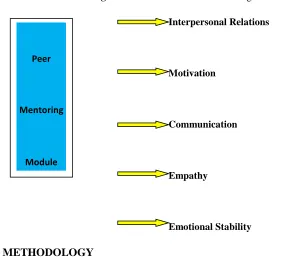
PMM was built systematically with activities (a 10-hours or 2-weeks training) as shown in
Figure 2, for peer mentors to give opinions and constructive responses within group cohesiveness.
As a result, the existence of mentoring relationship will be very strong among them and their
protégé. Mentoring relationship among peers can be based on trust and empathy. In Model of
Youth Mentoring by DuBois and Karcher (2005), it shows that this kind of special relationship on
trust and empathy will lead to social-emotional, identity, and cognitive development.
Figure-2. Five Skills in Peer Mentoring Module
Interpersonal Relations Motivation Communication Empathy Emotional Stability
3.
METHODOLOGY
This study used a survey research design to investigate the research problem. The main aim of
using survey research was to obtain data to describe specific characteristic, attitude, or behaviours
of a group (Fraenkel and Wallen, 1996). The Big Five Inventory (BFI) recognizes which of the
aspects from the Big Five Personality Dimensions best represent the characteristics of peer
mentors. Oliver and Sanjay (1999) stated that these dimensions did not represent a particular
theoretical perspective, but were derived from analyses from the natural-language terms which
people used to describe themselves and others. Table 1 below indicates the sub-dimensions for
each characteristic mentioned in BFI.
Table-1. Big Five Personality Dimensions
Extraversion Agreeableness Conscientiousness Neuroticism Openness
© 2014 AESS Publications. All Rights Reserved.
The BFI consists of 44 questions with a five-point Likert scale from `1’ indicates Disagree strongly , `2’ indicates Disagree a little, `3’ indicates Neither agree nor disagree, `4’ indicates Agree a little and `5’ Agree strongly. Subjects are among 20 Bachelor Degree students of University Tenaga National (UNITEN) as shown in Table 2, with Cumulative Grade Point Average
(CGPA) 3.00 points and above (requirement to be selected as peer mentors). They are grouped and
trained with Peer Mentoring Module (PMM) for 2 weeks / 10 hours.
Table-2. Group According to Gender, College and Year
Group Gender (%) College (%) Year (%)
PMM Male Female COE COIT 1 2 3 4
70 30 70 30 3 8 5 4
A brief explanation was given to both groups of subjects on the description of the Big Five
Personality Dimensions. With examples of statements on each dimension, subjects are considered
to understand more in order to fill in the Big Five Inventory (BFI). The duration of answering the
BFI was about 30 minutes to 1 hour long.
4.
RESULTS
Analyses of the Big Five Inventory (BFI) arefocused on the mean score and mean total score
of each dimension for both subject groups. The total minimum and maximum score for each
dimension is:
i. Extraversion (total min. score, 8 items x 1 = 8; total max. score, 8 items x 5 = 40)
ii. Agreeableness (total min. score, 9 items x 1 = 9; total max. score, 9 items x 5 = 45)
iii. Conscientiousness (total min. score, 9 items x 1 = 9; total max. score, 9 items x 5 = 45)
iv. Neuroticism (total min. score,8 items x 1 = 8; total max. score, 8 items x 5 = 40)
v. Openness (total min. score, 10 items x 1 = 10; total max. score, 10 items x 5 = 50)
Please refer to Table 3 and Figure 3a & 3b.
Table-3. Big Five Personality for Group with PMM Mean Score & Total Score
Big Five Personality Mean Score Total Score
Extraversion 28 70
Agreeableness 32 72
Conscientiousness 27 66
Neuroticism 24 58
Figure-3a. Big Five – Mean Score
Figure-3b. Big Five – Total Score
The findings for this research showed that openness has the highest total score with 39 points,
followed by agreeableness with 32 points, extraversion in third place with 28 points,
conscientiousness in fourth place with 27 points and lastly neuroticism with 24 points. Before
0 20 40
Extraversion Agreeableness Conscientiousn…
Neuroticism
Openness Extraversion
Agreeableness
Conscientiousness
Neuroticism
Openness
70
72
66 58
78
Extraversion
Agreeableness
Conscientiousness
Neuroticism
© 2014 AESS Publications. All Rights Reserved.
personality of peer mentors. The mean score of both groups is shown in Table 4, while Figure 4
shows the comparisons graphically between 2 groups with PMM and without PMM. It clearly
shows that with PMM the personality of peer mentors is focused on Openness and Agreeableness
characteristics which lead to relationship, trust, empathy, feelings, value, understanding,
cooperative, forgiving, warm and generosity.
Table-4. Big Five Personality: Comparisons of Group A and Group B
Big Five Personality
Group A (without PMM)
Group B (with PMM)
Extraversion 28 28
Agreeableness 35 32
Conscientiousness 33 27
Neuroticism 20 24
Openness 33 39
Figure-4. Big Five Personality: Comparisons of Group A and Group B
5.
CONCLUSION
The essential characteristics of a successful peer mentor as stated by Berkeley (1994), is like a
supporter who is willing to listen, is warm and caring, and always make himself/herself available in
times of need; he or she also gives guidance on students’ problems and encourages the learners to
learn from experience, reflects the skills provided in Peer Mentoring Module. A peer mentor with
the right personality will make a good academic mentoring by bringing the underachievers success.
REFERENCES
Berkeley, J., 1994. Young people mentoring: An employment perspective. Education Training, 36(5): 27-31.
DuBois, D.L. and M.J. Karcher, 2005. Handbook of youth mentoring. Sage Publication, Inc.
Fraenkel, J.R. and N.E. Wallen, 1996. How to design and evaluate research in education. 3rd Edn., New York:
McGraw-Hill. Book. (ISBN 0070217742 ). pp: 19, 602.
Glenn, O., 2011. Faculty mentor program handbook. Educational opportunity program. USA: California State
University Northridge. 0 5 10 15 20 25 30 35 40
Group A
Haizan, M.T. and H.A.J. Fauziah, 2009. Characteristics of peer mentors among university and school students
in Malaysia. The International Journal of Child Health and Human Development. Nova Science
Publishers, Inc. New York, USA, 2-4.
Oliver, P.J. and S. Sanjay, 1999. The big five trait taxonomy: History, measurement, and theoretical
perspectives. Handbook of personality: Theory and research. 2nd Edn., New York: Guilford.
Wan Noradila Wan Mohd Zain, 2007. Peers studies in Sarawak. Unpublished Report. UKM, Bangi.