1
AN ANALYSIS OF THE APPLICATION OF THE MESH INTERVENTION IN ASTHMA
SARAH DENFORD
A thesis submitted in partial fulfilment of the requirements of the University of the West of
England, Bristol for the degree of Professional Doctorate in Health Psychology
Department of Psychology, Faculty of Health and Life Science, University of the West of England, Bristol
2
Contents page
Contents
Acknowledgements ... 3
Foreword ... 4
Introduction ... 5
Interventions for improving asthma self-care in adults: A systematic review ... 6
Background ... 8
Methods ... 10
Results ... 36
Discussion... 44
Reference List ... 49
Exploration of factors influencing nurses’ abilities to deliver the MESH intervention ... 53
Background to this research ... 56
Methods ... 80
Results ... 88
Discussion... 104
Overall conclusion ... 117
Reference List ... 118
3
Acknowledgements
This thesis would not have been possible without the nurses who gave their valuable time to deliver the intervention, and the participants who agreed to take part in the intervention. I would like to thank my supervisory team of Professor Diana Harcourt and Professor Nicky Rumsey for their immense knowledge, support, and guidance. Professor Harcourt’s continued patience and encouragement was indispensable and very much appreciated.
In addition, I must thank the rest of the Health Psychology team at the University of the West of England for their dedication and advice. Your assistance ensured that I was successful in passing all the competencies.
4
Foreword
In 2008, I started a PhD at the University of Exeter PhD entitled “Identifying processes that are associated with behaviour change in asthma self-care interventions”. My PhD was positioned within a wider program of work, led by my director of studies (Dr Colin Greaves), which aimed to improve understanding of psychological processes that change over the course of
interventions targeting asthma self-care. Work conducted at part of my PhD will be referred to as Denford, (2012) for the remainder of this thesis.
The first study of my PhD was a systematic review of interventions targeting asthma self-care. Meta-regression was used to explore potential associations between individual techniques and the effectiveness of the intervention. Methodological concerns meant that the results of the meta-regression should be interpreted with caution. For this reason, a second analysis of the data, using narrative synthesis was conducted and is presented in chapter one of this thesis (p6)
My PhD also included a process evaluation of an intervention targeting asthma self-care. The intervention, the Managing illness by empowerment and harmonisation of patient and practitioner agendas (MESH) intervention, was developed by my PhD director of studies, Dr Colin Greaves. The process evaluation revealed disparities in the way in which the nurses delivered the MESH intervention. This led to the conduct of the research presented in chapter 2 of this thesis (p54) entitled “An analysis of the application of the MESH intervention in asthma.”
5
Introduction
Asthma is a chronic respiratory condition experienced by approximately 5.2 million people in the United Kingdom. The condition is responsible for 80,000 hospital admissions and 1,126 deaths per year (Office for National Statistics, 2012). Although numerous successful interventions targeting asthma self-care have been developed, it is not clear which
intervention and patient processes that are included in or targeted during such interventions are associated with change in self-care behaviour.
6
Interventions for improving asthma self-care in adults: A
systematic review
Introduction
Control of asthma is often poor, leading to considerable economic and personal costs. Many randomised controlled trials and systematic reviews have led to the conclusion that asthma self-care interventions can be effective in improving asthma control, nevertheless, interventions are often
heterogeneous in their content, delivery mode, delivery personnel, setting and intensity. This diversity has not been explored in existing systematic reviews, thus characteristics of successful interventions have not been identified.
Aim
The aim of this review is to summarise the evidence and identify components of interventions that are associated with improved asthma self-care
behaviours and subsequent health outcomes. Methods
A search of Central, EMBASE, CINAHL, MEDLINE, and Psych info from 1998 to April 2008 was conducted. An additional hand-search of reference lists of existing systematic reviews, related journals, and meeting abstracts supplemented the search.
Randomised controlled trials of behavioural interventions aiming to improve asthma self-care behaviours in adult asthmatic patients were eligible for inclusion. A quality assessment was carried out for each study, using an amended version of the Cochrane risk of bias assessment tool. Trials judged to have a high risk of bias in key methodological categories were excluded. Data was extracted on the content, setting, duration, population, and delivery provider of the interventions. It was found that heterogeneity was
considerable, making meta-analysis inappropriate. A narrative synthesis was used to describe effective interventions.
7
Forty four studies were included in the review. Interventions took place in a range of settings, were of different durations and delivered by a variety of providers. Results showed an overall positive effect of intervention on three main outcomes (symptoms, healthcare use and adherence). Techniques associated with increased effectiveness were education, action planning, self-monitoring, and follow up. The evidence is based on mildly affected
8
Background
Asthma is a global health problem. According to a report conducted by the Global Initiative for Asthma (GINA), asthma is estimated to affect three hundred million individuals worldwide, and five point two million in the United Kingdom (GINA, 2009). A report based on data obtained by the European Community Respiratory Health Survey showed that the prevalence is increasing, and it is predicted that by 2025, there will be an additional one hundred million asthma suffers worldwide (Masoli, Fabian, Holt, & Beasley, 2004).
Currently, patient control over their asthma is less than optimal. The Asthma Insights and Reality (AIR) survey (Rabe et al., 2004) of 10,939 asthma patients in 29 countries,
demonstrates the size of the problem. The results showed that in Western Europe, 17% of asthma patients required days off work due to asthma, 56% had daytime symptoms, 41% had night time symptoms, 7% required hospitalisation, 10% attended the emergency room, 25% required unscheduled care and 36% reported asthma restricted their general activities. Many patients with persistent asthma use higher levels of reliever medication than recommended and took below the recommended dose of controller medication. The Office for National Statistics (2012) hospital episode statistics show that many patients still require unscheduled care. In England in 2004, over sixty seven thousand people required emergency care and were admitted to hospital after suffering an asthma attack (Department of Health, 2007).
It is believed that many of the problems, exacerbations, restrictions and even fatalities could often have been avoided (GINA, 2009). Confidential enquiries into the nature of the deaths from asthma show that the fatality could often have been avoided though better routine and emergency care, avoiding delay in seeking care and / or taking medication as prescribed (Burr et al., 1999). It has been estimated that 75% of hospital admissions could be avoided with better control (Blainey, Beale, Lomas, & Partridge, 1994).
9
Whilst many randomised controlled trials have been undertaken, these vary in content, settings, delivery personnel, intensity and duration. The content of interventions ranged from purely didactic educational interventions (talks /lectures), to complex multifaceted behaviour change interventions including a range of techniques (e.g. use of specific written action plans, self-monitoring, relapse prevention). Following on from this, within the systematic reviews of these studies, there is often evidence of heterogeneity in the results.
Broad attempts have been made to categorise interventions by their content. Gibson et al suggested that interventions need to include education, monitoring, a written
self-management plan, and a regular follow up review (Gibson et al., 2002). Interventions that did include all the components (termed “optimal”) appeared to have some beneficial effects over interventions that were less complex. The authors provided no rational for looking specifically at this combination of techniques and often the interventions included many more techniques than these four alone. Smith et al attempted to statistically pool interventions categorised as educational, self-management, psychological/psychosocial, or multifaceted (as defined by original authors), however, she found that there was more variation within these
classifications than between them (Smith et al., 2007).
Other authors have used author defined classifications as inclusion / exclusion criteria, and so only include reviews that are defined by the original author as, for example, “educational” or “self-management” (Gibson et al., 2002). However, as Smith suggests, the author’s
classifications appear to bear little relation to the content of the intervention. This means review authors are pooling heterogeneous interventions and excluding comparable interventions. By pooling heterogeneous interventions, systematic reviews are potentially making inaccurate conclusions, and are failing to demonstrate exactly what works in what situation.
There are a number of existing systematic reviews targeting asthma self-care. Some conclude that interventions are effective (Gibson et al., 2002), whilst others suggest that evidence is equivocal (Smith et al., 2007; Yorke, Flemming, & Shuldham, 2006). Whilst some trials are included in more than one review depending on the classification system used by the authors, to date, the degree of overlap of studies included in reviews is minimal. No systematic review of all interventions to promote self-management has been attempted.
10
what kind of interventions are likely to improve asthma. Rather than looking at an overall effect of heterogeneous interventions, the current review will use a different form of analysis, namely narrative analysis, to summarise self-management interventions and identify what works. This will be of interest to health care workers and future intervention developers. Narrative synthesis has been recommended by the Economic and social research council (ESRC) (Popay et al., 2006) to review the efficacy of complex interventions. Narrative synthesis is a form of combining interventions that focuses on words and text to explain the results. In this respect it is capable of moving beyond demonstrating effectiveness to answering a number of questions such as what works and for whom. For this reason, narrative synthesis was considered to be preferable to the more traditional meta-analysis, which appears to be more appropriate to “simple” trials.
Objectives
The aim of this review is to use high quality evidence to examine the effectiveness of asthma self-care interventions and to identify characteristics associated with improved outcomes.
1. To use a narrative synthesis to summarise and provide an assessment of the effectiveness of high quality asthma self-care interventions.
2. To identify which behavioural change techniques or combinations of techniques (intervention content) are associated with effective interventions
3. To establish whether successful behavioural change techniques are consistently effective across settings, outcomes, and populations.
This will be beneficial to clinicians and intervention developers who are involved with asthmatic patients.
Methods
Types of studies
Quality assessed randomised controlled trials of complex interventions aiming to improve asthma self-care behaviours were included. Inclusion was restricted to interventions that used a randomised controlled trial (RCT) design as RCT’s are considered to be the highest quality of evidence and minimise the risk of bias associated with non randomised designs (Higgins & Green, 2009).
11
Interventions were aimed at participants aged 18 or above, with a diagnosis of asthma (according to a criterion specified by the author of the original article). As age has an impact on both self-care behaviours and asthma outcomes, the interventions were restricted to adults only. Self-management interventions aimed at children have shown beneficial effects on a number of outcomes, however, these interventions differ considerably from interventions aimed at adults and usually target both the child and parents and families Wolfe. For this reason, it was decided that it would be inappropriate to pool interventions targeting children with those targeting adult asthmatics. Studies that target both children and adults were included as long as the percentage of adults was greater than 50%. Information regarding patient factors such as severity and co morbid illnesses (e.g. chronic oesophagus pulmonary disorder; COPD) was also extracted to help explain the results.
Types of interventions
Eligible interventions could be executed in primary, secondary, community, or work based settings. They could be given by nurses, GP’s, researchers or self-administered (videos, books etc). The format could include individual, small groups, or a combination of the two.
Whilst the link between self-management and improved asthma outcomes is evident, the relative contribution of different behaviours in improving health differs. For example, there is conclusive evidence that adhering to medication improves asthma, with numerous Cochrane systematic reviews supporting the effectiveness. The results surrounding other behaviours such as breathing control, stress management and trigger avoidance are considered equivocal. Evidence on dust-mite control (one specific form of trigger avoidance) suggests no benefit when applied to the general population (Gotzsche & Johansen, 2008). Inclusion of self-management interventions aiming to improve house dust mites may be successful in changing behaviour, but if the behaviour has no effect on asthma outcomes, there is a danger of rejecting successful behavioural change techniques as unsuccessful.
The authors of the current review decided that interventions would be considered appropriate for inclusion if they targeted one or more asthma self-management behaviours that are considered to be effective in improving asthma outcomes. This included interventions that aim to change (one or more of) the following behaviours: a) medication adherence b) medication dose-adjustment c) trigger avoidance (excluding dust-mite control) d) breathing control training or relaxation (anxiety-control) techniques e) general stress management.
12
The aim of asthma self-care interventions is to change behaviour, it is often problematic to measure behavioural change reliably and objectively. Medication adherence may be
considered a measure of behavioural change but assessing adherence is problematic due to a number of often contradictory methods for measuring adherence. Many researchers use proxy outcomes such as health service utilization or asthma symptom /lung function
measures, as these are often more obtainable. The problem with this is a null result in terms of proxy outcomes may underestimate the effectiveness of behavioural interventions, as the intervention may be effective in improving self-management behaviours, yet fail to have an impact on health service use. The majority of interventions use a combination of outcomes. Commonly, asthma symptoms, health care use and adherence are provided as outcomes, using a range of measures and scales. Data was extracted and summarised under these headings. Objective or validated measures of outcomes were used where possible.
Quality assessment
An assessment of the quality of each study was made in accordance with an amended version of the Cochrane Risk of bias assessment. The Cochrane Risk of Bias assessment includes an assessment of six areas that may introduce bias, thus affecting the believability of the results (of both the primary trial and the current review). The areas include sequence generation, allocation concealment, blinding, incomplete outcome data, selective outcome reporting, and other issues. As each domain is unlikely to be equally “harmful” for all randomised controlled trials, in line with Cochrane recommendations (Higgins & Green, 2009), a judgement was made on key areas defined by the authors of the current review regarding the criticality of each domain.
Areas that were considered to be of high risk of bias by the authors of the current review were; allocation concealment, incomplete data reporting and group balance at baseline. Studies considered a high risk of bias for other domains, including sequence generation and the extent to which the intervention was received, were also excluded. Note; this was only taken into consideration if the risk of bias was high (as opposed to unclear). For example, if over 30% of the intervention condition did not receive the intervention as intended, this would be considered high risk of bias, however, if fidelity was not assessed, then the trial would receive an unclear for this domain, without having an impact on the overall quality score of the trial.
13
as unclear in for any critical domain. Any study that was considered high risk for any critical domain was rated “C” and excluded from the review. Authors were contacted and asked to clarify any ambiguities. The quality assessment form can be found as part of the data extraction template in appendix 1.
Data collection Search strategy
Using the search engine “dialogue data star”, the Cochrane Central Register of Controlled Trials (CENTRAL), EMBASE, CINAHL, MEDLINE and PsycInfo was searched with the date spanning 1998 – April 2008. Search terms were adapted for each data base. An additional hand search of the Airways specialised register, the clinical trials register, and references from existing systematic reviews was also conducted. Authors were contacted to identify any unpublished or ongoing studies. Search terms for each database are included in appendix 2.
Study eligibility
There were four stages in this review.
1. Two authors independently pre-screened titles of reports for inclusion or exclusion. Disagreements were settled by discussion.
2. Abstracts of articles deemed suitable based on the title were scrutinised and coded by two independent reviewers as;
i. RCT, adult, asthma, self-management intervention
ii. Adult, asthma, possible RCT but cannot identify from abstract
iii. RCT, possible adult, asthma, self-management intervention but cannot identify from abstract
iv. Non RCT, paediatric / child targeted intervention, not self-management. Articles in categories (i) and (ii) and (iii) were retrieved in full, discrepancies were resolved via discussion.
1. Data was extracted by one author. Data extraction was checked on a sample of articles by a second author. Disagreements were resolved via discussion. 2. Data was synthesised using a narrative synthesis. Following recommendations
(Popay et al., 2006), this form of analysis includes four elements, beginning with a theory (self-management interventions lead to improved self-care), followed by a description of studies in terms of size and direction of effect, moving onto
14
settings, duration, population etc. The final stage refers to making an assessment of the robustness of the evidence. We considered the following sources of heterogeneity; intervention content, sample population, setting of intervention and intensity of intervention. We have adopted a best evidence approach, whereby a strict quality assessment tool was applied to each intervention. Only interventions judged to be high quality were included in the review.
In line with recommendations (Popay et al., 2006), quantitative results of the intervention were transformed into a common rubric; namely odds ratios. A description of the
interventions is provided in a tabular form, with corresponding odds ratios. For studies that did not provide a quantitative outcome, a description is provided with an indication of the
direction of effect (see table one).
15
Table 1: Trials included in the analysis
Study Intervention Participants Outcomes Quality Results OR (CI) Notes
Allen, 1995 Content; Education
Number of sessions; 4
Setting; hospital
Delivery provider; nurses
Format; group
Control; usual care
Randomised; 116
Intervention; 58 control; 58
Completed; 92
Intervention; 47
Control; 45
Severity; not stated
Male; 50% Self-reported symptoms Asthma knowledge questionnaire Self-reported adherence % taken
Self-reported days HCU
Concealment; unclear
Outcome assessors; un-blind Withdrawals; described Theory; no Score B Symp HCU
Adh; 5.0 (1.85, 13,59)
Alofi 1995 Content; Education
Number of sessions; 4
Setting; hospital
Delivery provider; nurse
Format; individual
Control; not stated
Randomised 44
Intervention 22
Control 22
Completed 100%
Severity not stated
Male 50% Self-reported hospital admissions Unscheduled care Scheduled care Concealment; unclear
Outcome assessor; un-blind
Withdrawals; described
Theory; no
Score B
16 Armour
2007
Content; optimal
Number of sessions; 4
Setting; pharmacist
Delivery provider; pharmacist
Format; individual
Control; usual care
Randomised; 396 Intervention; 191 Control; 205 Completed; 349 Intervention; 165 Control; 184
Severity; 75% severe
Male; 35% Control Adherence BMQ* Symp QoL* Concealment; closed envelope
Outcome assessors; un-blind
Withdrawals; described
Receipt of intervention; unclear
Theory; no
Score B
Symp: 0.55 (0.36, 0.85)
Adh: 4.06 (2.00, 8.21)
Bailey 1999 Content; optimal plus
Number of sessions; one to two
Setting; hospital
Delivery provider; educator
Format; individual and group
Control; standard education
Randomised; 236 Intervention; 78 Control; 78 Completed; 236 Intervention; 78 Control; 76
Severity; moderate to severe
Male; 30%
Symptoms*
Health care use*
Self-report adherence*
Concealment; closed envelope
Outcome assessors; un-blind
Withdrawals; described
Theory; social cognitive
Score a
Symp: 1.16 (0.5, 2.70)
HCU: 0.68 (0.32, 1.45)
17 Bailey 1990 Content; optimal plus
Number of sessions; 2
Setting; hospital
Delivery provider; educator
Format; individual and group
Control; standard education
Randomised; 267 Intervention; 132 Control; 135 Completed; 225 Intervention 124 Control; 101
Severity; mild to severe
Male; 35%
Adherence*
Symptoms*
Health care use*
Concealment; closed envelope
Outcome assessors; un-blind
Withdrawals; described
Theory; health belief and PRECEDE
Score A
Symp: 0.40 (0.19, 0.84)
HCU: 0.48 (0.22, 1.03)
Adh: 6.49 (3.14, 13.40)
Barbanel 2003
Content; optimal
Number of sessions; 1
Setting; pharmacist
Delivery provider; pharmacist
Format; individual (+ telephone)
Control; usual care
Randomised; 24 Intervention; 12 Control; 12 Completed; 23 Intervention 11 Control; 12
Severity; not stated
Male; 45%
Symptoms* Randomisation; unclear
Outcome assessors; un-blind
Withdrawals; described
Theory; no
Score A
18 Behera 2006 Content; optimal minus follow up
Number of sessions; 0
Setting; hospital
Delivery provider; not stated
Format; Booklet
Control; no booklet
Randomised; 523
Intervention; 260
Control; 263
Completed; 100%
Severity; not stated
Male; 56% Knowledge Symptoms HCU RCT Concealment; unclear Outcome assessors; unblind Withdrawals; described Theory; no Score B
Symp: 0.95 (0.71, 1.28)
HCU +
Berg 1997 Content; education
Number of sessions; 6
Setting; community
Delivery provider; nurses
Format; individual and group
Control; usual care
Randomised; 68
Intervention; 31
Control; 24
Completed; 55
Severity; moderate to severe
Male; 35%
Adherence MDI*
Symptom free days
RCT
Concealment; unclear
Outcome assessors; un-blind
Withdrawals; unclear
Theory; self efficacy
Score B
Symp: 1.57 (0.60, 4.10)
Adh: 2.75 (1.01, 7.46)
Imbalance at baseline exaggerating effect
Castro 2002 Content; not optimal
Number of sessions; as many as needed before discharge
Setting; hospital
Delivery provider; nurses
Format; individual
Control; usual care, education, medication maximised
Randomised; 96
Intervention; 50
Control; 46
Completed; not stated
Severity; moderate to severe (hospitalised)
Male; 18%
N of re-admissions and ER visits?
Symptoms AQKQ*
RCT
Concealment; sealed envelopes
Outcome assessor; un-blind
Withdrawals; unclear
Theory; no
Score B
Symp: 1.14 (0.55, 2.35)
19 Chatkin
2006
Content; not optimal
Number of sessions; 12
Delivery provider; nurses
Setting; primary
Format; telephone
Control; no follow up
Randomised; 278
Intervention; 131
Control; 140
Completed; unclear
Severity; moderate to severe
Male; 26%
% taking 85% Adherence*
RCT
Concealment; unclear
Outcome assessor; unblind
Withdrawals; unclear
Theory no
Score B
Adh: 2.61 (1.34, 5.09)
Clark 2007 Content; optimal plus
Number of sessions; 4
Setting; home
Delivery provider; educator
Format; telephone
Control; asthma education
Randomised; 808 Intervention; 424 Control; 384 Completed; 608 Intervention; 311 Control; 297 Severity; mild Male; 0% Symptoms self-reported total N
HCU self-reported
QoL
RCT
Concealment; unclear
Outcome assessor; un-blind
Withdrawals; described
Theory; social cognitive
Score B
Symp: 1.14 (0.90, 1.44)
HCU: 1.00 (0.78, 1.29)
20 Cordina
2001
Content; not optimal
Number of sessions; unclear
Setting; pharmacy
Delivery provider; pharmacist
Format; Individual
Control; not stated
Randomised; 152 Intervention; 86 Control; 66 Completed; 119 Intervention; 64 Control; 55
Severity; not stated
Male; 50
Adherence self-reported
HCU rates self-report
Symptoms QoL*
Satisfaction
RCT
Concealment; unclear
Outcome assessor; unblind
Withdrawals; described
Theory; no
Score B
Symp: 0.45 (0.20, 1.01)
HCU: 0.04 (0.0, 0.77)
Adh: 1.27 (0.60, 2.68)
Cowie 1997 Content; not optimal
Number of sessions; one
Setting; hospital
Delivery provider; nurse
Format; individual Control; education Randomised; 151 Intervention; 48 Control; 50 Completed; 94 Intervention; 46 Control; 48 Severity; severe Male; 38% Self-reported symptoms Self-reported HCU RCT Concealment; sealed envelopes
Outcome assessor; unblind
Withdrawals; described
Theory; no
Score B
Symp
21 de Oliveira
1999
Content; optimal
Number of sessions; 6
Setting; clinics
Delivery provider; Pneumologists
Format; individual
Control; usual care
Randomised; 53 Intervention; 26 Control; 22 Completed; 42 Intervention; 21 Control; 16
Severity; moderate to severe
Male; 11% N hospital admissions Frequency of symptoms scale* Skills Lung function QoL RCT Concealment; sealed envelopes Outcome assessors; unblind Withdrawals; described Theory; no Score B
Sym: 0.14 (0.04, 0.44)
HCU: 0.25 (0.08, 0.75)
Adh: 6.05 (1.73, 21.21)
Gallefoss 1999
Content; optimal plus
Number of sessions; 4
Setting; outpatient clinic
Delivery provider; nurse and GP
Format; individual and group
Control; usual care
Randomised; 78 Intervention; 39 Control; 39 Completed; 71 Intervention; 32 Control; 39
Severity; not stated
Male; 29%
Symptoms scale of QoL*
Self-reported HCU
Adherence
prescriptions taken*
Days off work
Satisfaction
RCT
Concealment; unclear
Outcome assessor; unblind
Withdrawals; described
Theory; no
Score B
Symp: 0.36 (0.16, 0.85)
HCU: 0.20 (0.08, 0.52)
22 Garrett 1994 Content; not optimal
Number of sessions; as many as needed
Setting; hospital work or home
Delivery provider; multiple
Format; individual
Control; usual care
Randomised; 500 Intervention; 249 Control; 251 Completed; 446 Intervention; 249 Control; 249
Severity; not stated
Male; 42% Self-reported HCU Adherence Self-management QoL RCT Concealment; unclear
Outcome assessor; unblind
Withdrawals; described
Theory; health belief models
Score B
HCU: 1.04 (0.72, 1.51)
Adh: 2.27 (1.53, 3.36)
Slightly favours control, but both improved
Ghosh 1998 Content; optimal plus
Number of sessions; 4
Setting; outpatient clinic
Delivery provider; social scientist
Format; individual and group
Control; usual care
Randomised; 303 Intervention; 153 Control; 150 Completed; 276 Intervention; 140 Control; 136 Severity; severe Male; 41% HCU Symptoms
Days off work
RCT
Concealment; unclear
Outcome assessor; unblind
Withdrawals; described
Theory; social cognitive
Score B
Symp: 0.31, (0.2, 0.48)
23 Griffiths
2004
Content; optimal
Number of sessions; one (+1fu)
Setting; primary care
Delivery provider; nurses
Format; individual and telephone
Control; education
Randomised; 324
Intervention; 175
Control; 149
Completed; 324
Severity; mild
Male; 50%
HCU medical records*
Symptoms
RCT
Concealment;
minimisation program
Outcome assessor; blind
Withdrawal; described
Theory; no
Score A
Symp; no difference
HCU +
0.65 (0.41, 1.02)
Grover 2007 Content; optimal plus
Number of sessions; 10
Setting; hospital outpatient
Delivery provider; unclear
Format; individual
Control; intensive management program
Randomised; 40
Intervention; 20
Control; 20
Completed 100%
Severity; severe
Male; unclear
Symptoms*
HADs
AQLQ
RCT
Concealment; unclear
Outcome assessor; unblind
Withdrawal; described
Theory; CBT
Score B
24 Hesslink
2003
Content; not optimal
Number of sessions; 1-4
Setting; primary care
Delivery provider; assistants
Format; individual
Control; usual care
Randomised; 276
Intervention; 139
Control; 137
Completed; 209
Severity; severe and COPD included Male; 45 Inhaler technique QoL Self-report adherence Self-reported symptoms RCT Concealment; unclear
Outcome assessor; unblind
Withdrawal; described
Receipt; not 100%
Theory; no Score B Sym Adh Brief intervention and COPD were included Holloway 2007
Content; Not optimal
Number of sessions; 5
Setting; primary care
Delivery provider; respiratory physiologist
Format; individual
Control; routine education
Randomised; 85
Intervention; 39
Control; 46
Completed; 72
Severity; not stated
Male; 18%
Symptoms scale of QoL*
HADs
RCT
Concealment; unclear
Outcome assessor; unblind
Withdrawal; reported
Theory; no
Score B
Sym: 0.40 (0.17, 0.94)
Janson 2003 Content; optimal
Number of sessions; 85
Setting; clinical lab
Delivery provider; nurses
Format; face to face
Control; same n of visits and monitoring, no explicit instruction
Randomised; 65
Intervention; 33
Control; 32
Completed; 65
Severity; mild to moderate
Male; 45% Self-reported adherence QoL Symptoms RCT Concealment; unclear
Outcome assessor; unblind
Withdrawal; described
Theory; no
Score A
Sym: 1.31, (0.54, 3.16)
Adh: 4.44, 1.80, 10.93)
25 Kauppien
1998, 1999, 2000
Content; optimal plus
Number of sessions; unclear
Setting; hospital
Delivery provider; nurses
Format; individual and video
Control; optimal
Randomised; 162
Intervention; 80
Control; 82
Severity; newly diagnosed
Male; unclear
Symptoms scale of SGRQ*
Self-reported HCU
RCT
Concealment; unclear
Outcome assessor; unblind
Withdrawal; described
Theory; no
Score B
Sym: 0.95 (0.53, 1.71)
HCU
No benefit of intervention on HCU
Klein 2001 Content; optimal plus
Number of sessions; 3
Setting; unclear
Delivery provider; nurses
Format; individual and group
Control; education not including self treatment
Randomised; 245
Intervention; 123
Control; 122
Severity; mild to moderate
Male; 45% Symptoms Self-reported HCU Control Confidence RCT Concealment; closed envelope
Outcome assessor; unblind
Withdrawal; described
Theory; no
Score A
HCU: 1 (0.2, 5.09) No benefit of intervention or control
Kotses 1995 Content; optimal
Number of sessions; 7
Setting; not stated
Delivery provider; group leader
Format; group
Control; peek flow
Randomised; 85
Intervention; 45
Control; 40
Completed; 76
Severity; moderate to severe
Male; 35% Symptoms attack frequency Adherence asthma diary Self-reported HCU RCT Concealment; unclear
Outcome assessor; unblind
Withdrawal, described Theory; behavioural control Score B Sym + HCU +
Adh: 1.73 (0.75, 4.03)
26 Kotses 1996 Content; educational
Number of sessions; one
Setting; not stated
Delivery provider; not stated
Format; individual and video
Control; usual care
Randomised; 34
Completed; 33
Intervention 1; 11
Intervention 2; 11
Control: 12
Severity; moderate
Male; 20%
Symptoms
Health care use
RCT
Concealment; unclear
Outcome assessor; unblind
Withdrawal; unclear Theory; no Score B Symp HCU HCU not really needed by either conditions
Kritikos 2007 Content; education
Number of sessions; 1
Setting; community
Delivery provider; pharmacist/educator
Format; individual
Control; written information only
Randomised; 48
Intervention1; 16
Intervention2; 16
Control; 16
Severity; mainly severe
M ale; 41%
Symptoms/severity Adherence MARS* QoL Inhaler technique RCT Concealment; Unclear
Outcome assessor; unblind
Withdrawal; described
Theory; no
Score B
Sym: 0.33 (0.07, 1.49)
27 Lahdensuo,
1996
Content; optimal plus
Number of sessions; 1
Setting; outpatient clinic
Delivery provider; nurses and physiotherapists
Format; individual
Control; not stated
Randomised; 122 Intervention; 60 Control; 62 Completed; 115 Intervention; 56 Control; 59
Severity; mild to moderate
Male; 37%
HCU self-reported
Symptoms scale of QoL*
Days off work
RCT
Concealment; sealed envelopes
Outcome assessor; unblind
Withdrawal; described
Theory; no
Score A
Sym: 0.17 (0.08, 0.33)
HCU: 0.48 (0.22, 1.03) (but rare in both conditions)
Levy, 2000 Content; educational
Number of sessions; three with telephone follow up
Setting; hospital
Delivery provider; Nurses
Format; Individual with telephone follow up
Control; usual care
Randomised; 211 Intervention; 103 Control; 108 Completed; 197 Intervention; 99 Control; 98
Severity; Not stated but recruited from A and E
Male; unclear
Symptoms scale of QoL*
Adherence to SM plans
RCT
Concealment; unclear
Outcome assessor; unblind
Withdrawal; described
Theory; no
Receipt; 38% received all!
Score B
28 Magar, 2005 Content; optimal
Number of sessions; 6
Setting; Educational centre
Delivery provider; nurses
Format; individual and group
Control; “un-educated”
Randomised; 238
Intervention; 127
Control; 111
Completed; 202
Intervention; 104
Control; 89
Severity; not stated
Male; unclear
Self-reported symptoms
Anxiety
LoC
RCT
Concealment; scratch box
Outcome assessor; unblind
Withdrawal; described
Theory; no
Score A
Sym +
Marabina 2001
Content; Optimal plus
Number of sessions; 3
Delivery provider; physician
Setting; outpatient department
Format; individual and group
Control; optimal
Randomised; 77
Intervention; 37
Control; 40
Completed; 69
Intervention; 37
Control; 32
Symptoms scale QoL*
Self-reported HCU RCT
Concealment; unclear
Outcome assessor; unblind
Withdrawal; described
Score B
Sym: 0.40 (0.17, 0.91)
29 Mehuys, 2007 Content; educational Sessions; 3 Setting; pharmacy
Delivery provider; pharmacist
Format; individual
Control; usual care
Randomised; 201 Intervention; 107 Control; 94 Completed; 183 Intervention; 99 Control; 84
Severity; not stated, but very uncontrolled were excluded
Male; 47% Control Symptoms* Exacerbations Adherence RCT Concealment; sealed envelopes
Outcome assessor; Unblind
Withdrawal; described
Theory; no
Receipt; questionable
Score A
Sym: 0.85 (0.49, 1.48) Effects at 3months ns
(Longer term results were sig but large attrit)
Moldofsky 1979
Content; educational video
Sessions; one
Setting; research institute
Delivery provider; video
Format; video
Control; no video
Randomised; 79 Intervention; 40 Control; 39 Completed; 62 Intervention 31 Control; 31
Severity; not stated
Male; 60%
Knowledge
Symptoms
RCT
Concealment; unclear
Outcome assessor; unblind
Withdrawal; described
Theory; no
Score B
30 Morice 2001 Content; optimal
Sessions; 2
Setting; hospital inpatient
Delivery provider; nurse
Format; individual
Control; routine care
Randomised; 80 Intervention; 40 Control; 40 Completed; 65 Intervention; 35 Control; 30
Severity; acute asthma
Male; 38.5% Self-reported unscheduled care Knowledge RCT Concealment; unclear
Outcome assessor; unblind
Withdrawal; described
Theory; no
Score B
HCU: 0.48 (0.16, 1.44)
Moudgil, 2000
Content; educational
Sessions; 3
Delivery provider; a researcher
Setting; community
Format; individual
Control; usual care
Randomised; 689 Intervention; 343 Control; 346 Completed; 593 Intervention; 304 Control; 289
Severity; mild, moderate and severe Male; 51% AQLQ symptoms scale * Self-reported HCU RCT Concealment; computer generated prior to arrival
Outcome assessor; unblind
Withdrawal; described
Theory; no
Score B
HCU: 0.62 (0.25, 1.55) (Symp + but large att)
31 Nathall,
2005
Content; optimal plus
Sessions; inpatient
Setting; inpatient
Delivery provider; multiple
Format; individual and group
Control; usual care
Randomised; 197 Intervention; 101 Control; 96 Completed; 175 Intervention; 99 Control; 76
Severity; not stated
Male; 45%
Adherence % use of steroids
Symptoms N sick days
RCT
Concealment; outside researcher
Outcome assessor; Unblind
Withdrawal; described
Theory; no
Score A
Sym: 0.80 (0.46, 1.39)
Adh: 2.01 (1.10, 3.70)
Osman, 2002
Content; optimal
Sessions; 2
Setting; inpatient
Delivery provider; nurse
Format; individual
Control; usual care
Randomised; 280 Intervention; 135 Control; 145 Completed; 226 Intervention; 108 Control; 118
Severity; acute asthma
Male; 34% HCU Symptoms RCT Concealment; sealed envelopes
Outcome assessor; blind
Withdrawal; described
Theory; no
Score A
Sym: 0.29 (0.15, 0.57)
32 Putt, 2003 Content; optimal plus
Sessions; 6
Delivery provider; researchers
Format; individual
Setting; outpatient clinic
Control; unclear
Randomised; 23
Intervention; 12
Control; 11
Completed; unclear
Severity; mild to moderate
Male; 47%
Symptoms scale of QoL*
Adherence scale*
RCT
Concealment; envelopes
Outcome assessor; unblind
Withdrawal; unclear
Theory; no
Score B
Symp: 0.55 (0.12, 2.43)
Adh: 2.48 (0.55, 11.24)
Schaffer, 2004
Content; educational
Sessions; 1
Delivery provider; video and workbook
Format; video and work book
Setting; home
Control; usual care
Randomised; 46
Intervention; 23
Control; 23
Completed; unclear
Severity; mild to moderate
Male; 32%
Symptoms scale AQLQ*
Adherence verified*
Knowledge
RCT
Concealment; unclear
Outcome assessor; unblind
Withdrawal; unclear
Theory; PMT
Score B
Sym: 1.09 (0.26, 4.67)
33 Smith, 2005 Content; optimal plus
Sessions; 4
Delivery provider; nurse
Setting; primary
Format; individual and group
Control; routine care
Randomised; 92 Intervention; 47 Control; 45 Completed; 84 Intervention; 42 Control; 42 Severity; severe Male; 27% Symptoms control* Adherence RCT Concealment; centralised system
Outcome assessor; unblind
Withdrawal; described
Theory; a range of psychological theories underpinning behaviour change
Score A
Sym: 0.93 (0.43, 2.04)
Adh: 2.18 (1.04, 4.59)
Thoonen, 2003
Content; optimal
Sessions; 4
Delivery provider; GP
Setting; primary care
Format; Individual
Control; usual care
Randomised; 214 Intervention; 110 Control; 104 Completed; 193 Intervention; 98 Control; 95
Severity; mild to moderate
Male; 38% Successful self-care QoL symptoms* Lung function Self-reported exacerbations requiring HCU RCT Concealment; unclear
Outcome assessor; unblind
Withdrawal; described
Theory; no
Score B
34 Urek, 2004 Content; educational
Sessions; 3
Delivery provider; physicians and nurses
Setting; hospital
Format; individual and group
Control; written information
Randomised; 69
Completed; 40
Intervention; 20
Control; 20
Severity; moderate to persistent Male; 35% Self-reported Symptoms Knowledge Lung function RCT Concealment; unclear
Outcome assessor; unblind
Withdrawal; unclear
Theory; no
Score B
Symp: 0.37 (0.12, 1.18)
Wilson, 1993
Content; educational
Sessions; 3-5
Delivery provider; educator
Setting; medical centre
Format; individual v group v control
Control; usual care
Randomised; 235
Intervention; 81
Intervention 2; 83
Control; 71
Severity; moderate to severe
Male; not reported
Symptoms self-reported Adherence MDI* Self-reported HCU RCT Concealment; Unclear
Outcome assessor; unclear
Withdrawal; reported
Theory; social cognitive
Receipt; 88%
Score B
Sym: 0.35 (0.18, 0.69)
HCU: 2.56 (1.42, 4.61)
35 Windsor
1990
Content; educational
Sessions; 2
Delivery provider; nurse and physician
Setting; hospital
Format; Individual and group
Control; not stated
Randomised; 285
Intervention; 132
Control; 153
Completed; 267
Intervention; 97
Control; 127
Severity; mild to moderate
Male; 35%
Adherence* RCT
Concealment; Unclear
Outcome assessor; Unblind
Withdrawal; reported
Theory; no
Receipt; 89%
Score B
36
Results
Description of interventions
Overall forty four interventions were included in the analysis. The date of interventions ranged from 1979 to 2008. The mean number of participants per study was 87.5 (4.96). Follow up periods ranged from one to forty eight months. The mean follow up period was 12 months. Asthma severity was assessed in a variety of ways (mainly in line with GINA guidelines based on treatment level), and although some interventions targeted a specific population (mild, moderate or severe) the majority of interventions included a range of severities. Twenty five studies were set in primary care and sixteen were set in secondary care. Setting was not clear in three studies. It was possible to work out the duration (in hours) for 30 of the 44 articles. This ranged from 0.5 to 12 hours (mean 4.3). Interventions were delivered individually (27), in groups (2), a combination of group and individual sessions (12) or self-administered (3). Eight interventions stated that they were based on a theory. The most common theory was social cognitive theory, with five of the eight interventions being based on this theory.
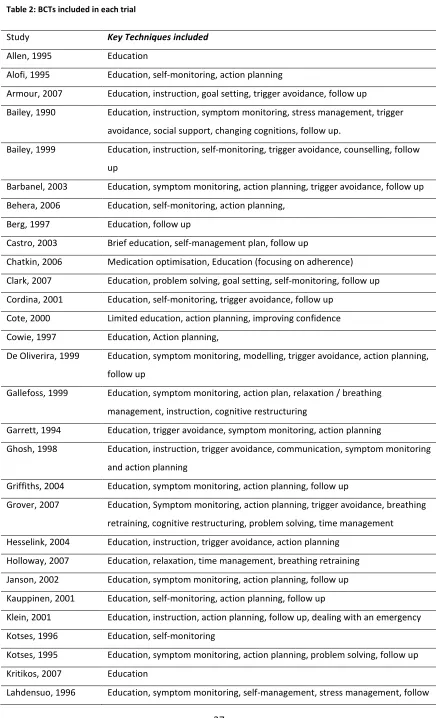
The content of the interventions were typically complex. The majority of studies reported giving participants some form of information on asthma (N=28) and / or some form of
37 Table 2: BCTs included in each trial
Study Key Techniques included
Allen, 1995 Education
Alofi, 1995 Education, self-monitoring, action planning
Armour, 2007 Education, instruction, goal setting, trigger avoidance, follow up
Bailey, 1990 Education, instruction, symptom monitoring, stress management, trigger
avoidance, social support, changing cognitions, follow up.
Bailey, 1999 Education, instruction, self-monitoring, trigger avoidance, counselling, follow
up
Barbanel, 2003 Education, symptom monitoring, action planning, trigger avoidance, follow up
Behera, 2006 Education, self-monitoring, action planning,
Berg, 1997 Education, follow up
Castro, 2003 Brief education, self-management plan, follow up
Chatkin, 2006 Medication optimisation, Education (focusing on adherence)
Clark, 2007 Education, problem solving, goal setting, self-monitoring, follow up
Cordina, 2001 Education, self-monitoring, trigger avoidance, follow up
Cote, 2000 Limited education, action planning, improving confidence
Cowie, 1997 Education, Action planning,
De Oliverira, 1999 Education, symptom monitoring, modelling, trigger avoidance, action planning,
follow up
Gallefoss, 1999 Education, symptom monitoring, action plan, relaxation / breathing
management, instruction, cognitive restructuring
Garrett, 1994 Education, trigger avoidance, symptom monitoring, action planning
Ghosh, 1998 Education, instruction, trigger avoidance, communication, symptom monitoring
and action planning
Griffiths, 2004 Education, symptom monitoring, action planning, follow up
Grover, 2007 Education, Symptom monitoring, action planning, trigger avoidance, breathing
retraining, cognitive restructuring, problem solving, time management
Hesselink, 2004 Education, instruction, trigger avoidance, action planning
Holloway, 2007 Education, relaxation, time management, breathing retraining
Janson, 2002 Education, symptom monitoring, action planning, follow up
Kauppinen, 2001 Education, self-monitoring, action planning, follow up
Klein, 2001 Education, instruction, action planning, follow up, dealing with an emergency
Kotses, 1996 Education, self-monitoring
Kotses, 1995 Education, symptom monitoring, action planning, problem solving, follow up
Kritikos, 2007 Education
38 up
Levy, 2000 Education,
Magar, 2005 Education, trigger avoidance, symptom monitoring, action planning, follow up
Marabini, 2000 Education, symptom monitoring, trigger avoidance, action planning
Mehuys, 2007 Education, instruction, trigger avoidance
Moldofsky, 1979 Education
Morice, 2001 Education, symptom monitoring, action planning, follow up
Moudgil, 2000 Education, instruction, symptom monitoring, action planning, follow up
Nathall, 2005 Education, symptom monitoring, action planning, trigger avoidance, goal
setting, coping skills, consequences of not adhering, follow up, physical
management, weight loss instruction
Osman, 2002 Education, symptom monitoring, self-management, follow up
Put, 2003 Education, cognitive restructuring, symptom monitoring, action planning,
consequences of not adhering, stress management, follow up
Smith, 2005 Education, symptom monitoring, action planning, social support, trigger
avoidance, coping skills, cognitive restructuring
Schaffer, 2004 Education focused on adherence
Thoonen, 2003 Education, instruction, symptom monitoring, action planning, follow up
Urek, 2005 Education
Windsor, 1990 Instruction, follow up
39
Quality assessment
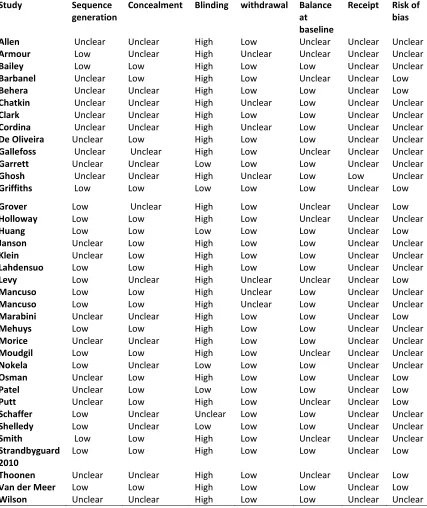
Based on the quality domains considered by the authors to be critical twelve interventions received a quality rating of A, and thirty two were judged to be B quality. A summery table is provided (Table 3). Of the 44 included trials, seventeen trials reported adequate methods of sequence generation. Allocation was adequately concealed in 18 of the interventions. Only two trials reported adequate blinding of outcome assessors. For eight trials it was unclear as to how attrition and drop outs were handled. Only two studies reported that the intervention had been adequately received by all participants in the intervention group, with fidelity of the remainder of the interventions being unclear.
40 Table 3: Risk of bias from key criteria for each trial
Study Sequence generation
Concealment Blinding withdrawal Balance at baseline
Receipt Risk of bias
Allen Unclear Unclear High Low Unclear Unclear Unclear Armour Low Unclear High Unclear Unclear Unclear Unclear Bailey Low Low High Low Low Unclear Unclear Barbanel Unclear Low High Low Unclear Unclear Low Behera Unclear Unclear High Low Low Unclear Low Chatkin Unclear Unclear High Unclear Low Unclear Unclear Clark Unclear Unclear High Low Low Unclear Unclear Cordina Unclear Unclear High Unclear Low Unclear Unclear De Oliveira Unclear Low High Low Low Unclear Unclear Gallefoss Unclear Unclear High Low Unclear Unclear Unclear Garrett Unclear Unclear Low Low Low Unclear Unclear Ghosh Unclear Unclear High Unclear Low Low Unclear Griffiths Low Low Low Low Low Unclear Low
Grover Low Unclear High Low Unclear Unclear Low Holloway Low Low High Low Unclear Unclear Unclear
Huang Low Low Low Low Low Unclear Low
Janson Unclear Low High Low Low Unclear Unclear Klein Unclear Low High Low Low Unclear Unclear Lahdensuo Low Low High Low Low Unclear Unclear Levy Low Unclear High Unclear Unclear Unclear Low Mancuso Low Low High Unclear Low Unclear Unclear Mancuso Low Low High Unclear Low Unclear Unclear Marabini Unclear Unclear High Low Low Unclear Low Mehuys Low Low High Low Low Unclear Unclear Morice Unclear Unclear High Low Low Unclear Unclear Moudgil Low Low High Low Unclear Unclear Unclear Nokela Low Unclear Low Low Low Unclear Unclear Osman Unclear Low High Low Low Unclear Low Patel Unclear Low Low Low Low Unclear Low Putt Unclear Low High Low Unclear Unclear Low Schaffer Low Unclear Unclear Low Low Unclear Unclear Shelledy Low Unclear Low Low Low Unclear Unclear Smith Low Low High Low Unclear Unclear Unclear Strandbyguard
2010
Low Low High Low Low Unclear Low
41
Summary of Results
Overall, interventions suggested a positive effect. Twenty five of the thirty seven studies that reported a measure of symptoms showed a positive effect (67%). Fifteen out of the twenty four studies that reported a measure of health care use (62%) showed a positive effect and. The most consistently positive effect was seen for the outcome adherence, with nineteen out of twenty (95%) interventions that measured adherence, showing a positive effect. In
summary, asthma self-care interventions were effective across outcomes. Narrative synthesis
Seven studies showed consistently large positive effects of intervention across all outcomes (Osman et al., 2002; Bailey, Richards, Brooks, Soong, & Windsor, 1990; Barbanel, Eldridge, & Griffiths, 2003; de-Oliveira, Faresin, Bruno, de-Bittencourt, & Fernandes, 1999; Gallefoss, Bakke, & Rsgaard, 1999; Lahdensuo et al., 1996; Windsor, Bailey, & Richards, Jr., 1990). Five of these studies were considered to be high quality (grade A) evidence (Osman et al., 2002; Bailey et al., 1990; Barbanel et al., 2003; de-Oliveira et al., 1999). Four studies (Morice & Wrench, 2001; Put, van den Bergh, Lemaigre, Demedts, & Verleden, 2003; Nathan et al., 2006)
demonstrated consistently positive, but smaller effects. One of these studies was considered to be high quality evidence (Nathan et al., 2006). A number of similarities were apparent within these eleven trials. In terms of the content, all interventions included education on symptoms, triggers and medication use. All provided instruction on how and when to appropriately use medication and access care. All provided self-management plans and encouraged monitoring of symptoms. Highly effective interventions were set in primary care, outpatient clinics or pharmacies (not hospital settings). All were delivered individually in one initial intensive session, with some form of follow up. Both face to face and follow up by telephone appeared to be effective. In this respect they may be seen as synonymous with the interventions defined as “optimal” in the review by Gibson. Of the most effective
interventions, the population of interest was comparable between the studies and mainly included participants with a classification of moderate asthma. Often, as in the case of Lahdensuo and Barbanel, severe asthmatics were excluded.
42
Four studies demonstrated a large effect of intervention on adherence (Schaffer & Tian, 2004; Bailey et al., 1990; de-Oliveira et al., 1999; Windsor et al., 1990). Interestingly, all four studies used behavioural change techniques specifically targeting adherence (as opposed to other self-care behaviours in general). In these studies, (two of which were considered to be high quality (Bailey et al., 1990; de-Oliveira et al., 1999) all the interventions used education that focused on adherence and the costs of non adherence. However, unless like the other highly effective interventions, the interventions also included symptom monitoring, action planning and follow up (de-Oliveira et al., 1999; Bailey et al., 1990), the improvement in adherence failed to translate to an improvement in symptoms or a decrease in health care use (Schaffer & Tian, 2004; Windsor et al., 1990). This suggests that we can be fairly confident in concluding that interventions specifically targeting adherence, are more effective than generic
self-management interventions in improving adherence. However, unless the intervention is multifaceted, then the effectiveness will not extend to clinical outcomes.
Based on lower quality evidence, less complex interventions, i.e. those that did not include all the aforementioned behavioural change techniques appeared to be less effective (Wilson, Scamags, & German, 1993; Hesselink et al., 2004; Allen, Jones, & Oldenberg, 1995; Castro et al., 2003; Moldofsky, Broder, Davies, & Leznoff, 1979). Minimal education such as that in the trials by Schaffer, Moldofsky, Allen and Hesslink appeared to be ineffective in improving asthma outcomes. In the trials by Schaffer, and Moldofsky, the limited education was administered by the patients themselves (i.e., in the form of watching a video or reading a booklet). This suggests that limited education only, is ineffective at changing both behavioural and clinical outcomes. This appears to be the case with both self-administered and
professionally delivered interventions.
Interestingly, some of the studies reported an improvement in one outcome and not another. For example, whilst minimal education alone was ineffective at changing severe patient’s symptoms, in the intervention by Castro, minimal education did appear to have an impact on health care use, as measured by hospital readmissions (Castro et al., 2003). It could be that minimal education is enough to influence severe exacerbations without changing day to day symptoms. However, the extent to which this can be believed is debateable as the
intervention by Castro is only considered to be grade B evidence, and none of the other minimal educational interventions were able to demonstrate an improvement in health care use.
43
Krass, 2008; Bailey et al., 1990; Cordina, McElnay, & Hughes, 2001; de-Oliveira et al., 1999; Garrett et al., 1994; Ghosh, Ravindran, Joshi, & Stearns, 1998; Grover, Kumaraiah, Prasadrao, & D'souza, 2002; Hesselink et al., 2004; Marabini et al., 2002; Nathan et al., 2006), cognitive restructuring (Grover et al., 2002; Bailey et al., 1990; Gallefoss & Bakke, 1999; Put et al., 2003), and stress management (Holloway & West, 2007; Bailey et al., 1990; Gallefoss & Bakke, 1999; Grover et al., 2002; Lahdensuo et al., 1996). However, high quality studies with these
additional techniques did not appear to have any additional effects over trials that only included the four “optimal” techniques. In contrast, studies that included additional
techniques at the exclusion of the four “optimal” techniques appeared to be less effective than those that did include the optimal techniques (Hesselink et al., 2004; Holloway & West, 2007). This suggests that whilst adding on additional techniques does not increase effectiveness, not included the four “optimal” techniques limits effectiveness.
Four high quality (grade A) studies failed to show an effect of intervention (Bailey et al., 1999; Griffiths et al., 2004; Jones, Mullee, Middleton, Chapman, & Holgate, 1995; Janson et al., 2003). These trials all reported that participants in control conditions were likely to receive fairly intensive treatment. In the trial by Janson, both the intervention and control participants underwent a “run in period” whereby medication was maximised and self-monitoring was taught. Both groups were required to monitor symptoms and received the same number of visits. The only difference was that the control condition did not receive “self-management education” at the bi weekly sessions. Instead they were monitored and informed that if they had any specific questions, to consult their GP’s. This suggests that the reinforced education appears to have no beneficial effects over education delivered in one session at the beginning of the intervention. Similarly in the intervention by Griffiths, both conditions received fairly intensive education at the beginning of the intervention including checking inhaler technique, and discussing how to recognise and respond to attacks. In the intervention by Smith, usual care appeared to be fairly intensive and included six weekly visits whereby education was provided and symptom monitoring and action planning was encouraged. The control
44
In summary, based on high quality evidence, asthma self-care interventions do work. The most effective interventions include education, self-monitoring, action planning and follow up. They are delivered either individually or part individual and part group. Interventions to improve adherence were most effective if the intervention was targeting adherence
specifically (as opposed to self-management in general.) Additional techniques do not appear to increase the effectiveness of interventions beyond “optimal” interventions, especially if the four optimal techniques are not included. High quality complex interventions were unlikely to be successful if the control comparison received interventions including the aforementioned techniques.
Based on lower quality evidence, less effective interventions were brief and / or
self-administered. Minimal education only interventions were ineffective at improving symptoms, but could have been effective in improving health care use.
Discussion
The current systematic review is the first to explore the effectiveness of asthma self-care interventions using a narrative synthesis. Based on high quality evidence, a positive effect of intervention on both behavioural and clinical outcomes was found. Generally, high quality studies showed consistent results across outcomes, with studies demonstrating an
improvement in adherence and symptoms which possibly explains the decrease in health care recourses. This is in line with previous meta-analytic systematic reviews (Gibson et al., 2002), which found improvements across a range of asthma outcomes following self-management interventions.
Interventions included in the current review were diverse in their setting, duration, delivery, intensity and content. In order to move beyond merely stating that interventions work, the current review aimed to unpack the “black box”, and discover exactly what it was that improved effectiveness in interventions.
Based on high quality evidence, behavioural change techniques associated with increased effectiveness were education, self-monitoring, action planning and follow up. These studies were set in primary or community settings (not secondary care) and targeted mildly severe populations. This corresponds with Gibson’s (Gibson et al., 2002) review, which identified these techniques to be crucial to the effect of interventions. Fifteen out of the 44 the studies in the existing review were also in the Gibson review (which included 36 trials). It is
45
A criticism of the review by Gibson was that the interventions often included more than just the four techniques defined as “optimal.” The current review was able to overcome this limitation by describing additional techniques above and beyond the “optimal” (education, self-monitoring, action planning and follow up) techniques using a narrative synthesis to analysis the data. Whilst a number of high quality studies did include more than just the four optimal techniques, these studies failed to show larger effects than interventions that did not include additional techniques. Furthermore, high quality interventions that included the optimal techniques as standard or to the control condition, failed to show an additional benefit of intervention. This means that we can be fairly confident in saying that the four optimal techniques are effective in improving asthma, and additional techniques do not appear to enhance the effectiveness.
Based on lower quality evidence, similarities were noted amongst the studies that
demonstrated the smallest effect. Least effective interventions were less intense, usually self-administered minimal education only. Again this fits in with previous systematic reviews that have failed to show an effect of minimal education only (Gibson et al., 2002). Another interpretation could be that the fact that the intervention was self-administration, resulted in the patients not actually reading or watching the information. There is very little evidence regarding the efficiency of self-administered interventions.
Interestingly, in some cases, minimal education led to improvements in hospital readmissions (Castro et al., 2003) or adherence (Garrett et al., 1994), without having an effect on symptoms. With regard to health care use, it is conceivable that the provision of education is adequate to prevent sever exacerbations without having an impact on symptoms. With regard to
adherence, this is a much more subjective measure. It is possible that the improvements in self-reported adherence are exaggerated by the fact that blinding is not possible. However, this is based on lower quality evidence and so further research is necessary before we can be confident that interventions can improve certain outcomes and not others.
46
include these techniques at the exclusion of the four optimal techniques were less effective. These results are based on mildly severe populations in primary care settings. It is not possible to make recommendations about the effectiveness of these behavioural change techniques for other populations, in other settings. More research is needed before we can reach any
conclusions.
The current review was also able to increase the confidence in which we can rely on these findings as it included all the high quality interventions aiming to improve asthma
management. To the authors knowledge, no existing review has looked at all high quality self-management interventions for asthma in one review. A description of effective interventions was presented based on the description published in the original article (as opposed to previously defined classifications). A description of patients most likely to benefit from these interventions is also presented. The fact that the results support the results of existing systematic reviews (based on sub samples of lower quality evidence) is encouraging. Limitations to the review
Whilst the current review was able to support Gibson’s findings that interventions need to include education, self-monitoring, action planning and follow up, this is a highly cited review. It is therefore plausible that interventions developed after this review was published may report these techniques at the exclusion of others if space is limited. This may explain why these techniques were most commonly reported in intervention descriptions. The extent to which interventions included more than just these techniques remains unclear. Despite this limitation, there is good evidence that these techniques are associated with increased effectiveness, and reported additional techniques appear not to increase efficacy. As to whether additional (unreported) techniques are needed to support these techniques, the evidence will remain unclear until we can be confident that the reporting of content of interventions is accurate and comprehensive.
In some cases, it was impossible to decipher exactly what the intervention included. For example, Bailey included “adherence promoting education.” It is impossible to synthesis results or replicate interventions based on such reporting. Improvements in the reporting of the content of interventions are vital. Revised consort guidelines state that improving reporting of the content of complex trials is vital (Altman, Simera, Hoey, Moher, & Schutz, 2008).