1
An Evaluation of the Foundation Degree in Healthcare
Science
FINAL REPORT
September 2014
Dr Antonia Beringer & Dr Katherine Pollard
2
Contents
1. Introduction ... 3
2. Methodology ... 4
2.1 Participants ... 4
2.2 Data Collection ... 6
2.3 Ethical Considerations ... 6
3.0 Findings... 6
3.1 Questionnaire Results ... 7
3.1.1 First Questionnaire ... 7
3.1.2 Second Questionnaire* ... 8
3.2 Interview Findings ... 9
3.2.1 Programme set up... 10
3.2.2 Programme delivery ... 14
3.2.3 Work/study balance... 16
3.2.4 Workplace factors ... 19
4.0 Key messages from the evaluation ... 22
3
1. Introduction
This report outlines the design, process and outcomes of an evaluation of the FdSC Healthcare Science course launched by the Faculty of Health & Applied Sciences, UWE, in partnership with Cogent: Skills for Science, Modernising Scientific Careers and Healthcare science employers.
The FdSC is an innovative course that facilitates the development of new roles in the workplace; associate and assistant practitioners in the various fields of biomedical and healthcare sciences. It also provides a progression pathway to degree level studies for those who wish to develop their career further. It is responsive not only to national training agendas but also to the needs of the employer. The learning pathways available within the course are identified by employers to ensure the needs of their service are met now and in the future. The course is part of the national Higher Apprenticeship Framework and is therefore compliant with SASE (Speciation of Apprenticeship Standards for England) as well as complying with Modernising Scientific Careers career pathways.
The FdSC course runs over a two year period. The first intake began in September 2013. It uses a ‘blended learning’ approach, comprising technology enhanced learning, seminars, tutorials and laboratory work, underpinned by facilitated work based learning in the students practice environment. This approach was built on an already established partnership between UWE academic staff and the clinical managers and practice training officers, who will help the student to identify learning goals and develop an action plan.
4
three way dialogue, between UWE academics, the students and practice based staff is to facilitate communication between the programme team and their colleagues in practice to ensure the integration of students learning to practice, thereby promoting the development of an Associate Practitioner role which is fit for purpose, by meeting on-going service needs.
This evaluation reflects the innovative and responsive features of the Foundation Degree Programme.
The evaluation was designed to:
develop the evidence-base for the contribution the Foundation Degree can make to the development of the Associate Practitioner role in biomedical sciences
evaluate the use of technology enhanced learning (TEL) in this context help to understand the process by which role development can
become established and successful, providing useful learning for practitioners, their clinical services and the course providers.
2. Methodology
A qualitative mixed-methods approach was used, which is suited to the evaluation of interventions that take place across organisations.
2.1 Participants
Three groups of participants were included in the evaluation.
i. Practitioners enrolled on the course (Students)
5
would find useful and/or interesting to measure and to raise the expectation of participation. We designed a short questionnaire that was tailored to the specific needs of this evaluation. The questionnaire was sent to the practitioners near the beginning of the course and repeated (with adaptations to maintain currency) towards the end of first academic year. The Practitioners were also invited to take part in a one to one telephone interview or a face to face group interview. This enabled us to explore the questionnaire responses on more depth and capture their experience of being a course member. Interviews were be held during the first term of the course and then towards the end of the first year course.
ii. Clinical Practice staff (Mentors)
Key to the success of developing roles is commitment and organisational support at all levels. It was important to establish the understanding clinical managers and training officers have of the Course and their views on how their services have improved as a result. We held an initial informal discussion with Mentors to introduce the evaluation, to gather ideas about aspects of the course and to raise the expectation of participation. Telephone interviews with these participants were carried out during the first term of the course and repeated towards the end of the first year, them an opportunity to compare their expectations with the actual outcomes.
iii. Project Advisory Group members
6
2.2 Data Collection
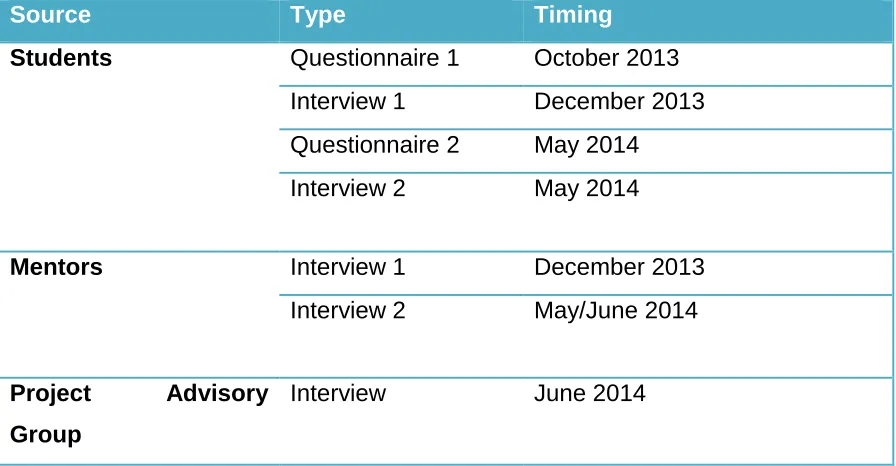
Data were collected from participants at defined stages of the programme (see table 1).
Source Type Timing
Students Questionnaire 1 October 2013
Interview 1 December 2013
Questionnaire 2 May 2014
Interview 2 May 2014
Mentors Interview 1 December 2013
Interview 2 May/June 2014
Project Advisory
Group
[image:6.612.83.531.163.396.2]Interview June 2014
Table 1: data collection sources and times.
2.3 Ethical Considerations
The project received approval from the Health and Applied Science Faculty Research Ethics Committee of the University of the West of England, Bristol (UWE REC REF No: HAS/13/10/119).
3.0 Findings
7
Twelve individual interviews and 2 group interviews, both involving 6 people, were conducted. These comprised individual interviews with students (n=4), focus group interviews with students (n=6 x2), individual interviews with mentors (n=3 x2) and individual interviews with project advisory group members (n=2).
The interviews were digitally recorded and transcribed verbatim. Transcripts were read and re-read by the evaluators. Emerging themes were noted and discussed, with the transcripts being referred back to in line with the constant comparative method.
3.1 Questionnaire Results
3.1.1 First Questionnaire
Question
“On a scale of 1 (not at all prepared) to 10 (very well prepared), please write down the number which best matches…
Mean Range
1. how prepared you felt for the Foundation Degree in Healthcare Science when you started it.
3.17 1-8
2. how confident you feel about meeting your learning objectives for the degree.
4.83 3-7
3. your level of knowledgeabout the scientific basis of life. 3.75 1-6
4. your level of knowledge about principles of healthcare science. 6.08 5-7
5. your level of knowledge about the pathophysiology of disease. (One respondent answered N/A to this question)
5.8 5-7
6. your level of knowledge about anatomy and physiology. (One respondent answered N/A to this question)
5 4-6
7. how useful you think completing the degree will be for your work/practice.
[image:7.612.93.521.352.637.2]9 8-10
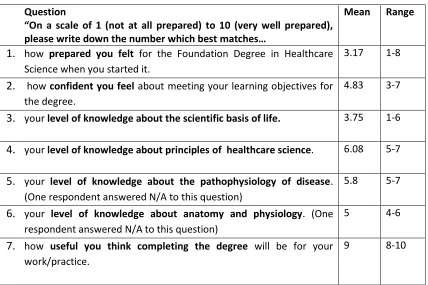
Table 2: first questionnaire responses
8
about particular aspects of the course. Take, for example, the range of scores for knowledge about the scientific basis of life (Q2) which ranges from 1, the lowest possible, up to 6. Even wider disparity is evident in the answer Q1, ‘how prepared you felt for the course when you started it’, where answers ranged from 1 to 8.
Note also the already high level of expectation revealed by the responses to Q7, ‘how useful do you think completing the degree will be for your work/practice, with students scoring this from 8-10.
3.1.2 Second Questionnaire*
Question
“On a scale of 1 (not at all prepared) to 10 (very well prepared), please write down the number which best matches…
Mean Range
1. how confident you feel about meeting your learning objectives for
the first year. 7.33 6-9
2. your level of knowledgeabout the scientific basis of life. 7.33 7-9
3. your level of knowledge about principles of healthcare science. 7.83 7-9
4. your level of knowledge about the pathophysiology of disease. 7.67 7-8
5. your level of knowledge about anatomy and physiology. 4.83 4-6
6. how prepared you feel for the second year of the Foundation
Degree in Healthcare Sciences. 7.42 6-9
7. how useful you think completing the degree will be for your
work/practice. 9.83 9-10
[image:8.612.95.522.242.514.2]*Note: questions were updated and numberings adjusted to retain currency and meaning for the second questionnaire.
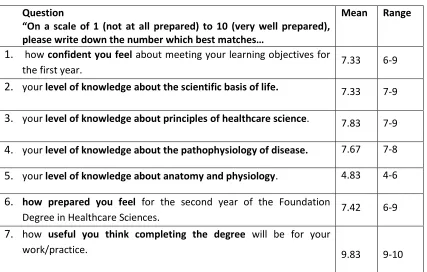
Table 3: second questionnaire responses
The scores for the second questionnaire show an overall upward trend. If the mean scores are added; the total mean score for the first questionnaire was 6.15 and for the second it rose to 8.7. These figures indicate that the students, in general, felt more confident and knowledgeable across this range of indicators by the end of their first academic year.
9
of responses indicates a developing homogeneity of the group during the year.
Looking at the responses to individual questions, the figures show us there was an increase in mean scores for three of the programme modules over the year. The highest rise recorded was for the scientific basis of life module. A fall in scores was recorded for the anatomy and physiology module.
The levels of confidence, reported by students, in meeting learning objectives and feeling prepared for the forthcoming year had risen significantly by the end of the first year. The high level of expectation that the course would be useful for their career was maintained.
These questionnaire responses are represented in the chart below.
Chart 1: mean scores for responses to first and second questionnaire.
3.2 Interview Findings
Results are presented under the following headings; programme setup, programme delivery, work/study balance and workplace factors.
0.00 2.00 4.00 6.00 8.00 10.00 How confident you feel about meeting your
learning objectives
Your level of knowledge about the scientific basis of life.
Your level of knowledge about principles in healthcare science.
Your level of knowledge about the pathophysiology of disease.
Your level of knowledge about anatomy and physiology.
How prepared you felt for first year/second year
How useful you think completing the degree will be for your work/practice.
10 3.2.1 Programme set up
Programme design and purpose
The programme was designed in response to the Modernising Scientific Careers review that identified a gap in training and development opportunities for people already employed in healthcare scientist posts. A Foundation degree was put forward as a way of offering access to a higher education programme to those who did not necessarily have the standard undergraduate degree entry requirements.
The Foundation degree was mapped closely to the UWE undergraduate programme to enable students to step on to the undergraduate programme after the 2 year foundation degree and ‘top up’ to a BSc.
Student recruitment and selection
Seven students were recruited to the first run of the programme in September 2013. Six students were working in NHS biomedical science services in the Bristol and Bath area and one student was working in a private London hospital. One service supported the attendance of two students but in most cases the student was the only person attending the course from their workplace.
The principle considerations of the programme:
Programme delivery must be accessible and flexible.
Should include part-time taught courses, distance learning and blended learning options.
Should be training for the ‘role’ in line with Higher Level Apprenticeships
Must carry academic credit to ensure individuals are eligible to progress to the practitioner training programme (PTP).
11
The four female and three male students entered the programme from a diverse range of employment histories and educational backgrounds. What they had in common was a desire to progress in their career and the support of their employers to do so.
The process by which students were chosen varied between organisations. Some organisations adopted a formal process of selection involving written applications and interviews. Students from smaller laboratories may have been the only eligible candidate and were more likely to be selected by their employer as part of their planned professional development. Many services described the financial restrictions they faced in being able to support students to attend the programme. As one remarked, “we’re slimmed down to the bone now, there’s no back-up system at all” (Workplace Mentor 3).
Despite this, the benefit of offering the programme as a means of retaining and developing valued staff was recognised, as expressed by the following speaker.
“I think it’s very important that as an organisation, if you have got keen people the right people already employed, that you have a way of keeping and maintaining the motivation of those people and training them up into the positions that they are ideally suited for so a grow your own type of approach.”(Academic Staff Member)
This ‘growing your own’ concept was echoed by a workplace mentor who described the importance of ‘getting the right people and developing them’ rather than expecting new employees to have the necessarily skill set from the outset, as this extract demonstrates,
“I would much rather take a young BMSW [Biomedical Support Worker] who’s done you know five years in my lab and encourage them to advance themselves and become a BMS [Biomedical Scientist]. They’re going to stand a much better chance of taking to the work than the traditional route which of late has been biomedical scientist student whose registration portfolio is part of their degree”. (Workplace Mentor 2)
12
now knew the student would need to be highly self-motivated to cope with the academic demands of the programme.
Programme preparation
When asked about preparation for the Programme, the biggest concern for workplace mentors and students was the short notice they were given that the programme would be running and whether they would have a place on it. The length of notice students received varied, ranging from ‘a couple of months’ to ‘ten days’. One student recounted:
“they were thinking about doing this like two years ago so my training officer was already telling me about it then and just kept me in the loop sort of thing and then we got up to it and I think I found I got on the course about a week before it started so it was a bit of a rush trying to get that all sorted but there was already a few other people who were interested in doing it as well. I think they were just using me as the guinea pig really to see how it goes.”(Student)
This illustrates that although the programme had been in the negotiation and planning stages for over two years, the decision to run the Programme was taken very close to the start date.
Factors which contributed to this were felt to be associated with the different planning cycles followed by the organisations involved, as this speaker explains:
“It was very much reliant on networking with the employers rather than the traditional prospectus online marketing and I think it was quite slow because of the nature of it. The employers… have to seek the approval and the funding for that training and those cycles work very different to our own cycles. So we found that we had a lot of verbal indication of interest but that it didn’t really come to fruition in terms of solid numbers until very late on and over the summer and so there was a lot of breath holding and learning to deal with the way that the financial wheels turn in the NHS”. (Academic staff member)
13
Widespread, because of the uncertainty this created for all the participants. Students reported feeling anxious and unable to prepare both academically, for example by pre-reading and practically, for example by planning study time. One student recounted their uncertainty about the course content during the first Focus group.
“…the only thing I had to go on was, because I didn’t know anything all, I had to go on was what the UWE website told me, and I was like ‘Scientific Basis of Life, what the hell’s that?’ and the Principles of Healthcare Science, I was like ‘what is that?”(Student Focus group 1)
Mentors reported having to make last minute workforce planning decisions to ensure service delivery was maintained. Academic staff found themselves preparing the materials for a programme which they were unsure would run and were unable to anticipate the impact this would have on their other academic commitments, as this member of staff reflects;
“One of the key things I think about when you’re setting up a programme like this, you do need clear directions and very clear planning from the beginning. It’s not something that can develop as the course starts. Now it doesn’t mean it can’t adapt but it means it gives staff a direction to follow, it gives staff the structure to follow and I think it makes it run smoothly and gets a lot of the stress out of it”. (Academic staff member)
Despite the short notice and some last minute workplace negotiations, the selected students were all able to attend the course from day one: an early indication of their adaptability and determination.
Expectations of the Programme
The student group held high expectations of the Programme in terms of its perceived benefit to the career development form the outset and these high expectations were maintained, with a slight increase as indicated by the questionnaire data, by the end of the first year.
14
opportunity to expand their repertoire of skills. Other students described the wider range of posts for which they would be eligible to apply on completion.
3.2.2 Programme delivery
The Foundation degree followed a modular structure with four modules being taught during the first year. The Programme was delivered over four week- long study blocks, for which the students attended University, and fortnightly online seminars. This delivery structure and year plan was presented the launch event in June 2013, however, the impact of this mixed delivery was not fully realised by many workplace staff until after the programme had begun.
“When we first initially envisaged the degree we didn’t realise how much time out of the lab was needed and when their manager agreed and said ‘yeah ok, that’s fine’ then we sent back and found out how much time out of the lab they actually needed. It’s not just half an hour, half a day a week, we normally give foundation degree students, it’s the extra bits on top [study blocks] we had to give them really… and we weren’t ready for that” (Workplace Mentor)
The module content was delivered in a variety of ways, including traditional face to face lectures and group seminars, during the study blocks and more technologically enhanced learning systems, such as the online seminars or ‘collaborate’ sessions where students would log-in to join a ‘virtual’ learning environment using remote access. This approach is often referred to as ‘blended learning’. The students, however regarded themselves as ‘distance leaners’ and used this term during the Focus Group discussions. This suggested they held a clear distinction between their own student identity and that of other students undertaking a conventional BSc degree.
As distance learners, it was vital that remote IT access to learning materials worked well. The IT access initially proved challenging for some, as the following extracts recount.
15
“They [IT systems] are all different. My computer at work always updates itself afterwards so every time I go to change to do ‘Collaborate’ as soon as I shut down it will go back to how it was before. So I have to keep phoning up IT and getting them to change the access before I go in. “(Students Focus group 1)
Many students had found ways around these problems, often with the help of their workplace mentors.
“We are using our own laptops because the laptops at work, none of them have speakers so you can’t hear anything, none have got mikes”.
“Well, I spoke to my training officer, because we are using someone else’s dongle, I said, ‘are we going to put a case in?’ For this was like two weeks after using this person’s dongle. I said ‘have you put a case in for our own dongle?’ ‘Oh, um, I guess I should then shouldn’t I?” (Student, Focus Group1)
And from the mentors perspective;
“We had software issues because our network can’t cope with Webinar for start, just haven’t got the band width, we can’t do that. So I did organise it. In the end that we got a wireless dongle and it actually, went not our network but on an outside network”. (Workplace mentor)
The academic level at which the students were being taught was universally perceived as ‘very high’. Students commented on the ‘strong focus and expectation about science [knowledge]’. A workplace mentor commented,
“I must admit, when the whole thing started off, I was a touch sceptical about it all, I imagined a lot of BMS’s probably were… but having looked into it more, having come along to the mentor training sessions and stuff that you ran and seen [student name] go through this and being able to see the level of work that’s been expected… I’m a full convert to the idea now.” (Workplace mentor)
The volume of material students were expected to cover caused concern for some.
16
In addition to the level of content, participants shared their views about the timing and sequence of material.
“But the introduction of those two [study] blocks were so confusing because we were there doing practicals and you are like ‘so what are we doing?’ and they are like ‘don’t worry you will get the lectures later on in the year’. So you did a practical but you didn’t know what you were doing and then you do the lecture and you are like and they say ‘oh refer back to practical’ and you are like ‘I can’t remember what I did’. (Student, Focus group 1)
Similar concerns were raised by the timing of a collaborate session on the subject of the portfolio. The portfolio Students would have found this more beneficial if it had been held during a study block week when they were present at the university.
The style of delivery was also reported by the students to facilitate or hinder their ability to learn the material. Learning was facilitated by consistency in format. Online quizzes were also named as a universally popular and effective way of reinforcing leaning and helping to prepare for examinations.
Factors which hindered leaning included a high volume of slides per lecture, the inclusion of extra material that would not be examined and the late addition of material to Blackboard [virtual learning environment] .
Students were encouraged to give feedback to academic staff and felt that this had been listened to and acted on. The end of study block lunches provided a welcome opportunity to have face to face discussions about the programme and promote networking between the student group and the lecturers. This was mirrored by academic staff who reported having been responsive to student requests. By the end of the first year high levels of satisfaction were recorded.
3.2.3 Work/study balance
Students reported that the course had required far more time than they had initially expected, with noticeable consequences for their domestic and social lives:
17
“I get home from work, I cook tea, bath the kids, seven o’clock they are all in bed and I sit down and study and I am just in a routine of Monday, Tuesday and Thursday night, that is what I do.” (Student, Focus Group 2).
In some cases this impacted on their completion of study tasks:
“Our work don’t let us do the portfolio in our time so I haven’t really had a huge amount of time to do it because it’s always been one of those things – you are like ‘well, I have got lectures to do, I have got revision to do, or coursework to do’. Portfolios is always the thing, always got trapped under the table.” (Student, Focus Group 2)
Some students’ working patterns were also affected by the time pressures of the course:
“When we started the course everyone at work says ‘oh, can you do this, can you do that?’ and you have to get into a sort of mindset of saying ‘no, I have got to study’ because if you say ‘yes, yes, yes’ they will keep relying on you to do things at work and you are not looking after yourself and you get behind.” (Student, Focus Group 2)
This situation resulted in negotiation between some students and their workplaces to facilitate their study:
Interviewer: Your student wanted to do a lot of the coursework from work rather...
Workplace mentor:.. . we would have given her the afternoon off, but she felt that she would work better at work ...
Interviewer: ... and you mentioned that she tends to make up the time coming in on Saturdays and things like that.
Workplace mentor: She does, she puts a lot of work in, she sort of stays late and ...
Another workplace mentor commented that the time required for the course had also surprised workplace managers:
18
Some students felt that they were at a disadvantage compared to ‘normal’ full time students, both due to time pressures and due to the limitations they experienced in face-to-face contact with lecturers:
Student: The normal full time students, they have access to the lecturers when they need them and they see them, whereas we didn’t see two of our lecturers because they couldn’t attend the collaborative sessions, we’ve never seen them.
Student: So that was actually really hard because in those two subjects I don’t know what was going on. (Focus Group 2)
One student had been unable to cope with the combined demands of the course, work and family life, and had changed to a part time route of study.
It had, from the outset, been recognised that the programme would require active partnership working between UWE and the workplace. This meant that everyone involved, namely, academic staff, mentors and managers in students’ workplaces and the students themselves, would all appreciate the competing demands faced by the student:
“It felt very important that there was a three way contract being set up, that there was a lot of work-based learning that was going to be required and that partnership with the employer with the work-based mentor was really important... to establish that relationship was key.” (Academic staff member).
Active partnership working relies on there being clear lines of communication between the organisations involved. Those in practice reported initial confusion about who their contacts were, as one workplace mentor recounts;
“Right at the beginning the person who was course tutor is no longer, lots of changes have happened which is a bit confusing for us and you know, at one point we were getting emails from people whose names we didn’t even recognise, so um and several emails. I think they’ve probably sorted that out now so it’s maybe one point of contact”. (Workplace mentor)
19
The completion of portfolios was the subject of much discussion during interviews with students and mentors with each seeing this as the focus of much of the student/mentor contact. For some this was not a problem, as they were familiar with the process.
Mentor: [the student] has just starting to do the portfolios and that’s where I come in because I will obviously have to do all the stuff online with her or sign it off or advise. I’m lucky because I’ve seen them before; it’s two portfolios and I have PTP students and trainees so I know how to do portfolios now.
Interviewer: OK and how do you find them?
Mentor: The IBMS ones are fine because I’ve been doing that for years. The PTP’s are a bit strange. (Workplace mentor, second interview)
One mentor suggested that more guidance on completion on of the PTP portfolio would be welcome. Students echoed this request suggesting;
Student: ...maybe like they should do next year a portfolio session.
Student: But not at UWE because they did like the portfolio thing at UWE when none of us were logged into the system, none of us knew what was going on. Have like a collaborate session but have a collaborate session on the portfolio.
Student: Or maybe, in that January week that we were here, maybe actually have a session for the portfolios so we have got them there because I don’t mind the online collaborate sessions but they are a pain in the ass sometimes so actually being here with the portfolio and just to sit down and be like, ‘right this is what you need to do’. (Students, Focus group 2)
3.2.4 Workplace factors
20
“They do want to progress the staff, they do want to give them extra education, they want them to stay in the department and one way of doing that is you know giving them an education.... but you’ve also got to weigh up how many can stay out of the lab in any one day... and then you’ve got to factor in leave and sickness ...” (Workplace Mentor)
Funding was another important workplace factor affecting students’ opportunities to study. Students had had variable experiences with regards to obtaining funding to do the course. One student was self-funding, though most were being financially supported by their employers. However, getting funding could be a long-drawn out bureaucratic process:
Student: You might have put it [funding application] in in January but you won’t get an answer until like April...
Student: Mine had to be signed off by13 people going up through my line manager, my management, the senior management, then it had to go through all the boards up to the head of the Public Health England for him to send it off, then it had to be transferred to the finance department and I think another… I think it was six people had to sign it off. (Focus group 2)
In at least one case, uncertainly about funding had affected the selection process, in that only staff who were prepared and eligible to apply for a student loan if necessary were considered suitable by their managers to apply for the course. The comparative cost of courses was acknowledged as a factor influencing where staff could be permitted to study:
“If you want to retain some sort of qualification that leads to registration of some sort then you have to go externally, but I know they [the employers] will shop about and they’ll want to try and get the cheapest deal.” (Workplace mentor)
However, there was evidence that actually being on the course had positively affected the funding situation for the individual who had been promoted to a Band 5 post:
21 3.3 Advice from the first cohort of students
Students were asked what would say to the new first years beginning the programme in September 2014. They offered a range of practical advice:
“I think organisation helps especially, I mean, that’s one thing I found. Everything has to be organised otherwise I don’t know what’s going on but communication because I think that was another thing in September you were still a bit new, a bit scared of kind of talking to people and even the lecturers, you were not sure. So I would say communication and organisation has helped me brilliantly.”
“I would say the importance of time management if you are going to study and don’t put it off because otherwise you end up with no weekend and not doing anything to give yourself a break.”
Advice on managing competing demands:
“I think I would say, especially to the people coming from my workplace, is look out for Number One. Just because when we started the course everyone at work says, ‘oh, can you do this, can you do that?’ and you have to get into a sort of mind set of saying ‘no, I have got to study’.
“I would say to the just take it at face value. Don’t get too stressed about it because that’s what I was doing. I was going ‘oh no, I can’t understand this’. I was trying to read too much into something at level one you don’t need to necessarily know. So I have learnt just to take a step back and just take it as it comes. I don’t try to look at the kind of stuff that you might need to know at level three or level two. Just take a step back, calm yourself.”
Advice to take the long view.
“I am quite good mates with the person who is coming in anyway so I have told him that it’s worth being in it because it’s the only way you are going to be able to progress.”
And finally,
22
4.0 Key messages from the evaluation
4.1 Timely information about the structure, timings and cost of the programme is important to allow students and workplace mentors to manage the competing demands of study time and workload.
4.2 Smoothly functioning IT and appropriate use of technology enhanced learning (TEL) are vital for the blended learning approach to be successful. Consistency in style of delivery and format of content is important.
4.3 Students have felt that their feedback has been listened to and acted on by academic staff. Study blocks have been valued as an opportunity to meet other students and develop a sense of group identity which, as distance learners, might otherwise not develop. There is universal sense of achievement in having completed the first year.
4.4 Service colleagues value the programme as it helps to develop knowledge and confidence in staff who are already team members. The academic level is recognised to be high and is therefore respected. It supports retention of staff by opening a new pathway to career progression, which has already been demonstrated in practice.
Dr Antonia Beringer Senior Research Fellow
Faculty of Health and Applied Sciences Glenside Campus 1H14
+44(0)117 32 88209
Dr Katherine Pollard Senior Research Fellow
Faculty of Health and Applied Sciences Glenside Campus 1H14
+44(0)117 32 81125
23
5.0 Appendices
Evaluation Preliminary Findings p24
Information sheet for Students p26
Interview questions for students p28
Information sheet for mentors P30
Interview questions for mentors p32
24
Evaluation of the Foundation Degree in Health Sciences: Preliminary
findings
A. Questionnaire Data. Source: individual student responses to email questionnaire (n=6/7)
Question
“On a scale of 1 (not at all prepared) to 10 (very well prepared), please write down the number which best matches…
Mean Range*
1. how prepared you felt for the Foundation Degree in Health Sciences when you started it.
3.17 1-8
2. how confident you feel about meeting your learning objectives for the degree.
4.83 3-7
3. your level of knowledgeabout the scientific basis of life. 3.75 1-6
4. your level of knowledge about principles in healthcare science. 6.08 5-7
5. your level of knowledge about the pathophysiology of disease. (One respondent answered N/A to this question)
5.8 5-7
6. your level of knowledge about anatomy and physiology. (One respondent answered N/A to this question)
5 4-6
7. how useful you think completing the degree will be for your work/practice. 9 8-10
*Note the wide range of scores given indicating a heterogeneous group. Note too the high level of expectation in response to Q7.
B. Interview data. Source: Individual interviews with students (n=4), focus group interview with students (n=6) and individual interviews with mentors (n=3).
Background: a diverse range of employment histories and routes taken before commenced course.
Notice: variable range of notice given that they would be starting on the course; ‘a couple of months’ to ‘ten days’. Hindered opportunities for students to prepare in advance. Lack of clarity about content and expectations made it difficult to negotiate study time with their managers.
Course: level generally perceived as ‘very high’. Students commented, ‘too high to be able to carry on full-time’ and ‘strong focus and expectation about science’.
Delivery - structure: Blocks of study time unexpected. Mixed opinions about study blocks. Weren’t expecting practicals so early.
25
recognised and appreciated. Some delays in email responses reported.
Study time: Some students struggling with work /study balance. Wide range of support offered by workplace. Some confusion about entitlements to study leave – individuals having to negotiate own release time.
Barriers: Not getting fully protected time at work . No family/external support. Difficulties with work colleagues. Unfamiliarity with UWE laboratory equipment – different from workplace. IT access and connectivity problems – particularly accessing collaborate sessions from NHS settings.
Facilitators: Work supportive of giving study time. Good support from colleagues. Good support from Mentor.
26
Evaluation of the Foundation Degree in Health Sciences
Information Sheet for Students
You are invited to take part in the Evaluation of the Foundation Degree in Health Sciences. This information sheet is about why the evaluation is being done and what it will involve. Please take a few moments to read this carefully and discuss it with others, if you wish. Ask us if there is anything that is not clear or if you would like more information (contact details overleaf). Take time to decide whether or not you wish to take part.
Title Evaluation of the Foundation Degree in Health Sciences
Purpose The aim of the evaluation is to find out how the UWE Foundation Degree in Health Sciences contributes to role development in biomedical sciences.
Duration The evaluation will begin in October 2013 and will end in September 2014.
Why have I been chosen?
You are being asked to take part because you have enrolled on the UWE Foundation Degree in Health Sciences.
Do I have to take part?
No, you do not have to take part in the evaluation. If you decide to take part and then change your mind you can withdraw at any time without giving a reason. If you decide not to take part, or to withdraw, this will not affect your course in any way. However, your input would be very valuable, so we hope that you will participate in the evaluation.
What will taking part involve?
If you take part in the evaluation you will be asked to complete a short e-mail survey twice: the first one near the beginning of the course, and the second at the end of the degree course. There will be a question on the survey which will ask you if you would be willing to talk to one of the researchers about your experience of the course. If you are willing to do so, we will arrange a convenient time to talk to you on the phone; the interview will take between 30 and 45 minutes and, with your consent, will be audio-recorded. We will ask you questions about your reasons for doing the course, and your experiences on it so far. Some of the questions the researcher asks will be based on your answers to the survey. We would plan to interview you twice, once after you have completed the first survey and once after you have completed the second survey.
27 possible
benefits of taking part?
the Foundation Degree helps to develop staff in their working roles. This knowledge will be used to help decide how the degree course can be developed and improved. You may also find that the process of taking part in the evaluation gives you the opportunity to reflect on and consolidate what you have learned from your experience.
How will the information I
give be
handled?
All the information you give will be kept strictly confidential. Any information used in written reports will be made anonymous to protect your identity. The evaluation has been approved by a UWE Research Ethics Committee.
What will happen to the results?
You will be given feedback about the evaluation findings. These will also be published in professional journals, presented at conferences and publicised through the university website.
For further information
You are welcome to contact the researchers, directly;
Katherine Pollard
Rm 1H14, Glenside Campus, University of the West of England Faculty of Health & Applied Sciences, Blackberry Hill
Bristol BS16 1DD
Tel: 0117 328 1125
Email: [email protected]
Antonia Beringer
Rm 1H14, Glenside Campus, University of the West of England Faculty of Health & Applied Sciences, Blackberry Hill
Bristol BS16 1DD
Tel: 0117 328 8209
Email: [email protected]
If you have any questions you would like to answered before deciding whether or not to take part, please contact one of us by phone or email.
What shall I do
now?
If you would like to take part in the evaluation please complete the attached survey and return it to [email protected].
28
Evaluation of the Foundation Degree in Health Sciences
Telephone interview with students – indicative questions
The plan is to interview students undertaking the Foundation Degree in Health Sciences
twice; once near the beginning of the course (November/December 2013) and again towards the end of the course (May/June 2014). The interviews will take place after the student has completed a short e-mail questionnaire (see attached), which will be used to inform individual interviews.
The topics covered by each interview will be consistent across both, to enable us to compare responses over time, with changes to tenses in the wording where necessary.
Interview 1: Beginning of course
A. Student information:
These questions are about you and where you work.
What is the title of your current post?
When did you take up this post?
Please describe your work role.
What is your academic background?
B. Starting out on the degree:
These questions are about the early stages of the course.
How did you come to enrol on the Foundation Degree in Health Sciences?
How much notice did you have that you would be starting the degree in September 2013?
Please tell us your opinion about the pre-course preparation and/or reading provided by UWE.
29
Please tell us your opinion of the degree course content.
How useful do you think completing the degree will be for you in your work?
Do you expect to bring knowledge/skills from the degree course into the laboratory/workplace while you are still studying?
D. Enabling and hindering factors:
These questions are about some of the factors that can affect your capacity to complete the Foundation Degree in Health Sciences successfully.
How many hours per week do you think you will need to devote to study in order to complete the degree successfully?
How many hours protected time per week will you have to devote to study?
Can you think of any particular knowledge and skills they may need to complete the degree successfully?
(Prompt – are there any skill gaps you hope will be filled?)
From whom do you think you will get support whilst doing the degree?
Fellow students Work colleagues Your mentor UWE staff Family & friends
Other source (please name)
Is there anything else you would like to say about your experience of enrolling and being on the course so far?
Closing remarks:
Thank you for taking the time to talk to me.
If there’s anything you think of that you’d like to add please call or email me. I’ll be in touch again before the end of the degree course.
30
Evaluation of the Foundation Degree in Health Sciences
Information Sheet for Mentors
You are invited to take part in the Evaluation of the Foundation Degree in Health Sciences. This information sheet is about why the evaluation is being done and what it will involve. Please take a few moments to read this carefully and discuss it with others, if you wish. Ask us if there is anything that is not clear or if you would like more information (contact details overleaf). Take time to decide whether or not you wish to take part.
Title Evaluation of the Foundation Degree in Health Sciences
Purpose The aim of the evaluation is to find out how the UWE Foundation Degree in Health Sciences contributes to role development in biomedical sciences.
Duration The evaluation began in November 2013 and will end in July 2014.
Why have I been chosen?
You are being asked to take part because you are mentoring a staff member who has enrolled on the UWE Foundation Degree in Health Sciences.
Do I have to take part?
No, you do not have to take part in the evaluation. If you decide to take part and then change your mind you can withdraw at any time without giving a reason. However, your input would be very valuable, so we hope that you will participate in the evaluation.
What will taking part involve?
If you take part in the evaluation you will be asked to take part in two telephone interviews: the first one near the beginning of the degree course, and the second at the end of the degree course. We will ask you questions about your role, your opinion of the course and how you think it is affecting/has affected your staff member’s working role. The interviews will be conducted at a time that is convenient to you, and will take 30-45 minutes; with your consent, it will be audio-recorded.
What are the possible benefits of taking part?
31 How will the
information I
give be
handled?
All the information you give will be kept strictly confidential. Any information used in written reports will be made anonymous to protect your identity. The evaluation has been approved by a UWE Research Ethics Committee.
What will happen to the results?
You will be given feedback about the evaluation findings. These will also be published in professional journals, presented at conferences and publicised through the university website.
For further information
You are welcome to contact the researchers, directly;
Katherine Pollard
Rm 1H14, Glenside Campus, University of the West of England Faculty of Health & Applied Sciences, Blackberry Hill
Bristol BS16 1DD
Tel: 0117 328 1125
Email: [email protected]
Antonia Beringer
Rm 1H14, Glenside Campus, University of the West of England Faculty of Health & Applied Sciences, Blackberry Hill
Bristol BS16 1DD
Tel: 0117 328 8209
Email: [email protected]
If you have any questions you would like to answered before deciding whether or not to take part, please contact one of us by phone or email.
What shall I do
now?
If you would like to take part in the evaluation please e-mail Katherine Pollard at [email protected] so that we can arrange a mutually convenient time for the telephone interview.
32
Evaluation of the Foundation Degree in Health Sciences
Telephone interview with mentors – indicative questions
The plan is to interview mentors of students undertaking the Foundation Degree in Health Sciences
twice; once near the beginning of the course (November/December 2013) and again towards the end of the course (June 2014).
The topics covered by each interview will be consistent across both, to enable us to compare responses over time, with changes to tenses in the wording where necessary.
Interview 1: Beginning of course
C. Mentor information:
These questions are about you and where you work.
What is the title of your current post?
When did you take up this post?
Please describe your work role.
Are you responsible for training staff? Yes – explore further
What support will you receive in your role as mentor to your staff member?
D. Starting out on the degree:
These questions are about the early stages of the course.
How did you first hear about the Foundation Degree in Health Sciences?
From a senior manager From a colleague From UWE staff Other
How was your staff member selected to enrol on the degree?
33
member to do the degree? (prompt with following options) interest in the subject
to develop specific aspects of practice to help meet organisational needs to improve patient care
for personal development to meet/network with others for career prospects
other reason
How would you rate the current level of knowledge of your staff member (where 1 is novice and 10 is expert) about:
a) the scientific basis of life
b) principles in healthcare science c) the pathophysiology of disease d) anatomy and physiology.
How useful do you think completing the degree will be for your staff member at work?
Please tell me your opinion of the degree course content.
Do you expect your staff member to bring knowledge/skills from the degree course into the laboratory/workplace while they are still studying?
D. Enabling and hindering factors:
These questions are about some of the factors that can affect your staff member’s capacity to complete the Foundation Degree in Health Sciences successfully.
How many hours per week do you expect the staff member will have to devote to study?
Can you think of any particular knowledge and skills they may need to complete the degree successfully?
(Prompt – are there any skill gaps you hope will be filled?)
From whom do you think they will get support whilst doing the degree?
Fellow students Work colleagues Me as mentor UWE staff Family & friends
34
Is there anything else you would like to say about the degree course at this stage?
Closing remarks:
Thank you for taking the time to talk to me.
If there’s anything you think of that you’d like to add please call or email me. I’ll be in touch again before the end of the degree course.