• No results found

THE EXACT SOLUTION AND NUMERICAL IMPLEMENTATION OF THE FLAT ELECTRODYNAMIC PROCESS

N/A
N/A
Protected

Academic year: 2020

Share "THE EXACT SOLUTION AND NUMERICAL IMPLEMENTATION OF THE FLAT ELECTRODYNAMIC PROCESS"

Copied!
14
0
0

Loading.... (view fulltext now)

Full text

(1)

THE EXACT SOLUTION

AND NUMERICAL IMPLEMENTATION OF THE FLAT ELECTRODYNAMIC PROCESS

Irina DMITRIEVA , Nikolay BALAN **

Abstract. Mathematical simulation of the electromagnetic field behavior in the flat guided structure is done using boundary value problem for the general wave equation with respect to all scalar components of the vector intensities.

The explicit solution of given problem is suggested as well.

The numerical implementation and computer modeling are also proposed.

Keywords and phrases: differential Maxwell system, mathematical and computer modeling.

1. Introduction

The present paper deals with the specific case of the classical differential Maxwell equations in the Cartesian coordinate system

.

,

; 0 div

,

; div

, rot

, rot

0 0

E i

H B B

E D D

B E

i D H

 

 

(1.0)

In (1.0): E , H E , H ( x , y , z , t ),

) , , , ( ,

, B D B x y z t D

are intensities and inductions of electric / magnetic field respectively; , determine specific electric and magnetic permeability; ii  ( x , y , z , t )

is the charge with the density ( x , y , z , t ), and 0 .

t

The proposed here specific statement of (1.0) is the basic model for the electromagnetic wave propagation in the isotropic homogeneous

Higher Mathematics Department, Odessa National Academy of Telecommunications, Kuznechnaya Str., 1, Odessa 65029, Ukraine; [email protected]

** Odessa National Academy of Telecommunications, [email protected]

(2)

rectangular flat slow-guided structures. They are metal and have no either magnetics ( a 12 , 56 10 7 H/м) or dielectrics ( a 8 , 85 10 12 F/м), or charges inside ii  ( x , y , z , t ).

The last constraint means the zero value as for i  0 ,

as for the charge density ( x , y , z , t ) 0 . Moreover, the requirement for specific conductivity implies metal to be the perfect conductor.

Electromagnetic field vector intensities E  , HE  , H  ( x , y , z , t )

vary according to the harmonic law regarding the temporal argument , t i.e.

), exp(

) , , ( ,

, H E H x y z i t

E    

where i 1 and is the oscillation frequency [1, chapter 1].

Hence, under those mentioned conditions after the simple obvious computation, (1.0) turns into the aforesaid particular differential Maxwell system which looks like [2]

a a

a a

H E i E

t

E H i H

t rot

rot

0 0.

a a

E i H

i E H

rot

rot

All symbols in (1.1) are explained earlier, a , a determine the electric and magnetic permeability of the medium respectively whose above mentioned numerical values are accepted here as characters of an air [1, chapter 1].

In monograph [1, chapter 1], one of the purposes was an analytic study of (1.1). Unfortunately, not even particular specific approach was proposed there, though the declared results looked almost obvious. As far as it is known, until recently, the aforesaid problem was not explicitly solved. The procedure of this problem exact solution was proposed in [2]

basing on the earlier general theoretical results from [3].

That’s why at first, the present paper deals with the explicit solution of (1.1). Also, after that the corresponding boundary problem regarding this system will be considered here. The latter mathematically describes the electromagnetic field behavior in the flat rectangular cavities whose importance in technical electrodynamics remains irresistible even till now.

Not taking into account the remoteness of [1], in any case, in modern

electrodynamics, the ideas and aims of this monograph should be admitted

as urgent. It concerns as their corresponding declared analytic

(1.1)

(3)

investigation, as the appropriate numerical implementation regarding (1.1).

Hence, the goal of the given paper includes both of those mentioned directions of the present research.

2. General theoretic results

Returning to (1.1) and using results of [2], [3] system (1.1) was reduced to the equivalent general wave PDE (partial differential equation) regarding all scalar components of the electromagnetic field vector intensities

; 0 )

( a a 2 F kj

1 j j j ( , , ), 2 j j j ( , , ), ( 1, 3),

F E E x y z F H H x y z j

where

3

1 2 j

j is the Laplace operator, and

. ,

, 2

2 2 2 3 2 2 2 2 2 2

1 x y z

Using the classical method of integral transforms [4] which was partially improved in [5], this procedure was applied to all spatial variables

) , ,

( x y z irrespectively to the specific boundary conditions, and leaving the time argument t as the main one. Therefore, the general solution of (2.0) was obtained in terms of transforms for (2.1)

2 0 0 ki tr ki tr

tr

F f ( k 1, 2; i 1, 3),

regarding all scalar components of electromagnetic field vector intensities.

In (2.2): x x 1 , y x 2 , z x 3 ; K i K i ( x i , p i ) is the kernel of the direct integral transform

i

i b

a

i i i i

i K x p x

S ( , ) d by variable x i with parameter p i where a , i b i are the initial and finishing points of the open integration contour L i , i ( 1 , 3 ) . Those points can be either finite, or infinite real, or complex as well [4]. After application of the i th integral transform to

3

1 2 i

i F

F in (2.0) and double integration by parts, the following formula was obtained

(2.0) (2.1)

(2.2)

(4)

i

i i

i i i

i

b

a

i i i b

a x i i i

i b

a

i i i i

i F ) K ( x , p ) d x ( K ( F ) ( K ) F ) | ( K ) F d x

( 2 2

, ) ( )

; ) 3 , 1

; ( ,

( i i i i tr

i p x i t p F

s (i 1 , 3 ) ,

where

( , ( ; 1, 3); )

i i i

s s p x i t

i i i b

a x i

i i

i F K F

K ( ) ( ) ) |

( s p x x t i ( i , , , ), ( , l l i l ; ),

and the left or the right inferior index «tr» everywhere in the present paper implies the corresponding transform.

Though i , , l 1 , 3 in (2.4), but due to both last inequalities in (2.4) l

, can possess only two values among three indicated above. In addition, the second summand i ( p ) i i F tr from the right part of (2.3) has the parameter-dependent factor i ( p i ) regarding p i from the i th integral transform, and it appears after application of 2 i K i , (i 1 , 3 ).

The “incomplete” i th transform of the function F by the variable x i looks like

i F tr

tr

i F ( , ( ; 1 , 3 ) ; ) ( ( 1 , 3 ); ) ( , ) d d ,

i

i i

i

b

a

i i i

i i i b

a i

i x i t F x i t K x p x F K x

p

).

3 , 1

(i (2.5) Then, basing on (2.5) the “complete” transform of F by its all spatial arguments ( x , y , z ) ( x i , i 1 , 3 ) is determined by the expression

tr i i

b

a tr

i tr

tr F p i t F p t K x F

F

3

1

d )

, ( )

; ) 3 , 1 ( (

; d d ) , , , ( ) , ( ) , (

l

l b

a b

a

l l

i tr i l l

l x p F p x x t x x

K p x

K ( 1 , 2 , 3 ),

3

1

p p p p p

i

i

, ) 3 , 1 (i

where conditions for , l remain the same as for s i , (i 1 , 3 ) in (2.4). In terms of (2.2), F tr turns into ki F tr , ( k 1 , 2 ; i 1 , 3 ) .

(2.3)

(2.6)

(2.4)

(5)

Turning again towards (2.2) it can be noticed that some symbols from its right part should be explained. Namely,

3

1 i

i i tr

tr p p ; i

i i

b

a tr

ki f K x s

3

1 3

1

d , (i 1 , 3 ) , (2.7) and the expression under the sum symbol from the second formula in (2.7) is of the same meaning as in (2.6)

i i

b

a

s x K

3

1

d ( , ) ( , ) ( , , , ) d d ,

l

l b

a b

a

l l

i i l l

l x p s p x x t x x

K p x K

. ) 3 , 1 , ,

;

; ,

( l i l i l (2.8) The subsequent conversion to the original inverse transforms of the wave functions (2.1) gives

( , , ) ,

3

1 1 l

tr ki l ki

ki F x y z S F

F ( k 1 , 2 ; i 1 , 3 ) , (2.9) where S l 1 , (l 1 , 3 ) , represent all backward integral transformations with respect to initially used ( , ) d ,

i

i b

a

i i i i

i K x p x

S (i 1 , 3 ) .

3. Specific explicit solution

At last, we come nearer to the analysis of the electromagnetic field features in the case of the flat rectangular cavity. Attaining this purpose, the relevant mathematical model should be proposed. It is expressed as the boundary value problem regarding the specific type of (2.0), (2.1) over the space ( x , y ), where the boundary conditions look like

), , 0 ( )

1 ( y F y

g kj kj g 2 kj ( y ) F kj ( p , y ); h 1 kj ( x ) F kj ( x , 0 ),

h 2 kj ( x ) F kj ( x , q ), x [ 0 , p ], y [ 0 , q ], ( k , j 1 , 2 ). (3.1) The given functions g , h in (3.1) conform to the exponential law and are continuous while x [ 0 , p ], y [ 0 , q ]. The last condition implies the lack of singularities for the considered flat cavity.

Application of the finite integral Fourier sin -transform [4] to (2.0),

(2.1), under the flat statement ( x , y ) together with (3.1) gives the general

unknown transform regarding F kj ( x , y ), ( k , j 1 , 2 ) :

(6)

tr F kj

2 2

1 1 2

1 2 1 2

( tr kj 1 n tr kj ) ( tr kj ( 1) m tr kj ) a a

n m

g g h h n m

p q p q

. (3.2) In (3.2), as earlier, the left inferior index “tr” designates the transform operation whose relative formulae for transforms are the following

).

2 , 1 , , ( , d sin

) ( ,

d sin

) (

; d d sin

sin ) , (

0 0

0 0 2

j k s x p x x n

p h h y q y

y m q g

g

y x q y

x m p y n

x pq F

F

p skj skj

tr q

skj skj

tr

p q kj kj

tr

(3.3) The further influence of the finite integral backward Fourier sin - transformation upon (3.2), together with (3.3) reduces to the desired explicit expressions regarding all scalar components of the electromagnetic field vector intensities E , H E , H ( x , y )

, sin

2 sin )

, (

1 1

2

2 y

q x m

p F n

pq y

x F

n m

kj tr

kj ( k , j 1 , 2 ). (3.4)

In (3.4), all designations are from (2.2), (3.1) – (3.3), and the joint calculation formula looks like

N

n M

m

a a kj

q m p

n pq mn

y x F

1 1

2 2

2 2 2

) 2 ( ) , (

2 2

1 1

2 2

1 2

) ( ) (

) exp(

) 1 ( ) 1

1 ) (

( ) (

) exp(

) 1 ( 1

m kj

kj m

kj q

kj q p

q n m

m

, sin

) sin ( ) (

) exp(

) 1 ( ) 1

1 ) (

( ) (

) exp(

) 1 ( 1

2 2

1 1

2 2

1 2

q y x m

p n n

kj

kj n

kj p

kj p q

p n m n

( k , j 1 , 2 ).

In (3.5), the whole expression (let it be denoted as kj C m n ) disposed under the double sum symbol up to the sin -product is called “the coefficient of the field modification”. It is quite natural, since just this coefficient represents electromagnetic field behavior under the given boundary conditions.

(3.5)

(7)

If M, N in (3.5), then the analytic solution (3.4) is got, and it is expressed as the double functional series under the above mentioned specific boundary conditions. Taking into account the structure of kj C m n and sin - product in (3.5), it is easy to find the conditional convergence of the aforesaid functional series by m , n simultaneously, for all possible values x, y .

Analysis of the series’ behavior by each variable, either m or n , gives even absolute and uniform convergence.

4. Numerical implementation

The further numerical implementation is done by the discretization scheme [6, p. 87] with the nodes

( x , y l ), ( 1 , c ; l 1 , d ; ), c , d N, where , l , d y q c

x p l (4.1)

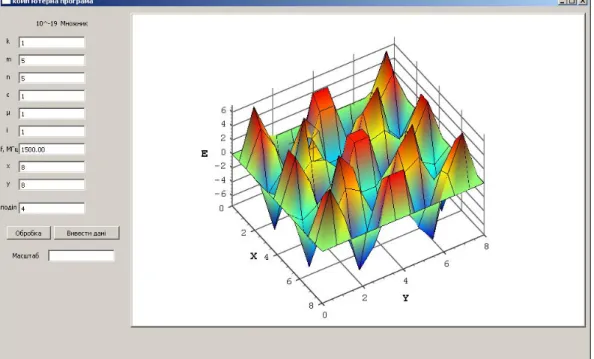
and the following flow-chart (look Fig. 2) is the base for the computer modeling of the electromagnetic field behavior.

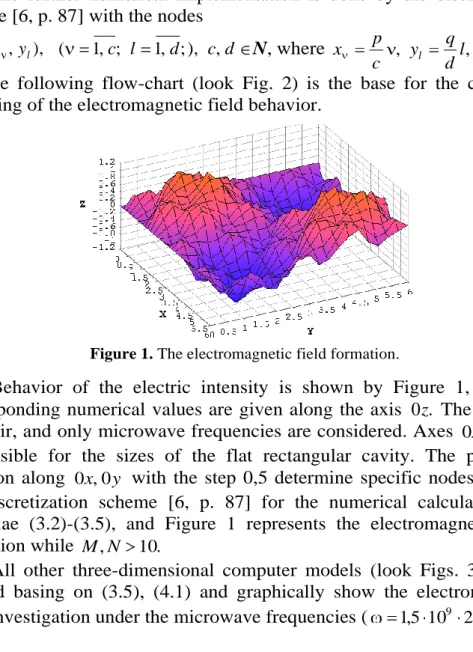
Figure 1. The electromagnetic field formation.

Behavior of the electric intensity is shown by Figure 1, and the corresponding numerical values are given along the axis 0z The medium . is an air, and only microwave frequencies are considered. Axes 0 x 0 , y are responsible for the sizes of the flat rectangular cavity. The points of partition along 0 x 0 , y with the step 0,5 determine specific nodes (4.1) of the discretization scheme [6, p. 87] for the numerical calculations by formulae (3.2)-(3.5), and Figure 1 represents the electromagnetic field formation while M , N 10 .

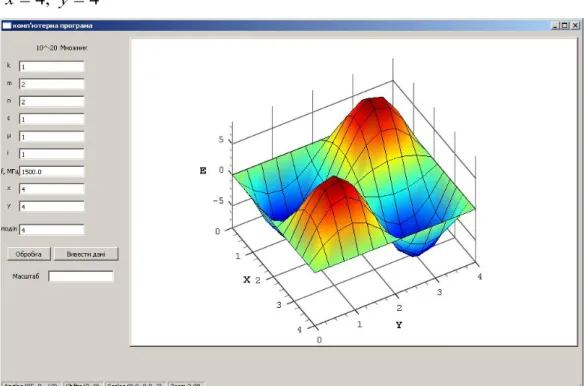
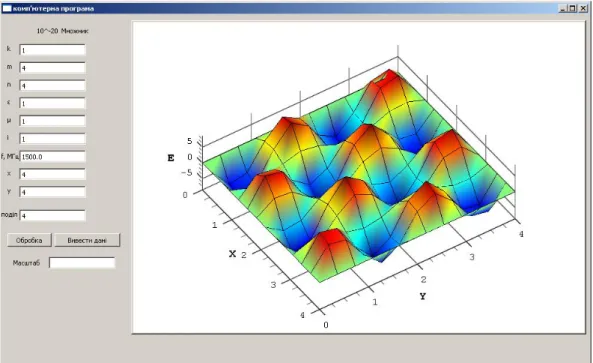
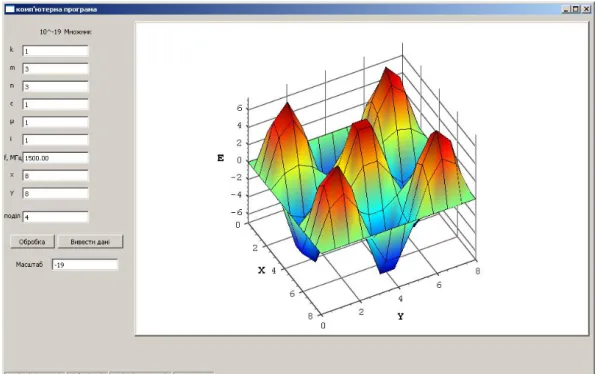
All other three-dimensional computer models (look Figs. 3-12) are

created basing on (3.5), (4.1) and graphically show the electromagnetic

field investigation under the microwave frequencies ( 1 , 5 10 9 2 Hz).

(8)

begin

no

yes

yes

no

; :

; :

; :

; :

; :

; :

; :

d c

q p

: , ( 1 , )

) , 1 ( , :

array

d l d l y q

c c v

x p

l

) , ( :

; :

; 1 :

; :

; 1 :

l l

l

y x F F

y y l

x x

remember

to

1 : v v

l : l 1 v c

) , (

: l

l F F x y

to remember

l d

table the

as

of values

all print to

d c

F d

c vl

end Figure 2. The flow-chart of the numerical implementation.

(9)

х = 4, у = 4

Figure 3. The field partition (2).

Figure 4. The field partition (3).

(10)

Figure 5. The field partition (4).

Figure 6. The field partition (5).

(11)

Figure 7. The field partition (6).

х = 8, у = 8

Figure 8. The field partition (2’).

(12)

Figure 9. The field partition (3’).

Figure 10. The field partition (4’).

(13)

Figure 11. The field partition (5’).

Figure 12. The field partition (6’).

(14)

5. Conclusions

The appropriate developed computer programs are intended for determination of the numerical values and graphic construction of the electromagnetic field vector intensities in three-dimensional Cartesian coordinate system. The original data of frequency, electric and magnetic permeability of the medium, the sizes of the observable field, the number of the first or the second scalar component of the vector intensity, the scaling coefficient for the coordinate axes are given.

Those aforesaid computer programs can be used in various computer- aided technologies for representation of the electromagnetic field vector intensities in terms of three-dimensional graphs.

The present numerical implementation is simpler and more accurate in comparison with all known because of the exact final formulae which are obtained here basing on the general explicit solutions in the classical Maxwell theory.

R E F E R E N C E S

[1] R. A. Silin, and V. P. Sazonov, The Slow-Guided Structures, Moscow; Soviet Radio, 1966 (Russian).

[2] P. Vorobiyenko, and I. Dmitrieva, Comparative analysis in study of the classical differential Maxwell system for the slow-guided structures, in Hyperion Intl. J. of Econophysics, vol. 8, iss. 2, 2015, pp. 333-349.

[3] I. Dmitrieva, Diagonalization problems in the classical Maxwell theory and their industrial applications, in Hyperion Intl. J. of Econophysics, vol. 1, iss. 1, 2008, pp. 21-35.

[4] C. J. Tranter, Integral Transforms in the Mathematical Physics, London: Methuen and Co. Ltd.; New York: Wiley and Sons, Inc., 1951.

[5] I. Yu. Dmitrieva, Detailed explicit solution of electrodynamic wave equations, in Sci. J. “Works of Odessa Polytechnic University”, vol. 2(46), 2015, pp. 145-154.

[6] I. Dmitrieva, Analytic approach in study of the slow-wave structures, in Proc. of the Intl. Sci. Conf. ENEC-2016, Bucharest, Hyperion Univ., vol. 9, iss. 2, 2016, pp. 85-90.

Figure

Figure 1. The electromagnetic field formation.
Figure 3. The field partition (2).
Figure 5. The field partition (4).
Figure 7. The field partition (6).
+3

References

Related documents