(
E
)-2-[(2-Hydroxy-5-nitrophenyl)-iminiomethyl]-4-nitrophenolate
Yousef M. Hijji,aBelygona Barare,aRay J. Butcherb* and Jerry P. Jasinskic
aDepartment of Chemistry, Morgan State University, Baltimore, MD 21251, USA, bDepartment of Chemistry, Howard University, 525 College Street NW, Washington DC 20059, USA, andcDepartment of Chemistry, Keene State College, 229 Main Street, Keene, NH 03435-2001, USA
Correspondence e-mail: [email protected]
Received 23 December 2008; accepted 6 January 2009
Key indicators: single-crystal X-ray study;T= 296 K; mean(C–C) = 0.002 A˚; Rfactor = 0.041;wRfactor = 0.129; data-to-parameter ratio = 12.4.
The title molecule, C13H9N3O6, consists of a
2-hydroxy-5-nitrophenyliminio group and a 4-nitrophenolate group bonded to a methylene C atom with both of the planar six-membered rings nearly in the plane of the molecule [dihedral angle = 1.3 (4)]. Each of the nitro O atoms is twisted slightly
out of the plane of the molecule. The amine group forms an intramolecular hydrogen bond with both nearby O atoms, each of which has partial occupancy of attached H atoms [0.36 (3) and 0.64 (3)]. An extended -delocalization throughout the entire molecule exists producing a zwitterionic effect in this region of the molecule. The shortened phenolate C—O bond [1.2749 (19)], in concert with the slightly longer
phenol C—O bond [1.3316 (19) A˚ ], provides evidence for this effect. The crystal packing is influenced by extensive strong intermolecular O—H O hydrogen bonding between the depicted phenolate and hydroxy O atoms and their respective H atoms within the-delocalized region of the molecule. As a result, molecules are linked into an infinite polymeric chain diagonally along the [110] plane of the unit cell in an alternate inverted pattern. A MOPAC AM1 calculation provides support for these observations.
Related literature
For related structures, see: Butcheret al.(2007); Ersanlıet al.
(2003); Gu¨let al.(2007); Hijji et al.(2008); Odabas¸og˘lu et al.
(2006); Jasinski et al. (2007). For related literature, see: Schmidt & Polik (2007).
Experimental
Crystal data
C13H9N3O6
Mr= 303.23 Monoclinic,P21=c a= 7.9649 (1) A˚
b= 8.6110 (1) A˚
c= 19.1190 (3) A˚ = 98.433 (2)
V= 1297.11 (3) A˚3
Z= 4
MoKradiation = 0.13 mm1
T= 296 (2) K 0.370.270.18 mm
Data collection
Oxford Diffraction Gemini R diffractometer
Absorption correction: multi-scan (CrysAlis RED; Oxford Diffraction, 2007)
Tmin= 0.954,Tmax= 0.978
6432 measured reflections 2495 independent reflections 1819 reflections withI> 2(I)
Rint= 0.023
Refinement
R[F2> 2(F2)] = 0.041
wR(F2) = 0.129
S= 1.05 2495 reflections
202 parameters
H-atom parameters constrained
max= 0.22 e A˚
3
min=0.17 e A˚
[image:1.610.315.565.477.584.2]3
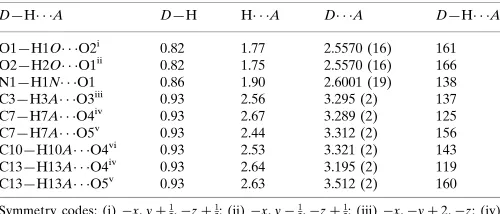
Table 1
Hydrogen-bond geometry (A˚ ,).
D—H A D—H H A D A D—H A
O1—H1O O2i
0.82 1.77 2.5570 (16) 161 O2—H2O O1ii
0.82 1.75 2.5570 (16) 166 N1—H1N O1 0.86 1.90 2.6001 (19) 138 C3—H3A O3iii
0.93 2.56 3.295 (2) 137
C7—H7A O4iv
0.93 2.67 3.289 (2) 125
C7—H7A O5v 0.93 2.44 3.312 (2) 156 C10—H10A O4vi
0.93 2.53 3.321 (2) 143
C13—H13A O4iv
0.93 2.64 3.195 (2) 119
C13—H13A O5v
0.93 2.63 3.512 (2) 160
Symmetry codes: (i)x;yþ1 2;zþ
1
2; (ii)x;y 1 2;zþ
1
2; (iii)x;yþ2;z; (iv)
xþ1;yþ1;z; (v)xþ1;y;z; (vi)x;yþ1 2;zþ
1 2.
Data collection: CrysAlisPro (Oxford Diffraction, 2007); cell refinement: CrysAlisPro; data reduction: CrysAlisPro program(s) used to solve structure: SHELXS97(Sheldrick, 2008); program(s) used to refine structure: SHELXL97 (Sheldrick, 2008); molecular graphics: SHELXTL (Sheldrick, 2008); software used to prepare material for publication:SHELXTL.
Support to YMH and BB was provided by DOE-CETBR grant No. DE—FG02–03ER63580 and NSF-RISE Award No. HRD-0627276. RJB acknowledges the NSF MRI program (grant No. CHE-0619278) for funds to purchase an X-ray diffractometer.
organic compounds
Acta Cryst.(2009). E65, o291–o292 doi:10.1107/S1600536809000543 Hijjiet al.
o291
Acta Crystallographica Section E Structure Reports Online
Supplementary data and figures for this paper are available from the IUCr electronic archives (Reference: HG2463).
References
Butcher, R. J., Jasinski, J. P., Yathirajan, H. S., Vijesh, A. M. & Narayana, B. (2007).Acta Cryst.E63, o3748.
Ersanlı, C. C., Albayrak, C¸ . Odabas¸og˘lu, M. & Erdo¨nmez, A. (2003).Acta Cryst.C59, o601–o602.
Gu¨l, Z. S., Ag˘ar, A. A. & Is¸ık, S¸. (2007).Acta Cryst.E63, o4564.
Actuators B: Che., doi:10.1016/j.SnB.2008.11.045.
Jasinski, J. P., Butcher, R. J., Narayana, B., Swamy, M. T. & Yathirajan, H. S. (2007).Acta Cryst.E63, o4566–o4567.
Odabas¸og˘lu, M., Albayrak, C. & Bu¨yu¨kgu¨ngo¨r, O. (2006).Acta Cryst.E62, o1094–o1096.
Oxford Diffraction (2007).CrysAlisProandCrysAlis RED. Oxford Diffrac-tion Ltd, Abingdon, England.
Schmidt, J. R. & Polik, W. F. (2007).WebMO Pro. WebMO, LLC: Holland, MI, USA; URL: http://www.webmo.net.
supporting information
sup-1
Acta Cryst. (2009). E65, o291–o292supporting information
Acta Cryst. (2009). E65, o291–o292 [doi:10.1107/S1600536809000543]
(
E
)-2-[(2-Hydroxy-5-nitrophenyl)iminiomethyl]-4-nitrophenolate
Yousef M. Hijji, Belygona Barare, Ray J. Butcher and Jerry P. Jasinski
S1. Comment
Schiff bases have a wide range of application in chemistry. The title compound, a Schiff base derivative, was synthesized under microwave conditions and recrystallized from ethanol to give brown crystals. The structural data shows that it exists as an iminio-phenolate zwitterion in the solid state. Typically, keto-amine tautomer behavior has been observed in related derivative compounds (Butcher et al. (2007); Jasinski et al. (2007); Gül et al. (2007); Odabaşoğlu et al. (2006)); Ersanlı et al. (2003)). Compounds of this type can be used as anion sensors in acetonitrile (Hijji et al. (2008)) that tend to exist in the keto-amine form, which is generally favored over the phenol-imine form in the solid state. Introduction of electron deficient groups to the aromatic rings tends to increase the acidity of the phenolic proton.
The title molecule, C13H9N3O6, consists of a 2-hydroxy-5-nitrophenyliminio group and a 4-nitrophenolate group bonded
to a methylene carbon atom with both of the planar six-membered rings nearly in the plane of the molecule. The dihedral angle between the mean planes of the phenyl and phenolate rings measures 1.3 (4)°. Each of the nitro oxygen atoms are twisted slightly out of the plane of the molecule [torsion angles = 172.16 (17)° (O3—N2—C4—C5); -7.1 (2)° (O4—N2 —C4—C5); -7.6 (3)° (O3—N2—C4—C3); 173.17 (15)° (O4—N2—C4—C3); and 178.63 (16)° (O6—N3—C12— C13); -3.4 (3)° (O5—N3—C12—C13); 174.28 (18)° (O5—N3—C12—C11); -3.7 (3)° (O6—N3—C12—C11)]. The phenolate (O1) and hydroxy (O2) oxygen atoms are essentially in the plane of the molecule [torsion angles =
179.03 (16)° (O1—C1—C6—C5); 0.5 (3)° (O1—C1—C6—C7); 179.31 (18)° (O2—C9—C10—C11); -177.90 (15)° (C13—C8—C9—O2)]. The imino group forms an intramolecular hydrogen bond with each of the nearby oxygen atoms (O1 and O2) which have partial occupancy of hydrogen atoms (H1O [0.36 (3)] and H2O [0.64 (3)], respectively) (see Fig. 1 which shows only the predominant component, H2O, and Table 2). There appears to be an extended π
delocalization effect throughout the entire molecule producing a zwitterionic effect in this region of the molecule. The shortened C1—O1 bond (1.2749 (19) Å in concert with the slightly longer C9—O2 bond (1.3316 (19) Å) provide structural evidence for this effect.
Crystal packing is influenced by extensive strong intermolecular O—H···O hydrogen bonding between the depicted phenolate and hydroxy oxygen atoms (O1 & O2) and their respective hydrogen atoms within the π delocalized region (O1 —H1O(0.36)···O2; 2.5570 (16) Å) and O2—H2O(0.64)···O1; 2.5570 (16) Å) of the molecule. Additional weak
(restricted) wavefunction was used and minimizations were terminated at an r.m.s. gradient of less than 0.01 kJ mol-1 Å-1]
of the zwitterionic form with WebMO Pro (Schmidt, 2007). As a result of this energy minimization, the dihedral angle between the phenyl and phenolate rings changes from 1.3 (4)° in the crystal structure to 7.6 (6)°, producing a slightly more twisted molecule than the nearly planar molecule in the crystalline environment. Thus, it is apparent that the extensive hydrogen bonding and π-π stacking intermolecular interactions significantly influence crystal packing with this molecule.
S2. Experimental
The title compound was synthesized as follows: 2-amino-4-nitrophenol (0.15 g, 1 mmol) and 2-hydroxy-5-nitro-benzaldehyde (0.17 g, 1 mmol) were mixed in a loosely capped vial. The reaction mixture was allowed to heat at full power in a conventional microwave for 8 minutes. The compound was recrystallized from ethanol affording a brown solid (0.20 g, 68%). (mp 591–593 K) 1H-NMR (400 MHz, DMSO-d
6), δ (p.p.m.): 14.64 (s, br, 1H), 11.74 (s, br, 1H) 9.37
(s, 1H), 8.72 (d, J = 2.87 Hz, 1 H), 8.41 (d, J = 3.3 Hz, 1H), 8..27 (dd, J = 9.2, 3.1 Hz, 1H), 8.13 (1H, dd, J = 9.06, 2.7 Hz, 1 H), 7.16 (d, J = 9.1 Hz, 1H), 7.09 (d, J = 9.2 Hz, 1H), 13C-NMR (100 MHz, DMSO-d
6) δ (p.p.m.): 167.90, 162.13,
157.48, 139.89, 138.76, 133.40, 128.95, 128.69, 124.51, 118.78, 118.25, 116.54, 115.24.
S3. Refinement
[image:4.610.126.487.382.585.2]H1A, H1O and H2O were obtained from a difference Fourier map. The occupancies of H1O and H2O refined to values of 0.36 (3) and 0.64 (3), respectively. The rest of the H atoms were placed in their calculated positions and then refined using the riding model with C(N,O)—H = 0.82 to 0.93 Å, and with Uiso(H) = 1.15–1.20Ueq(C,N).
Figure 1
The molecular structure of C13H9N3O6, showing the atom numbering scheme and 50% probability displacement
supporting information
[image:5.610.129.483.71.332.2]sup-3
Acta Cryst. (2009). E65, o291–o292Figure 2
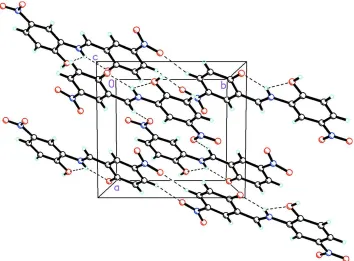
The molecular packing for C13H9N3O6 viewed down the c axis. Dashed lines indicate intermolecular O–H···O, C–H···O
and intramolecular N–H···O hydrogen bonds. The predominately occupied (0.64) hydrogen atom (H2O) is shown attached to O2 while H1O at 0.36 occupancy is not depicted.
(E)-2-[(2-Hydroxy-5-nitrophenyl)iminiomethyl]-4-nitrophenolate
Crystal data C13H9N3O6
Mr = 303.23
Monoclinic, P21/c
Hall symbol: -P 2ybc a = 7.9649 (1) Å b = 8.6110 (1) Å c = 19.1190 (3) Å β = 98.433 (2)° V = 1297.11 (3) Å3
Z = 4
F(000) = 624 Dx = 1.553 Mg m−3
Mo Kα radiation, λ = 0.71073 Å Cell parameters from 3209 reflections θ = 3.9–73.2°
µ = 0.13 mm−1
T = 296 K
Prism, orange-brown 0.37 × 0.27 × 0.18 mm
Data collection
Oxford Diffraction Gemini R diffractometer
Radiation source: fine-focus sealed tube Graphite monochromator
Detector resolution: 10.5081 pixels mm-1
φ and ω scans
Absorption correction: multi-scan
(CrysAlis RED; Oxford Diffraction, 2007) Tmin = 0.954, Tmax = 0.978
6432 measured reflections 2495 independent reflections 1819 reflections with I > 2σ(I) Rint = 0.023
θmax = 26.2°, θmin = 2.6°
Refinement on F2
Least-squares matrix: full R[F2 > 2σ(F2)] = 0.041
wR(F2) = 0.129
S = 1.05 2495 reflections 202 parameters 0 restraints
Primary atom site location: structure-invariant direct methods
Secondary atom site location: difference Fourier map
Hydrogen site location: inferred from neighbouring sites
H-atom parameters constrained w = 1/[σ2(F
o2) + (0.0833P)2]
where P = (Fo2 + 2Fc2)/3
(Δ/σ)max < 0.001
Δρmax = 0.22 e Å−3
Δρmin = −0.17 e Å−3
Special details
Geometry. All e.s.d.'s (except the e.s.d. in the dihedral angle between two l.s. planes) are estimated using the full covariance matrix. The cell e.s.d.'s are taken into account individually in the estimation of e.s.d.'s in distances, angles and torsion angles; correlations between e.s.d.'s in cell parameters are only used when they are defined by crystal symmetry. An approximate (isotropic) treatment of cell e.s.d.'s is used for estimating e.s.d.'s involving l.s. planes.
Refinement. Refinement of F2 against ALL reflections. The weighted R-factor wR and goodness of fit S are based on F2,
conventional R-factors R are based on F, with F set to zero for negative F2. The threshold expression of F2 > σ(F2) is used
only for calculating R-factors(gt) etc. and is not relevant to the choice of reflections for refinement. R-factors based on F2
are statistically about twice as large as those based on F, and R- factors based on ALL data will be even larger.
Fractional atomic coordinates and isotropic or equivalent isotropic displacement parameters (Å2)
x y z Uiso*/Ueq Occ. (<1)
O1 0.03590 (18) 0.47993 (15) 0.16546 (7) 0.0582 (4)
H1O 0.0038 0.5417 0.1934 0.070* 0.36 (3) O2 0.11482 (19) 0.12327 (15) 0.24445 (7) 0.0600 (4)
H2O 0.0821 0.0752 0.2769 0.072* 0.64 (3) O3 0.1437 (2) 0.91245 (18) −0.08314 (9) 0.0810 (5)
O4 0.32836 (18) 0.73565 (16) −0.09586 (7) 0.0624 (4) O5 0.57970 (19) −0.17153 (18) 0.04796 (7) 0.0688 (4) O6 0.5900 (2) −0.35343 (18) 0.12493 (8) 0.0745 (5) N1 0.22628 (18) 0.25045 (16) 0.13638 (7) 0.0452 (4)
H1N 0.1589 0.2915 0.1624 0.054*
N2 0.2182 (2) 0.79148 (18) −0.06471 (8) 0.0518 (4) N3 0.54401 (19) −0.22526 (18) 0.10334 (8) 0.0515 (4) C1 0.0787 (2) 0.5537 (2) 0.11302 (9) 0.0448 (4) C2 0.0151 (2) 0.7055 (2) 0.09352 (10) 0.0496 (4) H2A −0.0587 0.7535 0.1202 0.060* C3 0.0605 (2) 0.7798 (2) 0.03718 (9) 0.0480 (4)
H3A 0.0173 0.8782 0.0253 0.058*
C4 0.1732 (2) 0.70949 (19) −0.00398 (9) 0.0440 (4) C5 0.2393 (2) 0.56601 (19) 0.01239 (9) 0.0432 (4) H5A 0.3139 0.5216 −0.0150 0.052* C6 0.1948 (2) 0.48596 (18) 0.07028 (8) 0.0413 (4) C7 0.2629 (2) 0.3352 (2) 0.08516 (9) 0.0451 (4)
H7A 0.3376 0.2956 0.0565 0.054*
supporting information
sup-5
Acta Cryst. (2009). E65, o291–o292C10 0.2737 (3) −0.1128 (2) 0.23769 (9) 0.0552 (5) H10A 0.2348 −0.1551 0.2771 0.066* C11 0.3830 (2) −0.1967 (2) 0.20269 (9) 0.0521 (5) H11A 0.4196 −0.2947 0.2187 0.062* C12 0.4378 (2) −0.1335 (2) 0.14340 (8) 0.0443 (4) C13 0.3896 (2) 0.01318 (19) 0.11899 (8) 0.0434 (4) H13A 0.4281 0.0539 0.0792 0.052*
Atomic displacement parameters (Å2)
U11 U22 U33 U12 U13 U23
O1 0.0756 (9) 0.0495 (7) 0.0590 (8) 0.0052 (7) 0.0411 (7) 0.0022 (6) O2 0.0794 (9) 0.0546 (8) 0.0554 (8) 0.0097 (7) 0.0411 (7) 0.0059 (6) O3 0.1039 (12) 0.0618 (9) 0.0839 (11) 0.0172 (9) 0.0357 (9) 0.0286 (8) O4 0.0727 (9) 0.0637 (8) 0.0571 (8) −0.0062 (7) 0.0302 (7) 0.0013 (7) O5 0.0802 (10) 0.0740 (10) 0.0606 (8) 0.0124 (8) 0.0375 (7) −0.0015 (7) O6 0.0804 (10) 0.0618 (9) 0.0859 (11) 0.0272 (8) 0.0270 (8) 0.0051 (8) N1 0.0526 (8) 0.0419 (7) 0.0464 (8) 0.0009 (6) 0.0247 (6) −0.0008 (6) N2 0.0598 (9) 0.0486 (9) 0.0496 (8) −0.0094 (7) 0.0163 (7) −0.0001 (7) N3 0.0475 (8) 0.0537 (9) 0.0547 (9) 0.0054 (7) 0.0127 (7) −0.0049 (7) C1 0.0481 (9) 0.0434 (9) 0.0467 (9) −0.0053 (8) 0.0193 (7) −0.0017 (7) C2 0.0519 (10) 0.0444 (9) 0.0572 (10) 0.0024 (8) 0.0233 (8) −0.0053 (8) C3 0.0513 (10) 0.0380 (9) 0.0566 (10) 0.0011 (7) 0.0146 (8) −0.0003 (8) C4 0.0470 (9) 0.0397 (9) 0.0469 (9) −0.0046 (7) 0.0121 (7) −0.0017 (7) C5 0.0442 (9) 0.0413 (9) 0.0473 (9) −0.0035 (7) 0.0171 (7) −0.0056 (7) C6 0.0436 (9) 0.0372 (8) 0.0459 (9) −0.0030 (7) 0.0159 (7) −0.0041 (7) C7 0.0480 (9) 0.0462 (9) 0.0459 (9) −0.0011 (8) 0.0228 (7) −0.0025 (7) C8 0.0490 (9) 0.0393 (8) 0.0407 (8) −0.0009 (7) 0.0139 (7) 0.0008 (7) C9 0.0552 (10) 0.0489 (10) 0.0405 (8) 0.0009 (8) 0.0207 (8) −0.0001 (7) C10 0.0739 (13) 0.0542 (10) 0.0420 (9) 0.0033 (9) 0.0237 (9) 0.0097 (8) C11 0.0639 (12) 0.0459 (9) 0.0483 (9) 0.0081 (8) 0.0145 (8) 0.0081 (8) C12 0.0437 (9) 0.0476 (9) 0.0437 (8) 0.0022 (7) 0.0127 (7) −0.0030 (7) C13 0.0475 (9) 0.0447 (9) 0.0411 (8) −0.0049 (7) 0.0167 (7) 0.0017 (7)
Geometric parameters (Å, º)
O1—C1 1.2749 (19) C3—C4 1.414 (2)
O1—H1O 0.8200 C3—H3A 0.9300
O2—C9 1.3316 (19) C4—C5 1.361 (2)
O2—H2O 0.8200 C5—C6 1.393 (2)
O3—N2 1.225 (2) C5—H5A 0.9300
O4—N2 1.2283 (19) C6—C7 1.420 (2)
O5—N3 1.2264 (19) C7—H7A 0.9300
O6—N3 1.216 (2) C8—C13 1.378 (2)
N1—C7 1.288 (2) C8—C9 1.405 (2)
N1—C8 1.420 (2) C9—C10 1.393 (3)
N1—H1N 0.8600 C10—C11 1.378 (2)
C1—C2 1.431 (2) C11—H11A 0.9300
C1—C6 1.444 (2) C12—C13 1.381 (2)
C2—C3 1.347 (2) C13—H13A 0.9300
C2—H2A 0.9300
C1—O1—H1O 109.5 C6—C5—H5A 120.1
C9—O2—H2O 109.5 C5—C6—C7 118.51 (14)
C7—N1—C8 128.10 (14) C5—C6—C1 120.56 (15)
C7—N1—H1N 116.0 C7—C6—C1 120.92 (14)
C8—N1—H1N 116.0 N1—C7—C6 123.19 (15)
O3—N2—O4 122.95 (15) N1—C7—H7A 118.4
O3—N2—C4 118.60 (15) C6—C7—H7A 118.4
O4—N2—C4 118.45 (15) C13—C8—C9 121.00 (15) O6—N3—O5 122.63 (16) C13—C8—N1 124.02 (14) O6—N3—C12 118.91 (15) C9—C8—N1 114.98 (14) O5—N3—C12 118.43 (15) O2—C9—C10 124.19 (15) O1—C1—C2 122.32 (15) O2—C9—C8 116.76 (15) O1—C1—C6 120.74 (15) C10—C9—C8 119.05 (15) C2—C1—C6 116.94 (14) C11—C10—C9 120.25 (15) C3—C2—C1 121.08 (15) C11—C10—H10A 119.9
C3—C2—H2A 119.5 C9—C10—H10A 119.9
C1—C2—H2A 119.5 C10—C11—C12 119.28 (16) C2—C3—C4 120.53 (16) C10—C11—H11A 120.4
C2—C3—H3A 119.7 C12—C11—H11A 120.4
C4—C3—H3A 119.7 C13—C12—C11 122.07 (16) C5—C4—C3 121.09 (15) C13—C12—N3 118.20 (14) C5—C4—N2 119.60 (14) C11—C12—N3 119.68 (16) C3—C4—N2 119.31 (15) C8—C13—C12 118.30 (14) C4—C5—C6 119.79 (15) C8—C13—H13A 120.8
C4—C5—H5A 120.1 C12—C13—H13A 120.8
supporting information
sup-7
Acta Cryst. (2009). E65, o291–o292C2—C1—C6—C7 −179.29 (16) N1—C8—C13—C12 179.01 (16) C8—N1—C7—C6 178.42 (16) C11—C12—C13—C8 −0.3 (3) C5—C6—C7—N1 −178.28 (16) N3—C12—C13—C8 177.31 (15) C1—C6—C7—N1 0.2 (3)
Hydrogen-bond geometry (Å, º)
D—H···A D—H H···A D···A D—H···A
O1—H1O···O2i 0.82 1.77 2.5570 (16) 161
O2—H2O···O1ii 0.82 1.75 2.5570 (16) 166
N1—H1N···O1 0.86 1.90 2.6001 (19) 138
C3—H3A···O3iii 0.93 2.56 3.295 (2) 137
C7—H7A···O4iv 0.93 2.67 3.289 (2) 125
C7—H7A···O5v 0.93 2.44 3.312 (2) 156
C10—H10A···O4vi 0.93 2.53 3.321 (2) 143
C13—H13A···O4iv 0.93 2.64 3.195 (2) 119
C13—H13A···O5v 0.93 2.63 3.512 (2) 160