DEVELOPING SELF-CARE AT WORK
JANE KEEP
A thesis submitted in partial fulfilment of the requirements of the University of the West of England, Bristol, for the degree of PhD
Faculty of Business and Law, University of the West of England, Bristol
Acknowledgements and Appreciations
This PhD study has been inspired by the teachings of Serge Benhayon, Universal Medicine. I appreciate the consistent and unfaltering support I have had from Serge Benhayon and other Universal Medicine Practitioners during the past 8 years.
A huge thank you to all of the inquiry group participants who have been involved in this study along the way, without them the study would not have been possible.
I very much appreciate the support I have had from my Research Supervisors, Carol Jarvis and Peter Simpson, both of whom have offered me regular support, suggestions, encouragement, and openness towards my way of working and undertaking this study.
I appreciate the support I have had from many friends, relatives and colleagues for their encouragement, and practical things like help with spelling or grammar.
I deeply appreciate myself in undertaking this study, and lovingly methodically piece by piece, seeing it through to completion. It is a truly great piece of work, and I treasure myself for that. It has been life changing in that now I absolutely know I matter at work, and I now feel harmonious, consistent and steady when I work. I also know that self-care at work matters, as the quality of the way I work has changed inordinately since the beginning of the study.
ABSTRACT: Developing Self-Care At Work
This PhD Study explored the practical development of self-care at work. The study enabled an understanding of self-care at work as a phenomena, and enabled the practitioners involved to free themselves from ideological and other chains holding them back from developing their own self-care at work, to such a point that in the end, they realised ‘I matter’ at work, and that self-care at work matters. The findings show that it is not normal for there to be a focus on ‘me’ and consider self truly during the working day, and that many people see clients, colleagues or their boss as ‘king’ consistently putting them first before considering self. The findings also show if we do not self-care at work, and, we keep working when we are feeling under ‘par’ it is uncomfortable for us to work in this way, and the quality of the services we offer can suffer.
CONTENTS
LIST OF FIGURES...6
Chapter 1 Introduction ...7
Chapter 2 Methodology ...13
Chapter 3 Literature Review ...46
Chapter 4 The Auto Ethnographical Findings and Discussion ...86
Chapter 5 Third Party (Inquiry Group) Findings and Discussion ...124
Chapter 6 Implications for Practice ...174
Chapter 7 Limitations and Implications for Future Study ...206
References ...215
Appendix 1 Inquiry Group - Guiding Questions in Full (Chapter 2) ...235
Appendix 2 Data Collection Methods in Full (Chapter 2) ...237
Appendix 3 Research Study Operating Principles - in full (Chapter 2) ...238
LIST OF FIGURES
Figure 1....Burrell and Morgan’s (1979) Four Paradigms for the analysis of social theory ...16 Figure 2....Self-Care At Work Development Framework (a prompt to develop
self-care at work) ...178 Figure 3....An example of the iterative approach to developing self-care at work
...179 Figure 4....A practical example of an inquiry based self-care at work practice for
a coach ...181 Figure 5....A process for developing and deepening self observation, and self
awareness...185 Figure 6....A process for developing and deepening self observation and self
Chapter 1
Introduction
1.1
Introduction to this PhD study
This chapter introduces this study’s inception and the curiosities that inspired the researcher to undertake this study. It also briefly outlines the layout of the rest of thesis. This study was undertaken with the intention of an exploration of self-care at work, so as to offer an ‘open letter to humanity’ about self-care at work, offering perhaps a deeper understanding of ‘care at work’, some practical suggested steps (via the self-care at work conceptual framework for instance) and an inspiration to those who work so that they could develop their own self-care at work approach whatever their work.
work, and found herself to be in the exact same pattern of behaviour as those she wanted to support often feeling tired, depleted, and exhausted, and finding it difficult to take care of self at work though not understanding why it felt so difficult. She was used to putting others (e.g. the staff in the hospital and their needs) first over and above her own self-care needs.
Just prior to this PhD study the researcher became very ill. This ‘stop’ moment (as the researcher was forced to rest for 6 weeks) awakened the researcher to the realisation of how little she had taken care of herself at work and further awakened her curiosity and willingness to want to understand how she could learn to make self caring choices that supported her at work, and why this wasn’t a natural phenomena at work not just for her but for those around her. Equally she reflected on the work she had done with others in supporting their self-care at work and wondered for herself, and those she had worked with what got in the way of self-care of work or what got in the way of a consistent approach to personal self-care whilst working, as she could feel there was something missing yet at this point she was unable to put her finger on what was missing, or why it seemed so difficult. It was almost as though personal legitimacy to take care of self at work was missing. This curiosity was confirmed by others as the researcher was always being asked by colleagues and clients that same question ‘how can I take more care of myself while I work?’ or ‘how do we take care of our teams and employees at work?’ This was the impetus that led the researcher to choose to self fund a PhD with a local university so as to take a deeper look over a period of time (in this case 6 years part time) with the support of a few wise mentors, PhD supervision, a university library and other useful resources to undertake a study such as this.
practitioners could explore together over a period of time, the notion of self-care at work, what gets in the way (e.g. the ideologies, beliefs), what enables the development of self-care at work, how to break out of old (uncaring) ways, looking at this from a practical perspective and an individual perspective, and not looking organisationally or from a policy perspective.
This study matters because in the first instance the researcher knew there had to be a different way of taking care of self at work and she knew from colleagues that they too were searching for something. Curiosities were arising not only in understanding self-care at work and what got in the way, but also in how self-self-care at work was practically developed? And what supported the development of self-care at work? Equally what supported personal legitimacy to focus on developing or deepening self-care at work?
This study also matters as workplace health and well-being nowadays appears regularly in the professional and practitioner press and is raised more frequently by leaders in organisations as a potential problem, not only in the scale of employee illness but in the impact illness or an ailing workforce has at work for example:
● The CMI estimated that illness at work costs UK employers £12.2 billion a year as a result of sick days taken. (CMI 2009)
● Worral and Cooper (2006) suggest 58% of UK managers admit to being unproductive for at least 20% of working time due to poor health. Worral and Cooper (2006) also suggest that 60% of managers reported that sickness rates have increased in the past twelve months but that most health concerns remain unreported (or under reported).
● The CIPD (2012 b) suggest that for example obesity accounts for £1.3-£1.6 billion of lost earnings in the UK or around 16 million days off as a consequence of certified sickness absence.
● Annual surveys of sickness absence from the CBI (CIPD/AXA 2012 b:1) highlight that ‘there is a significant cost of work-related stress, depression and anxiety which is over 13 million days a year’.
● ‘Employers believe health issues are the most common factor causing employees to perform below their potential capacity at work according to the CBI survey 2011’ (CIPD/AXA PPP healthcare 2012 b:2)
● The Boorman Review (2009) into health and well-being of NHS staff concluded that 15,000 NHS staff would be available to deliver patient care if absence levels in the health service were reduced to the average private sector level saving around £500 million a year. Researchers also found that hospitals with worse staff health are less productive and have higher rates of superbug infection, unnecessary use of agency workers and higher patient death rates. More than three-quarters of staff believe that the state of their health affects patient care.
● ‘There is a good evidence base to suggest that looking after the health and well-being of staff is very important in terms of delivering productivity and quality.’ (Dean Royles as quoted in Mooney 2011:22)
A study about self-care at work arguably has a contribution to play in supporting individuals and organisations to make a change to some of the statistics above.
1.2
Inspiration
At the outset of this PhD study whilst having a personal development session with Serge Benhayon (Universal Medicine) the researcher was deeply inspired by this quote that Serge shared in an email:
‘The true delivery of service begins first by delivering that same service to self in every way, and to all others by the same manner, that are within the group, before any organisation can truly serve’ (Benhayon 2006).
One further introductory note here is the ‘methodological’ stance the researcher naturally had, and that supports this study. The researcher in her work with universities had undertaken a number of qualitative, interpretive studies including many inquiry based studies such as action research (Reason and Bradbury 2001). More so, one of the things that bothered the researcher that she was curious about was what got in the way of self-care at work, why wasn’t it simply a natural way of working and why didn’t people at work generally take care of themselves? It was a ‘no brainer’ yet it was a constant question/issue on people’s tongues (‘I really need to take more care of myself at work but I can’t seem to’, ‘I know I need to take care of myself at work, but something gets in the way’, ‘self-care at work is so difficult’, and so on). It was almost as though personal legitimacy to self-care at work was missing, yet no one at work had ever said ‘do not take care of yourself at work’!
The researcher in life was not what you might call ‘compliant’ as she was often looking at ‘ways around’ situations that were not in the first instance the ‘normal’ or mainstream’ way of looking at something. The researcher naturally worked and researched in a way that not only inquired and maintained a curiosity as to why things were the way they were but she also looked at ways of ‘breaking out’ of things (whether they were rules and regulations, or processes, or ideals and beliefs) once she understood them, always guided by the feeling ‘there must be another way’. For the researcher it was important to undertake this study in a way that honoured that. A way that offered both an inquiry to deepen understanding and also through that understanding offered a way to ‘break’ the chains, or ideals or beliefs that were in the way. She felt this study needed to both see what was going on with ‘self-care at work’ and what the ‘chains’ were that needed to be broken to emancipate individuals to develop a consistent self-care at work approach. This was because it seemed to the researcher like an inevitability and a dichotomy that self-care at work both mattered and yet it didn’t matter when it came down to it practically and on a daily basis.
these drive a cognitive wedge between himself and his true consciousness.’ (Burrell and Morgan 1979:32). ‘It is a brand of social theorising designed to provide a critique of the status quo’ and for the researcher it had the potential to ask why the status quo was as it was, and what was needed to break out of that status quo - the status quo here being the dichotomy of self-care at work both being a ‘no brainer’ yet it not being practiced consistently by employees, let alone not being celebrated as a success factor in employee effectiveness (e.g. well and vital employees who take super care of themselves are arguably not commonly celebrated for that success/achievement). These methodological considerations are outlined in more detail in the following chapter 2.
1.3
Brief outline of this thesis
Chapter 1 has provided a brief introduction to the inception of this study, and, why to the researcher it mattered.
Chapter 2 provides a detailed description of the methodological and research methods choices for this study including the practicalities of this.
Chapter 3 provides the literature/theoretical context for the study.
Chapter 4 outlines the researcher’s auto ethnographic findings and discussion. Chapter 5 outlines the third party (inquiry group) findings and discussion.
Chapter 6 outlines implications for practice including the development of self-care at work conceptual framework.
Chapter 7 outlines the limitations and potential aspects for future study and dissemination.
Chapter 2
Methodology
2.1 Introduction
This chapter outlines the methodological choices and research methods choices made for this study.
This chapter discusses the ontology, epistemology, methodology for this PhD study, and in particular Burrell and Morgan’s (1979) sociological paradigms; ethnography; auto ethnography; reflective practice; action science, participatory and inquiry based research; the practical research methods and processes; ethics and robustness.
2.2
The research question
Overarching question: How is self-care at work developed?
The underpinning research question/s that this overarching question is based on are:
1 Do organisational practitioners who work as coaches, facilitators, managers practically take care of themselves in their daily living and working?
2 What is it like to offer a service to others with little or no consideration of self? 3 What does it feel like to work or offer services while you feel ‘under par’ or
unwell?
4 What gets in the way of self-care at work? (e.g. organisational ideologies, beliefs, or lack of personal legitimacy to take care of self for instance)
5 How do organisational practitioners (e.g. coaches, managers, facilitators) practically take care of themselves at work? How do they personally legitimise self-care at work?
7 What difference does it make when we take care of ourselves at work?
8 Does taking care of self at work matter? How does the practitioner feel when they are consistently taking care of self at work?
This study was undertaken to understand more about taking care of self while working, with a curiosity to understand why it was not second nature that everyone took care of themselves while at work and why and how had people lost what seemed like a sense of personal legitimacy to do that. This study was also undertaken to see if there was an alternative way, and how they could learn to or deepen self-care at work.
The researcher was curious as to whether taking care of self at work mattered. To get to this she wanted to understand what self-care other people did at work? how do practitioners develop self-care at work (or deepen self-care at work)? And whether then in taking care of self at work it had an impact on the quality of their work (whether it mattered)?
2.3
Methodology - an introduction
‘All approaches to the study of society are located in a frame of reference of one kind or another. Different theories tend to reflect different perspectives, issues and problems worthy of study and are generally based upon a whole set of assumptions which reflect a particular view of the nature of the subject under investigation’ (Burrell and Morgan 1979:10).
● ‘What methods do we propose to use?
● What methodology governs our choice and use of methods?
● What theoretical perspective lies behind the methodology in question?
● What epistemology informs this theoretical perspective?’
‘In virtually all research… …the epistemology is ‘rules of science’ (Barron 2006:202) The ontologies of research ‘reflect the world view or ‘map’ with which the researcher engages’ (Sapsford and Jupp 2006:175), ‘with questions pertaining to the kind of things that exist in society … the nature of social bodies’ (Barron 2006:202). The decisions researchers make on matters of methodology are determined by the researchers philosophical assumptions whether known or tacit to the researcher, these would arguably include cultural, social and other aspects based on the beliefs, and experiences of the researcher, or based on their education and learning preferences, or schooling, and upbringing. The choices are based on many hidden and unhidden facets of the individual, for instance, in this research the researcher became aware of many more of her hidden beliefs and ideals through the process of studying towards this PhD study which uncovered many assumptions and perspectives.
‘Empirical research is not simply a choice of method... research as a mode of engagement is part of a wider process... ...the selection of method implies some view of the situation being studied’ (Gill and Johnson 2005:89),
This includes the decisions made throughout the study about what is being studied and how it is being studied, and that the research makes assumptions of an ontological nature which concern the very essence of the phenomena to be researched.
2.4
Sociological paradigms
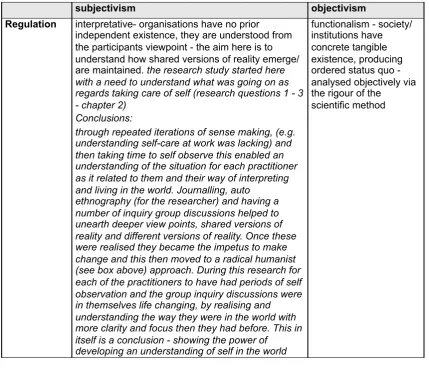
subjectivism objectivism Radical
change
Radical humanism
Socially constructed realities entrap people, the aim is to release people from these ideological constraints through developing alternatives The research study moved here after understanding through the early part of the study what was going on regarding taking care of self at work and that changes could be (and were) made.The researcher had lived and worked based on the assumptions and ideas in this paradigm, in that not only do we create the world, we can understand it and from that we can change it and that there is nothing that once understood cant be changed.
The research methods chosen to support this were auto ethnography and participatory action research inquiry.
Radical structuralism
Society/organisations dominate, exploit, the aim here is to analyse these processes, their
contradictions, in an objective way so as to identify how they can lead to social change
Regulation Interpretative
Organisations have no prior independent existence, they are understood from the participants viewpoint - the aim here is to understand how shared versions of reality emerge/are maintained. The research study commenced here with a need to understand what was going on as regards taking care of self at work.
Functionalism
[image:16.595.119.540.56.386.2]Society/institutions have concrete tangible existence, producing ordered status quo - analysed objectively via the rigour of the scientific method
Figure 1. Burrell and Morgan’s (1979) Four Paradigms for the analysis of social theory
(Adapted by J Keep for the purpose of this PhD study. Sources: Fig 3.1 ‘Four Paradigms for the analysis of social theory Burrell and Morgan 1979:22, adapted by Johnson and Duberley Fig 4.3 2000:80)
human consciousness (Johnson and Duberley 2000:78). This was not the way the researcher viewed in the world.
Reviewing this from an epistemological perspective within the subjective-objective dimension of Burrell and Morgan’s paradigms (1979) the epistemological assumptions are about how we understand the world and communicate this as knowledge to others. These assumptions entail ideas for example, about what forms of knowledge can be obtained, and how we sort out what is regarded as ‘true’ from what is regarded as ‘false’ thus offering a dichotomy of ‘true - false’ which creates an epistemological stance in itself. This is based on whether it is possible to identify or communicate knowledge itself as being hard, real and tangible or whether it is softer, more subjective, based on insights or experience for instance (Burrell and Morgan 1979).
In Burrell and Morgan (1979:3) the paradigm is a
‘scheme for analysing assumptions about the nature of social science (Fig 1.1 1985:3) there are a further set of assumptions, concerning ‘human nature’ and, in particular, the relationship between human beings and their environment... ...all social science clearly, must be predicated upon this type of assumption, since human life is essentially the subject and object of enquiry’.
All of this influences methodology and influences or has consequences for the way we research, explore, investigate and obtain ‘knowledge’ about the social world, as each different ontology/epistemology determines social scientists towards different methodologies. For example for some treating the world as hard, real and external to the individual, and for the researcher in this study, where the world is personal and subjective and, the search for understanding the way in which the individual creates, modifies, and interprets the world in which he or she finds himself/herself, which is the basis of this study. This research supports a more ‘ideographic’ (Burrell and Morgan 1979) approach by understanding the social world in getting close to the subject. In the case of this PhD study it gets close to the researcher auto-ethnographically (e.g. Chang 2008, Reed-Danahay 1997, Ellis 2004), and it gets close to a cohort of research participants via participatory inquiry (Reason and Bradbury 2001). It also involves getting accounts (stories) and observing self and others in daily living to understand, and unpick/uncover what underpinned the actions and approaches of the human beings being studied. Overall, for the researcher, the philosophical choices are based on the ‘recognition of the relevance of human subjectivity’ (Gill and Johnson 2004:95 Fig 9.1) whereby the researcher choose auto ethnography coupled with an inquiry group as the methods, which are discussed later on in this chapter.
different things to different people, Burrell and Morgan (1979:16) suggest the attempt to reduce the two models to a common base ignores the fundamental differences which exist between them, and much of the confusion has arisen because of the ambiguity of the descriptions and terminology associated with the two models, suggesting a need to change ‘order - conflict’ to ‘regulation - radical change’ to further clarify the debate about the dimensions on the vertical axis.
Regulation here is about providing explanations of society, its underlying unity and cohesiveness and the need for regulation in human affairs. If there is social cohesion and solidarity, this is suggested as a clear illustration of a sociology of regulation.
The sociology of radical change is believed to be a basic concern to find explanations for radical change whereby there is deep seated structural conflict, modes of domination, and is concerned with the emancipation from the structures which limit and stunt man’s potential for development. The radical change dimension looks at potentiality and actuality in what is possible rather than acceptance of status quo. From the researcher’s perspective she has always worked and studied with a philosophical perspective of radical change in understanding what is going on, and the possibilities and potential to change anything that ‘caps’ individuals, or organisations from moving forward rather than accepting the status quo. This PhD study relates to the passion the researcher had in realising that ‘there must be a different way’ to take care of self at work, and that the only way (for her) was to develop understanding, to look at the ideologies for instance that were ‘capping’ or inhibiting self-care at work, and then to look at the new possibilities that broke out of old patterns and ways of behaving as regards self-care at work.
(1979:3) with regard to the nature of social science provided a powerful tool for the analysis and classification of social theory for those, like the researcher, who relate to that way of classifying and analysing social science research and philosophy, and the social world, however, the researcher found (as described below) that she moved between two of the social paradigms - interpretivism, and radical humanism.
humanism) didn’t feel incommensurable. The researcher experienced that in order to emancipate it was necessary (for the purposes of this research) to interpretively understand. To explain this a little further, the researcher knowing she was subjectivist in her approach to research initiated this PhD study from an interpretive perspective wanting to understand what was going on as regards self-care at work, and soon realised that once there was a deeper understanding about the phenomena being studied, there was a need for the researcher to take the study further than that, based on her own philosophical world view. In that, once there was a realisation that the daily things in the social world such as taking care of self at work, were influenced by illusory structures or beliefs (e.g. a lack of personal legitimacy for self-care at work, or self-care at work is selfish), then it became clear that these beliefs and ideals were holding ‘back’ the researcher/inquiry group in making daily living choices that supported them based on what they felt they actually needed. Once this was clear in the early part of the research, then a shift to the radical humanist paradigm was made as the nature of this research study was not only to understand, but to actually change, and see the possible other alternatives and potentials, ‘unchaining’ the researcher/inquiry group from their ‘selective’ view of the world, and enabling real practical change, therefore working between these two social paradigms rather than only working in one, thus the researcher does not from this experience support paradigm incommensurability.
2.5
Interpretivism through to radical humanism
explanation of its effects, and that ‘action is social in so far as it takes account of the behaviour of others’. For Weber the objective reality of the social world is not a central issue, it is the way in which it is interpreted by human actors that is key. Natanson (1966) in Burrell and Morgan (1979:233) suggests the endeavour of phenomenology is to transcend the natural attitude of daily life so as to render for philosophical scrutiny to describe and account for its essential structure, and, that in this process the external world is an artefact of consciousness, and man is shown as living in a world created through consciousness.
The other side of the radical change axis is where the functionalist social theorists create and sustain a view of social reality which reinforces the status quo and which is understood as but one aspect of the network of ideological domination which pervades contemporary western society.
Theorists in both of these paradigms are committed to revolutionary changes in society, but the radical structuralists place more emphasis upon deep economic and political ‘structures’ in their analysis more concerned with structure, contradiction, and crisis, while radical humanists focus on consciousness, alienation and critique also emphasising that reality is socially created and socially sustained.
As this research study was undertaken, the researcher more and more realised that this was ‘true’ for her in that we have socially created many of the things around us including the notion of time, and the ‘laws’ or ‘rituals’ that fill our daily work and lives, which unknowingly (most of the time) we sustain ourselves even when we feel the drudgery or incompatibility of them - rarely do we look up and ask ‘is this all there is? - there has to be another way?’ Once we look up and ask this we can start to see beyond the illusion that there is only one way, and that there is another way, and we have a choice within this. Related to this the researcher watched the movie The Truman Show (1998) a few times at the outset of this PhD study. This satirical movie highlighted the essence of what the researcher felt once being able to see above the ‘parapet’ or out of fog (or illusion) and realise there are more choices in the world and that a lot of the social world seemed to be socially constructed and socially sustained (although unlike Truman in The Truman Show (1998), everyone was a ‘Truman’ e.g. everyone at work, not just Truman and a bunch of actors who knew they were on a TV show). This particularly supported the underlying notion around ‘the individual creates the world in which he lives’ (Burrell and Morgan 1979: 279)
that were in the way. The strongest aspect of radical humanism was that there was an opportunity here for this research to be ‘overthrowing the limitations of existing social arrangements’ (Burrell and Morgan 1979). This, combined with discussing the methodological issues and engaging with philosophical issues and ethical and social issues raised through the research (as is the practice of the subjective side of the paradigm) enabled this research to both observe/understand the phenomena, offering the conscious process of reflection and reflexivity within the research that inspired the researcher and the inquiry group participants to make new choices, affording personal legitimacy, as they each were inspired to break out of the old patterns and behaviours that no longer served or worked.
2.6
The research methods
Having discussed ontology, epistemology, human nature, and methodology using Burrell and Morgan’s (1979) sociological paradigms, there followed a series of choices regarding research methods. Research method being ‘a technique for collecting data’ (Bryman and Bell 2003:32). Crotty’s questions earlier in this chapter (2005:2) ask the researcher to consider ‘what methods do we propose to use? This section outlines these choices.
This PhD study used qualitative methods as a ‘variety of research techniques and procedures associated with the goal of trying to understand the complexity of the social world in which we live and how we go about thinking, acting and making meaning in our own lives’ (Ellis 2004:25). Qualitative research methods include participant observation, interviews, auto ethnography, narrative, and social action research. This PhD study used auto ethnography, and participatory inquiry (using an inquiry group) within which a number of data collection methods were used (discussed later in this chapter). This section of this chapter outlines auto ethnography and action science participatory inquiry methods. These research practices emphasise ‘getting close to those we study attempting to see the world through participants eyes and conveying the experience in a way faithful to their everyday life’ (Ellis 2004:25).
understanding’ (Wall 2008:38) which was the researchers first choice of a way not only to understand, but to express the understanding, and the changes in behaviour that were made during this study. The researcher also wanted to work with a inquiry group so as to share, discuss, reflect, and gain understandings and perspectives of others on the same phenomena that she was exploring via auto ethnography:
‘you may decide to investigate a certain life experience of yours, but instead of studying only yourself, you include others with a similar experience as co-participants in the study’ (Chang 2008:65).
The research focus was anchored in the researcher’s personal experiences as a study of self alongside the experience of others in the inquiry group.
2.7 Auto ethnography
Auto Ethnography can be described as a qualitative research method that ‘utilises ethnographic methods to bring cultural interpretation to the autobiographic data of researchers with the intent of understanding self and others’ (Chang 2008:56). Auto ethnographies vary in emphasis on auto (self), the ethno (sociocultural connection) and the ‘graphy’ (application of the research process). Ethnography is described as
‘the study of people in naturally occurring settings or ‘fields’ by methods of data collection which capture their social meanings and ordinary activities, involving the researcher participating directly in the setting if not also the activities, in order to collect data in a systematic manner but without meaning being imposed on them externally’ (Brewer 2000:6),
the social world, ‘what does seem important is that I describe what it means to me’ (Etherington 2004:71) and auto ethnography enabled bringing ‘self’ into the study.
From the outset the researcher was aware of perspectives cited by natural scientists about using auto ethnography and felt that
‘despite the credible nature of subjects experiences in qualitative research the legitimate use of experiential evidence feels awkward against a hierarchy of evidence and empirical dominance over all other processes of knowledge’ (Regan 2008:200).
John Locke (1689) advocated the use of experiments (meaning experience in the seventeenth century) by using the senses to prompt belief in a physical occurrence (or thing), ‘establishing a new body of inductive knowledge and truisms’. This resonated with the researcher.
‘The first and most obvious feature of auto ethnography is that the researcher is a complete member in the social world under study, and benefits greatly from the thought that self is an extension of community rather than that it is an independent self sufficient being’ (Chang 2008:26).
McIlveen (2008) suggests the ontology of auto ethnography comes from the notion of lived experience, subjectivity and meaning within relative contexts, ‘it is nominalist in that reality is a product of our minds, a projection of our consciousness’ (Johnson and Duberley 2000:78). Epistemologically, it is anti-positivistic, as it is about the way we understand the world, and share this knowledge and our understanding with others, based on the subjective insights, experiences, observations, and awarenesses of the researcher and the inquiry group. It is ideographic (Burrell and Morgan 1979) in that the world is personal, subjective and the search for understanding of how the individual creates and interprets the world, getting close to the subject, and observing self and others (e.g. the inquiry group, or self in a work place setting).
continued existence of humankind is dependent on a new attitude of cooperation rather than conquest vis-a-vis community’. Auto ethnography benefits greatly from the thought that self is an extension of a cultural community rather than being independent and self sufficient. Chang (2008:23) sees culture as a product of interactions between self and others in a community of practice whereby an individual becomes a basic unit of culture and from this individual’s point of view ‘self is the starting point for cultural acquisition and transmission, for this reason, scholars of culture pay a great deal of attention to the concept of self’ bearing in mind that the concept of self varies at different times in different cultures.
2.8
Stories and narrative in auto ethnography
‘There are few regulations on how to write an auto ethnographic narrative analysis as it is the meaning of the story that is important rather than the conventions of scholarly production’ (McIlveen 2008:15).
2.9
Reflexivity and reflectivity in auto ethnography
Reflexivity and reflectivity play a part in this research study in a number of ways. Reflexivity as it relates to auto ethnography can be cited as
‘reflexivity implies a difference in how we view the self as a real entity to be discovered or actualised or as a constantly changing sense of ourselves within the context of our changing world’ (Etherington 2004:30).
Reflexivity has become an increasingly significant theme in contemporary social research with an ongoing debate about its value and meaning that runs across discipline boundaries in social science (Etherington 2004: Berg and Smith 1988; Braud and Anderson 1998; Ely et al 1997) with some researchers wholly embracing this principle while others reject or question its value.
‘I understand researcher reflexivity as the capacity of the researcher to acknowledge how their own experiences and contexts (which might be fluid and changing) inform the process and outcomes of inquiry’ (Etherington 2004:31).
In this, as cited by Etherington (2004:32), if we are aware of how our own thoughts, feelings, culture, environment, social and personal history inform us as we dialogue with participants, transcribe their conversations with us, and write our representations of the work, then perhaps we can come close to the rigour that is required of good qualitative research. There are researchers who agree that
‘critical and purposeful reflexivity is an essential ingredient of rigorous qualitative research yet do not include reflexivity in their representation of their research, or do so limitedly, some recognise this as their crises of representation that they face as they struggle with how to locate themselves and their subjects in reflexive texts’ (Denzin and Lincoln 2000:3).
to provide information on what is known as well as how it is known, a validating opportunity for researchers particularly epistemologically based on the way the knowledge was obtained, or acquired, and how the conclusions of the research came to be. Reflexivity and reflectivity support a subjectivist approach enabling an iteration of unpicking, unearthing, sensing, and understanding and a place for free will, whereby ‘human action arises out of the culturally derived meanings they have been deployed during sense-making’ (Johnson and Duberley 2000:78), also enabling exposure of the way the researcher or researched created, modified, or interpreted the world from an ideographic sense, up close, recognising the relevance of human subjectivity (Gill and Johnson 2004:95 Fig 9.1).
2.10
Rigour and limitations of auto ethnography
For the researcher, the strongest pull towards auto ethnography came from the opportunity it presented to get close in, understand experiences and ways of being in the social world, and in particular the workplace as in her experience it provided a profoundly vivid social setting in which to explore, experience, interpret, and make change using a research method that could journal it and offered scope to use stories from the past to discover behaviours, ideals, and self limiting beliefs in the present, that could then be changed. The researcher had developed a strong experiential sense of being in the world and learning from experience, using all her senses, feelings, as well as being open to see her assumptions, ideas and beliefs.
‘All our senses are important in fieldwork, not just vision. I experience the clinic through my body, as well as my mind and eyes. I sense the way the clinic smells, the sounds of pagers... ...the feel of handshakes, hugs, body contact, and physical pain, I experience bodies out of control, and all my senses come into play to make sense from the sensations’ (Stroller in Ellis 2004:87).
This was an important factor as the researcher was feeling, seeing, listening, tasting, and smelling all around her as she already developed and used sensations and feelings within her own body to guide her daily choices for example in regards to self-care.
‘Reflexive ethnographers ideally use all their senses, their bodies, feelings and whole being, they use the ‘self’ to learn about the ‘other’ and they use their experiences in other worlds to reflect critically on their own’ (Ellis 2004:48).
responses and reactions to the workplace on the phenomena of ‘self-care’ and partly to use the inquiry to add a robustness to the study.
A further criticism of auto ethnography is that it could be seen as narcissistic focusing exceptionally on the researcher, being potentially egotistically preoccupied with self, personal preferences, aspirations, needs and success. However, this was far from the experience of the researcher. Yes, the auto ethnographic journaling and inquiry that the researcher undertook, did enable her to understand herself more, but what was more profound was that it helped her to understand others for more when she was working with them through our own understanding of her own lived (and observed) experience. In addition, by taking the time to focus on self, and observe self in this way, she was able to understand how to work offering more quality to clients (rather than less), and how to be more in the world rather than less in that the more she got to know herself, the more she felt drawn to interact with the world, particularly as her confidence grew. In addition, knowing that auto ethnography does have its criticisms (e.g. narcissism) because this research was undertaken using both an auto ethnographic study, and third party inquiry group study combined, this offered a constant check in so as to ensure the researcher didn’t disappear into her own self interest. The auto ethnography supported the inquiry group in that the researchers observations and understanding was shared, and they too could learn from that, and the inquiry group’s observations and understanding helped the researcher to understand more deeply some of the ideals and beliefs that were being uncovered.
2.11
Action science as the basis for an inquiry group
In this PhD study an inquiry group was used based on action science with the action scientist as an ‘interventionist who seeks both to promote learning in the client system and to contribute to general knowledge’ (Argyris Putnam and Smith 1985:36). Action science attempts to address the widening gap between social science theory/research and social science based professional practice. Schon (1987) described this gap as the rigour vs relevance dilemma in which both practitioners and researchers face the choice between remaining on the high ground where they can solve relatively unimportant problems and non rigorous inquiry (Schon 1987:3). In creating communities of inquiry within communities of practice according to action science there need be no division of labour between those who produce knowledge (e.g. researchers) and those who use it (e.g. practitioners). Here the specific role of the researcher is to create conditions under which practitioners e.g. coaches, social workers, managers, can build and test theories of practice for the purpose of learning so that the goal of action science is research in practice and not research on practice. Argyris, Putnam and Smith (1985) expressed this integration as the creation of ‘communities of inquiry in communities of social practice defining a community of practice as professionals, such as therapists, managers, social workers etc who share a common language of practice learned in the course of their education and apprenticeship (Argyris Putnam and Smith 1985:30). For this PhD study the community of practice is a set of organisational practitioners (coaches, facilitators, managers etc) who offer their services to support organisations and the individuals who have a shared interest and curiosity to understand and develop self-care at work, not only for themselves but for their clients/colleagues.
The researcher was drawn to an action science inquiry as practitioners can discover the
‘tacit choices they have made about their perceptions of reality about their goals and about their strategies for achieving them, the fundamental assumption of action science is that by gaining access to these choices people can achieve greater control over their own fate’ (Argyris, Putnam and Smith 1985:30).
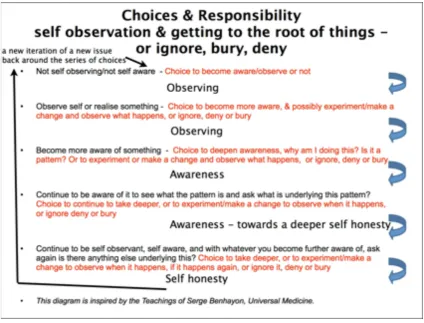
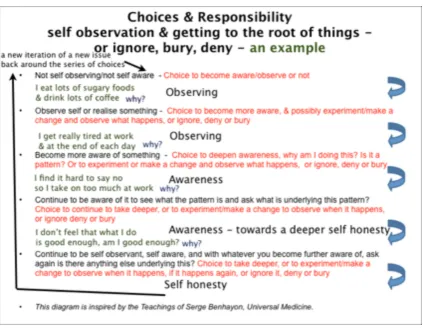
responsibility, then giving them some leverage for producing change, or breaking out of the chains (Burrell and Morgan 1979). Of note here is that ‘people and organisations are often unaware of the theories that drive their behaviour’ (Argyris and Schon 1996:74,76). And action science aids practitioners to infer theories of action from observed behaviour so these can be critically examined and changed. This supports Burrell and Morgan’s (1979) radical humanist conceptual framework whereby not only is data interpreted it also gives leverage to act upon and make changes, and to break out of patterns of behaviours. The theme for this thesis is developing self-care at work and within that theme data is collected first and foremost for the purpose of helping people understand and solve practice problems of concern to them in their daily working lives. In this the inquiry group practitioners are not simply problem solvers, but also researchers committed to critically examining their practice while also observing the distinction between espoused ‘theories’ and ‘theories-in-use’ (Friedman 2001:134). Further supporting subjectivism action science assumes that ‘human beings construct theories of reality which they continually test through action’ (Argyris and Schon 1974, Friedman and Lipshitz 1992, Senge 1990 in Reason and Bradbury 2001) and this gave scope within this study for more than one iteration of exploration, analysis, sense making, action, reflection, further exploration, trying out new ‘action’, reflection/ reflexivity, and so on.
Related to action science is co-operative inquiry as a research method ‘with’ people rather than ‘on’ people, ‘co-operative research with people on matters of practical concern to them, a well-considered way of closing the gap between research and the way we live and work together’ (Heron and Reason 2001:144) which also supports the intention of this study. The researcher using auto ethnography wanted to work with people who had similar concerns and interests to her in order to understand and make sense of self-care at work, and to develop new and creative ways of looking at self-care at work whilst learning how to act to change or improve things.
within the research process. As in action science and co-operative inquiry (as discussed above) participatory research is action-orientated research activity in which people address common needs arising in their daily lives and in the process they generate knowledge. The purpose of participatory change is that groups of people come together to tousle with social issues that affect them in their daily lives so as to bring about changes by improving their circumstances.
2.12
The inquiry group
academic setting related to coaching, or worked in organisations commissioning coaching. This quickly grew to 113 as a number of other organisational practitioners agreed to join the inquiry group which included a group of 7 coaches (from coaching supervision that the researcher facilitated), 20 managers on a leadership programme, and 50 coaches, management consultants, and facilitators from a social network group via Linkedin. They were wide spread across the UK (with 7 from Holland), from both the public and private sector. Some were self employed, some employed. They were two thirds women, one third men, of mixed ages between aged 35 and 60. The group changed over time, with honesty about time, logistics and ability to commit in that a few stepped back, and a few new people asked to join the group. The researcher kept in touch with them face to face (e.g. inquiry group meetings), by email, by Linkedin, and at times with some of them by phone.
2.13
Reflection and reflexivity in action inquiry
Reflexivity and reflectivity play a key role in action inquiry (just as they do in auto ethnography), exposing what is known as well as how it is known. ‘A participatory perspective asks us to be both situated and reflexive, to be explicit about the perspective from which knowledge is created, and to see inquiry as a process of coming to know’ (Reason and Bradbury 2001:7). Action inquiry offers first-person, second-person, third-person types of research that can be conducted in the midst of our own ongoing practices at home or work:
‘First-person research in the midst of practice involved widening our awareness to include possible incongruities among our intent, our strategy, our actual performance and our effects; second-person research in the midst of a conversation or team meeting involves speaking in ways that encourage mutual inquiry and mutual influence; third-person research in the midst of organisational practice can entail re-visioning the collective future, transforming strategies to meet the emerging era or re-crafting members practices’ (Torbert 2001:207).
This PhD study has used all three of these, first, second and third-person research.
rarely actively wish to engage subjectively in first person research/practice in the present...’ ‘...I could go days at a time in the researcher’s everyday life without a simple moment of intentional self observation.’ (Torbert 2001:207). ‘In order for us to discover our own capacity for an attention supple enough to catch at any moment glimpse of its own fickleness we must each exercise our attention’. Once committed to and engaged in first person action inquiry as a practitioner it can support self understanding to create the opportunity to make changes to work more effectively and can become self motivating way of continuous self reflexivity and change, and daily rituals such as journalling can support this. In the same way this study used this both as the way of collecting data and undertaking the research as well as a supportive ‘tool’ and way of practice to enable a deeper sense of self-care during work. This enabled the stories, the auto ethnography, the observations (of self and others), unearthing behaviours, illusions and perceptions, helping the researcher and inquiry group understand the world (of work), understanding how we were individually and collectively understanding the world (of work), realising where the ‘human action’ came from (e.g. which culturally derived meanings were driving it), and, getting close in to the subject (ourselves) which then supported the move from first-person research to second-person research whereby mutual inquiry was encouraged and undertaken and third person research whereby we developed and experienced new ways of self-care at work.
2.14
The inquiry group study phases and guiding questions
were you observing?’ what did you become aware of? How did this understanding influence your next steps? Did you try and test out something new based on your understanding and observations? what then happened? What did you learn from this about self-care for yourself, and about self-care at work? (These questions are outlined more fully at appendix 1).
There were also some suggested points in the day for inquiry group participants/the researcher to use as moments to reflect on how we were feeling or what we were observing and experiencing based on these
questions:-● at the beginning of the day,
● during the day,
● before coaching/facilitating a client/s,
● during coaching/facilitating a client/s and after,
● at the end of the day,
And at the same time using a set of physical indicators and sensations to get a sense of for example:
● how the physical body feels (e.g. tired, any aches like back or neck or head, any pressure or pain, heat or coldness in any part of the body),
● physiologically (e.g. hunger, thirst, sleepiness, bloating, indigestion, stiffness or lack of flow in physical movement, being hot or cold from wearing too little or too much that day),
● emotionally (e.g. frustrated, stressed or pressurised, sadness or ‘down in the dumps’, ‘hyper’ or agitated etc).
These were consistently throughout the study used as prompts for self reflection by the researcher and the practitioners in the inquiry group.
2.15
Data collection methods
‘Ethnographic field work includes everything you do to gather information in a setting, especially hanging around, making conversation, and asking questions, but also formal interviewing and other information gathering’ (Ellis 2004:2).
The data collection consisted of diaries, e-dialogues, semi structured questions and questionnaires, inquiry group meetings, desk based review of organisational documents, and review and synthesis of literature. ‘There are no guidelines in qualitative research for determining how many data are necessary to support a conclusion or interpretation’ (Taylor and Bogdan 1984:39 in Chang 2008:121). The data collection sources are outlined more fully at appendix 2.
2.16
Data analysis
‘One of the main difficulties with qualitative research is that it very rapidly generates a large, cumbersome database because of its reliance on process in the form of such media such as field notes, interview transcripts, or documents’ (Bryman and Bell 2003:427).
The researcher was faced with a large amount of data not just from the desk based research and her own journal but from the transcribed inquiry group meetings (3 iterations of 4 meetings = 12 over a couple of years, a coaching supervision group, and, notes from a leadership programme) and the semi structured interviews as well as an ongoing email exchange over a two year period.
theory ‘in its most recent incarnation’ has been defined as ‘theory that was derived from data, systematically gathered and analysed through the research process’ (Bryman and Bell 2003:428). During this research study the more work with the data the clearer the themes became and one theme and one iteration supported understanding and clarity of the next towards finding cultural meaning beyond the data. The researcher and the inquiry group found the beauty of the process for this research study was the ‘zooming in’ (analysis and a microscopic appreciation of the minutest detail) and ‘zooming out’ (interpretation, and making sense of the whole by hoovering over the entire data and content that was emerging at any given time). Through this the researcher found with the data there would be stages where the same concept or cluster or theme would come up which confirmed, or reconfirmed, or reaffirmed what researcher was exploring. This can be described as ‘theoretical saturation’ (Bryman and Bell 2003:428) whereby there is ‘no further point in reviewing your data to see how well they fit with your concepts or categories’. However ‘the process of analysis, evaluation and interpretation are neither terminal or mechanical. They are always emergent, unpredictable, unfinished, so long as it gains cultural understanding’ (Denzin and Lincoln 1994:479) and within this study this is the case whereby the researcher had long completed the empirical study phase of the research yet, continued to work on the theme of self-care in her work and personal development and in that of others such as the leadership groups she worked with, reaffirming, confirming, and realising other facets, and that the development of self-care at work is a life long study and process along side the commitment to continue to self develop through self observation and self awareness.
2.17
Research study operating principles and ethics
way (set of operating principles) we were each developing for ourselves with our own personal development of self-care at work. These principles are outlined in appendix 3.
Over and above these the ‘treaty’ outlined below was used as a guide (for the researcher in particular) about the way of deepening a relationship with self and with others throughout this study. The researcher found this to be a supportive reminder for instance to not be ‘self critical’ and harshly disciplined:
‘The spirit loves the illusion
- It is founded on it and thus, it will not let go without a fight.
However, for those whose inner calling is greater than the outer need, for those who truly seek truth and for those who are prepared to tread ‘the way’ - There is a difference, and those who are ready can be met with such truth:
It requires a very present and very aware state of being and not the pursuit of numbness.
It requires one to be real, but not critical.
It requires honesty and a loving self-assessment, and not courage.
It requires the willingness to accept what is within and not allow the outer to dominate and manipulate one to be.
It requires gentleness, harmony and joy and not the usual harsh discipline, arduous struggle and suffering to achieve it.
It requires the inner-most feelings of the inner-heart and not the mental approach that fills the mind with pranic-knowledge at the expense of our own inner-truth.
And finally, it requires one foundational ingredient – LOVE and to self-love. If this is truly sought, then ‘the way of the initiation’ is for you.’
Benhayon (2008:160)
prior to each round of data collection e.g. during inquiry group iterations (or interviews).‘Working from ethical principles and guidelines rather than a rule book leaves greater responsibility for negotiation as well as greater flexibility within the grasp of research partners’ (Etherington 2004:32). Anything that was written up and disseminated or published was done so only with the permission of those involved. ‘Ethical issues are floating constantly beneath the surface of what we do, they typically receive too little public attention within and beyond the research community’ (Miles and Huberman 1994:289). Prior to, during and after each inquiry group and interview and throughout the whole study aspects of confidentiality and sensitivity were given the utmost importance and were discussed by the inquiry group whenever the topic arose including discussing ‘who owns the data?’.
The inquiry group also included a ‘process review’ at the beginning or end of each meeting to include ‘how did we do when we last worked together?’ ‘Is there anything different we need to do now?’ and at the end ‘how did we work together and is there anything we can learn from the way we were today?’
2.18
Robustness
bridge between interpretation and the process by which it is conveyed in text’ (Brewer 2000:127) - ‘reflexive ethnographers should thus account for them and their social relations, as well as the substantive finding and construction of the text’ (Brewer 2000:131).
Auto ethnography and participatory inquiry offered a reflexive and reflective way of researching focusing both in the research data itself, and the research methodology consistently throughout the study. In addition having an inquiry group offered another ‘point of reflection’ for this too. If it didn’t make sense to them, then it wasn’t going to make sense to anyone else and, if it didn’t seem real, or credible to them, it wouldn’t to anyone else.
The robustness of this research study both methodologically and interpretively have been further discussed in the limitations (chapter 7) to offer reflections on where the short comings, and potential for future research are for this study.
2.19
Conclusion
Radical humanism intrigued the researcher as her founding philosophy and way of researching was about developing understanding and sense making, seeing the illusion/ chains that got in the way of human development, and then realising the potential to change and, making changes and understanding the impact of those changes. Auto ethnography was a ‘method’ that the researcher had already been using as a reflective practitioner and for her ongoing self development in daily living in that she readily made notes of observations, took time to understand them, and then made changes about her daily living and working practices based on what was realised or exposed. Equally working with an inquiry group of practitioners is a familiar stance for the researcher who has worked in organisations in this way not only having undertaken a number of action research projects and appreciative inquiries, but in her masters degree on strategic human resource development where her dissertation evaluated action research.
Chapter 3
Literature Review
3.1 Introduction
Following the methodology chapter which outlined the methodological underpinnings to this PhD study, this literature chapter outlines the conceptual framework and theoretical underpinnings for this PhD study. Radical humanism (Burrell and Morgan 1979) is the underpinning methodological framework and also underpins the theme and process of a study into self-care at work, using organisational practitioners (e.g. coaches, facilitators, managers) as a case in point. It is not just about understanding self-care at work and how this does or doesn’t occur, or the way it occurs, but also about enabling an emancipation from old ways of self caring (or not self caring) towards the development of new practices of self-care and observing the impact on the quality of the services offered when we take care of self and whether from this we get a sense of whether self-care matters and why.
this understanding we can then choose for instance to deepen our self-care (which requires unlearning, trying/testing, experimenting with new ways etc) and experience for ourselves whether this makes a difference.
This literature is broadly from books and journals, and additionally the researcher undertook a 2 year desk based review of codes of conduct for organisational practitioners (e.g. coaches), and a review of professional development/CPD, workshops offered by organisational practitioner organisations such as coaching workshops, to get a sense of what support is offered to coaches and other organisational practitioners for instance in supporting their awareness of the potential opportunity to self-care at work.
3.2
The research questions and themes for the literature search
The overall research question/s that underpin this PhD study were outlined in the methodology section, the overarching question being: How is self-care at work developed?
All of the questions and themes for the literature search that were explored are outlined in appendix 4.
The Literature
3.3 Illness, well-being, stress and burnout - an impetus for change?
What is wellness? What is well-being? Is it relative to our social context? Where is the impetus to change?
‘Today, it means to be ‘well’ in comparison to what and how we know another who is much worse to be. We reference or, compare our state of being to an experience of another we may know is much worse than we are. We are therefore doing ‘well’ if we have a nagging sore back and are a type 2 diabetic with perhaps a bad knee that also restricts movement so long as we do not have cancer. Such a person is not well at all and nor was it considered well some 10 to 15 years ago using the date of 2011 to say or compare as such. The rise of cancer and other forms of more grave conditions have pushed the level of ‘well’ to mean much, much less than it once was.’(Benhayon 2013).
Disease is viewed by some (including the researcher of this study) as a manifestation of health, as disease ‘is an integral part of the dynamic equilibrium that we ordinarily think of as health’ (Jobst et al 1999:71), although disease and health can be thought of by some as distinct opposites.
‘People get ill because there is something going ‘wrong’ in their lives. This could occur in a whole range of ways - relationships, environment, food or job’ (Jobst et al 1999:71).
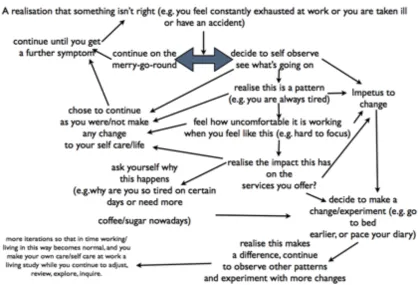
This PhD study subscribes to the view that a feeling of disease or dis-ease, illness, a sense of un-wellness, or being out of kilter as an indicator that something isn’t right in our lives and by understanding and accepting this it uses this indicator as a motivator to change - towards an emancipation out of a situation, habit or way of working. ‘In this way, instead of being meaningless, people’s problems become diseases of meaning’(Jobst et al 1999:71), enabling an opportunity to understand a situation or era in their lives and make change. The World Health Organisation forecasts make it clear that diseases of meaning will continue well into the next millennium to be the major cause of suffering and death worldwide. To deal with them the world needs to address the need to understand the reasons why these diseases arise so that disease is no longer seen as something bad (as we are conditioned to see it that way, but to understanding why the disease is there and look at how to restore balance and heal.
like reducing the amount of sugar intake, or getting more rest. This is further explored in this PhD study.
Hesslow (1993) discusses the ‘frequent complaint’ of the so called ‘medical model of disease’ which has a view that disease is a deviation from some ideal ‘design’ which means doctors overly focus on correcting mechanical faults rather than looking at the whole person to get a sense of what is going on in their life that is causing these so called ‘faults’.
‘Our beingness has its own knowing of what well is. It is quite normal to complain about a nagging hip or knee or sore back. And one should make such a complaint as the complaint itself leads to the seeking of and for help and or a cure etc. However, if we subvert our natural expression to complain about what we innately know is not right or natural and negate such expressions with a language that avoids the focus on what is not truly well, we are subjugating truth and creating a much lower level of what life is or could be.’ (Benhayon 2013).
Despite significant attention to wellness in the literature there is surprisingly little consensus on the definition. As cited by Rosco (2009:216) ‘most authors generally agree that wellness is a multidimensional construct (Adams et al, 1997; Ardell, 1977; Hettler, 1980) that is represented on a continuum, not as an end state (Clark, 1996; Dunn, 1977; Lafferty, 1979; Lorion, 2000; Sarason, 2000; Sechrist, 1979; Teague, 1987)’. This arguably means that current wellness assessment instruments can only be as good as the conceptual frameworks upon which they are based.
tension patterns and reactions, also seeking appropriate medical care and taking action to prevent and detect illness. Physical wellness is the active and continuous effort to maintain the optimum level of physical activity and focus on nutrition, self-care and maintaining healthy lifestyle choices (e.g. use of medical services, preventative health measures, abstinence from drugs, excess alcohol, safe sex practices). Oishi and Koo (2008:290) discuss health and mortality in that although people do not list health as a major life goal, health is essential for individuals to be successful at work and love and that health is an important life outcome with mortality widely considered the ultimate health outcome because illness can lead to death. Maslow’s (1954) hierarchy of needs suggests that the foundation of meeting basic requirements for physical nourishing of life are key in that it is difficult to obtain higher social and psychological pursuits such as altruism, meaning, etc if one were contending daily with starvation or similar threats to physical health. Often in our workplaces we assume we are taking care of basic needs like physical nourishment (food and hydration), but even though it is available we do not avail of it.
Taking this into the workplace authentic